Generalized Bradley-Terry Models and
Multi-Class Probability Estimates
Tzu-Kuo Huang [email protected]
Department of Computer Science National Taiwan University Taipei 106, Taiwan
Ruby C. Weng [email protected]
Department of Statistics National Chengchi University Taipei 116, Taiwan
Chih-Jen Lin [email protected]
Department of Computer Science National Taiwan University Taipei 106, Taiwan
Editor:Greg Ridgeway
Abstract
The Bradley-Terry model for obtaining individual skill from paired comparisons has been popular in many areas. In machine learning, this model is related to multi-class probability estimates by coupling all pairwise classification results. Error correcting output codes (ECOC) are a general framework to decompose a multi-class problem to several binary problems. To obtain probability estimates under this framework, this paper introduces a generalized Bradley-Terry model in which paired individual comparisons are extended to paired team comparisons. We propose a simple algorithm with convergence proofs to solve the model and obtain individual skill. Experiments on synthetic and real data demonstrate that the algorithm is useful for obtaining multi-class probability estimates. Moreover, we discuss four extensions of the proposed model: 1) weighted individual skill, 2) home-field advantage, 3) ties, and 4) comparisons with more than two teams.
Keywords: Bradley-Terry model, probability estimates, error correcting output codes, support vector machines
1. Introduction
The Bradley-Terry model (Bradley and Terry, 1952) for paired comparisons has been broadly applied in many areas such as statistics, sports, and machine learning. It considers a set of
kindividuals for which
P(individualibeats individual j) = pi
pi+pj
, (1)
andpi>0 is the overall skill of individuali. Suppose that the outcomes of all comparisons
log-likelihood takes the form
l(p) =−X
i<j
rijlog pi pi+pj
+rjilog pj pi+pj
. (2)
Since l(p) = l(αp) for any α > 0, l(p) is scale invariant. Therefore, it is convenient to assume thatPk
i=1pi= 1 for the sake of identifiability. One can then estimatepi by
min
p l(
p)
subject to 0≤pj, j= 1, . . . , k, k X
j=1
pj = 1.
(3)
This approach dates back to Zermelo (1929) and has been extended to more general settings. For instance, in sports scenario, extensions to account for the home-field advantage and ties have been proposed. Some reviews are, for example, (David, 1988; Davidson and Farquhar, 1976; Hunter, 2004; Simons and Yao, 1999). The solution of (3) can be solved by a simple iterative procedure:
Algorithm 1:
1. Start with any initialp0
j >0, j= 1, . . . , k.
2. Repeat (t= 0,1, . . .)
(a) Lets= (t mod k) + 1. Define
pt+1≡
"
pt1, . . . , pts−1, P
i:i6=srsi P
i:i6=s rsi+ris
pt s+pti
, pts+1, . . . , ptk #T
. (4)
(b) Normalize pt+1.
until ∂l(pt)/∂pj = 0, j = 1, . . . , k are satisfied.
This algorithm is so simple that there is no need to use sophisticated optimization techniques. If rij ∀i, j satisfy some mild conditions, Algorithm 1 globally converges to the
unique minimum of (3). A systematic study on the convergence of Algorithm 1 is in Hunter (2004).
An earlier work (Hastie and Tibshirani, 1998) in statistics and machine learning con-sidered the problem of obtaining multi-class probability estimates by coupling results from pairwise comparisons. Assume
¯
is known. This work estimatespi =P(x in classi) by minimizing the (weighted)
Kullback-Leibler (KL) distance between ¯rij andµij ≡pi/(pi+pj):
min
p
X
i<j nij
¯
rijlog
¯
rij µij
+ ¯rjilog
¯
rji µji
subject to 0≤pj, j = 1, . . . , k, k X
j=1
pj = 1,
(5)
where nij is the number of training data in class i or j. By defining rij ≡ nij¯rij and
removing constant terms, (5) reduces to the same form as (2), and hence Algorithm 1 can be used to find p. Although one might interpret this as a Bradley-Terry model by treating classes as individuals and rij as the number that the ith class beats the jth class, it is not
indeed. First, rij (now defined as nijr¯ij) may not be an integer any more. Secondly, rij
are dependent as they share the same training set. However, the closeness between the two motivates us to propose more general models in this paper.
The above approach involving comparisons for each pair of classes is referred to as the “one-against-one” setting in multi-class classification. It is a special case of the framework
error correcting output codes (ECOC) to decompose a multi-class problem into a number of binary problems (Dietterich and Bakiri, 1995; Allwein et al., 2001). Some classification techniques are two-class based, so this framework extends them to multi-class scenarios. Zadrozny (2002) generalizes the results in (Hastie and Tibshirani, 1998) to obtain prob-ability estimates under ECOC settings. The author proposed an algorithm analogous to Algorithm 1 and demonstrated some experimental results. However, the convergence issue was not discussed. Though the author intended to minimize the KL distance as Hastie and Tibshirani (1998) did, in Section 4.2 we show that their algorithm may not converge to a point with the smallest KL distance.
Motivated from multi-class classification with ECOC settings, this paper presents a generalized Bradley-Terry model where each competition is between two teams (two disjoint subsets of subjects) and team size/members can vary from competition to competition. Then from the outcomes of all comparisons, we fit this general model to estimate the individual skill. Here we propose a simple iterative method to solve the generalized model. The convergence is proved under mild conditions.
The proposed model has some potential applications. For example, in tennis or bad-minton, if a player participates in many singles and doubles, this general model can combine all outcomes to yield the estimated skill of all individuals. More importantly, for multi-class problems by combining binary classification results, we can also minimize the KL distance and obtain the same optimization problem. Hence the proposed iterative method can be directly applied to obtain the probability estimate under ECOC settings.
preliminary version of this paper appeared in an earlier conference NIPS 2004 (Huang et al., 2005).1
2. Generalized Bradley-Terry Model
In this section we study a generalized Bradley-Terry model for approximating individual skill. Consider a group of kindividuals: {1, . . . , k}. Each time two disjoint subsetsIi+ and
Ii− form teams for a series of games and ri ≥ 0 (r0i ≥ 0) is the number of times that Ii+
beatsIi− (Ii− beatsIi+). Thus, we haveIi ⊂ {1, . . . , k}, i= 1, . . . , mso that Ii =Ii+∪Ii−, Ii+6=∅, Ii−6=∅, and Ii+∩Ii−=∅.
If the game is designed so that each member is equally important, we can assume that a team’s skill is the sum of all its members’. This leads to the following model:
P(Ii+ beatsIi−) =
P j∈Ii+pj P
j∈Iipj
.
If the outcomes of all comparisons are independent, then estimated individual skill can be obtained by defining
qi ≡ X
j∈Ii
pj, q+i ≡ X
j∈Ii+
pj, qi−≡ X
j∈I−
i
pj
and minimizing the negative log-likelihood
min
p l(
p) =−
m X
i=1
rilog(qi+/qi) +ri0log(qi−/qi)
subject to
k X
j=1
pj = 1,0≤pj, j = 1, . . . , k.
(6)
Note that (6) reduces to (3) in the pairwise approach, where m = k(k−1)/2 and Ii, i =
1, . . . , mare as the following:
Ii+ Ii− ri r0i
{1} {2} r12 r21
..
. ... ... ...
{1} {k} r1k rk1
{2} {3} r23 r32
..
. ... ... ...
{k−1} {k} rk−1,k rk,k−1
In the rest of this section we discuss how to solve the optimization problem (6).
2.1 A Simple Procedure to Maximize the Likelihood
The difficulty of solving (6) over (3) is that nowl(p) is expressed in terms ofqi+, qi−, qi but
the real variable is p. We propose the following algorithm to solve (6).
Algorithm 2:
1. Start with initial p0
j > 0, j = 1, . . . , k and obtain corresponding q0 ,+ i , q
0,−
i , qi0, i =
1, . . . , m.
2. Repeat (t= 0,1, . . .)
(a) Lets= (t mod k) + 1. Definept+1 by ptj+1=pt
j, ∀j 6=s,and
pts+1=
P i:s∈Ii+
ri
qit,+ + P
i:s∈I−
i
r0
i
qt,i−
P i:s∈Ii
ri+r0i
qt i
pts. (7)
(b) Normalize pt+1. (c) Updateqit,+, qit,−, qt
i toq t+1,+ i , q
t+1,−
i , qit+1, i= 1, . . . , m.
until ∂l(pt)/∂pj = 0, j = 1, . . . , k are satisfied.
The gradient of l(p), used in the stopping criterion, is:
∂l(p)
∂ps
= −
m X
i=1
ri
∂logq+i ∂ps
+r0i∂logq − i ∂ps −
(ri+r0i) ∂logqi
∂ps
= − X
i:s∈Ii+ ri qi+ −
X
i:s∈I−
i
r0i q−i +
X
i:s∈Ii
ri+r0i qi
, s= 1, . . . , k. (8)
In Algorithm 2, for the multiplicative factor in (7) to be well defined (i.e., non-zero denominator), we need Assumption 1, which will be discussed in Section 3. Eq. (7) is a simple fixed-point type update; in each iteration, only one component (i.e.,pts) is modified
while the others remain the same. If we apply the updating rule (7) to the pairwise model,
pts+1=
P i:s<i
rsi
pt
s +
P i:i<s
rsi
pt s
P i:s<i
rsi+ris
pt s+pti +
P i:i<s
ris+rsi
pt s+pti
pts =
P i:i6=srsi P
i:i6=s rsi+ris
pt s+pti
The updating rule (7) is motivated from using a descent direction to strictly decrease
l(p): If ∂l(pt)/∂ps= 0 and6 pts>0, then under suitable assumptions on ri, ri0,
∂l(pt)
∂ps
(pts+1−pts) = ∂l(p
t)
∂ps
P i:s∈Ii+
ri
qi+ + P
i:s∈I−
i
r0
i
q−
i −
P i:s∈Ii
ri+ri0
qi
P i:s∈Ii
ri+r0i
qt i
pts
= −
∂l(pt)
∂ps 2
pts !
.
X
i:s∈Ii
ri+ri0 qt
i
<0. (9)
Thus,pt+1
s −pts is a descent direction in optimization terminology since a sufficiently small
step along this direction guarantees the strict decrease of the function value. As now we take the whole direction without searching for the step size, more efforts are needed to prove the strict decrease in the following Theorem 1. However, (9) does hint that (7) is a reasonable update.
Theorem 1 Let sbe the index to be updated at pt. If
1. pts>0,
2. ∂l(pt)/∂ps6= 0, and
3. P
i:s∈Ii(ri+r
0 i)>0, then
l(pt+1)< l(pt).
The proof is in Appendix A. Note thatP
i:s∈Ii(ri+r
0
i)>0 is a reasonable assumption. It
means that individualsparticipates in at least one game.
2.2 Other Methods to Maximize the Likelihood
We briefly discuss other methods to solve (6). For the original Bradley-Terry model, Hunter (2004) discussed how to transform (3) to a logistic regression form: Under certain assump-tions,2 the optimalp
i>0,∀i. Using this property and the constraintspj ≥0, Pk
j=1pj = 1
of (3), we can reparameterize the function (2) by
ps= eβs
Pk j=1eβj
, (10)
and obtain
−X
i<j
rijlog
1
1 +eβj−βi +rjilog
eβj−βi
1 +eβj−βi
. (11)
This is the negative log-likelihood of a logistic regression model. Hence, methods such as iterative weighted least squares (IWLS) (McCullagh and Nelder, 1990) can be used to fit
the model. In addition, β is now unrestricted, so (3) is transformed to an unconstrained optimization problem. Then conventional optimization techniques such as Newton or Quasi Newton can also be applied.
Now for the generalized model, (6) can still be re-parameterized as an unconstrained problem with the variable β. However, the negative log-likelihood
−
m X
i=1
rilog P
j∈I+
i e
βj
P j∈Iie
βj +r
0 ilog
P j∈I−
i e
βj
P j∈Iie
βj
!
(12)
is not in a form similar to (11), so methods for logistic regression may not be used. Of course Newton or Quasi Newton is still applicable but their implementations are not simpler than Algorithm 2.
3. Convergence of Algorithm 2
Though Theorem 1 has shown the strict decrease of l(p), we must further prove that Algorithm 2 converges to a stationary point of (6). Thus ifl(p) is convex, a global optimum is obtained. A vector p is a stationary (Karash-Kuhn-Tucker) point of (6) if and only if there is a scalarδ and two nonnegative vectorsλand ξ such that
∇f(p)j =δ+λj−ξj,
λjpj = 0, ξj(1−pj) = 0, j = 1, . . . , k.
In the following we will prove that under certain conditions Algorithm 2 converges to a point satisfying
0< pj <1,∇f(p)j = 0, j = 1, . . . , k. (13)
That is, δ=λj =ξj = 0,∀j. Problem (6) is quite special as through the convergence proof
of Algorithm 2 we show that its optimality condition reduces to (13), the condition without considering constraints. Furthermore, an interesting side-result is that from Pk
j=1pj = 1
and (13), we obtain a point inRk satisfying (k+ 1) equations.
If Algorithm 2 stops in a finite number of iterations, then ∂l(p)/∂pj = 0, j = 1, . . . , k,
which means a stationary point of (6) is already obtained. Thus, we only need to handle the case where{pt} is an infinite sequence. As{pt}∞
t=0 is in a compact set
{p|0≤ps ≤1, k X
j=1
pj = 1},
there is at least one convergent subsequence. Assume that{pt}, t∈K is any such sequence and it converges top∗. In the following we will show that ∂l(p∗)/∂pj = 0, j = 1, . . . , k.
To prove the convergence of a fixed-point type algorithm (i.e., Lyapunov’s theorem), we requirep∗s >0,∀s. Then if ∂l(p∗)/∂ps 6= 0 (i.e.,p∗ is not optimal), we can use (7) to find
p∗+1 6=p∗, and, as a result of Theorem 1, l(p∗+1) < l(p∗). This property further leads to a contradiction. To havep∗
s>0,∀s, for the original Bradley-Terry model, Ford (1957) and
Hunter (2004) assume that for any pair of individualssand j, there is a “path” from sto
Since Pk
r=1p∗r = 1, there is at least one p∗j > 0. If in certain games s beats s1, s1 beats s2, . . ., and st beatsj, then p∗s, the skill of individual s, should not be as bad as zero. For
the generalized model, we make a similar assumption:
Assumption 1 For any two different individuals s and j, there are Is0, Is1, . . . , Ist, such
that either
1. rs0 >0, rs1 >0, . . . , rst >0,
2. Is+0 ={s};Is+r ⊂Isr−1, r= 1, . . . , t;j∈I − st,
or
1. rs00 >0, r0s1 >0, . . . , rs0t >0,
2. Is−0 ={s};I −
sr ⊂Isr−1, r= 1, . . . , t;j∈I + st.
The idea is that if p∗j >0, and sbeats Is−0, a subset of Is0 beats I −
s1, a subset ofIs1 beats I−
s2, . . . ,and a subset of Ist−1 beatsI −
st, which includes j, thenp
∗
s should not be zero. How
this assumption is exactly used is in Appendix B for proving Lemma 2.
Assumption 1 is weaker than that made earlier in (Huang et al., 2005). However, even with the above explanation, this assumption seems to be very strong. Whether the gener-alized model satisfies Assumption 1 or not, an easy way to fulfill it is to add an additional term
−µ k X
s=1
log Pkps
j=1pj !
(14)
tol(p), whereµis a small positive number. That is, for each s, we make anIi ={1, . . . , k}
with Ii+ ={s}, ri =µ, and ri0 = 0. As Pk
j=1pj = 1 is one of the constraints, (14) reduces
to−µPk
s=1logps, which is usually used as a barrier term in optimization to ensure thatps
does not go to zero.
An issue left in Section 2 is whether the multiplicative factor in (7) is well defined. With Assumption 1 and initial p0
j > 0, j = 1, . . . , k, one can show by induction that ptj > 0,∀t
and hence the denominator of (7) is never zero: If ptj >0, Assumption 1 implies that there is someisuch thatIi+={j} orIi−={j}. Then eitherP
i:j∈Ii+ri/q t,+ i or
P i:j∈I−
i r
0 i/q
t,− i is
positive. Thus, both numerator and denominator in the multiplicative factor are positive, and so isptj+1.
The result p∗
s >0 is proved in the following lemma.
Lemma 2 If Assumption 1 holds, p∗
s>0, s= 1, . . . , k.
The proof is in Appendix B.
As the convergence proof will use the strictly decreasing result, we note that Assump-tion 1 implies the condiAssump-tion P
i:s∈Ii(ri +r
0
i) > 0,∀s, required by Theorem 1. Finally, the
convergence is established:
Theorem 3 Under Assumption 1, any convergent point of Algorithm 2 is a stationary
The proof is in Appendix C. Though ri in the Bradley-Terry model is an integer
indicating the number of times that team Ii+ beatsIi−, in the convergence proof we do not use such a property. Hence later for multi-class probability estimates, where ri is a real
number, the convergence result still holds.
Note that a stationary point may be only a saddle point. If (6) is a convex programming problem, then a stationary point is a global minimum. Unfortunately, l(p) may not be convex, so it is not clear whether Algorithm 2 converges to a global minimum or not. The following theorem states that in some cases including the original Bradley-Terry model, any convergent point is a global minimum, and hence a maximum likelihood estimator:
Theorem 4 Under Assumption 1, if
1. |Ii+|=|Ii−|= 1, i= 1, . . . , m or 2. |Ii|=k, i= 1, . . . , m,
then (6)has a unique global minimum and Algorithm 2 globally converges to it.
The proof is in Appendix D. The first case corresponds to the original Bradley-Terry model. Later we will show that under Assumption 1, the second case is related to “one-against-the rest” for multi-class probability estimates. Thus though the theorem seems to be rather restricted, it corresponds to useful situations.
4. Multi-class Probability Estimates
A classification problem is to train a model from data with known class labels and then predict labels of new data. Many classification methods are two-class based approaches and there are different ways to extend them for multi-class cases. Most existing studies focus on predicting class labels but not probability estimates. In this section, we discuss how the generalized Bradley-Terry model can be applied to multi-class probability estimates.
As mentioned in Section 1, there are various ways to decompose a multi-class prob-lem into a number of binary classification probprob-lems. Among them, the most commonly used are “one-against-one” and “one-against-the rest.” Recently Allwein et al. (2001) pro-posed a more general framework for the decomposition. Their idea, extended from that of Dietterich and Bakiri (1995), is to associate each class with a row of a k×m “coding matrix” with all entries from {−1,0,+1}. Here m is the number of binary classification problems to be constructed. Each column of the matrix represents a comparison between classes with “−1” and “+1,” ignoring classes with “0.” Note that the classes with “−1” and “+1” correspond to our Ii− and Ii+, respectively. Then the binary learning method is run for each column of the matrix to obtainm binary decision rules. For a given example, one predicts the class label to be j if the results of the m binary decision rules are “clos-est” to labels of row j in the coding matrix. Since this coding method can correct errors made by some individual decision rules, it is referred to as error correcting output codes
Givenni, the number of training data with classes inIi =Ii+∪Ii−, we assume here that
for any given datax,
¯
ri=P(xin classes of Ii+|xin classes of Ii) (15)
is available, and the task is to estimate P(x in classs), s = 1, . . . , k. We minimize the (weighted) KL distance between ¯ri and qi+/qi− similar to (Hastie and Tibshirani, 1998):
min
p
m X
i=1 ni
¯
rilog
¯
ri
(qi+/qi)
+ (1−r¯i) log
1−r¯i
(qi−/qi)
. (16)
By defining
ri ≡nir¯i and ri0 ≡ni(1−¯ri), (17)
and removing constant terms, (16) reduces to (6), the negative log-likelihood of the gener-alized Bradley-Terry model. It is explained in Section 1 that one cannot directly interpret this setting as a generalized Bradley-Terry model. Instead, we minimize the KL distance and obtain the same optimization problem.
We show in Section 5 that many practical “error correcting codes” have the same |Ii|,
i.e., each binary problem involves the same number of classes. Thus, if data is balanced (all classes have about the same number of instances), thenn1 ≈ · · · ≈nm and we can remove ni in (16) without affecting the minimization of l(p). As a result,ri = ¯ri and ri0 = 1−r¯i.
In the rest of this section we discuss the case of “one-against-the rest” in detail and the earlier result in (Zadrozny, 2002).
4.1 Properties of the “One-against-the rest” Approach
For this approach,m=kand Ii, i= 1, . . . , mare
Ii+ Ii− ri r0i
{1} {2, . . . , k} r1 1−r1
{2} {1,3, . . . , k} r2 1−r2
..
. ... ... ...
{k} {1, . . . , k−1} rk 1−rk
Clearly, |Ii| =k ∀i, so every game involves all classes. Then, n1 =· · · =nm = the total
number of training data and the solution of (16) is not affected byni. This and (17) suggest
that we can solve the problem by simply taking ni = 1 and ri+ri0 = 1,∀i. Thus, (8) can
be simplified as
∂l(p)
∂ps
=−rs
ps − X
j:j6=s r0
j
1−pj
+k.
Setting∂l(p)/∂ps = 0∀s, we have
rs ps −
1−rs
1−ps
=k−
k X
j=1 r0
j
1−pj
Since the right-hand side of (18) is the same for alls, we can denote it byδ. Ifδ = 0, then
pi =ri. This happens only ifPki=1ri= 1. If δ6= 0, (18) implies
ps=
(1 +δ)−p
(1 +δ)2−4r sδ
2δ . (19)
In Appendix E we show thatps defined in (19) satisfies 0≤ps≤1. Note that
((1 +δ) +p(1 +δ)2−4rsδ)/2δ
also satisfies (18), but whenδ <0, it is negative and whenδ >0, it is greater than 1. Then the solution procedure is as the following:
If Pk
i=1ri = 1,
optimalp= [r1, . . . , rk]T.
else
find the root ofPk s=1
(1+δ)−√(1+δ)2−4r
sδ
2δ −1 = 0.
optimalps= (19).
IfPk
i=1ri = 1, p= [r1, . . . , rk]T satisfies∂l(p)/∂ps= 0∀s, and thus is the unique optimal
solution in light of Theorem 4. For the else part, Appendix E proves that the above equation ofδ has a unique root. Therefore, instead of using Algorithm 2, one can easily solve a one-variable nonlinear equation and obtain the optimal p. This “one-against-the rest” setting is special as we can directly prove the existence of a solution satisfying k+ 1 equations:
Pk
s=1ps = 1 and ∂l(p)/∂ps = 0, s = 1, . . . , k. Earlier for general models we rely on the
convergence proof of Algorithm 2 to show the existence (see the discussion in the beginning of Section 3).
From (19), if δ >0, larger ps implies smaller (1 +δ)2−4rsδ and hence larger rs. The
situation for δ < 0 is similar. Therefore, the order of p1, . . . , pk is the same as that of r1, . . . , rk:
Theorem 5 If rs≥rt, then ps≥pt.
This theorem indicates that results from the generalized Bradley-Terry model are reasonable estimates.
4.2 An Earlier Approach
Zadrozny (2002) was the first to address the probability estimates using error-correcting codes. By considering the same optimization problem (16), she proposes a heuristic updat-ing rule
pts+1≡ P
i:s∈Ii+ri+ P
i:s∈I−
i r
0 i
P i:s∈I+
i
niqt,i+
qt i
+P
i:s∈I−
i
niqt,i−
qt i
pts, (20)
5 impliesp1 =p2. Then (18) and p1+p2+p3 = 1 give
3 4p1 −
1 4(1−p1)
= 1
2p3 −
1 2(1−p3)
= 1
2(1−2p1) −
1 4p1
.
This leads to a solution
p= [15−√33,15−√33,2√33−6]T/24, (21)
which is also unique according to Theorem 4. If this is a convergent point by using (20), then a further update from it should lead to the same point (after normalization). Thus, the three multiplicative factors must be the same. Since we keepPk
i=1pti = 1 in the algorithm,
with the propertyri+ri0 = 1, for this example the factor in the updating rule (20) is
rs+Pi:i6=sr0i pt
s+ P
i:i6=s(1−pti)
= k−1 + 2rs−
Pk i=1ri k−2 + 2pt
s
= 2rs 1 + 2pt
s
. (22)
Clearly thep obtained earlier in (21) by our approach of minimizing the KL distance does not result in the same value for (22). Thus, in this case Zadrozny (2002)’s approach fails to converge to the unique solution of (16) and hence lacks a clear interpretation.
5. Experiments: Simulated Examples
In the following two sections, we present experiments on multi-class probability estimates using synthetic and real-world data. In implementing Algorithm 2, we use the following stopping condition:
max
s:s∈{1,...,k}
P i:s∈Ii+
ri
qt,i+ + P
i:s∈I−
i
r0
i
qt,−
i
P i:s∈Ii
ri+ri0
qt i
−1
<0.001,
which implies that ∂l(pt)/∂ps, s= 1, . . . , k are all close to zero.
5.1 Data Generation
We consider the same setting in (Hastie and Tibshirani, 1998; Wu et al., 2004) by defining three possible class probabilities:
(a) p1 = 1.5/k,pj = (1−p1)/(k−1),j = 2, . . . , k.
(b) k1 = k/2 if k is even, and (k + 1)/2 if k is odd; then p1 = 0.95 ×1.5/k1, pi =
(0.95−p1)/(k1−1) fori= 2, . . . , k1, and pi = 0.05/(k−k1) for i=k1+ 1, . . . , k.
(c) p1 = 0.95×1.5/2, p2= 0.95−p1, and pi = 0.05/(k−2), i= 3, . . . , k.
All classes are competitive in case (a), but only two dominate in (c). For given Ii, i =
1, . . . , m, we generate ri by adding some noise to qi+/qi and then check if the proposed
method obtains good probability estimates. Since qi+/qi of these three cases are different,
it is difficult to have a fair way of adding noise. Furthermore, various ECOC settings (described later) will also result in different q+i /qi. Though far from perfect, here we try
1. An “absolute” amount of noise:
ri= min(max(, qi+
qi
+ 0.1N(0,1)),1−). (23)
Then r0
i = 1−ri. Here= 10−7 is used so that allri, r0i are positive.
This is the setting considered in (Hastie and Tibshirani, 1998).
2. A “relative” amount of noise:
ri = min(max(, q+i
qi
(1 + 0.1N(0,1))),1−). (24)
ri0 and are set in the same way.
5.2 Results of Various ECOC Settings
We consider the four encodings used in (Allwein et al., 2001) to generate Ii:
1. “1vs1”: the pairwise approach (Eq. (5)).
2. “1vsrest”: the “One-against-the rest” approach in Section 4.1.
3. “dense”: Ii ={1, . . . , k} for all i. Ii is randomly split to two equally-sized sets Ii+ and Ii−. [10 log2k]3 such splits are generated. That is,m= [10 log
2k].
Intuitively, more combinations of subjects as teams give more information and may lead to a better approximation of individual skill. Thus, we would like to select a diversified
Ii+, Ii−, i= 1, . . . , m. Following Allwein et al. (2001), we repeat the selection 100 times. For each collection of Ii+, Ii−, i= 1, . . . , m, we calculate the smallest distance between any pair of (Ii+, Ii−) and (Ij+, Ij−). A larger value indicates better quality of the coding, so we pick the one with the largest value. For the distance between any pair of (Ii+, Ii−) and (Ij+, Ij−), Allwein et al. (2001) consider a generalized Hamming distance defined as follows:
k X
s=1
0 ifs∈Ii+∩Ij+ ors∈Ii−∩Ij−,
1 ifs∈Ii+∩Ij− ors∈Ii−∩Ij+,
1/2 if s /∈Ii ors /∈Ij.
4. “sparse”: Ii+, Ii− are randomly drawn from {1, . . . , k} with E(|Ii+|) = E(|Ii−|) = k/4. Then [15 log2k] such splits are generated. Similar to “dense,” we repeat the procedure 100 times to find a good coding.
The way of adding noise may favor some ECOC settings. Since in general
q+i qi
for “1vs1” q
+ i qi
for “1vsrest,”
adding 0.1N(0,1) to qi+/qi result in very inaccurate ri for “1vsrest.” On the other hand,
if using a relative way, noise added to ri and ri0 for “1vsrest” is smaller than that for
“1vs1.” This analysis indicates that using the two different noise makes the experiment more complete.
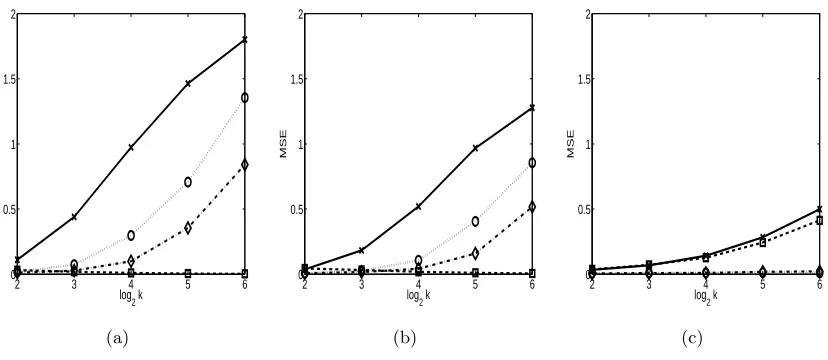
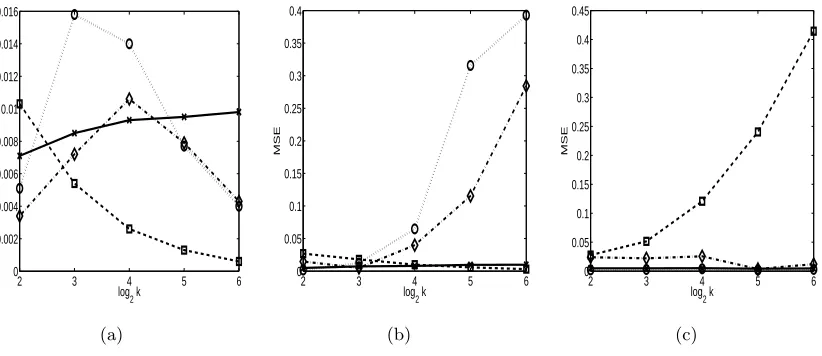
Figures 1 and 2 show results of adding an “absolute” amount of noise. Two criteria are used to evaluate the obtained probability estimates: Figures 1 presents averaged accuracy rates over 500 replicates for each of the four encodings when k = 22,23, . . . ,26. Figure 2 gives the (relative) mean squared error (MSE):
MSE = 1
500
500 X
j=1 k X
i=1
(ˆpji −pi)2/ k X
i=1 p2i
!
, (25)
where ˆpj is the probability estimate obtained in the jth of the 500 replicates. Using the same two criteria, Figures 3 and 4 present results of adding a “relative” amount of noise. Clearly, following our earlier analysis on adding noise, results of “1vsrest” in Figures 3 and 4 are much better than those in Figures 1 and 2. In all figures, “dense and “sparse” are less competitive in cases (a) and (b) whenk is large. Due to the large|Ii+|and |Ii−|, the model is unable to single out a clear winner when probabilities are more balanced. For “1vs1,” it is good for (a) and (b), but suffers some losses in (c), where the class probabilities are highly unbalanced. Wu et al. (2004) have observed this shortcoming and proposed a quadratic model for the “1vs1” setting.
Results here indicate that the four encodings perform very differently under various conditions. Later in experiments for real data, we will see that in general the situation is closer to case (c), and all four encodings are practically viable.4
6. Experiments: Real Data
In this section we present experimental results on some real-world multi-class problems. There are two goals of experiments here:
1. Check the viability of the proposed multi-class probability estimates. We hope that under reasonable ECOC settings, equally good probabilities are obtained.
2. Compare with the standard ECOC approach without extracting probabilities. This is less important than the first goal as the paper focuses on probability estimates. However, as the classification accuracy is one of the evaluation criteria used here, we can easily conduct a comparison.
6.1 Data and Experimental Settings
We consider data sets used in (Wu et al., 2004): dna,satimage,segment, andletterfrom the Statlog collection (Michie et al., 1994), waveform from UCI Machine Learning Repository (Blake and Merz, 1998),USPS (Hull, 1994), andMNIST(LeCun et al., 1998). Except dna, which takes two possible values 0 and 1, each attribute of all other data is linearly scaled to [−1,1]. The data set statistics are in Table 6.1.
2 3 4 5 6 0
0.2 0.4 0.6 0.8 1
log2 k
Test Accuracy
(a)
2 3 4 5 6
0 0.2 0.4 0.6 0.8 1
log2 k
Test Accuracy
(b)
2 3 4 5 6
0 0.2 0.4 0.6 0.8 1
log2 k
Test Accuracy
(c)
Figure 1: Accuracy of predicting the true class by four encodings and (23) for generating noise: “1vs1” (dashed line, square marked), “1vsrest” (solid line, cross marked), “dense” (dotted line, circle marked), “sparse” (dashdot line, diamond marked). Sub-figures 1(a), 1(b) and 1(c) correspond to the three settings of class probabil-ities in Section 5.1.
2 3 4 5 6
0 0.5 1 1.5 2
log2 k
MSE
(a)
2 3 4 5 6
0 0.5 1 1.5 2
log2 k
MSE
(b)
2 3 4 5 6
0 0.5 1 1.5 2
log2 k
MSE
(c)
2 3 4 5 6 0
0.2 0.4 0.6 0.8 1
log2 k
Test Accuracy
(a)
2 3 4 5 6
0 0.2 0.4 0.6 0.8 1
log2 k
Test Accuracy
(b)
2 3 4 5 6
0 0.2 0.4 0.6 0.8 1
log2 k
Test Accuracy
(c)
Figure 3: Accuracy of predicting the true class by four encodings and (24) for generating noise. The legend is the same as that of Figure 1.
2 3 4 5 6
0 0.002 0.004 0.006 0.008 0.01 0.012 0.014 0.016
log2 k
MSE
(a)
2 3 4 5 6
0 0.05 0.1 0.15 0.2 0.25 0.3 0.35 0.4
log2 k
MSE
(b)
2 3 4 5 6
0 0.05 0.1 0.15 0.2 0.25 0.3 0.35 0.4 0.45
log2 k
MSE
(c)
dna 0 waveform satimage segment usps mnist letter 0.05
0.1 0.15 0.2 0.25 0.3 0.35 0.4
Data sets
Test error
(a) via proposed probability estimates
dna 0 waveform satimage segment usps mnist letter 0.05
0.1 0.15 0.2 0.25 0.3 0.35 0.4
Data sets
Test error
(b) via exponential-loss decoding
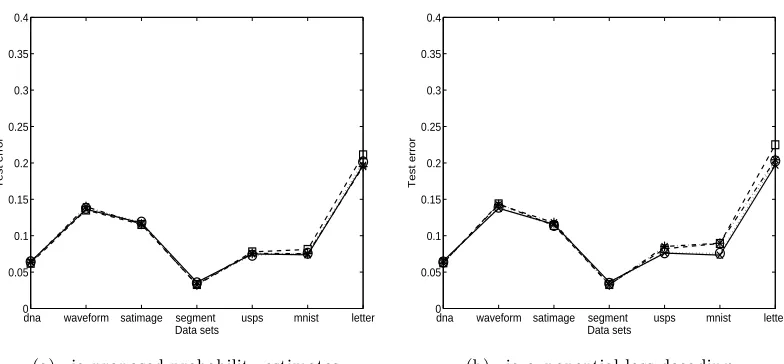
Figure 5: Testing error on smaller (300 training, 500 testing) data sets by four encodings: “1vs1” (dashed line, square marked), “1vsrest” (solid line, cross marked), “dense” (dotted line, circle marked), “sparse” (dashdot line, asterisk marked).
dna 0 waveform satimage segment usps mnist letter 0.05
0.1 0.15 0.2 0.25 0.3 0.35 0.4
Data sets
Test error
(a) via proposed probability estimates
dna 0 waveform satimage segment usps mnist letter 0.05
0.1 0.15 0.2 0.25 0.3 0.35 0.4
Data sets
Test error
(b) via exponential-loss decoding
dataset dna waveform satimage segment USPS MNIST letter
#classes 3 3 6 7 10 10 26
#attributes 180 21 36 19 256 784 16
Table 1: Data Set Statistics
After data scaling, we randomly select smaller (300/500) and larger (800/1,000) train-ing/testing sets from thousands of points for experiments. 20 such selections are generated and results are averaged.5
We use the same four ways in Section 5 to generateIi. All of them have|I1| ≈ · · · ≈ |Im|.
With the property that these multi-class problems are reasonably balanced, we set ni = 1
in (16).
We consider support vector machines (SVM) (Boser et al., 1992; Cortes and Vapnik, 1995) with the RBF (Radial Basis Function) kernele−γkxi−xjk2 as the binary classifier. An
improved version (Lin et al., 2003) of (Platt, 2000) obtains ri using SVM decision values.
It is known that SVM may not give good probability estimates (e.g., Zhang (2004)), but Platt (2000) and Wu et al. (2004) empirically show that using decision values from cross validation yields acceptable results in practice. In addition, SVM is sometimes sensitive to parameters, so we conduct a selection procedure before testing. Details can be found in Figure 4 of (Wu et al., 2004). The code is modified from LIBSVM(Chang and Lin, 2001), a library for support vector machines.
6.2 Evaluation Criteria and Results
For these real data sets, there are no true probability values available. We consider the same three evaluation criteria used in (Wu et al., 2004):
1. Test errors. Averages of 20 errors for smaller and larger sets are in Figures 5(a) and 6(a), respectively.
2. MSE (Brier Score).
1
l l X
j=1 k X
i=1
(Iyj=i−pˆ
j i)2
! ,
where l is the number of test data, ˆpj is the probability estimate of the jth data,
yj is the true class label, and Iyj=i is an indicator function (1 if yj =i and 0
other-wise). This measurement (Brier, 1950), popular in meteorology, satisfies the following property:
arg min
ˆ
p
EY[ k X
i=1
(IY=i−pˆi)2]≡arg min ˆ
p
k X
i=1
(ˆpi−pi)2,
where Y, a random variable for the class label, has the probability distribution p. Brier score is thus useful when the true probabilities are unknown. We present the average of 20 Brier scores in Figure 7.
3. Log loss:
−1
l l X
j=1
log ˆpjy
j,
where ˆpj is the probability estimate of thejth data andyj is its actual class label. It
is another useful criterion when true probabilities are unknown:
min
ˆ
p
EY[− k X
i=1
log ˆpi·IY=i]≡min ˆ
p −
k X
i=1
pilog ˆpi
has the minimum at ˆpi=pi, i= 1, . . . , k.Average of 20 splits are presented in Figure
8.
Results of using the three criteria all indicate that the four encodings are quite com-petitive. Such an observation suggests that in practical problems class probabilities may resemble those specified in case (c) in Section 5; that is, only few classes dominate. Wu et al. (2004) is the first one pointing out this resemblance. In addition, all figures show that “1vs1” is slightly worse than others in the case of largerk(e.g.,letter). Earlier Wu et al. (2004) pro-posed a quadratic model, which gives better probability estimates than the Bradley-Terry model for “1vs1.”
In terms of the computational time, because the number of binary problems for “dense” and “sparse” ([10 log2k] and [15 log2k], respectively) are larger than k, and each binary problem involves many classes of data (all and one half), their training time is longer than that of “1vs1” and “1vsrest.” “Dense” is particularly time consuming. Note that though “1vs1” solves k(k−1)/2 SVMs, each is small via using only two classes of data.
To check the effectiveness of the proposed model in multi-class classification, we compare it with a standard ECOC-based strategy which does not produce probabilities: exponential loss-based decoding by Allwein et al. (2001). Let ˆfi be the decision function of the ith
binary classifier, and ˆfi(x)>0 (<0) specifies that dataxto be in classes inIi+ (Ii−). This
approach determines the predicted label by the following rule:
predicted label = arg min
s
X
i:s∈Ii+
e−fˆi+ X
i:s∈I−
i
efˆi
! .
Testing errors for smaller and larger sets are in Figures 5(b) and 6(b), respectively. Com-paring them with results by the proposed model in Figures 5(a) and 6(a), we observe that both approaches have very similar errors. Therefore, in terms of predicting class labels only, our new method is competitive.
7. Extensions of the Generalized Bradley-Terry Model
dna 0 waveform satimage segment usps mnist letter 0.01
0.02 0.03 0.04 0.05 0.06 0.07 0.08
Data sets
MSE
(a) 300 training, 500 testing
dna 0 waveform satimage segment usps mnist letter 0.01
0.02 0.03 0.04 0.05 0.06 0.07 0.08
Data sets
MSE
(b) 800 training, 1000 testing
Figure 7: MSE by four encodings. The legend is the same as that of Figure 5.
dna 0 waveform satimage segment usps mnist letter 0.2
0.4 0.6 0.8 1 1.2 1.4 1.6 1.8 2
Data sets
log loss
(a) 300 training, 500 testing
dna 0 waveform satimage segment usps mnist letter 0.2
0.4 0.6 0.8 1 1.2 1.4 1.6 1.8 2
Data sets
log loss
(b) 800 training, 1000 testing
Figure 8: Log loss by four encodings. The legend is the same as that of Figure 5.
7.1 Weighted Individual Skill
In some sports, team performance is highly affected by certain positions. For example, many people think guards are relatively more important than centers and forwards in basketball games. We can extend the generalized Bradley-Terry model to this case: Define
¯
qi ≡ X
j:j∈Ii
wijpj, q¯i+≡ X
j:j∈Ii+
wijpj, q¯i−≡ X
j:j∈I−
i
wijpj,
where wij > 0 is a given weight parameter reflecting individual j’s position in the game
individual skill can be obtained. Here Algorithm 2 can still be applied but with the updating rule replaced by
pts+1=
P i:s∈I+
i
riwis
¯ qt,i+ +
P i:s∈I−
i
r0
iwis
¯ qt,−
i
P i:s∈Ii
(ri+r0i)wis
¯ qt
i
pts, (26)
which is derived similarly to (7) so that the multiplicative factor is equal to one when
∂l(p)/∂ps = 0. The convergence can be proved similarly. However, it may be harder to
obtain the global optimality: Case 1 in Theorem 4 still holds, but Case 2 may not since ¯
qi needs not be equal to one (the proof of Case 2 requires qi = 1, which is guaranteed by
|Ii|=k).
7.2 Home-field Advantage
The original home-field advantage model (Agresti, 1990) is based on paired individual com-parisons. We can incorporate its idea into our proposed model by taking
P(Ii+ beatsIi−) =
θqi+ θq+
i +q
−
i
ifIi+ is home, q+
i
q+
i +θq−i
ifIi− is home,
whereθ >0 measures the strength of the home-field advantage or disadvantage. Note that
θis an unknown parameter to be estimated, while the weightswij in Section 7.1 are given.
Let ¯ri ≥0 and ¯r0i ≥0 be the number of times that Ii+ wins and loses at home,
respec-tively. ForIi+’s away games, we let ˜ri ≥0 and ˜r0i≥0 be the number of times thatIi+ wins
and loses. The minimization of the negative log-likelihood function thus becomes:
min
p,θ
l(p, θ) =
− m X i=1 ¯
rilog θqi+
θq+i +qi− + ˜rilog q+i
q+i +θqi− + ¯r 0 ilog
q−i
θq+i +qi− + ˜r 0 ilog
θq−i qi++θq−i
under the constraints in (6) and the conditionθ≥0.
To apply Algorithm 2 on the new optimization problem, we must modify the updating rule. For eachs,∂l(p, θ)/∂ps = 0 leads to the following rule:6
pts+1 =
P i:s∈Ii+
¯ ri+˜ri
qi+ + P
i:s∈I−
i
¯ r0
i+˜r0i
q−
i
P i:s∈Ii+
θ(¯r
i+¯r0i)
θqi++q−
i
+ r˜i+˜r0i
q+i+θq−
i
+P
i:s∈I−
i
¯r
i+¯r0i
θq+i+q−
i
+θ(˜ri+˜ri0)
q+i+θq−
i
p t
s. (27)
Forθ, from∂l(p, θ)/∂θ= 0, we have
θt+1=
Pm
i=1(¯ri+ ˜ri0) Pm
i=1 q+
i (¯ri+¯r0i)
θtq+
i +qi−
+qi−(˜ri+˜ri0)
q+i+θtq−
i
. (28)
6. For convenience,qit,+(q t,−
i ) is abbreviated asq
+
i (q−i). The same abbreviation is used in the updating
Unlike the case of updating pt
s, there is no need to normalize θt+1. The algorithm then
cyclically updates p1, . . . , pk,and θ. If ps is updated, we can slightly modify the proof of
Theorem 1 and obtain the strict decrease of l(p, θ). Moreover, Appendix F gives a simple derivation of l(pt, θt+1)< l(pt, θt). Thus, if we can ensure that θt is bounded above, then
under a modified version of Assumption 1 where max(¯rsi,r˜si) > 0 replaces rsi > 0, the
convergence of Algorithm 2 (i.e., Theorem 3) still holds by a similar proof.
7.3 Ties
Suppose ties are possible between teams. Extending the model proposed in (Rao and Kupper, 1967), we consider:
P(Ii+ beatsIi−) = q
+ i q+i +θqi−, P(Ii− beatsIi+) = q
− i
θq+i +qi−, and P(Ii+ tiesIi−) = (θ
2−1)q+ i q−i
(qi++θq−i )(θqi++q−i ), whereθ >1 is a threshold parameter to be estimated.
Let ti be the number of times that Ii+ ties Ii− and ri, r0i defined as before. We then
minimize the following negative log-likelihood function:
min
p,θ
l(p, θ)
=−
m X
i=1
rilog q+i
qi++θq−i +r 0 ilog
qi−
θqi++q−i +tilog
(θ2−1)q+i qi−
(q+i +θqi−)(θq+i +qi−)
=−
m X
i=1
rilog q+i
qi++θq−i +r 0 ilog
qi−
θqi++q−i +tilog θq+i
θq+i +qi− +tilog θqi− q+i +θqi−
(29)
−
m X
i=1 tilog
θ2−1
θ2 (30)
under the constraints in (6) and the conditionθ >1. For updating pt
s, θ is considered as a constant and (29) is in a form of the Home-field
model, so the rule is similar to (27). The strict decrease of l(p, θ) can be established as well. For updatingθ, we have
θt+1 = 1 2Ct
+
s
1 + 1 4C2
t
, (31)
where
Ct=
1 2Pm
i=1ti m X
i=1
(ri+ti)q−i qi++θtq− i
+
m X
i=1
(ri0+ti)qi+ θtq+
i +qi− !
.
7.4 Multiple Team Comparisons
In this type of comparison, a game may include more than two participants, and the result is a ranking of the participants. For a game of three participants. Pendergrass and Bradley (1960) proposed using
P(i best,j in the middle, and kworst) = P(i beatsj and k)·P(j beats k)
= pi
pi+ (pj+pk)· pj pj+pk
.
A general model introduced in (Placket, 1975) is:
P(a(1)→a(2)→ · · · →a(k)) =
k Y
i=1
pa(i)
pa(i)+pa(i+1)+· · ·+pa(k)
, (32)
where a(i),1 ≤ i ≤k is the ith ranked individual and → denotes the relation “is ranked higher than.” A detailed discussion of this model is in (Hunter, 2004, Section 5).
With similar ideas, we consider a more general setting: Each game may include more than two participating teams. Assume that there arek individuals andN games resulting in N rankings; the mth game involves gm disjoint teams. Let Imi ⊂ {1, . . . , k} be the ith
ranked team in the mth game, 1≤i≤gm, 1≤m≤N. We consider the model:
P(Im1 →Im2 → · · · →Igm
m ) = gm
Y
i=1 P
s:s∈Ii mps
Pgm
j=i P
s:s∈Imj ps
. (33)
Defining
qim= X
s:s∈Ii m
ps,
we minimize the negative log-likelihood function:
min
p
l(p) =−
N X
m=1 gm
X
i=1
log q
i m Pgm
j=iq j m
(34)
under the constraints in (6).
In fact, (34) is a special case of (6). Each ranking can be viewed as the result of a series of paired team comparisons: the first ranked team beats the others, the second ranked team beats the others except the first, and so on; for each paired comparison,ri = 1 and ri0 = 0.
Therefore, Algorithm 2 can be applied and the updating rule is:
pts+1=
P j:s∈Ij(q
φj(s)
j )−1 P
j:s∈Ij
Pφj(s)
i=1 ( Pgj
v=iqvj)−1
pts, (35)
where φj(s) is the rank of the team that individual s belongs to in the jth game and Ij =∪gi=1j Iji.
I1
j vs. Ij2∪ · · · ∪I gj
j , Ij2 vs. Ij3∪ · · · ∪Igj
j ,
.. .
Iφj(s)
j vs. I φj(s)+1
j ∪ · · · ∪I gj
j .
From (7), the numerator of the multiplicative factor involves winning teams that individual
sis in, so there is only one (i.e.,φj(s)) in each game thatsjoins; the denominator involves
teams of both sides, so it is in the form ofPφj(s)
i=1 ( Pgj
v=iqjv)−1.
8. Discussion and Conclusions
We propose a generalized Bradley-Terry model which gives individual skill from group competition results. We develop a simple iterative method to maximize the log-likelihood and prove the convergence. The new model has many potential applications. In particular, minimizing the negative log likelihood of the proposed model coincides with minimizing the KL distance for multi-class probability estimates under error correcting output codes. Hence the iterative scheme is useful for finding class probabilities. Similar to the original Bradley-Terry model, we can extend the proposed generalized model to other settings such as home-field advantages, ties, and multiple team comparisons.
Investigating more practical applications using the proposed model is certainly an im-portant future direction. The lack of convexity ofl(p) also requires more studies. In Section 5, the “sparse” coding hasE(|Ii+|) =E(|Ii−|) =k/4, and hence is not covered by Theorem 4 which proves the global optimality. However, this coding is competitive with others in Section 6. If possible, we hope to show in the future that in general the global optimality holds.
Acknowledgments
This work was supported in part by the National Science Council of Taiwan via the grants NSC 92-2213-E-002-062 and NSC 92-2118-M-004-003.
Appendix A. Proof of Theorem 1
Define
qt,i\+s ≡ X j∈Ii+,j6=s
ptj, and qit\s≡ X
j∈I−
i ,j6=s
ptj.
Using
−logx≥1−logy−x/y with equality if and only ifx=y,
we have
where
Q1(ps) ≡ − X
i:s∈I+
i
ri log(qt,i\+s +ps)− qt
i\s+ps qt
i
−logqit+ 1
!
−
X
i:s∈I−
i
r0i log(qit,\−s +ps)− qt
i\s+ps qt
i
−logqit+ 1
!
= − X
i:s∈Ii+
rilog(qt,i\+s +ps)− X
i:s∈I−
i
ri0log(qit,\−s +ps) +
X
i:s∈Ii
(ri+ri0) qt
i\s+ps qt
i
+ logqti−1
! .
For 0< λ <1, we have
log(λx+ (1−λ)y)≥λlogx+ (1−λ) logy with equality if and only if x=y.
Withpt s>0,
log(qt,i\+s +ps)
= log q
t,+ i\s qt,i+ ·1 +
pt s qit,+ ·
ps pt s
!
+ log(qit,+)
≥ p
t s
qit,+(logps−logp t
s) + logq t,+
i with equality if ps=p t s.
Then
Q2(ps)≥l([pt1, . . . , pts−1, ps, pts+1, . . . , ptk]T) with equality ifps=pts,
where
Q2(ps)
≡ − X
i:s∈Ii+ ri
pt s
qit,+(logps−logp t
s) + logq t,+ i
!
−
X
i:s∈I−
i
r0i p t s
qt,i−(logps−logp t
s) + logq t,− i
!
+ X
i:s∈Ii
(ri+ri0) qt
i\s+ps qt
i
+ logqit−1
! .
As we assumept
s >0 and P
i:s∈Ii(ri+r
0
i)>0,Q2(ps) is a strictly convex function ofps. By dQ2(ps)/dps= 0,
X
i:s∈Ii+ ri qit,+
X
i:s∈I−
i
r0i qt,i−
pts ps
= X
i:s∈Ii
ri+r0i qt
i
leads to the updating rule. Thus, if pt+1
s 6=pts, then
Appendix B. Proof of Lemma 2
If the result does not hold, there is an index ¯sand an infinite index set T such that
lim
t∈T,t→∞p t ¯
s=p∗¯s= 0.
Since Pk
s=1pts= 1,∀tand kis finite,
lim
t∈T,t→∞ k X
s=1 pts=
k X
s=1
p∗s = 1.
Thus, there is an indexj such that
lim
t∈T,t→∞p t
j =p∗j >0. (36)
Under Assumption 1, one of the two conditions linking individual ¯s and j must hold. As both cases are similar, we consider only the first here. Withp∗
¯
s= 0 andIs+0 ={s¯}, we claim thatp∗u= 0,∀u∈Is−0.If this claim is wrong, then
l(pt) = −
m X
i=1
rilog qit,+
qt i
+r0ilogq
t,− i qt
i !
≥ −rs0log qst,0+
qt s0
= −rs0log
pt ¯ s pt
¯ s+
P u∈I−
s0 pt
u
→ ∞when t∈T, t→ ∞.
This result contradicts Theorem 1, which implies l(pt) is bounded above by l(p0). Thus,
p∗u = 0,∀u ∈ Is0. With I +
s1 ⊂ Is0, we can use the same way to prove p ∗
u = 0,∀u ∈ Is1. Continuing the same derivation, in the end p∗
u = 0,∀u ∈ Ist. Since j ∈ I
− st, p
∗ j = 0
contradicts (36) and the proof is complete.
Appendix C. Proof of Theorem 3
Recall that we assume limt∈K,t→∞pt = p∗. For each pt, t ∈ K, there is a corresponding
indexsfor the updating rule (7). Thus, one of{1, . . . , k}must be considered infinitely many times. Without loss of generality, we assume that allpt, t∈Khave the same corresponding
s. Ifp∗ does not satisfy
∂l(p∗)
∂pj
= 0, j = 1, . . . , k,
starting froms, s+1, . . . , k,1, . . . , s−1, there is a first component ¯ssuch that∂l(p∗)/∂p¯s6= 0.
Asp∗¯s >0, by applying one iteration of Algorithm 2 onp∗s¯, and using Theorem 1, we obtain p∗+16=p∗ and
Since ¯sis the first index so that the partial derivative is not zero,
∂l(p∗)
∂ps
= 0 =· · ·= ∂l(p
∗)
∂p¯s−1 .
Thus, at thetth iteration,
lim
t∈K,t→∞p t+1
s = lim t∈K,t→∞
P i:s∈Ii+
ri
qt,i+ + P
i:s∈I−
i
r0
i
qt,−
i
P i:s∈Ii
ri+ri0
qt i
pts=
P i:s∈Ii+
ri
q∗,+
i
+P
i:s∈I−
i
r0
i
q∗,−
i
P i:s∈Ii
ri+ri0
q∗
i
p∗s =p∗s
and hence
lim
t∈K,t→∞p
t+1 = lim t∈K,t→∞p
t=p∗.
Assume ¯scorresponds to the ¯tth iteration, by a similar derivation,
lim
t∈K,t→∞p
t+1 =· · ·= lim t∈K,t→∞p
¯ t=p∗
and
lim
t∈K,t→∞p ¯
t+1 =p∗+1.
Thus, with (37),
lim
t∈K,t→∞l(p ¯
t+1) =l(p∗+1)< l(p∗)
contradicts the fact that
l(p∗)≤ · · · ≤l(pt),∀t.
Appendix D. Proof of Theorem 4
The first case reduces to the original Bradley-Terry model, so we can directly use existing results. As explained in Section 3, Assumption 1 goes back to (Hunter, 2004, Assumption 1). Then the results in Section 4 of (Hunter, 2004) imply that (6) has a unique global minimum and Algorithm 2 globally converges to it.
For the second case, as qi =Pkj=1pj = 1, l(p) can be reformulated as
¯
l(p) =−
m X
i=1
(rilogqi++r0ilogq−i ), (38)
which is a convex function of p. Then solving (6) is equivalent to minimizing (38). One can also easily show that they have the same set of stationary points.
From Assumption 1, for each pj, there is i such that either Ii+ = {s} with ri > 0, or Ii− ={s} withr0i>0. Therefore, either−rilogps or −r0ilogps appears in (38). Since they
are strictly convex functions of ps, the summation on all s= 1, . . . , k makes (38) a strictly
Appendix E. Solving Nonlinear Equations for the “One-against-the-rest” Approach
We show that ifδ 6= 0,ps defined in (19) satisfies 0≤ps≤1. If δ >0, then
(1 +δ)≥p(1 +δ)2−4r sδ,
sops≥0. The situation forδ <0 is similar. To prove ps≤1, we consider three cases:
1. δ≥1. Clearly,
ps=
(1 +δ)−p
(1 +δ)2−4r sδ
2δ .≤
1 +δ
2δ ≤1.
2. 0< δ <1.
With 0≤rs≤1, we have 4δ−4rsδ ≥0 and
(1 +δ)2−4rsδ≥1−2δ+δ2.
Using 0< δ <1,
ps=
(1 +δ)−p
(1 +δ)2−4rsδ
2δ .≤
1 +δ−(1−δ)
2δ = 1.
3. δ <0.
Now 4δ−4rsδ ≤0, so
0≤(1 +δ)2−4rsδ≤1−2δ+δ2.
Then
−p(1 +δ)2−4r
sδ≥δ−1.
Adding 1 +δ on both sides and dividing them by 2δ leads tops≤1.
To find δ by solving Pk
s=1ps−1 = 0, the discontinuity at δ = 0 is a concern. A simple
calculation shows
lim
δ→0 k X
s=1
(1 +δ)−p(1 +δ)2−4rsδ
2δ −1 =
k X
s=1 rs−1.
One can thus define the following continuous function:
f(δ) =
(Pk
s=1rs−1 ifδ= 0, Pk
s=1
(1+δ)−√(1+δ)2−4r
sδ
2δ −1 otherwise.
Since
lim
f(δ) = 0 has at least one root. Next we show that f(δ) is strictly decreasing: Consider
δ6= 0, then
f0(δ) =
k X
s=1
−1 +√1+δ−2rsδ
(1+δ)2−4r
sδ
2δ2 .
If 1+δ−2rsδ ≤0, then of coursef0(δ)<0. For the other case, first we use−4rsδ2+4rs2δ2 <0
to obtain
(1 +δ)2−4rsδ(1 +δ) + 4rs2δ2<(1 +δ)2−4rsδ.
Since 1 +δ−2rsδ >0, taking the square root on both sides leads tof0(δ)<0.
Therefore,
f(δ) = 0 has a unique solution at δ >0 (<0) if
k X
s=1
rs−1>0 (<0).
Appendix F. Update θ for Models with Home-field Advantages or Ties
For the Home-field model, we use the “minorizing”-function approach in (Hunter, 2004):
Terms ofl(pt, θ) related toθ
= −
m X
i=1
(¯ri+ ˜ri0) logθ−(¯ri+ ¯r0i) log(θqi++qi−)−(˜ri+ ˜ri0) log(qi++θq−i )
≤ −
m X
i=1
(¯ri+ ˜ri0) logθ−(¯ri+ ¯r0i) −1 + log(θtq+i +qi−) +
θq+i +qi− θtq+
i +q − i
−(˜ri+ ˜r0i) −1 + log(qi++θ tq−
i ) +
q+i +θqi− qi++θtq− i
≡ Q(θ).
The inequality becomes equality ifθ=θt. Thus, Q0(θ) = 0 leads to (28) and l(pt, θt+1)< l(pt, θt).
For the model which allows ties, we again define a minorizing function of θ.
Terms ofl(pt, θ) related to θ
= −
m X
i=1
tilog(θ2−1)−(ri+ti) log(qi++θq−i )−(ri0+ti) log(θqi++q−i )
≤ −
m X
i=1
tilog(θ2−1)−(ri+ti)
1 + log(qi++θtqi−) + q
+ i +θqi− q+i +θtq− i
−(ri0+ti)
1 + log(θtqi++qi−) + θq
+ i +qi− θtq+
i +qi−
≡ Q(θ).
Then Q0(θ) = 0 implies
m X
i=1
2θti θ2−1 −
(ri+ti)q−i q+i +θtq− i
−(r
0
i+ti)qi+ θtq+
i +q−i
and henceθt+1 is defined as in (31).
References
A. Agresti. Categorical Data Analysis. Wiley, New York, 1990.
E. L. Allwein, R. E. Schapire, and Yoram Singer. Reducing multiclass to binary: a unifying approach for margin classifiers. Journal of Machine Learning Research, 1:113–141, 2001. ISSN 1533-7928.
C. L. Blake and C. J. Merz. UCI repository of machine learning databases. Technical report, University of California, Department of Information and Computer Science, Irvine, CA, 1998. Available at http://www.ics.uci.edu/~mlearn/MLRepository.html.
B. Boser, I. Guyon, and V. Vapnik. A training algorithm for optimal margin classifiers. In Proceedings of the Fifth Annual Workshop on Computational Learning Theory, pages 144–152. ACM Press, 1992.
R. A. Bradley and M. Terry. The rank analysis of incomplete block designs: I. the method of paired comparisons. Biometrika, 39:324–345, 1952.
G. W. Brier. Verification of forecasts expressed in probabilities. Monthly Weather Review, 78:1–3, 1950.
C.-C. Chang and C.-J. Lin. LIBSVM: a library for support vector machines, 2001. Software available at http://www.csie.ntu.edu.tw/~cjlin/libsvm.
C. Cortes and V. Vapnik. Support-vector network. Machine Learning, 20:273–297, 1995.
H. A. David.The method of paired comparisons. Oxford University Press, New York, second edition, 1988.
R. R. Davidson and P. H. Farquhar. A bibliography on the method of paired comparisons.
Biometrics, 32:241–252, 1976.
T. G. Dietterich and G. Bakiri. Solving multiclass learning problems via error-correcting output codes. Journal of Artificial Intelligence Research, 2:263–286, 1995. URL
citeseer.ist.psu.edu/dietterich95solving.html.
L. R. Jr. Ford. Solution of a ranking problem from binary comparisons. American Mathe-matical Monthly, 64(8):28–33, 1957.
T. Hastie and R. Tibshirani. Classification by pairwise coupling. The Annals of Statistics, 26(1):451–471, 1998.
T.-K. Huang, R. C. Weng, and C.-J. Lin. A generalized Bradley-Terry model: From group competition to individual skill. In Advances in Neural Information Processing Systems 17. MIT Press, Cambridge, MA, 2005.
D. R. Hunter. MM algorithms for generalized Bradley-Terry models. The Annals of Statis-tics, 32:386–408, 2004.
Y. LeCun, L. Bottou, Y. Bengio, and P. Haffner. Gradient-based learning applied to doc-ument recognition. Proceedings of the IEEE, 86(11):2278–2324, November 1998. MNIST database available at http://yann.lecun.com/exdb/mnist/.
H.-T. Lin, C.-J. Lin, and R. C. Weng. A note on Platt’s probabilistic outputs for support vector machines. Technical report, Department of Computer Science, National Taiwan University, 2003. URL http://www.csie.ntu.edu.tw/~cjlin/papers/plattprob.ps.
P. McCullagh and J. A. Nelder. Generalized Linear Models. CRC Press, 2nd edition, 1990.
D. Michie, D. J. Spiegelhalter, and C. C. Taylor. Machine Learning, Neural and Sta-tistical Classification. Prentice Hall, Englewood Cliffs, N.J., 1994. Data available at
http://www.ncc.up.pt/liacc/ML/statlog/datasets.html.
R. N. Pendergrass and R. A. Bradley. Ranking in triple comparisons. In Ingram Olkin, editor, Contributions to Probability and Statistics. Stanford University Press, Stanford, CA, 1960.
R. L. Placket. The analysis of permutations. Applied Statistics, 24:193–202, 1975.
J. Platt. Probabilistic outputs for support vector machines and comparison to regularized likelihood methods. In A.J. Smola, P.L. Bartlett, B. Sch¨olkopf, and D. Schuurmans, editors, Advances in Large Margin Classifiers, Cambridge, MA, 2000. MIT Press. URL
citeseer.nj.nec.com/platt99probabilistic.html.
P. V. Rao and L. L. Kupper. Ties in paired-comparison experiments: A generalization of the Bradley-Terry model. Journal of the American Statistical Association, 62:194–204, 1967. [Corrigendum J. Amer. Statist. Assoc. 63 1550-1551].
G. Simons and Y.-C. Yao. Asymptotics when the number of parameters tends to infinity in the Bradley-Terry model for paired comparisons. The Annals of Statistics, 27(3): 1041–1060, 1999.
T.-F. Wu, C.-J. Lin, and R. C. Weng. Probability estimates for multi-class classification by pairwise coupling. Journal of Machine Learning Research, 5:975–1005, 2004. URL
http://www.csie.ntu.edu.tw/~cjlin/papers/svmprob/svmprob.pdf.
B. Zadrozny. Reducing multiclass to binary by coupling probability estimates. In T. G. Dietterich, S. Becker, and Z. Ghahramani, editors, Advances in Neural Information Pro-cessing Systems 14, pages 1041–1048. MIT Press, Cambridge, MA, 2002.
E. Zermelo. Die berechnung der turnier-ergebnisse als ein maximumproblem der wahrschein-lichkeitsrechnung. Mathematische Zeitschrift, 29:436–460, 1929.