EXPERIMENTAL STUDY ON SELF COMPACTING CONCRETE USING GGBS
R.Selvapriya
[1]; M.Rajkannan
[2] [1]PG student(Structural Engineering), Civil Department, Paavai Engineering College, Pachal.
[2]Assistant Professor, Civil Department, Paavai Engineering College, Pachal.
Abstract
Ground granulated blast furnace slag (GGBS), due to its pozzolanic nature, could be a great asset for the modern construction needs, because slag concretes can be of high performance, if appropriately designed. The use of GGBS as a cementitious material as well as fine filler is being increasingly advocated for the production of High performance concrete (HPC), Roller compacted concrete (RCC) and Self compacting concrete (SCC), etc. However, for obtaining the required high performance in any of these concrete composites, slag should be properly proportioned so that the resulting concrete would satisfy both the strength and performance criteria requirements of the structure. The paper is an effort towards presenting a new mix design methodology for the design of self compacting GGBS concretes based on the efficiency concept. The methodology has already been successfully verified through a proper experimental investigation and the self compacting slag concretes were evaluated for their self compactability and strength characteristics. The results indicate that the proposed method can be capable of producing high quality SCC.
KeyWords: Self compacting concrete, Compressive Strength, split tensile strength, Flexural strength, GGBS, admixtures, plasticizers
.
I. INTRODUCTION
Green concrete is very often also cheap to produce, because, for example, waste products are used as a partial substitute for cement, charges for the dumping of waste are avoided, energy utilization in production is inferior, and durability is superior. In India there is an extreme manufacture of fly ash as it is used in the production of electricity in nuclear power plants. Ground granulated blast furnace slag (GGBS)then dried and ground into a fine powder. By well judged use of available materials for concrete making and their proportioning, concrete mixes are produced to have the desired properties in the fresh and hardened states, as the situation demands.
Waste can be used to fabricate new products or can be used as admixtures so that natural sources are used more effectiveness and the environment is sheltered from waste deposits. To avoid the toxic waste and reprocess the waste material, the present study is carried out.
As the properties are as good as the cement, the Class F fly ash (coal fly ash) and Ground granulated blast furnace slag (GGBS) is used as fine partial replacement in the cement in Self compacting concrete.
Self – compacting concrete (SCC) is a fluid mixture, which is suitable for placing difficult conditions and also in congested reinforcement, without vibration. In principle, a self – compacting or self – consolidating concrete must:
Have a fluidity that allows self – compaction without External energy
Remain homogeneous in a form during and after the placing process and
Flow easily through reinforcement
Self – consolidating concrete has recently been used in the pre – cast industry and in some commercial applications, however the relatively high material cost still hinders the wide spread use of such specialty concrete in various segments of the construction industry, including commercial and residential construction.
High binder content typically includes substitutions of cement with 20 to 40% fly ash or GGBS and, in some cases low contents of micro silica employed. The cost of SCC can be reduced through the selection of adequate concrete - making materials and admixture constituents, including partial substitutions of cement and supplementary Cementations materials by readily available fillers.
Regardless of its binder composition, SCC is characterized by its low yield value to secure high deformability, and moderate viscosity to provide uniform suspension of solid particles, both during casting and thereafter until setting. The mixture proportioning of SCC to simultaneously meet the various performance requirements at minimum cost involves the optimization of several mixture constituents that have a marked influence on performance. This process is quite complex and can be simplified by understanding the relative significance of various mixture parameters on key properties of SCC. This includes deformability, passing ability, filling capacity and segregation resistance.
II.
Literature Review
H. Venkataram Pai et al [1]: . Have experimentally aimed at producing SCC mixes of M25 grade by using the Modified Nan Su method, incorporating five mineral admixtures. This paper gives the comparison of these SCC mixes in terms of their properties. They have concluded that modified Nan Su method of developing SCC, the quantity of the powder mainly depends on the specific gravity and consistency of the powder itself. The SCC mix containing GGBS exhibiting greater strength could be because of the high pozzolonic activity of GGBS like compressive, split tensile, and flexural strengths. The fresh concrete properties are also included in the study.
Dr. DinakarPasla et al [2]: Presented new mix design methodology for the design of self-compacting GGBS concretes based on the efficiency concept. In this study a new mix design methodology for the design of self- compacting concrete with ground granulated blast furnace slag (GGBFS) for percentage replacements varying between 20-80%. The results of the self-compacting GGBS 60 MPa concrete show even at 60% replacement, showed strength gain rate similar to normal concrete and attained target strength at 28 days and attained strengths much higher than normal concrete at 90 days.
Ganesh Babu et al [3]:Aimed to quantify the 28-days cementitious efficiency of ground granulated blast furnace slag (GGBFS) in concrete at the various replacement levels. From the results of the investigation sreported that replacement levels in the concrete studied varied from 10% to 80% and the strength efficiencies at the 28 days were calculated.
Finally concluded that the prediction of the strength of concretes varying from 20to 100 MPa with GGBFS levels varying from 10% to 80%.
Mallikarjuna Reddy V et al [4]: Investigated on the workability and mechanical properties of self-compacting concrete. In this research mix design used is based on NAN-SU method. This study represents specifications of the mixes used for obtaining the workability, compressive strength, split tensile strength and flexural strength of self- compacting concrete. From the result it is concluded that, Required minimum slump is achieved for a w/c ratio of 0.23 with optimum strength for M70 grade high strength self compacting concrete.
Mr. Dhruvkumar H. Patel et al [5]: According to study the use of Ground granulated blast furnace slag (GGBS) as a replacement of cement and understand its effects on the fresh properties, compressive strength weathering. The study also intended to quantify the amount of Ground granulated blast furnace slag (GGBS) to be added to the concrete according to the value of concrete properties Measured. The workability of self- compacted concrete is increased as content of GGBS increased. Compressive strength of SCC with GGBS is increased up to 10% replacement of cement with GGBS and also mineral admixture replacements have a better workable concrete.
III. MATERIALS INVESTIGATION
A. Cement
The Ordinary Portland cement of 53-grade was used in this study conforming to IS: 12269-1987 .The specific gravity of cement is 3.15. The initial and final setting times were found as 35 minutes and 178 minutes respectively. Standard consistency of cement was 31%.
B. Fine aggregates
The river sand is used as fine aggregate conforming to the requirements of IS: 383-1970. Having specific gravity of 2.62 and fineness modulus of 2.86 has been used as fine aggregate for this study.
C. Coarse Aggregate
Coarse aggregate obtained from local quarry units has been used for this study, conforming to IS: 383-1970 is used. Maximum size of aggregate used is 20mm with specific gravity of 2.707.
D. Fly Ash
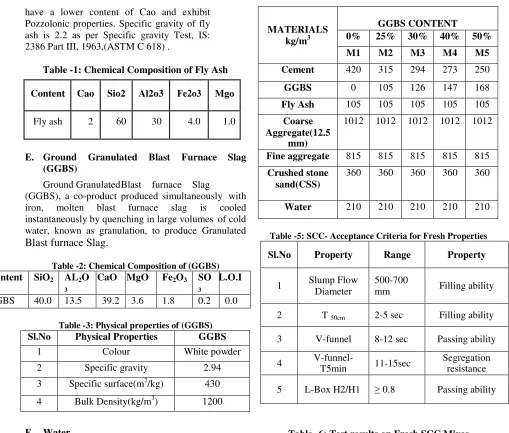
have a lower content of Cao and exhibit Pozzolonic properties. Specific gravity of fly ash is 2.2 as per Specific gravity Test, IS: 2386 Part III, 1963,(ASTM C 618) .
Table -1: Chemical Composition of Fly Ash
Content Cao Sio2 Al2o3 Fe2o3 Mgo
Fly ash 2 60 30 4.0 1.0
E. Ground Granulated Blast Furnace Slag
(GGBS)
Ground Granulated Blast furnace Slag
(GGBS), a co-product produced simultaneously with iron, molten blast furnace slag is cooled instantaneously by quenching in large volumes of cold water, known as granulation, to produce Granulated
Blast furnace Slag.
Table -2: Chemical Composition of (GGBS)
Content SiO2 AL2O 3
CaO MgO Fe2O3 SO 3
L.O.I
GGBS 40.0 13.5 39.2 3.6 1.8 0.2 0.0
Table -3: Physical properties of (GGBS)
Sl.No Physical Properties GGBS
1 Colour White powder
2 Specific gravity 2.94
3 Specific surface(m2/kg) 430
4 Bulk Density(kg/m3) 1200
F. Water
The water used for experiments was potable water conforming as per IS: 456-2000.
IV. EXPERIMENTAL PROCEDURE
SCC mixes with different replacements of mineral admixture were prepared and examined to quantify the properties of SCC. The replacement of GGBS was carried out at levels of 25%, 30%, 35% and 40% of cement content. After iterative trial mixes the water/cement ratio (w/c) was selected as 0.40.Some design guidelines have been prepared from the acceptable test methods. Many different test methods have been developed in attempts to characterize the properties of Self Compacting Concrete. So far, no single method or combination of methods has achieved universal approval and most of them have their adherents.
Table -4: Details of Mix Proportions of Concrete
Table -5: SCC- Acceptance Criteria for Fresh Properties
Sl.No Property Range Property
1 Slump Flow Diameter
500-700
mm Filling ability
2 T 50cm 2-5 sec Filling ability
3 V-funnel 8-12 sec Passing ability
4 V-funnel-
T5min 11-15sec
Segregation resistance
5 L-Box H2/H1 ≥ 0.8 Passing ability
Table -6: Test results on Fresh SCC Mixes
% of Replacement
% of GGBS
0% 25
%
30% 35% 40
%
Slump
Flow(mm) 645 680 685 648 620
U box (mm) 29 19 21 26 28
V funnel
(sec) 12 9 10 12 13
L box
0.89 0.93
0.90
0.86 0.85
MATERIALS kg/m3
GGBS CONTENT
0% 25% 30% 40% 50%
M1 M2 M3 M4 M5
Cement 420 315 294 273 250
GGBS 0 105 126 147 168
Fly Ash 105 105 105 105 105
Coarse Aggregate(12.5
mm)
1012 1012 1012 1012 1012
Fine aggregate 815 815 815 815 815
Crushed stone sand(CSS)
360 360 360 360 360
Mix-1
Control mix 6.82
Mix-4
35% of GGBS 8.63
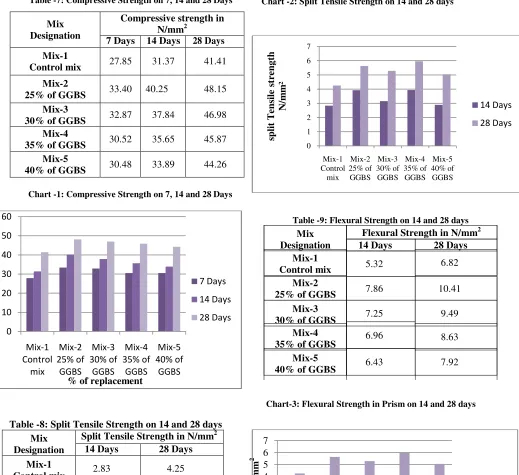
Table -7: Compressive Strength on 7, 14 and 28 Days
Mix Designation
Compressive strength in N/mm2
7 Days 14 Days 28 Days
Mix-1
Control mix 27.85 31.37 41.41
Mix-2
25% of GGBS 33.40 40.25 48.15
Mix-3
30% of GGBS 32.87 37.84 46.98
Mix-4
35% of GGBS 30.52 35.65 45.87
Mix-5
40% of GGBS 30.48 33.89 44.26
Chart -1: Compressive Strength on 7, 14 and 28 Days
Table -8: Split Tensile Strength on 14 and 28 days
Chart -2: Split Tensile Strength on 14 and 28 days
Table -9: Flexural Strength on 14 and 28 days
Chart-3: Flexural Strength in Prism on 14 and 28 days
0 10 20 30 40 50 60 Mix-1 Control mix Mix-2 25% of GGBS Mix-3 30% of GGBS Mix-4 35% of GGBS Mix-5 40% of GGBS C o m p re ss iv e st re n g th N /m m 2
% of replacement
7 Days 14 Days 28 Days 0 1 2 3 4 5 6 7 Mix-1 Control mix Mix-2 25% of GGBS Mix-3 30% of GGBS Mix-4 35% of GGBS Mix-5 40% of GGBS sp li t T en si le s tr en g th N /m m ² 14 Days 28 Days 0 1 2 3 4 5 6 7 Mix-1 Control mix Mix-2 25% of GGBS Mix-3 30% of GGBS Mix-4 35% of GGBS Mix-5 40% of GGBS 14 Days 28 Days
Flexural Strength in N/mm2
7.92 6.43
Mix-5 40% of GGBS
6.96
9.49 7.25
Mix-3 30% of GGBS
10.41 7.86
Mix-2 25% of GGBS
5.32 28 Days 14 Days Mix Designation F le x u ra l S tr en g th N /m m 2 Mix Designation
Split Tensile Strength in N/mm2
14 Days 28 Days
Mix-1
Control mix 2.83 4.25
Mix-2
25% of GGBS 3.92 5.63
Mix-3
30% of GGBS 3.15 5.28
Mix-4
35% of GGBS 3.93 5.96
Mix-5
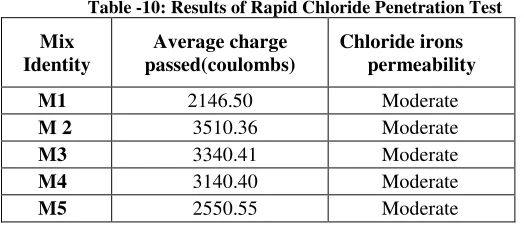
Table -10: Results of Rapid Chloride Penetration Test
Mix Identity
Average charge passed(coulombs)
Chloride irons permeability
M1 2146.50 Moderate
M 2 3510.36 Moderate
M3 3340.41 Moderate
M4 3140.40 Moderate
M5 2550.55 Moderate
V. RESULTS AND DISCUSSION
When the percentage of GGBS replaced to cement with varying percentage from 25% to 40% the following results were drawn.
1. With 25% of GGBS the compressive strength at the end of 7,14 and 28 days 33.4, 40.25 and 48.15 N/mm2 respectively.
2. The compressive strength at the end of 28 days decreases when the GGBS percentage is increased beyond 40%. However the compressive strength of M30 concrete at the end of 28 days for 40% replacement of GGBS is 44.26 N/mm2 as shown in Table -7.
3. The compressive strength showed a steep decrease when the GGBS percentage is increased as shown in Chart -1.
4. A similar increase in the split tensile strength was observed when the GGBS is increase 25% (5.63 N/mm2 at the end of 28 days). 5. The split tensile strength at the end of 28 days
decreases when the GGBS percentage is increased beyond 40%. However the split tensile strength of M30 concrete at the end of 28 days for 40% replacement of GGBS is 5.05 N/mm2 as shown in Table -8.
6. The split tensile strength showed a steep decrease when the GGBS percentage is increased beyond 40% as shown in Chart -2. 7. A similar increase in the Flexural strength
was observed when the GGBS is increase 25% (10.41N/mm2 at the end of 28 days). 8. The Flexural strength at the end of 28 days
decreases when the GGBS percentage is increased beyond 40%. However the Flexural strength of M30 concrete at the end of 28 days for 40% replacement of GGBS is 7.92 N/mm2 as shown in Table -9.
9. The Flexural strength showed a steep decrease when the GGBS percentage is increased beyond 40% as shown in Chart -3. 10. Corrosion of reinforcing steel due to chloride
ingress is one of the most common environmental attacks that lead to the deterioration of concrete structures. Rapid penetration is moderate in all mixes as shown in table-10.
REFERENCE
1. Chandrakant u. Mehetre, pradnya p. Urade, shriram h. Mahure & k. Ravi, “Comparative study of properties of self compacting concrete with metakaolin and cement kiln dust as mineral admixtures” International Journal of Research in Engineering & Technology (IMPACT: IJRET), Vol. 2, Apr 2014, 37-52.
2. U. N. Shahi,” study on fresh properties of self compacting concrete with process fly ash”, International Journal Research in Engineering & Technology Vol.2, Issue 5, May 2014.
3. Prajapati Krishnapal, Chandak Rajeev and Dubey Sanjay Kumar, “Development and properties of self compacting concrete mixed with fly ash”, Research Journal of Engineering Science Vol.1 (3), 11-14, Sept. (2012).
4. Beeralingegowda and V. D. Gundakalle ,”The effect of addition of limestone powder on the properties of self- compacting concrete”, International Journal of Innovative Research in Science, Engineering and Technology, Vol. 2, Issue 9, September 2013.
5. Dhiyaneshwaran. S, Ramanathan. P.Baskar and Venkatasubramani, R,”Study on durability characteristics of self compacting concrete with fly ash”, Jordan journal of Civil Engineering, Column 7, No.3, 2013.
6. Darshan H R, M.Rame Gowda ‘Development and study of behavior of self-compacting concrete using GGBS‟, International Journal of Advanced Technology in Engineering and Science ,Volume No.02, Issue No. 07, July 2014.
7. Deepa Balakrishnan S., Paulose ,”Workability and strength characteristics of self compacting concrete containing fly ash and dolomite powder”, American Journal of Engineering Research (AJER), Vol-2, pp-43-47.
8. Mohammad Kamran, Mudit Mishra „Behavior of self- compacting concrete using PPC and OPC with different proportions of fly ash‟, International Journal of Research in Engineering and Technology, Volume: 03, Issue: 09 Sep-2014. 9. MD Nor Atan, Hanizam Awang ,”The compressive
and flexural strengths of self compacting concrete using raw rice husk ash”, Journal of Engineering Science and Technology, Vol. 6, No. 6 (2011) 720 – 732.