
M
−
Polynomial of some Graph Operations and Cycle
Related Graphs
BOMMANAHALBASAVANAGOUD,ANAND PRAKASH BARANGI AND
PRAVEEN JAKKANNAVAR
Department of Mathematics, Karnatak University, Dharwad − 580 003, Karnataka, India
ARTICLE INFO ABSTRACT
Article History:
Received: 29 August 2018 Accepted: 5 May 2019 Published online 30 July 2019 Academic Editor: Sandi Klavžar
In this paper, we obtain M-polynomial of some graph operations and cycle related graphs. As an application, we compute M-polynomial of some nanostructures viz., [ , ] nanotube,
[ , ] nanotorus, line graph of subdivision graph of
[ , ] nanotube and [ , ] nanotorus, V-tetracenic nanotube and V-V-tetracenic nanotorus. Further, we derive some degree based topological indices from the obtained polynomials.
© 2019 University of Kashan Press. All rights reserved Keywords:
M-polynomial
Degree-based topological index Line graph
Subdivision graph Wheel graph
1.
I
NTRODUCTIONLet be a simple, connected, undirected graph of order and size with vertex set ( )
and edge set ( ). The degree ( ) of a vertex ∈ ( ) is the number of edges incident to it in . An isolated vertex or singleton graph is a vertex with degree zero. Let
{ , , . . . , } be the vertices of and let = ( ). The subdivision graph ( ) [24] of a graph is the graph obtained by inserting a new vertex onto each edge of . Let and be two graphs of order , and size , respectively. The union [24] of and is the graph with vertex set ∪ and edge set ∪ is denoted by ∪ and
| ( ∪ )| = + , | ( ∪ )| = + . The join [24] + of and is the graph obtained from ∪ by joining each vertex of with every vertex of by an edge. Order and size of + are + and + + , respectively. The
Corresponding Author (Email address: [email protected]) DOI: 10.22052/ijmc.2019.146761.1388
corona [24] ∘ of two graphs and of order and respectively, is defined as the graph obtained by taking one copy of and copies of and then joining the vertex of to every vertex in the copy of . For undefined graph theoretic terminologies and notions refer [24].
Several topological indices have been defined in the literature. Among them some standard topological indices are first Zagreb index [22], second Zagreb index [23], modified second Zagreb index [10], Randic′ index [36], harmonic index [16], symmetric division index [10] and inverse sum index [10]. The general form of these degree-based topological indices of a graph is given by
( ) =
∈ ( )
( ( ), ( )),
where = ( , ) is a function appropriately chosen for the computation. Table 1 gives the standard topological indices defined by ( , ). For more details on degree-based and distance based topological indices refer [1−7,12,13,18,19,21,32,39−41,43,45].
It would be interesting that, if all these topological indices are obtained from a single expression. This role is played by polynomials. In fact there are several graph polynomials like PI polynomial [3], Tutte polynomial [14], matching polynomial [15,20], Schultz polynomial [25], Zang-Zang polynomial [46], etc., Among them, the Hosoya polynomial [26] is the best and well-known polynomial which plays a vital role in determining distance-based topological indices such as Wiener index [44], hyper Wiener index [9] of graphs. Similarly, M-polynomial which was introduced in 2015 by Deutsch and Klavzar in [10], which is useful in determining many degree-based topological indices (listed in Tables 1 and 2). This motivates us to study M-polynomial of some graph operations and some cycle related graphs. Recently, the study of M-polynomial are reported in [8,11,28,33−35,37].
Table 1. [10] Operators to derive degree-based topological indices from M-polynomial.
Notation Topological Index ( , ) Derivation from ( ; , )
( ) First Zagreb + ( + )( ( ; , ))| ( ) Second Zagreb ( )( ( ; , ))|
M ( ) Second modified
Zagreb
1
( )( ( ; , ))|
( ) Symmetric division + ( + )( ( ; , ))|
( ) Harmonic 2
+ 2 ( ( ; , ))|
( ) Inverse sum
where, = ( , ), = ( , ), =∫ ( , ) , =∫ ( , ) and ( ( , )) = ( , ) are the operators. Along with these operators, we also mention two more operators in Table 2 to calculate general sum connectivity index and first general Zagreb index.
Definition 1. [10] Let be a graph. Then M-polynomial of is defined as
( ; , ) = ∑ ( ) ,
where , , ≥ 1, is the number [19] of edges of such that { ( ), ( )} = { , }.
Table 2: New operators to derive degree-based topological indices from M-polynomial.
Notation Topological Index ( , ) Derivation from ( ; , )
( ) General sum
connectivity [21] ( + ) ( ( ( ; , )))|
( ) First general Zagreb [31] + ( + )( ( ; , ))|
Note 1: Hyper Zagreb index is obtained by taking = 2 in general sum connectivity index. Note 2: Taking = 2,3 in first general Zagreb index, first Zagreb and forgotten topological indices are obtained respectively.
2.
M
−
P
OLYNOMIAL OF SOMEG
RAPHO
PERATIONSIn this section, we obtain M-polynomial of some graph operations.
Lemma 2.1. For any -regular graph of order and size , the M-polynomial of is
given by ( ; , ) = .
Proof. Since is a -regular graph with edges and every edge is incident on vertex of degree , the proof follows.
The product [24] × of graphs and has the vertex set ( × ) = ( ) × ( ) and ( , )( , ) is an edge of × if and only if [ = and ∈ ( )] or [ =
and ∈ ( )].
Theorem 2.2. Let be an -regular graph of order and be an -regular graph of
order . Then ( × ; , ) = .
Proof. Since the graphs and are regular graphs of degree and respectively. Therefore the graph obtained by product of and is a regular graph of degree +
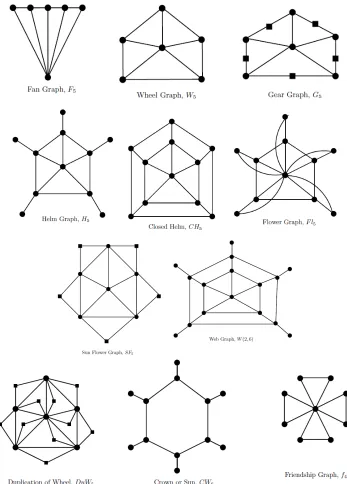
Figure 1. Some cycle related graphs.
The composition [24] [ ] of graphs and with disjoint vertex sets ( ) and
( ) and edge sets ( ) and ( ) is the graph with vertex set ( [ ]) = ( ) × ( )
Theorem 2.3. Let be an -regular graph of order and be an -regular graph of
order . Then, ( [ ]; , ) = .
Proof. Since and are regular graphs of degree and respectively. The graph obtained by the composition of two graphs and is a regular graph of degree +
with vertices. Hence the result follows from Lemma 2.1.
3.
M
−
P
OLYNOMIAL OFC
YCLER
ELATEDG
RAPHSIn this section, we obtain M-polynomial of some cycle related graphs, Figure 1. Definitions 2-10 can be found in [17], definition 11 is in [42] and definitions 12-16 can be found in [30, 38]. We also derive some topological indices (mentioned in Tables 1 and 2) of these graphs from the respective M-polynomials. For more details on wheel related graphs refer [17,27,38,42] and references cited there in.
Definition 2. The fan graph , ( ≥ 3) is defined as the graph + , where is singleton graph and is the path on vertices.
Theorem 3.1. Let be a fan of order + 1 and size 2 −1. Then,
( ; , ) = 2 + 2 + ( −3) + ( −2) .
Proof. The fan has + 1 vertices and 2 −1 edges. It is easy to see that | { , }| =
2, | { , }| = 2 and the remaining edge partition of is as follows:
| { , }| = | ∈ ( ): = 3 = 3| = ( −3),
| { , }| = | ∈ ( ): = 3 = | = ( −2),
proving the result.
Corollary 3.2. If is a Fan, then 1. ( ) = + 9 −10, 2. ( ) = 3 + 7 −15, 3. M ( ) = ,
4. ( ) = ,
5. ( ) =
( ) + ( ),
6. ( ) = ( )+ ( )+ ,
Proof. The M-polynomial for fan is given by
( ; , ) = 2 + 2 + ( −3) + ( −2) .
Using the expressions from Tables 1 and 2, we have
= ( , ) = 4 + 4 + 3( −3) + 3( −2)
= ( , ) = 2 + 6 + 3( −3) + ( −2)
= ∫ ( , ) = + +( ) +( )
= ∫ ( , ) = + +( ) +( ) .
Therefore,
( ) = + ( ; , ) | = + 9 −10,
( ) = ( ; , ) | = 3 + 7 −15,
M ( ) = ( )( ( ; , ))| = + ,
( ) = + ( ; , ) | = ,
( ) = 2 ( ; , ) | =
( ) + ( ),
( ) = ( ; , ) | = ( )+ ( )+ ,
( ) = ( ; , ) | = 2⋅5 + 2( + 2) + ( −3)⋅6α+ ( −2)( −3) ,
( ) = + ( ; , ) | = 2 + 3 (2 −5) + 3 ( −1) + .
Definition 3. The wheel = + is a graph with + 1 vertices and 2 edges, where the vertex with degree is called the central vertex while the vertices on the cycle are called rim vertices.
Theorem 3.3. Let be a wheel of order + 1 and size 2 . Then,
( ; , ) = (1 + ).
Proof. The wheel has + 1 vertices and 2 edges. The edge set of can be partitioned as,
| { , }| = | ∈ ( ): = 3 = 3| = ,
| { , }| = | ∈ ( ): = 3 = |
= | ( )−| { , }| = .
Corollary 3.4. If is a wheel, then 1. ( ) = + 9 ,
3. ( ) = ,
4. ( ) = ,
5. ( ) =
( ),
6. ( ) = + ,
7. ( ) = (6 + ( + 3) ),
8. ( ) = 3 + .
Proof. Let ( ; , ) =∑ ( ) = (1 + ). Using the expressions from Tables 1 and 2, we have
= ∂ ( , )
∂ = 3 + 3
= ∂ ( , )
∂ = 3 +
= ( , ) =
3 + 3
= ( , ) =
3 + .
Thus we get,
( ) = + ( ; , ) | = + 9 ,
( ) = ( )( ( ; , ))| = 3 + 9 ,
M ( ) = ( ; , ) | = + ,
( ) = + ( ; , ) | = ,
( ) = 2 ( ; , ) | = + ,
( ) = ( ; , ) | = + ,
( ) = ( ; , ) | = (6 + ( + 3) ),
( ) = + ( ; , ) | = 3 + .
Definition 4. The gear graph is a wheel graph with a vertex added between each pair adjacent vertices of the outer circle.
Theorem 3.5. Let be a gear graph. Then ( ; , ) = 2 + .
| { , }| = | ∈ ( ): = 2 = 3| = 2 ,
| { , }| = | ∈ ( ): = 3 = |
= | ( )|−| { , }| = .
Using definition of M-polynomial and above edge partitions, we get the desired result.
Corollary 3.6. If is a gear graph, then 1. ( ) = + 13 ,
2. ( ) = 3 + 12 ,
3. ( ) = ,
4. ( ) = + + 3,
5. ( ) = + ,
6. ( ) = + ,
7. ( ) = 2 5 + ( + 3) ,
8. ( ) = (2 + 3 + ).
Definition 5. The helm is a graph obtained from a wheel with central vertex , by attaching a pendant edge to each rim vertex of . A closed helm is the graph with central vertex , obtained from a helm by joining each pendant vertex to form a cycle.
Theorem 3.7. Let be a helm. Then ( ; , ) = + + .
Proof. Let is a graph having (2 + 1) vertices and 3 edges. The edge partition of is given by,
| { , }| = | ∈ ( ): = 1 = 4| = ,
| { , }| = | ∈ ( ): = 4 = 4| = ,
| { , }| = | ∈ ( ): = 4 = |
= | ( )|−| { , }|−| { , }| = .
Corollary 3.8. If is a helm graph, then 1. ( ) = + 17 ,
2. ( ) = 4 + 20 ,
3. ( ) = ,
4. ( ) = ( )+ 6 + 4 ,
5. ( ) = + + ,
7. ( ) = (5 + 8 + ( + 4) ,
8. ( ) = (4 + ).
Theorem 3.9. Let be a closed helm. Then ( ; , ) = + + + . Proof. Let is a graph having (2 + 1) vertices and 4 edges. The edge partition of is given by, | { , }| = | ∈ ( ): = 3 = 3| = ,
| { , }| = | ∈ ( ): = 3 = 4| = ,
| { , }| = | ∈ ( ): = 4 = 4| = ,
| { , }| = | ∈ ( ): = 4 = | = .
Corollary 3.10. If is a gear graph, then 1. ( ) = + 25 ,
2. ( ) = 4 + 37 , 3. ( ) = , 4. ( ) = , 5. ( ) = + + + , 6. ( ) = + + + 2 ,
7. ( ) = (6 + 7 + 8 + ( + 4) ), 8. ( ) = (3 + 4 + ). Definition 6. The flower is the graph obtained from a helm by joining each pendant vertex to the central vertex of the helm. Theorem 3.11. Let be a flower. Then ( ; , ) = + + + . Proof. Let flower is a graph having (2 + 1) vertices and 4 edges. The edge partition of is given by, { , } = | ∈ ( ): = 2 = 4| = ,
{ , } = | ∈ ( ): = 2 = 2 | = ,
{ , } = | ∈ ( ): = 4 = 4| = ,
{ , } = | ∈ ( ): = 4 = 2 |
Corollary 3.12. If is a flower graph, then 1. ( ) = 4 ( + 5),
2. ( ) = 12 ( + 2) ,
3. ( ) = ,
4. ( ) = + + 3 ,
5. ( ) = + + ,
6. ( ) = + + + 2 ,
7. ( ) =n(6α+ 8α+(2n + 2)α+(2n + 4)α),
8. ( ) = (2α+1+ 4α+1+ α2α+1).
Definition 7. The sunflower graph is a graph obtained from a wheel with central vertex , -cycle , , . . . , and additional vertices , , . . . , where is joined by edges to , for = 0,1, . . . , −1 where + 1 is taken modulo .
Theorem 3.13. Let be a sunflower. Then ( ; , ) = 2 + + .
Proof. The sunflower graph is a graph having (2 + 1) vertices and 4 edges. The edge partition of is given by,
| { , }| = | ∈ ( ): = 2 = 5| = 2 ,
| { , }| = | ∈ ( ): = 5 = 5| = ,
| { , }| = | ∈ ( ): = 5 = |
= | ( )|−| { , }|−| { , }| = .
Corollary 3.14. If is a sunflower graph, then 1. ( ) = + 29 ,
2. ( ) = 5 ( + 9) ,
3. ( ) = + + ,
4. ( ) = ,
5. ( ) = + + ,
6. ( ) = + + ,
7. ( ) = (2⋅7 + 10 + ( + 5) ),
Definition 8. The friendship graph is a collection of -triangles with a common vertex. Friendship graph can also be obtained from a wheel with cycle by deleting alternate edges of the cycle. That is = + .
Theorem 3.15. Let be a friendship graph. Then ( ; , ) = + 2 .
Proof. Let friendship graph is a graph having (2 + 1) vertices and 3 edges. The edge partition of is given by,
| { , }| = | ∈ ( ): = 2 = 2| = ,
| { , }| = | ∈ ( ): = 2 = 2 | = | ( )|−| { , }| = 2 .
Corollary 3.16. If is a flower graph, then
1. ( ) = 4 ( + 2),
2. ( ) = 4 (2 + 1) , 3. ( ) = ,
4. ( ) = 2( + + 1), 5. ( ) = + ,
6. ( ) = + ,
7. ( ) = (4 + 2 ( + 1) ),
8. ( ) = 2 ( + 2).
Definition 9. A web graph is the graph obtained by joining a pendant edge to each vertex
on the outer cycle of the closed helm. ( , ) is the generalized web with cycles each of order .
Theorem 3.17. Let ( , ) be a generalized web. Then
( ( , ); , ) = + (2 −1) + .
Proof. Let generalized web ( , ) is a graph having ( + + 1) vertices and (2 + 1)
edges. The edge partition of ( , ) is given by,
| { , }| = | ∈ ( ( , )): = 1 = 4| = ,
| { , }| = | ∈ ( ( , )): = 4 = 4| = (2 −1),
| { , }| = | ∈ ( ( , )): = 4 = |
= | ( ( , ))|−| { , }|−| { , }| = .
1. ( , ) = ( + 8(2 −1) + 9),
2. ( ( , ) ) = 4 ( + 4(2 −1) + 1) ,
3. ( ( , ) ) = + ( )+ ,
4. ( ( , ) ) = + + 2 (2 −1) + 4 + 4,
5. ( ( , ) ) = + ( )+ ,
6. ( ( , ) ) = + 2 (2t−1) + ,
7. ( ( , ) ) = (5 + (2 −1)8 + (4 + ) ,
8. ( , ) = 2 ⋅4 + 2 ⋅4 (2 −1) + + .
Definition 10. The crown (or sun) is a corona of form ∘ where ≥ 3. That is crown is a helm without central vertex.
Theorem 3.19. Let be a crown graph. Then
( ; , ) = + .
Proof. Let is a crown graph having 2 vertices and 2 edges. The edge partition of is given by,
| { , }| = | ∈ ( ): = 1 = 3| = ,
| { , }| = | ∈ ( ): = 3 = 3|
= | ( )|−| { , }| = .
Corollary 3.20. If is a flower graph, then 1. ( ) = 10 ,
2. ( ) = 12 ,
3. ( ) = ,
4. ( ) = ,
5. ( ) = + ,
6. ( ) = ,
7. ( ) = (4 + 6 ),
8. ( ) = (3 + 1).
Definition 11. Consider a wheel = + with , , . . . , as its rim vertices and as its central vertex. Let , , . . . , be the rim edges of which are duplicated by new vertices , , . . . , , respectively and let , , . . . , be the spoke edges of which are duplicated by the vertices , , . . . , , respectively. The resultant graph is called duplication of the wheel denoted by .
Theorem 3.21. Let be the duplication of the wheel. Then
( ; , ) = 3 + + + .
Proof. Let duplication of the wheel is a graph having (3 + 1) vertices and 6
edges. The edge partition of is given by,
| { , }| = | ∈ ( ): = 2 = 6| = 3 ,
| { , }| = | ∈ ( ): = 2 = 2 | = ,
| { , }| = | ∈ ( ): = 6 = 6| = ,
| { , }| = | ∈ ( ): = 6 = 2 | = | ( )|−| { , }|−| { , }|−| { , }| = .
Corollary 3.22. If be the duplication of the wheel, then 1. ( ) = 4 ( + 11),
2. ( ) = 8 (2 + 9), ,
3. ( ) = ,
4. ( ) = ,
5. ( ) = + + + ,
6. ( ) = + + 3 ,
7. ( ) = (3⋅8 + 12 + (2 + 2) + (2 + 6) ),
8. ( ) = (4 ⋅2 + 6 ⋅6 + (2 ) ).
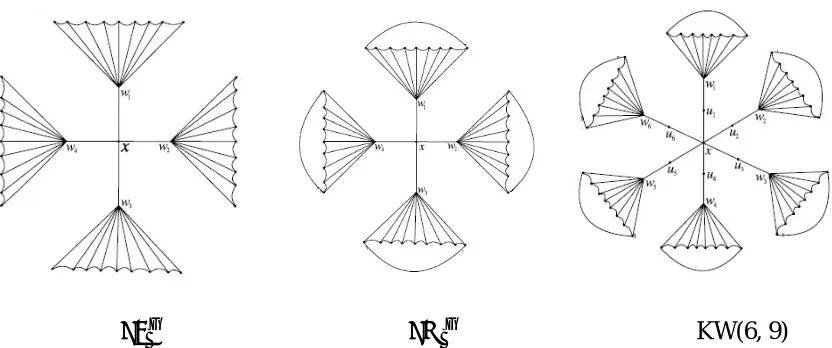
Definition 12. A uniform -fan split graph , contains a star with hub at such that the deletion of edges of partitions the graph into independent fans = +
KW(6, 9)
Figure 2. Self explanatory examples of , and KW(6, 9) graphs.
Theorem 3.23. Let be a uniform -fan split graph. Then
( ; , ) = 2 + 2 + ( −3) + ( −2) + .
Proof. The uniform -fan split graph has ( + + 1) vertices and 2 edges. The edge set of can be partitioned as,
| { , }| = | ∈ ( ): = 2 = 3| = 2 ,
{ , } = | ∈ ( ): = 2 = + 1| = 2 ,
| { , }| = | ∈ ( ): = 3 = 3| = ( −3),
| { , }| = | ∈ ( ): = 3 = + 1| = ( −2), | { , }| = | ∈ ( ): = = + 1|
= | ( )−| { , }|−| { , }|−| { , }|−| { , }| = .
Corollary 3.24. If be a uniform -fan split graph, then 1. ( ) = ( + 11 + −9),
2. ( ) = (3 + + 10 + −17), ,
3. ( ) = ( )
( ) ,
4. ( ) = ( ) ( )
( ) ,
5. ( ) = ( − + + 10 −9) ,
6. ( ) = ( )
( )+
( )
( )( ) ,
7. ( ) = 2 5 + 2 ( + 3) + ( −3)6 + ( −2)( + 4) + ( + + 1)
Definition 13. The graph contains a star with hub at such that the deletion of the edges of partitions the graph into independent wheels = + , (1≤
≤ ) and an isolated vertex, Figure 2.
Theorem 3.25. Let be the graph having ( + + 1) vertices and (2 + 1) edges. Then
( ; , ) = + + .
Proof. Let is a graph having ( + + 1) vertices and (2 + 1) edges. The edge partition of is given by,
| { , }| = | ∈ ( ): = 3 = 3| = ,
| { , }| = | ∈ ( ): = 3 = + 1| = ,
| { , }| = | ∈ ( ): = = + 1| = | ( )|−| { , }|−| { , }| = .
Corollary 3.26. If graph, then
1. ( ) = + ( + 1) + ( + 10),
2. ( ) = ( + 1) + 3 ( + 4) ,
3. ( ) =
( ) ,
4. ( ) = ( ) ( )
( ) ,
5. ( ) =
( )+ ( ) ,
6. ( ) = ( )
( ) +
( )
( ) ,
7. ( ) = nr⋅6α+ nr (r + 4)α+ n(n + r + 1)α,
8. ( ) = 3nr⋅3α+ nα+1+ nr(r + 1)α+ n(r + 1)α.
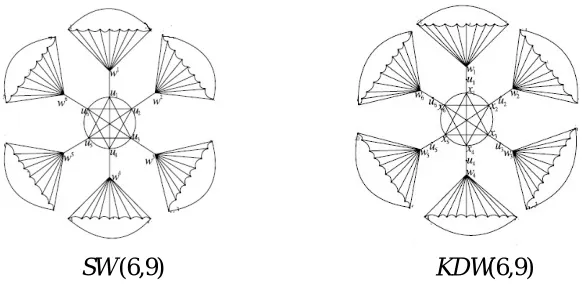
Definition 14. Let , (1≤ ≤ ) be the vertices of the complete graph . Let = +
be the wheel with hubs , (1≤ ≤ ), respectively. Let , (1≤ ≤ ) be an edge. The graph so constructed is called uniform -wheel split graph ( , ), Figure 2.
Note: A uniform -wheel split graph ( , ) is a graph in which the deletion of edges
, (1 ≤ ≤ ) partitions the graph into a complete graph and independent wheels .
SW (6,9) KDW(6,9)
Figure 3. Graphs SW (6,9) and KDW(6,9).
Theorem 3.27. Let ( , ) be a uniform -wheel split graph. Then
( ( , ); , ) = + + +
2 .
Proof. Let ( , ) uniform -wheel split graph having ( + 2) vertices and (4 + + 1) edges. The edge partition of ( , ) is given by,
| { , }| = | ∈ ( ( , )): = 3 = 3| = ,
| { , }| = | ∈ ( ( , )): = 3 = + 1| = ,
| { , }| = | ∈ ( ( , )): = = + 1| = ,
| { , }| = | ∈ ( ( , )): = = |
= | ( ( , ))−| { , }|−| { , }|−| { , }| = 2 .
Corollary 3.28. If ( , ) be a uniform -wheel split graph, then
1. ( , ) = + ( + 1) + ( + 10),
2. ( ( , )) = ( ) ( ) ,
3. ( ( , )) = ( ) ( )
( ) − ,
4. ( ( , )) = − + 1 + ( )
( ) + ,
5. ( ( , )) =
( ) + ( ) − ,
6. ( ( , )) = ( + 3) + −
( )− ( ),
7. ( ( , )) = ⋅6 + ( + 4) + ( + + 1) + (2 )
Definition 15. Let , (1≤ ≤ ) be the vertices of a star with a hub at . Let
, (1 ≤ ≤ ) be an edge. Let = + be wheels with hubs , (1≤ ≤ ). The graph so obtained is denoted by ( , ), Figure 3.
Theorem 3.29. Let ( , ) be the graph having ( + 2) + 1 vertices and 2 ( + 1)
edges. Then
( ( , ); , ) = + + + .
Proof. Let ( , ) is a graph having ( + 2) + 1 vertices and 2 ( + 1) edges. The edge partition of ( , ) is given by,
| { , }| = | ∈ ( ( , )): = 2 = | = ,
| { , }| = | ∈ ( ( , )): = 2 = + 1| = ,
| { , }| = | ∈ ( ( , )): = 3 = 3| = ,
| { , }| = | ∈ ( ( , )): = 3 = + 1| = | ( ( , ))−| { , }|−| { , }|−| { , }| = .
Corollary 3.30. If ( , ) be a graph, then
1. ( , ) = + ( + 5) + ( + 10),
2. ( , ) = 2 + 2 ( + 1) + 3 ( + 4) ,
3. ( ( , )) = ( )
( ) ,
4. ( ( , )) = ( ) ( ) ( ( ) ( ) )
( ) ,
5. ( ( , )) = ( )
( ) +
( )
( ) ( ),
6. ( ( , )) = + ( )+ ( )
( ) ,
7. ( ( , )) = ( + 2) + ( + 3) + ⋅6 + ( + 4) ,
8. ( ( , )) = 2 + ⋅3 + + ( + 1) + ( + 1) .
Definition 16. Let , (1≤ ≤ ) be the vertices of the complete graph . Let = +
be wheel with hub , (1≤ ≤ ). Let , (1≤ ≤ ) be an edge. Subdivide each edge by , (1≤ ≤ ). The graph so obtained is denoted by ( , ), Figure 3.
Theorem 3.31. Let ( , ) be the graph having ( + 3) vertices and (4 + + 3).
Then
( ( , ); , ) = + + + +
2 .
Proof. Let ( , ) is a graph having ( + 3) vertices and (4 + + 3) edges. The
edge partition of ( , ) is given by,
| { , }| = | ∈ ( ( , )): = 2 = | = ,
| { , }| = | ∈ ( ( , )): = 2 = + 1| = ,
| { , }| = | ∈ ( ( , )): = 3 = 3| = ,
{ , } = | ∈ ( ( , )): = 3 = + 1| = ,
| { , }| = | ∈ ( ( , )): = = |
= | ( ( , ))|−| { , }|−| { , }|−| { , }|−| { , }| = 2 .
Corollary 3.32. If ( , ) be a graph, then
1. ( , ) = + ( + 5) + ( + 10),
2. ( ( , )) = ( ( ( ) ) ) ( ) ,
3. ( ( , )) = ( ) ( ( ) ( ))
( ) ,
4. ( ( , )) = ( ) ( )
( ) ,
5. ( ( , )) = + + + + − ,
6. ( ( , )) = + − + ( )+ ( )
( ) ,
7. ( ( , )) = ( + 2) + ( + 3) + ⋅6 + ( + 4) + (2 ) ,
8. ( ( , )) = ⋅2 + ⋅3 + + ( + 1) + ( + 1) + ( −1)
4.
M
−P
OLYNOMIAL OF SOMEN
ANOSTRUCTURESIn science and technology, nanostructures play a vital role in small electronic devices to big satellites, pharmaceutical and medical treatments, communication and information, food science and so on. Among these, M-polynomial of dendrimers were studied in [33], V-phenylenic nanotubes and nanotori in [29] titania nanotubes in [34], Armchair polyhex nanotube and zig-zag polyhex nanotubes were encountered in [35]. In this paper, we consider [ , ] nanotube, [ , ] nanotorus, line graph of the subdivision graph of [ , ] nanotube and [ , ] nanotorus, V-tetracenic nanotube and V-tetracenic nanotorus and compute M-polynomial.
subdivision graph of [4,2] nanotorus is given in Figure 6 (b). The structures V-tetracenic nanotube and V-V-tetracenic nanotorus are given in Figures 7 and 8, respectively.
Figure 4. (a) [4,3] nanotube; (b) [4,3] nanotorus.
Figure 5. (a) Subdivision graph of [4,3] of nanotube; (b) line graph of the subdivision graph of [4,3] of nanotube.
Figure 6. (a) Subdivision graph of [4,2] of nanotorus; (b) line graph of the subdivision graph of [4,2] of nanotorus.
We now obtain M-polynomial of these nanostructures as follows.
Theorem 4.1. Let = [ , ] nanotube. Then
( ; , ) = 4 + (6 −5 ) .
Proof. The [ , ] nanotube has 4 vertices and 6 − edges. The edge set of
| { , }| = | ∈ ( ): = 2 = 3| = 4 ,
| { , }| = | ∈ ( ): = 3 = 3|
= | ( )−| { , }| = 6 −5 .
Theorem 4.2. Let = [ , ] nanotorus. Then, ( ; , ) = 6 .
Proof. The [ , ] nanotorus is a 3- graph with 6 edges. Thus, from Lemma 2.1, M-polynomial of [ , ] nanotorus is ( ; , ) = 6 .
Theorem 4.3. Let be the line graph of subdivision graph of [ , ] nanotube. Then
( ; , ) = 2 + 4 + (18 −11) .
Proof. The line graph of subdivision graph of [ , ] nanotube has 12 −2
vertices and 18 −5 edges. The edge partition of line graph of subdivision graph of
[ , ] nanotube is given by,
| { , }| = | ∈ ( ): = 2 = 2| = 2 ,
| { , }| = | ∈ ( ): = 2 = 3| = 4 ,
| { , }| = | ∈ ( ): = 3 = 3|
= | ( )−| { , }|−| { , }| = 18 −11 .
Theorem 4.4. Let be the line graph of subdivision graph of [ , ] nanotorus. Then ( ; , ) = 18 .
Proof. The line graph of subdivision graph of [ , ] nanotorus is a 3-graph with 18 edges. Thus, from Lemma 2.1 we have, ( ; , ) = 18 .
Figure 7. V-tetracenic nanotube [ , ].
Theorem 4.5. Let be the V-tetracenic nanotube. Then
Proof. The V-tetracenic nanotube has 18 vertices and 27 −4 edges. The edge partition of V-tetracenic nanotube is obtained as,
| { , }| = | ∈ ( ): = 2 = 3| = 16 ,
| { , }| = | ∈ ( ): = 3 = 3|
= | ( )|−| { , }| = 27 −20 .
Figure 8. V-tetracenic nanotorus [ , ].
Theorem 4.6. Let be the V-tetracenic nanotorus. Then ( ; , ) = 27 .
Proof. The proof follows from Lemma 2.1 as V-tetracenic nanotorus is 3-regular graph with 27 edges.
We skip calculating topological indices of these nanostructures as it is routine work.
5.
C
ONCLUDINGR
EMARKSIn this paper, we have proposed new operators to derive general sum connectivity index and first general Zagreb index of a graph from the respective M-polynomial. Further, we have obtained M-polynomials of some graph operations and cycle related graphs. In addition, some degree based topological indices of these graphs are derived. The advantage of M-polynomial is that, from that one expression we can obtain several degree-based topological indices. It is very challenging to obtain new operators to derive all the degree-based topological indices from M-polynomial.
A. P. Barangi supported by Karnatak University, Dharwad, Karnataka, India, through University Research Studentship (URS), No.KU/Sch/URS/2017-18/471, dated 3rd July 2018. P. Jakkannavar supported by Directorate of Minorities, Government of Karnataka, Bangalore, through M. Phil/Ph. D Fellowship-2017-18: No. DOM/FELLOWSHIP/CR-29/2017-18, dated 9th August 2017.
R
EFERENCES1. M. S. Anjum and M. U. Safdar, K Banhatti and K hyper-Banhatti indices of nanotubes, Eng. Appl. Sci. Lett. 2 (1) (2019) 19−37.
2. A. R. Ashrafi, T. Došlić and A. Hamzeh, Extremal graphs with respect to the Zagreb coindices, MATCH Commun. Math. Comput. Chem. 65 (2011) 85−92. 3. A. R. Ashrafi, B. Manoochehrian and H. Yousefi-Azari, On the PI polynomial of a
graph, Util. Math. 71 (2006) 97−108.
4. B. Basavanagoud, A. P. Barangi and S. M. Hosamani, First neighbourhood Zagreb index of some nano structures, Proc. Inst. Appl. Math. 7 (2) (2018) 178−193.
5. B. Basavanagoud and P. Jakkannavar, Kulli-Basava indices of graphs, Int. J. Appl. Eng. Res. 14(1) (2019) 325−342.
6. B. Basavanagoud and P. Jakkannavar, Computing leap Zagreb indices of generalized xyz-point-line transformation graphs T (G) when z = +, J. Comp. Math. Sci. 9 (10) (2018) 1360−1383.
7. B. Basavanagoud, Chitra E, On the leap Zagreb indices of generalized xyz-point-line transformation graphs T (G) when z = 1, Int. J. Math. Combin., 2 (2018) 44-66.
8. B. Basavanagoud and P. Jakkannavar, M-polynomial and degree-based topological indices of graphs, Electronic J. Math. Anal. Appl., 8 (1) (2020) 75−99.
9. G. G. Cash, Relationship between the Hosoya polynomial and the hyper-Wiener index, Appl. Math. Lett. 15 (2002) 893−895.
10.E. Deutsch and S. Klavžar, M-Polynomial and degree-based topological indices, Iran. J. Math. Chem. 6 (2) (2015) 93−102.
11.E. Deutsch and S. Klavžar, M-Polynomial revisited: Bethe cacti and an extension of Gutman's approach, J. Appl. Math. Comput. 60 (2019) 253−264.
12.N. De, Computing reformulated first Zagreb index of some chemical graphs as an application of generalized hierarchical product of graphs. Open J. Math. Sci. 2 (1) (2018) 338−350.
14.T. Došlić, Planar polycyclic graphs and their Tutte polynomials, J. Math. Chem. 51
(2013) 1599−1607.
15.E. J. Farrell, An introduction to matching polynomials, J. Combin. Theory Ser. B
27 (1979) 75−86.
16.S. Fajtlowicz, On conjectures of Graffiti - II, Congr. Numer. 60 (1987) 187−197. 17.J. A. Gallian, A dynamic survey of graph labeling, Electron. J. Combin. #DS6,
(2018) 502 pages.
18.W. Gao, M. Asif and W. Nazeer, The study of honey comb derived network via topological indices, Open J. Math. Anal. 2 (2) (2018) 10−26.
19.I. Gutman, Molecular graphs with minimal and maximal Randić indices, Croat. Chem. Acta 75 (2002) 357−369.
20.I. Gutman, The acyclic polynomial of a graph, Publ. Inst. Math. 22 (36) (1979) 63−69.
21.I. Gutman, Degree-based topological indices, Croat. Chem. Acta 86 (2013) 351−361.
22.I. Gutman and N. Trinajstić, Graph theory and molecular orbitals, Total -electron energy of alternant hydrocarbons, Chem. Phys. Lett. 17 (1972) 535−538.
23.I. Gutman, B. Ruščić, N. Trinajstić and C. F. Wilcox, Graph theory and molecular orbitals, XII. Acyclic polyenes, J. Chem. Phys. 62 (1975) 3399−3405.
24.F. Harary, Graph Theory, Addison-Wesely, Reading, 1969.
25.F. Hassani, A. Iranmanesh and S. Mirzaie, Schultz and modified Schultz polynomials of fullerene, MATCH Commun. Math. Comput. Chem. 69 (2013) 87−92.
26.H. Hosoya, On some counting polynomials in chemistry, Discrete Appl. Math. 19
(1988) 239−257.
27.I. Javaid and S. Shokat, On the partition dimension of some wheel related graphs, J. Prime Res. Math. 4 (2008) 154−164.
28.S. M. Kang, W. Nazeer, W. Gao, D. Afzal and S. N. Gillani, M-polynomials and topological indices of dominating David derived networks, Open Chem. 16 (2018) 201−213.
29.Y. C. Kwun, M. Munir, W. Nazeer, R. Rafique and S. M. Kang, M-polynomials and topological indices of V-phenylenic nanotubes and nanotori, Sci. Reports 7 (2017) Art. 8756.
30.Y. Kins, Radio labeling of certain graphs, Ph.D. Thesis, University of Madras, India, November 2011.
32.X. Li and Y. Shi, A survey on the Randić index, MATCH Commun. Math. Comput. Chem. 59 (2008) 127−156.
33.M. Munir, W. Nazeer, S. Rafique and S. M. Kang, M-polynomial and related topological indices of nanostar dendrimers, Symmetry 8 (2016) 97.
34.M. Munir, W. Nazeer, S. Rafique, A. R. Nizami and S. M. Kang, M-polynomial and degree-based topological indices of titania nanotubes, Symmetry 8 (2016) 117. 35.M. Munir, W. Nazeer, S. Rafique, A. R. Nizami and S. M. Kang, M-Polynomial
and Degree-Based Topological Indices of Polyhex Nanotubes Symmetry, 8 (2016) 149.
36.M. Randić, On characterization of molecular branching, J. Am. Chem. Soc. 97
(1975) 6609−6615.
37.M. Riaz, W. Gao and A. Q. Baig, M-Polynomials and degree-based Topological Indices of Some Families of Convex Polytopes. Open J. Math. Sci. 2 (1) (2018) 18−28.
38.S. Roy, Packing chromatic number of certain fan and wheel related graphs, AKCE Int. J. Graphs Comb. 14 (2017) 63−69.
39.Z. Shao, A. R. Virk, M. S. Javed, M. A. Rehman and M. R. Farahani, Degree based graph invariants for the molecular graph of Bismuth Tri-Iodide, Eng. Appl. Sci. Lett.
2 (1) (2019) 1−11.
40.H. Siddiqui and M. R. Farahani, Forgotten polynomial and forgotten index of certain interconnection networks, Open J. Math. Sci. 1 (1) (2017) 44−59.
41.Z. Tang, L. Liang and W. Gao, Wiener polarity index of quasi-tree molecular structures, Open J. Math. Sci. 2 (1) (2018) 73−83.
42.S. K. Vaidyaa and M. S. Shukla, b-Chromatic number of some wheel related graphs, Malaya J. Math. 2 (4) (2014) 482−488.
43.A. R. Virk, M. N. Jhangeer and M. A. Rehman, Reverse Zagreb and reverse hyper-Zagreb indices for silicon carbide [ , ] and [ , ], Eng. Appl. Sci. Lett. 1 (2) (2018) 37−50.
44.H. Wiener, Structural determination of paraffin boiling points. J. Am. Chem. Soc. 69
(1947) 17−20.
45.L. Yan, M. R. Farahani and W. Gao, Distance-based indices computation of symmetry molecular structures, Open J. Math. Sci. 2 (1) (2018) 323−337.
![Table 1. [10] Operators to derive degree-based topological indices from M-polynomial.](https://thumb-us.123doks.com/thumbv2/123dok_us/8891409.1825423/2.612.91.523.525.698/table-operators-derive-degree-based-topological-indices-polynomial.webp)
![Figure 6. (a) Subdivision graph of ������[4,2] of nanotorus; (b) line graph of the subdivision graph of ������[4,2] of nanotorus](https://thumb-us.123doks.com/thumbv2/123dok_us/8891409.1825423/19.612.189.443.128.236/figure-subdivision-graph-nanotorus-graph-subdivision-graph-nanotorus.webp)
![Figure 7. V-tetracenic nanotube �[�, �].](https://thumb-us.123doks.com/thumbv2/123dok_us/8891409.1825423/20.612.182.431.508.637/figure-v-tetracenic-nanotube.webp)
![Figure 8. V-tetracenic nanotorus �[�, �].](https://thumb-us.123doks.com/thumbv2/123dok_us/8891409.1825423/21.612.157.464.105.357/figure-v-tetracenic-nanotorus.webp)
