I
nternationalJ
ournal of PharmaceuticalB
iological andC
hemicalS
ciences e-ISSN: 2278-5191International Journal of Pharmaceutical, Biological and Chemical Sciences (IJPBCS) | JUL-SEPT 2014 | VOLUME 3 | ISSUE 3 | 66-74 www.ijpbcs.net or www.ijpbcs.com
R
esearch
A
rticle
Pa
ge
66
ANTIMICROBIAL ACTIVITY OF FLUORESCENT BENZANTHRONE
IN AQUEOUS SOLUTION AND IN POLYLACTIC ACID FILM
M.S.I. Makki1, D. Staneva2, E. Vasileva-Tonkova3, T.R. Sobahi1, R.M. Abdеl-Rahman1, A.M. Asiri1, 4, I. Grabchev1, 5*
1
Chemistry Department, Faculty of Science, King Abdulaziz University, Jeddah 21589, Saudi Arabia
2
University of Chemical Technology and Metallurgy, 1756 Sofia, Bulgaria
3
Institute of Microbiology, Bulgarian Academy of Sciences, 1113 Sofia, Bulgaria
4
Center of Excellence for Advanced Materials Research (CEAMR), King Abdulaziz University, Jeddah 21589, Saudi Arabia
5Sofia University “St. Kliment Ohridski”, Faculty of Medicine, 1407 Sofia, Bulgaria
*Corresponding Author Email: [email protected]
INTRODUCTION
One of the main tasks faced by the mankind in the
course of its long history is the improvement of quality
of life where the level of medical knowledge has
always had a particular role. This public health
problem has increased especially for the last years.
Due to this fact, the search for new effective bioactive
agents with novel chemical structures is a great
worldwide concern and is the basis of the
investigations of researchers from many countries.
In the recent years dye chemistry is one of the key
research domains because the dyes have found
different non traditional applications in high
technology including in medicine and biology [1]. It is
known that the cationic compounds and especially the
quaternary ammonium salts are important biocides and
they can be used as effective antiseptic and disinfectant
agents in different areas [2,3]. They are active against a
broad spectrum of microorganisms such as
Gram-positive and Gram-negative bacteria, fungi and certain
types of viruses [4]. The microbial agents damage the
cell wall or alter cell membrane permeability, denature
proteins, inhibit enzyme activity or inhibit lipid
synthesis, all of them are essential for cell survival.
An interesting area of research is a combination of the
properties of substances with dyeing capacity with
antibacterial properties. This requires the introduction
of specific groups in the chromophores systems to give
other antibacterial properties without changing its color
performance. Dyes with quaternary ammonium group
can be prepared by incorporating long alkyl chain
quaternary ammonium salts into the chromophores
through covalent bonds. The obtained cationic dyes
show excellent color and antimicrobial functions in
solutions [5-8]. Various cationic compounds have been
ABSTRACT:
Тhe antimicrobial activity of a new benzanthrone dye (B) with biocide quaternary ammonium group has been investigated against Gram-positive and Gram-negative indicator bacteria and yeasts using agar well diffusion method and Minimum inhibitory concentration. Thin polylactic acid film with compound B into the polymer matrix has been prepared and its antimicrobial ability in aqueous solution has also been evaluated. The results showed that the polymer film has very good antibacterial activity against P. aeruginosa, E. coli and B. subtilis which is due to the release of B from the polymer.
KEYWORDS:
I. Grabchev* et al;ANTIMICROBIAL ACTIVITY OF FLUORESCENT BENZANTHRONE IN AQUEOUS SOLUTION...
International Journal of Pharmaceutical, Biological and Chemical Sciences (IJPBCS) | JULY-SEPT 2014 | VOLUME 3 | ISSUE 3 | 66-74| www.ijpbcs.net
Pa
ge
67
tested such as the polyelectrolyte layers and the
dendrimers [9, 10].
Polylactide acid (PLA) is a biodegradable and
biocompatible polymer produced from renewable
resources such as corn, potatoes, sugar etc. Due to
transparently and low toxicity the PLA is one of the
most promising biopolymers able to replace the
petroleum-derived polymers for different industrial
applications [11, 12]. PLA fiber is most commonly
dyed with disperse dyes [13].
A new benzanthrone dye was recently synthesized by
incorporating biocidal quaternary ammonium group
into the chomophore structure [14]. This compound
has exhibited very good dyeing ability. It has been
shown that this dye changes its color parameter in
different pH media and demonstrated that can be used
as a sensor for metal ions and ammines [15,16 ].
In this work we investigate the antimicrobial properties
of a benzanthrone dye with biocidal quaternary
ammonium group. Its antimicrobial activity against
bacteria and yeasts and minimum inhibitory
concentration are discussed. The antibacterial
efficiency of the thin PLA-B film in aqueous solution
was also evaluated against positive and
Gram-negative bacteria.
MATERIALS AND METHODS
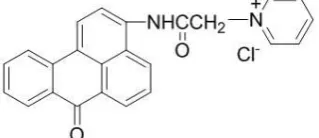
The synthesis and characterization of compound B has
been described recently [17] (Figure 1).
Fig. 1: Chemical structure of compound B
Preparation of polylactic acid film
Pure polylactic acid (PLA) and antimicrobial PLA
films were prepared by solvent casting method.
Polylactic acid (0.5 g) was dissolved in 10 ml
chloroform and 5 x 10⁻⁴ g compound B was added
After 30 minutes stirring, the homogeneous mixture
was poured into a Petri dish and the solvent was
evaporated slowly. Thus a stable polymer film with a
thickness of 80 m was obtained. The same method
has been used to produce pure PLA film.
Preliminary microbiological screening
Preliminary microbiological screening test for
determination of the antimicrobial activity of the newly
synthesized B compound was accomplished by the
agar well diffusion method with slight modification
[17]. The following indicator microbial strains were
used: Gram-positive bacteria Bacillus subtilis, Bacillus
cereus, Sarcina lutea and Micrococcus luteus,
Gram-negative bacteria Pseudomonas aeruginosa,
Escherichia coli, Acinetobacter johnsonii and
Xanthomonas oryzae, and yeasts Candida lipolytica
and Saccharomyces cerevisiae. Sterile Petri plates with
nutrient agar medium (pH = 7.2) were prepared with 4
mm agar layer thickness. The investigated compound
was dissolved in dist. H2O to obtain stock solution with
concentration 10 mg/mL. Suspensions of overnight
grown indicator cultures were prepared and smeared
onto the surface of nutrient agar in Petri plates. Wells
(7 mm in diameter) were punched aseptically in the
agar medium, to which 100 µL of the sample solution
(1.5 mg/ml) were added. Commercial discs with
gentamicin (10 µg) and nystatin (100 units) were used
as reference standards for antibacterial and antifungal
activity, respectively. After incubation of the plates at
25°C for 48 h, the diameter (in mm) of the resulting
I. Grabchev* et al;ANTIMICROBIAL ACTIVITY OF FLUORESCENT BENZANTHRONE IN AQUEOUS SOLUTION...
International Journal of Pharmaceutical, Biological and Chemical Sciences (IJPBCS) | JULY-SEPT 2014 | VOLUME 3 | ISSUE 3 | 66-74| www.ijpbcs.net
Pa
ge
68
Determination of Minimum Inhibitory
Concentration (MIC)
The MIC of the tested B compound against the
indicator bacteria and yeasts was determined by the
agar serial diffusion method. After inoculation of Petri
plates containing nutrient agar with suspensions of
exponentially grown indicator strains, wells (7-mm in
diameter) were made in the agar surface. The solution
of B compound with starting concentration 10 mg/mL
was further diluted in dist. H2O to obtain the following
concentrations (mg/ml): 0.1, 0.2, 0.3, 0.5, 0.8, 1.0 and
1.5. Then, 100 µL of each sample dilution were added
into the wells. The MIC of B against each indicator
strain was defined as the lowest concentration that
inhibited the visible growth of the strains in the form of
zone of inhibition around the wells after incubation of
the plates for 48 h at 25°C. An inhibition zone of
greater than 10 mm indicated the presence of an
inhibitory activity. The MIC value was determined as
the zero intercept of a linear regression of the squared
size of the inhibition zones, plotted against the
logarithm of the B concentration.
Test of films antimicrobial activity
The antimicrobial effect of the obtained PLA-B film
was investigated against Gram-negative Escherichia
coli and Pseudomonas aeruginosa, and Gram-positive
Bacillus subtilis as test microorganisms. For
antimicrobial tests, square shape speciments of 6 mm
were cut from the PLA and PLA-B films under aseptic
conditions. The test tubes with 2.5 ml sterile nutrient
broth medium were inoculated with overnight bacterial
cultures and left at room temperature for 15 min. Then,
the specimens were inserted into the test tubes. Test
tubes without inserted film speciments were also
prepared for each bacterial culture. After 24 h
incubation at 25°C under shaking at 240 rpm, the
specimens were removed and the bacterial growth was
determined by measuring the turbidity of the medium
at 570 nm (OD570). The speciments were placed also
onto Petri plates containing nutrient agar seeded with
the test cultures. After incubation of the plates for 48 h
at 25°C, the diameter of the formed zones, if any, was
measured.
Spectral measurements
UV-Vis spectrophotometric investigations were
performed using “Thermo Spectronic Unicam UV 500” spectrophotometer. Emission spectra were taken on a “Cary Eclipse” spectrofluorometer. All spectra
were recorded using 1 cm path length synthetic quartz
glass cells. Absorption and fluorescence measurements
of the benzanthrone compound B were carried out at
concentration 105 mol/l.
RESULTS AND DISCUSSION
Release of B from PLA matrix
In order to explore the possibility to use the PLA-B as
antimicrobial film, the release of B from the PLA-B
matrix has been investigated in aqueous media at pH =
7 by dropping method. The PLA film is hydrophobic
while B compound is more hydrophilic and as a result
the release of B from the polymer matrix is possible.
Absorption and fluorescence spectroscopy have been
used for detection the colour change of the aqueous
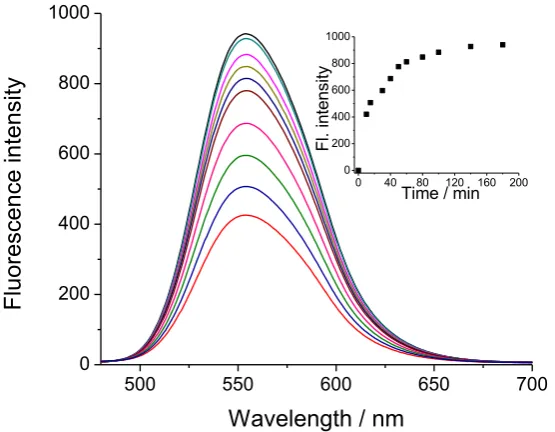
solution. In Figures 2 and 3 are presented in vitro
release profiles of compound B from the PLA matrix
investigated by both spectral methods. During the
contact of the PLA-B film with water the compound B
releases from the PLA matrix and the aqueous solution
becomes yellow in color. A rapid release of B has been
observed in the first 60 min and continued up to 180
min. Due to the strong hydrophobic interaction
between compound B and PLA, the efficiency of the
release of B increased with the time indicating that the
compound B has been released from the polymer matrix by diffusion. The absorption and fluorescence
maxima in aqueous solution were determined A = 414
nm and F = 555 nm respectively, which are the same
as compound B investigated in aqueous media [17].
This means that no changes in the structure of
compound B occurred after its introduction into the
polymer matrix or after the release thereof. As can be
I. Grabchev* et al;ANTIMICROBIAL ACTIVITY OF FLUORESCENT BENZANTHRONE IN AQUEOUS SOLUTION...
International Journal of Pharmaceutical, Biological and Chemical Sciences (IJPBCS) | JULY-SEPT 2014 | VOLUME 3 | ISSUE 3 | 66-74| www.ijpbcs.net
Pa
ge
69
and fluorescence maxima remained unchanged but the
intensity increased.
250 300 350 400 450 500
0,0 0,2 0,4 0,6 0,8 1,0
t = 180 min
A
bsor
ban
ce
Wavelength, nm
t = 10 mim
Fig. 2: Absorption release profile of B from PLA-B matrix in aqueous solution at pH = 7 and 25oC for 180 min
500 550 600 650 700
0 200 400 600 800 1000
0 40 80 120 160 200 0
200 400 600 800 1000
F
l.
in
te
ns
ity
Time / min
F
luor
escen
ce int
ensity
Wavelength / nm
Fig. 3: Fluorescent release profile of B from PLA-B matrix in aqueous solution at pH = 7 at 25oC for 180 min.
Inset shows the change of fluorescence intensity with the time
Antimicrobial screening and MIC
The antimicrobial efficiency depends strongly on the
concentration, which should not drop below the MIC.
This is why the antimicrobial activity of benzanthrone
B in aqueous solutions was tested by the minimum
inhibitory concentration (MIC).
It was found that compound B is biologically active
against the used eight indicator bacteria and two
yeasts. The results revealed that at the used conditions
the compound possesses good antibacterial and
antifungal potential. As seen in Figure 4, compound B exhibited better zones of inhibition against
Gram-positive bacteria (in the range 17-20 mm) than those
observed against the indicator Gram-negative bacteria
I. Grabchev* et al;ANTIMICROBIAL ACTIVITY OF FLUORESCENT BENZANTHRONE IN AQUEOUS SOLUTION...
International Journal of Pharmaceutical, Biological and Chemical Sciences (IJPBCS) | JULY-SEPT 2014 | VOLUME 3 | ISSUE 3 | 66-74| www.ijpbcs.net
Pa
ge
70
The new compound exerted dose-dependent inhibition
activity (Figures 5, 6). The MIC values (mg/ml) of compound B against the indicator strains was
determined by the serial dilution method. As seen in
Figure 7, MIC values varied from 80 to 160 µg/ml.
The B was most effective (the lowest MIC) in
inhibiting the growth of S. lutea at about 80 µg/ml. The
highest MIC value 160 µg/ml was determined for the
yeast C. lipolytica followed by P. aeruginosa (150
µg/ml), and B. cereus (140 µg/ml). M. luteus was
found to be resistant to the used concentrations of B
compound.
Fig. 4: Inhibition zones (mm in diameter) of B compound (1.5 mg/ml) against the studied bacteria and yeasts. Controls: G, Gentamicin; NS, Nystatin
I. Grabchev* et al;ANTIMICROBIAL ACTIVITY OF FLUORESCENT BENZANTHRONE IN AQUEOUS SOLUTION...
International Journal of Pharmaceutical, Biological and Chemical Sciences (IJPBCS) | JULY-SEPT 2014 | VOLUME 3 | ISSUE 3 | 66-74| www.ijpbcs.net
Pa
ge
71
Fig. 6. Inhibitory effects of compound B at different concentrations (mg/ml) against indicator bacteria and yeasts. An inhibition zone of greater than 10 mm indicates the presence of an inhibitory activity
Fig. 7: MIC values (µg/ml) of B compound against indicator bacteria and yeasts
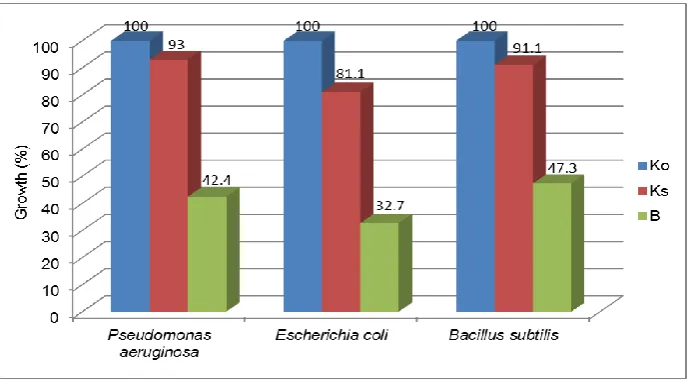
Fig. 8: Effect of PLA film (KS), and PLA-B film on the growth of P. aeruginosa, E. coli and B. subtilis strains
I. Grabchev* et al;ANTIMICROBIAL ACTIVITY OF FLUORESCENT BENZANTHRONE IN AQUEOUS SOLUTION...
International Journal of Pharmaceutical, Biological and Chemical Sciences (IJPBCS) | JULY-SEPT 2014 | VOLUME 3 | ISSUE 3 | 66-74| www.ijpbcs.net
Pa
ge
72
The following processes occur with microorganisms
exposed to cationic agents [18-20]: (i) adsorption and
penetration of the agent into the cell wall; (ii) reaction
with the components of the cytoplasmic membrane
leading to membrane disorganization; (iii) leakage of
intracellular low-molecular-weight material; (iv)
degradation of proteins and nucleic acids; and (v) wall
lysis caused by autolytic enzymes. The observed
antibacterial effect of the new B compound was better
than that of other recently reported benzanthrone
derivatives [21]. More pronounced antimicrobial effect
of B in the case of Gram-positive bacteria probably
due to the lack of additional permeability barriers. The
outer membrane in Gram-negative bacteria decreases
the outer membrane permeability impairing penetration
of antimicrobial agents in the cells [22, 23]. It has been
reported that other resistance mechanisms in
Gram-negative bacteria, such as efflux systems, have
increased effectiveness in the presence of the outer
membrane [24].
Antimicrobial activity of B incorporated films
In the resent years there is considerable interest in
biodegradable packaging due to environmental
concerns. Current innovations in food packaging
research include the development of active packaging
systems based on materials, which can include a
variety of additives such as antioxidants,
antimicrobials, vitamins, flavours and colorants with
the aim of improving their appearance and to extend
foodstuff shelf-life [25,26]. PLA is one of the most
important commercially available biobased and
biodegradable thermoplastic polyesters offering a
sustainable alternative for food packaging across a
wide range of commodity applications in response to
consumers' demands and market trends in the use of
renewable resources [27,28]. In the last years, different
nanocomposites based on PLA with nanoclays or
active additives have been developed and reported by
several authors [29,30].
The results of antimicrobial tests of the obtained film
are shown in Figure 8. As seen, the inhibition efficiency of the PLA film incorporated with B was
significantly higher than that of the PLA film against
both tested strains. The B-PLA film caused a
significant decrease in optical densities of growth
media of tested strains P. aeruginosa, E. coli and B.
subtilis (around 58%, 67% and 53%, respectively),
while in the presence of the pure PLA film this
decrease was much lower (7%, 19% and 9%,
respectively). The antimicrobial effect should be due to
release of the hydrophilic B compound from the
hydrophobic PLA matrix by diffusion. No zones of
inhibition were observed in nutrient agar tests probably
due to insufficient degree of hydrophilicity of the film
surface that is difficult to be achieved on the agar
surface, which prevent the release of the B from the
film. It has been reported that some other factors such
as the level of immobilized antimicrobial activity
retained at film surfaces and the surface area of films
may also have effect the release profile of the
immobilized activity [31].
CONCLUSIONS
The antimicrobial screening of the newly synthesized
product showed its good antibacterial and antifungal
potential better pronounced in Gram-positive bacteria.
It could be concluded that the new benzanthrone
compound could be used as antimicrobial agent in
biomedical and agrochemical applications. Preliminary
tests showed the antimicrobial efficiency of the
obtained PLA films incorporated with the new B
compound suggesting its suitability for application as
new additive in the antimicrobial packaging
technology combining the dyeing with antimicrobial
effect.
ACKNOWLEDGEMENT
This paper was funded by the Deanship of Scientific
I. Grabchev* et al;ANTIMICROBIAL ACTIVITY OF FLUORESCENT BENZANTHRONE IN AQUEOUS SOLUTION...
International Journal of Pharmaceutical, Biological and Chemical Sciences (IJPBCS) | JULY-SEPT 2014 | VOLUME 3 | ISSUE 3 | 66-74| www.ijpbcs.net
Pa
ge
73
grant no. (17-130-35-HiCi). The authors,
therefore, technical and financial support of KAU.
REFERENCES
1. Laurent, A.D., Adamo, C., Jacquemin, D., 2014. Dye chemistry with time-dependent density functional theory.
Phys. Chem. Chem. Phys., 16: 14334-14356.
2. Gao, Y., Cranston, R., 2008. Recent Advances in Antimicrobial Treatments of Textiles. Textile Res. J., 78: 60-72.
3. Simoncic, B., Tomsic, B., 2010. Structures of Novel Antimicrobial Agents for Textiles, A Review. Textile Res. J., 80: 1721-1737.
4. Ahlström, B., Chelminska-Bertilsson, M., Thompson, R.A., Edebo, L., 1995. Long-chain Alkanoylcholines, a New Category of Soft Antimicrobial Agents that are Enzymatically Degradable. Antimicrob. Agents Chemother., 39: 50-55.
5. Ma, M., Sun, Y., Sun, G., 2003. Antimicrobial cationic dyes: part 1: synthesis and characterization. Dyes Pigments, 58: 27-35.
6. Liu, S., Ma, J., Zhao, D., 2007. Synthesis and characterization of cationic monoazo dyes incorporating quaternary ammonium salts. Dyes Pigments, 75: 255-262.
7. Caruso, E., Banfi, S., Barbieri, P., Leva, B., Orlandi, V.T., 2012. Synthesis and antibacterial activity of novel cationic BODIPY photosensitizers. J. Photochem. Photobiol. B: Biology, 114: 44-51.
8. Chan, K.Y., Zhang, J., Chang, C.W.T., 2011. Mode of action investigation for the antibacterial cationic anthraquinone analogs. Bioorg. Med. Chem. Lett., 21: 6353-6356.
9. Chen, C.Z., Cooper, S.L., 2000. Recent advances in antimicrobial dendrimers. Adv. Mater., 12: 843-846. 10. Thome, J., Holländer, A., Jaeger, W., Trick, I., Oehr, C.,
2003. Ultrathin antibacterial polyammonium coatings on polymer surfaces. Surf. Coat. Technol., 174-175: 584-587.
11. Shah Mohammadi M., Bureau, M.N., Nazhat, S.N., 2014. Polylactic acid (PLA) biomedical foams for tissue engineering. In Netti P. (ed), Biomedical Foams for Tissue Engineering Applications, Elsevier, pp. 313-334. 12. Hagen, R., 2012. Polylactic Acid. Polymer Science: A
Comprehensive Reference, 10.12: 231-236.
13. Karst, D., Nama, D., Yang, Y., 2007. Effect of disperse dye structure on dye sorption onto PLA fiber. J. Colloid Interface Sci., 310: 106-111.
14. Staneva, D., Betcheva, R., Chovelon, J.-M., 2006. Fluorescent Benzo[de]anthracen-7-one pH-sensor in Aqueous Solution and Immobilized on Viscose Fabrics.
J. Photochem. Photobiol. A, 183: 159-164.
15. D. Staneva, D., Becheva, R., Synthesis and functional propertiws of new optical pH sensor based on benzo[de]anthracen-7-one immobilized on the viscose.
Dyes Pigments, 74: 148-153.
16. Staneva, D., Betcheva, R., Chovelon, J.-M., 2007. Optical Sensor for Aliphatic Amines Based on the Simultaneous Colorimetric and Fluorescence Responses of Smart Textile. J. Appl. Polym. Sci., 106: 1950-1956. 17. Perez, C., Pauli, M., Bazevque, P., 1990. An antibiotic
assay by the agar well diffusion method. Acta Biol. Medic. Exp., 15: 113-115.
18. Chen, C.Z., Cooper, S.L., 2002. Interactions between dendrimer biocides and bacterial membranes.
Biomaterials, 23: 3359-3368.
19. Kügler, R., Bouloussa, O., Rondelez, F., 2005. Evidence of a charge-density threshold for optimum efficiency of biocidal cationic surfaces. Microbiology, 151: 1341-1348.
20. Carmona-Ribeiro, A.M., Carrasco L.D.M., 2013. Cationic antimicrobial polymers and their assemblies.
Int. J. Mol. Sci., 14: 9906-9946.
21. Refat, M.S, Megahed, A.S., El-Deen, I.M., Grabchev, I., El-Ghol, S., 2011. Spectroscopic, Thermal and Biological Studies on Newly Synthesized Cu (II), Ni (II) and Co (II) Complexes with 3-N-2-hydroxyethylamine Benzanthrone and 3-N-2-aminoethylamine Benzanthrone. J. Korean Chem. Soc., 55: 28-37. 22. Poole, K., 2001. Multidrug resistance in Gram-negative
bacteria. Curr. Opin. Microbiol., 4: 500-508.
23. Stancu, M.M., Grifoll, M., 2011. Multidrug resistance in hydrocarbon-tolerant Gram-positive and Gram-negative bacteria. J. Gen. Appl. Microbiol., 57: 1-18.
24. Poole, K., 2005. Efflux-mediated antimicrobial resistance. J. Antimicrob. Chemother., 56: 20-51. 25. Cha, D.S., Chinnan, M.S., 2004. Biopolymer-based
I. Grabchev* et al;ANTIMICROBIAL ACTIVITY OF FLUORESCENT BENZANTHRONE IN AQUEOUS SOLUTION...
International Journal of Pharmaceutical, Biological and Chemical Sciences (IJPBCS) | JULY-SEPT 2014 | VOLUME 3 | ISSUE 3 | 66-74| www.ijpbcs.net
Pa
ge
74
26. Del Nobile, M.A., Conte, A., Buonocore, G.G., Incoronato, A.L., Massaro, A., Panza, O., 2009. Active packaging by extrusion processing of recyclable and biodegradable polymers. J. Food Eng., 93: 1-6.
27. Inkinen, S., Hakkarainen, M., Albertsson, A.-C., Sodergard, A., 2011. From Lactic Acid to Poly (lactic acid) (PLA): Characterization and Analysis of PLA and Its Precursors. Biomacromolecules, 12: 523-532. 28. Hughes, J., Thomas, R., Byun, Y., Whiteside, S., 2012.
Improved flexibility of thermally stable poly-lactic acid (PLA). Carbohydr. Polym., 88: 165-172.
29. Byun, Y., Kim, Y.T., Whiteside, S., 2010. Characterization of an antioxidant polylactic acid (PLA)
film prepared with α-tocopherol, BHT and polyethylene glycol using film cast extruder. J. Food Eng., 100: 239-244.
30. Hwang, S.W., Shim, J.K., Selke, S.E.M., Soto-Valdez, H., Matuana, L., Rubino, M., Auras, R., 2012. Poly (L-lactic acid) with added α-tocopherol and resveratrol: optical, physical, thermal and mechanical properties.
Polym. Int., 61: 418-425.
31. Güçbilmez, Ç.M., Yemenicioflu, A., Arslanoflu, A., 2007. Antimicrobial and antioxidant activity of edible zein Wlms incorporated with lysozyme, albumin proteins and disodium EDTA. Food Res. Int., 40: 80-91.
*Corresponding author address:
Email address: