
Preparation of Ultra High Molecular Weight Polyethylene Using
Ziegler-Natta Catalyst System: Optimization of Parameters by
Response Surface Methodology
M. Shafiee, A. Ramazani S.A.∗, H. Bahrami, A. Kheradmand
Department of Chemical and Petroleum Engineering, Sharif University of Technology, Tehran, Iran
Abstract
The ultra-high molecular weight polyethylene (UHMWPE) was prepared using titanium tetrachloride (TiCl4) supported by MgCl2 (ethoxide type), accompanied by triisobutylaluminium (TIBA) as co-catalyst. These all constituted the Ziegler–Natta catalytic system. MgCl2 is one of the best supports for Ziegler-Natta catalyst in order to increase its yield.In the present study, the process variables were investigated through response surface methodology (RSM) to optimize the productivity of the catalyst and also the molecular weight of the polymer. Taking this into consideration a three-level Box-Behnken design for three factors with temperature (X1), monomer pressure (X2), and [Al]/[Ti] molar ratio (X3) as the independent variables were selected. Different molar ratio of [Al]/[Ti] is achieved by changing the amount of the co-catalyst.The dependent variables were productivity and molecular weights of the prepared polymers. Specifically, using these three parameters at three levels including 50, 60, and 70°C for temperature; 4, 6, and 8 bar for pressure; and 150, 250, and 350 for [Al]/[Ti] molar ratio. The RSM yielded optimum reaction conditions equal to: temperature of 55°C, pressure of 8 bar, and [Al]/[Ti] molar ratio of 230. Under these optimum conditions, the productivity and molecular weight were 2628 g PE/mmolTi.h and 5.09×10⁶ g/mol, respectively.
Keywords: UHMWPE, Ziegler-Natta, Optimization, Response Surface Methodology
∗ Corresponding author: [email protected] 1. Introduction
Ultrahigh molecular weight polyethylene (UHMWPE) is a unique polymer with outstanding physical and mechanical properties (i.e., high strength and stiffness, good fatigue, and wear characteristics), and is widely used in a wide spectrum of applications such as bearings, pulleys, and joint replacement prostheses in the human body [1-4].
Modern production of ultrahigh molecular weight polyethylene (UHMWPE) is based on the use of this method as well [8].
In the polymerization, polymerization method, reaction conditions such as temperature, pressure, type of catalyst, cocatalyst, and chain transfer agent can significantly effect the composition, molecular weight and its distribution, degree of branching and the final structure of the prepared polymer [8-10].
Response surface methodology (RSM) is an effective method for optimization and developing regression equations that describe relations between input parameters and output responses [11]. It is well known that molecular weight has a significant effect on the processability and end-use properties of olefin polymers. Therefore, it was necessary to control the molecular weight of polyolefin to produce various grades suitable for the many end-use applications of polyolefin.In this contribution, optimization of process condition such as temperature, monomer pressure and [Al]/[Ti] molar ratio on productivity, and molecular weight was carried out via Box-Behnkendesign.
2. Experimental
2-1. Materials
Ethylene monomer (industrial-grade) was supplied by Amir Kabir Petrochemical Co. (Mahshahr, Iran) and further purified by passing through molecular sieve columns (4A type having a 4-A pore size). High-purity argon (≥99.999%) was used to produce an inert atmosphere for the catalytic system preparation as well as the polymerization. Industrial grade n-hexane was supported by Amir Kabir Petrochemical
Co. (Mahshahr, Iran) and dried by a sodium benzo-phenole complex (diphenylketyl). Titanium tetrachloride (TiCl4, Riedel-de
Haen Chemical Laboratory) was used as the catalyst while Magnesium ethoxide (Mg(OEt)2, Fluka) and dibutyl phthalate (as
an internal donor, Merck) were used for preparation of the catalyst. Triisobutyla-luminium (TIBA, Aldrich) was used as the cocatalyst.
2-2. Catalyst preparation
The preparation of catalyst was carried out according to the method developed by our group [2-3,12-13]. Magnesium ethoxide (8 g) was fed into a triple-necked, round-bottom flask which was equipped with a magnetic stirrer and immersed in an oil bath. Two openings of the flask were equipped with gas valves. One was connected to a vacuum pump while the other was connected to the ethylene monomer cylinder; the third opening was sealed with a rubber septum for further chemical injection. Degassing 3 times and backfilling the flask with high-purity argon caused an inert atmosphere to assure a completely inert condition. After that, 150 mL of n-hexane/ toluene (50/50 wt%) was injected into the flask. The temperature gradually increased to 80°C while the flask contents were vigorously stirred. Upon reaching the desired temperature, TiCl4 (8
flask was cooled down to room temperature; the catalyst was dissolved into 100 mL of n-hexane, and the produced catalyst complex was stored under argon atmosphere for polymerization process. As schematically shown in Fig. 1, the Ziegler-Natta catalyst was supported over Magnesium ethoxide.
Figure 1. Schematic of the mechanism of supporting
Ziegler-Natta catalyst on a Mg(OEt)2.
2-3. Polymerization
A 1 L pressure reactor (versoclave; Buchi AG, Flawil, Switzerland) equipped with a mechanical stirrer, a temperature controller, and a pressure control system was purged with high-purity argon at 1.1 bar at 90°C to assure a completely dry and inert atmosphere. Then, 400 mL of degassed nhexane was transferred to the reactor. Subsequently, while stirring, degassed Triisobutyla-luminium (TIBA) was injected into the reactor. After 5 min, 10 mL of the catalyst complex produced beforehand was added to the mixture and instantly ethylene monomer was introduced into the reactor at different pressure. Finally, after the polymerization was carried out for the desired time, the ethylene inlet was closed, reactor was purged with air, and 10 mL of concentrated HCl was injected into the reactor to deactivate the catalyst and terminate the polymerization. After bringing
the reactor temperature down to room temperature, the contents of the reactor were vacuum filtered, washed with ethanol and acetone, and subsequently dried under vacuum at 80°C for 24 h.
2-4. Characterization
The viscosity average molecular weight (Mv)
of the synthesized polyethylene was determined by the Mark-Houwink equatioin [3]: M=5.37×10⁴[η] after the measurement of intrinsic viscosity of diluted solutions of UHMWPE in decalin at 135°C.
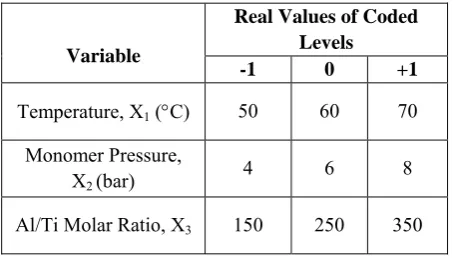
Table1. Independence Factors and their Coded Levels
used in Box-Behnken design.
Variable
Real Values of Coded Levels
-1 0 +1
Temperature, X1 (°C) 50 60 70
Monomer Pressure,
X2 (bar) 4 6 8
Al/Ti Molar Ratio, X3 150 250 350
The mathematical relationship between the three variables and the response can be expressed by the second order polynomial equation:
Y =β 0β +1X1β +2X2β +3X3β +11X12β +22X22+
β33X32β+12X1X2β +13X1X3β +23X2X3
(1)
Where, Y is the response; β0 is a constant; β1,
β2β ,3 are linear coefficients; β11β ,22β ,33 are
quadratic coefficients, and β12β ,13β ,23 are
cross-product coefficient. X1, X2, and X3 are
the factors to be studied.
3. Results and discussion
3-1. Model fitting for productivity and molecular weight
Fifteen experiments were augmented including three replications at the central point for evaluating the pure error. Table 2 lists the Box-Behnken experimental design employed in this work and the obtained results from the experiments.
Table 2. Experimental Box-Behnken design runs and corresponding results.
Run T(°C) P(bar) Al/Ti Productivity
(g PE/mmolTi.h)
MW×10-6 (g/mol)
1 60 8 150 1944 5.34
2 50 8 250 2628 5.1
3 70 4 250 1302 3.86
4 70 6 350 2255 4.12
5 60 4 150 1068 4.4
6 70 6 150 1412 4.78
7 50 6 150 1353 5.11
8 70 8 250 2414 4.63
9 60 4 350 1225 3.72
10 60 6 250 2455 4.57
11 50 4 250 1176 4.11
12 50 6 350 1708 4.46
13 60 8 350 2604 4.62
14 60 6 250 2395 4.54
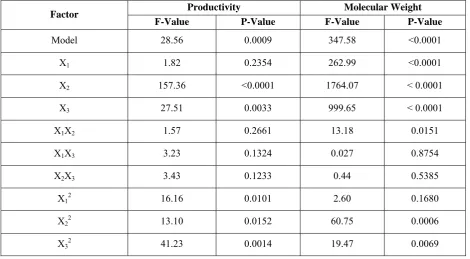
Analysis of variance (ANOVA) results of the quadratic models are shown in Table 3. ANOVA indicated that the model equations derived by RSM could be adequately used to describe the catalyst activity and molecular weight under a wide range of operating conditions. P-value is the probability value used to determine the effect in the model that was statistically significant. The smaller the value of P, the more significant the corresponding coefficient. For a 95% confidence level, the P-value should be less than or equal to 0.05 for the effect to be statistically significant [17]. After eliminating insignificant parameters, the obtained models in terms of coded parameters were determined as follows:
Productivity = 2420 + 602.38X2 + 251.88X3 -
284.12X12 - 255.88X22 -
453.88X32
(2)
Mw = 4.56-0.17X1 + 0.45X2 - 0.34X3
-0.055X1X2 -0.12X22 + 0.072X32
(3)
where X1, X2, and X3 are temperature,
monomer pressure, and Al/Ti molar ratio, respectively.
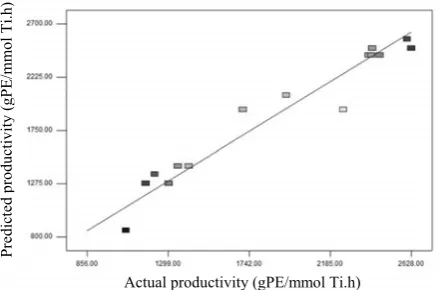
Figs. 2 and 3 show the differences between actual and predicted process productivity and molecular weight, respectively. As can be seen, the predicted values by the models are reasonably close to the actual value obtained by the experiments. However, the actual and predicted values of molecular weight are somewhat closer than those of the productivity because the coefficient of determination (R2) of the molecular weight model was found to be 0.9974 which is higher than the value of 0.9426 for the productivity model.
Table 3. Analysis of variance results for productivity and molecular weight.
Factor Productivity Molecular Weight
F-Value P-Value F-Value P-Value
Model 28.56 0.0009 347.58 <0.0001
X1 1.82 0.2354 262.99 <0.0001
X2 157.36 <0.0001 1764.07 < 0.0001
X3 27.51 0.0033 999.65 < 0.0001
X1X2 1.57 0.2661 13.18 0.0151
X1X3 3.23 0.1324 0.027 0.8754
X2X3 3.43 0.1233 0.44 0.5385
X12 16.16 0.0101 2.60 0.1680
X22 13.10 0.0152 60.75 0.0006
Figure 2. Plot of differences between actual and
predicted catalyst productivity.
Figure 3. Plot of differences between actual and
predicted molecular weight of synthesized polymers.
3-2. Effects of parameters
Figs. 4 and 5 show the surface plot of productivity and molecular weight as a function of temperature and pressure at the middle level of [Al]/[Ti] molar ratio. As seen in the Figures, pressure has positive effects, both on productivity and molecular weight. This could be due to the increasing of the monomer solubility in the solvent and monomer concentration near the catalyst active centers and more fragmentation of the catalyst at higher monomer pressure. Productivity increases as the temperature increases from 50 to 60°C and thereafter decreases further up to 70°C. By increasing of the reactor temperature, alkylation rate, active center formation, and polymerization
rate increase, but irreversible deactivation of the active centers may also occur. It is obvious from Fig. 5 that temperature has a negative effect on molecular weight because of an increment in chain transfer reaction rate [14,15].
Figure 4. Productivity as a function of monomer
pressure and temperature.
Figure 5. Molecular weight as a function of monomer
pressure and temperature.
Figs. 6 and 7 show the surface plot of productivity and molecular weight as a function of [Al]/[Ti] molar ratio and pressure at temperature of 60°C. The plot related to the productivity response is more dome shaped. In these types, in one axis there is a linear increase in the catalyst activity, while in the other axis there is an increase in the catalyst activity only up to a certain extent and a decrease thereafter. This indicates that
Predicted
pr
oductivit
y
(g
PE/mmo
l Ti.h
)
Predicted molecular weight
(million g/mol)
Actual productivity (gPE/mmol Ti.h)
Actual molecular weight (million g/mol)
Monomer pressure (bar)
there are critical values for [Al]/[Ti]ratio in order to get the maximum catalyst activity. At low concentration of TIBA, the impurity of the system has an influence on productivity and not all active centers were activated. At higher concentration than the optimum value the reduction of Ti4+ to Ti2+ occurred, which is less active for ethylene polymerization. The molecular weight surface plot shows the molecular weight decreases by increasing the [Al]/[Ti] molar ratio. However, since the reaction rate of chain transfer to cocatalyst compounds increases as the concentration of cocatalyst rises, a reduction in the molecular weight is expected.
Figure 6. Productivity as a function of monomer
pressure and [Al]/[Ti] molar ratio.
Figure 7. Molecular weight as a function of monomer
pressure and [Al]/[Ti] molar ratio.
4. Conclusions
Response surface methodology was used to investigate most affecting parameters on ethylene polymerization catalyzed by Ziegler-Natta catalytic system for preparing ultra high molecular weight polyethylene (UHMWPE). Polymerization temperature, monomer pressure, and [Al]/[Ti] molar ratio were considered as the main process variables. A Box-Behnken design was developed by these three parameters while three levels were considered for each of them through Design-Expert 7 software. Productivity and viscosity average molecular weight were selected as the objective responses. Two empirical models to simulate the catalyst activity and molecular weight were developed in terms of the polymerization conditions by Box–Behnken design and an ANOVA test was performed. The correlation coefficient for the models was evaluated quite satisfactorily. The optimum values for temperature, pressure and [Al]/[Ti] ratio were found to be at 55°C, 8 bar, and 230, respectively.
References
[1] Kurtz, S.M., "UHMWPE biomaterials handbook", 2nd ed., Academic Press, Boston, USA, p. 355 (2009).
[2] Amoli, B.M., Ramazani S.A., A. and Izadi, H., "Preparation of ultrahigh-molecular-weight polyethylene/carbon nanotube nanocomposites with a Ziegler–Natta catalytic system and investigation of their thermal and mechanical properties", J. Polym. Sci., 125(1), 453 (2012).
[3] Ramazani S.A., A., Saremi M.G., Amoli, B.M. and Izadi, H., "Production and characterization of UHMWPE/
Monomer pressure (bar)
fumed silica nanocomposites", Polym. Compos., 33(10), 1858, (2012).
[4] Davim, J.P. and Marques., N., "Evaluation of tribological behaviour of polymeric materials for hip prostheses application", Tribol. Lett., 11(2), 91, (2001).
[5] Soga, K. and Shiono, T., "Ziegler-Natta catalysts for olefin polymerizations", Progress in Polym. Sci., 22(7), 1503, (1997).
[6] Lee, D.H., Jeong, Y.T., Soga, K. and Shiono, T., "Propylene polymerization with Mg(OEt)2/benzoyl chloride/
TiCl4–triethyl aluminum/ external
donor catalyst systems", J. Polym. Sci., 47(8), 1449, (1993).
[7] Kashiwa, N., "The discovery and progress of MgCl2-supported TiCl4
catalysts", J. Polym. Sci., Part A: Polym. Chem., 42(1), 1 (2004).
[8] Padmanabhan, S., Sarma, K.R. and Sharma, S., "Synthesis of ultrahigh molecular weight polyethylene using traditional heterogeneous Ziegler−
Natta catalyst systems", Ind. Eng. Chem. Res., 48(10), 4866, (2009).
[9] Shin, Y.J., Zhang, H.X., Yoon, K.B. and Lee, D.H., "Preparation of ultra-high molecular weight polyethylene with MgCl2/TiCl4 catalysts: Effect of
temperature and pressure", Macromol. Res., 18(10), 951, (2010).
[10] Velikova, M., "Study of the effect of the nature of catalyst systems on the molecular structure and properties of ultra-high molecular weight polyethylene", Eur. Polym. J., 37(6), 1255, (2001).
[11] William, R.M., Response surface methodology, Encyclopedia of biopharmaceutical statistics, 2nd ed, Taylor & Francis, Null, p. 858 (2013).
[12] Ramazani S.A., A., Tavakolzadeh, F. and Baniasadi, H., "In-situ polymerization of polyethylene/clay nanocomposites using a novel clay-supported Ziegler-Natta catalyst", Polym. Compos., 30(10), 1388, (2009). [13] Nikkhah, S.J., Ramazani S.A., A.,
Baniasadi, H. and Tavakolzadeh, F., "Investigation of properties of polyethylene/clay nanocomposites prepared by new in situ Ziegler–Natta catalyst", Mater. Des., 30(7), 2309, (2009).
[14] Kissin, Y.V., Mezhikovsky, S.M. and Chirkov, N.M., "The stereospecific mechanism of olefin polymerization by heterogeneous complex catalysts-I. The degree of the catalyst surface filling with active sites and the chemical structure of the sites, "Eur. Polym. J., 6(2), 267, (1970).
[15] Jamjah, R., Zohuri, G.H., Javaheri, M., Nekoomanesh, M., Ahmadjo, S. and Farhadi, A., "Synthesizing UHMWPE using Ziegler-Natta catalyst system of MgCl2 (ethoxide type)/ TiCl4
/Tri-isobutylaluminum", Macromol. Symp., 274(1), 148, (2008).
[16] Baskan, M.B. and Pala, A. "A statistical experiment design approach for arsenic removal by coagulation process using aluminum sulfate", Desalination, 254(1), 42, (2010).

![Figure 6. Productivity as a function of monomer pressure and [Al]/[Ti] molar ratio.](https://thumb-us.123doks.com/thumbv2/123dok_us/8887479.1823293/7.595.74.286.571.723/figure-productivity-function-monomer-pressure-al-molar-ratio.webp)
