Simulation of Leaching of Starch from Potato in a Batch Extractor
B. Abbasi Souraki*
, R. Hasanzadeh
Chemical Engineering Department, Faculty of Engineering, University of Guilan, Iran
Abstract
In this paper, extraction of starch and protein from potato during leaching in a batch extractor, using distilled water as the solvent, was investigated. The experiments were carried out by soaking bulk of infinite slab shape potato samples in distilled water in a temperature and agitation controlled batch extractor at the three temperatures of 30, 45 and 55ºC. A mathematical model was developed for prediction of mass transfer during the leaching process, by defining a partition factor (K) as the ratio of the concentration on the surface of the body to that in the bulk of solution. Diffusion coefficients of the solutes and moisture were obtained by fitting the experimental data of solute loss and moisture gain to the first six terms of the series solution of the mathematical model by using a non-linear regression analysis. The diffusivity values for starch, protein and moisture were evaluated between 0.273 10-10 and 1.577 10-10 m2/s, with adjustment parameter R2 values in the range
of 0.941 to 0.986 and mean relative error (MRE) values between 0.092 and 0.356, respectively. Results showed that the proposed model could be used for explaining the diffusion of solutes and moisture into the potatoes, during the leaching process, with acceptable degree of goodness.
Keywords: Leaching, Extraction, Partition Factor, Potato, Starch
1. Introduction
The leaching (solvent extraction) of a substance from a solid material with the aid of a liquid is a common process in chemical and food engineering which can be applied to appropriate biological, inorganic and organic substances. Examples of leaching include the removal of copper and gold from their ores by sulfuric acid and sodium cyanide solutions, the removal of sugar from sugar beet using hot water, the extraction of
Corresponding author: [email protected]
oils from seeds using organic solvents such as hexane, acetone or ether [1] and extraction of solutes from foodstuffs by soaking in water [2].
0.96% lipids; and about 0.44% ash [5]. Most (about 77%) of the dry matter of a potato tuber consists of starch granules [4]. Potato starch can be used in food and other industrial applications as a thickener, colloidal stabilizer, gelling agent, bulking agent, and water-holding agent [6]. The starch consists of two macromolecular components; amylose (21–25%) and amylopectin (75 – 79%) [4].
After starch, an important product from potato is protein, which is present in the extract of soaked potatoes. Potato fruit water (PFW) is a dilute byproduct from the potato starch industry that contains about 5% dry matter. Dry matter of PFW also contains minerals and other soluble carbohydrates such as sugars [7]. About one third of the dry matter is protein, peptides and amino acids/amides [8]. Potato is a proper source of protein for many people in the world who are allergic to other sources of protein such as foods with egg, gluten, soy, fish and nuts [8]. Starch and protein can be extracted by immersion of potato slices into the water [5]. This process involves simultaneous counter-current solute diffusion from, and moisture diffusion into the potato samples. These phenomena occur because of differences between chemical potentials of the solute and water in the solid and solution. Both solute and moisture transfer in the soaking process are affected by operating parameters such as temperature and contacting time, and also matrix properties of the cellular material [7]. Soaking of vegetables whether as a complete process or as a pre-treatment is widely used in industry for different reasons: extracting some components [9], inactivating destructive enzymes [10], decreasing cooking
time [11], and improving flavor of the products [12].
Batch solvent extraction is commonly used to extract active compounds from plants. The current food industry has adopted this technique and focuses on extracting and recovering valuable active compounds from different plants and waste residues. In conventional solvent extraction, the solid sample is immersed in a solvent and the extract is collected after attainment of the final equilibrium condition [13].
Numerous theoretical and experimental studies have been carried out on the solute extraction from natural sources [9,10,14]. Most of the researches deal with developing differential equations based on Fick’s second law of diffusion and solving them by analytical or numerical methods.
Arroqui et al. estimated the diffusivity of ascorbic acid in potato during blanching in distilled water [15]. Pedreschi et al. studied the extraction of reducing sugar from potato slabs during blanching, by using the classical analytical solution of Fick’s second law, and developed a modified model with variable diffusivity [10].
concentration into consideration and defining a partition factor K, such that the concentration just within the surface of the sample is K times that in the solution [16]. The analytical solution of Fick’s second law of diffusion was used for prediction of the starch and protein loss and also the water gain by the thin potato slabs immersed in distilled water. The experiments were carried out by soaking infinite slab shape potato samples in distilled water in a temperature and agitation controlled batch extractor at 30, 45 and 55ºC.
2. Theory
2-1. Mathematical modeling
A number of solid bodies are immersed in a limited volume of solvent, and the solvent is well stirred. If the volume of the solvent in which the bodies are immersed is not large enough to neglect the amount of solute taken up or extracted from the solid, then the concentration in the liquid will change as diffusion proceeds. By stirring the solution well, time would be the only parameter affecting the concentration of the solute in the fluid. It is useful from an experimental point of view to have only a limited amount of solution since the rate of leaching of solute by the solvent can be deduced from observations of the uniform concentration in the solution. It is often simpler to do this than to observe directly the amount in the solid material [16]. The unsteady-state one-dimensional mass transfer in the solid materials can be described by Fick’s second law of diffusion as follows [16]:
r C r r r D t
C m
m e
1
(1)
Where m=0 for slab shape bodies, m=1 for cylinders and m=2 for spheres. In this study, solid materials (potatoes) were cut into infinite slab shape samples of finite thickness 2l. It is assumed that the volume and thermo-physical properties of the materials are constant during leaching. The solid materials with a uniform concentration of C0 are
immersed in a solvent at constant temperature. The rate at which solute inters the solvent is always equal to that at which it leaves the solid materials over the surfaces x=±l. Thus the following initial and boundary conditions are taken [16]:
0 )
0 ,
(x C0 at t
C (2)
l x at x C NAD t
C
V e
L
L 2 (3)
Where VL is the volume of solvent, N is the number of solid samples in the solution, C, without superscript, is the concentration in the solid, CL is the concentration in the solution, x is the spatial coordinate and De is
the effective diffusivity of solute in the solid material, which is a function of temperature.
By defining a partition factor K, we assume that the concentration of solute just within the surface of the sheet is K times that in the solution. With this assumption, the solution of the problem can be obtained by using Laplace transform in a form expressing the total amount of solute, Mt, in
the sheet at time t with respect to the corresponding quantity after infinite time, M , as follows [16]:
) / exp( 1
) 1 ( 2
1 2 2
1
2
2q Dqt l
M M
n e
n n
t
or as a function of dimensionless time (=Det/l2) as:
) ( exp 1 ) 1 ( 2 1 ) ( 2 1 2 2 n n n t q q M M (5)
Where the qns are the non-zero positive
roots of [16]:
n
n q
q
tan (6)
and is[16]:
K V V S L (7)
It is sometimes convenient to express in terms of the fraction of total solute finally taken up by the solvent. In the final equilibrium state, since the total amount of solute in the solution and sheet was originally contained in the solid of concentration C0, we have:
0 C V C V C
V S S
L
L (8)
Substituting the definition of partition factor K in Eq. (8), results in:
S L S L KV V C V K C
C 0 (9)
Final fractional uptake of the solution, defined as the final amount of extracted solute to its initial value in the material can be obtained by the following equation [16]:
1 1 1 0 0 0
0 L s
s s L s L L L KV V C V C V V C V C V M M (10)
During the leaching process, an amount of solvent could be attracted by the solid material. In the leaching of starch by distilled water, water is attracted by the potato samples. Eq. (5) can still be applied here for
predicting the amount of moisture absorbed by the potato slabs. In this case, Mt is the
amount of moisture in the solid at time t and M is the corresponding value after infinite time. Having value for each component, qns will be known from Eq. (6). Mass
balance on the solvent (water) gives the following equation:
L L S L
LC VC VC
V 0 (11)
Substituting partition factor relationship and rearrangement would lead to:
S L L L V K V C V C 0 (12)
The final fractional uptake of the solid body (sheet), defined as the final amount of attracted solvent to its initial value in the solution is given by [16]:
L L L L S L M M M M C V C V M M M 0 0 0 0 0 0 0 1 1 (13)
M and M0 are the final and initial
amounts of solvent in the solid and L
M0 is the
initial mass of solvent.
2-2. Estimation of effective diffusivities
Solutes and moisture effective diffusivities could be estimated by fitting of the first six terms of Fourier series of the analytical solution of Fick’s law, Eq. (5), to the experimental data of starch and protein loss and water gain. The amounts of the solutes loss and water gain by the samples are calculated in dimensionless form as follows:
SL SL SL SL SL SL
WG WG WG
WG WG WG
w 1 (15)
in which:
s s s
C C C SL
0 0
(16)
w w w
C C C WG
0 0
(17)
Values of are estimated by Eqs. (10) and (13) for the solutes and the moisture. Also, the values of qns are determined by solution
of the Eq. (6) up to n=6.
3. Materials and methods
3-1. Sample preparation
Potatoes were purchased from a specified market in Rasht, situated in the north of Iran. This market was chosen as the single place of supplying further potatoes, in order to maximize reproducibility of results. After washing and drying with absorbent tissue paper, the potatoes were kept in a plastic bag in a refrigerator at 4ºC for more than 24 h before experiment in order to equilibrate the moisture content. The potatoes were removed from the refrigerator and left to equilibrate at room temperature. They were then cut into disks using a laboratory scale slicer, without removing the skin, so that only the cut surfaces were available for mass transfer and thus to ensure the assumption of infinite slab geometry (Fig. 1). Both the thicknesses and diameters of the potato samples were measured at ten points, using a micrometer of ±0.02 mm accuracy. To ensure the homogeneity of the samples, slices with the average thickness of 1.5±0.2 mm, and average diameter of 6±0.1 cm were chosen for the experiments.
Figure 1. Potatoes sliced by laboratory scale slicer.
3-2. Apparatus
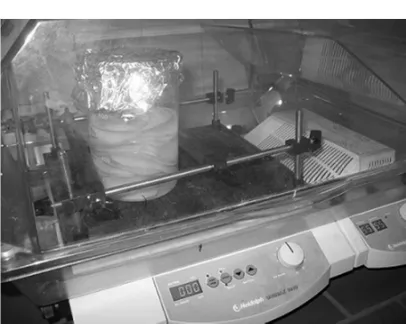
Leaching process was carried out in sealed glass containers inserted into a temperature and agitation controlled shaker incubator (Model: Heidolph UNIMAX 1010, Germany). A schematic figure of this device has been illustrated in Fig. 2.
Figure 2. Schematic diagram of temperature and agitation controlled shaker incubator.
5 h under constant conditions and after different process duration times (i.e. 30, 60, 120, 180, 240, 300 min) some specified samples were weighed and put back immediately. Also, 10 mL of the solution was pulled out by a pipet for measuring the amount of extracted starch and protein. At the end of the process the samples were removed from the solution, rinsed and blotted using blotting paper, to eliminate the surface moisture and starch, and then were weighed. After that, they were analyzed for their moisture. All experiments were done in triplicate and the average values were reported.
Figure 3. Samples in shaker incubator during the process at 55°C.
3-3. Analysis
The initial weight of the dry matter in potatoes was 23.52±0.54 (g/100g), determined by drying 15 samples in an electrical oven, until reaching the constant weight at 80ºC using the oven method according to AOAC [17]. Total amount of extracted solid was determined by drying 10 mL of the extract after different time durations in the electric oven. For measuring the amount of extracted protein from the
tissues, 0.5 mL of the solution was analyzed calorimetrically using biuret method, by measuring the absorbance value at 540 nm immediately in a Cary 50 Bio UV-Visible spectrophotometer (Varian Australia, certified/evaluated as: CSA 1010-1 UL 3101-1) [18]. Total amount of extracted starch was determined by subtraction of the amount of extracted protein from the total extracted solid. It should be noted that the amount of extracted starch is much more than other extracted solids.
Knowing the amounts of solid losses at the time duration t (SLt), water gain (WGt)
was calculated by the following mass balance equation:
100 )
(
0 0
m SL m m
WG t t
t (18)
In which m0 and mt are the initial weight
of the potato samples and their weights after process time duration of t.
4. Results and discussion
the temperature.
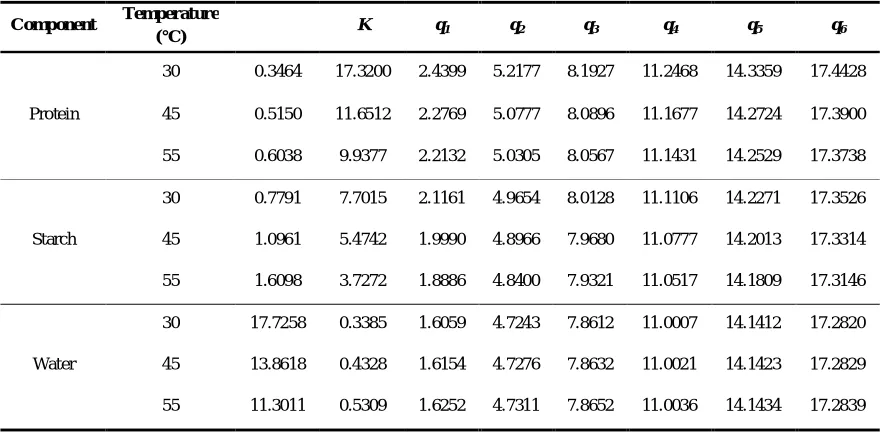
After obtaining the final equilibrium values of solutes loss and moisture gain by the potato samples, effective diffusivities of solutes and moisture were estimated by fitting the experimental data of starch and protein loss and moisture gain to the solution of the Fick’s second law of diffusion, according to Eq. (5). Estimated values of , K and qns at different temperatures were
given in Table 2 for protein, starch and moisture.
After finding the values of , K and qns, a
non-linear regression analysis was applied using MATLAB software (Version 7.10.0; R2010a) to fit Eq. (5) to the experimental data. The goodness of fit was determined by various statistical parameters such as coefficient of correlation, R2, and root mean square error (RMSE) values. Also, mean relative errors (MRE) between the predictions of the model and the experimental data were estimated. These parameters were obtained using the following equations [19]:
Table 1
Equilibrium solute losses and moisture gain at different temperatures.
Temperature (°C) PL StL WG
30 0.753±0.022a 7.960±0.402 28.245±1.023
45 0.994±0.390 9.505±0.250 35.667±1.451
55 1.101±0.045 11.212±0.185 43.123±1.053
a
Average value ± Maximum error of measurements
Table 2
Values of , K and qns at different temperatures.
Component Temperature
(°C) K q1 q2 q3 q4 q5 q6
Protein
30 0.3464 17.3200 2.4399 5.2177 8.1927 11.2468 14.3359 17.4428
45 0.5150 11.6512 2.2769 5.0777 8.0896 11.1677 14.2724 17.3900
55 0.6038 9.9377 2.2132 5.0305 8.0567 11.1431 14.2529 17.3738
Starch
30 0.7791 7.7015 2.1161 4.9654 8.0128 11.1106 14.2271 17.3526
45 1.0961 5.4742 1.9990 4.8966 7.9680 11.0777 14.2013 17.3314
55 1.6098 3.7272 1.8886 4.8400 7.9321 11.0517 14.1809 17.3146
Water
30 17.7258 0.3385 1.6059 4.7243 7.8612 11.0007 14.1412 17.2820
45 13.8618 0.4328 1.6154 4.7276 7.8632 11.0021 14.1423 17.2829
N
i Exp i Mean
N 0 ,
1
(19)
N
i
Mean Exp i N
i
edict i Exp i
R
1
2 ,
1
2 Pr , , 2
) (
) (
1 (20)
2 Pr , ,
0( )
1
edict i Exp i N i
N
RMSE (21)
N
i i edict edict i Exp i
N MRE
0 ,Pr
Pr , ,
1
(22)
In these relationships N is the number of the experimental data and i,Exp and i,Predict
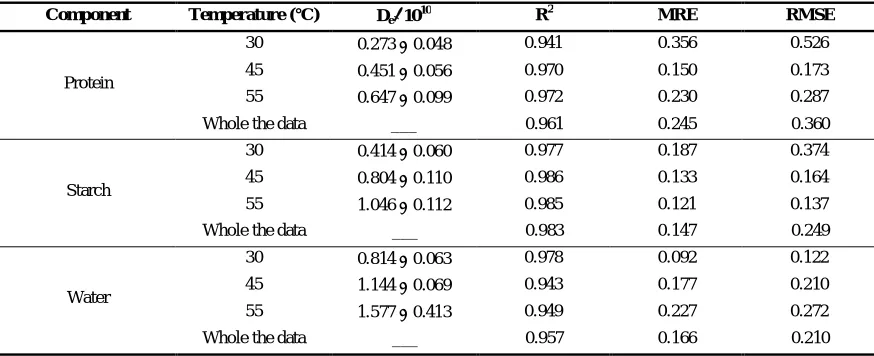
are the experimental and predicted dimensionless concentrations, respectively. The estimated effective diffusivities of starch, protein and moisture, as well as fitting goodness parameters of RMSE, MRE and R2, were given in Table 3. Diffusivities are in the range of 0.273×10⁻¹⁰-1.577×10⁻¹⁰ m2/s, in agreement with the literature data for diffusivities in fruits and vegetables [20].
In order to check the accuracy of the proposed model, predicted values of
solute loss and moisture gain by the model are shown in graphical form in comparison with the experimental data. Figures 4, 5 and 6 show the variations of predicted dimensionless concentrations of starch, protein and moisture, respectively, in comparison with the experimental data. Figures show that the model predictions followed the general trend of the experimental data. As it can be seen in these figures, solid loss and water gain increase rapidly at the early stages of process and then increase slowly and reach their final equilibrium values at the final stages of leaching. Figures show that most mass transfer occurs at the early stages of the process. Figures show that the rate of mass transfer (slope of the solid loss and moisture gain curves) increases by increasing the temperature. This fact could be explained by decrease in the viscosity of the water, swelling and plasticizing and destruction of the cell membrane structure with increasing the temperature [21].
Table 3
Effective diffusivities of protein, starch and water at different temperatures.
Component Temperature (°C) De 1010 R
2
MRE RMSE
Protein
30 0.273 0.048 0.941 0.356 0.526
45 0.451 0.056 0.970 0.150 0.173
55 0.647 0.099 0.972 0.230 0.287
Whole the data ___ 0.961 0.245 0.360
Starch
30 0.414 0.060 0.977 0.187 0.374
45 0.804 0.110 0.986 0.133 0.164
55 1.046 0.112 0.985 0.121 0.137
Whole the data ___ 0.983 0.147 0.249
Water
30 0.814 0.063 0.978 0.092 0.122
45 1.144 0.069 0.943 0.177 0.210
55 1.577 0.413 0.949 0.227 0.272
Whole the data ___ 0.957 0.166 0.210
a
Figure 4. Comparison between predicted dimensionless concentrations of starch and experimental data.
Figure 5. Comparison between predicted dimensionless concentrations of protein and experimental data.
Figure 6. Comparison between predicted dimensionless concentrations of water and experimental data.
Fig. 7 shows the predicted values of dimensionless concentrations versus experimental data for starch, protein and water at different temperatures. The figure shows some scattering and dispersion in the experimental data, because experimental values were obtained from different potato samples (discontinuous method) with similar sizes. Also, some of the deviations from the experimental data could be attributed to the propagation of the estimation error of the diffusivity values, used in the mathematical model, in the final results.
Figure 7. Comparison between the predictions of the model and experimental data.
5. Conclusions
Extraction of starch and protein from potato during leaching in a batch extractor, using distilled water as the solvent, was modeled by defining a partition factor (K) as the ratio of the concentration on the surface of the body to that in the bulk of solution. The proposed model was validated by the experimental data, obtained from soaking of bulk of infinite slab shape potato samples in distilled water in a temperature and agitation controlled batch extractor at 30, 45 and 55ºC. Results show a good agreement between the model predictions and experimental data.
Nomenclature
A Slab surface (m2)
C Concentration (g/100g of fresh fruit)
De Effective diffusivity (m2/s)
Des Effective diffusivity of solute (m2/s)
Dew Effective moisture diffusivity (m2/s)
K Partition factor
l Half thickness of samples (m)
m Mass of sample (g)
M
Component extracted from or absorbed by samples (g/100g fresh fruit)
PL Protein loss (g/100g fresh fruit)
qn Non-zero positive roots of Eq. (6):
r Distance from center of coordinate (m)
SL Solute loss (g/100g fresh fruit)
StL Starch loss (g/100g fresh fruit)
t Time (s)
V Volume (m3)
WG Water gain (g/100g fresh fruit)
x Distance from the center of sample (m)
Subscript
0 Initial
exp Experimental
L Liquid (solvent)
n nth term of the series predict Predicted
S Solid or solute t At the time t
w Water
Greek letters
A parameter defined in Eq. (7)
Dimensionless concentration
Dimensionless time (Det/l2)
At time (equilibrium)
References
[1] Treybal, R. E., Mass Transfer Operations, 3rd ed., McGraw-Hill, Singapore, p. 717 (1981).
[2] Mestdagh, F., Wilde, T. D., Fraselle, S., Govaert, Y., Ooghe, W., Degroodt, J. M., Verhe, R., Peteghem, C. V. and Meulenaer, B. D., "Optimization of the blanching process to reduce acrylamide in fried potatoes", LWT-Food Sci. Technol., 41, 1648 (2008).
[3] Alvani, K., Qi, X., Tester, R. F. and Snape, C. E., "Physico-chemical properties of potato starches", Food Chem., 125, 958 (2011).
[4] Grommers, H. E. and Krogt, D. A.V. d., Potato Starch: Production, Modifications and Uses, in: BeMiller, J. and Whistler, R. (Eds.) Starch: Chemistry and Technology, Elsevier Inc., p. 511 (2009).
[5] Liu, Q., Donner, E., Tarn, R., Singh, J. and Chung, H. J., "Advanced Analytical Techniques to Evaluate the Quality of Potato and Potato Starch", Elsevier Inc., 221 (2009).
[6] Singh, J., Kaur, L. and McCarthy, O. J., "Potato Starch and its Modification",
Elsevier Inc., 273 (2009).
[8] Løkra, S., Helland, M. H., Claussenc, I. C., Strætkverna, K. O. and Egelandsdalb, B., "Chemical characterization and functional properties of a potato protein concentrate prepared by large-scale expanded bed adsorption chromatography", LWT-Food Sci. Technol., 41, 1089 (2008).
[9] Hojnik, M., Skerget, M. and Knez, Z., "Extraction of lutein from Marigold flower petals - Experimental kinetics and modelling", LWT-Food Sci. Technol., 41, 2008 (2008)
[10] Pedreschi, F., Travisany, X., Reyes, C., Troncoso, E. and Pedreschi, R., "Kinetics of extraction of reducing sugar during blanching of potato slices", J. Food Eng., 91, 443 (2009).
[11] Yildirim, A., Öner, M. D. and Bayram, M., "Fitting Fick’s model to analyze water diffusion into chickpeas during soaking with ultrasound treatment", J. Food Eng., 104, 134 (2011).
[12] Shi, J. and Maguer, M. L., "Mass transfer in cellular material at solid–liquid contacting interface", LWT-Food Sci. Technol., 36, 3 (2003).
[13] Chan, C.-H., Yusoff, R. and Ngoh, G. C., "Modeling and kinetics study of conventional and assisted batch solvent extraction", Eng.ResearchDesign, 1169 (2013).
[14] Šimková, D., Lachman, J., Hamouz, K. and Vokál, B., "Effect of cultivar, location and year on total starch, amylose, phosphorus content and starch grain size of high starch potato cultivars for food and industrial processing", Food Chem., 141 (4), 3872 (2013).
[15] Arroqui, C., Rumsey, T. R., Lopez, A. and Virseda, P., "Effect of different soluble solids in the water on the ascorbic acid losses during water blanching of potato tissue", J. Food Eng., 47 (2), 123 (2001).
[16] Crank, J., The Mathematics of Diffusion, second ed., Oxford University Press, London, p. 56 (1975).
[17] AOAC, Official Methods of Analysis, 13th ed., Association of Official Analytical Chemists, Washington, D.C. p. 614 (1980).
[18] Gornall, A. G., Bardawill, C. J. and David, M. M., "Determination of serum proteins by means of the biuret reaction", J. Biol. Chem., 177, 751 (1948).
[19] Bevington, P. R. and Robinson, D. K., Data Reduction and Error Analysis for Physical Sciences, 3ed., McGraw-Hill Higher Education, p. 116 (2003).
[20] Mujumdar, A. S., Handbook of industrial drying, Second ed., Marcel Dekker Inc., USA, p. 82 (1995).