*Majid Moavenian
Email Address: [email protected] 10.22068/ijae.9.1.2895
An adaptive modified fuzzy-sliding mode longitudinal control design and
simulation for vehicles equipped with ABS system
Sina Sadeghi Namaghi1, Majid Moavenian*
1MSc student, Mechanic Department of Ferdowsi University of Mashhad, Mashhad, Iran *Associate Professor, Mechanic Department of Ferdowsi University of Mashhad, Mashhad, Iran
ARTICLE INFO A B S T R A C T
Article history:
Received :26 Feb 2019 Accepted: 18 Mar 2019 Published:
In order to improve the safety and longitudinal stability of a vehicle equipped with standard ABS system, this paper, analyzes the basic principles of vehicles stability and proposes a control strategy based on fuzzy adaptive control which will adjust PID gain parameters, using genetic algorithm. A linear three-degree-of-freedom (DOF) vehicle model was set up in Simulink and the stability test was conducted utilizing jointly a joint established simulation platform with CarSim. For controlling the brake length, traditional controllers have difficulty in guaranteeing performance and stability over a wide range of parameter changes and disturbances. Therefore, a two level controller by providing a modified Sliding Mode Control (SMC) will be used. Using this approach the flexibility increased and brake length and rotor temperatures decreases significantly. This results improvement of the vehicle’s stability and brakes fatigue lifespan.
Keywords: ABS
Adaptive Fuzzy-PID SMC
Longitudinal Stability
1. Introduction
When a vehicle is travelling at high speeds and brakes are applied, the wheels are the first to slow down. But the vehicle itself continues to travel by its own momentum which is higher than the wheels due to higher unsprung mass of the vehicle. Hence the vehicle does not slow down as quickly as the wheels. This difference in speed causes the wheels to lock up. In such a case the driver has no control over the steering and hence the direction of the vehicle cannot be controllable. This causes many accidents. Hence, .Anti-lock braking systems (ABS) is preferred over conventional braking. ABS takes care of two aspects of braking, wheel lock-up and longitudinal control of the vehicle
.
At present, many of the studies on the longitudinal stability of the vehicle has a more in-depth study, put forward a different stability control strategy [1].In the previous studies, various methods and theories have been investigated. These include the PID control method with mixed slip characteristics [2], the robust predictive control method [3], the fuzzy control method [4] the model reference adaptive method [5] the neural‐network
control compensation for PID method [6], the SVR (support vector regression) method [7], the fractional‐order control method [8],and Soc Method [9]. Recently much attention has been attracted by the usage of the PID control method. PID control has such advantages as a simple structure, good control effect and fast calculation time, robust and easy implementation [10]. Unfortunately, this method does not deal with parameter optimization and automatically adapt to the environmental factors caused by the complexity of vehicle dynamics, uncertainty of the external environments noise and the non‐ holonomic limitations of the vehicle [11]. To solve these difficulties, an adaptive control algorithm has received attention and been studied for this paper. A Longitudinal controller is designed using the sliding mode control (SMC) algorithm due to its inherent capabilities to deal with nonlinearities, uncertainties and parametric variations in [12] and
results show that the controller yields good transient performances at the expense of strong control signal and non-smooth movements. However, sliding model control has limited usage
International Journal of Automotive Engineering
Journal Homepage: ijae.iust.ac.ir
IS
S
N:
2
0
0
8
-9
8
9
9
Downloaded from www.iust.ac.ir at 17:30 IRDT on Monday April 29th 2019
2896 International Journal of Automotive Engineering (IJAE) in practice since it requires fast switching on the
input which may result in the chattering phenomenon. Thus, it has to be eliminated or alleviated as much as possible, in [13] the boundary layer theory is introduced to eliminate the chattering around the switching surface and the control discontinuity within a thin boundary layer. However, the boundary layer approach results in the degradation of tracking performance. To tackle these difficulties, integration of fuzzy logic control (FLC) and SMC with FSMC has been proposed to address the chattering reduction problem. This integration has been confirmed to be a powerful control scheme for a nonlinear system with uncertainties and disturbances [14]
In this paper, a modified adaptive fuzzy-sliding mode control (MAFSMC) approach is presented to improve the tracking performance and ensure sliding mode signal chattering reduction and accelerate the brake actuator interference. Using cooperation of CarSim / Simulink platforms for simulation of testing vehicle brake system, the stability and brake length reduction of the vehicle is confirmed, monitoring the yaw rate and slip angle.
2. Approach
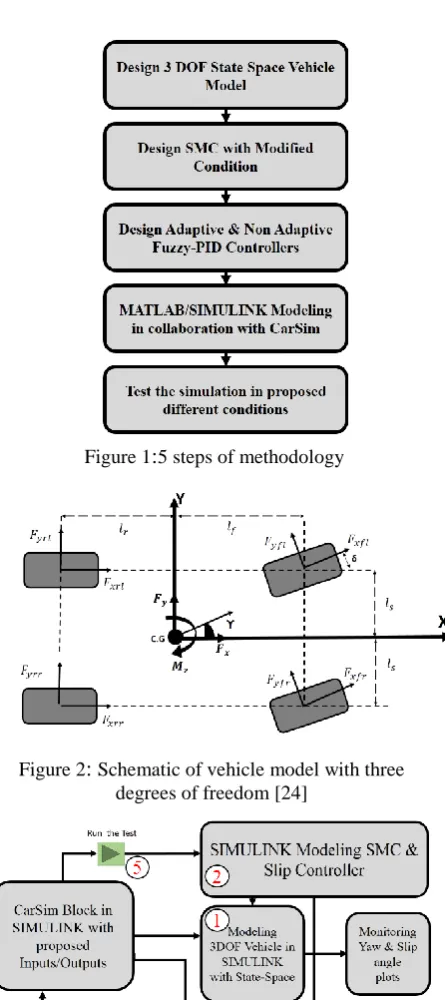
The methodology used in this research has 5 steps as shown in Figure 1. In the first step state space model for the 3 DOF vehicle model shown in Figure 2 is derived based on Euler and Newton second law. In the second step, a modified SMC is designed to obtain sliding mode signal for brake actuators considering the inputs (longitudinal speed of wheels and sprung mass) and the outputs (slip angles). In step 3 brake actuators transfer function plants are identified, designing a two level Fuzzy-PID adaptive and non-adaptive, with the inputs (slip angle and master brake pressure) and output (rotor brake pressure). In step 4 the state space of vehicle dynamics, SMC, actuators and
controllers are simulated in
MATALB/SIMULINK in collaboration with CarSim program to test the proposed MAFSMC with 3 different proposed road conditions in step 5. The flow chart of the process is presented in Figure3.
Figure 1:5 steps of methodology
Figure 2: Schematic of vehicle model with three degrees of freedom [24]
Figure3: Schematic Interconnection CarSim and MATLAB
2.1. Vehicle Model
Ignoring the pitch and roll motions, the vehicle has three planar degrees of freedom: lateral motion, longitudinal motion, and yaw motion. Figure 2, shows the schematic of the vehicle model. Where, CG is the vehicle’s center of gravity. 𝑉𝑥 , 𝑉𝑦 are the longitudinal and lateral speeds respectively and 𝛾 is the yaw rate. Therefore, dynamic equations of
Downloaded from www.iust.ac.ir at 17:30 IRDT on Monday April 29th 2019
International Journal of Automotive Engineering (IJAE) 2897
the vehicle can be expressed below as given in [15] and [16].
{
𝑀𝑉𝑥̇ = (𝐹𝑥𝑓𝑙+ 𝐹𝑥𝑓𝑟)𝑐𝑜𝑠𝛿 − (𝐹𝑦𝑓𝑙+ 𝐹𝑦𝑓𝑟)𝑠𝑖𝑛𝛿 +
𝐹𝑥𝑟𝑙+ 𝐹𝑥𝑟𝑟− 0.5𝜌𝑎𝐶𝐷𝐴𝑉𝑥2+ 𝑀𝑉𝑦𝛾
̇ 𝑀𝑉𝑦̇ = (𝐹𝑦𝑓𝑙+ 𝐹𝑦𝑓𝑟)𝑐𝑜𝑠𝛿 − (𝐹𝑥𝑓𝑙+ 𝐹𝑥𝑓𝑟)𝑠𝑖𝑛𝛿 + 𝐹𝑦𝑟𝑙+ 𝐹𝑦𝑟𝑟− 𝑀𝑉𝑥𝛾 𝐼𝑧𝛾̇ = (𝐹𝑦𝑓𝑙𝑠𝑖𝑛𝛿 − 𝐹𝑥𝑓𝑙𝑐𝑜𝑠𝛿 + 𝐹𝑥𝑓𝑟𝑐𝑜𝑠𝛿 − 𝐹𝑦𝑓𝑟𝑠𝑖𝑛𝛿) 𝑙𝑠+ (𝐹𝑥𝑟𝑟− 𝐹𝑥𝑟𝑙)𝑙𝑠− (𝐹𝑦𝑓𝑟+ 𝐹𝑦𝑟𝑟)𝑙𝑓 +((𝐹𝑥𝑓𝑙+ 𝐹𝑥𝑓𝑟)𝑐𝑜𝑠𝛿 + (𝐹𝑦𝑓𝑙+ 𝐹𝑦𝑓𝑟)𝑠𝑖𝑛𝛿)𝑙𝑓 (1) where, 𝐹𝑥𝑖 and 𝐹𝑦𝑖 (i = fl, fr, rl, rr) are respectively longitudinal and lateral forces of each tire, M is the mass of the vehicle, 𝜌𝑎 is the air density, 𝐶𝐷 is the aerodynamic drag, A is the vehicle front area, δ is the angle front wheel steering angle, and distances 𝑙𝑓, 𝑙𝑟 , and 𝑙𝑠 are shown in Fig. 2.
In (1), the steering angles of the two front wheels are assumed to be equal however in reality, these angles are approximately equal and there is a little difference between them. So, in this study, for simplicity the difference is neglected [15].
Considering (1), the state space equations of vehicle can be expressed as follows:
[ 𝑉𝑥 𝑉̇𝑦 𝛾̇ ] = [ 𝑉𝑦𝛾 −𝜌𝑎𝐶𝐷
2𝑀 𝐴𝑉𝑥
2 −𝑉𝑥𝛾 0 ] + 𝐵𝑦 [ 𝐹𝑦𝑓𝑙 𝐹𝑦𝑓𝑟 𝐹𝑦𝑟𝑙 𝐹𝑦𝑟𝑟] + 𝐵𝑥 [ 𝐹𝑥𝑓𝑙 𝐹𝑥𝑓𝑟 𝐹𝑥𝑟𝑙 𝐹𝑥𝑟𝑟] (2)
Where 𝐵𝑋 and 𝐵𝑦 are:
𝐵𝑥 = [ 𝑐𝑜𝑠𝛿 𝑀 𝑐𝑜𝑠𝛿 𝑀 1 𝑀 1 𝑀 𝑠𝑖𝑛𝛿 𝑀 𝑙𝑓𝑠𝑖𝑛𝛿 − 𝐼𝑠𝑐𝑜𝑠𝛿 𝐼𝑧 𝑠𝑖𝑛𝛿
𝑀 0 0
𝑙𝑓𝑠𝑖𝑛𝛿 + 𝐼𝑠𝑐𝑜𝑠𝛿 𝐼𝑧 −𝑙𝑠 𝐼𝑧 −𝑙𝑠 𝐼𝑧 ] (3) 𝑩𝒚 = [ −𝑠𝑖𝑛𝛿 𝑀 −𝑠𝑖𝑛𝛿
𝑀 0 0
𝑐𝑜𝑠𝛿 𝑀 𝑙𝑓𝑐𝑜𝑠𝛿 + 𝐼𝑠𝑠𝑖𝑛𝛿 𝐼𝑧 𝑐𝑜𝑠𝛿 𝑀 𝑙𝑓𝑐𝑜𝑠𝛿 − 𝐼𝑠𝑠𝑖𝑛𝛿 𝐼𝑧 1 𝑀 −𝑙𝑟 𝐼𝑧 1 𝑀 𝑙𝑟 𝐼𝑧] (4)
2.1.1. Tire Model
In each wheel, the traveled distance by the tire is different from the expected distance from its peripheral speed. The longitudinal slip ratio (defined as the relative difference between tire peripheral speed and tire center speed) is used to express this phenomenon [16] as:
𝑆𝑖=
𝜔𝑖𝑅𝑒𝑓𝑓−𝑉𝑥𝑖
max (𝑉𝑥𝑖 ,𝜔𝑖𝑅𝑒𝑓𝑓) (5)
Where 𝑅𝑒𝑓𝑓 is the effective tire radius, 𝜔𝑖 is the angular speed of i-th tire, and 𝑉𝑥𝑖 is the longitudinal speed at the center of i-th wheel. The wheel speeds at the wheel centers are calculated as follows:
{ 𝑉𝑋𝑓𝑙= (𝑉𝑥− 𝛾𝑙𝑠)𝐶𝑜𝑠𝛿 + (𝑉𝑦+ 𝛾𝑙𝑓)𝑆𝑖𝑛𝛿 𝑉𝑋𝑓𝑟= (𝑉𝑥+ 𝛾𝑙𝑠)𝐶𝑜𝑠𝛿 + (𝑉𝑦+ 𝛾𝑙𝑓)𝑆𝑖𝑛𝛿 𝑉𝑋𝑟𝑙= 𝑉𝑥− 𝛾𝑙𝑠 𝑉𝑋𝑟𝑟= 𝑉𝑥− 𝛾𝑙𝑠 (6)
The slip angle of each tire is defined as angular difference between the orientation of a wheel and the velocity of the wheel center [23]. If the tire slip angles are small, the lateral forces of tires can be calculated as [24]:
{
𝐹𝑦𝑓𝑟 ≅ 𝐹𝑦𝑓𝑙≅ 𝐶𝑓(𝛿 − 𝜃𝑣𝑓) 𝐹𝑦𝑟𝑟 ≅ 𝐹𝑦𝑟𝑙 ≅ 𝐶𝑟(−𝜃𝑣𝑟)
tan(𝜃𝑣𝑓) = 𝛽 +
𝑙𝑓𝛾
𝑉𝑥
tan(𝜃𝑣𝑟) = 𝛽 −
𝑙𝑟𝛾
𝑉𝑥
𝑤𝑖𝑡ℎ 𝛽 = tan−1(𝑉𝑥
𝑉𝑦)
(7)
Where, 𝜃𝑣𝑓 and 𝜃𝑣𝑟 are slip angles of front and rear tires, respectively. 𝐶𝑓 and 𝐶𝑟are stiffness coefficients of front and rear tires, receptively, and 𝛽 is the vehicle body sideslip angle.
In a vehicle, maximum applied force to a wheel is limited by the maximum capacity of the powertrain system and the friction coefficient between road and tire as (8).
𝐹max 𝑖= 𝜇𝐹𝑧𝑖 (8)
Where 𝐹𝑧𝑖 is the normal load at the center of i-th wheel.
Vehicle sprung mass in a vehicle cause a load transfer during acceleration, braking and cornering conditions. The load transfer changes the normal forces of the wheel centers𝐹𝑧𝑖. The applied force to a wheel center can be affected by its normal force [16]. Therefore, it is required to be modeled. This phenomenon has two parts that are described as longitudinal and lateral load transfers as follow:
Downloaded from www.iust.ac.ir at 17:30 IRDT on Monday April 29th 2019
2898 International Journal of Automotive Engineering (IJAE)
2.1.2. Longitudinal Load Transfer
Assume, 𝐹𝑧𝑑𝑖 (𝐹𝑧𝑑−𝑓𝑙, 𝐹𝑧𝑑−𝑟𝑙, 𝐹𝑧𝑑−𝑓𝑟, and
𝐹𝑧𝑑−𝑟𝑟) are the tire normal forces in a standstill
state or on driving with a constant speed. In (9), m is the sprung mass, ℎ𝐶𝐺 is the height of sprung mass and 𝑚𝑤 is the total mass of the wheel [24].
{
𝐹𝑧𝑑−𝑓= 𝐹𝑧𝑑−𝑓𝑙= 𝐹𝑧𝑑−𝑓𝑟= 𝑚𝑤𝑔 +
𝑚𝑔𝑙𝑟 2(𝑙𝑓+ 𝑙𝑟)
𝐹𝑧𝑑−𝑟= 𝐹𝑧𝑑−𝑟𝑙 = 𝐹𝑧𝑑−𝑟𝑟= 𝑚𝑤𝑔 +
𝑚𝑔𝑙𝑟 2(𝑙𝑓+ 𝑙𝑟)
(9) In the acceleration and braking conditions, the sprung mass is moved backward and forward, respectively. Consequently, the normal forces of the wheels, during longitudinal load transfer (𝑧𝑥), can be expressed as follows:
{
𝐹𝑧−𝑓𝑟𝑜𝑛𝑡 = 𝐹𝑧𝑑−𝑓− 𝑍𝑥
𝐹𝑧−𝑟𝑒𝑎𝑟 = 𝐹𝑧𝑑−𝑟+ 𝑍𝑥
𝑍𝑥 =
𝑚ℎ𝐶𝐺𝑎𝑥
2(𝑙𝑓+𝑙𝑟)
(10)
2.1.3. Lateral Load Transfer
The sprung mass is moved during vehicle cornering because of centrifugal force. In this situation, the wheel’s normal forces on one side of the vehicle are increased and the normal forces on the other side are reduced. Therefore, the lateral load transfer (𝑧𝑦) can be expressed as follows:
{ 𝐹𝑧𝑓𝑙 = 𝐹𝑧𝑑−𝑓𝑙+ 𝑍𝑦 𝐹𝑧𝑟𝑙 = 𝐹𝑧𝑑−𝑟𝑙+ 𝑍𝑦 𝐹𝑧𝑓𝑟 = 𝐹𝑧𝑑−𝑓𝑟− 𝑍𝑦 𝐹𝑧𝑟𝑟 = 𝐹𝑧𝑑−𝑟𝑟+ 𝑍𝑦 𝑍𝑦= 𝑚ℎ𝐶𝐺𝑎𝑦 4𝑙𝑠 (11)
Consequently, the total tire normal loads can be calculated as [16]:
{
𝐹𝑧𝑓𝑙= 𝑚𝑤𝑔 +
𝑚𝑔𝑙𝑟 2(𝑙𝑓+ 𝑙𝑟)
− 𝑚ℎ𝐶𝐺𝑎𝑥 2(𝑙𝑓+ 𝑙𝑟)−
𝑚ℎ𝐶𝐺𝑎𝑦 4𝑙𝑠
𝐹𝑧𝑓𝑟= 𝑚𝑤𝑔 +
𝑚𝑔𝑙𝑟 2(𝑙𝑓+ 𝑙𝑟)
− 𝑚ℎ𝐶𝐺𝑎𝑥 2(𝑙𝑓+ 𝑙𝑟)
+𝑚ℎ𝐶𝐺𝑎𝑦 4𝑙𝑠
𝐹𝑧𝑓𝑙= 𝑚𝑤𝑔 +
𝑚𝑔𝑙𝑓 2(𝑙𝑓+ 𝑙𝑟)
− 𝑚ℎ𝐶𝐺𝑎𝑥 2(𝑙𝑓+ 𝑙𝑟)
−𝑚ℎ𝐶𝐺𝑎𝑦 4𝑙𝑠
𝐹𝑧𝑓𝑙= 𝑚𝑤𝑔 +
𝑚𝑔𝑙𝑓 2(𝑙𝑓+ 𝑙𝑟)
− 𝑚ℎ𝐶𝐺𝑎𝑥 2(𝑙𝑓+ 𝑙𝑟)
+𝑚ℎ𝐶𝐺𝑎𝑦 4𝑙𝑠
(12) By selecting 𝛽 and 𝛾 as state variables, the state space of a vehicle can be expressed as (13).Where 𝑀𝑧 is the vehicle direct moment.
[𝛽̇ 𝛾̇] = [
−2(𝐶𝑓+𝐶𝑟)
𝑀𝑉𝑥
2(−𝑙𝑓𝐶𝑓+𝑙𝑟𝐶𝑟)
𝑀𝑉𝑥2
2(−𝑙𝑓𝐶𝑓+𝑙𝑟𝐶𝑟)
𝐼𝑧
−2(𝑙𝑓2𝐶𝑓+𝑙𝑟2𝐶𝑟)
𝐼𝑧𝑉𝑥
] [𝛽𝛾] +
[
2𝐶𝑓
𝑀𝑉𝑥
2𝑙𝑓𝐶𝑓
𝐼𝑧
] 𝛿 + [01
𝐼𝑧
] 𝑀𝑧 (13)
2.2. Modified Conditions SMC
More than 7 decades is past since early definition and design principles of SMC is published in automatic control literatures. A new sliding mode controller was proposed byH.Alipour et al. [17] , where Lyapunov theorem is used to prove the stability. They showed that the designed sliding mode control structure was faster, more accurate and robust, with lower chatter than classic sliding mode controller. They calculated the setting time using following equation:
𝑡𝑠𝑒𝑡 ≤ 2
𝑘ln
𝑘1
𝑘𝜆(𝑆0+
𝑘𝜆
𝑘𝑖) (14) Note that, 𝑡𝑠𝑒𝑡(𝑀𝑎𝑥) for classic SMC is equal to 𝑆0/𝑘 and in [25], 𝑡𝑠𝑒𝑡(𝑀𝑎𝑥) is reduced logarithmic with k. But in the present study the value of k is set using Genetic Algorithm method with the aim of minimizing slip angle (one of the inputs of brake actuator), the result was considerable reduction of chattering and start time of the controller activity, leading to reduction of brake distance.
2.3. Adaptive Fuzzy-PID Controllers
The brake pressures as output of the brake system, are optimized by brake actuator controllers to reduce the braking time and distance. Two inputs for brake system are selected. The first one, 𝛽𝑖 is one of SMC outputs (the slip angle of each tire), and the second one, is 𝑃𝑐𝑜𝑛 (the pedal pressure applied by the driver).
To maintain the test in a real condition, 1 minute delay is considered for driver reaction time, when 15Mpa pedal pressure is activated, as shown in Figure 4.
Figure 4: Pedal Brake Pressure
Downloaded from www.iust.ac.ir at 17:30 IRDT on Monday April 29th 2019
International Journal of Automotive Engineering (IJAE) 2899
To obtain transfer functions for this multi-input/single-output system (MISO), MATLAB system identification toolbox was used by enforcing unit pulse 𝛿(𝑡) inputs and presumed non zero and 2 poles transfer function. The identified transfer function 1 (tf1) applied for SMC output, named “control mode”. Also transfer function 2 (tf2) for pedal pressure (Pcon) input. Both transfer
function's outputs are brake pressure (Pbi) which
are set in brake actuator controllers below, respectively.
𝑡𝑓1 = 5.6×10⁻⁵
𝑠2+0.4384 𝑠+0.1182 (15)
𝑡𝑓2 =𝑠2+0.8348 𝑠+0.2126.5×10−5
(16)
The brake actuator is divided into 2 controllers shown in Figure 5 and 6. Figure 5 represent Figure 3 with more details, signal connections and inputs-output of 2-Level Fuzzy-PID Controller (the MISO system) mentioned before.
Figure5: Scheme of Simulink blocks and signals
Figure6: Scheme of 2 level Fuzzy-PID controller of Brake Actuator
2.3.1. Main Level Fuzzy-PID controller
Controller 1 and 2 have two levels called Main and Inner part, their difference is only, being adaptive or non-adaptive which are defined in Figures 7 and 8.
Figure7: Controller 1 scheme
Figure8: Controller 2 scheme
The Fuzzy Core of main controller builds on having two inputs, e and 𝑒𝑐 (error and derivative of error) and three output gains, Kp, Ki and Kd. The initial gain values 𝐾𝑝0 , 𝐾𝑖0 and 𝐾𝑑0 for the controller are obtained by means of Genetic Algorithm as presented in Table 1. A genetic algorithm (GA) is a method for solving both constrained and unconstrained optimization problems based on a natural selection process that mimics biological evolution. The algorithm repeatedly modifies a population of individual solutions. At each step, the genetic algorithm randomly selects individuals from the current population and uses them as parents to produce the children for the next generation. Over successive generations, the population "evolves" toward an optimal solution.
The Fuzzy Logic toolbox let us model complex system behaviors using simple logic rules, and then implement these rules in a fuzzy inference system. It be can used as a stand-alone fuzzy inference engine. Alternatively, you can use fuzzy inference blocks in Simulink and simulate the fuzzy systems within a comprehensive model of the entire dynamic system.
Table1: initial values for PID controllers
Parameter 𝑲𝒑𝟎 𝑲𝒊𝟎 𝑲𝒅𝟎
Value 10 0.5 1
Fuzzy rules, input and output functions used in the main controller are shown in Table2, Figure 9 and 10 respectively.
Downloaded from www.iust.ac.ir at 17:30 IRDT on Monday April 29th 2019
2900 International Journal of Automotive Engineering (IJAE) Table2: Fuzzy Rules (Main Controller)
Figure9: Input functions (e and𝑒𝑐)
Figure10: Output functions (Ki, Kp and Kd)
2.3.2 Inner Level Fuzzy Controller
The inner controller is based on Fuzzy Core with two inputs E and 𝐸𝑐 (error and derivative of error and three outputs). Kp, Ki and Kd (gain values) are obtained by MATLAB (optimization toolbox) as presented in table 2 below:
Table3: gain values for PID controllers
Parameter 𝑲𝒑𝟎 𝑲𝒊𝟎 𝑲𝒅𝟎
Value 0.5 0.5 0.00005
The proposed Fuzzy rules, input and output function, used in the inner controller are shown in Tables 4-6 and Figures 11 and 12.
Table4: Fuzzy rules of Kp
Table5: Fuzzy rules (Ki)
Table6: Fuzzy rules (Kd)
Figure11: Inputs Functions (E and 𝐸𝑐)
Figure12: Outputs Functions (Kp, Ki and Kd)
2.4. Simulink Modeling
Inputs and outputs for the proposed MAFSMC
system in CarSim software are selected and exported into Simulink platform (MATLAB). Vehicle dynamics, SMC, Brake actuators and signal structures was shown in figure 5.
2.5. Test Conditions
The conducted experiments were carried on a chosen class of vehicle’s which is available in CarSim and will be used as the test rig for all experiments. The chosen class has the following specification shown in figures 13 and 14 which can be verified by Vehicles in C-Class Hatch back like Audi A3 as an example of common familial car.[18]
Downloaded from www.iust.ac.ir at 17:30 IRDT on Monday April 29th 2019
International Journal of Automotive Engineering (IJAE) 2901
.
Figure13: CarSim vehicle’s configuration part
Figure14: Vehicle’s ABS ON/OFF controller in CarSim
Table7: Vehicle’s Parameters
Parameters Notation Value Unit
Vehicle total mass M 1500 kg Vehicle Sprung mass m 1370 kg Roll inertia 𝐼𝑥𝑥 671.3 𝑘𝑔. 𝑚2
Pitch inertia 𝐼𝑦𝑦 1972. 8
𝑘𝑔. 𝑚2
Yaw inertia 𝐼𝑧𝑧 2315.
3
𝑘𝑔. 𝑚2
Aerodynamic Drag Coefficient
𝐶𝐷 0.32 -
Frontal Area A 2.5 𝑚2
Air density ρ 1.206 𝑘𝑔
/𝑚3
Tire effective rolling radius
𝑅𝑒𝑓𝑓 0.325 m
Half of Lateral distance between centers of tire
𝑙𝑠 0.85 m
Distance from the front axle to the mass center
𝑙𝑓 1.1 m
Distance from the rear axle to the mass center
𝑙𝑟 1.2 m
Maximum Allowable
Brake Torque 𝑇𝑏
500 N.m/
MPa Engine Model (for 6
speed transmission Automatic)
- 150 kW
And three road conditions (dry, wet and icy see table 8) were considered for vehicle driven in three following simulated conditions that imported manually in CarSim.
Figure 15: CarSim Test conditions procedure part Table8: JASO (Japanese Standard Organization) Test
Conditions
Road Condition Friction Speed
Dry road Dry asphalt
0.8 120 km/h
0.8 50 km/h
Wet road Wet asphalt 0.5 80 km/h
0.5 50 km/h
Icy road Icy asphalt 0.2 50 km/h
For vehicle driven in three simulated conditions; 1)“Carsim_ABS_OFF”, 2)“Carsim_ABS_ON” 3) and the proposed “MAFSMC_ON” see Figure 14.
2.5. Brake Rotor Modeling
The brakes system is critical with respect to
vehicle safety. One situation during which
the brake system is put to the test is an Alpine
descent. Such a descent causes very high brake
system temperatures.Stress and Temperature
distribution for FGM brake pads had been
studied at [19]. The model and its specification
that used in our study adapted form [20].
Which its data and modal investigated with
accuracy and fits our CarSim Vehicle Model.
3. Results
In order to evaluate the test results, the first step is to check whether they are observing the standard regulation established by ‘Transport Research Laboratory of UK’ [21] and also stopping sight distance prepared for “
Oregon Department of
Transportation Salem” [22]
see figures 17 and 18. Stop Distance Results for each conditionsDownloaded from www.iust.ac.ir at 17:30 IRDT on Monday April 29th 2019
2902 International Journal of Automotive Engineering (IJAE) compared to previous study [23].however a study
which held test conditions for Brake rotor temperature like our study was not found and ought to just make sure they don’t exceed the maximum Torque/Pressure Coefficient of pads which are 250 and 150 N.m/MPa for front and rear wheels. This can be helped by applying an “If Block” in Simulink model of Brake signal which prevent the test if overlap occurs.
Figure 17: Standard stop distance proposed by [26]
Figure18: Decision sight distance for braking in different road condition [27]
Running the above tests the resulted following figures for all conditions are shown in sections 3.1 to 3.3.
3.1. Dry Road
Figure20: Brake Speed km/h-Time(s) “Carsim_ABS_OFF”
Figure21: Brake Distance m-Time(s) “Carsim_ABS_OFF”
Figure22: Brake Rotor Temperature C-Time(s) “Carsim_ABS_OFF”
Figure23: Brake Speed km/h-Time(s) “Carsim_ABS_ON”
Figure24: Brake Distance m-Time(s) “Carsim_ABS_ON”
Figure25: Brake Rotor Temperature C-Time(s) “Carsim_ABS_ON”
Downloaded from www.iust.ac.ir at 17:30 IRDT on Monday April 29th 2019
International Journal of Automotive Engineering (IJAE) 2903
Figure26: Brake Speed km/h-Time(s) “MAFSMC _ON”
Figure27: Brake Distance m-Time(s) “MAFSMC _ON”
Figure28: Brake Rotor Temperature C-Time(s) “MAFSMC _ON”
Figure29: Comparison of Brake Distance in different situations
Figure30: Comparison of Brake Rotor Temperature in different situation (No exceed)
3.2. Wet Road
Figure31: Brake Speed km/h-Time(s) “Carsim_ABS_OFF”
Figure32: Brake Distance m-Time(s) “Carsim_ABS_OFF”
Figure33: Brake Rotor Temperature C-Time(s) “ABS_OFF”
104 97.75 75.75
102 95
50 70 90 110
CarSim_ABS_OFF Carsim_ABS_ON MAFSMC_ON Min Standard Stop Distance Previous Study
Stop Distance (m)
Dry 120 km/h
5.5
99.5
14.5
0 10 20 30 40 50 60 70 80 90 100 110
CarSim_ABS_OFF Carsim_ABS_ON MAFSMC_ON
TE
MPE
R
A
TURE
(
C)
Dry 120 km/h
Downloaded from www.iust.ac.ir at 17:30 IRDT on Monday April 29th 2019
2904 International Journal of Automotive Engineering (IJAE) Figure34: Brake Speed km/h-Time(s)
“Carsim_ABS_ON”
Figure35: Brake Distance m-Time(s) “Carsim_ABS_ON”
Figure36: Brake Rotor Temperature C-Time(s) “Carsim_ABS_ON”
Figure37: Brake Speed m-Time(s) “MAFSMC _ON”
Figure38: Brake Distance m-Time(s) “MAFSMC _ON”
Figure39: Brake Rotor Temperature C-Time(s) “MAFSMC _ON”
Figure40: Comparison of Brake Distance in different situations
Figure41: Comparison of Brake Rotor Temperature in different situation (No exceed)
3.3. Icy Road
Figure42: Brake Speed km/h-Time(s) “Carsim_ABS_OFF”
78.6 76.1 59.5
81 76
50 60 70 80 90
CarSim_ABS_OFF Carsim_ABS_ON MAFSMC_ON Min Standard Stop Distance Previous Study
Stop Distance (m)
Wet 80 km/h
2
35.2
5.75
0 5 10 15 20 25 30 35 40
CarSim_ABS_OFF Carsim_ABS_ON MAFSMC_ON
TE
MPE
R
A
TURE
(
C)
Wet 80 km/h
Downloaded from www.iust.ac.ir at 17:30 IRDT on Monday April 29th 2019
International Journal of Automotive Engineering (IJAE) 2905
Figure43: Brake Distance m-Time(s) “Carsim_ABS_OFF”
Figure44: Brake Rotor Temperature C-Time(s) “Carsim_ABS_OFF”
Figure45: Brake Speed km/h-Time(s) “Carsim_ABS_ON”
Figure46: Brake Distance m-Time(s) “Carsim_ABS_ON”
Figure47: Brake Rotor Temperature C-Time(s) “Carsim_ABS_ON”
Figure48: Brake Speed km/h-Time(s) “MAFSMC _ON”
Figure49: Brake Distance m-Time(s) “MAFSMC _ON”
Figure50: Brake Rotor Temperature C-Time(s) “MAFSMC _ON”
Figure51: Comparison of Brake Distance in different situations
67.5 67.2 56.9
65 67
50 55 60 65 70
CarSim_ABS_OFF Carsim_ABS_ON MAFSMC_ON Min Standard Stop Distance Previous Study
Stop Distance (m)
Icy 50 km/h
Downloaded from www.iust.ac.ir at 17:30 IRDT on Monday April 29th 2019
2906 International Journal of Automotive Engineering (IJAE) Figure52: Comparison of Brake Rotor Temperature in
different situation (No exceed) Variable Icy
Condition Wet Condition Dry Condition Brake Distance Reduction
10.3 m 6.5 m 4.5 m
Brake Rotor Temperature Reduction
6.5 C 23 C 26.5 C
Table 9: Reduction of Brake Distance and Rotor Temperature in three different condition when
MAFSMC_ON is replaced with traditional SMC(Carsim_ABS_ON)
4. Discussion
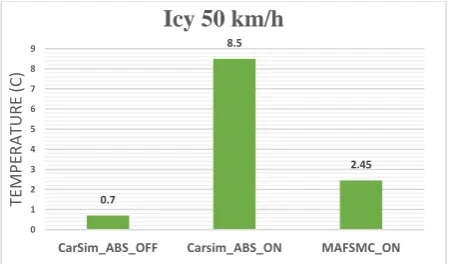
As it can be seen from the result figures above when comparing the brake distance, the proposed MAFSMC system reduces the distance (braking time) considerably.
Considering the results in terms of increasing brake rotor temperature although MAFSMC brake
system temperature is reduced comparing with all “CarSim ABS_ON” (condition 2), but
obviously when condition 1 is active the temperature is very low.
As it can be seen in Table 9 brake distance and temperature are reduced in all conditions at equal speed of 50 km/h , since the relation between friction coefficients of road and slip angle are not quite linear (Eq 1.) and slip angle as input of SMC follows a logarithmic relation, modified with Genetic Algorithm (Eq 14), the reduction percentages will not follow an exact linear function of the road friction coefficient.
Due to limitations on the required physical facilities for experiments the selected test rig in this research was chosen to be CarSim simulation software. Although CarSim is used by lots of vehicle industries as a powerful design tool, but there are some more improvements needed to make it ideal, for example in this research variation of road friction coefficients was needed for one tire,
but it was not accessible through Simulink co-operation with CarSim .
5. Conclusion
In this paper, a Fuzzy Adaptive sliding mode controller for an anti-lock braking system is developed to reduce brake distance. Simulation results through running co-simulation of CarSim and MATLAB verified the vehicle has a better performance than when controlled by ABS alone. The main achievements of this investigation can be summarized as below:
1. Accelerating ABS performance, a modified condition SMC was used to compensate the driver’s delay.
2. Modifying SMC design by applying Genetic Algorithm for setting time to minimize the slip angle.
3.Using Two types of Fuzzy-PID controllers, adaptive and non-adaptive for SMC and pedal pressure, respectively were set for controlling brake actuators.
4.Verifying the performance of MAFSMC brake system designed in this paper, various road conditions with different friction settings were examined considering JASO regulation.
The results obtained show that MAFSMC brake has better performance in comparison to traditional vehicle ABS system.
References
[1] Hui-min Lia, Xiao-bo Wang. Vehicle Control Strategies Analysis Based on PID and Fuzzy Logic Control. Procedia Engineering, 2016, 137: 234 – 243.
[2]
Meng Q. Chen et al.,Mixed Slip-
Deceleration PID Control of Aircraft Wheel
Braking System
, IFAC PapersOnLine 51-4 (2018) 160–165[3] H. Mirzaeinejad,Robust predictive control of wheel slip in antilock braking systemsbased on adial basis function neural network Applied Soft Computing 70 (2018) 318–329.
[4] Hui-min Li et al, Vehicle Control Strategies Analysis Based on PID and Fuzzy Logic
ControlProcedia Engineering 137 ( 2016 ) 234 – 243.
[5] Jinghua Guo , Linhui Li , Keqiang Li & Rongben Wang (2013) An adaptive fuzzy-sliding lateral control strategy of automated vehicles
0.7 8.5 2.45 0 1 2 3 4 5 6 7 8 9
CarSim_ABS_OFF Carsim_ABS_ON MAFSMC_ON
TE MPE R A TURE ( C)
Icy 50 km/h
Downloaded from www.iust.ac.ir at 17:30 IRDT on Monday April 29th 2019
International Journal of Automotive Engineering (IJAE) 2907
based on vision navigation, Vehicle System Dynamics: International Journal of Vehicle Mechanics and Mobility, 51:10, 1502-1517.
[6] PID Control with Intelligent Compensation for Exoskeleton Robots,Chapter5:PID Control with eural Compensation, ,2018 DOI: 10.1016/B978-0-12-813380-4.00005-0.
[7] J. Feng et al., Dynamic reliability analysis using the extended support vector regression (X-SVR) Mechanical Systems and Signal Processing 126 (2019) 368–391.
[8]
Tufan Dogruer et al, Design of PI Controller using Optimization Method in Fractional Order Control System IFAC PapersOnLine 51-4 (2018) 841–846.[9] M. Esfahanian et al. Antilock Regenerative Braking System Design for a Hybrid Electric Vehicle, International Journal of Automotive Engineering, Vol.8, No. 3, (2018), 2769-2780.
[10] Visioli, A. (2006). Practical PID Control. Springer Verlag Advances in Industrial Control Series
.
[11]
Barton M. (2001) Controller development
and implementation for path planning and
following in an autonomous urban vehicle.
Undergraduate thesis, University of Sydney,
Sydney, Australia.
[12] Z. Sun et al, Nested adaptive super-twisting sliding mode control design for a vehicle steer-by- wire system. Mechanical Systems and Signal Processing 122 (2019) 658–672.
[13] R. Karve, D. Angland, T. Nodé-Langlois, An analytical model for predicting rotor broadband noise due to turbulent boundary layer ingestion, Journal of Sound and Vibration (2018), doi: 10.1016/j.jsv.2018.08.020.
[14] X. Ma et al. Cornering stability control for vehicles with active front steering system using T-S fuzzy based sliding mode control strategy, Mechanical Systems and Signal Processing (2018)
[15] Wang R, Wang J. Fault-tolerant control with active fault diagnosis for fourwheel independently driven electric ground vehicles. IEEE Trans Veh Technol 2011;60(9):4276–87.
[16] Rajamani R. Vehicle dynamics and control. 2nd ed. Springer; 2012.
[17] Alipour H et al. Lateral stabilization of a four wheel independent drive electric vehicle on slippery roads. Mechatronics (2014),
http://dx.doi.org/10.1016/j.mechatronics.2014.08.00 6
[18] Audi A3 Specification Manual, AUDI AG, Auto-Union-Strasse 185045 Ingolstadt
www.audi.com, Valid from June 2016 ,Printed in
Germany, 633/1153.32.24
[19] P. Hosseini Tehrani and M.Talebi, Stress and Temperature Distribution Study in a Functionally Graded Brake Disk, International Journal of Automotive Engineering Vol. 2, Number 3, July 2012
[20] ADRIAAN NEYS, In-Vehicle Brake System Temperature Model, Master Thesis in the Master’s programme in Automotive Engineering, Department of Applied Mechanics CHALMERS UNIVERSITY OF TECHNOLOGY Göteborg, Sweden, 2012.
[21] Transport Research Laboratory,UK,2018 [22] Transportation Research Institute
Oregon State University Corvallis, Oregon 97331-4304, STOPPING SIGHT DISTANCE AND DECISION SIGHT DISTANCE.
[23] DukSun Yun et al, Brake Performance Evaluation of ABS with Sliding Mode Controller on a Split Road with Driver Model, INTERNATIONAL JOURNAL OF PRECISION ENGINEERING AND MANUFACTURING Vol. 12, No. 1, pp. 31-38
Downloaded from www.iust.ac.ir at 17:30 IRDT on Monday April 29th 2019
![Figure 17: Standard stop distance proposed by [26]](https://thumb-us.123doks.com/thumbv2/123dok_us/8949289.1858657/8.595.62.280.390.498/figure-standard-stop-distance-proposed.webp)