Instrument development of the environment ethics on high
school students
Sastra Wijaya, Yuliatri
Universitas Negeri Jakarta, Indonesia ([email protected])
Andriani, Yunis
SMA Negeri OKU, Indonesia ([email protected])
Received: 17 January 2015 Revised: 29 April 2015 Accepted: 13 May 2015
Available Online: 15 June 2015 DOI: 10.5861/ijrsp.2015.1191
ISSN: 2243-7681 Online ISSN: 2243-769X
OPEN ACCESS
Abstract
This study aimed to develop an instrument that evaluates the environment ethics on high
school students. Sampling technique in this study was randomized stages (multistage random
sampling). Development of test theoretical point statement based on expert and panelist. The
Scale used in this study was Likert scales. Based on the tests and panelists expert produce 61
point statements. The test was executed in two stages of 610 high school students in Jakarta,
Bogor and Lampung. Data analysis used Structural Equation Modeling (SEM). The results of
the first test, the items were reduced as much as nine points previously repaired models
(re-specification). In the second trial based on the fit model test, it fits the standards for fit
model and does not need to be furbished up again, the item is brought down as much as
3-point statement, so that the final instrument consists of 49 points. Having tested the validity
and reliability, it can be concluded that this instrument is valid and reliable. Further trials are
still needed by the greater number of samples and more variety to produce a standardized
instrument.
Instrument development of the environment ethics on high school students
1. Introduction
Ethics toward environment is a way to be able to maintain the balance of the ecosystem. The lack of our ethics toward environment does not make more beautiful the place of our life. Ethics are closely related to moral values provide guidance to us to be able to apply or act according with the norms and good moral values. Ethics to the environment means we have to implement the norms and appropriate moral values to maintain and preserve the environment.
One of the 2013 curriculum development emphasis for the future competence is the learners have a sense of responsibility towards the environment. It is devoted again to the subjects of biology for class X, XI and XII in two basic competences (BC), which emphasizes the cultivation of sensitive and caring attitude towards environmental issues, maintain and care for the environment as a manifestation of the practice of the teachings of their religion. In addition to the guidelines for the development of local content, one of the things to be developed is concern for the environment. Even in some provinces Adiwiyata program in a public high school or vocational level. Adiwiyata program is one of the world's educational efforts to foster a sense of love and responsibility for the environment in self-learners and mitigate the effects of global warming is now more worrying.
Ethics often equated with moral or character that refers to how a person should behave or act towards others or based on habits and values prevailing in the community. Someone who behaved normally called ethical, otherwise if someone behaves badly or does not act in accordance with the prevailing values of the community, then it is not considered ethical or not ethical either. Good or bad a person's behavior will affect how others respond to him and also his neighborhood. Ethics according Kitchner as quoted by Gall et al. (2007) is a branch of philosophy which refers to the question of how a person should behave towards others according with the norms or values applicable laws and developed that provides guidance on the values of kindness or should be.
Keraf (2002) explain that ethics is a critical reflection on norms and values or moral principles commonly known so far in relation to the environment, the human perspective with a human, the human relationship with nature, and the behavior that comes from this perspective. Studying ethics aiming to get the same concept of good judgment is bad for all humans in space and time and the particular time. Ethics is usually called a normative science, because ethics set size for human actions with the use of norms about what is good and bad. These norms are usually a prevailing custom in the community and accepted by all members of society to act or behave.
plays an important role in human life that can behave in a positive or negative impact in the society. Good behavior is very overlooked in ethics, provides many benefits for life, otherwise bad behavior brings discomfort or even damage to life.
2. Environment ethics
Environment is complex systems that are beyond the individual that affect the growth and development of organisms. The factors that exist in the environment in addition to interacting with organisms also interact with other factors. Environmental factors are classified into two categories: abiotic and biotic environment. Abiotic environment includes everything that is not life that are in the environment, such as temperature, air, atmospheric light, nutrients, minerals, water, earth, fire. The biotic environment outside the living creatures’ biotic environment, such as humans, animals and plants; between the environment and the organism cannot be separated, there was a close relationship and reciprocal (Irwan, 2007).
Environment is the space occupied by a living thing along with the nonliving and living in it. The scope of this environment can be narrow or broad. In a narrow scope, the environment can be a home environment, yards, gardens, or fields. In the broad scope of the environment can be an island environment, the environment of the earth (biosphere) or even the solar system environment of the universe (Soemarwoto, 2008). Manik (2007) defines environment as a unity with all things space, power, state, and living creatures, including humans and their behavior, which affects the continuity of life and well-being of humans and other creatures. Environmental division into three basic groups: First is the physical environment are all things that shaped human around inanimate objects such as home, car, mountain, air, water, soil, rocks and so on. The second is a biological environment, and all of things that exist around the human form of life apart from the human organism itself, such as the animals from large to small and herbs from the largest to the smallest. Third is the social environment, the other human beings who are nearby such as neighbors, friends and even people who have not known.
According to the Low of Environment No. 32, 2009 about the general provisions in Chapter I, on the protection and management of environment, ministry of environment, the environment is unity with all things space, power, and the state of living beings including humans and their behavior affect the continuity of life and well-being of humans and other creatures. Environmental ethics is a critical reflection on norms and values or moral principles that have been known to the human society to be applied more widely in the biotic community or ecological community (Keraf, 2002). Environmental ethics according Sudjoko et al (2011) is a critical reflection on what to do in the face of human moral choices related to environmental issues including moral choice in meeting their needs that have an impact on the environment. Discuss environmental ethics norms and moral principles that govern human behavior in dealing with nature, as well as the values and moral principles that animates human behavior in dealing with the nature (Rochyadi et al., 2009).
The instrument development of environment ethics of high school students forms the construct of environmental ethics. Constructs of environmental ethics is the study variables that represents a synthesis of the theories of environmental ethics that has been discussed and analyzed as well as the presentation described in the theoretical assessment or review of the literature from a variety of sources derived from experts and people who are competent. Constructs are described in the definition of conceptual and operational definitions which also include the dimensions and indicators of the variables measured. Construct variables that capture variables in the data (instrument) requires theories and concepts are translated into indicators that are needed to construct a grain of statements that will be used as a measuring tool to measure environmental ethics students.
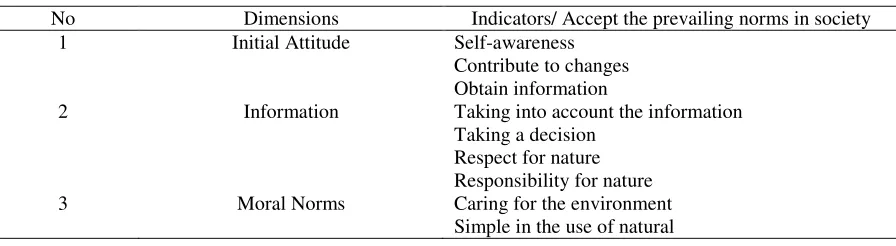
Based on theoretical studies were synthesized into a construct, and then get the dimensions and indicators measuring instrument environmental ethics students. Environmental ethics instrument consists of 3 dimensions and 10 indicators. The first dimension is, the initial attitude which consists of 3 indicators that accepts the norms prevailing in society, self-awareness, and role in change. Secondly, the information consists of 3 indicators, namely obtaining information, manage information and make decisions. Third, the moral norms which consists of four indicators, namely respect for nature, responsibility towards nature, caring for the environment and utilize simple in nature.
In this study the analysis of the data using Structural Equation Model (SEM) with CFA procedure. SEM methodology is a combination of two disciplines, namely confirmatory factor analysis models were taken from the psychometric and Structural Equation Models (SEM) were taken from econometrics (Southern, 2012). SEM is a combination of the two statistical methods of factor analysis developed in psychology/psychometrics or sociology and simultaneous equations models developed in econometrics. Two reasons underlying the use of SEM is, the first, SEM has the ability to estimate the relationship between variables that are multiple relationships. This relationship formed in the structural model (relationships between independent and dependent construct). Secondly, SEM has the ability to describe the relationship between the latent construct and manifest variables (Yamin & Kurniawan, 2009).
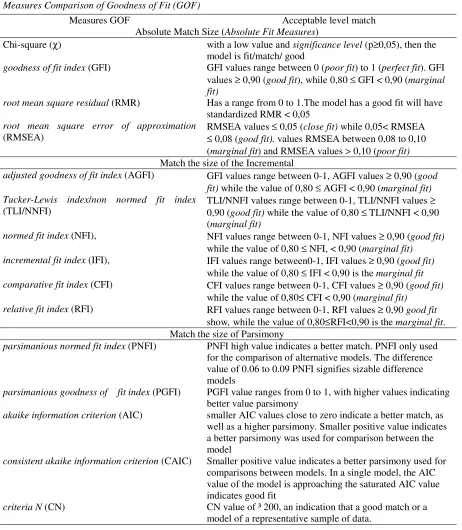
According to Bollen and Long, as quoted southern (2012), there are 5 (five) process to be followed in SEM analysis, in which each stage will affect the next stage, namely: (1) specification of the model, (2) identification of the model, (3) estimation of the model, (4) evaluation of the model and (5) respesifikasi models. Evaluation phase models with regard to compatibility testing between the models with the data, the validity and reliability of the measurement model. Some of the criteria match the size of the model or the Goodness of Fit (GOF) can be used. There are three groups of test size model fit: (1) the size of a match absolute (absolute fit measures), (2) the size of a match incremental (Incremental / relative fit measures), and (3) the size of a match parsimony (parsimonious / adjusted fit measures). To measure the absolute compatibility is commonly used measures: (1) chi-square (c), (2) the goodness of fit index (GFI), (3) root mean square residual (RMR), (4) root mean square error of approximation (RMSEA).
There are several sizes to measure the incremental match included in this measure are: (1) the Adjusted Goodness of Fit Index (AGFI), (2) Tucker-Lewis index / Non-Normed Fit Index (TLI / NNFI), (3) Normed Fit Index (NFI), (4) Incremental Fit Index (IFI), (5) the Comparative Fit Index (CFI), and (6) the Relative Fit Index (RFI). Several sizes match the size of parsimony are classified: (1) Parsimanious Normed Fit Index (PNFI), (2) Parsimanious Goodness of Fit Index (PGFI), (3) Akaike Information Criterion (AIC), (4) Consistent Akaike Information Criterion (CAIC), and (5) Criteria N (CN).
Table 1
Measures Comparison of Goodness of Fit (GOF)
Measures GOF Acceptable level match
Absolute Match Size (Absolute Fit Measures)
Chi-square (χ) with a low value and significance level (p≥0,05), then the model is fit/match/ good
goodness of fit index (GFI) GFI values range between 0 (poor fit) to 1 (perfect fit). GFI values ≥ 0,90 (good fit), while 0,80 ≤ GFI < 0,90 (marginal fit)
root mean square residual (RMR) Has a range from 0 to 1.The model has a good fit will have standardized RMR < 0,05
root mean square error of approximation
(RMSEA)
RMSEA values ≤ 0,05 (close fit) while 0,05< RMSEA ≤ 0,08 (good fit). values RMSEA between 0,08 to 0,10 (marginal fit) and RMSEA values > 0,10 (poor fit)
Match the size of the Incremental
adjusted goodness of fit index (AGFI) GFI values range between 0-1, AGFI values ≥ 0,90 (good fit) while the value of 0,80 ≤ AGFI < 0,90 (marginal fit) Tucker-Lewis index/non normed fit index
(TLI/NNFI)
TLI/NNFI values range between 0-1, TLI/NNFI values ≥ 0,90 (good fit) while the value of 0,80 ≤ TLI/NNFI < 0,90 (marginal fit)
normed fit index (NFI), NFI values range between 0-1, NFI values ≥ 0,90 (good fit)
while the value of 0,80 ≤ NFI, < 0,90 (marginal fit) incremental fit index (IFI), IFI values range between0-1, IFI values ≥ 0,90 (good fit)
while the value of 0,80 ≤ IFI < 0,90 is the marginal fit comparative fit index (CFI) CFI values range between 0-1, CFI values ≥ 0,90 (good fit)
while the value of 0,80≤ CFI < 0,90 (marginal fit) relative fit index (RFI) RFI values range between 0-1, RFI values ≥ 0,90 good fit
show, while the value of 0,80≤RFI<0,90 is the marginal fit. Match the size of Parsimony
parsimanious normed fit index (PNFI) PNFI high value indicates a better match. PNFI only used for the comparison of alternative models. The difference value of 0.06 to 0.09 PNFI signifies sizable difference models
parsimanious goodness of fit index (PGFI) PGFI value ranges from 0 to 1, with higher values indicating better value parsimony
akaike information criterion (AIC) smaller AIC values close to zero indicate a better match, as well as a higher parsimony. Smaller positive value indicates a better parsimony was used for comparison between the model
consistentakaike information criterion (CAIC) Smaller positive value indicates a better parsimony used for comparisons between models. In a single model, the AIC value of the model is approaching the saturated AIC value indicates good fit
criteria N (CN) CN value of ³ 200, an indication that a good match or a model of a representative sample of data.
and VE ≥≥≥ 0.50. If under both these values, the model must be fixed because it is not reliable. ≥
3. Research Methodology
The general purpose of this study was to develop instrument of environment ethics on high school students were valid and reliable. The general objective can be broken down into more operational objectives, as follows:
Describe the dimensions and indicators of the underlying concept of environment ethics.
Constructing instruments valid environment ethics.
Constructing instruments for reliable environment ethics.
Environment ethics on high school students is a measure of the behavior of high school students on the environment, in the form of a set of scores obtained by the measuring instruments of environment ethics that includes: (1) the initial attitude which consists of understand the norms prevailing in the community, accept the prevailing norms in the community and implement the norms prevailing in society, (2) the information consists of information, managing information and making decisions, (3) moral norms, which consists of natural respect, responsibility towards nature, caring for the environment and simple in the use of nature.
From the review of the theory related to environment ethics to high school students, it can be formulated that includes assessment dimensions of the individual indicators can be seen in Table 2.
Table 2
Grid Instruments
No Dimensions Indicators/ Accept the prevailing norms in society
1 Initial Attitude Self-awareness
Contribute to changes Obtain information
2 Information Taking into account the information
Taking a decision Respect for nature Responsibility for nature
3 Moral Norms Caring for the environment
Simple in the use of natural
The test was done theoretically and empirically. Theoretical trials conducted on 3 and 30 expert panelists. For experts only trial conducted qualitative analysis of the language and the accuracy of the indicator point statement. While the panelists for the test, the validity of the analysis by using the formula Aiken validity and reliability using the formula Hoyt reliability (interrater reliability). The test was done 2 times with each trial for stage 1 and 2 were 305 respondents. As the number of items on the first test was 61 points, then 5 x 61 points = 305 points statement. Respondents in the first experiment were students from three high schools in Jakarta, namely Lab school Rawamangun SMA, SMA Negeri 44 Jakarta and SMA Negeri 103 Jakarta. For the second trial of the respondents came from three schools in Bogor, West Java, namely SMA Negeri 1 Parung, SMA Negeri 1 Ciseeng, SMA Negeri 1 Rumpin, and 1 high school that is in Ambarawa, Lampung, namely SMA 1 Ambarawa, Lampung.
Empirical trials conducted to test the validity of the instrument. The number of respondents is based on the number of valid points of theoretical validation of the test results. Once the data is obtained test results, further analysis of the power discrimination items by calculating the correlation coefficient between the score distribution of grains with a scale score distribution itself (rix). This calculation uses the formula of Pearson product-moment
followed by SEM approach using LISREL software. Loading factor ≥ 0.30, the grain is not in the drop / fall. The value of t value less than 1.96, then the model must be improved. Good construct reliability if the value of the calculation result ≥ 0.70.
4. Results and Discussion
Theoretical test on instruments made by 3 experts and 30 panelists. The results of the expert review of this revised gained as much as 61-point declaration will further test the theoretical second stage. After the draft revised instrument then be tested theoretical validity to the panelists as many as 30 people. In this theoretical validation activities, point statement in instruments valued based on two aspects of the assessment are: (1) the accuracy of the grain in the measure indicators and (2) correct use of language. While the number of grains in a draft statement that validated instrument as many as 61 points. Testing the validity of the draft instrument using Aiken validity coefficients (Aiken V). The test results showed all items panelists valid and can be used for empirical tests.
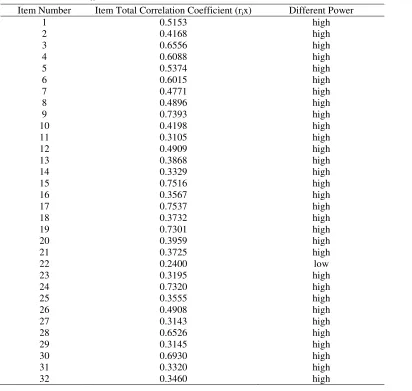
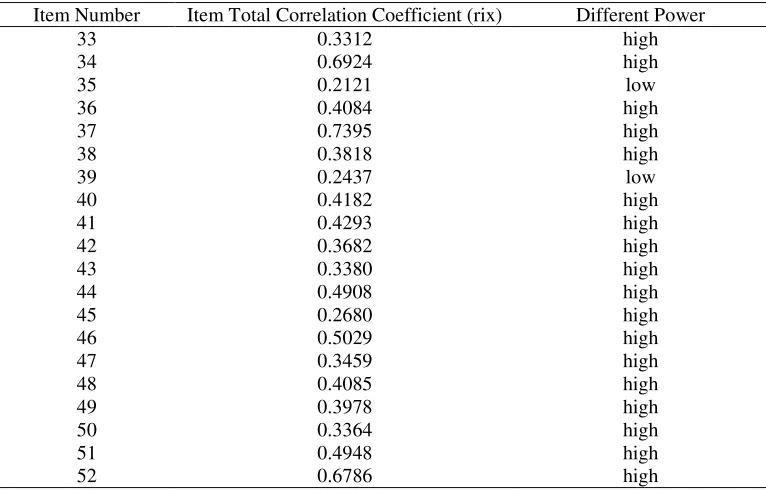
In the first experiment there are 9 items that fall grain, so to be 52 points, with 1 in the drop indicator. For the second trial, the items that fall there are 3 points, so to be 49 grains that have been through the test of validity and reliability. Thus the instruments that have been developed in this study amounted to 49 points, which came 9 indicators and build a 3-dimensional construct environmental ethics. The following table analyzes the results of the second test instrument based on test validity and reliability.
Table 3
Item Correlation Coefficient (rix) Trial 2
Item Number Item Total Correlation Coefficient (rix) Different Power
1 0.5153 high
2 0.4168 high
3 0.6556 high
4 0.6088 high
5 0.5374 high
6 0.6015 high
7 0.4771 high
8 0.4896 high
9 0.7393 high
10 0.4198 high
11 0.3105 high
12 0.4909 high
13 0.3868 high
14 0.3329 high
15 0.7516 high
16 0.3567 high
17 0.7537 high
18 0.3732 high
19 0.7301 high
20 0.3959 high
21 0.3725 high
22 0.2400 low
23 0.3195 high
24 0.7320 high
25 0.3555 high
26 0.4908 high
27 0.3143 high
28 0.6526 high
29 0.3145 high
30 0.6930 high
31 0.3320 high
Table 3 … continued
Item Number Item Total Correlation Coefficient (rix) Different Power
33 0.3312 high
34 0.6924 high
35 0.2121 low
36 0.4084 high
37 0.7395 high
38 0.3818 high
39 0.2437 low
40 0.4182 high
41 0.4293 high
42 0.3682 high
43 0.3380 high
44 0.4908 high
45 0.2680 high
46 0.5029 high
47 0.3459 high
48 0.4085 high
49 0.3978 high
50 0.3364 high
51 0.4948 high
52 0.6786 high
Table 4
Compatibility of Model Test Results (Goodness of Fit) Environmental Ethics construct with Second Order CFA
on Trial 2
Size Suitability Model Threshold Values Output Lisrel Model
χ2 low 51.72 Match
p Chi-square > 0.05 0.0013 not match
RMSEA < 0.08 0.059 Match
RMSR < 0.05 0.40 not match
GFI ≥ 0.90 0.96 Match
AGFI ≥ 0.90 0.93 Match
IFI ≥ 0.90 0.97 Match
NFI ≥ 0.90 0.94 Match
CFI ≥ 0.90 0.97 Match
RFI ≥ 0.90 0.91 Match
CN > 200 249.01 Match
Table 5
Summary of Factor Analysis of Environmental Ethics construct with Second Order CFA on Trial 2
Dimensions Name
Goodness of Fit
Indicators Factor
Loading T
value R
2
Remarks
Df χ2 p value
Initial Attitude
S2 0.59 0.35 valid
S3 0.68 3.70 0.47 valid
Information
I1 0.66 0.44 valid
I2 0.79 7.69 0.62 valid
25 51,72 0,0013 I3 0.59 7.73 0.34 valid
Moral Values
M1 0.88 0.77 valid
M2 0.79 13.90 0.63 valid
M3 0.63 10.99 0.39 valid
Table 6
Analysis of Construct Reliability Measurement Model Test 2
Indicators of Reliability Values
Construct Reliability 0.9756
Varianced Extracted 0.8192
5. Conclusion
Based on the results of empirical tests that have been done twice trials, it can be concluded that there were three-dimensional instrument of environment ethics of high school students that build the construct theories of environmental ethics; the dimensions of the initial attitude, information and moral values. These dimensions are in accordance with the theory that builds construct environmental ethics. Based on the model fit test using a second order confirmatory measurement model analysis, the final model obtained is appropriate or suitable for measuring the environmental ethics of high school students who see the value of goodness of fit that meets the criteria required cut-off value. Goodness of fit index that indicates the model fit are RMSEA, GFI, AGFI, IFI, NFI, CFI, RFI and CN, as well as the value of chi-square (χ). This instrument has been reliable with the value of Construct Reliability (CR) and Varianced Extracted (VE) above the cut-off value.
5.1 Implications
The results of the instrument development of environmental ethics of high school students who have been tested for validity and reliability is expected to provide benefits to the reader, teacher, school inspector, education observers, observers and environmental practitioners, and policy makers in education and the environment. This instrument can be a reference and can be used as a measurement of environmental ethics, especially high school students and learners in general. With the development of this instrument is expected to be input or consideration for the parties concerned to be able to take strategic steps for the preservation of the environment. Currently there is no instrument that measures high school students' environmental ethics. Therefore, teachers need to be helped to develop aspects of these attitudes towards the environment, so that learning objectives of PLH can be measured.
6. References
Attfield, R. (2010). Global environmental ethics [Etika Lingkungan Global]Translate Saut Pasaribu. Bantul: Kreasi Wacana.
Azwar, S. (2008). Scale preparation in psychology [Penyusunan Skala Psikologi]. Yogyakarta: Pustaka Pelajar. Engel, J. R., & Engel, J. G. (1990). Ethics of environment and development: Global challenge and international
response. London: Belhaven Press.
Gall, M. D., Gall, J. P., & Borg, W. R. (2007). Educational research. Boston: Pearson Education, Inc. Irwan, Z. D. (2007). Principles of organizational ecology and ecosystems, community, and environment
[Prinsip-Prinsip Ekologi dan Organisasi: Ekosistem, Komunitas, dan Lingkungan]. Jakarta: Bumi Aksara.
Keraf, A. S. (2002). Environmental ethics[Etika Lingkungan]. Jakarta: Penerbit Buku Kompas.
Latan, H. (2012). Structural equation modeling: Concepts and applications using the program Lisrel 8.80.
Bandung: Alfabeta.
Manik, K. E. S. (2007). Environmental management [Pengelolaan Lingkungan Hidup]. Jakarta: Penerbit Djambatan.
Rochyadi, Y., Djubaedah, E., & Ginanjar, A. (2009). Environmental education [Pendidikan Lingkungan Hidup].
Bogor: Setia Jaya Mandiri.
Soemarwoto, O. (2008). Ecology, environmental, and development [Ekologi, Lingkungan Hidup, dan Pembangunan]. Jakarta: Penerbit Djambatan.
Lingkungan Hidup]. Jakarta: Penerbit Universitas Terbuka.
Wijanto, S. H. (2008). Structural equation modelling Lisrel 8.8: Tutorial. Yogyakarta: Graha Ilmu.