
University of New Orleans University of New Orleans
ScholarWorks@UNO
ScholarWorks@UNO
University of New Orleans Theses and
Dissertations Dissertations and Theses
Spring 5-17-2013
Studies on Structure and Property of Polymer-based
Studies on Structure and Property of Polymer-based
Nano-composite Materials
composite Materials
Yun Zhai
Follow this and additional works at: https://scholarworks.uno.edu/td
Part of the Materials Science and Engineering Commons, and the Mechanical Engineering Commons
Recommended Citation Recommended Citation
Zhai, Yun, "Studies on Structure and Property of Polymer-based Nano-composite Materials" (2013). University of New Orleans Theses and Dissertations. 1680.
https://scholarworks.uno.edu/td/1680
This Dissertation is protected by copyright and/or related rights. It has been brought to you by ScholarWorks@UNO with permission from the rights-holder(s). You are free to use this Dissertation in any way that is permitted by the copyright and related rights legislation that applies to your use. For other uses you need to obtain permission from the rights-holder(s) directly, unless additional rights are indicated by a Creative Commons license in the record and/ or on the work itself.
Studies on Structure and Property of Polymer-based
Nano-composite Materials
A Dissertation
Submitted to the Graduate Faculty of the University of New Orleans
in partial fulfillment of the requirements for the degree of
Doctor of Philosophy in
Engineering and Applied Science Mechanical Engineering
by
Yun Zhai
B.S. Southwest JiaoTong University, Chenddu, China, 2006 M.S. Southwest JiaoTong University, Chengdu, China, 2008
ii
DEDICATION
iii
ACKNOWLEDGEMENT
First of all, I would like to show my thankfulness to my chief advisor Prof. David
Hui for the opportunity to work with him on this promising project. Discussions with
Prof. Hui always enlightened me a lot and helped to save me large amount of time on the
experiment design. I would also like to thank Prof. Hui for offering me opportunity to
travel to other research center and collecting valuable data from advanced facilities. His
patience with me, guidance for my research and wise suggestion will always be deeply
appreciated.
I would like to thank Dr. Kazim Akyuzlu, Dr. Weilie Zhou, Dr. Huimin Chen, and
Dr. Hall Carsie for serving on my committee.
Acknowledgements are also due to the Defense Advanced Research Projects
Agency for their financial support and Advanced Materials Research Institute at
University of New Orleans for their advanced facilities and resources.
I am thankful to Dr. Kazim M. Akyuzlu, Dr. Dongming Wei, Dr. Carsie A. Hall,
Dr. Weilie Zhou, Dr. Salvadore Guccione, Dr. Kenneth Holladay for all they have taught
me and all the help they offered. Special thanks to Dr. Weilie Zhou’s PhD student Kai
Wang and postdoctoral Dr. Baobao Cao for the assistance on the training of scanning
electron microscope and transmission electron microscopy.
I would also like to express my gratitude towards Prof. Mircea Chipara,
University of Texas Pan American, for his advices, patience, and gentleness during my
iv
experimental data interpretation. I also want to thank Prof. Chipara for the assistance on
Raman spectroscopy characterization which helped me to identify the carbon nanotube
feature in the composite materials.
Finally, I would like to thank my family for their unconditional love. Their
v
TABLE OF CONTENTS
ABSTRACT ... viii
CHAPTER 1 LITERATURE REVIEW ... 1
1.1. Introduction and Background ... 1
1.2. Layered Nano-Inclusion and Polymer Matrix ... 3
1.3. Structure of Single Wall Carbon Nanotube ... 6
1.4. Electronic Properties of Nanotubes ... 8
1.5. Mechanical Properties of Carbon Nanotubes ... 11
1.6. Application of Atomic Force Microscope ... 14
1.7. Raman Spectroscopy ... 20
1.8. Dispersion of Nanotube in Polymer ... 24
1.9. Fabrication of Nanotube/Polymer Composite ... 27
1.9.1 Solution Blending ... 27
1.9.2 Melt Blending ... 29
1.9.3 In Situ Polymerization ... 33
1.10. Application of Carbon Nanotube Composites ... 35
CHAPTER 2 TITANIUM DIOXIDE AND POLYANILINE COMPOSITE ... 36
2.1 Thermoelectric Effect and Applications ... 36
2.1.1 Seebeck Effect ... 36
2.1.2 Peltier Effect ... 38
2.1.3 Thomson Effect ... 38
2.1.4 Application of Thermoelectric Devices ... 39
2.2 Titanium Dioxide and Polyaniline Composite ... 41
2.3 Synthesis of TiO2/PANI Nano-composites ... 42
2.4 Characterization of TiO2/PANI Nano-composites ... 45
2.4.1 Scanning Electron Microscopy ... 45
2.4.2 X-Ray Powder Diffraction ... 47
2.4.3 Fourier Transform Infrared Spectroscopy ... 49
vi
2.4.5 Electrical Conductivity Measurement ... 54
2.4.5 The Seebeck coefficient Measurement ... 56
2.4.6 Figure of Merit ... 58
2.5 Summery ... 60
CHAPTER 3 POLYSTYRENE-ANATASE TITANIUM DIOXIDE NANOCOMPOSITE ... 61
3.1 Synthesis of Polystyrene/TiO2 composites ... 61
3.2 Thermogravimetric Analysis ... 63
3.2.1 Introduction of TGA Curve and Avrami Equation ... 63
3.2.2 Interface between Polymer and Nanoparticles ... 65
3.2.3 Experimental Results and Discussions ... 65
3.2.4 Mathematical Simulation on Thermal Analysis ... 68
3.3 Raman Spectroscopy and Wide-angle X-ray Scattering ... 73
CHAPTER 4 POLYSTYRENE-POLYANILINE-TIO2 TERNARY POLYMERIC NANOCOMPOSITE ... 78
4.1 Introduction ... 78
4.2 Methodology ... 80
4.3 Experimental Data ... 82
4.4 Conclusion ... 86
CHAPTER 5 POLYETHYLENE OXIDE-TIO2 NANOCOMPOSITES ... 87
5.1 Introduction ... 87
5.2 Methodology ... 89
5.3 Experimental Data ... 90
5.4 Conclusion ... 104
CHAPTER 6 VINYL ACETATE-ETHYLENE AND CARBON NANOTUBE COMPOSITES ... 105
6.1 Structure Introduction ... 105
6.1.1 Single Wall Carbon Nanotube ... 105
6.1.2 Vinyl Acetate-ethylene Copolymer ... 108
6.1.3 Poly(3,4-ethylenedioxythiophene)/poly(styrenesulfonate) ... 110
6.1.4 Networks Created With a Polymer Emulsion ... 111
6.2 Processing Methods ... 113
6.2.1 Nanodebee ... 113
6.2.2 Production line ... 115
vii
6.3.1 Scanning Electron Microscope Characterization ... 117
6.3.2 Raman Spectroscopy Characterization ... 119
6.3.3 Atomic Force Microscope Characterization ... 123
6.4 Calculation of Conducting Percolation in SWNT Composites ... 130
6.4.1 Assumptions ... 130
6.4.2 Calculation ... 133
CHAPTER 7 SUMMARY AND FUTURE WORK ... 136
REFERENCES ... 142
viii
ABSTRACT
The mixing of polymers and nanoparticles makes it possible to give advantageous
macroscopic material performance by tailoring the microstructure of composites. In this
thesis, five combinations of nano inclusion and polymer matrix have been investigated.
The first type of composites is titanium dioxide/ polyaniline combination. The
effects of 4 different doping-acids on the microstructure, morphology, thermal stability
and thermoelectric properties were discussed, showing that the sample with HCl and
sulfosalicylic dual acids gave a better thermoelectric property. The second combination is
titanium dioxide/polystyrene composite. Avrami equation was used to investigate the
crystallization process. The best fit of the mass derivative dependence on temperature has
been obtained using the double Gaussian dependence. The third combination is titanium
dioxide/polyaniline/ polystyrene. In the titanium dioxide/polyaniline/ polystyrene ternary
system, polystyrene provides the mechanical strength supporting the whole structure;
TiO2 nanoparticles are the thermoelectric component; Polyaniline (PANI) gives the
additional boost to the electrical conductivity. We also did some investigations on
Polyethylene odide-TiO2 composite. The cubic anatase TiO2 with an average size of
13nm was mixed with Polyethylene-oxide using Nano Debee equipment from BEE
international;
Single wall carbon nanotubes were introduced into the vinyl acetate-ethylene
copolymer (VAE) to form a connecting network, using high pressure homogenizer (HPH).
ix
sample quality. Theoretical percolation was derived according to the excluded volume
theory, turning out the threshold () as a function of aspect ratio (A) to be
1 exp .
Key words: Single wall carbon nanotube, polymer, titanium dioxide, thermoelectric,
1
CHAPTER 1
LITERATURE REVIEW
1.1. Introduction and Background
Polymer composites have broad applications in industry products, such as
sporting goods, aerospace components, automobile, because the composite material
combines the excellent physical properties of the Nano filler and the mechanical stability
of the polymer matrix. The clay-reinforced resin was introduced in the early 1900’s as
one of the first mass-produced polymer-nanoparticle composites[1]. In early 1990s,
Toyota researchers revealed the introduction of mica into nylon produced a five-fold
increase in the yield and tensile strength of the material[2]. After that, the
polymer-nanoparticle composites became a popular research area in material science and
engineering. The final products do not have to be in nanoscale, but can be micro- or
macroscopic in size. This surge in the field of nanotechnology has been greatly facilitated
by the application of scanning tunneling microscopy and scanning probe microscopy in
the early 1980s[3]. Also the increasing application of computer modeling and simulation
has made it easier to design and predict the material performance at the nanoscale[4].
The material physical properties changes significantly when micro particles
transits to nanoparticles. One main character of nanoscale materials is the large surface
for a given volume. When the particle size transits from micro to nanoscale, the physical
properties changes dramatically because many chemical and physical interaction are
2
Figure 1.1 is the common particle geometries and their surface area-to–volume ratios. The area-to-volume ratios are dominated by the first term in the equation
especially for the fiber and layered material. The second term (2/l and 4/l) is often
omitted compared to the first term. Therefore when the particle diameter, layer thickness
and fibrous material diameter change from micrometer to nanometer, the surface
area-to-volume ratio will be affected by three orders of magnitude[5].
3
1.2. Layered Nano-Inclusion and Polymer Matrix
According to interaction between the nano layer and polymer matrix, three types
of nanocomposites can be defined. We use layered silicate and polymer composite as
example[6].
If no polymers get involved into the interspace between silicate layers, as shown
in Figure 1.2(a), the layers exist as a separated phase in the matrix. This is so-called
phase separated nanocomposite. The layered phase can be identified by X-Ray diffraction,
Figure 1.3(a)[7]. When the polymer chain is intercalated between the silicate layers, it
becomes intercalated nanocomposite. Since the interspaces between the layers are
increased, the peak of layer phase shifts towards the lower angle values, Figure 1.3(b). If
the nano layers are dispersed well enough with spacing larger than 8nm, the layer phase
4
5
6
1.3. Structure of Single Wall Carbon Nanotube
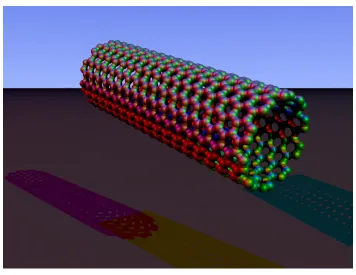
Single wall carbon nanotube is a single layer of a graphite crystal rolled up into a
seamless cylinder. The cylinder wall is 1 atom thick and the tube has 10-40 numbers of
carbon atoms along the circumference and a micron scale length along the cylinder axis[8]
(Figure 1.4).
Figure 1.4 Single wall carbon nanotube
Each SWNT is specified by the chiral vectorC, which is often described by the
pair of indices n, m that denote the number of unit vector naand ma in the hexagonal
honeycomb lattice.
7
The physical meaning of chiral vector is the description of how graphite sheet is
rolled up. The chiral angle θ is the angle between the unite vector a and chiral vectorC,
as showed in Figure 1.5. Three types of single wall carbon nanotube can be defined
according to the chiral angle. When θ =0°, it is called zigzag nanotube; when θ =30°, it’s
called armchair nanotube; when 0° ! 30° , it’s called chiral nanotube. The
translation vector T is perpendicular to the chiral vectorC, meaning the axial direction of
the nanotube cylinder and therefore the length of vector |C| can be understood as
circumference of bottom plane.
8
1.4. Electronic Properties of Nanotubes
In the field of material science, microstructure determines the physical properties
of material. As for carbon nanotube, the electronic property mainly depends on two
structure factors: the chirality and the diameter. As we mentioned before, the chirality of
carbon nanotube can be described by a pair of indicesn, m. When n m(armchair), the
nanotubes show metallic properties; When n m 3p, where p is an integer, the
nanotubes are expected to show metallic property; When n m $ 3p, the nanotubes are
expected to semi-conducting materials[10]. Figure 1.6 shows the conducting properties
with respect to chiralities on a 2-dimensional graphite sheet.
When it comes to diameter, the band gap theory needs to be considered. As
showed in Figure 1.7, the higher band gap energy
valence band, the lower conductivities of the material.
Figure 1.7 The electronic band structure of metals, semiconductors, and insulators
The band gap can be
where is the C-C tight-binding overlap
distance in graphite sheet;
see the band gap energy is inversely proportional to
Jeroen W. G et al experimentally showed the value of
diameter ranging from 0.6 to 1.1nm
9
it comes to diameter, the band gap theory needs to be considered. As
, the higher band gap energy between the conduction band
valence band, the lower conductivities of the material.
he electronic band structure of metals, semiconductors, and insulators
can be described as
binding overlap energy; is the nearest neighbor
is the diameter of the nanotube. From this equation we can
is inversely proportional to the diameter of the nanotube.
et al experimentally showed the value of as a function
diameter ranging from 0.6 to 1.1nm[11], as showed in Figure 1.8.
it comes to diameter, the band gap theory needs to be considered. As
the conduction band and the
he electronic band structure of metals, semiconductors, and insulators
(1.2)
neighbor C-C
is the diameter of the nanotube. From this equation we can
the diameter of the nanotube. Wilder,
10
11
1.5. Mechanical Properties of Carbon Nanotubes
Since the discovery of carbon nanotube[12-15], it was expected to display similar
stiffness like graphite with in-plane modulus of 1.06TPa[16]. An empirical lattice
dynamics model was used to predict the elastic properties of single and multilayered
nanotubes[17], Figure 1.9. JP Lu concluded that elastic moduli are insensitive to size and
helicity and the Young's and shear moduli of nanotubes are comparable to that of
diamond.
12
Wong et al made a direct measurement on elasticity, strength and toughness of
multi wall nanotubes[18]. They used AFM to measure the bending force versus
displacement along the unpinned lengths of nanotube, Figure 1.10. After the AFM tip
made contact with nanobeam, the measured lateral force increased linearly as the
nanobeam was elastically displaced from its equilibrium position.
Figure 1.10 AFM tip scanning perpendicular to the axis of the nanobeam[18]
A typical F d data was acquired to determine the E of a nanotube. According to
the F d curve, force constant as a function of position was obtained, Figure 1.11, where
force constant kx ()
(* .They got the average E value of 1.28 . 0.59TPa with no
dependence on tube diameter, similar to the in-plane modulus of graphite 1.06TPa. The
13
14
1.6. Application of Atomic Force Microscope
Atomic force microscope was invented by Binning, Quate and Gerber in 1986[19].
It is a powerful tool to detect the material surface topography in nano scale. Figure 1.12 is
the central component of the AFM system used in this research. The major parts from top
to bottom are laser head, probe holder and probe, scanner, motor control and base. The
height value as a function of position x, y is collected when a sharp probe is scanned
across the material surface.
15
The laser path is showed in Figure 1.13. A laser is generated from the laser head 1
and then reflected by the mirror 2, hit the back of cantilever, reflected by the tilt mirror 4
and finally detected by the photodetector 5.
Figure 1.13 Multimode AFM laser head
There 2 typed of scanning method for this AMF: contact mode and tapping mode.
Contact mode AFM operates by scanning a tip attached to the end of a cantilever across
the sample surface while monitoring the change in cantilever deflection with a split
photodiode detector. A feedback loop, Figure 1.14(a), maintains a constant deflection
between the cantilever and the sample by vertically moving the scanner at each x, y
data point to maintain a “setpoint” deflection. By maintaining a constant cantilever
16
Tapping Mode AFM operates by scanning a tip attached to the end of an
oscillating cantilever across the sample surface. The cantilever is oscillated at or slightly
below its resonance frequency with amplitude ranging typically from 20nm to 100nm.
The tip lightly “taps” on the sample surface during scanning, contacting the surface at the
bottom of its swing. The feedback loop, Figure 1.14(b), maintains a constant oscillation
amplitude by maintaining a constant RMS of the oscillation signal acquired by the split
photodiode detector.
Figure 1.14 (a) contact mode (b) tapping mode
Atomic Force microscope can be used to detect interfacial adhesion between the
nanotube and surrounding polymer[20]. One end of nanotube is attached on the tip of
AFM and the other end is embedded in polymer matrix. During the polling out process,
the interfacial shear strength can be measured by detecting the cantilever bending force,
as showed in Figure 1.15. Increasing the nanotube embedded length causes the nanotube
to break instead of pullout from the polymer. As a result, the forces required to pull out
17
18
Figure 1.16 The force required to pull out nanotubes embedded at various lengths[20]
Atomic force microscopy-based nanoindentation can be used to map the nano
scale mechanical properties like elasticity and stiffness. Dusan Losic et al performed
nanoindentation on cribellum surface using Veeco Dimension 3000 AFM with diamond
tip[21], Figure 1.17. Typical force penetration curve with loading and unloading can also
19
20
1.7. Raman Spectroscopy
When a strain is applied to a nano composite material, the interatomic distances of
C-C change, and thus the vibrational frequencies of some of the normal modes change
causing a Raman peak shift.
The Raman spectrum for nanotubes has been well documented by Rao, A. M et
al[22]. They did lattice dynamics calculations based on C-C force constant. The
intensities and frequencies turned out to agree well with Raman scattering measurement,
Figure 1.18.
21
C.A. Cooper et al observed that G5 Raman band shifts to a higher wavenumber
when the SWCTs is under hydrostatic pressure, Figure 1.19; while G5 Raman band shifts
to a lower wavenumber when tensile stress is applied, Figure 1.20[23]. They
demonstrated that the effective modulus of SWNTs dispersed in a composite could be
over 1 TPa.
22
Figure 1.20 Variation of the 65 Raman peak position with tensile strain for pulsed laser SWNT dispersed in epoxy resin[23].
Schadler, L. St al found the second order band of multiwall carbon nanotube
shifts slightly positive in tension and negatively in compression, Figure 1.21[24]. The
large shift in compression compared to tension indicates that the MWCTs carry more
23
.
24
1.8. Dispersion of Nanotube in Polymer
It is quite a challenge to achieve a high degree dispersion of SWNTs in polymer
matrix due to their tendency to aggregate in bundles and agglomeration[25]. Wise, K.E et
al dispersed SWNTs in a nitrile functionalized polyimide matrix[26]. They observed G
band upshifts in Raman spectra which indicate a noncovalenet interaction between
nanotube and polymer, Figure 1.22.
25
Badaire, Stéphane et al measured the dimentions of CNTs in dispersed state via
Depolarized dynamic light scattering[27]. They studied the effect of sonication time and
power on the dispersion of nanotube in surfactant solutions, as showed in Table 1.1. The
diameter of the SWNT bundles decrease with the incraeasing of sonication time at a
constant pressure.
Table 1.1 Influence of Sonication Time and Power on the Dimensions of CNT Bundles[27]
Barry J. Bauer et al used small angle neutron scattering to determine the average
dispersion of large collection of SWNTs. They applied power law to measure the degree
of aggregation[28]. For example, a slope of between -2 and -3 for a chain molecule such
as polymer or a SWNT strongly suggests aggregation, Figure 1.23 Power law scattering
26
Figure 1.23 Power law scattering from fractal objects[28]
Dale W. Schaefer et al used small angle X-ray scattering to determine the
morphology of carbon nanotube suspension on a scale of 1nm-50µm[29]. They found the
morphology is dominated by a network structure of aggregated tubes instead of rod like
27
1.9. Fabrication of Nanotube/Polymer Composite
Three mainly fabrication methods have been used to synthesize nanotube/polymer
composite: solution blending, melt blending and in situ polymerization. All methods are
to improve the nanotube dispersion in polymer matrix because a homogeneous
distribution of nanotube has a great influence on composite performance[30].
1.9.1 Solution Blending
The solution blending is the most popular method to fabricate the
nano-composite[31]. Three major steps are involved in solution blending: disperse nanotubes
in a solvent; mix the solvent with polymer which can be solid or emulsion; drying the
solution into a solid composite. Before the drying process, usually a high power
sonication is applied to make a temperately suspension with nanotube[32]. It is common
for researchers to use different kinds of surfactants to modify the surface of the nanotube
and make the tubes stable in the solution[33].
M. F. Islam et al used NaDDBS(C12H25C6H4SO3Na) as surfactant to exfoliate
nanotube bundles into single tubes with a fraction of 63±5% in water[32]. They used
tapping mode AFM to measure the fraction of single tubes. The tube diameters were
derived from height measurements. As showed in Figure 1.24, the shaded regions define
28
Figure 1.24 Length and diameter distribution of HiPCO tubes dispersed by the bath sonicator[32]
Xiaoyi Gong et al used Polyoxyethylene 8 lauryl as nonionic surfactant to
dissolve nanotube in acetone with mechanical stirring[34]. The addition of 1 wt % carbon
nanotubes in the composite increases the glass transition temperature from 63 °C to 88 °C.
As shown in Figure 1.25(b), the agglomerated carbon nanotubes without surfactant can
29
Figure 1.25 SEM photographs of carbon nanotubes on fracture surfaces of the composite samples: (a) with surfactant and (b) without surfactant[34]
1.9.2 Melt Blending
Melt processing method is suitable to deal with thermoplastic polymers which can
be easily softened when heated. When the heating temperature is above the polymer glass
transitionT7, semi-crystalline polymers become soft enough to form a viscous liquid[35].
30
form of compression molding, injection molding or extrusion[36]. Several groups have
report their composite samples processed by melt blending in Polystyrene[37],
PMMA[38], polypropylene[39], PBO[40].
R. Haggenmueller et al combined the solvent casting and melt mixing to disperse
SWNT in PMMA[38]. They broke solvent casting film into pieces and hot pressed the
pieces at 1808 and 3000lb for 3 minutes. The melt mixing procedure was repeated up to
31
Figure 1.26 Optical micrographs of a SWNT±PMMA nanocomposite (a)solvent casting sample. (b) hot pressing (180°C, 3000 lb, 3 min) for 1 cycle; (c) 5 cycles; (d)
20 cycles[38].
Emilie J. Siochi et al used melt extrusion and fiber drawing process to align
SWNT in the fiber direction and achieved higher tensile moduli and yield stress[41].
Figure 1.27 show the single screw extruder developed at NASA Langley Research Center.
A filter (component 4 in the figure) was used in the nozzle to help breaking up
32
Figure 1.27 Components of extruder used for melt processing of SWCNT/Ultem nanocomposites[41].
Arup R. Bhattacharyya et al[42] mixed polypropylene with 1wt% SWNT in a
Haake rheomix mixer at 2408 at 50rpm for 30min and passed the PP/SWNT composite
through a 300, 250, 120 and 80 mesh filters at 2408. X-ray diffraction was obtained to
33
Figure 1.28 Integrated wide angle X-ray diffraction intensity of PP/SWNT
composite fiber[42].
1.9.3 In Situ Polymerization
In situ polymerization applies condensation reactions to connect functionalized
nanotubes to the polymer matrix by covalent bonding[43]. The Chemical modification
and functionalization of nanotube can enhance the interaction between pristine nanotubes
and surrounding matrix. If the interfacial bonding is not strong enough, the load transfer
from polymer to nanotube could be limited[44]. Also the sliding of the SWNTs within
the blending of bundles limits the mechanical enhancement due to the disorder of the
34
Jiang Zhu et al used optimized acid treatment and subsequent fluorination to
disperse functionalized SWNTs into an epoxy composite, increasing 30% in modulus and
18% in tensile strength[47]. Xiaoyi Gong et al reported the introduction of surfactant as
processing aid increased the glass transition temperature from 638 to 888. The elastic
modulus was also increased by more than 30%[34]. Mohammad Moniruzzaman et al
applied high shear mixing of the epoxy resin and SWNT and heat treating the mixture
prior to introducing the hardener to prepare SWNT/epoxy nanocomposites. The whole
method is showed in Figure 1.29. They researched an improvement of 17% in flexural
modulus and 10% in flexural strength at 0.05wt% of nanotubes[48].
35
1.10. Application of Carbon Nanotube Composites
It has been reported that the tensile modulus and strength of the nanotubes range
about 270Gpa to 1TPa and 11-200GPa [49, 50]. The carbon nanotubes exhibit excellent
tensile strength compared with graphite, Kevlar fibres and stainless steel, as showed in
Figure 1.30[10]. Since the carbon-carbon covalent bonds are one of the strongest in
nature, the tube structure based on such bonds would produce an extraordinary strong
material along the axis of tube. The nanotubes are 100 times stronger than steel but only
one-sixth as heavy as steel making it enable to be used as reinforcements in high strength,
light weight, high performance composites.
36
CHAPTER 2
TITANIUM DIOXIDE AND POLYANILINE
COMPOSITE
2.1 Thermoelectric Effect and Applications
The thermoelectric effect is the direct conversion of temperature differences to
electric voltage and vice-versa. An applied temperature gradient can cause charge carriers
in the material to diffuse from the hot side to the cold side. Conventional metal or metal
alloys can generate tens of microvolts per degree temperature difference. They are used
in the measurement of temperature or as sensors to operate control systems. However, the
modern semiconductors with material properties and geometry specifically tailored
possess Seebeck coefficients of hundreds of microvolts per degree. The term
“thermoelectric effect” encompassed three separately identified effects: the Seebeck
effect, Peltier effect and Thomson effect.
2.1.1 Seebeck Effect
The Seebeck effect is the conversion of temperature differences directly into
electricity. The thermoelectric energy conversion can be discussed in with reference to
the schematic of a thermocouple shown in Figure 2.1. A and B are two thermoelecments electronically connected. The junctions of A and B are maintained at different
where and are the thermopowers of material A and B as a function of temperature.
For a small temperature differences the relation is linear, the above formula can be
approximated as:
Figure 2.1 Schematic basic thermocouple. A and B are two different materials.
37
are the thermopowers of material A and B as a function of temperature.
or a small temperature differences the relation is linear, the above formula can be
Schematic basic thermocouple. A and B are two different materials.
are the thermopowers of material A and B as a function of temperature.
or a small temperature differences the relation is linear, the above formula can be
38
2.1.2 Peltier Effect
In Figure 2.1, if the reverse situation is considered with an external V voltage
applied and a current I flows around the circuit then a rate of heating q occurs at one
junction between A and B and a rate of cooling q occurs at the other. The ratio of I to q
defines the Peltier coefficient Π >
? , representing how much hear current is carried per
unit charge through a given material.
2.1.3 Thomson Effect
The Thomson effect describes the heating or cooling of a current-carrying
conductor with a temperature gradient. If a current density J is passed through a
homogeneous conductor, and there is a temperature difference between two points of the
conductor, the material will either absorb or release heat. The rate of the generation of
heat q per unit volume is:
q ρJ µJdT
dx
where ρ is the resistivity of the conductor, µ is the Thomson coefficient. The first
term is the Joule heating, the second term is the Thomson heating following J sign
39
2.1.4 Application of Thermoelectric Devices
Thermoelectric devices are simple and have no moving parts. As shown in the
Figure 2.2 left, when an external power is applied on the thermal couple, negatively
charged electrons carry electrical current in the n-type leg, and positively charged holes
carry the current in the p-type leg. Both the electrons and the holes carry heat away from
the cold side, resulting cooling. Inversely, if a heat source is applied on one side of the
device, as shown in Figure 2.2 right, a voltage can develop on the other side, converting
heat energy to electrical power.
40
The critical issue with the thermoelectric device is the poor efficiency. The
material properties of the C- and D- type semiconductor plays an important role in
improving the energy conversion efficiency. The efficiency of the thermo electrical
material is determined by a dimensionless parameter EF, called figure of merit:
EF GHI
where G is the electrical conductivity, H is the Seebeck coefficient, and I is the
thermal conductivity. Effective thermoelectric materials have a low thermal conductivity
41
2.2 Titanium Dioxide and Polyaniline Composite
Recently conducting polymer with heavily doped semiconductors has become
popular due to the fact that insulators have poor electrical conductivity and metals have
low Seebeck coeffient. Titanium dioxide stands out among the most promising transition
semiconductors because of its special chemical and physical properties[52]. However,
low value of EF and other unmatched mechanical properties limit its application.
Polyaniline (PANI) is one of the most important conducting polymers because of
its high environmental stability, low cost and reversible control of its conductivity[53].
Polymer/inorganic composites have received much attention due to their independent
electrical, optical, and mechanical properties[54-56]. The combination of conducting
polymers and semiconducting inorganic materials with the properties of semiconducting
inorganic particles has brought new prospects for applications[57]. Usually, the strong
interaction between eigenstate PANI rigid chains leads to low conductivity. However, H+
can be easily poured into the PANI molecular chains, and thus increases the level of
charge delocalization and improves the conductivity. Up to now, various protonic acids
have been used as dopants during the process of synthesis. Commonly, these protonic
acids were inorganic acids (e.g. HCl, H2SO4, H3PO4, and HClO4) [58-60]. Recently, it
has been reported that PANI doped with organic acids, such as benzenesulfonic acid
(BSA)[61], sulfosalicylic acid (SSA)[62], camphorsulfonic acid (CSA)[63] and
42
To deal with the aggregation of TiO2 nano-particles, we introduce
attapulgite(ATT) into the material system. ATT is a species of hydrated manesium
aluminum silicate non-metallic mineral [(H2O)4(Mg,Al,Fe)5(OH)2Si8O20 •4H2O] with
commonly a fibrous morphology, is characterized by a porous crystalline structure
containing tetrahedral layers alloyed together along longitudinal sideline chains[65].
Presently ATT has been widely used as adsorbents, adhesives, and catalyst supports,
owing to its unique structure and considerable textual properties[66, 67].
2.3 Synthesis of TiO
2/PANI Nano-composites
ATT/TiO2 (ATO) nano-particles were first prepared by heterogeneous nucleation
method; then, ATT/TiO2/PANI (ATOP) was synthesized by in situ polymerization in the
presence of ATO nano-particles under various acids (HCl, SSA, HCl+SSA dual acid,
HClO4). The ATT was used as support to reduce the aggregation and improve the
dispersibility of nano-particles, and reduce the thermal conductivity simultaneously. We
systematically investigated the effects of various acid-doping on the morphology,
crystallographic, thermal stability and thermoelectric properties of ATOP
nano-composites.
Figure 1 shows the flow chart of preparation on the ATOPnano-composites. The
ATT/TiO2 (ATO) nano-particles were synthesized firstly. 10 ml Tetrabutyl titanate
43
smidgeon of triethanolamine (about 0.2 ml) by vigorous mechanical stirring (namely
solution A). 1.3 ml HNO3 in 2 ml distilled water was added to 10 ml absolute alcohol
(namely solution B). Then solution B was added dropwise to solution A with vigorous
stirring for 1 h at room temperature. After mixing uniformly, transparent, stable and
flaxen TiO2 sol was added dropwise to the pure ATT suspension with sonic stirring for
1h. After aging for 4 h in the air, the mixture was washed with distilled water. The
resulting solid was dried at 353 K for 24 h and subsequently calcined at 723 K for 3 h;
then the solid was ground into ATO nano-particles. The second step was to fabricate
ATT/TiO2/PANI (ATOP) nano-composites, which were synthesized by the oxidation of
precursor with ammonium peroxydi-sulfate (APS) as oxidant. ATO (0.64g) was
dispersed into 40ml 1.0 M acid solution (HCl, SSA, HCl+SSA dual acid, HClO4) by
sonication respectively. Then 1.86g aniline and little surfactant hexadecyl trimethyl
ammonium bromide (CTAB) were added into ATO acid solution under protection of
nitrogen atmosphere. The molar ration of aniline/surfactant was taken as 10. After 30 min,
APS (3.65g) in 20ml 1.0 M acid solution was added dropwise to this mixture.
Polymerization was carried out at 273 K under nitrogen atmosphere with controlled
stirring for 5 h. Dark green ATOP nano-composites was filtered and washed with
44
Figure 2.3 Flow chart of preparation on the ATOP nano-composites
Ti(OBu)4
C2H5OH)
Solution A
HNO3
H2O Solution B
C2H5OH)
TiO2 sol
ATT suspension
ATO nano-particles
ATO acid solution
Aniline CTAB
HCl, SSA, HCl+SSA, HClO4
APS ATOP nano-composites
STEP 1
45
2.4 Characterization of TiO
2/PANI Nano-composites
The surface morphology of the TiO2/PANI nano-composites was examined by a
Hitachi S-3000N scanning electron microscope (SEM). X-ray powder diffraction were
performed on a D8 Advance diffractometer (XRD) using Cu-Kα radiation (λ=0.15405
nm). FTIR spectra were recorded using a Nicolet 5700 Fourier Transform Infrared
Spectrometer in a dry-nitrogen atmosphere. Thermo-gravimetric analysis was performed
with NETZSCH STA409PC thermal analyzer at a heating rate of 15 K/min from 298 K
to 473 K under a nitrogen atmosphere. The thermal conductivity of the composites was
measured using EKO HC-110 thermal conductivity test meter, which is based on a
steady-state heat flux technique. The powder samples were in the form of compressed
pellet (Φ22 mm×2 mm) for the thermoelectric related measurements. Electrical conductivity was measured by ST2253 four-probe tester. The Seebeck coefficient was
tested on BHTE-08 Seebeck Measurement System.
2.4.1 Scanning Electron Microscopy
Figure 2.4 (a)-(d) shows the SEM micrographs of HCl, SSA, HCl+SSA and
HClO4 doped ATOP nano-composites, respectively. Hereinafter these samples were
denoted as ATOP-1, ATOP-2, ATOP-3, and ATOP-4. It can be seen that all the samples
are of rod-like structure with a length of ~650 nm and diameter of ~100nm, which agrees
46
the pure ATT, the surface of samples is not smooth; and the dimensions of samples are
increased. This may attribute to the extra TiO2 and PANI coatings, confirming a good
cladding structure.
Figure 2.4 SEM image of ATOP nano-composites. (a) ATOP-1 nano-composites; (b) ATOP-2 composites; (c) ATOP-3 composites; and (d) ATOP-4
47
2.4.2 X-Ray Powder Diffraction
Fig. 3 displays the XRD pattern of various acid-doped ATOP samples. Pure TiO2,
ATT and PANI are also listed for the comparison. It can be seen that the diffraction
patterns of all ATOP samples match well with the typical patterns of ATT、PANI and
TiO2. The peaks at 8.56° can be observed in the doped samples, which is ascribed to {110}
crystal face of ATT. The distinct peaks of 2! at 25.4°, 38°, 48.3°, 54.1°, 55.2°, 53.9°,
62.8°and 70.5° are in agreement with the standard anatase TiO2 XRD spectrum. Also the
distinct peaks of 2! at 15.1°, 20.8°and 25.4° agree with the standard PANI XRD
spectrum, indicating the formation of PANI. Two peaks at 20.8° and 25.4° belong to
periodicity parallel and perpendicular to polymer chain respectively. It is reported that
there was a positive correlation between the conductivity and intensity
of diffraction peaks at 25.4°. However, only according to the counts of diffraction peaks
at 25.4°, we cannot deduce the order of electric conductivity among various acid-doped
48
10
20
30
40
50
60
70
80
ATOP-4
ATOP-3
ATOP-2
C
o
u
n
ts
(
A
.U
.)
2
θ
(
O)
ATOP-1
ATT
PANI
TiO
2Figure 2.5 X-ray diffraction patterns of pure ATT, PANI, TiO2, and ATOP
49
2.4.3 Fourier Transform Infrared Spectroscopy
The FTIR spectra of the ATOP samples are shown in Figure 2.6. The absorption
band observed at 2912 cm-1 ~ 2851 cm-1 in the doped sample, can be ascribed to the
surfactant DBSA; the absorption bands at 1676 cm-1 and 1019 cm-1 are assigned to the
O=S=O stretching of organic acid. It should be noted that most PANI peaks of
acid-doped ATOP samples are shifted to the lower wave number compared with that of the
eigenstate PANI. Table 2.1 lists all the absorption bands in the spectra. The offset of
vibration peaks can be calculated, comparing with the eigenstate PANI. The maximum
offset occurs in N=Q=N bond, shifted by 22 cm-1 (ATOP-1), 6 cm-1 (ATOP-2), 26 cm-1
(ATOP-3), and 18 cm-1 (ATOP-4), respectively. This red shift phenomenon may result
from conjugative effect after doped with acids. Some documents indicate that the dopants
are mainly bonded with the nitrogen atoms in quinine-type. It is believed that acid-doping
leads to a delocalization effect which decreases the force constant between atoms, and
thus decreases the electron density on PANI chains in various levels. Similar results can
50
3600 3000 2400 1800 1200
600
ATOP-4
ATOP-3
ATOP-2
1 2 3 6 1 2 9 4ATOP-1
pure PANI
1 0 1 9T
ra
n
s
m
it
ta
n
c
e
(%
)
Wavenumbers(cm
-1)
1 2 2 9 1 3 0 0 1 3 0 0 1 2 3 0 1 2 2 8 1 3 0 0 1 0 1 9 1 2 9 6 1 2 2 9 1 6 7 6 1 6 7 6
51 Wavenumber((((cm-1))))
Band characteristics PANI ATOP-1 ATOP-2 ATOP-3 ATOP-4
3435 3430 3440 3436 3434 N-H stretching vibration
1586 1564 1580 1560 1568 N=Q=N vibration
1495 1480 1480 1480 1480 N-B-N stretching vibration
1230, 1302 1229, 1300 1228, 1300 1229, 1296 1230, 1300 Ar-N stretching
1121 1106 1115 1103 1109 C-H (Q) in of plane bending vibration
827 798 798 798 798 C-H (B) out of plane bending vibration
638 616 595 595 624 C-C (B) bending vibration
52
2.4.4 Thermogravimetry Analysis
The thermal analysis results of pure TiO2, ATT, PANI and various acid-doped
ATOP samples are illustrated in Fig. 5. It can be seen that the residual weight of
acid-doped ATOP samples is much higher than those of pure TiO2, ATT, and PANI. This
means the thermal stability of ATOP samples can be improved after composite treatment.
However, the weight loss of ATOP-1 sample is the largest, when the temperature is
higher than 350 K, compared with that of other three acid-doped samples. Usually the
weight loss of the samples at low temperature attribute to the removal of free water,
absolute alcohol, acid and other small molecules. In fact, the weight loss of ATOP-2
sample is the minimum and that of the ATOP-3 is less. This result is in line with our
expectation because hydrochloric acid is volatile; whereas organic acids and perchloric
acid are less volatile. To sum up, the thermal stability of the ATOP samples doped with
53
300
320
340
360
380
400
80
85
90
95
100
ATOP-1
ATOP-2
ATOP-3
ATOP-4
ATT
PANI
TiO
2
W
e
ig
h
t(
%
)
Temperature (K)
54
2.4.5 Electrical Conductivity Measurement
The temperature dependence of electrical conductivity (σ) of pure TiO2, PANI and various acids doped ATOP samples is shown in Figure 2.8. It is of interest that the
ATOP nano-composites possess a higher electrical conductivity, compared with the pure
TiO2 and PANI. This probably originates from the compound of TiO2 and PANI. On the
one hand, TiO2 can cause the regular arrangement of PANI chains; on the other hand, the
cladding structure is conducive to electronic transfer along chain and jump between
chains. Although the ATT belongs to insulator, the addition of it has no negative effect
on electrical conductivity. In contrast, the electrical conductivity of ATOP samples has
been improved. Moreover, it should be noted that the electrical conductivity of all the
samples can reach several S/cm and exhibit a typical non-metallic temperature
dependence (dσ/dT>0)[69]. This may be ascribed to the increase of the carrier concentration after the temperature elevated; and thus increase the electrical
conductivity[70]. In our present work, the electrical conductivity of ATOP-3 sample is
the best; it reaches the maximum (6.67 S/cm), 2 times more than that of PANI (2.58 S/cm)
55
300
320
340
360
380
0
2
4
6
8
ATOP-1
ATOP-2
ATOP-3
ATOP-4
TiO
2
PANI
σ
(
S
/c
m
)
Temperature (K)
Figure 2.8 The temperature dependence of electrical conductivity of pure TiO2,
56
2.4.5 The Seebeck coefficient Measurement
Figure 2.9 shows the temperature dependence of the Seebeck coefficient (α) for pure TiO2, PANI and various acids doped ATOP samples. The Seebeck coefficient shows
an opposite trend to that of electrical conductivity. The pure TiO2 and PANI are proved to
be n-type inorganic semiconductor and p-type organic semiconductor, respectively. The
ATOP nano-composites are classified as p-type. It is encouraging to find out that the
Seebeck coefficient of acid-doped ATOP samples is about 2-4 times higher than that of
pure TiO2 and PANI. In addition, the Seebeck coefficient decreases with the temperature
increasing attribute to the increase of carrier concentration[71]. The Seebeck coefficient
of ATOP-3 sample is better than others in the range of 320-373 K; it keeps a higher value
57
300
320
340
360
380
-80
-40
0
40
80
120
160
ATOP-1
ATOP-2
ATOP-3
ATOP-4
TiO
2
PANI
α
(
µ
V
/K
)
Temperature (K)
Figure 2.9 The temperature dependence of Seebeck coefficient of pure TiO2, PANI,
58
2.4.6 Figure of Merit
The thermoelectric figure-of-merit (ZT) is a common measure of a material’s
energy conversion efficiency:
ZT= (α2σ/κ)T Equation 2.1
Where α, σ, κ, and T are Seebeck coefficient, electrical conductivity, thermal conductivity and absolute temperature respectively.
The thermal conductivity of ATT is about 0.06 Wm-1K-1 and that of PANI is
around 0.3 Wm-1K-1 at room temperature[72, 73]. Mun et al. have reported the thermal
conductivity of TiO2 is 0.5 Wm-1K-1 [74]. The average thermal conductivity of ATOP
nano-composites is about 0.148 Wm-1K-1. We also note that the thermal conductivity do
not change significantly with the temperature increased. For example, the thermal
conductivity of ATOP-3 is about 0.155 Wm-1K-1 at 323 K, and is about 0.144 Wm-1K-1 at
373 K. This means that the addition of ATT can reduce the thermal conductivity
efficiently and maintain a good stability over a wide temperature range.
The ZT of ATOP nano-composites can be calculated according to the equation 1.
Figure 2.10 shows the ZT of ATOP-3 nano-composites as a function of temperature.
Though ZT decrease slightly with the increase of temperature, dropped from 5.88×10⁻³ at
303K to 3.82×10⁻³ at 373K, ZT still maintain a relative higher value according to our
evaluation. The ZT of ATOP-3 nano-composites is several hundred times larger than that
of pure TiO2 and PANI, which is 0.48×10⁻⁴ and 0.26×10⁻⁴ at 373K, respectively. Li et al
have reported the maximum of ZT in doped PANI is 1.2×10⁻⁴ at 373 K[69]. Though the
59
the existing literature on TiO2, PANI or their composites, the ZT of ATOP-3
nano-composites is the largest. We believe that HCl+SSA dual acids doped ATT/TiO2/PANI
nano-composites can be promising for thermoelectric applications, especially in power
generation with low temperature heat, e.g. exhaust gas, terrestrial heat, solar energy, etc.
Therefore, even if a little part of waster can be converted into electricity, its impact on the
energy situation would be enormous.
300
320
340
360
380
0
2
4
6
8
Z
T
(
X
1
0
-3
)
Temperature (K)
60
2.5 Summery
Acid-doped ATOP nano-composites are of rod-like structure with a length of ~
650 nm and diameter of ~100nm. Acid-doped ATOP nano-composites possess a higher
Seebeck coefficient, electrical conductivity, and a lower thermal conductivity compared
with pure TiO2, PANI or their composites. The electrical conductivity of ATOP-3
nano-composites can reach 6.67 S/cm at 373K and exhibit a typical non-metallic temperature
dependence. The Seebeck coefficient of ATOP-3 sample is 57 µV/K at 363K, about 2-4 times higher than that of pure TiO2 and PANI. The addition of ATT can reduce the
thermal conductivity of ATOP nano-composites, and maintain a good stability over a
wide temperature range. The thermal conductivity of ATOP nano-composites is about
0.148 Wm-1K-1. Compared with other samples, the ZT of HCl+SSA dual acids doped
nano-composites is the largest and is several hundred times larger than that of pure TiO2
and PANI. Moreover, it can maintain a relatively larger value, 3.82×10⁻³ at 373K. It is
strongly believed that HCl+SSA dual acids doped ATOP nano-composites could be
61
CHAPTER 3
POLYSTYRENE-ANATASE TITANIUM
DIOXIDE NANOCOMPOSITE
The dispersion of nanometer-sized fillers within polymeric matrices can affect
significantly their physical properties. The main source of these modifications is due to
the interface macromolecular chains-nanofiller and the large surface area of the nanofiller.
Technically, in such nanocomposites, the physical properties of the interface become
dominant over the bulk properties of the polymeric matrices.
The addition of nanometer-sized fillers to polymeric matrices typically affects the
thermal and thermo-oxidative degradation of the polymer, the Young modulus, the
strength of the polymeric matrix and the crystallization process. In most cases, the effect
of nanofillers consists in a rather modest increase of the temperature at which the mass
loss of the polymer is highest. This parameter, easily obtained by TGA analysis (more
frequently done in inert atmosphere) can be considered as a fingerprint of the formation
of a polymer-nanoparticle interface.
3.1 Synthesis of Polystyrene/TiO
2composites
TiO2 nanoparticles with a dominant anatase structure, spherical morphology, and
an average particle size of about 15 nm were purchased from Nanostructured and
Amorphous Materials Inc. and used as received. The polymeric matrix (atactic
polystyrene) was purchased from Sigma-Aldrich. PS-TiO2 nanocomposites loaded with
62
by dissolving PS in cyclohexane (CH), who is a theta solvent at room temperature.
Consequently, the interactions between the polymeric segments are balanced by the
interactions with solvent's molecules. TiO2 nanoparticles have been added to the PS-CH
solution and the as obtained mixture was sonicated at 1 kW for 100 minutes by using a
Hielscher sonicator. This process aimed to a homogeneous distribution of nanoparticles
within PS. As no significant shifts in the glass transition temperature of polystyrene was
noticed after the sonication of PS-CH solution for 100 minutes, it was concluded that PS
is not degraded by sonication. The as obtained homogeneous solution was cast on
microscope glass slides. It was noticed (from TGA data) that the solvent was not fully
removed after storing the samples in air, at room temperature for a week. Consequently,
an additional heat treatment of PS-TiO2 films in a vacuum oven at 150 8, for 3 hours,
has been performed. TGA data confirmed the complete removal of the solvent after this
additional thermal treatment, within an ± 1% accuracy. TGA measurements have been
performed in nitrogen atmosphere by using a TGA Q 500 instrument. The as obtained
thermograms (residual mass versus temperature and mass derivative versus temperature)
were fitted by using Origin 8.1 Pro (both built-in functions as well as user defined
63
3.2 Thermogravimetric Analysis
This subsection was focused on the simulation of Thermogravimetric Analysis
data, aiming to a refined understanding of the interactions between of polystyrene and
TiO2 nanoparticles. The dependence of the first derivative of residual mass on
temperature has been used to determine more accurately the temperature at which the
mass loss is maximized. Several functions have been used to simulate the dependence of
the first derivative of mass loss on the temperature of the sample. An increase of the
thermal stability of the polymeric matrix upon loading with TiO2 was also investigated.
3.2.1 Introduction of TGA Curve and Avrami Equation
Thermogravimetric Analysis (TGA) examines the dependence of the mass of the
sample on temperature, in a controlled atmosphere. TGA curve of polystyrene (PS) and
polystyrene-TiO2 (PS-TiO2) nanocomposites in nitrogen atmosphere are single sigmoids,
characterized by a single inflection point. The mass of the sample starts to decrease
slowly; as the temperature is increased the mass loss rate becomes larger and larger until
the inflection temperature FJ is reached. At the inflection point, the mass loss rate KJ is
highest. As the temperature exceeds FJ, the mass loss starts to decrease and eventually
becomes zero (when all the mass of the sample is volatilized). The thermogravimetric
64
Figure 3.1 Q 500 Thermogravimetric Analyzer
Avrami equation[75] can be used to describe the temperature evolution of the
mass of a polymer or polymer-based nanocomposites.
KF KF LMNOPNPQR Equation 3.1
where KF is the residual mass at a temperature F, KF is a fitting constant
associated to the position of the zero line, L is the amplitude of the degradation process
(amount of vaporized polymer), F represents the temperature at which degradation starts,
S is a constant connected to the volatilization rate, and C is a parameter. Avrami equation
has been frequently used to investigate crystallization processes. In our cases, C is
65
TGA allows also the recording of the mass derivative as a function of temperature.
Such dependence presents a single maxim at the inflection point of the mass versus
temperature dependence. A detailed analysis reveals that this derivative is not perfectly
symmetric, while the Avrami equation describes symmetrical sigmoids. This justifies the
effort to find better functions to simulate the dependence of the mass derivative on
temperature.
3.2.2 Interface between Polymer and Nanoparticles
Typically, the filling of polymeric matrices by nanoparticles results in the
formation of a polymer-nanoparticle interface. Due to the huge surface area of
nanoparticles, the fraction of polymer belonging to this interface can be appreciable and
consequently the physical properties of the polymeric matrix modified[25]. In most cases,
this interface increases the stability of polymeric matrices shifting the inflection
temperature towards higher values. The increase of the concentration of nanoparticles
enhances the total surface of nanoparticles, confining more and more polymer within the
interface. A saturation point is expected, where (almost) all polymer is interacting with
the nanofiller.
3.2.3 Experimental Results and Discussions
The dependence of mass loss versus temperature for some PS-TiO2
66
thermograms are represented by single sigmoids. The TGA measurement is from room
temperature to 700oC by 10oC heating rate. It is noticed that the temperature at which the
mass loss reaches the highest value (i.e. the inflection point, or TM) increases by more
than 258 as the concentration of the filler is increased up to 11wt%. Further increase of
the filler concentration does not resulted in a further increase of the degradation
temperature. This demonstrates the formation of an interface between the nanofiller and
the nanocomposites.
375 400 425 450 475 500
0 5 10 15 20 25 30 35 40 45 50
PS + 11% TiO2 PS + 9% TiO2 PS + 5% TiO2 PS + 2% TiO2 PS + 1% TiO2 PS PRISTINE
M
a
s
s
[
m
g
]
Temperature [
oC]
67
In order to determine accurately TM and the width of the thermal degradation
process the as recorded thermograms have been fitted by a modified Breit-Wigner
lineshape.
0
0
2 0
1
(
)
( )
[1 (
) ]
T
T
p
d
M T
M
T
T
d
−
+
=
−
+
Equation 3.2Where M0 is the mass of the sample, at the inflection temperature TM, d describes
the width of the thermal degradation process, and p is a parameter associated with the
68
3.2.4 Mathematical Simulation on Thermal Analysis
The temperature dependence of the mass derivative (which is the first derivative
of the residual mass versus temperature) can be described with an acceptable accuracy by
using symmetrical equations such as simple Gaussian (Equation 3.3) and Lorentzian
(Equation 3.4) line shapes. The inflection point of the mass versus temperature
dependence is converted into an extreme point in the mass derivative versus temperature
dependence. 2 2 ( ) 0 ( ) iG G T T W
d d G G
m T m A e
− −
= + Equation 3.3
0 2 2
( )
( )
L L
d d L
L iL
A W m T m
W T T
= +
+ − Equation 3.4
where md0G adjust the zero, AG and AL are the amplitudes of mass loss rates, TiG
and TiL are the temperature at which the mass loss is maxim, WG and WL describe the
width of the dependence mass derivative md versus temperature. The subscripts G and L
identifies the Gaussian and Lorentzian lineshapes. While this approach results in
reasonable values for the extreme (inflection) temperatures, it fails to explain the
asymmetry of experimental data.
Based on the fact that either Lorentzian or Gaussian lineshapes describe with an
acceptable accuracy the dependence of md on temperature, a convolution like line shape
69
2 2
4ln 2
( )
0 2 2
4ln 2
( ) (2 / ) (1 )
4( ) iV G T T W L
d d V V
G
L iV
W
m T m A e
W
W T T
α π α π − − = + + − + − Equation 3.5
where α is a fitting parameter and the subscript V identifies the Voigt line shape. Asymmetrical lineshapes have been simulated in spectroscopy by using various functions.
The Breit-Wigner-Fano (BFW - see Equation 3.6) lineshape has been frequently used to
simulate asymmetrical Raman spectra:
2
1 ( )
( )
[1 ( ) ]
iBWF
BWF
d doBWF BWF
iBWF
BWF T T p
W m T m A
T T W
− +
= + −
+ Equation 3.6
Where the fitting parameter p describes the deviation from the Lorentzian
lineshape. An asymmetric lineshape is typically associated with a non constant width; i.e.
the width of the left side is not identical to the width of the right side of the extreme
(inflection) point. Accordingly, the dependence of the mass derivative on temperature has
been fitted by asymmetrical Gaussians and BWF lineshapes (see Equation 3.7and
Equation 3.8):
0 2 2
0 2 2
( ) exp ( ) ( ) exp iG
d G GL iG
GL
d
iG
d G GR iG
GR T T
m A T T
w
m T
T T
m A T T
w
−
+ − <
![Figure 1.1 Common particle reinforcements/geometries and their respective surface area-to-volume ratios[5]](https://thumb-us.123doks.com/thumbv2/123dok_us/8940742.1850110/12.612.137.499.330.547/figure-common-particle-reinforcements-geometries-respective-surface-volume.webp)
![Figure 1.2 Different types of composite arising from the interaction of layered silicates and polymers[6]](https://thumb-us.123doks.com/thumbv2/123dok_us/8940742.1850110/14.612.129.490.74.348/figure-different-composite-arising-interaction-layered-silicates-polymers.webp)
![Figure 1.3 XRD patterns of: (a) phase separated microcomposite; (b)intercalated nanocomposite (c) exfoliated nanocomposite[7]](https://thumb-us.123doks.com/thumbv2/123dok_us/8940742.1850110/15.612.134.465.77.378/figure-patterns-separated-microcomposite-intercalated-nanocomposite-exfoliated-nanocomposite.webp)
![Figure 1.5 Chiral vector of single wall carbon nanotube.[9]](https://thumb-us.123doks.com/thumbv2/123dok_us/8940742.1850110/17.612.93.514.338.595/figure-chiral-vector-single-wall-carbon-nanotube.webp)
![Figure 1.6 The 2D graphite sheet with given chirality[10].](https://thumb-us.123doks.com/thumbv2/123dok_us/8940742.1850110/18.612.135.475.401.621/figure-d-graphite-sheet-given-chirality.webp)
![Figure 1.8 Energy gap versus diameter d for semiconducting chiral tubes[11].](https://thumb-us.123doks.com/thumbv2/123dok_us/8940742.1850110/20.612.139.453.73.352/figure-energy-gap-versus-diameter-semiconducting-chiral-tubes.webp)
![Figure 1.23 Power law scattering from fractal objects[28]](https://thumb-us.123doks.com/thumbv2/123dok_us/8940742.1850110/36.612.139.471.72.298/figure-power-law-scattering-fractal-objects.webp)
![Figure 1.24 Length and diameter distribution of HiPCO tubes dispersed by the bath sonicator[32]](https://thumb-us.123doks.com/thumbv2/123dok_us/8940742.1850110/38.612.142.479.77.360/figure-length-diameter-distribution-hipco-tubes-dispersed-sonicator.webp)
![Figure 1.25 SEM photographs of carbon nanotubes on fracture surfaces of the composite samples: (a) with surfactant and (b) without surfactant[34]](https://thumb-us.123doks.com/thumbv2/123dok_us/8940742.1850110/39.612.168.447.77.483/figure-photographs-nanotubes-fracture-surfaces-composite-surfactant-surfactant.webp)
