RESEARCH ARTICLE
Development and evaluation of the Persian version of the
multiple auditory processing assessment
Ensieh Ebadi1, Farnoush Jarollahi1*, Ali Akbar Tahaei1, Mohsen Ahadi1, Agha Fatemeh Hosseini2
1
- Department of Audiology, School of Rehabilitation Sciences, Iran University of Medical Sciences, Tehran, Iran
2
- Department of Biostatistics, School of Public Health, Iran University of Medical Sciences, Tehran, Iran
Received: 7 Feb 2016, Revised: 25 Feb 2016, Accepted: 1 Mar 2016, Published: 18 May 2016
Abstract
Background and Aim: Auditory processing
disorders may have detrimental consequences on a child’s life, if undiagnosed and untreated. The multiple auditory processing assessment (MAPA), as a valid model, has been introduced for central auditory processing assessment and diagnosis in school children. The purpose of this study was to design and evaluate the Persian version of MAPA for auditory pro-cessing assessment in 9-12 year-old school children.
Methods: The present study was conducted
in two phases. First, the Persian version of the MAPA, consisting of five subtests, namely the monaural selective auditory attention, the trip-let dichotic digits test, competing sentences, quadruple pitch pattern test and Tap test was developed and compiled into a CD. Second, to assess the Persian version of MAPA, a study was conducted on 300 children of both genders, aged 9-12, who were selected from seven nor-mal primary schools. The children’s nornor-mal peripheral hearing was ensured through scree-ning, and then central auditory system was assessed through the Persian version of MAPA.
Results: The results showed that the mean
scores obtained in each of the five subtests increased with age (p>0.0001), and no signi-ficant differences was observed between the gender in the mean scores obtained in any of the five subtests (p>0.05). The results con-firmed high reliability of each of the tests as well as the mean score of all the five subtests (ICC=0.91).
Conclusion: The Persian version of the MAPA
has a high validity and test-retest reliability for the assessment of auditory processing in 9-12 year-old Persian-speaking children.
Keywords: Auditory processing disorder;
school children; multiple auditory processing assessment
Introduction
Central auditory processing disorder (CAPD) is an information processing deficiency that is specific to the auditory modality [1]. Accor-ding to the 1996 consensus statement by the American Speech-Language-Hearing Associ-ation (ASHA), the central auditory processing system is responsible for six behavioral pro-cesses. These six processes are sound localiz-ation and lateralizlocaliz-ation, auditory discrimina-tion, auditory pattern recognidiscrimina-tion, temporal aspects of audition, auditory performance decr-ements with competing acoustic signals, and auditory performance decrements with degrad-ed acoustic signals [2].
A rough prevalence estimate for auditory
* Corresponding author: Department of Audiology,
School of Rehabilitation Sciences, Iran University of Medical Sciences, Shahid Shahnazari St., Madar Square, Mirdamad Blvd., Tehran, 15459-13487, Iran. Tel: 009821-22221577 ext. 266,
processing disorders (APD) in childhood is 7% [3]. According to Musiek and Chermak, the prevalence of this disorder is about 2% to 3% in children; they have also mentioned that if the tests are accurate enough the prevalence can be higher. [4] The prevalence of APD in learning disability has been found to be 30-50% [5]. Children with APD may have difficulty recog-nizing subtle differences between sounds in words or may have difficulty with interpreta-tion of longer strands of auditory informainterpreta-tion, such as verbal directions. Moreover, children with APD often have significantly increased difficulty in the presence of background noise [6].
Currently, there are two pre-packaged test batteries available to assess and diagnose APD in children. These test batteries are: the scree-ning test for auditory processing disorder (SCAN) and the multiple auditory processing assessment (MAPA) [7,8,9]. The purpose of these test batteries is to allow for early diagno-sis and detection of APD in children in order to augment early intervention [9].
In an attempt to provide a reliable behavioral test battery, Domitz and Schow, administered a battery of APD tests to school-aged children. They named their test battery the multiple auditory processing assessment (MAPA) [9]. The MAPA protocol consists of five subtests within three domains of auditory processing, including monaural (low redundancy; monaural separation closure-MSC), temporal (auditory pattern temporal ordering-APTO) and binaural (dichotic speech; binaural integration/binaural separation-BIBS). The tests include the monau-ral selective auditory attention test (mSAAT), the Tap test, the pitch pattern test (PPT), the dichotic digits test (DDT) and the competing sentences test (CST) [9].
In mSAAT, it requires the subject to listen for a word selected from the monosyllabic word list that is embedded in competing background noise of high-interest speech (e.g. a story(. In the Tap test, three series of taps are pre-sented to the listener. After each series the lis-tener must indicate the number of taps heard. The MAPA pitch pattern test, introduces high
and low pitches binaurally in a four-tone series, and the subject identifies the pattern by verba-lizing, (e.g. high-high-low-high). The MAPA dichotic digits employed number triplets pre-sented dichotically, the subject repeats items from the right ear first, then from the left. In the MAPA competing sentences test, two sentences are presented dichotically, and the subject rep-eats both sentences. MAPA as a new CAPD battery test compared to SCAN have high sensitivity for CAPD [9,10].
The diagnosis and treatment of auditory pro-cessing disorders (APD), especially in children, is at the forefront of research in audiology [11,12,13]. In Iran, no studies have been done on the prevalence of CAPD in school children. Considering high prevalence and effects of some skills including communication and aca-demic and social skill, identifying children at the risk for auditory processing disorders should be a priority, as it enables early inter-vention, treatment and rehabilitation and reduc-es their learning difficultireduc-es in educational cen-ters [14,15]. Therefore, in this study, we tend to create the Persian version of MAPA which has been introduced as a new test battery for central auditory processing assessment, and to evaluate the Persian version of MAPA for 9-12 year-old school children.
Methods
was recorded via analog-to-digital method and software Cubase 5. The CST was derived from the original Persian model of the tests and was adjusted by the researcher for zero signal to noise ratio (SNR) in accordance with the MAPA model. Instructions on how to perform each test were also recorded in the studio by a male talker voice and compiled into a CD along with the five subtests and some exercises and were labelled as the "Persian MAPA model". In phase two, the researchers were settled in the schools and positioned themselves in a quiet area with no auditory or visual distractions and then randomly selected one classroom and examined all of its students. Prior to the assess-ments, the students’ parents signed the consent form. The dominance of the students’ right or left handedness was determined using the Edinburg handedness inventory (EHI). After establishing the students’ verbal consent throu-gh a short interview and preparing them for completing the tests, a Welch Allyn otoscope was used to assess the tympanic membrane and external auditory canal. A tympanoscopy was then performed on both ears using a Rexton Hand Tymp (Denmark) and an audiometric screening was then performed using the SA78B sound echo device for assessing peripheral hearing. The study began with 324 children aged 9-12 from seven different schools in Arak, but 24 did not meet the inclusion criteria and were thus excluded. The study inclusion crite-ria for the students consisted of having received normal results on the pure tone audiometry (PTA) for screening peripheral hearing at an intensity level of 20 dB and at frequencies of 500 to 4000 Hz, type A tympanogram (0.3<Ytm<1.6 cc and -50<TPP<+50dapa) in both ears [17], fluent speech without stuttering, willingness to take part in the experiment and not being too tired to complete the tests.
Central auditory assessments were then per-formed with mSAAT, followed by the DDT, the CST, the Tap and PPT. Instructions to complete the test were explained to each parti-cipant in advance and exercises were given to ensure the students’ full understanding of the proper completion of the test. The students
were free to withdraw from the study at any point in time. The study limitations included difficulty obtaining the consent of Markazi Province, Ministry of Education as well as the school heads and teachers, and ensuring the cooperation of the children in completing the tests. The students with abnormal results on the peripheral hearing test or with inadequate atten-tion and care during the assessments were replaced by other students.
The central auditory assessment tests were carried out on a lap top using A4Tech HS-800 supra aural headsets (U.K). At the beginning of each session, the lap top and headset sound quality was controlled by the sound level meter to ensure a comfortable hearing. Students’ res-ponses were recorded simultaneously in the MAPA answer registration form. The Persian version of this form was designed by the resea-rcher in accordance with the original form and includes the respondent’s personal details and audiometry, tympanoscopy and central auditory processing test details.
The data obtained in each age group were des-cribed using the central tendency and dispe-rsion indices (the mean and standard devi-ation). The Kolmogorov-Smirnov test was first used to ensure the normal distribution of the data. The independent t-test was then perfor-med to compare the scores obtained by gender and the ANOVA to compare them by age group. The reliability of the MAPA was asse-ssed using the Pearson correlation coefficient, the intra class correlation (ICC) and the stan-dard error of measure (SEM). The data obtain-ed were analyzobtain-ed using SPSS 22.
Results
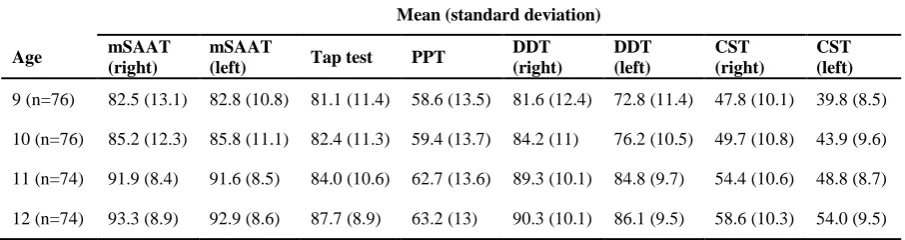
The results of the ANOVA showed statistically significant differences between the age groups in the mean scores obtained in all the five subtests. The results of the Games-Howell post hoc test revealed that the mean scores increased with age (p<0.0001). Table 1 presents the mean scores obtained in all the five subtests by age group.
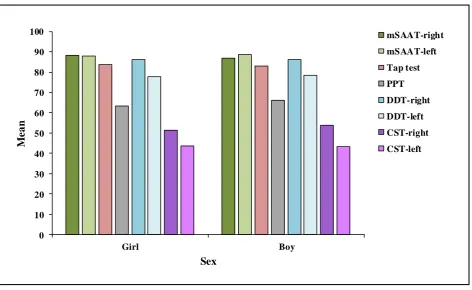
As shown in Fig.1, the independent t-test sho-wed no significant differences between the gen-der in the mean scores obtained in any of the five subtests (p>0.05).
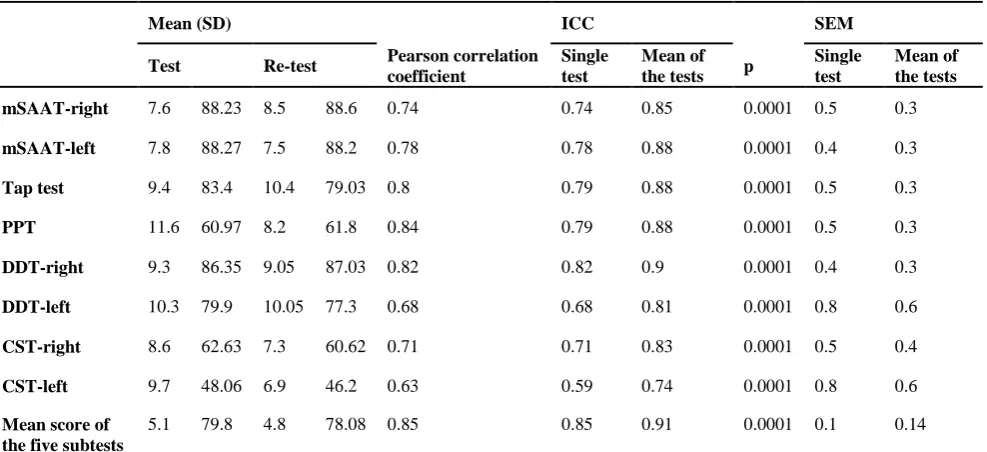
The reliability of the tests was assessed using the Pearson correlation coefficient, the ICC and the SEM, and the obtained results confirmed the reliability of each single test as well as the reliability of the mean score of all the five subtests (Table 2).
Discussion
The present study was conducted to develop and evaluate the Persian version of the MAPA model. The results showed an increase in the mean scores of all the five subtests (the mSAAT, the three pair DDT, the CST, the Tap and the PPT) with age (p<0.0001). No signifi-cant differences were observed between the genders in the mean scores obtained (p>0.05). The assessment of the reliability of the tests confirmed the reliability of each single test as well as of the mean scores of all the five sub-tests.
Summers studied the MAPA in 8-11 year-old
school children and showed an increase in the mean scores of all the tests with age in both genders [10]. Conlin studied the MAPA in 9- 13 year-old children and also showed an incr-ease in the mean scores with age [10]. In the present study, the mean scores of all the five subtests increased with age in both genders as well (Table 1). These results were expected as auditory processing improves with the deve-lopment of the auditory system, the brain hemi-spheres and the interhemispheric pathways, which occur with the child's growth, and also as the child’s auditory attention and memory improve with age. These improvements result in better test scores with increasing age.
Domitz and Schow conducted a study on 8-9 year-old children using the previous version of the MAPA. Conlin then compared the results of his test with those obtained by Domitz and Schow and reported lower mean scores in all the tests [9]. The mean scores obtained in the present study were also lower than those obtained in the study by Domitz and Schow. Conlin attributed the lower mean scores in his study to the structural changes and the more difficult tasks assigned in the new version of the MAPA (the Beta III version). In the new version, the CST requires 100% correct repeats of the two sentences heard simultaneously, which makes the test more difficult, especially for younger age groups. The mean score obtai-ned in this test by 9 year-old children was reported as 41% (with a standard deviation of Table 1. The mean (standard deviation) and minimum normal scores in the five subtests of the Persian version of the MAPA by age group in percentage (n=300)
Mean (standard deviation)
Age mSAAT
(right)
mSAAT
(left) Tap test PPT
DDT (right)
DDT (left)
CST (right)
CST (left)
9 (n=76) 82.5 (13.1) 82.8 (10.8) 81.1 (11.4) 58.6 (13.5) 81.6 (12.4) 72.8 (11.4) 47.8 (10.1) 39.8 (8.5)
10 (n=76) 85.2 (12.3) 85.8 (11.1) 82.4 (11.3) 59.4 (13.7) 84.2 (11) 76.2 (10.5) 49.7 (10.8) 43.9 (9.6)
11 (n=74) 91.9 (8.4) 91.6 (8.5) 84.0 (10.6) 62.7 (13.6) 89.3 (10.1) 84.8 (9.7) 54.4 (10.6) 48.8 (8.7)
12 (n=74) 93.3 (8.9) 92.9 (8.6) 87.7 (8.9) 63.2 (13) 90.3 (10.1) 86.1 (9.5) 58.6 (10.3) 54.0 (9.5)
14%) [10], which is consistent with the results of the present study with respect to this age group.
The DDT results obtained in the present study were similar to those obtained by Conlin. The three pair DDT model requires a greater memo-ry engagement, which makes the test more diff-icult and results in lower scores [10]. The quad-ruple PPT is also more difficult and results in lower mean scores [10]. The results obtained in the present study for the PPT were similar to those obtained by Conlin.
Nevertheless, the results obtained in the present study for the mSAAT were inconsistent with those obtained by Conlin. The different results may be attributed to the differences in the lan-guage structure and content of the two studies and the cultural differences amongst the partici-pants [10]. The differences in study methods may also be at play. A comparison of the obtai-ned mean scores with the normal scores shows the necessity of conducting further studies on the Persian version of the MAPA in different age groups.
Aarabi et al. used the Persian version of the mSAAT to examine 34 (27 normal and 7 learn-ing disabled) school children aged 7-9 and rep-orted the mean scores obtained by the 9 year-old children as 92%, which is very similar to the score reported in the present study. They also confirmed the reliability of the Persian version of the mSAAT with an ICC of 0.79 [16].
Rajabpur et al. carried out the two pair DDT on 7-9 year-old male school children [18], and reported higher mean scores with this test than with the three pair DDT used in the present study in the group of 9 year-old children. The different results may be attributed to the diffe-rent structure of the three pair DDT which eng-ages the memory more than the two pair ver-sion [10].
In the present study, the reliability of the Persian version of the MAPA was assessed using different statistical methods, all of which showed a good reliability for the tests. The Pearson correlation coefficient was 0.85 for the mean scores of all the five subtests, ranging
0 10 20
30
40 50 60 70 80 90 100
Girl Boy
M
e
a
n
Sex
mSAAT-right mSAAT-left Tap test PPT DDT-right DDT-left CST-right CST-left
from 0.63 to 0.82 for each (Table 2). The ICC provides a highly sensitive measure of reli-ability. The reliability of all the tests was con-firmed with ICCs of 0.85 and 0.88 for the mSAAT (right and left ears), 0.88 for the PPT, 0.88 for the Tap, 0.9 and 0.81 for the DDT (right and left ears) and 0.83 and 0.74 for the CST (right and left ears); (p<0.0001). Accor-ding to the SEM, all the tests had a good reli-ability.
In the study by Domitz and Schow, the corre-lation coefficient of the mean scores was repo-rted as 0.94 for all the tests, ranging from 0.54 to 0.99 for the single tests [9]. Schow and Domitz reported the correlation coefficients obtained for the two pair DDT and the CST as 0.54 and 0.57 which are not very favorable and require further studies. In the study condu-cted by Summers on 8-11 year-old school chil-dren, the test-retest reliability of the mSAAT, PPT, Tap, DDT and CST was confirmed with Pearson correlation coefficients of 0.67, 0.91, 0.77, 0.73, and 0.86, respectively. The overall reliability of the MAPA was also reported as favorable by the SEM. In a study by Shiffman conducted over two consecutive years, the reli-ability of the MAPA was confirmed with a
Pearson correlation coefficient of 0.85 [10]. The present study was conducted on 300 subjects among 9-12 year-old school children in the third grade and above. This population was selected due to the onset of auditory processing disorders from this age. Screening for this disorder is therefore recommended to begin from this age. Furthermore, children understand how to complete auditory proce-ssing tests only from this age [9,10]. Summers [10] and Domitz and Schow also selected their participants from third-graders and above.
Conclusion
The results of the present study confirmed app-ropriate reliability and validity of the Persian MAPA model with five subtests. An increase in the mean scores was observed in all the sub-tests with increasing age. No significant diffe-rences were observed between the genders in the mean scores obtained in any of the subtests. The Persian version of the MAPA has an appa-rent utility as a multiple-test CAPD battery for 9-12 year-old school-age children from both genders. In addition, the non-invasiveness and low cost of this set of tests enable its clinical application. This model comes with a CD and Table 2. The test-retest reliability of the tests in the Persian version of the MAPA (n=32)
Mean (SD) ICC SEM
Test Re-test Pearson correlation
coefficient
Single test
Mean of the tests p
Single test
Mean of the tests
mSAAT-right 7.6 88.23 8.5 88.6 0.74 0.74 0.85 0.0001 0.5 0.3
mSAAT-left 7.8 88.27 7.5 88.2 0.78 0.78 0.88 0.0001 0.4 0.3
Tap test 9.4 83.4 10.4 79.03 0.8 0.79 0.88 0.0001 0.5 0.3
PPT 11.6 60.97 8.2 61.8 0.84 0.79 0.88 0.0001 0.5 0.3
DDT-right 9.3 86.35 9.05 87.03 0.82 0.82 0.9 0.0001 0.4 0.3
DDT-left 10.3 79.9 10.05 77.3 0.68 0.68 0.81 0.0001 0.8 0.6
CST-right 8.6 62.63 7.3 60.62 0.71 0.71 0.83 0.0001 0.5 0.4
CST-left 9.7 48.06 6.9 46.2 0.63 0.59 0.74 0.0001 0.8 0.6
Mean score of the five subtests
5.1 79.8 4.8 78.08 0.85 0.85 0.91 0.0001 0.1 0.14
is well-suited for use in the classroom or in acoustic rooms. Further study will be needed on other ages in normal subjects and on chil-dren suspected of the disorder for a better validity-assessment of this set of tests.
Acknowledgements
This article is part of an MSc thesis approved by the Ethics Committee of Iran University of Medical Sciences registered under the code 93/340/1757.
REFERENCES
1. Jerger J, Musiek F. Report of the consensus conference on the diagnosis of auditory processing disorders in school-aged children. J Am Acad Audiol. 2000;11(9):467-74.
2. American Speech-Language-Hearing Association. (central) auditory processing disorders [Technical Report]. 2005. Available from www.asha.org/policy. 3. Bamiou DE, Musiek FE, Luxon LM. Aetiology and
clinical presentations of auditory processing disorders—a review. Arch Dis Child. 2001;85(5):361-5.
4. American Speech-Language-Hearing Association. Guidelines for audiology service provision in and for schools [Guidelines]. 2002. Available from www.asha.org/policy.
5. Yathiraj A, Maggu AR. Comparison of a screening test and screening checklist for auditory processing disorders. Int J Pediatr Otorhinolaryngol. 2013;77(6):990-5.
6. Yathiraj A, Maggu AR. Screening test for auditory processing (STAP): a preliminary report. J Am Acad Audiol. 2013;24(9):867-78.
7. Keith RW. Development and standardization of SCAN-C test for auditory processing disorders in children. J Am Acad Audiol. 2000;11(8):438-45.
8. Schow RL, Seikel JA, Chermak GD, Berent M. Central auditory processes and test measures: ASHA 1996 revisited. Am J Audiol. 2000;9(2):63-8.
9. Domitz DM, Schow RL. A new CAPD battery— multiple auditory processing assessment: factor analysis and comparisons with SCAN. Am J Audiol. 2000;9(2):101-11.
10. Lampe B. Are currently available pre-packaged behavioural test batteries (SCAN and MAPA) effective for use in the assessment and or diagnosis of auditory processing disorder (APD) in children assuming the American Speech-Language Hearing Association (ASHA) definition of APD?.2011. http://www.uwo.ca/fhs/lwm/ebp/reviews/2010-11/Lampe.pdf
11. Cacace AT, McFarland DJ. Central auditory processing disorder in school-aged children: a critical review. J Speech Lang Hear Res. 1998;41(2):355-73.
12. Tillery KL. Central auditory processing evaluation: a test battery approach. In: Katz J, Medwetsky L, Burkard R, Hood LJ, editors. Handbook of clinical audiology. 6th ed. Baltimore: Lippincott Williams & Wilkins; 2009. p. 627-41.
13. Vanniasegaram I, Cohen M, Rosen S. Evaluation of selected auditory tests in school-age children suspected of auditory processing disorders. Ear Hear. 2004;25(6):586-97.
14. Rocha-Muniz CN, Zachi EC, Teixeira RA, Ventura DF, Befi-Lopes DM, Schochat E. Association between language development and auditory processing disorders. Braz J Otorhinolaryngol. 2014;80(3):231-6. 15. Rosen S, Cohen M, Vanniasegaram I. Auditory and
cognitive abilities of children suspected of auditory processing disorder (APD). Int J Pediatr Otorhinolaryngol. 2010;74(6):594-600.
16. Aarabi S, Jarollahi F, Jalaie S. Development and determination of the validity of Persian version of monaural selective auditory attention test in learning disabled children. Aud Vest Res. 2016;25(1):49-54. 17. Diefendorf AO. Assessment of hearing loss in children.
In: Katz J, Medwetsky L, Burkard R, Hood LJ, editors. Handbook of clinical audiology. 6th ed. Baltimore: Lippincott Williams & Wilkins; 2009. p. 545-63. 18. Rajabpur E, Hajiabolhasan F, Tahaei SA, Jalaie S.