Online at http://jdesert.ut.ac.ir
DESERT 15 (2010) 167-174
Comparison of artificial neural network and multivariate
regression methods in prediction of soil cation exchange capacity
(Case study: Ziaran region)
A. Keshavarzi
a*, F. Sarmadian
aa
Faculty of Soil and Water Engineering, University of Tehran, Iran
Received: 24 April 2010; Received in revised form: 13 September 2010; Accepted: 22 November 2010
Abstract
Investigation of soil properties like Cation Exchange Capacity (CEC) plays important roles in study of environmental reaserches as the spatial and temporal variability of this property have been led to development of indirect methods in estimation of this soil characteristic. Pedotransfer functions (PTFs) provide an alternative by estimating soil parameters from more readily available soil data. 70 soil samples were collected from different horizons of 15 soil profiles located in the Ziaran region, Qazvin province, Iran. Then, multivariate regression and neural network model (feed-forward back propagation network) were employed to develop a pedotransfer function for predicting soil parameter using easily measurable characteristics of clay and organic carbon. The performance of the multivariate regression and neural network model was evaluated using a test data set. In order to evaluate the
models, root mean square error (RMSE) was used. The value of RMSE and R2 derived by ANN model for CEC were
0.47 and 0.94 respectively, while these parameters for multivariate regression model were 0.65 and 0.88 respectively. Results showed that artificial neural network with seven neurons in hidden layer had better performance in predicting soil cation exchange capacity than multivariate regression.
Keywords: Easily measurable characteristics; Feed-forward back propagation; Hidden layer; Pedotransfer functions; CEC; Ziaran
1. Introduction
There is an increasing demand for reliable large-scale soil data to meet the requirements of models for planning of land-use systems, characterization of soil pollution, and prediction of land degradation (McBratney et al., 2002). These models have been developed to improve the understanding of important soil processes and also to act as tools for evaluating agricultural and environmental problems. Consequently, simulation models are now regularly used in research and management (Minasny and McBratney, 2002). As soil properties can be highly variable spatially and
Corresponding author. Tel.: +98 912 3685235, Fax: +98 261 2231787.
E-mail address:[email protected]
1991), and is used as an input in soil and environmental models (Keller et al., 2001). CEC is the amount of negative charge in soil that is available to bind positively charged ions (cations). CEC is used as a measure of fertility, nutrient retention capacity and the capacity to protect groundwater from cation contamination. CEC buffers fluctuations in nutrient availability and soil pH. Soil components known to contribute to CEC are clay and organic matter and to a lesser extent, silt (Seybold et al., 2005). Although CEC can be measured directly, its measurement is especially difficult and expensive in the Aridisols of Iran because of the large amounts of calcium carbonate (Carpena et al., 1972) and gypsum (Fernando et al., 1977). Various PTFs have been developed to estimate CEC from basic physical and chemical soil properties (Breeuwsma et al., 1986; Manrique et al., 1991; Bell & van Keulen, 1995; McBratney et al., 2002). In most of these models, CEC is assumed to be a linear function of soil organic matter and clay content (Breeuwsma et al., 1986; McBratney et al., 2002). Results show that greater than 50% of the variation in CEC could be explained by the variation in clay and organic C content for several New Jersey soils (Drake and Motto, 1982), for some Philippine soils (Sahrawat, 1983), and for four soils in Mexico (Bell and Keulen, 1995). Only a small improvement was obtained by adding pH to the model for four Mexican soils (Bell and Keulen, 1995). In B horizons of a toposequence, the amount of fine clay was shown to explain a larger percent of the variation in CEC than the total clay content (Wilding and Rutledge, 1996). The two common methods used to develop PTFs are multiple-linear regression (MLR) method and ANN. MLR analysis is generally used to find the relevant coefficients in the model equations. Often, however, models developed for one region may not give adequate estimates for a different region (Wagner et al., 2001). A recent approach to model PTFs is the use of artificial neural networks (ANNs) (Schaap et al., 1998). ANN offers a fundamentally different approach for modeling soil behavior. ANN is an oversimplified simulation of the human brain and composed of simple processing units referred to as neurons. It is able to learn and generalize from experimental data even if they are noisy and imperfect. This ability allows this computational system to learn constitutive relationships of materials directly from the result of experiments. Unlike conventional models, it needs no prior knowledge, or any constants and/or assumptions about the deformation
characteristics of the geomaterials. Other powerful attributes of ANN models are their flexibility and adaptivity, which play an important role in material modeling. When a new set of experimental results cannot be reproduced by conventional models, a new constitutive model or a set of new constitutive equations needs to be developed. However, trained ANN models can be further trained with the new data set to gain the required additional information needed to reproduce the new experimental results. These features ascertain the ANN model to be an objective model that can truly represent natural neural connections among variables, rather than a subjective model, which assumes variables obeying a set of predefined relations (Banimahd et al., 2005). In brief, a neural network consists of an input, a hidden, and an output layer all containing “nodes”. The number of nodes in input (e.g. soil bulk density, soil particle size data, etc.) and output (different soil properties) layers corresponds to the number of input and output variables of the model (Manyame et al., 2007). A type of ANN known as multilayer perceptron (MLP), which uses a back-propagation training algorithm, is usually used for generating PTFs (Schaap et al., 1998; Minasny et al., 1999; Minasny and McBratney, 2002; Amini et al., 2005). This network uses neurons whose output is a function of a weighted sum of the inputs. The major advantage of neural networks over the two groups of PTFs described earlier is that they do not require a-priori concept of the relations between input and output data (Schaap and Leij, 1998). However, because of their greater feasibility, ANN models are generally expected to be superior to MLR models (Sarmadian et al., 2009; Amini et al., 2005; Minasny et al., 1999).
methods for prediction of soil bulk density. They pointed out that the ANNs are able to predict the soil bulk density better than the PTFs. Amini et al. (2005) estimated the cation exchange capacity in the central of Iran using soil organic matter and clay contents. They used the ANN and five experimental models that were on the basis of regression methods for their predictions. They showed that a neural network PTF with eight hidden neurons was able to predict CEC better than the regression PTFs. Also the ANN model significantly improved the accuracy of the prediction by up to 25%. They concluded that network models are in general more suitable for capturing the non-linearity of the relationship between variables. Jain and Kumar (2006) indicated that the ANN technique can be successfully employed for the purpose of calibration of infiltration equations. They had also found that the ANNs are capable of performing very well in situations of limited data availability. In contrast Merdun et al. (2006) pointed out that although the differences between regression and ANN models were not statistically significant, regression predicted point and parametric variables of soil hydraulic parameters better than ANN. Hence, the present study was carried out with objective to comparison the efficiency
of ANNs and multivariate regression for estimation of cation exchange capacity using some easily measurable soil parameters in Ziaran region.
2. Materials and methods
2.1. Study area
The study was carried out in Ziaran region, Qazvin province in Iran. The research commenced in 2008 and ended in 2009. The land investigated in the research is located between latitudes of 35°58´ and 36°4´ N and between longitudes of 50°24´ and 50°27´ E which has the area about 5121 hectares. The average, minimum and maximum heights points of Ziaran district are 1204, 1139 and 1269 meters from the sea level, respectively (Fig1). The soil moisture and temperature regimes of the region by means of Newhall software are Weak Aridic and Thermic, respectively. Based on soil taxonomy (USDA, 2006), this region has soils in Entisols and Aridisols orders. The climate of the region is arid and semi-arid. Mean annual precipitation and mean annual air temperature are 230 mm and 14.6 °C, respectively.
Fig.1. Location of the study area
2.2. Data collection and soil sample analysis
After preliminary studies of topographic maps (1:25000), using GPS, studying location was appointed. 70 soil samples were collected from different horizons of 15 soil profiles located in Ziaran region in Qazvin Province. Measured soil parameters included texture (determined using Bouyoucos hydrometer method), Organic carbon (O.C) was determined using Walkley-Black method (Nelson and Sommers, 1982) and CEC (cation exchange
capacity in cmolc kg-1 soil) determined by the method of Bower (Sparks et al., 1996).
2.3. Methods to fit PTFs
2.3.1. Multivariate regression
The most common method used in estimation PTFs is to employ multiple linear regressions. For example:
Y=aX1+bX2+cX3+…..
Where: Y denotes depended variable, Xi
(i1,2.,n) is independent variable, and a, b, … are unknown coefficients of the model.
2.3.2. Artificial neural network
An artificial neural network is a highly interconnected network of many simple processing units called neurons, which are analogous to the biological neurons in the human brain. Neurons having similar characteristics in an ANN are arranged in groups called layers. The neurons in one layer are connected to those in the adjacent layers, but not to those in the same layer. The strength of connection between the two neurons in adjacent layers is represented by what is known as a ‘connection strength’ or ‘weight’. An ANN normally consists of three layers, an input layer, a hidden layer, and an output layer. In a feed forward network, the weighted connections feed activations only in the forward direction from an input layer to the output layer. On the other hand, in a recurrent network additional weighted connections are used to feed previous
activations back into the network. The structure of a feed-forward ANN is shown in Figure 2. This ANN is a popular neural network which known as the back propagation algorithm introduced by Karaca and Ozkaya (2006). This ANN had k input and one output parameters. They used this ANN for accurate modeling of the leachate flow-rate. They also reported that the input parameters, number of neurons at the hidden and output layer should be determined according to currently gathered data. Moreover, an important step in developing an ANN model is the training of its weight matrix. The weights are initialized randomly between suitable ranges, and then updated using certain training mechanism (Minasny and McBratney, 2002; Pachepsky et al., 1996; Schaap et al., 1998). In this study, the training process was performed by NeuroSolutions 5, which includes a number of training algorithms including the back propagation training algorithm. This is a gradient descent algorithm that has been used successfully and extensively in training feed forward neural networks.
Fig.2. Structure of feed-forward ANN
2.4. Performance criteria
The performance of the models was evaluated by a set of test data using the root mean square error (RMSE) and the coefficient of determination between predicted and measured values. The RMSE is a measure of accuracy and reliability for calibration and test data sets (Wösten et al., 1999) and is defined as:
n
k p o z
z n RMSE
1 2
) (
1 (2)
Where: Zo is observed value, Zp is predicted
value, n is number of samples.
3. Results and discussion
3.1. Data summary statistics
Simple linear correlation coefficients (r) between CEC and independent variables were also calculated (Table 3). As Table 3 illustrates correlations between O.C and CEC and between clay and CEC were positive and highly significant. For example the correlation coefficients between CEC and clay content (r = 0.92**) is more than between CEC and O.C content (r = 0.56*). Positive correlation between
CEC, O.C and clay content is related to existence of negative charges on these properties (Manrique et al., 1991; Bell and Keulen., 1995; Noorbakhsh et al., 2005). However with regarding to these correlation coefficients, both of them are suitable for developing PTFs for prediction of CEC in soils of Ziaran region.
Table 1. Statistics of training data set for cation exchange capacity
Soil parameter Min Max Mean Std
CEC (CmolcKg-1) 7.42 20.45 15.87 2.64
Clay (%) 3.20 56.80 23.85 12.05
Training set
O.C (%) 0.04 1.10 0.36 0.23
Table 2. Statistics of testing data set for cation exchange capacity
Soil parameter Min Max Mean Std
CEC (CmolcKg-1) 11.10 19.69 16.02 2.21
Clay (%) 7.20 48.00 23.79 11.79
Testing set
O.C (%) 0.09 0.76 0.32 0.20
Table 3. Simple linear correlation coefficients (r) between CEC and independent variables CEC (CmolcKg-1) Clay (%) O.C (%) CEC (CmolcKg-1) 1
Clay (%) 0.92** 1
O.C (%) 0.56* 0.22* 1
* Correlation is significant at the 0.05 level ** Correlation is significant at the 0.01 level
Hence with respecting to Table 3, multivariate regression equation was developed for studied parameters using SPSS 15 software. We selected only regression model that had a coefficient of determination (R2), greater than 0.5 (Amini et al., 2005; Lake et al., 2009). This equation was expressed as:
CEC=10.644+0.198Clay+1.372O.C, R2=0.88 (3)
3.2. Developing PTFs using multivariate regression and artificial neural network
After determining of eq. (3), performance of multivariate regression was developed for test data set. Coefficient of determination (R2) and RMSE have been obtained 0.88 and 0.65 respectively. Sarmadian et al. (2009) also observed high correlation coefficient in their results (r = 0.78). For predicting the soil CEC by means of artificial neural networks, the input data were similar to those used for multivariate linear regression. In the present study for predicting soil properties we did not increase the input date for constructing artificial neural network. Because according to findings of Lake
0 0.4 0.8 1.2 1.6 2 2.4 2.8 3.2 3.6 4
1 2 3 4 5 6 7 8 9 10
Number of neurons
RM
S
E
Fig. 3. RMSE values for 1-10 neurons in hidden layer (cation exchange capacity)
The levels of RMSE and R2 for CEC were 0.47 and 0.94 respectively. In addition, the levels of coefficient of determination and RMSE derived by artificial neural network for studied soil parameter had higher values than those derived by multivariate linear regression (Table 4) which is in line with the work done by Amini et al. (2005), Tamari et al. (1996), Minasny and McBratney (2002) and Schaap et al. (1998). Amini et al. (2005) found that the neural network-based models provided more reliable predictions than the regression-based PTFs. Schaap et al. (1998) confirmed applicability of ANNs and concluded that
accuracy of these models depend on number of inputs. Koekkoek and Booltink (1999) found that ANN performed slightly better, but the differences were not significant. The network models for CEC were more suitable for capturing the non-linearity of the relationship between variables. One of the advantages of neural networks compared to traditional regression PTFs is that they do not require a priori regression model, which relates input and output data and in general is difficult because these models are not known (Schaap and Leij, 1998).
Table 4. Statistical parameters in test stage for different methods based on pedotransfer functions
Statistical parameters Multivariate linear regression Artificial neural network
RMSE 0.65 0.47
R2 0.88 0.94
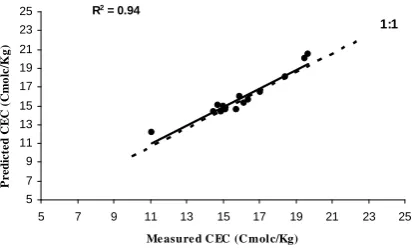
The scatter plot of the measured against predicted CEC for the test data set are given in Figure 4 for the ANN model which we identified as being the best model for predicting
soil parameter. So that according to this diagram, the best fitted line has the angle of near to 45° that shows the high accuracy of estimation by the neural network model.
1:1
R2 = 0.94
5 7 9 11 13 15 17 19 21 23 25
5 7 9 11 13 15 17 19 21 23 25
Me asure d C EC (C molc/Kg)
P
r
e
d
ic
te
d
C
E
C
(
C
mo
lc
/K
g
)
Fig.4. The scatter plot of the measured versus predicted CEC
The reason of this superior efficiency of ANNs models compare with the basic regression equations is probably because; the PTFs that have derived from various areas have
that with creation a suitable equation between input and output data we are able to achieve to the best results. Also, due to the occurring of nonlinear equations between dependent variables and predicting variables, the neural network have the better efficiency compared with the basic regression equations. Pachepsky et al. (1996) investigated the accuracy of artificial neural network and analyzed the regression method using correlation coefficient and the root mean square error. They reported that the neural network is able to predict the easily measurable soil parameters with more accuracy and less error. The similar results have reported by the Tamari et al. (1996) as well. They found that using artificial neural network leads to less RMSE values than the multivariable linear regression. They also reported that the neural network has not better efficiency than linear regression models in occasion of high stability of data. However, the high accuracy of data leads to more efficiency of neural network and also, shows the proper selection of testing and training data. Analysis of the ANN parameters suggested that more input variables were necessary to improve the prediction of soil parameters (Tamari et al., 1996; Mermoud and Xu, 2006).
4. Conclusion
In this study, multivariate linear regression and neural network model (feed-forward back-propagation network) were employed to develop a pedotransfer function for predicting soil cation exchange capacity by using available soil properties. This network was consisted of one hidden layer, a sigmoid activation function in hidden layer, and a linear activation function in output layer and Levenberg-Marquardt training algorithm used due to efficiency, simplicity and high speed. For predicting the soil property by means of PTFs, the input data were consisted of the percentages of clay and organic carbon for CEC. The performance of the multivariate linear regression and neural network model was evaluated using a test data set. Results showed that artificial neural network with seven neurons in hidden layer had better performance in predicting soil CEC than multivariate regression. The network model for this parameter was more suitable for capturing the non-linearity of the relationship between variables. ANN can model non-linear functions and have been shown to perform better than linear regression. With regarding to the evaluation criteria, the results of this study revealed that the artificial neural networks had
superiority to the basic regression equations for prediction of mentioned soil parameter. This is a crucial result because, since ANN– PTFs formed from local data produce more accurate predictions than those built from data spread from a wider area, the concept of data conservation becomes a critical factor in ANN– PTF construction (Baker and Ellison, 2008). However, due to difficulties of direct measurement of soil parameters, we recommend using of neuro-fuzzy models in the future studies for obtaining the logical equations of other soil parameters, especially soil hydraulic properties, in each area and also we recommended testing mentioned formula for CEC in other regions.
Acknowledgement
The financial support provided by the University of Tehran, Iran, is gratefully acknowledged.
References
Amini, M., K.C. Abbaspour, H. Khademi, N. Fathianpour, M. Afyuni and R. Schulin, 2005. Neural network models to predict cation exchange capacity in arid regions of Iran. Eur. J. Soil Sci., 53: 748-757. Baker, L. and D. Ellison, 2008. Optimisation of pedotransfer functions using an artificial neural network ensemble method. Geoderma., 144: 212– 224.
Banimahd, M., S.S. Yasrobi and P.K. Woodward, 2005. Artificial neural network for stress–strain behavior of sandy soils: Knowledge based verification. Comput. Geotech., 32: 377–386.
Bell, M.A. and J. Van keulen, 1995. Soil pedotransfer functions for four Mexican soils. Soil Sci Soc. Am. J., 59: 865-871.
Bouma, J., 1989. Using soil survey data for quantitative land evaluation. Advances in Soil Science., 9: 177– 213.
Breeuwsma, A., J.H.M. Wosten, J.J. Vleeshouwer, A.M. Van slobbe and J. Bouma, 1986. Derivation of land qualities to assess environmental problems from soil surveys. Soil Sci Soc. Am. J., 50: 186.190.
Carpena, O., A. Lux and K. vahtras, 1972. Determination of exchangeable calcareous soils. Soil Sci., 33: 194-199.
Drake, E.H. and H.L. Motto, 1982. An analysis of the effect of clay and organic matter content on the cation exchange capacity of New Jersey soils. Soil. Sci., 133: 281-288.
Fernando, M.J., R.G. Burau and K. Arulanandam, 1977. A new approach to determination of cation exchange capacity. Soil Sci.Amer. J., 41: 818-820.
Heusher, S.A., C.C. Brandt and P.M. Jardin, 2005. Using soil physical and chemical properties to estimate bulk density. Soil Sci. Soc. Am. J., 69: 51- 56.
infiltration model parameters. Appl. Soft Comput., 6:272–282.
Karaca, F. and B. Ozkaya, 2006. NN-LEAP: A neural network-based model for controlling leachate flow-rate in a municipal solid waste landfill site. Environ. Modell. Software., 21: 1190-1197.
Kaur, R., S. Kumar and H.P. Gurung, 2002. A pedotransfer function soil data and its comparison with existing PTFs. Aust. J. Soil Res., 40: 847- 857. Keller, A., B. Von Steiger, S.T. Vander Zee and R. Schulin, 2001. A stochastic empirical model for regional heavy metal balances in agroecosystems. Journal of Environmental Quality., 30: 1976-1989. Koekkoek, E.J.W. and H. Booltink, 1999. Neural network models to predict soil water retention. Eur. J. Soil Sci., 50: 489-495.
Lake, H.R., A. Akbarzadeh and R. Taghizadeh Mehrjardi, 2009. Development of pedotransfer functions (PTFs) to predict soil physico-chemical and hydrological characteristics in southern coastal zones of the Caspian Sea. Journal of Ecology and the Natural Environment., 1(7): 160-172.
Manrique, L.A., C.A. Jones and P.T. Dyke, 1991. Predicting cation exchange capacity from soil physical and chemical properties. Soil Science Society of America Journal., 50: 787-794.
Manyame, C., C.L. Morgan, J.L. Heilman, D. Fatondji, B. Gerard and W.A. Payne, 2007. Modeling hydraulic properties of sandy soils of Niger using pedotransfer functions. Geoderma., 141: 407–415. McBratney, A.B., B. Minasny, S.R. Cattle and R.W. Vervoot, 2002. From pedotransfer function tosoil inference system. Geoderma., 109: 41-73.
Merdun, H., O. Cınar, R. Meral and M. Apan, 2006. Comparison of artificial neural network and regression pedotransfer functions for prediction of soil water retention and saturated hydraulic conductivity. Soil Till.Res., 90: 108–116.
Mermoud, A. and D. Xu, 2006. Comparative analysis of three methods to generate soil hydraulic functions. Soil Till. Res., 87: 89–100.
Minasny, B. and A.B. McBratney, 2002. The neuro-m methods for fitting neural network parametric pedotransfer functions. Soil Sci. Soc. Am. J., 66: 352–361.
Minasny, B., A.B. McBratney and K.L. Bristow, 1999. Comparison of different approaches to the development of pedotransfer functions for water retention curves. Geoderma., 93: 225- 253.
Najafi, M. and J. Givi, 2006. Evaluation of prediction of bulk density by artificial neural network and PTFs. 10th Iranian Soil Science Congress. Karaj., pp: 680- 681. (in Persian)
Nelson, D.W. and L.E. Sommers, 1982. Total carbon, organic carbon, and organic matter. In: Page, AL, Miller, RH, Keeney DR (Eds.), Methods of Soil Analysis. Part II, 2nd ed. American Society of Agronomy, Madison, WI, USA., pp: 539-580.
Noorbakhsh, F., A. Jalalian and H. Shariatmadari, 2005. Prediction of cation exchange capacity with using some soil properties. Iranian Journal of Science and Technology of Agriculture and Natural Resources., 3: 107-117 (In Persian).
Pachepsky, Y.A., D. Timlin and G. Varallyay, 1996. Artificial neural networks to estimate soil water retention from easily measurable data. Soil Sci. Soc. Am. J., 60: 727–733.
Sahrawat, K.L., 1983. An analysis of the contribution of organic matter and clay to cation exchange capacity of some Philippine soils. Commun. Soil Sci. Plant Anal., 14: 803-809.
Sarmadian, F., R. Taghizadeh Mehrjardi and A. Akbarzadeh, 2009. Modeling of some soil properties using artificial neural network and multivariate regression in Gorgan province, north of Iran. Australian J. of Basic and Applied Sci., 3(1):323- 329.
Schaap, M.G. and F.J. Leij, 1998. Using neural networks to predict soil water retention and soil hydraulic conductivity. Soil Till. Res., 47: 37–42.
Schaap, M.G., F.J. Leij and M.Th. Van Genuchten, 1998. Neural network analysis for hierarchical prediction of soil hydraulic properties. Soil Sci. Soc. Am. J., 62: 847–855.
Seybold, C.A., R.B. Grossman and T.G. Reinsch, 2005. Predicting Cation Exchange Capacity for soil survey using linear models. Soil Sci. Soc. Am. J., 69: 856- 863.
Sparks, D.L., A.L. Page, P.A. Helmke, R.H. Leoppert, P.N. Soltanpour, M.A. Tabatabai, G.T. Johnston and M.E. Summer, 1996. Methods of soil analysis, Soil Sci. Soc. Of Am. Madison, Wisconsin.
Tamari, S., J.H.M. Wosten and J.C. Ruiz-Suarez, 1996. Testing an artificial neural network for predicting soil hydraulic conductivity. Soil Sci. Soc. Am. J., 60: 1732-1741.
USDA., Soil Survey Staff, 2006. Keys to Soil Taxonomy. 10th edition.
Vos, B.D., M.V. Meirvenne, P. Quataert, J. Deckers and B. Muys, 2005. Predictive quality of pedotransfer functions for estimating bulk density of forest soils. Soil Sci. Soc. Am. J., 69: 500–510.
Wagner, B., V.R. Tarnawski, V. Hennings, U. Muller, G. Wessolek and R. Plagge, 2001. Evaluation of pedo- transfer functions for unsaturated soil hydraulic conductivity using an independent data set. Geoderma., 102: 275–279.
Wilding, L.P. and E.M. Rutledge, 1966. Cation exchange capacity as a function of organic matter,