Technical Research
Design & manufacturing a computerized Multi-Channel Isometric
Dynamometer
Abbas Meamarbashi1
1. Professor in Sport Biomechanics, University of Mohaghegh Ardabili, Ardabil, Iran
Introduction
Muscular strength is an important feature of human fitness, health and quality of life [19] and considered one of the main fitness components. In sports sciences, muscular strength is generally accepted as a major factor influencing the athletic success [20-22]. It is also essential for differential diagnosis, determining functional impairment, measuring improvement or deterioration, and for developing an effective plan for rehabilitation care [23]. Generally, the assessment of muscle function is frequently used in rehabilitation medicine, orthopedic medicine, neurology and physical therapy for clinical diagnosis and evaluation [24]. To measure muscle force, different methods have been invented to evaluate the highest force produced by the muscles and the capability of the muscles to sustain the maximum force during the task. It is also the most important physical attribute in certain sports, like weightlifting, wrestling, and hammer throwing. In many other sports like rugby, soccer, and volleyball, having good muscular strength is very important as part of the overall fitness profile [25]. Moreover, reliable and valid evaluation of muscle strength has great importance in determining the effectiveness of various physical and occupational therapy procedures.
The maximum force that can be generated depends on the size and number of muscles involved, the proportion of recruited muscle fibers, the coordination of the muscle groups, the physical condition of the muscles and the mechanical advantage of the levers involved. Due to this complexity and the variations in these properties for each muscle group, there is no single recommended test for measurement of the muscle strength. On the contrary, functional field tests are not able to address adequately the contributing factors and components of muscular strength, therefore, controlled laboratory testing techniques must be considered. The three main forms of muscular strength testing are: isometric, isokinetic, and isotonic. Importantly, each form
ABSTRACT
In our technological world, there are plenty of opportunities to utilize science and engineering to improve exercise performances. Muscular strength is one of the main components of the physical fitness. In this regard, the Isometric Dynamometer is a scientific instrument intended to quantify the muscle strength. Hence, the aim of this project was to manufacture an innovative computerized isometric dynamometer package and relevant software.
In the current project a high precision isometric force transducers (2000 and 5000 N), instrumental amplifier, high precision Analog-to-Digital Converter connected to a high speed microcontroller were implemented. A graphic LCD, MicroSD memory card used in the data logger to display and record the force data. Professional software was designed to communicate with the data logger by a USB port and display four-channel line charts in online mode. Offline data processing and record the processed data on a database is also available. This device provided an innovative method of simultaneous right & left side dynamometry using two sensors to measure any imbalance in the strength between two limbs. Additionally, this package has a grip dynamometer, a pull and press hands dynamometer, and optional connection to other force sensors. The linearity of the sensors’ output for 0, 10, 50, 100, 200 kg weights was 99.99 and test-retest measurements confirmed very high reliability (0.99±0.012). This package was extensively applied in the laboratory researches due to its unique simultaneous force measurement feature. Hence, this package with distinctive specifications can extensively implement in clinic, gym, laboratory, field tests.
16 of testing measures different qualities, so the tests cannot be used interchangeably. This is largely due to the complex interaction of muscular, tendons and neural factors influencing the muscular strength. In order to determine the best possible series of tests, it is important to consider issues of test specificity and reliability, the safety of subjects, and the ease of test administration. Isometric muscle contraction generates force without changing the muscle length. Isometric assessment of muscle function is a popular form of testing which has been used in exercise science for over 40 years. Isometric tests can be easily standardized and have a high reproducibility (0.85-0.99), which requires minimum familiarization, it is easy to administer and generally safe to perform. Notably, appropriate test varies for athletes, non-athletes, women, men, and children.
Isometric tests can be used to assess the strength over various ranges of motion, and it is possible to conduct it with relatively inexpensive equipments. In this test, maximal voluntary contraction (MVC) performed at a specified joint angle against an unyielding resistance measure with force sensor, cable tensiometer or similar device. Often both the maximum force and the rate of force development over time are important to record.
Technical and Experimental Information
It is a very precise, reliable and all-in-one testing unit appropriate for conducting all the usual isometric strength tests. The system can be used in a wide range of sports in which muscular strength’s balance is crucial like weight lifting, gymnastics, etc. It has 4-channels to connect four force sensors and can simultaneously measure compression or tensile forces. Data can be recorded offline or via a USB port to collect the data online. Traditional leg-back-chest dynamometer like Lafayette Dynamometer can measure only lift with both hands, but this device additional to that can use two sensors to measure right & left side lift force simultaneously, or if use for legs, can measure any imbalance in the strength between two legs. It also has a hand dynamometer for hand grip strength measurement. Any other dynamometer like pinch dynamometer or custom analog force sensor can be implemented. This novel multichannel dynamometer provided a unique opportunity for dual-side lift dynamometry which is not commonly measured due to lack of a suitable instrument.
The present study was carried out in four phases: 1) Design and development of electronic data logger 2) development of software 3) construct the platform and accessories 4) calibration and validation of the
force transducers.
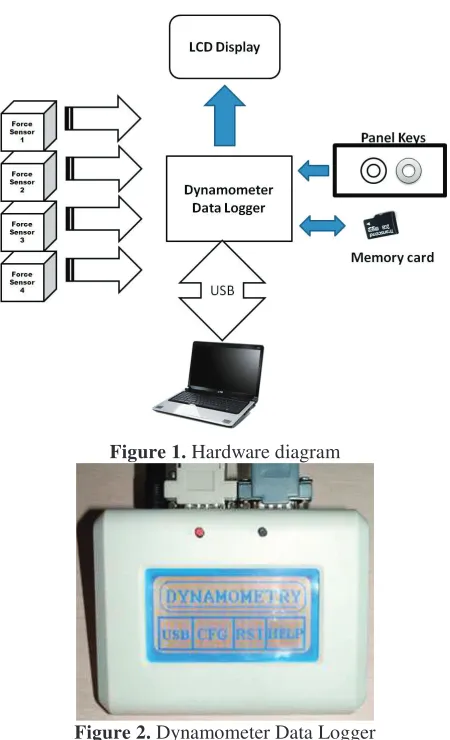
Two stainless steel load cells with strain gauge technology used to measure both tension and compression with 5000 N capacity. A low power, compact, reliable, robust and versatile electronic data logger was designed for the low-pass filtration, amplification of analog output and convert to digital by using four-channel 16-bit analog to digital converter. The digital output of the device sent into a high speed AVR microcontroller. Microcontroller was programmed by C language to display the test results and save the force values on a high capacity Memory Card (MicroSD) using the FAT32 format at 120 Hz. To display data during the test, test results demonstrated on a graphic LCD display and simultaneously sent to USB port to show an online Force-Time chart on the monitor. Real-time force, test time, maximum force and test number are displayed on LCD during the test and can use it stand-alone without a computer or by using a memory card to save data and process the force-time data by the software in offline mode.
Figure 1. Hardware diagram
Figure 2. Dynamometer Data Logger
The mechanical parts are consisting of a platform, handle bar, grips, hooks, adjustable chain, and other accessories.
Accurate measurement is essential and it is deemed as one of the most important considerations in the instrumental development. Dynamometer software designed to calibrate sensors and send calibration data to the data logger to restore in the device flash memory for up to 10 force transducers. Calibration is required to define zero force and then apply known force usually by means of weight (e.g. 10 kg). After calibration, verification of the dynamometer accuracy should implement by different weights.
The most frequent dynamometers in the market are spring, hydraulic, and strain-gauge or capacitor load cell dynamometers. Spring type or digital dynamometers able to show maximum force and only computerized dynamometers are able to record high sampling rate force data and store it on a memory card to provide detailed information about the force changes during the time. The force-time curve is valuable for evaluation of the muscle isometric force. This dynamometer provided an opportunity to compare right and left limbs force with many software computations like comparing force-time chart surface by integration of force and time, force development rate, mean force of right and left side dynamometry, etc.
18 right & left side dynamometry which is very important in evaluating of muscular strength’s symmetry in the right and left limbs (e.g. hand or legs). The force sensors of this package is applicable for pull and press, therefore, like other dynamometers can use for different types of lifts and also acts as a cable tensiometer where sensor is attached between target limb and a fixture. Moreover, current dynamometer is applicable in different setting like arms pull, shoulder lift, arms press (push) and pull, etc.
Figure 3. Bilateral leg and back lift (left) and hands lift (right)
Figure 4. Grip (right) and hands push & pull (left) dynamometry
Leg press by means of two sensors and special metal plate mounted on an inclined leg press can be used to measure right and left-side forces or in similar setup for hands, trunk, etc.
Results
The outcome of this project was fabricate a computerized multichannel isometric dynamometer package capable of measuring central lift, right & left side lift, hands push & pull, and grip dynamometry. The data logger of this package is capable of measuring channel analog force sensors at the same time with four-channel 16-bit Analog to Digital Converter (ADC), high speed microcontroller, high capacity memory card, graphic LCD, USB port, and many software features.
The device was tested in a laboratory experiment. Test–retest experiments showed that the offset and the sensitivity of the dynamometer were equal for each measurement and remained constant for five consecutive days. The regression coefficient (r) of calibration curve for 0, 10, 50, 100, 200 kg weights was 99.99 and its reliability was 0.99±0.012 for test-retest measurements with these weights.
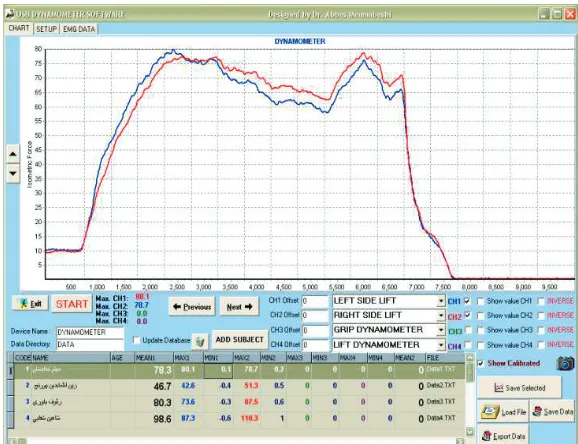
Dynamometer software programmed to acquire data from USB port and trace the real-time force on a graphic chart. Connected sensor is selectable before start the test and each channel force on graphic chart has one specific color. Software has utilities to show raw or calibrated data, real-time force and maximum force in each channel, and finally save data in a database for each test. In the setup section, connection to the USB port verification, calibration data, and chart title, time and Y and X axes scale is available. When a test terminated, data recorded on a personal database for further analysis by Microsoft Excel, SPSS, or other applications and the result of maximum force present on a table. Review the previous data is applicable by double click on a person’s name.
The force curve empirical evaluation is feasible by knowing peak force, average force divided by peak force, peak force divided by body weight (normalized force by body weight), force-time curve integral, time to reach peak force, the time to attain a relative force level (e.g. 30% of maximum), the slope of the force–time curve over a given time interval and the force or impulse (force × time) value reached in a specified time.
20
Discussion
Computerizing traditional isometric force measurement is a paramount objective of many advanced companies to exploit utmost aptitude of computer processing and digital electronics. Hence, prevail expectation of professional sport researchers and organizations have changed toward efficient evaluation of athletes and patients during training or recovery period.
Application of current dynamometer package is not limited to ordinary leg-back-chest lift, handgrip, or hands push dynamometry. Portable force sensors can use in vast applications or attached to spring to evaluate isotonic force or in the gym’s body building machine to evaluate an isoinertial force in a real-time fashion.
It is worthy to mention that peak force value is a simple outcome of muscular strength and could be confusing when robust comparison of muscle force between subjects is important. In this case, computation of surface under the force-time curve by measuring integration of force-time data providing a quantitative data to compare force data over constant period of time. Moreover, normalizing force data by subject’s body weight or muscle’s cross sectional area (CSA) may gives a more accurate measure of muscular strength per mass of effective muscle.
Conclusions
Electronic load cells are unarguably precise with high reliability, if maximum applied force is less than its nominal load capacity. Linear electrical response of these sensors to the force is very high and applicable in high sampling rate data acquisition, therefore made them suitable for research in the field of isometric force measurement. Mechanical dynamometers made by spring and cheap digital dynamometers are using spring and capacitive load cell, therefore they are not measuring true isometric force and their accuracy and reliability are unquestionably lower than strain gauge load cells.
Current advancement of new digital isometric dynamometers in the market led to a computerized dynamometer manufactured by JTech Medical Company (USA). However, the dynamometer setup followed the traditional leg-back-chest dynamometers (e.g. Baseline®) by using one load cell for the lift. To the best of my knowledge, there is no any dynamometer in the market to enable right & left side of the body dynamometry. Moreover, the available dynamometer packages are limited to few isometric testing.
Conflict of Interest
This device and software designed and manufactured by the author.
Acknowledgment
The author would like to express his gratitude to the Ardabil Elites Foundation for the best inventor prize in the North-West Inventions Expo in August 20-22, 2013.
References
1. Meamarbashi, A., Muscular Strength Measurement. 2016, Paramount, CA: Amazon.
2. Borges, G., et al., The torque-velocity relation of elite soccer players. Journal of Sports Medicine and Physical Fitness, 2003; 43(3):261-266.
4. Athanasios, Z., et al. Bilatral peak torque of the knee extensor and flexor muscles in elite and amatur male soccer players. Physical Training (Online) 2005 [Available from: http://ejmas.com/pt/ptframe.htm]. 5. Ammar, T.A., Inter-Rater and Test-Retest Reliability of Hand Held Dynamometer in Shoulder
Dysfunction. Bulletin of Faculty of Physical Therapy, 2011; 16(2): 115-120.
6. Harlaar, J., M.E. Roebroeck, and G.J. Lankhorst, Computer-assisted hand-held dynamometer: low-cost instrument for muscle function assessment in rehabilitation medicine. Medical & Biological Engineering & Computing, 1996; 34(5):329-335.
7. Bao, S., et al., Force measurement in field ergonomics research and application. International Journal of Industrial Ergonomics, 2009; 39(2):333–340.