Grape size detection and online gradation based on machine
vision
Wang Qiaohua
*,
Tang Yihua
,
Xiao Zhuang
(College of Engineering, Huazhong Agricultural University, Wuhan 430070, China)Abstract: This research investigated the size detecting and online grading of Red Globe grapes using images of entire cases, rather than individual grapes. Method of ellipse fitting based on iterative least median squares was proposed and the process of grape grading includes the following four steps: stem removal from the RGB and NIR images collected by the 2-CCD camera; edge extraction by multiple methods of edge detection, image binarization, morphological processing, et al.; size determination of individual grapes by using image segmentation and ellipse fitting to calculate short axis length; Finally, grading based on the 15% downgrade principle, this means that if the case contains more than 15% of multiple grades, then the case is re-evaluated. Thirty-eight cases of Red Globe grapes were graded using these methods and 35 cases were correctly graded with an accuracy rate reaching 92.1%. The results showed that the accuracy and speed meet the requirements of grape automatic online detection.
Keywords: machine vision, Red Globe grape, iterative least median squares, ellipse fitting, gradation DOI: 10.3965/j.ijabe.20171001.2517
Citation: Wang Q H, Tang Y H, Xiao Z. Grape size detection and online gradation based on machine vision. Int J Agric & Biol Eng, 2017; 10(1): 226–233.
1 Introduction
Recently, machine vision technique has been widely applied to outer quality detection and gradation of farm products, including citrus, pears, apples, eggs, etc.[1-3]
Nevertheless, there is little literature available related to size detection of farm products in bunches. Ling[4] segmented the bunch of grapes by using image segmentation method and proposed a polar formatting algorithm to detect individual grapes. Cheng et al.[5] put forward a grading method based on the analysis of
Received date: 2016-04-07 Accepted date: 2016-05-25 Biographies: Tang Yihua, Graduate student, research interests: machine vision and intelligent detection technology, Email: [email protected]; Xiao Zhuang, Graduate student, research interests: machine vision and intelligent detection technology, Email: [email protected].
*Corresponding author: Wang Qiaohua, Professor, research interests: machine vision and intelligent detection technology. Mailing address: Engineering College, Huazhong Agricultural University, Wuhan 430070, China. Tel: +86-18702768307, Email: [email protected].
curvilinear structure, and designed a mushroom grading system based on machine vision. Deng[6] proposed a method for detecting egg size based on machine vision. They established the center of mass, and defined the maximum and minimum from the center to the edge, respectively, as the long axis and short axis of eggs.
Although grapes are the second most cultivated fruit, there is little research on grape in the world. Most of this limited research focused on nearly-circular grape. Chen et al.[7-8] proposed a method for detecting the size of nearly-circular Jufeng grape and graded it by its outer qualities. In their study, firstly, the contour curve of grape clusters was extracted; secondly, the diameter and location of the grape were calculated by using the methods of ellipse fitting based on least squares; thirdly, the tinctorial yield of fruit surface was calculated by RGB color-space. The parameters of cluster, including size and shape, were calculated using the method of projected area and direction projective curves of fruit axis. Finally, outer quality grading was achieved. Zeng et al.[9]
grapes that were overlapped and not covered by images as the study object and measured the overlapped grape using the image processing method based on mathematical morphology. Wang et al.[10] designed a
kind of automatically grading device based on machine vision to detect an entire bunch of Red Globe grapes. The grading accuracy was 85% after extracting size characteristics of the Red Globe grape in various ways including calculating its angle of curvature, mutational site, and so on. Blanc[11] got a patent of inventing a device to classify and pack a bunch of fruit. The patent mainly detected quality parameters to classify the fruit, including grape, tomato, and so on. Cubero et al.[12] analyzed the individual fruit images to find the location of fruit stems and to determine the fruit size. The edge of fruit was detected, and its contour was segmented, and the position of fruit stems was found and the diameter of fruit was detected by combining the method of radius mutation and curvature image. The prediction coefficients of the diameters of Grenache and Tempranillo were 0.97, and the weight coefficients were 0.98 and 0.96, respectively. The fitted linear equation was significant. Roscher et al.[13] detected the grain size on the surface of the grape clusters. In the natural environment, the green grape images were collected by artificial illumination method. After pretreatment, the edges of the fruit were prominently displayed, and all the possible grape grains were detected by Hough transform. The mean error was 1 mm and the correlation was 0.88. The average error between the grain size measured by the image method and the manual measurement was 1 mm, and the correlation was 0.88. Li[14] proposed a method
about the non-destructive automatic gradation of grape size. In that method, three appropriate points along the edge were obtained, and the feature parameters could be fitted in the method of least squares ellipse fitting. The results showed that the grading accuracy reached 85%. The above-mentioned methods are too simple to deal with practical problems since these methods only involve a single berry. The size detection and gradation of grape fruit in bunches remains to be further studied.
Red Globe grape is a kind of grape variety which is very valuable and rich in nutrition. However, Red
Globes grapes are difficult to be separated from the whole bunch due to its complex structure and the ellipse-like shape. Grapes produced in Xinjiang Province of China are famous for good taste and high production and sells very well in the retail market. For the sales of grape, the whole case of grapes needs to be graded by its size. The present grading method of grape is as follows: firstly, a few grapes on the surface of the whole case are sampled to be sheared artificially; then, its maximum in the radial direction is measured with vernier caliper and the whole case of grapes is graded. Since this grading method depends on intensive manual work, it is destructive and time-consuming. To solve these problems, ellipse-like grapes produced in Xinjiang were chosen as subjects for grape size detection and gradation based on machine vision. In the stage of image pre-processing, a comprehensive method was used to remove grape stems by dealing with RGB and NIR images, which is beneficial to detect grape edge for the next stage. In the stage of edge fitting, a method of ellipse fitting based on iterative least median squares was proposed to calculate short axis length of grapes which is proved to be quickly and accurately from the result.
2 Materials and methods
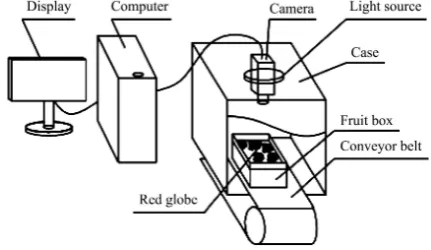
The experimental device is shown in Figure 1. An entire bunch of Red Globe grape was put into a camera obscura with its size of 500 mm×500 mm. In order to reduce the influence of external light, near-infrared light source and LED light source were installed on the top of the camera obscura. Two CCD cameras (AD-080GE, Kowa Company, Japan) have two channels to collect RGB images and NIR images at the same time. There is
a passage at the bottom of the camera obscura. The
conveyor belt was installed at the bottom of the case for purpose of on-line measurement. A total of 38 cases of Red Globe grapes in this study were purchased from the fruit wholesale market.
3 Image processing and parameter extracting
Images used in this study were captured in the Agricultural Equipment Test and Automation Laboratory in Huazhong Agricultural University, Hubei province, China, in October 2014. In this experiment, RGB and NIR images as illustrated in Figure 2 were collected under the same conditions. As is shown in the images, there are two or more grape overlapping on the surface of the whole case. As a result, some grapes and even whole individual grapes were shielded from being perceived by the camera. Some stems can be seen in the images and those affecting the image would be removed using image processing techniques in the next steps.
a. RGB image
b. NIR image
Figure 2 Original acquired image 3.1 Grapes stems removal
As mentioned above, the fruit stems must be removed before detecting the edge. It showed that from RGB image that stems and grapes are different in color, but the edge of Red Globe grapes contour is not clear. While as seen from NIR image, the edge is clear and stems have higher brightness than the grapes, but the stems are difficult to be distinguished from highlighted area of individual grapes since the latter had the same brightness with the stems. If RGB image is converted into HSV
image, most of the stems can be removed from the image by selecting the appropriate threshold in terms of the different reflectivity of individual grapes and stems, as shown in Figure 3a. However, the RGB image is dark with unclear contour, therefore, it is unsuitable for successive image processing. If parts of NIR image are enhanced and then segmented, as shown in Figure 3b, the effect of removing stems was found inferior than RGB image but the contour of grapes becomes clearer. In order to obtain the optimal effect of stems removal, this study proposed a comprehensive method of integrating the advantages of RGB and NIR images. The specific steps are shown in Figure 4.
a. Effect of stems removal in RGB image
Highlighted areas Stems of grape b. Effect of stems removal in NIR image
c. Effect of removing stems by using comprehensive method
Figure 3 Stems removal of images
Firstly, as the brightness value of grapes and stems were different, the RGB image was transformed to HSV by setting the channel-H threshold in the range of 0.089-0.283, the stems could be removed effectively. Then, the image was transformed into a binary image, in which the stems region was black and the grape region was white. Thirdly, the NIR image was processed by median filter with 3×3 neighborhood and enhanced by the imadjust function. Finally, the binary image was multiplied with the enhanced NIR image to get the final processed image.
The effect of stems removal using this comprehensive method is shown in Figure 3c. An obvious improvement can be observed, compared with Figures 3a and 3b.
3.2 Contour extracting
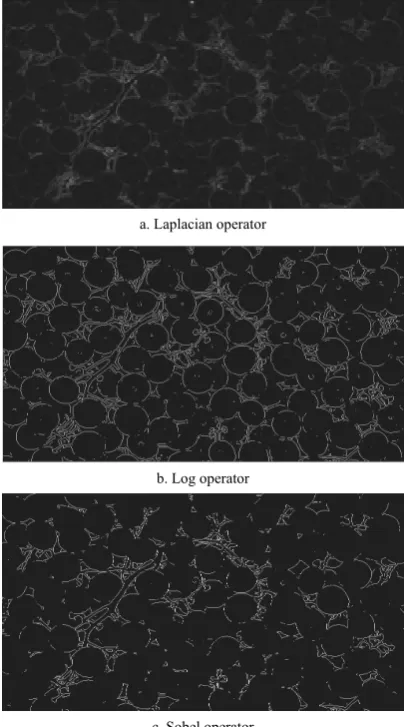
The image was further processed to obtain the edge of grape contour after removing the stems. Common operators, including laplacian operator, log operator, sobel operator etc., were used to obtain the edge of grape contour. The results are shown in Figure 5.
a. Laplacian operator
b. Log operator
c. Sobel operator
Figure 5 Edges detection of grape
From the results, it can be seen that the effect of sobel operator was better than others. Consequently, the sobel operator is selected to obtain the edge of grape contour.
3.3 Binarization of contour
If binary processing of images edge detection is conducted directly, a lot of noise will be produced, such as the unexpected information of from stems. As shown in Figure 6a, the brightness of stems was higher than that of edges. Considering this, the highlighted stems are set as 0. Then the gray image was transformed into a binary image with the threshold of 0.48. Thirdly, the imclose function of morphological closing operation was used to connect the discontinued edge. In the imclose function, ‘se’ style is ‘disk’ and the parameter is 3. The fourth step involves using the bwareaopen function. The bwareaopen was selected to remove the area smaller than 20. After performing these procedures, much of the noise was eliminated. As a result, a clear contour was obtained, as shown in Figure 6b.
Highlighted areas of stems a
b
Figure 6 Edge of the binary image 3.4 Edge fitting
segment the grape contour. The second step was to fit the grape edge in the method of ellipse fitting based on iterative least median squares. Segmentation loop iterative least median square method, which is composed of segmentation and iterative least median square method, contributes to reducing the quantity of calculation notably.
Segmentation loop iterative least median square method includes three steps.
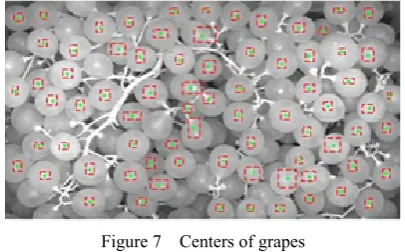
Step 1: The approximate center position of each individual grape is traced by the method of the mathematical morphology image processing (in Figure 7). For grapes within the central region experiencing the strongest reflections from other regions, the binarization threshold was selected as 0.9 to extract the center region. Then, the small area extraction method was used to remove interference information such as small areas with parameters of 60 which is the empirical value obtained by a large number of experiments then the region props function was applied to determine the center of each region, with the center as the approximate center of each grape.
Figure 7 Centers of grapes
Step 2: For image segmentation, the appropriate radius was determined according to acquired position of centers (Figure 5). In this study, considering the Red Globe grape size, 50 pixel was chosen as appropriate radius. The 16th segmentation image is showed in Figure 8.
Figure 8 A individual grape image
Step 3: Segmented image was fitted by the following common methods of ellipse fitting, such as Hough transform, least squares fitting, least median squares fitting, et al.[15-20] However, Hough transform requires a
large amount of calculations, and least squares fitting and least median squares fitting are sensitive to noisy environments. In general, there exists some noise in the segmented image, which interferes in the ellipse fitting. The iterative least median square method is used to effectively remove the noise so as to lower the impact caused by the noise points. This method turns out to be relatively effective and speedy and the procedure is outlined below:
a. Setting up an elliptic equation (Equation (1)). Where, (x, y) denotes the coordinate of point, A=(a, b, c,
d, e)
2 2
( , ; ) 1 0
g x y A =ax +bxy cy+ +dx ey+ + = (1)
b. The original fitting parameters, A0, is obtained by
processing all data points in least median squares method. c. Fitting errors, di, is obtained by putting all points
into parameter equation, di=(x, y; A), here, i=1,2,3,…,n, n represents the number of the coordinate points.
d. The median β1 is obtained by sorting di from small
to large. where, β1=mid{d1, d2, …, dn}.
e. The fitting errors is centralized, {d′1, d′2, …, d′n}=
{d′1 –β1, d′21–β2, …, d′n1 –βn}. The absolute value of
the centralized fitting error sequence is obtained with median β=mid{| d′1 |, | d′2|, …, | d′n|}.
f. In normal distribution, ±3σ is the standard reference
to identify noise points, where, σ is the variance of the sample data, which is obtained from the calculations,
σ=1.4728β. Noise points of the fitting errors were removed by the method of ±3σ.
g. The new fitting parameter, A1, is obtained by
processing the remaining data in least median squares method, A1=(a1, b1, c1, d1, e1). Then, the steps were
repeated from c to f.
If there are the data points remaining whose fitting errors are more than 3σ, the removal processing will continue until no errors are found. The fitting parameters finally obtained result from the iterative least median method.
superior to that of ellipse fitting based on iterative least median squares for purpose of processing contour with excessive noise points. Figure 9a is the original image and the red marked grape is the detected target. Figure 9b is the result of ellipse fitting based on least median square method, and Figure 9c is that based on iterative least median squares method. It can be found that the fitting result of Figure 9c was more close to the actual contour than Figure 9b. The reason is that iterative least median squares method was better at reducing the interference caused by extreme points.
a b c
Figure 9 Single fitting method 3.5 Parameter extracting
In XOY coordinates system, θ represents the angles
between X axis and the longer axis of ellipse Ra fitted by
elliptic Equation (1). If θ=0, then b=0. If θ≠0, it is necessary to rotate the axis by θ degrees to get new coordinates system X′OY′. Then, the new elliptic parameter equation is:
2 2
( , ; ) ... 1 0
g x y A =a x′ ′ +b x y′ ′ ′+ c y′ ′ +d x′ ′+e y′ ′+ = (2) Let x′=x*cosθ+y*sinθ, y′=–x*sinθ+y*cosθ, substitute it into Equation (1) and the result is:
2 2 2 2 2
2 2 2
( ) [2 ( ) ...
2 ] ( ) ( ) ...
( ) 1 0
ak bjk cj x ajk k j b
cjk xy aj bjk ck y dk ej x
dj ek y
− + + + − −
+ + + + − +
+ + =
where, j=sinθ, k=cosθ.
In the X'OY' coordinates, if θ=0, then, the coefficient before xy is zero, namely,
2 2
2ajk+(k − j b) −2jk=0
(3) It can be derived from Equation (3), namely,
1 arctan( ) 2 b c a θ =
−
(4)
2 2
a′ =ak −bjk cj+
(5)
2 2
2 ( ) 2 0
b′ = ajk+ k − j b− cjk = (6)
2 2
c′ =aj +bjk ck+
(7)
d′ =dk ej−
(8)
e′ = +dj ek
(9)
The elliptic standard equation is obtained by substituting Equation (4) into Equation (2), namely,
2 2
2 2
( 0) ( 0)
1
a b
x x y x
R R
′− + ′− = (10)
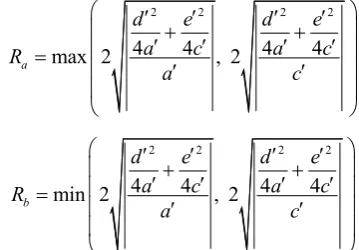
The result concluded from Equations (2)-(10) is as follows:
2 2 2 2
4 4 4 4
max 2 , 2
a
d e d e
a c a c
R a c ⎛ ′ ′ ′ ′ ⎞ ⎜ + + ⎟ ′ ′ ′ ′ ⎜ ⎟ = ⎜ ′ ′ ⎟ ⎜ ⎟ ⎝ ⎠
2 2 2 2
4 4 4 4
min 2 , 2
b
d e d e
a c a c
R a c ⎛ ′ ′ ′ ′ ⎞ ⎜ + + ⎟ ′ ′ ′ ′ ⎜ ⎟ = ⎜ ′ ′ ⎟ ⎜ ⎟ ⎝ ⎠
where, Ra means the ellipse longer axis of individual
grapes and Rb means the shorter ellipse axis of each
grape.
Due to the fact that edges of some individual grapes are not clear and the phenomenon that grape stacking is usually detrimental, it is necessary to remove these unusual ellipses. Actual measurements of grape size indicated that all the grape curvatures (shorter axis/longer axis) are above 0.75 in this study. All the ellipse are filtered by setting threshold t, namely, t=Rb/Ra>0.75.
The final result is shown in Figure 10.
a. Original image of size fitting
b. Image after removing abnormal ellipse
Figure 10 Size fitting image
However, grapes are different in shape from each other (ellipse and ellipse-like), and they are placed in different positions within the cases. In order to reduce errors, the length of elliptic shorter axis is set as the detection parameter of grape size. In the experiment, the actual area of view field is 328 mm×246 mm, and the total image pixel is 1024×768. Therefore, the ratio of actual length to image pixel is 0.32:1 approximately. So, the detecting pixel of short axis is multiplied by 0.32 to represent the actual size of this Red Grape.
4 Results and discussion
In this study, the grading standards of Xinjiang Red Globe grape include weight, color, diameter, shape, flesh, soluble solids, total acid content, and TSS-acid ratio (DB65/T2832.2007). The grading indexes of grape size are listed in Table 1.
Table 1 Size detection of Red Globe
Index Grade 1 Grade 2 Grade 3 Grade 4
Diameter/mm ≥26 24-26 22-24 ≤22
Twelve individual grapes representing an entire case of grapes were randomly chosen and were graded in terms of grading standards listed above. The grade with the highest frequency of the 12 grapes is determined as the final grade of the entire case of grapes. In the test, 15% down-grading principle is followed. This means, if the largest number of grapes found within the case is recorded as Grade 2, then the whole case is evaluated as Grade 2. However, if the percentage of grade 3 in the same case being evaluated goes above 15%, then 15 down-grading principle works, the case being reevaluated as Grade 3.
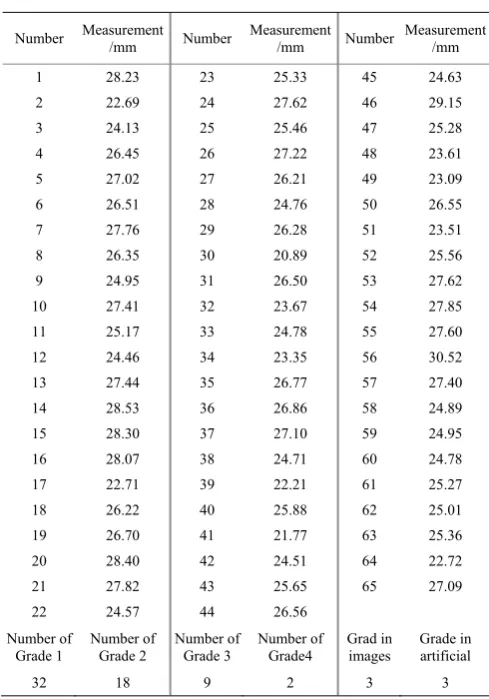
In this research, grapes were graded by the size of individual grapes. Grading modeling is built based on processed images. This study examined and graded 38 cases of grapes, Actual results indicated that 35 cases of them are accurately graded, suggesting that the accuracy rate of grading reached 92.1%. The detection results of 2nd case of grape are displayed in Table 2. Compared with Li’s research[14], this study clearly improved the accuracy rate from 85% to 92.1%. And the detection target is an entire case of grapes, rather than a single grape. The detection and gradation of an entire case of
grapes is within 4 seconds which is faster than detecting and grading many single grapes individually.
Table 2 Test results
Number Measurement
/mm Number
Measurement
/mm Number
Measurement /mm
1 28.23 23 25.33 45 24.63
2 22.69 24 27.62 46 29.15
3 24.13 25 25.46 47 25.28
4 26.45 26 27.22 48 23.61
5 27.02 27 26.21 49 23.09
6 26.51 28 24.76 50 26.55
7 27.76 29 26.28 51 23.51
8 26.35 30 20.89 52 25.56
9 24.95 31 26.50 53 27.62
10 27.41 32 23.67 54 27.85 11 25.17 33 24.78 55 27.60 12 24.46 34 23.35 56 30.52 13 27.44 35 26.77 57 27.40 14 28.53 36 26.86 58 24.89 15 28.30 37 27.10 59 24.95 16 28.07 38 24.71 60 24.78 17 22.71 39 22.21 61 25.27 18 26.22 40 25.88 62 25.01 19 26.70 41 21.77 63 25.36 20 28.40 42 24.51 64 22.72 21 27.82 43 25.65 65 27.09 22 24.57 44 26.56
Number of Grade 1
Number of Grade 2
Number of Grade 3
Number of Grade4
Grad in images
Grade in artificial 32 18 9 2 3 3
5 Conclusions
1) The stem of Red Globe grape can be effectively removed by combining RGB images with NIR images.
The method of ellipse fitting based on iterative least median squares method has advantage over least median squares for purpose of processing images with excessive noise points.
2) The improved method based on least median squares is applied to the size detection and grading of Red Globe grape. By using the iterative method, fitting errors is effectively reduced, and the detection results become clearer.
3) In this research, the detection target is enlarged from a single grape to an entire case of grapes, which satisfies practical application.
5) The grading method of grape size based on machine vision provides technical support for the grape’s quality detection and online grading.
Acknowledgements
This study was supported by Natural Science Fund of Hubei Province (2012FKB02910) and Research and Development Projects in Hubei Province (2011BHB01).
[References]
[1] Feng B, Wang M H. Detecting method of fruit size based on computer vision. Transactions of the CSAM, 2003; 43(1): 73–75. (in Chinese)
[2] Wang Q H, Wen Y X, Lin X D. Correlation between egg freshness and morphological characteristics of light transmission image of eggs. Transactions of the CSAE, 2008; 24(3): 83–187. (in Chinese)
[3] Zhou P, Liu J Y, Wang Q H. Egg image detection method and weight prediction model. Transactions of the CSAM, 2007; 38(11): 81–83. (in Chinese)
[4] Ling Y. Study on grain appearance quality inspection using machine vision. Master dissertation, China Agricultural University, Beijing, 2004. (in Chinese)
[5] Chen H, Xia Q, Zuo T. Determination of shiitake mushroom grading based on machine vision. Transactions of the CSAM, 2014; 45(1): 281–287. (in Chinese)
[6] Deng H X. Research on the detection method of eggs’ size based on machine vision. Master dissertation,, Huazhong Agricultural University, Wuhan, 2006. (in Chinese)
[7] Chen, Y, Li W, Zhang J X. Overlapped grapes berry size inspection based on image contour analysis. Transactions of the CSAM, 2011; 42(8): 168–172. (in Chinese)
[8] Chen Y, Liao T, Lin C K. Grape inspection and grading system based on computer vision. Transactions of the CSAM, 2010; 41(3): 169–172. (in Chinese)
[9] Zeng Q B, Liu C L, Miao Y B, Wang S P, Huang D F. Non-destructive measurement of diameter of overlapping grape fruit based on morphological image processing. Transactions of the CSAE, 2009; 25(9): 356–360. (in Chinese)
[10] Wang Q H, Ding Y C, Luo J. Automatic grading device for Red Globe grapes based on machine vision and method there of CN102680414A. 2012-09-19. (in Chinese)
[11] Blanc P. Unit for sorting and packing products capable of being hung on a hooking member for the purpose of their conveyance, such as bunches of fruits, in particular table grapes or truss tomatoes: US, 6957940. 2005-10-25. (USP) [12] Cubero S, Diago M P, Blasco J, Tardáguila J, Millán B,
Aleixos N. A new method for pedicel/peduncle detection and size assessment of grapevine berries and other fruits by image analysis. Biosystems Engineering, 2014; 117(1): 62–72.
[13] Roscher R, Herzog K, Kunkel A, Kicherer A, Pfer R, Rstner W. Automated image analysis framework for high-throughput determination of grapevine berry sizes using conditional random fields. Computers & Electronics in Agriculture, 2014; 100(1): 148–158.
[14] Li M. Grape grain size non-destruction detection based on machine vision. Master dissertation, Huazhong Agricultural University, Wuhan, 2013. (in Chinese)
[15] Xia J. A comparative study of ellipses fitting methods. Master dissertation, Jinan University, Guangzhou, 2007. (in Chinese)
[16] Li Z Q, Teng H F. Generalized Hough transform: fast randomized multi-circle detection. Journal of Computer- Aided Design & Computer Graphics, 2006; 18(1): 27–33. (in Chinese)
[17] Wang Z B, Wang K Y, Zhang S F, Liu Z Q, Ma C X. Whiteflies counting with κ-means clustering and ellipse fitting. Transactions of the CSAE, 2014; 30(1): 105–112. (in Chinese)
[18] Andrew F, Maurizio P, Robert B. Fisher direct least square fitting of ellipses. IEEE Transaction on Pattern Analysis and Machine Intelligence, 1999; 21(5): 476–480.
[19] Chien C F, Cheng Y C, Lin T T. Robust ellipse detection based on hierarchical image pyramid and Hough transform. Journal of the Optical Society of America A, 2011; 28(4): 581–589. (in Chinese)