44
ISSN 1392-2785 ENGINEERING ECONOMICS. 2007. No 4 (54) WORK HUMANISM
Application of Systemic Management Conception to Organization’s Management
Decisions Structuring
Tomas Karpavičius, Aurelijus Cvilikas, Rimantas Gatautis
Kauno technologijos universitetas K. Donelaičio g. 73, LT-44029, Kaunas
The developing conception of systemic management conditions the new understanding of organization man-agement. Systemic viewpoint to management and eco-nomic processes is one of the new management theories, which in most cases are striving for profound viewpoint to processes of management and their administration‘s principles. System viewpoint is important factor in some business areas, such as tourism, sport management, etc, where business processes are based on various organiza-tions’ constant collaboration. Systemic viewpoint firstly characterizes the structure of individual organization, which is the base for further system theory development in management area. The summarized analysis of various views to systemic organization management, which is used to determine the basic elements of systemic organi-zation management, is presented in this article. Many authors, who have been analyzing the conception and principles of behavior of system, treat system as the unit of elements, related interdependent by the same character connection, which functions as an individual object of environment. Management of organization in a context of systems‘theory can be treated as a complex process of information in which process employees of management‘s structure pursue functions of management by regulating all processes that happen in the organization. The analy-sis of Boulding (2004); Gregory, Stuart (1989); Černiak (1975); Zakarevičius (2002); Lydeka (2001) and other authors’ viewpoint in systemic management analysis al-lows stating that system can be described according to three dimensions: 1) system‘s inside structure‘s features; 2) specific systemic features’ attribute and 3) system‘s behavior features. But this viewpoint does not character-ize the social system aspect of organization. Social struc-ture can be defined as basic element of organization. So-cial structure in general involves members (participants) of organization which are an important part of complex organization as a social system. All parts of organization function facing environment, elements that do not belong to any particular system which in some cases complement system or become limiters of system‘s functioning, all the time. Therefore, structure of organization as a system can be expressed by evaluating reciprocity of inside elements of an organization and organization‘s as a system con-nection with elements of outside environment. Summariz-ing the analysis of systemic management, it is true to say that it is purposeful to relate management of an organiza-tion as a system with management of inside environ-ment‘s elements (social structure, technology, strategy and human resources) of organization, joining these
ele-ments into solid environment, which proximately contacts with outside environment of organization, using incoming (resources necessary for organization) and outgoing (re-sult of organization‘s activity) connections.
Keywords: systemic management, systems theory, or-ganization management.
Introduction
Systemic viewpoint in management is classed to new management theories, which reflect modern manage-ment‘s conception‘s change. Boulding (2004) gave a lot of attention to systemic viewpoint in management, he properly analyzed the basic principles of systemic theory; Gregory and Stuart (1989), showed great consideration to systems‘ analysis in economic processes‘ environment; Barnard (1938), formulated the idea of organization, as a social system; Černiak (1975), researched peculiarity of systemic analysis realization. In Lithuania, the theory of systems and systemic viewpoint to management pretty properly analyses Zakarevičius (2002), who gave comprehensive genesis of management study; Lydeka (2001) elaborated conception of economic; Vengrys (1973) gave great attention to the research of the eco-nomic system, too.
Subject and relevance. The developing conception of systemic management conditions a new understanding of organization management. Management starts being treated not as single individuals, working in the same environment, but as a solid system, which functions be-cause of closely related separate system elements inter-ests, control.
Systemic viewpoint to the management of a particu-lar organization can be considered as an advantage in the aspect that it lets warrant maximum synergy of members of organization and other elements (technical means, in-terests and so on), oriented to general purposes of organi-zation as a social system.
In this article, the influence of theory of systems to the organization‘s management is being analyzed in order to summarize viewpoint of various scientists to systemic management of organization and to distinguish the main elements of systemic management of organization.
The object of research – decision‘s structure of sys-tematic management of organization.
45 The methods of research is systemic, logic and comparable analysis of nonfiction.
The article analyses Boulding (2004), Gregory and Stuart (1989), Černiak (1975), Zakarevičius (2002), Lydeka (2001) and other authors’ viewpoint in systemic management analysis.
The conception of systemic administration in
processes of management environment
The idea of systemic management was raised by ex-ponents of classic systemic theory. The first, who started analyzing system as a particular part of elements‘ unit and formulated the idea of general systems theory, was Italian biologist L.Bertalanfi.
Systemic viewpoint to management and economic processes has classed the new management theories, which in most cases are striving for profound viewpoint to processes of management and their administration‘s principles. Fundamental pivot of systemic viewpoint is the conception of system.
Many authors, who have been analyzing the concep-tion and principles of behavior of system (Boulding, 2004; Bondarenko, 1996; Bertalanfi, 1973; Wiener, 1963; Gregory, Stuart, 1989), treat system as unit of elements, related interdependent by the same character connection, which functions as an individual object of environment. Lydeka (2001) defines system as ordered system of inter-acting elements, which consistently makes integrity with such typical features that other separate elements do not have. This definition reflects meaning of integrity in sys-temic viewpoint. Integrity might be treated as unit‘s de-gree of system‘s organization, which defines appropriate systemic features, characteristics of elements and their interaction.
System can also be defined as appropriate unit, unity of interdependent elements (Simanauskas, 1997). Ven-grys (1973) emphasizes system‘s contraposition to con-ception of chaos, when internecine independence of sepa-rate elements‘exists.
Defining measurements of systems‘theory, Zakare-vičius (2002), treats system as an object, which consists of at least two compound elements, which are interde-pendent with the same character connections. Author em-phasizes that system usually consists of rather more than two elements. This symbolizes system‘s, as an individual structure‘s, complexity. However next to this definition it is also necessary to emphasize that elements that are in
the same expanse can not necessarily be named as a sys-tem if there are not connections of the same character. Consequently, it is important to value necessity of ele-ments‘internecine connections, first of all detailing char-acter and features of these connections
Boulding (2004), who has properly analyzed sys-tems‘ theory, distinguishes various aspects of a system without concretizing system‘s constituent characteristics, but emphasizing that system in one or another form exists in any, without reference to character or aspect of scien-tific inquiry. According to this proposition, Boulding (2004) distinguishes several viewpoints to system‘s analysis, emphasizing static, dynamic, thermostatic (static in particular conditions), open, genetic-social, organic, humane and other systems‘existence and their analyzing demand through prism of system‘s theory.
In nonfiction (Lydeka, 2001; Gregory, Stuart, 1989; Wiener, 1961) system is usually being described accord-ing to:
System‘s inside structure‘s features: abundance; element; feature; connection; relation; interaction; integrity; organization; hierarchy; component; ma-terial; structure and others. These features reflect basics of system‘s structure (organization‘s); Specific systemic features‘ attribute: interaction;
reversible, direct, positive and negative connec-tion; management; state of elements; self-regulation; competition; integrity; dynamism; static; openness; insularity; integration; differen-tiation; centralization; stability; balance and oth-ers. These features reflect posed and possible po-tential systemic qualities;
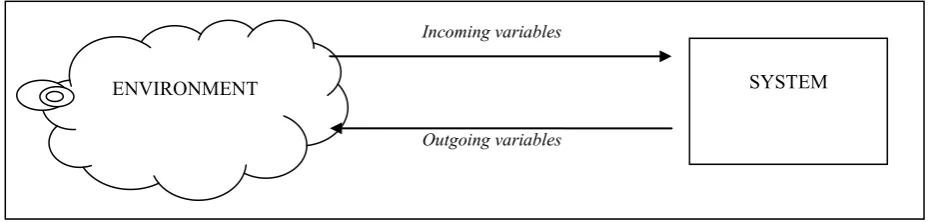
System‘s behavior features: purpose; environment; system‘s state; behavior; activity; alteration; func-tioning; determinism (conventionality); adaptation; development; evolution; training; genesis and oth-ers. These features reflect factual system‘s qualities which appear in interaction with real environment. In structural opinion system can be represented as in-dividualized part of a unit, which is related to environ-ment in particular connections (figure 1). Absolutely iso-lated systems, which do not have connections with envi-ronment, do not exist in real world. Therefore system‘s detachment from a unit can be treated as conditional de-cision, reasoned by particular assumptions. If they had changed, system‘s structure and relation with environ-ment would have changed.
Figure 1. System‘s structure and connection with environment (Boguslauskas, 1999) SYSTEM ENVIRONMENT
Incoming variables
46 The purpose of systems theory – systemic analysis and projection. It‘s gist – after analyzing system, new information is generated, which shows how qualitatively a system has to change so it‘s existence‘s efficiency would grow. Systemic analysis and projection‘s logic is based on this consistency to:
1. Ascertain to which class or group system belongs. 2. Estimate what functions it performs, what are it‘s
purposes.
3. Estimate system‘s structure.
4. Analyse every element – subsystem.
5. Ascertain system‘s connections with environment, estimate characteristics of environment.
6. Characterize processes happening in a system. 7. Analyze subsystems and processes of
manage-ment.
While researching systems, an urge has arisen to marshal-classify them anywise. One of the well-known initial systems‘classifications is given by K.Bouldig. This classification is special because it has not got a particular criterion of dividing systems. K.Boulding distinguished 8 classes of systems:
Static systems – made of elements which do not move and are closely connected.
Simple dynamic systems – systems in which ele-ments move in simple, restricted trajectories. Simple cybernetic systems – systems which react
to changes, happening in system‘s outside or in-side.
Open, adjusting systems – nature‘s rudiments. Flora – various plants.
Fauna – new quality systems which have recogni-tion‘s receptors and nervous system.
Human – a special perfect system. Human has in-tellect, which gives an opportunity to remember the past, evaluate present and forecast future. That shows the singularity of the system.
Social organization – system of groups of people who are related by common activity and interests. In mathematical opinion system and environment are related by two types of relations:
System‘s run more or less depends on outgoing variables received from environment, which can change particular parameters of system‘s behavior. System, functioning in particular purposes and in particular directions, generates outgoing variables, by which it contacts with environment and changes particular parameters of environment. Without reference to system‘s functioning particular-ity, these basic features of all systems are distinguished (Černiak, 1975; Zakarevičius, 2002):
Integrity. All elements in a system are joining to-gether in one unit.
Divisibility. Every system can conditionally be marshaled to separate elements.
Unique nature. Every system somehow differs from others.
Segregation. A system can segregate from outside
environment for some time.
Indetermination. It is impossible to record sys-tem‘s features at the same moment.
Identification. Every element of a system can be distinguished conditionally and estimate it‘s fea-tures.
Variety. Every element or it‘s behavior in a system is expedient and unique.
To summarize conception of a system position of ex-ponents of systems’ theory, it is true to say that the sys-tem is a substantial element of syssys-temic viewpoint. Analysis of it‘s conception requests to research system‘s own principle structure and it‘s constituent, by that iden-tifying system‘s connection with environment. This as-pect is extremely important analyzing organization as a system which is closely connected to various elements of environment surrounding it. Therefore analyzing concep-tion of systemic organizaconcep-tion‘s management first of all decision‘s structure of systematic management of organi-zation must be elaborated.
Decision‘s structure of systematic management
of organization
Management of organization can be treated as a com-plex process of information in which process employees of management‘s structure pursue functions of manage-ment by regulating all processes that happen in the or-ganization. System of management, which connects all processes happening in an organization to undivided unit – a system, vouches realization of processes of manage-ment in organizations as social systems.
The idea of organization as a social system was for-mulated by Barnard (1938). Barnard maintains that an organization is such sort of corporation‘s people who differ from other social groups in consciousness, predict-ability and singleness. Barnard and his exponents gave great attention to general actions of people, their corpora-tion, and only after that purposefulness was emphasizes. A strong representative of human nexus, analyzing prob-lems of incentives of actions, understands that activity of employees, quality of work and other results depend not only on motivation, but also on many others organiza-tion‘s factors which have strong interdependent connec-tions. Therefore he starts treating organization as a hu-man system in which one person, groups of people have strong interdependent connections and their actions are deliberately coordinated (Zakarevičius, 2003).
Barnard also gives the first conception of intercon-nection of social systems, bigger systems‘division into smaller. He refers to organizations as big systems be-cause they compile bigger systems (corporations, associa-tion). All organizations integrate into huge, informal and never finally defined organization called society.
Organization can be defined as two and more people having the same aim and purposely collaborating. It is evident that organization is a group of people who are related by connections of collaboration, corporate inter-ests and aims. In this regard every organization is a social system (Zakarevičius, 2002).
47 direct consolidation of Earth, physical capital and work force happens, in other words, primary economic process (in most cases industrial) happens, one or another (mate-rial, intellectual or other) product appears. It is necessary to emphasize that economic process happens not only in industrial or commercial organization, but also in organi-zation with other character. Therefore from this view-point every organization is an economic system.
Cole (1999) maintains that system of management, as a complex management subject, can be defined by four basic dimensions which recount realization‘s context of system of management (figure 2). According to this con-ception of management‘s system functioning, the role of information can be emphasized though the prism of func-tionality of management‘s system. It is evident that in-formation from this viewpoint can be treated as structural basis of any management’s system, establishing imple-ments of embodying aims of management‘s system. On the ground of control of information, system of ment that is being analyzed lets treat system of manage-ment as combination of information‘s flow managemanage-ment and procedures of communication, that compiles prereq-uisite for integrated management of all processes that are happening in an organization. In this context it is neces-sary to emphasize that according to famous economic experts (Oliveira, Centeno, 2004; Fischer, Stokic, 2002), is not only transmissible knowledge, but also aids and appliances of work which can make right decisions. Such information term‘s treatment is related to nascence of two new disciplines – mathematical information and theories of cybernetics. In these two disciplines information is treated as knowledge, which sheer or partially repeals obscurity which remained as yet.
Figure 2. Dimensions of system of management (Cole, 1999) Abstracted dimensions of system of management on the ground of information‘s management enable to relate definitions of information and management with close conceptual contacts, but in work‘s author opinion, it is beside the purpose to limit analysis of system of
agement only with connections with information‘s man-agement. Analyzing system‘s of management conception and it‘s role in business organization, it is expedient to research components of systemic management‘s purport, which validate necessity of systemic management, as implements of securing effective organization‘s / busi-ness‘functioning.
Systemic theory, analyzing organizational structure of organization‘s system‘s management, identify it with structure‘s analysis, analyzing composition of elements and connections between them at the same time. Zakare-vičius (2002) emphasizes that hereby description of or-ganizational structure is a description of oror-ganizational management structure.
Organizational management structure properly shows a whole view of a company. Company‘s managers choose (project) this structure, it‘s different variants. Company‘s work strategy, usable work methods depend on organiza-tional management structure (Zakarevičius, 2003).
Four basic variants of organizational management structure are (Ţvinklys, Vabalas, 2001):
simple or linear; functional;
workshop (subdivision); matrix.
Simple (linear) management structure. The prime ex-ample of simple management structure is management of a personal (individual) company. Undoubtedly similar management structure is also possible in partnership. Economic work‘s decisions collectively can be made there by all members of partnership without hiring special (professional) staff of management. Linear structure has superior because (Misevičius, 2001):
Every co-worker has only one supervisor who gives directions.
Strict management system is being established. However, this system has some demerits:
Every supervisor is to know, how to do and solve almost everything.
The bigger is a company, the greater are solutions. The passage through institutions is very long in
big companies.
In relation to these causes, linear structure is suitable only for small companies.
Functional management structure mostly is in com-panies which produce, sell a product or several products of one denomination which are interdependent or closely related by their markets of realization. Employees of such company are grouped according to the work they do and similar education. Employees, pursuing the same tasks, are organized into one separate company‘s subdivision – department, office and so on.
There are more organizational connections of work-shop‘s management structure and they are more complex. According to practice, the number of demerits of func-tional management structure is growing and they start to dwarf the advantages while the company is expanding. It particularly shows while nomenclature of production is expanding in a company, there appear more various con-1. Information‘s compilation/analysis
Private / public information‘s compilation
Consistent / contemporaneous information‘s processing
2. Information‘s transfer
Standardized / situational information‘s transfer
Simplex / interactive information‘s transfer
3. Communication of information‘s transfer Purposive / reticulate communication
Dragged in time / communication on time
4. Information‘s character in system of management Information oriented to the past / future
48 sumers or activity is expanding in geographical view-point. Work of such a company is diversified – products are being produced unrelated in technological viewpoint or various facilities are purveyed (Ţvinklys, Vabalas, 2001). In this case, it is necessary to form subdivisions, establish particular independent workshops or subdivi-sions which would do everything themselves – project, produce and sell their products.
Matrix‘s management structure is invoked in case high technology level is needed when tough competition is made to producible production, when requirements to production‘s standardization are high, when it is neces-sary to adjust to specific markets of different countries. Matrix‘s management structure is very complex because different ways of management interlace in it. Matrix‘s management structure is much more flexible than other organizational structures. It tries to alienate from power of traditional hierarchy and from unitary structure of team and reaches for balanced power and division of responsi-bility. The main elements, that distinguish matrix‘s struc-ture from the others are: a manager that simultaneously reports to two directors; managers that share subordina-tion; head manager that conducts this dual structure and solves emerged controversies (Navickas, 2003).
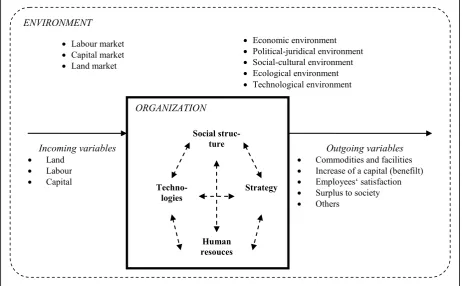
According to basic system‘s structure showed in il-lustration No.1, systemic management of organization can be defined analogically – as a system which consists
of planning, organization, control, monitoring and other functions of integrated realization, that is in process due to incoming variables which are treated resources, neces-sary for organization to function – people, tangibles, equipment, financial resources. According to classic prin-ciples of economics theory, all resources such as land, labour and capital, that are needed business organization, can in general be defined as factor of production. Due to these incoming variables, functioning system of business organization‘s processes generates outgoing variables – commodities and facilities, increase of a capital (benefit), employees‘ satisfaction, surplus to society and others. Incoming and outgoing variables connect business or-ganization (system) to environment. Graphically dis-cussed structure of business organization as a system is presented in figure 3.
It is also possible to resolve environment, as unit of elements surrounding management‘s system, into general elements. Classifying elements of environment according to incoming variables, three constituent can be distin-guished: labour‘s, capital‘s and land‘s market, correlation of which determines size of usable incoming variables. In another aspect, environment of business organization as system can also be treated as complex of economic, po-litical-juridical, social-cultural, ecological and techno-logical environment, which determines decisions of busi-ness organization procedures‘realization.
Figure 3. Structure of business organization as a system and its interaction with environment (according to Cole, 1999; Bennett, 1997; Boguslauskas, 1999)
Organizations by its origin are a big, complex, dy-namic, open, expedient, manageable system. These dimen-sions of organization‘s management can be defined as:
Big – there are many and various complex ele-ments in an organization. It is very difficuilt to evalue all of them.
Complex – characteristics of organization‘s struc-ture and proceeding processes can be measured only by complex methods. Some of them can be measured only approximately.
Dynamic – there are many and various by their purport and other parameters processes in an or-ganization.
Open – organization, related to outside
environ-ment by various connections, receives and gives to environment materials, information and so on. Expedient – organization functions estimating its
aims and implementing them.
Manageable – there are informational processes in an organization and it serves as a basis for its ac-tivity regulation.
Principle model of organization as a system is pre-sented in Figure 4. Basic element of organization in this model, given by Guščinskienė (2002), is social structure. Social structure can be treated in two ways: as normative, unbodying environment, or as factual order, inclusive rules, prohibitions, permits and similar elements which are applied to single individuals, which are necessary in
SYSTEM
Planning
Organization
Control
Monitoring
Other procedures
ENVIRONMENT Incoming variables
Land
Labour
Capital
Outgoing variables
Commodities and facilities
Increase of a capital (benefit)
Employees‘ satisfaction
Surplus to sociaty
Others
Labour market
Capital market
Land market
Economic environment
Political-juridical environment
Social-cultural environment
Ecological environment
49 regulating social life. In given a model, social structure in general involves members (participants) of organization which are an important part of complex organization as a social system. Members of organization is a unit of indi-viduals, everyone of them has to have necessary features and skills which let individual to take a particular place a social structure of organization and perform an appropri-ate social role. All members of organization construct organization‘s staff. Members of organization, having different capabilities and potential, have to fill all treads of social structure, all social positions in an organization. Social structure, as a basic element of organization, cannot function successfully without other important
con-stituents of organization. First of all these are aims of organization, which define activity‘s marks of all social system, partially characterize activity‘s purport of a par-ticular social system. According to it‘s origin, aims of organization can be related to:
Tasks, intended to vouch functioning of a whole system or it‘s individuals.
Marks which define basis of system‘s functioning and direction of evolution.
Systems that allow single organization (social sys-tem) to integrate into systems of outside environ-ment, which compile structural piece – society.
Figure 4. Principle structure of organization as a system (Guščinskienė, 2002) All parts of organization function facing
environ-ment, elements that do not belong to any particular sys-tem which in some cases complement syssys-tem or become limiters of system‘s functioning, all the time. Environ-ment, surround organizations and systems, can be ana-lyzed in two aspects, distinguishing general and specific environment. General environment is defined as envi-ronment which parameters are relevant to all systems or organizations. Natural environment defines general envi-ronment. Specific environment is such environment pa-rameters of which are relevant only to the system which is being analyzed. Such parameters of a system in a busi-ness organization can be a level of producible product or demand of a facility, specific infrastructure (traffic sys-tem, pipeline system and so on) or channels of stock re-ceiving.
The authors of the article consider two structures of organization to be an interdependent system because they emphasize different aspects of system‘s functioning: structure of organization as a system, given by Guščinskienė (2002), defines inside structure of organiza-tion joining all processes that are happening inside or-ganization and ignoring significance of outside environ-ment; structure of organization as a system, given by the authors of the article (according to Cole, 1999; Bennett, 1997; Boguslauskas, 1999) emphasizes organization‘s relations with elements of environment, amplifying
inte-gration of organization as a system into a wider-raging system – environment of organization. According to the description of these two viewpoints, it is true to say that structure of organization as a system can be expressed by evaluating reciprocity of inside elements of an organiza-tion and organizaorganiza-tion‘s as a system connecorganiza-tion with ele-ments of outside environment. The scheme of this struc-ture is presented in figure 5.
In authors’ opinion, treating organization as a system, it is expedient to regard to a structure of organization as a system, given by Guščinskienė (2002), however it should be modified in justice to:
Organization‘s as a system‘s component “Aims“ loosely specifies marks of organization activity. According to provisions of organization‘s strat-egy‘s forming specialists (Drummond, 2003; Vasi-liauskas, 2002; Hirschey, 1998; Andriuščneka, 2003), the concept “strategy“ should be used. It gives wider-raging meaning to this part of a sys-tem, inclusive not only the aims of organization, but also a vision, a mission and alternatives of strategy.
Participants of an organization should be named as human resources of an organization, their activity being limited by social structure and technologies. Exactly human resources determine realization of SOCIAL STRUCTURE
PARTICIPANTS
AIMS TECHNOLOGY
50 organization‘s strategy, using available social structure of organization technologies.
As it was mentioned above, organization is inseparable from outside environment, therefore it is necessary to evaluate organization‘s connections with outside while forming structure of organization as a system. For this
rea-son the elements of environment and organization‘s inter-action with outside environment must be defined, which vouch incoming and outgoing variables. These elements are discussed in illustration No.3 analyzing structure and interaction with environment of business organization as a system.
Figure 5. Inside and outside structure of organization as a system (made by authors) Summarizing the analysis of systemic management, it
is true to say that system of management, as one of or-ganization‘s subsystems, can be treaded as organiza-tion‘s, conceptualized as economic-social system, basis of rational and effective functioning. Such treatment of management‘s system enable to emphasize general ad-vantages of systemic viewpoint to management – security and maintenance of internecine interest‘s solidity of sys-tem‘s elements and secure of whole syssys-tem‘s purposeful evolution.
Conclusion
1. Evolution of systemic viewpoint to management, which started developing as one of trends of new school of management, determined alteration of concept of organization‘s management, as a result of which appeared opportunities of relating man-agement of organizations with economical-social system‘s management.
2. One of the main features of organization as a so-cial system is solidity, extent of which can be treated as a degree of internecine interests’ com-patibility of separate elements (members of or-ganization) of social system. In respect that exis-tence of separate elements in general environment is not enough for definition of a system, it is true
to say that solidity in a social system is determined by functioning of separate system‘s elements‘ cor-relation. After evaluating solidity‘s feature which is necessary for a social system to function, it is true to say that systemic viewpoint to management is based on search of internecine interests’ com-patibility of elements of organization as a social system and relating these interests with general in-terests of a whole organization.
3. Systemic theory, analyzing organizational struc-ture of organization‘s management system, identi-fies it with structure‘s analysis, analyzing structure of elements and relations between them at once. Hereby systemic theory involves complex identifi-cation of organization‘s elements and secures ra-tional functioning not of separate elements but of a system as unit. This feature of systemic manage-ment lets us maintain separate elemanage-ment looses it‘s individuality in a system and is treated as one of many replaceable parts of a system.
4. It is purposeful to relate management of an organi-zation as a system with management of inside en-vironment‘s elements (social structure, technol-ogy, strategy and human resources) of organiza-tion, joining these elements into solid environ-ment, which proximately contacts with outside en-vironment of organization, using incoming (re-ENVIRONMENT
ORGANIZATION
Incoming variables
Land
Labour
Capital
Outgoing variables
Commodities and facilities
Increase of a capital (benefilt)
Employees‘ satisfaction
Surplus to society
Others
Labour market
Capital market
Land market
Economic environment
Political-juridical environment
Social-cultural environment
Ecological environment
Technological environment
Social struc-ture
Techno-logies Strategy
51 sources necessary for organization) and outgoing (result of organization‘s activity) connections.
References
1. Andriuščneka, J. Strategic Planning // Organizacijų vadyba: siste-miniai tyrimai, Nr. 28, 2003, p. 7-19.
2. Bennett, R. Management. London: M&E Pitman Publishing, 1997. 3. Boguslauskas, V. Ekonometrija. Kaunas: Technologija, 1999. 4. Boulding, K.E. General Systems Theory: The Skeleton of Science
// E:CO, Special Double Issue, 2004, Vol. 6, No 1-2, p. 127-139. 5. Cole, G.A. Management: Theory and Practice. London: Letts
Edu-cational, 1999.
6. Drummond, G. Strategic Marketing. Planning and Control / G.Drummond, J.Ensor USA: Butterworth Heinemann, 2003. 7. Fischer, U. Organisational Knowledge Management in
Manufactur-ing Enterprises – Solutions and Open Issues / U.Fischer, D.Stokic // Challenges and Achievements in E-Business and E-Work Contents: International Conference, 2002, Vol. 1.
8. Gregory, P. Comparative Economic Systems / P.Gregory, R.Stuart. Boston: Irwin, 1989.
9. Guščinskienė, J. Organizacijų sociologija. Kaunas: Technologija, 2002.
10. Hirschey, M. Fundamentals of Managerial Economics, 6th ed. / M.Hirschey, J.L.Pappas. Chicago, 1998.
11. Lydeka, Z. Rinkos ekonomikos tapsmas. Teoriniai svarstymai. Kaunas: VDU leidykla, 2001.
12. Misevičius, V. Vadybos pagrindai. Kaunas: Technologija, 2001. 13. Navickas, V. Valdymo kontrolė tarptautinėse firmose. Kaunas:
Technologija, 2003.
14. Oliveira, J. M. Knowledge Management through ‘PED’ – A Per-sonal and Professional Success / J.M.Oliveira, C.C.Centeno // E-Commerce: IADIS International Conference, Portugal, 2004, p. 538-543.
15. Simanauskas, L. Informacinių sistemų analizė. Vilnius: VU leidyk-la, 1997.
16. Vasiliauskas, A. Strateginis valdymas. Vilnius: Enciklopedija, 2002.
17. Vengrys, A. Ekonominė sistema ir jos reguliavimas. Vilnius: VU leidykla, 1973.
18. Wiener, N. Cybernetics or Control and Communication in the An-imal and the Macine. London, 1961.
19. Zakarevičius, P. Pokyčiai organizacijose. Kaunas: VDU, 2003. 20. Zakarevičius, P. Vadyba: genezė, dabartis, tendencijos. Kaunas:
VDU, 2002.
21. Ţvinklys, J. Įmonės ekonomika / J.Ţvinklys, E.Vabalas. Vilnius: Vilniaus vadybos kolegija, 2001.
22. Берталанфи, Л. История и статус общей теории систем // Системные исследования. Ежегодник. Москва: Наука, 1973. 23. Бондаренко, Н.И. Методология системново подхода к
решению проблем: история, теория, практика. Санкт-Петербург: Изд-во УЭФ, 1996.
24. Черняк, Ю.И. Системный анализ в управлении экономикой. Москва: Экономика, 1975.
Tomas Karpavičius, Aurelijus Cvilikas, Rimantas Gatautis
Sisteminio valdymo koncepcijos taikymas organizacijos valdymo sprendimų struktūrizavimui
Santrauka
Besiformuojanti sisteminio poţiūrio koncepcija sąlygoja naują supratimą apie organizacijos valdymą. Sisteminis poţiūris į konkre-čios organizacijos valdymą gali būti laikomas privalumu tuo atţvil-giu, kad leidţia uţtikrinti maksimalią organizacijos narių ir kitų ele-mentų (techninių priemonių, interesų ir pan.) sinergiją, orientuotą į bendrus organizacijos kaip socialinės sistemos tikslus. Sisteminis poţiūris vadyboje priskiriamas prie naujųjų vadybinių teorijų, kurios
atspindi šiuolaikinį vadybos sampratos kitimą. Sisteminiam poţiūriui į valdymą nemaţai dėmesio skyrė Boulding (2004), išsamiai nagrinė-jęs sistemų teorijos bendruosius principus; Gregory ir Stuart (1989), daugiausia dėmesio skyrę sistemų analizei ekonominių procesų plot-mėje; Barnard (1938), suformulavęs organizacijos kaip socialinės sistemos idėją, Černiak (1975), tyręs sisteminės analizės realizavimo ypatumus. Lietuvoje sistemų teoriją ir sisteminį poţiūrį į valdymą gana išsamiai nagrinėja Zakarevičius (2002), pateikęs išsamią vady-bos mokslo genezę; Lydeka (2001), detalizavęs ekonomikos sistemos sąvoką; Vengrys (1973), taip pat didţiausią dėmesį skyręs ekonomi-nės sistemos tyrimui. Šiame straipsnyje tiriama sistemų teorijos įtaka organizacijai valdyti, siekiant apibendrinti įvairių mokslininkų poţiū-rį į sisteminį organizacijos valdymą ir išskirti pagrindinius sisteminio organizacijos valdymo elementus.
Tyrimo objektas – sisteminio organizacijos valdymo sprendimų struktūra.
Tyrimo tikslas – išanalizuoti sisteminio poţiūrio į valdymą spe-cifiką ir apibendrinti jo sąveiką su organizacijos funkcionavimu.
Daugelis autorių, nagrinėjusių sistemos sampratą ir funkciona-vimo principus, sistemą traktuoja kaip tarpusavyje vienodo pobūdţio ryšiais susijusių elementų visumą, kuri funkcionuoja kaip individua-lus aplinkos objektas. Mokslinėje literatūroje sistema daţniausiai aprašoma pagal tris dimensijas: 1) sistemos vidinės sandaros poţy-mius; 2) specifinių sisteminių savybių poţymius ir 3) sistemos elge-sio poţymius. Struktūriniu poţiūriu sistemą galima pavaizduoti kaip individualizuotą visumos dalį, kuri tam tikrais ryšiais siejasi su aplin-ka. Realiame pasaulyje visiškai izoliuotų sistemų, nepalaikančių su aplinka jokių ryšių, neegzistuoja. Todėl sistemos išskyrimas iš visu-mos gali būti traktuojamas kaip sąlyginis sprendimas, pagrįstas tam tikromis prielaidomis, kurias pakeitus, pasikeistų sistemos struktūra ir santykis su aplinka. Esminis sisteminio poţiūrio egzistavimo elemen-tas yra sistema, kurios sampratos analizė reikalauja ištirti pačios sistemos principinę struktūrą ir jos sudedamąsias dalis, kartu identifi-kuojant sistemos sąsajas su aplinka. Šis aspektas ypač svarbus nagri-nėjant organizaciją kaip sistemą, glaudţiai susijusią su įvairiais jos aplinkos elementais. Todėl, nagrinėjant sisteminio organizacijos valdymo koncepciją, pirmiausia reikia detalizuoti sisteminio organi-zacijos valdymo sprendimų struktūrą.
Organizacijos valdymas sistemų teorijos kontekste gali būti trak-tuojamas kaip sudėtingas informacinis procesas, kuriam vykstant valdymo sistemos darbuotojai vykdo valdymo funkcijas, regu-liuodami visus organizacijoje vykstančius procesus. Valdymo procesų realizavimą organizacijose kaip socialinėse sistemose uţtikrina val-dymo sistema, kuri sujungia visus organizacijoje vykstančius proce-sus į visumą – sistemą. Organizacija gali būti apibrėţta kaip du ir daugiau ţmonių, turinčių bendrą tikslą ir sąmoningai bendradarbiau-jančių, siekiant šio tikslo. Akivaizdu, kad organizacija yra ţmonių, kuriuos sieja bendradarbiavimo ryšiai, bendri interesai ir tikslai, grupė.
Viena pagrindinių organizacijos kaip socialinės sistemos savy-bių yra vientisumas, kurio mastą galima traktuoti kaip atskirų sociali-nės sistemos elementų (organizacijos narių) tarpusavio interesų sud e-rinamumo laipsnį. Kadangi sistemai apibrėţti neuţtenka vien tik atskirų elementų egzistavimo bendroje terpėje, galima teigti, kad vientisumą socialinėje sistemoje iš esmės lemia atskirų sistemos elementų tarpusavio ryšių funkcionavimas. Įvertinus socialinės sist e-mos funkcionavimui būtiną vientisumo savybę, galima teigti, kad sisteminis poţiūris į valdymą yra pagrįstas organizacijos kaip so-cialinės sistemos elementų (narių) tarpusavio interesų suderinamumo paieška bei šių interesų susiejimu su bendraisiais visos organizacijos interesais.
52
organizacijoje vykstančius procesus. Šiame kontekste reikia pabrėţti tai, kad informacija yra ne tik perduodamos ţinios, bet ir pagalbinė veiklos priemonė, įgalinanti priimti teisingus sprendimus. Toks in-formacijos termino suvokimas susijęs su dviejų naujų disciplinų – matematinės informacijos ir kibernetikos teorijų – atsiradimu, kuriose informacija traktuojama kaip ţinios, kurios visiškai ar iš dalies pa-naikina iki tol vyravusį neaiškumą.
Organizacijos sisteminį valdymą galima apibūdinti kaip sistemą, susidedančią iš planavimo, organizavimo, kontrolės, monitoringo ir kt. funkcijų integruoto realizavimo, vykstančio dėl įėjimo kintamųjų, kurie traktuojami kaip organizacijos funkcionavimui būtini ištekliai – ţmonės, materialinės vertybės, įranga, finansiniai ištekliai. Remiantis ekonomikos teorijos klasikiniais principais, paprastai visus verslo organizacijai reikalingus išteklius galima apibūdinti kaip gamybos veiksnius – ţemę, darbą ir kapitalą. Dėl šių įėjimo kintamųjų funk-cionuojanti verslo organizacijos procesų sistema generuoja išėjimo kintamuosius – prekes ir paslaugas, kapitalo prieaugį (pelną), darbuo-tojų pasitenkinimą, pridėtinę vertę visuomenei ir kt. įėjimo ir išėjimo kintamieji susieja verslo organizaciją (sistemą) su aplinka.
Aplinką kaip valdymo sistemą supančių elementų visumą taip pat galima išskaidyti į bendrinius elementus. Klasifikuojant aplinkos elementus pagal įėjimo kintamuosius, galima išskirti tris dedamąsias: darbo, kapitalo ir ţemės rinką, kurių tarpusavio santykis lemia naudo-jamų įėjimo kintamųjų apimtis. Kitu aspektu verslo organizacijos kaip sistemos aplinką galima traktuoti ir kaip ekonominės, politinės-teisinės, socialinės-kultūrinės, ekologinės bei technologinės aplinkų kompleksą, lemiantį verslo organizacijos procedūrų realizavimo sprendimus. Svarbu įvertinti tai, kad visos organizacijos dalys funk-cionuoja nuolat susidurdamos su aplinka – konkrečiai sistemai nepri-klausančiais elementais, kurie tam tikrais atvejais papildo sistemą arba tampa sistemos funkcionavimo ribotuvais. Organizacijų ir siste-mų aplinka gali būti nagrinėjama dviem aspektais, išskiriant bendrąją aplinką ir specifinę aplinką. Bendroji aplinka apibrėţiama kaip
aplin-ka, kurios parametrai aktualūs visoms sistemoms arba organizaci-joms. Bendrą aplinką apibūdina natūralioji aplinka. Specifinė aplinka – tai aplinka, kurios parametrai aktualūs tik nagrinėjamai organizaci-jai. Galimi tokio sistemos parametrai verslo organizacijoje yra gami-namo produkto arba paslaugos paklausos lygis, konkurencijos lygis, specifinė infrastruktūra (kelių sistema, dujotiekio sistema ir t.t.) ar ţaliavų gavimo kanalai.
Esminis organizacijos elementas yra socialinė struktūra, kuri ga-li būti traktuojama dvejopai: kaip normatyvinė, nieko neįkūnijanti aplinka, arba kaip faktinė tvarka, apimanti atskiriems individams taikomas taisykles, draudimus, leidimus ir pan. elementus. Socialinė struktūra paprastai apima organizacijos narius (dalyvius), kurie yra svarbi sudedamoji organizacijos kaip socialinės sistemos dalis. Be to, visos organizacijos dalys funkcionuoja nuolat susidurdamos su aplin-ka – konkrečiai sistemai nepriklausančiais elementais, kurie tam tikrais atvejais papildo sistemą arba tampa sistemos funkcionavimo ribotuvais. Todėl, straipsnio autorių nuomone, organizacijos kaip sistemos struktūrą galima išreikšti įvertinant tiek vidinių organizaci-jos elementų tarpusavio sąveiką, tiek ir organizaciorganizaci-jos, kaip vientiso elemento, sąryšį su išorinės aplinkos elementais. Tokiu atveju į vidi-nę organizacijos struktūrą gali būti ţiūrima kaip į socialinės struktū-ros, technologijos, strategijos ir ţmogiškųjų išteklių kompleksą, o į išorinę – kaip į organizacijos sąsajas su aplinka per įėjimo ir išėjimo kintamuosius.
Apibendrinant sisteminio valdymo specifikos analizę galima tei-gti, kad organizacijos kaip sistemos valdymą tikslinga sieti su organi-zacijos vidinės aplinkos elementų (socialinės struktūros, technologijų, strategijos ir ţmogiškųjų išteklių) valdymu, sujungiant šiuos elemen-tus į vientisą terpę, kuri betarpiškai kontaktuoja su išorine organizaci-jos aplinka, naudodama įėjimo (organizaciorganizaci-jos valdymui būtinus ištek-lius) ir išėjimo (organizacijos veiklos rezultatą) ryšius.
Raktaţodţiai: sisteminis valdymas, sistemų teorija, organizacijų valdymas.
The article has been reviewed.