IRJTE
Comparison of the effect of lecture and video projector
teaching methods on students’ attitude, knowledge and
practice
Giti Kashi
*1, Karim Karim Doost
2*1,2Assistant Professor, Department of Environmental Health, School of Health, Islamic Azad University, Tehran Medical
Sciences Branch, Khaghani St, Shariati Ave, Tehran, Iran.
Teachers used video projector in the classroom training. The aim of this research was to compare the students’ attitude, knowledge and practice about food health laboratory in conventional lecture and Video projector methods. In this quasi-experimental study; we grouped 40sophomore students of Environmental Health School, Islamic Azad University, and Tehran Medical Sciences Branch in Iran Country into two groups in April 2014. We collected the data by a researcher-made questionnaire including demographic (5) and food health laboratory (29) questions that used four-point Liker scales. We collected and measured the students’ knowledge and practice about food health laboratory in two groups by using pre and post-test. We analyzed the collected data by SPSS 18 software. The mean scores of the lecture and video projector groups were 10.95±5.28 (2-21), and 11.7±5.21 (6-24), respectively; the difference between the pre-test scores of the two groups was statistically significant (p=0.001). Knowledge scores of the two groups was statistically significant (p=0.001). Students’ practice in video projector method was higher than lecture method. The results indicated that the video projector was more efficacious, and more economic in enhancing the students' knowledge rate. This method led to increasing the students’ knowledge, and practice, it might be applied as a surrogate for traditional training such as lecture method in universities of medical sciences in the country.
Keywords: Food health, knowledge, learning, lecture, video projector
INTRODUCTION
Practical learning in health engineering fields, especially food safety laboratory, was considered as an essential factor of and promotion in students. A number of psychologists emphasized on key parameters that provided a quick transmitting for an effective practical teaching: teacher knowledge, laboratory activities, appraisement laboratory activities, effectual feedback, good interaction between the teacher and the student, educational circumstances, student interest, and student intrinsic aptness (Zolfaghari et al., 2007; Gurney, 2007).Teaching was mainly divided to two major groups of methods; namely the teacher-centered(such as lecture) and pupil-centered (Problem base learning). The
education methods were lecture, panel discussions, role play, drama, observations, film, and video projector. Lecture, as a traditional method, is an efficient method to present the many subjects to the many students.
*Corresponding Author: Dr. Giti Kashi, Assistant Professor, Department of Environmental Health, School of Health, Islamic Azad University, Tehran Medical Sciences Branch, Khaghani St, Shariati Ave, Tehran, Iran, Email: [email protected], Tel.:+982122006667, Fax: 98-21 22600714
International Research Journal of Teacher Education
Vol. 2(3), pp. 030-035, August, 2015. © www.premierpublishers.org, ISSN: XXXX-XXXX
However, low time of discussing, and fast forgetting of subject were some of the disadvantages of the above method (Golafrooz Shahri and Khaghanizade, 2010; Norouzi et al., 2011).Video projector, also known as a digital projector, pointed to an educational method that information could easily be communicated from teacher to student via equipment, and tools(W.H.O., 2010). Equipment such as video projector was the key to the quality education. The knowledge, and attitudes of teacher and his/or her skill in using of video projector led to more progressing students than any other parameter, including laboratory size, composition, and background, along with life style (Gonzalez and Riboli, 2010).Food health laboratory embodied a set of issues that provided a framework within which food health laboratory tests were planned, performed, recorded, and reported. These tests were undertaken to generate information that could be assessed the residues of food pharmaceuticals (such as antibiotics, antioxidants, and hormones), food additives (color, taste, and pesticides), food borne diseases (bacteria, fungi, protozoa, and helmets), food agrochemicals, food canned, and food sampling. The results of food health tests were a true reflection of the results obtained during the performance and could therefore be relied upon when making risk/safety assessments (W.H.O., 2010). Kaddoura (2011) suggested that case-centered teaching offered students opportunities to make meaning of their own world of nursing through active partnership in their own educating, developing inquiring minds and awareness of knowledge (Kaddoura, 2011). Popil (2011) suggested that the learner was inactive in the lecture method (Popil, 2011).Familiar to the concepts of the food health practical unit such as the performance method of tests was an intervention in the increasing students’ attitude, knowledge and practice to the performance method of tests. The students’ weak attitude, knowledge and practice led to students’ incorrect informing about food quality. The educational planning was one of the learning principals in the different parts of environmental health including food health. Therefore, correct planning in education needed to be chosen optimum method. The organoleptic tests were one of the most conventional laboratory practices in the diagnostic of the food adulteration and decay that could be led to generating incorrect results. Therefore, it was essential to generate the environmental heath students’ attitude, knowledge and practice about food health laboratory. The aim of this research was to compare the students’ attitude, knowledge and practice about food health laboratory in conventional lecture and Video projector methods.
MATERIAL AND METHODS
Study Setting and Sample
The food health laboratory course was planned to
present for sophomore students of Environmental Health School. 40 sophomore students of Environmental Health School, Islamic Azad University, Tehran Medical Sciences Branch in Iran Country left to choose the food health laboratory course. Therefore, in this quasi-experimental study, 40 sophomore students of Environmental Health School, Islamic Azad University, Tehran Medical Sciences Branch in Iran Country in April 2014 were grouped into two groups. To sample, random sampling were used. The data were collected by a researcher-made questionnaire including demographic (5)and food health laboratory (29) questions that used four-point Liker scales. The questionnaire was given to the students in the first and the last session of food health laboratory. Students filled the questionnaires approximately 40 minutes. The limitation of the students’ knowledge about food health laboratory questions was used four-point Liker scales and grouped in to three-layer including correct (equal to 1 degree), false (equal to 0 degree), and unknowing (equal to 0 degree). According to four-point Liker scales, the limitation of the students’ knowledge about food health laboratory score was grouped in to four-layer including excellent (22-29), good (15-21), moderate (7-14), and weak (0-6). We decided to use four-point Liker scales because none of students were chosen the neutral option.
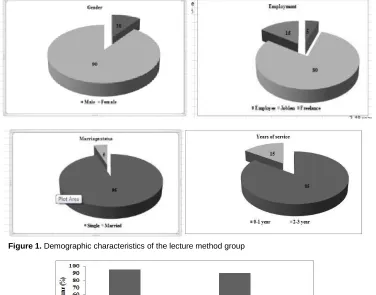
Figure 1. Demographic characteristics of the lecture method group
Figure 2. Information source in lecture method group vs. Video projector method group
Statistical Analysis
The collected data was analyzed by SPSS 18 software using paired t-test (for categorical variables), independent t-test, ANOVA and descriptive statistics. A p≤0.05 was considered as significant. The statistical analysis was done based on quantitative variables after transforming all of quantitative and qualitative variables into quantitative. To validate the questionnaire, content validity were used by ten faculty members. To reliable the questionnaire, test-retest method reliability were used by 4 students in the pilot test. Its reliability was obtained and confirmed using Kuder-Richardson (r=0.80) (Ghafourifard et al., 2013).
RESULTS
The results obtained from this study were shown below as tables and figures. The results of the demographic part in the lecture method indicated that of 20 sophomore
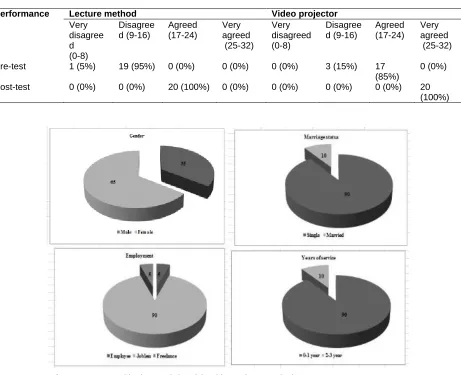
students who completed questionnaires, 90% (18students) were female, 95% (19 students) were single, 80% (16 students) were jobless, and 85% (17 students) were 0 year of service (Figure 1). The mean of students' age in the lecture method was 21.5±4.33. The mean knowledge scores of students in the before and after lecture method were 10.95±5.28 (moderate level, equal to answering to 37%), and 17.40±4.66 (good level, equal to answering to 60%), respectively (Table 1). The most important source of information gain in students in the lecture method was the media (90%, 18) (Figure 2). The mean practice scores of students in the before and after lecture method were 16.65±5.01 (disagreed level, equal to 52%), and 23.10±5.29 (agreed level, equal to 72%), respectively (Table 2).
Table 1. Frequency of environmental health students’ knowledge about food health laboratory in the lecture and video projector methods
Knowledge Lecture method Video projector
Weak (0-6)
Moderate (7-14)
Good (15-21)
Excellent (22-29)
Weak (0-6)
Moderate (7-14)
Good (15-21)
Excellent (22-29)
Pre-test 6 (30%) 9 (45%) 5 (25%) 0 (0%) 3 (15%) 12 (60%) 5 (25%) 0 (0%)
Post-test 0 (0%) 7 (35%) 10 (50%) 3 (15%) 0 (0%) 1 (5%) 8 (40%) 11 (55%)
Table 2. Frequency of environmental health students’ performance about food health laboratory in the lecture and video
projector methods
Performance Lecture method Video projector
Very disagree d (0-8)
Disagree d (9-16)
Agreed (17-24)
Very agreed (25-32)
Very disagreed (0-8)
Disagree d (9-16)
Agreed (17-24)
Very agreed (25-32)
Pre-test 1 (5%) 19 (95%) 0 (0%) 0 (0%) 0 (0%) 3 (15%) 17
(85%)
0 (0%)
Post-test 0 (0%) 0 (0%) 20 (100%) 0 (0%) 0 (0%) 0 (0%) 0 (0%) 20
(100%)
Figure 3. Demographic characteristics of the video projector method group
the video projector method was 20.2±1.23. The mean knowledge scores of students in the before and after lecture method were 11.70±5.21 (moderate level, equal to answering to 40%), and 22.35±3.66 (excellent level, equal to answering to 77%), respectively (Table 1). The most important source of information gain in students in the lecture method was the media (95%, 19) (Figure 2). The mean practice scores of students in the before and after video projector method were 17.4±5.28 (agreed level, equal to 54%), and 27.80±5.08 (very agreed, equal to 87%), respectively (Table 2).
Table 3. The mean and standard deviation of environmental health students’ knowledge about food health laboratory in the
lecture and video projector methods
Knowledge Lecture Video projector
Mean±Standarddividation Maximum Minimum Mean±Standarddividation Maximum Minimum
Pre-test 10.95±5.28 21 2 11.70±5.21 24 6
Post-test 17.40±4.66 27 10 22.35±3.66 29 13
Paired t-test t=27.47, df=44, p=0.001 t=9.06, df=30, p=0.001
Table 4. The mean and standard deviation of environmental health students’ performance about food health laboratory in the lecture
and video projector methods
performance Lecture Video projector
Mean±Standarddividation Maximum Minimum Mean±Standarddividation Maximum Minimum
Pre-test 16.65±5.01 17 8 17.4±5.28 24 16
Post-test 23.10±5.29 24 17 27.80±5.08 32 25
Paired t-test t=25.79, df=42, p=0.001 t=7.49, df=27, p=0.001
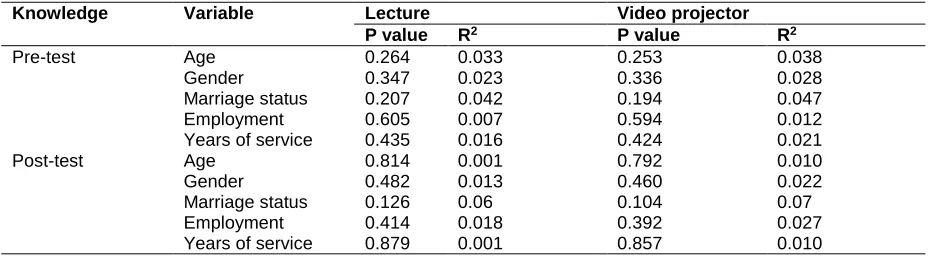
Table 5. Correlations among study variables
Knowledge Variable Lecture Video projector
P value R2 P value R2
Pre-test Age 0.264 0.033 0.253 0.038
Gender 0.347 0.023 0.336 0.028
Marriage status 0.207 0.042 0.194 0.047
Employment 0.605 0.007 0.594 0.012
Years of service 0.435 0.016 0.424 0.021
Post-test Age 0.814 0.001 0.792 0.010
Gender 0.482 0.013 0.460 0.022
Marriage status 0.126 0.06 0.104 0.07
Employment 0.414 0.018 0.392 0.027
Years of service 0.879 0.001 0.857 0.010
seen meaningful statistic relationships (P<0.001) (Tables 3-5).
DISCUSSION
In this research, the efficacy of these educational measures such as the traditional lecture, and the video projector methods on students’ attitude, knowledge and practice was compared. In lecture, and the video projector methods, it could be concluded that the mean students’ knowledge about food health laboratory enhanced from 10.95 to 17.40, and from 11.7 to 22.35, respectively, after the education compared to before. Therefore, it could be concluded that the higher efficiency with video projector method on students’ knowledge might be due to its greater attractiveness characteristic. The students’ knowledge about food health laboratory sharply increased in the video projector method in comparison with the lecture method during education. This finding supported that education efficiency was a function of learning method. In the lecture, and the video projector methods, between mean knowledge scores, and before and after learning were seen meaningful statistic relationships. These finding were in agreement
after learning are not seen meaningful statistic relationships (P>0.05) (Jafari, 2012). Hugenholtz et al. show that the e-learning, and traditional methods lead to increasing occupational physicians’ knowledge, and there are not seen meaningful statistic relationships between them (Hugenholtz et al., 2008).It was concluded that the video projector method was more effective due to increasing students’ knowledge scores and retention rates in comparison with the lecture method. This finding was in agreement with other studies. Namnabati et al. show the highest efficiency at nurses with lecture method in comparison with the problem-centered learning methods. Also they conclude that the lecture method leads to the mean of the highest nurses’ learning scores and retention rates while the problem-based learning method leads to the mean of the lowest nurses’ learning scores and retention rates (Namnabati et al., 2010). Fattahi et al. indicate that the blended teaching and pupil-centered methods are more efficiency in laboratory science students in comparison with traditional lecture method (Fattahi et al., 2007).Razvi and Avizhgan indicate that the blended teaching and pupil-centered methods are more efficiency in anatomical sciences students in comparison with traditional lecture method (Razvi and Avizhgan, 2012). Hassanpour et al. indicate thatthe problem-centered method is more efficiency in nurses’ attitude, knowledge, and performance (Hassanpour et al., 2006). Bahadorani et al. indicate that the scores of the medical students' knowledge and performances in blended teaching method are more than those in the online education, and face to face methods (Bahadorani et al., 2006).It was concluded that effect of education methods on health environmental students’knowledge, and performance was dealt with a variety of reasons including differences in students, teachers, and how thecurriculum in food health laboratory was arranged. The circumstances, resources and educating aims of the curriculum in food health laboratory were essential to effective education. According to finding of this research, the lecture, and video projector methods led to enhancing the students' knowledge, and performance scores although the students' knowledge, and performance scores were higher in the video projector method. This finding was agreement with other studies. Momeni et al., Jafari, and Kermaniyan et al. confirm that the students’ scores in pupil-centered and blended methods arehigher than that in the lecture method (Kermaniyan et al., 2008; Momeni et al., 2011; Jafari, 2012).Students in video projector method were faced the most recent kind of education method that resulted in more motives, present and practice. Also increasing the students’ knowledge led to producing their performances. Students would be stimulated strongly to take part in the attainment of need knowledge by applying the video projector, and students had more performances with this method in comparison with the other methods. The application of recent teaching methods including video projector, as a helpful
and efficient educational instrument, was a positive perspective of this research. It was purposed that other researchers could use this high technology due to saving time and cost-effectiveness.
CONCLUSIONS
Both lecture and video projector methods considerably increased the environmental health and students’ knowledge, and practice about food health laboratory. Due to the students’ performance and cost-effectiveness in the video projector method was more than lecture method, we purposed that the teachers applied video projector to compose theoretical education methods.
ACKNOWLEDGMENTS
The authors thanked the Department Environmental Health of Islamic Azad University, Medical Sciences Branch for financial and instrumental supports. The authors acknowledged the contributions of Anna Kourtesopoulou, Angela Carvalho and Dr. Chung Chin Hung for donating their time, critical evaluation, constructive comments, and invaluable assistance toward the improvement of this very manuscript.
REFERENCES
Anderson WL, Mitchell SM, Osgood MP (2005). Comparison of student performance in cooperative learning and traditional lecture-based biochemistry classes. Biochem. Molecul. Biology Educ. 33(6)387-393.
Bahadorani M, Yousefy AR, Changiz T (2006).The effectiveness of three methods of teaching medline to medical students: online, face to face and combined educational methods. Iranian J. Med. Educ. 6(2)35-43.
Fattahi BA, Karimi H, Anvari MH, Barzegar K (2007). Comparison of the effect of lecture and group discussion methodson learning of laboratory science students. Strides in Development Med. Educ. 4(1)51-56.
Ghafourifard M, Haririan HR., Aghajanloo A (2013). Case-based Teaching Method and Comparison with Lecture. Future Med. Educ. J. 3 (1) 8-12.
Golafrooz Shahri H, Khaghanizade M (2010). Introduction to oral presentation teaching method. Educ. Strategies J.2(4)161-166.
Gurney P. (2007).Five factors for effective teaching. New Zealand J. Teachers’ Work.4 (2) 89-98.
Hassanpourv DA, Kheiri S, Shahrani M (2006). The effect of teaching using problem based learning and lecture on behavior, attitude and learning of nursing BSc students. Shahrekord University of Med. Sciences J. 3(8)76-82.
Hugenholtz NIR, De Croon EM, Smits PB, Van Dijk FJH, Nieuwenhuijsen K (2008). Effectiveness of e-learning in continuing medical education for occupational physicians. Occup. Med.58(5)370-382.
Jafari M (2012). Comparison of lecture and blended teaching method son learning and satisfaction of medical students in biochemistry course. Iranian J. Med. Educ.12(7)488-497.
Kaddoura MA (2011). Critical thinking skills of nursing students in lecture-based teaching and case-based learning. Inter J. Scholar. Teach. Learn. 5(2)1-18. Kermaniyan F, Mehdizadeh M, Iravani S, Markazi
Moghadam N, Shayan Sh (2008). Comparing lecture and problem-based learning methods in teaching limb anatomy to first year medical students. Iranian J. Med. Educ.7(2)379-388.
Khatoni A, Nayery ND, Ahmady F, Haghani H (2011). Comparison the effect of web-based education and traditional education on nurses knowledge about bird flu in continuing education. Iranian J. Med. Educ. 11(2)140-148.
Koch S, Townsend CD, Dooley KE (2005). A case study comparison between web-based and traditional graduate level academic leadership instruction. J. Assess. Educ. 46(4)72-82.
Momeni DanaeiSh, Zarshenas L, Oshagh M, OmidKhoda SM (2011).Which method of teaching would be better; cooperative or lecture. Iranian J. Med. Educ.1(1)24-31.
Namnabati M, Fathi AE, Valizadeh S, Tazakori Z (2010). Lecturing or problem-based learning: comparing effects of the two teaching methods in academic achievement and knowledge retention in pediatrics course for nursing students. Iranian J. Med. Educ.10(4)474-482.
Norouzi HM, Mohsenizadeh SM, Jafary Suny H, Ebrahimzadeh S (2011). The effect of teaching using a blend of collaborative and mastery of learning models, on learning of vital signs: an experiment on nursing and operation room students of Mashhad University of Medical Sciences. Iranian J. Med. Educ.11(5)544-553.
Popil I (2011). Promotion of critical thinking by using case studies as teaching method. Nurs. Educ. Today. 31 204-207.
Razvi S, Avizhgan M (2012). Comparison of lecture and group discussion methods on learning anatomical sciences: A study in PhD students. Iranian J. Med. Educ.11 (6)580-591.
Unal Z (2005). A comparative study on learning outcomes of web based Vs. classroom based instruction. J. College Teach. Learn. 2(3)1-6.
Warnell R, Duk A, Christison G, Haviland G (2005). Teaching electoconvalsive therapy to medical students: Effects of instructional method on knowledge and attitudes. Academic Psychiatry. 29 433-436.
World Health Organisation. Retrieved. Prevention of food borne disease: Five keys to safer food. 2010.
Zolfaghari M, Mehrdad N, Parsa YZ, Salmani BN, Bahrani N (2007). The effect of lecture and e-learning methods on learning mother and child health course in nursing students. Iranian J. Med. Educ. 7(1)31-39.
Accepted 13 July, 2015.
Citation: Kashi G, Doost KK (2015). Comparison of the effect of lecture and video projector teaching methods on students’ attitude, knowledge and practice. International Research Journal of Teacher Education, 2(3): 030-035.