R E S E A R C H A R T I C L E
Open Access
Lateral inhibition in visual cortex of migraine
patients between attacks
Gianluca Coppola
1*, Vincenzo Parisi
1, Cherubino Di Lorenzo
2, Mariano Serrao
3, Delphine Magis
4,
Jean Schoenen
4and Francesco Pierelli
5Abstract
Background:The interictal deficit of habituation to repetitive visual stimuli in migraine patients could be due to deficient intracortical inhibition and/or to low cortical pre-activation levels. Which of these abnormalities contributes more to the habituation deficit cannot be determined with the common methods used to record transient visual responses.
We investigated lateral inhibition in the visual cortex during the migraine cycle and in healthy subjects by using differential temporal modulations of radial windmill-dartboard (WD) or partial-windmill (PW) visual patterns. Methods:Transient (TR-VEP) and steady-state visual-evoked potentials (SS-VEP) were recorded in 65 migraine patients (21 without and 22 with aura between attacks; 22 patients during an attack) and in 21 healthy volunteers (HV). Three stimulations were used in each subject: classic checkerboard pattern (contrast-reversion 3.1Hz), WD and PW (contrast-reversion ~4Hz). For each randomly presented stimulation protocol, 600 sweeps were acquired and off-line partitioned in 6 blocks of 100. Fourier analysis allowed data to extract in SS-VEP the fundamental (1H) and the second harmonic (2H) components that reflect respectively short-(WD) and long- range lateral inhibition (attenuation of 2H in WD compared to PW).
Results:Compared to HV, migraineurs recorded interictally had significantly less habituation of the N1-P1 TR-VEP component over subsequent blocks and they tended to have a smaller 1stblock amplitude. 1H amplitude in the 1st block of WD SS-VEP was significantly greater than in HV and habituated in successive blocks, contrasting with an amplitude increase in HV. Both the interictal TR-VEP and SS-VEP abnormalities normalized during an attack. There was no significant between group difference in the PW 2H amplitude and its attenuation. When data of HV and migraine patients were combined, the habituation slope of WD-VEP 1H was negatively correlated with that of TR-VEP N1-P1 and with number of days since the last migraine attack.
Conclusion:These results are in favour of a migraine cycle-dependent imbalance between excitation and inhibition in the visual cortex. We hypothesize that an interictal hypoactivity of monaminergic pathways may cause a
functional disconnection of the thalamus in migraine leading to an abnormal intracortical short-range lateral inhibition that could contribute to the habituation deficit observed during stimulus repetition.
Keywords:Habituation, Migraine, Short-range lateral inhibition, Thalamo-cortical dysrhythmia, Visual evoked potentials
* Correspondence:[email protected] 1
Departmen of Neurophysiology of Vision and Neuroophtalmology, G.B. Bietti Foundation IRCCS, Via Livenza 3-00198, Rome, Italy
Full list of author information is available at the end of the article
Background
Deficient habituation of pattern reversal visual evoked potentials (VEPs) during stimulus repetition is a frequent characteristic of migraine patients during the pain-free interval [1-3]. The neural mechanisms of this habituation deficit are not fully elucidated. There are at least two pos-sible, not mutually exclusive, explanations both supported by experimental data: hypofunction of intracortical inhibi-tory circuits [4,5] or reduced preactivation of the visual cortex by thalamocortical loops, secondary to hypoactive aminergic projections from the brainstem [1,2]. That the cortical dysexcitability in migraine could be due to abnormal thalamic control, namely to so-called“ thalamo-cortical dysrhythmia” is suggested by studies of high frequency oscillations in spontaneous EEG and visual or somatosensory evoked potentials [6-8]. This concept may reconcile the advocates of excessive excitation and defi-cient inhibition, since a defidefi-cient thalamo-cortical drive, i.e. a low level of cortical preactivation, results in a dys-function of both inhibitory and excitatory cortical neurons [9]. Reduced inhibition and low cortical preactivation may thus not be mutually exclusive, since the latter can pro-mote the former through a reduction of lateral inhibition. Which of excitatory or inhibitory mechanisms contribute more to the habituation deficit cannot be determined with the methods commonly used to evoke visual responses that reflect the summation of both excitatory and inhibi-tory postsynaptic potentials [10].
Temporal modulation of adjacent regions of radial windmill-dartboard (W-D) or partial-windmill (P-W) visual patterns, however, allow to distinguish the relative contribution from short- and long-range lateral inhib-ition between cortical neurons during steady-state VEPs [11-13]. These visual patterns have permitted to identify two distinct phenomena in humans: a high amplitude re-sponse generated at the fundamental frequency band, and the attenuation of the second harmonic response during W-D stimulation relative to the second harmonic response during P-W stimulation. The fundamental fre-quency is thought to be generated by highly localized neuronal processes that result from lateral interactions over short distances (short-range lateral inhibition), whereas attenuation of the second harmonic component is due to lateral interactions between neurons over greater distances (long-range lateral inhibition) [13].
Using steady state VEPs obtained with W-D and P-W patterns, lateral inhibition in visual processing was already found abnormal in diseases like epilepsy [14,15] and schizophrenia [16].
The aim of this study was to explore whether lateral inhibition in the visual cortex is involved in the nor-mal habituation phenomenon in healthy subjects and in the habituation deficit found in migraine patients between attacks.
Methods Subjects
We enrolled 65 consecutive migraine patients (51 women), mean age 30.5 years, attending our headache clinic. Forty-three (21 without [MO] and 22 with aura [MA]) underwent VEP recordings during the interictal period, i.e. they were attack-free at least three days be-fore and after the recordings. Twenty-two were recorded within a time range of 12 hours before or after the be-ginning of an attack. In this phase of the migraine cycle, close to an attack, the habituation deficit disappears showing a pattern similar to healthy controls [17-19]. This group of migraine patients were considered as ictal (MI). No preventive anti-migraine drugs were allowed during the preceding 3 months. For comparison, 21 healthy volunteers (HV) of comparable age and gender distribution (16 women, mean age 28.1 years) were recruited among medical school students and healthcare professionals. They had to be devoid of any overt med-ical condition, personal or family history of migraine or epilepsy, and regular drug intake. To minimize variabil-ity due to hormonal influences on cortical excitabilvariabil-ity, female subjects were always recorded at mid-cycle.
Participants taking medications on a regular basis and subjects who failed to reach a best-corrected visual acu-ity of > 8/10 were excluded. None of the enrolled subjects had sleep deprivation or alcohol ingestion the day preceding the recordings. Caffeinated beverages were not allowed on the day of recordings. All participants received a complete description of the study and granted written informed consent. The project was approved by the ethical review board of the Faculty of Medicine, University of Rome, Italy.
Visual evoked potential recordings
Stimulation paradigms
dynamic regions (central disc and 2nd annulus) of both stimuli were sinusoïdally reversed in contrast at a rate of 4 Hz (steady-state VEP [SS-VEP]). At the viewing dis-tance of 114 cm the stimulus display subtended a visual angle of 8°. In the W-D pattern, the black and white segments of the 1stand the 3rd annuli had a fixed con-trast of 45%, so that the overall stimulus pattern alternated between the windmill and dartboard forms (Figure 1 top). Conversely, in the P-W pattern, the segments of the 1stand the 3rdannuli were set at a 0% contrast, forming a uniform field at the mean luminance level (Figure 1 top).
Recordings
During all stimulations, subjects were instructed to fixate a red dot in the middle of the screen with the left eye covered by a patch to maintain stable fixation. VEPs were recorded from the scalp through gold-cup electrodes positioned at Oz (active electrode) and Fz (reference electrode, 10/20 system). A ground electrode was placed on the right forearm. The evoked potential signals were amplified with a Digitimer D360 amplifier (band-pass 0.05–2000 Hz, Gain 1000) and recorded with a CED™ power 1401 device (Cambridge Electronic Design Ltd, Cambridge, UK). For each of the three stimulation paradigms a total of 600 consecutive sweeps of 240 ms were collected and sampled at 512 Hz. Cor-tical responses were partitioned in 6 sequential blocks of 100, consisting of at least 95 artefact-free sweeps. Responses in each block were averaged off-line (“block averages”) using the Signal™ software package version 4.08 (CED Ltd).
All recordings were collected in the morning (between 09.00 and 12.00 a.m.) by the same investigators (V.P. & M.S.) and off-line analysed blinded for subjects’diagnosis.
Checkerboard TR-VEP components were identified according to their latencies: N1 as the most negative peak between 60 and 90 ms, P1 as the most positive peak following N1 between 80 and 120 ms, and N2 as the most negative peak following P1 between 125 and 150 ms (Figure 1). We measured peak-to-peak amplitude of the N1-P1 component.
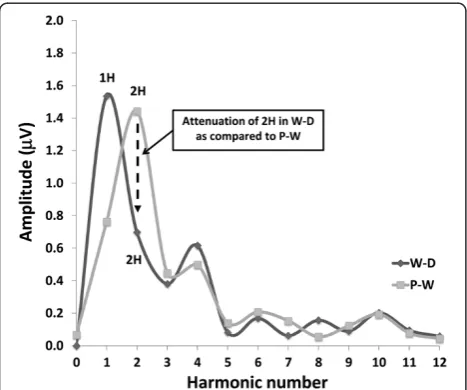
SS-VEP (W-D and P-W patterns, Figure 1) were analysed in the frequency domain. After a discrete Fourier trans-formation (Figure 1), we measured amplitude of the funda-mental harmonic (1H, at 4 Hz) for the W-D stimulus condition and of the 2ndharmonic (2H, double the stimulus frequency, i.e. 8Hz) for both W-D and P-W stimulus condi-tion [16]. To assess long-range lateral interaccondi-tions, we calculated attenuation of the second harmonic component in the W-D respective to the P-W pattern.
Statistical analyses
We used the Statistical Package for the Social Sciences (SPSS) for Windows, version 19.0 for all analyses. For each stimulus condition, we constructed a repeated ana-lysis of variance (ANOVA) taking as within-subject fac-tor “block” and as between-subject factors “Groups” (HV, MO, MA, MI). A regression analysis was used to disclose linear trends in VEP amplitude across blocks (slope) in each stimulus condition and group. Fisher’s least significant difference (LSD) test was used for post hoc analysis. Pearson’s correlation test was used to search for correlations among the VEP amplitude slopes and clinical variables.
P values ≤ 0.05 were considered to indicate statistical significance.
Results
VEP recordings from all participants yielded analysable data. VEP traces recorded with the three different visual patterns in a healthy volunteer, a MO and a MA patient are illustrated in Figure 2. The clinical and demographic characteristics of recorded subjects are shown in Table 1.
Transient-VEP (TR-VEP)
ANOVA for N1-P1 amplitude in averaged TR-VEP blocks disclosed a main effect of factor block (F(5,410)=
2.69, p=0.021) and a significant two-way interaction of group by block (F(15,410) = 3.74, p<0.001) (Figure 3,
upper row). N1-P1 amplitude in block 1 and 6 did not differed significantly between groups (F(3,88) = 0.58,
F(3,88) = 1.43, p>0.05). Linear regression analysis of
TR-VEP amplitudes recorded over all 6 blocks differed be-tween groups (F(3,80) = 9.66, p<0.001). Post hoc analysis
showed that the slope of TR-VEP amplitudes from block
1 to block 6 was negative (−0.15 ± 0.20) in HV and in MI (−0.24 ± 0.23) whereas it was positive in patients recorded interictally (MO +0.11 ± 0.32, MA +0.02 ± 0.18; Figure 2 upper traces). When all patient groups (MO, MA, MI) were combined, there was a negative correlation on Pearson’s test between the amplitude slope of TR-VEP N1-P1 and duration of the migraine disease in years (r= −0.356, p=0.008) on the one hand, and monthly number of days with headache (r=−0.290, p=0.03) on the other. The amplitude slope was, however,
positively correlated with the number of days since the last migraine attack (r= 0.275, p=0.05) (Figure 4).
Windmill-Dartboard Steady-State-VEP (short-range lateral inhibition)
In the W-D condition ANOVA for 1H amplitude in averaged SS-VEP blocks disclosed a significant two-way interaction of group by block (F(15,410)= 2.48, p=0.002),
but not a main effect of group (F(3,82) = 2.50, p=0.06)
and block (F(5,410) = 1.54, p= 0.17) separately. 1H
Figure 2Steady-state waveforms are converted into the frequency domain by Discrete Fourier Transformation in order to measure the amplitude at the first harmonic (4Hz, 1H) in the windmill-dartboard (W-D) stimulation,and of the second harmonic (8Hz, 2H) in both the windmill-dartboard and partial-windmill (W-D) stimulations.To assess long-range lateral interactions, we calculated attenuation of the 2nd harmonic component in the W-D respective to the P-W pattern.
Table 1 Clinical and demographic characteristics of healthy volunteers (HV) and migraine patients without (MO), with aura (MA), and those recorded ictally (MI)
Characteristics HV (n = 21) MO (n = 21) MA (n = 22) MI (n = 22)
Women (n) 16 17 19 15
Age (years) 28.1 ± 7.6 27.3 ± 6.5 30.8 ± 9.7 33.6 ± 11.9
Duration of migraine history (years) 13.8 ± 9.5 15.1 ± 8.8 19.7 ± 11.3
Attack frequency/month (n) 1.8 ± 1.1 2.1 ± 2.3 2.8 ± 2.5
Attack duration (hours) 27.3 ± 25.2 29.4 ± 23.7 33.1 ± 29.1
Days with headache/month (n) 3.3 ± 2.8 3.1 ± 3.2 4.2 ± 2.5
Days from the last migraine attack (n) 16.0 ± 23.4 17.0 ± 15.6
amplitude in the 1st block (F(3,82) = 10.14, p<0.001) and
slope of W-D VEP 1H amplitude changes over all 6 blocks (F(3,82)= 10.75, p<0.001) differed between groups.
Post hoc analysis showed that 1H amplitude in the 1st block was significantly lower in HV (0.85μV ± 0.43) and MI (0.53 μV ± 0.40) than in MO (1.31 μV ± 0.70, p=0.004 vs HV, p<0.001 vs MI) and MA (1.17μV ± 0.45, p=0.04 vs HV, p<0.001 vs MI) (Figure 3). 1H amplitude in the 6th block did not differed significantly between groups (F(3,88) = 0.44, p>0.05). The slope of 1H
ampli-tude variation from block 1 to block 6 was positive (+0.03 ± 0.10) in HV and in MI (+0.07 ± 0.08) but nega-tive in patients recorded interictally (MO −0.11 ± 0.16, p<0.001 vs HV, p<0.001 vs MI; MA−0.06 ± 0.11, p=0.01 vs HV, p<0.001 vs MI; Figure 3, middle row).
In the entire cohort of patients (MO, MA, MI), Pearson’s test disclosed a negative correlation between amplitude slope of WD-VEP 1H and that of TR-VEP N1-P1 (r=−0.392, p<0.001) (Figure 4). The former was nega-tively (r=−0.557, p<0.001), the latter positively (r= +0.275, p= 0.05) correlated with the number of days elapsed from the last migraine attack at the time of recordings (Figure 5). Moreover, 1H amplitude in the 1st block correlated positively with the slope of TR-VEP N1-P1 amplitudes (r=0.294, p=0.007), but not with amplitude in the 1stTR-VEP N1-P1 block (r=0.028, p=0.803).
Partial-Windmill Steady-State-VEP (SS-VEP)
In the P-W condition ANOVA for 2H amplitude in averaged SS-VEP blocks showed a significant main effect
of factor block (F(5,410)=4.27, p=0.001), but not of group
(F(3,82)=0.46, p=0.709) nor a two-way interaction of
group by block (F(15,410)=0.57, p=0.897) (Figure 3, lower
row). For the entire cohort of migraineurs combined there was no significant correlation between neuro-physiological and clinical data.
Long-range lateral inhibition
In order to assess long-range lateral inhibition we calculated the percentage change of the 2H amplitude between the P-W and the W-D conditions in each of the 6 sequential blocks of averagings. No significant main ef-fect of group (F(3,82)= 2.53, p=0.07) and block (F(5,410)=
1.19, p=0.310) was detected, nor a two-way interaction of group by block (F(15,410) = 1.07, p=0.377). There was
no significant correlation between 1stblock amplitude or habituation slope and clinical variables.
Discussion
We confirm in this study previous reports that TR-VEP 1st block amplitude is decreased and does not habituate over subsequent blocks in migraineurs between attacks compared to healthy volunteers, but normalizes during an attack. The most striking result in our study, how-ever, is that the degree of short-range lateral inhibition in the visual cortex of migraine patients differs from that of healthy volunteers. We found an increase in 1st harmonic (1H) SS-VEP amplitude during windmill-dartboard (W-D) visual stimulation, reflecting the degree of short-range lateral inhibition, in migraine patients be-tween attacks compared to healthy volunteers. Over suc-cessive blocks of recordings, however, short-range lateral inhibition decreases in migraineurs, while it increases in healthy controls.
Figure 4Correlation between the number of days since the last migraine attack and the slope of 1H WD-VEP amplitude changes (negative, linear regression:uninterrupted line) or the slope of N1-P1 TR-VEP amplitude changes (positive, linear regression: dashed line) in the total cohort of migraine patients.
During the ictal phase (MI), early short-range lateral inhibition, on the contrary, is much reduced compared to HVs, but it increases during stimulus repetition.
We found no difference between groups in long-range lateral interaction, as indexed by the attenuation of the 2ndharmonic component (2H) between the W-D and P-W stimulation patterns.
We will discuss the possible neurobiological underpinnings of these data and their potential relevance for migraine pathophysiology.
Transient visual evoked responses recorded from the scalp are a complex mixture of electrical activities generated by multiple parallel functional channels within the visual system [20]. Nonetheless, by using adequate stimulation protocols it is possible to study specific VEP components. For instance, the relative contributions from lateral interactions between neurons of the visual cortex can be determined through differential temporal modulation of adjacent regions by radial windmill-dartboard (W-D) patterns [12,16,21]. The nonlinear cross-talk between the two neural areas that receive in-put signals at different frequencies of modulation (i.e., driven by the static or the dynamic stimulus zones) induces two distinct phenomena: a strong intermodulation response at the fundamental frequency (1H), and attenu-ation of the habitually dominant component at double the stimulus frequency (the 2ndharmonic component, 2H). It is thought that the VEP component at the fundamental fre-quency elicited by the W-D stimulus is generated by a highly spatially localized phenomenon that is the result of lateral interactions occurring over small distances (“ short-range lateral interactions”). By contrast, attenuation of the 2nd harmonic component during W-D stimulation is the result of lateral interactions between neurons over longer distances (“long-range lateral interactions”) [13].
The lateral interactions in the visual cortex are attrib-utable to inhibitory processes, possibly mediated by GABAergic synapses. According to the model first proposed by Hubel and Wiesel (1959), excitatory feed forward information coming from the periphery of the visual system travels through the thalamic lateral genicu-late nucleus (LGN) and reaches simple and complex cells respectively in layers IV and III/II of the V1 area [22]. These cortical layers consist of spatial arrangements of direct-through excitatory inputs from the LGN, and lateral inhibitory pathways, orthogonal to the neurons’excitatory input [22,23]. The visual cortex contains a dozen of inhibi-tory GABAergic cell types [24,25]. Amongst them, those with extremely restricted lateral axon bundles (<100 μm) are responsible for powerful local effects and thought to be the anatomical substrate of short-range lateral inhibition [26,27], while large basket cells possess the largest lateral axonal field (2 to 4 mm) and probably mediate long-range lateral inhibition [28].
Considering these anatomo-physiological data on the visual cortex, our findings suggest that in migraine there is a cycle-dependent abnormal dynamics of the excitatory-inhibitory balance in response to stimulus repetition.
Our finding of an interictal increase of the initial short-range lateral inhibition might explain some of our previous observations with TR-VEPs. Indeed, amplitude of the 1st block of TR-VEP is reduced in migraine patients between attacks but, like short-range lateral in-hibition, normalizes during the attack [1,7,29-36]. An ar-gument against this explanation, however, is that we found no correlation between the increase in 1st block 1H WD-VEP and the decrease in 1st block TR-VEP N1P1 amplitudes. Moreover, such an explanation might be too simplistic, considering that the TR-VEP reflects the balanced summation of both excitatory and inhibi-tory postsynaptic potentials [10]. We propose therefore that interictally in migraine there is an excessive preva-lence of inhibition probably as a consequence of reduced excitation. The latter could account for the initial low amplitude of the TR-VEP N1-P1 component between attacks and its increase during attacks where the short-range lateral inhibition decreases and returns to normal, allowing excitatory connections to dominate. This inter-pretation receives support from various psychophysical studies exploring the balance between inhibition and excitation in migraine. With a pattern adaptation using visual illusions, a phenomenon attributed to a decrease in excitation from tonic pre-synaptic inputs [37,38], Shepherd et al. (2001, 2002) observed prolonged tilt after-effects, motion after-effects [39] and simultaneous tilt illusion [40] in MO and MA as compared to HV. This slow adaptation speed in migraine may indicate a lack of cortical excitatory connections [39-41], which consequently causes an increased strength of lateral in-hibition in the visual cortex [42]. One cannot exclude the possibility that 1st block 1H WD-VEP is increased because of persistent hyperexcitability of pyramidal cells that in turn would also up regulate inhibitory circuits. In this case, one would expect significantly increased amp-litude of the 1st TR-VEP block that would continue to increase in subsequent blocks, exceeding that of healthy volunteers. Our data, however, do not favor this hypoth-esis, since amplitude of the 1st TR-VEP block was nor-mal or even tended to be lower in migraineurs, and its increase over the 6 blocks never exceeded the baseline amplitude of healthy volunteers (see Figure 3).
This interpretation is supported by the inverse correlation we found between habituation of TR-VEP N1-P1 and that of the 1H SS-WD-VEPs: In other words, the more marked the VEP habituation deficit the more pronounced the ha-bituation of short-range lateral inhibition. We must point out, that 1H amplitude in the last block did not differ sig-nificantly between groups (Figure 2). This indicates that it is the difference in the initial degree of short-range lateral inhibition that determines the ensuing increase of inhib-ition or excitation of pyramidal cells, which aim at restoring normal cortical activation. Such interpretation is in line with the concept of cortical homeostatic metaplasticity, postulating that whatever the initial level of cortical ac-tivation subsequent stimulations trigger a homeostatic mechanism by which the cortex tends to maintain its excitability level within a physiological range [43,44]. Taken together, our data suggest that the interictal defi-cient habituation in later VEP blocks in migraine strongly depends on the initial level of cortical activation. That the initial cortical performance is of importance in migraine is further evidenced by the results recently obtained in a visual-stimulus-onset asynchrony (SOA) psychophysical paradigm, the metacontrast masking test, attributed to in-hibitory processes [45]. Shepherd et al. in an effort to rec-oncile the results from two previous contradictory studies [46,47], found that the apparently weaker metacontrast masking during visual SOA in migraine was due to the fact that both migraine groups performed differently in the baseline trials respective to controls. In fact, when baseline performance was taken into account, the group differences for each masking condition largely disappeared [45]. Our finding that the abnormalities of 1H and N1-P1 habituation increase with distance from the last mi-graine attack may be related to the ictal and peri-ictal changes described in thalamocortical connectivity [6] and cortical responsivity.
It is well known indeed that cortical responsivity fluctuates over time in relation to the migraine attack: just before and during the attack, habituation increases and normalizes [17]. TR-VEP N1-P1 habituation correlates in-versely with the monthly number of headache days. This is probably due to the fact that patients with a high attack frequency are more likely to be recorded in a period close to an attack, i.e. at a time point when ictal changes have not completely disappeared [3]. Interestingly, a similar correlation with time elapsed since the last migraine at-tack was recently found with another measure of visual in-hibition, the beforementioned metacontrast masking test [45]. This, together with our results, indicates that the overall inhibitory performance with stimulus repetition increases with proximity of the last migraine.
What causes the observed difference between impaired 1st harmonic responses to WD stimuli and normal 2nd harmonic responses to both PW and WD remains to be
determined. Large basket cells, the mediators of long-range lateral inhibition, provide a dominant non-iso-orien-tation inhibitory input that could play a significant role in generating orientation tuning and direction selectivity [28]. With visual psychophysical paradigms using reaction times, evidence both in favour [48,49] and against [50] orientation-specific discrimination deficits were reported in migraine. Impaired orientation-specific discrimination, with normal detection threshold, was nevertheless present in several migraineurs when stimuli were presented at low spatial frequencies (less than 2 cycles/degree) [48,49]. We cannot thus rule out that the spatial frequency of 2 cycles/ degree (15 min of arc) used in our study may have prevented us from detecting a significant impairment of long-range lateral inhibition in migraineurs which might have been possible with lower spatial frequencies.
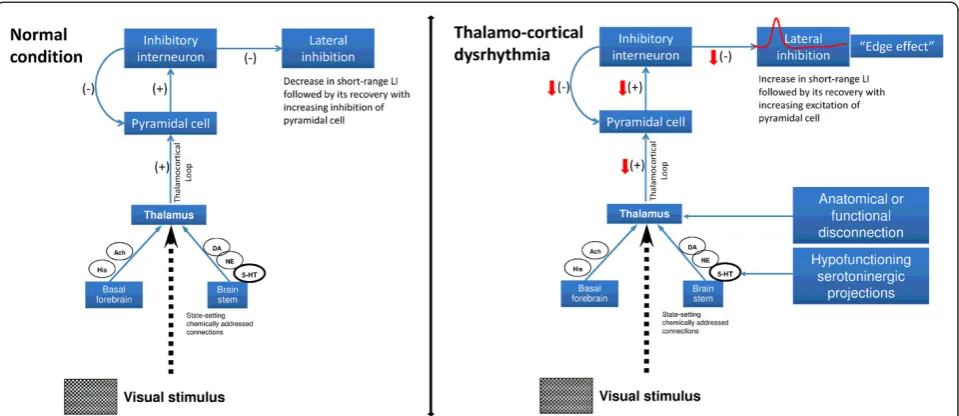
A dysfunction of cortical inhibition has been described in a number of functional brain disorders grouped under the name “thalamo-cortical dysrhythmia” (TCD) syndromes. The TCD theory postulates that in presence of an anatom-ical or functional disconnection of the thalamus from sub-cortical areas, a change of rhythmic thalamosub-cortical activity may occur favouring low frequency activity that at the cor-tical level will reduce firing rates of excitatory pyramidal cells at the beginning and of fast-spiking (FS) inhibitory interneurons during stimulus repetition [51-53]. The latter leads to a disinhibition in adjacent cortical columns manifesting as a progressive increase in high-frequency gamma band oscillations, the so-called“edge effect”[54,55]. Interestingly, FS inhibitory interneurons commonly make inhibitory electrical synapses with cells of the same type within a 100μm inter-somatic distance (short-range lateral inhibition) [56]. Evidence favoring abnormal thalamic and thalamo-cortical activity in migraine between attacks also comes from studies of spontaneous EEG [8] and visual [7] or somatosensory evoked high-frequency oscillations [6,57]. We have proposed previously that hypofunctioning serotoninergic projections to thalamus and cortex might cause a functional disconnection of the thalamus leading to increased gamma band oscillations in the cortex, as in other thalamocortical dysrhythmias, and to reduced cortical ha-bituation [2,7]. The role of serotonin transmission in mi-graine has been comprehensively reviewed by Hamel et al. (2007) and there is circumstantial evidence from clinical studies that migraine is a disorder with altered serotonergic transmission from the brainstem to the thalamus and cor-tex [58] (Figure 6).
Conclusions
functional thalamo-cortical disconnection due to a defi-cient serotoninergic innervation of thalamus and cortex. This may help to reconcile the controversy between ab-normal excitation and deficient inhibition in interictal mi-graine. Indeed, some authors have proposed that the deficient habituation is due to a basal cortical lack of in-hibition or increase of glutamatergic excitation [61-64]. At first glance, the fact that in our patients the amplitude of the short-range lateral inhibition was increased in the first block compared to healthy volunteers (see Figure 3) does not favour these hypotheses. Whereas, the observation that, after the early increase, the short-range inhibitory mechanisms abnormally decreased during long-term vis-ual stimulation seems to fit better with the results provided by modulating rTMS studies, i.e. a reduced in-hibition at long-term allowing excitatory connections to dominate [61-63]. Therefore, we propose that reduced in-hibition and thalamo-cortical hypoactivity, i.e. low cortical preactivation, may coexist, since the latter can promote the former via reduction of lateral inhibition during the stimulus repetition. The final common pathway of both dysfunctions is a heightened cortical response to repeated stimuli, i.e. a lack of habituation.
Further studies are needed to confirm the present functional abnormalities and to determine their precise
mechanisms, including its relation with changes in thalamo-cortical rhythms and in activity of subcortico-(thalamo-) cortical aminergic pathways. It will also be of uttermost importance to gather more data on the pos-sible genetic basis of these functional abnormalities and their responsiveness to preventive anti-migraine interventions. The better insight into the nature of the interictal cortical hyperresponsivity paves the way for novel acute and preventive therapeutic strategies and may allow a better understanding of the mode of action of available pharmacological therapies and promising non-invasive neurostimulation methods such as repetitive transcranial magnetic or direct current stimulations [65].
Abbreviations
EEG: Electroencephalography; FS: Fast-Spiking; H: Harmonic; HV: Healthy Volunteer; MA: Migraine with Aura; MI: Migraineur recorded during the attack (Ictal); MO: Migraine Without aura; PW: Partial-Windmill; RTMS: Repetitive Transcranial Magnetic Stimulation; SS: Steady-State; TCD: Thalamo-cortical dysrhythmia; TR: Transient; VEP: Visual Evoked Potential; WD: Windmill-Dartboard.
Competing interests
The authors declare that they have no competing interests.
Authors’contributions
GC made substantial contributions to interpretation of data as well as in drafting the manuscript. DM, VP, JS and FP were implied in the
interpretation of data as well as in drafting the manuscript; CDL gave critical Figure 6Schematic representation of visual information processing pathway describing the neural network model that can
revision of the manuscript for important intellectual content. VP and MS were implied in recording and analyzing data. All authors read and approved the final manuscript.
Author details
1
Departmen of Neurophysiology of Vision and Neuroophtalmology, G.B. Bietti Foundation IRCCS, Via Livenza 3-00198, Rome, Italy.2Don Carlo Gnocchi Onlus Foundation, Lombardy, Italy.3Department of Medico-Surgical Sciences and Biotechnologies,“Sapienza”University of Rome Polo Pontino, Latina, Italy.4Headache Research Unit. University Dept. of Neurology & GIGA-Neurosciences, Liège University, Liège, Belgium.5IRCCS-Neuromed, Pozzilli, (IS), Italy.
Received: 22 December 2012 Accepted: 25 February 2013 Published: 28 February 2013
References
1. Schoenen J, Wang W, Albert A, Delwaide P (1995) Potentiation instead of habituation characterizes visual evoked potentials in migraine patients between attacks. Eur J Neurol 2:115–122
2. Schoenen J (1996) Deficient habituation of evoked cortical potentials in migraine: a link between brain biology, behavior and trigeminovascular activation? Biomed Pharmacother 50:71–78
3. Coppola G, Pierelli F, Schoenen J (2009) Habituation and migraine. Neurobiol Learn Mem 92:249–259
4. Mulleners WM, Chronicle EP, Palmer JE, Koehler PJ, Vredeveld JW (2001) Visual cortex excitability in migraine with and without aura. Headache 41:565–572
5. Brighina F, Palermo A, Fierro B (2009) Cortical inhibition and habituation to evoked potentials: relevance for pathophysiology of migraine. J Headache Pain 10:77–84
6. Coppola G, Vandenheede M, Di Clemente L, Ambrosini A, Fumal A, De Pasqua V et al (2005) Somatosensory evoked high-frequency oscillations reflecting thalamo-cortical activity are decreased in migraine patients between attacks. Brain 128:98–103
7. Coppola G, Ambrosini A, Di Clemente L, Magis D, Fumal A, Gérard P et al (2007) Interictal abnormalities of gamma band activity in visual evoked responses in migraine: an indication of thalamocortical dysrhythmia? Cephalalgia 27:1360–1367
8. Bjørk M, Sand T (2008) Quantitative EEG power and asymmetry increase 36 h before a migraine attack. Cephalalgia 28:960–968
9. Coppola G, Pierelli F, Schoenen J (2007) Is the cerebral cortex
hyperexcitable or hyperresponsive in migraine? Cephalalgia 27:1427–1439 10. Zemon V, Kaplan E, Ratliff F (1980) Bicuculline enhances a negative
component and diminishes a positive component of the visual evoked cortical potential in the cat. Proc Natl Acad Sci USA 77:7476–7478 11. Ratliff F, Zemon V (1982) Some new methods for the analysis of lateral
interactions that influence the visual evoked potential. Ann N Y Acad Sci 388:113–124
12. Zemon V, Ratliff F (1982) Visual evoked potentials: evidence for lateral interactions. Proc Natl Acad Sci USA 79:5723–5726
13. Grose-Fifer J, Zemon V, Gordon J (1994) Temporal tuning and the development of lateral interactions in the human visual system. Invest Ophthalmol Vis Sci 35:2999–3010
14. Ratliff F (1982) Radial spatial patterns and multifrequency temporal patterns: possible clinical applications. Ann N Y Acad Sci 388:651–656
15. Conte M, Victor J (2009) VEP indices of cortical lateral interactions in epilepsy treatment. Vision Res 49:898–906
16. Kim D, Zemon V, Saperstein A, Butler P, Javitt D (2005) Dysfunction of early-stage visual processing in schizophrenia: harmonic analysis. Schizophr Res 76:55–65
17. Judit A, Sándor PS, Schoenen J (2000) Habituation of visual and intensity dependence of auditory evoked cortical potentials tends to normalize just before and during the migraine attack. Cephalalgia 20:714–719 18. Siniatchkin M, Kropp P, Gerber WD, Stephani U (2000) Migraine in
childhood–are periodically occurring migraine attacks related to dynamic changes of cortical information processing? Neurosci Lett 279:1–4 19. Coppola G, Currà A, Di Lorenzo C, Parisi V, Gorini M, Sava SL et al (2010)
Abnormal cortical responses to somatosensory stimulation in medication-overuse headache. BMC Neurol 10:126
20. Tobimatsu S, Celesia GG (2006) Studies of human visual pathophysiology with visual evoked potentials. Clin Neurophysiol 117:1414–1433
21. Zemon V, Ratliff F (1984) Intermodulation components of the visual evoked potential: responses to lateral and superimposed stimuli. Biol Cybern 50:401–408
22. Hubel D, Wiesel T (1959) Receptive fields of single neurones in the cat's striate cortex. J Physiol 148:574–591
23. Alitto H, Dan Y (2010) Function of inhibition in visual cortical processing. Curr Opin Neurobiol 20:340–346
24. Somogyi P (1989) Synaptic organization of GABAergic neurons and GABAA receptors in the lateral geniculate nucleus and visual cortex. In: Lam DK-T, Gilbert CD (eds) Neural mechanisms of visual perception. Portfolio Pub Co, Texas, pp 35–62
25. Kisvárday Z, Beaulieu C, Eysel U (1993) Network of GABAergic large basket cells in cat visual cortex (area 18): implication for lateral disinhibition. J Comp Neurol 327:398–415
26. Somogyi P, Cowey A, Halász N, Freund TF (1981) Vertical organization of neurones accumulating 3H-GABA in visual cortex of rhesus monkey. Nature 294:761–763
27. Jones E (1984) Neurogliaform or spiderweb cells. In: Peters A, Jones EG (eds) Cerebral Cortex. Plenum Press, New York, pp 409–418
28. Kisvárday ZF, Crook JM, Buzás P, Eysel UT (2000) Combined physiological-anatomical approaches to study lateral inhibition. J Neurosci Methods 103:91–106
29. Afra J, Cecchini AP, De Pasqua V, Albert A, Schoenen J (1998) Visual evoked potentials during long periods of pattern-reversal stimulation in migraine. Brain 121(Pt 2):233–241
30. Wang W, Wang GP, Ding XL, Wang YH (1999) Personality and response to repeated visual stimulation in migraine and tension-type headaches. Cephalalgia 19:718–724
31. Bohotin V, Fumal A, Vandenheede M, Gérard P, Bohotin C, Maertens de Noordhout A et al (2002) Effects of repetitive transcranial magnetic stimulation on visual evoked potentials in migraine. Brain 125:912–922 32. Ozkul Y, Bozlar S (2002) Effects of fluoxetine on habituation of pattern reversal
visually evoked potentials in migraine prophylaxis. Headache 42:582–587 33. Di Clemente L, Coppola G, Magis D, Fumal A, De Pasqua V, Schoenen J et al
(2005) Nociceptive blink reflex and visual evoked potential habituations are correlated in migraine. Headache 45:1388–1393
34. Fumal A, Coppola G, Bohotin V, Gérardy PY, Seidel L, Donneau AF et al (2006) Induction of long-lasting changes of visual cortex excitability by five daily sessions of repetitive transcranial magnetic stimulation (rTMS) in healthy volunteers and migraine patients. Cephalalgia 26:143–149 35. Coppola G, Currà A, Serrao M, Di Lorenzo C, Gorini M, Porretta E et al (2010)
Lack of cold pressor test-induced effect on visual-evoked potentials in migraine. J Headache Pain 11:115–121
36. Coppola G, Crémers J, Gérard P, Pierelli F, Schoenen J (2011) Effects of light deprivation on visual evoked potentials in migraine without aura. BMC Neurol 11:91
37. Carandini M, Ferster D (1997) A tonic hyperpolarization underlying contrast adaptation in cat visual cortex. Science 276:949–952
38. Carandini M, Movshon JA, Ferster D (1998) Pattern adaptation and cross-orientation interactions in the primary visual cortex. Neuropharmacology 37:501–511
39. Shepherd AJ (2001) Increased visual after-effects following pattern adaptation in migraine: a lack of intracortical excitation? Brain 124:2310–2318 40. Shepherd AJ, Palmer JE, Davis G (2002) Increased visual after-effects in
migraine following pattern adaptation extend to simultaneous tilt illusion. Spat Vis 16:33–43
41. Shepherd A (2006) Local and global motion after-effects are both enhanced in migraine, and the underlying mechanisms differ across cortical areas. Brain 129:1833–1843
42. Battista J, Badcock D, McKendrick A (2011) Migraine increases centre-surround suppression for drifting visual stimuli. PLoS One 6 43. Siebner H, Lang N, Rizzo V, Nitsche M, Paulus W, Lemon R et al (2004)
Preconditioning of low-frequency repetitive transcranial magnetic stimulation with transcranial direct current stimulation: evidence for homeostatic plasticity in the human motor cortex. J Neurosci 24:3379–3385 44. Lang N, Siebner H, Ernst D, Nitsche M, Paulus W, Lemon R et al (2004)
45. Shepherd A, Wyatt G, Tibber M (2011) Visual metacontrast masking in migraine. Cephalalgia 31:346–356
46. Palmer J, Chronicle E, Rolan P, Mulleners W (2000) Cortical hyperexcitability is cortical under-inhibition: evidence from a novel functional test of migraine patients. Cephalalgia 20:525–532
47. Huang J, DeLano M, Cao Y (2006) Visual cortical inhibitory function in migraine is not generally impaired: evidence from a combined psychophysical test with an fMRI study. Cephalalgia 26:554–560 48. McKendrick AM, Vingrys AJ, Badcock DR, Heywood JT (2001) Visual
dysfunction between migraine events. Invest Ophthalmol Vis Sci 42:626–633 49. Tibber MS, Guedes A, Shepherd AJ (2006) Orientation discrimination and
contrast detection thresholds in migraine for cardinal and oblique angles. Invest Ophthalmol Vis Sci 47:5599–5604
50. Wilkinson F, Crotogino J (2000) Orientation discrimination thresholds in migraine: a measure of visual cortical inhibition. Cephalalgia 20:57–66 51. Llinás RR, Ribary U, Jeanmonod D, Kronberg E, Mitra PP (1999)
Thalamocortical dysrhythmia: A neurological and neuropsychiatric syndrome characterized by magnetoencephalography. Proc Natl Acad Sci USA 96:15222–15227
52. Llinás RR, Choi S, Urbano FJ, Shin HS (2007) Gamma-band deficiency and abnormal thalamocortical activity in P/Q-type channel mutant mice. Proc Natl Acad Sci USA 104:17819–17824
53. Walton KD, Dubois M, Llinás RR (2010) Abnormal thalamocortical activity in patients with Complex Regional Pain Syndrome (CRPS) Type I. Pain 150:41–51 54. Llinás R, Urbano FJ, Leznik E, Ramírez RR, van Marle HJF (2005) Rhythmic
and dysrhythmic thalamocortical dynamics: GABA systems and the edge effect. Trends Neurosci 28:325–333
55. Walton K, Llinás R (2010) Central Pain as a Thalamocortical Dysrhythmia: A Thalamic Efference Disconnection? In: Kruger L, Light AR (eds) Translational Pain Research: From Mouse to Man. CRC Press, Chapter 13
56. Beierlein M, Gibson J, Connors B (2000) A network of electrically coupled interneurons drives synchronized inhibition in neocortex. Nat Neurosci 3:904–910
57. Coppola G, De Pasqua V, Pierelli F, Schoenen J (2012) Effects of repetitive transcranial magnetic stimulation on somatosensory evoked potentials and high frequency oscillations in migraine. Cephalalgia 32:700–709
58. Hamel E (2007) Serotonin and migraine: biology and clinical implications. Cephalalgia 27:1293–1300
59. Hartline H (1972) Visual receptors and retinal interaction. Amsterdam: From Nobel lectures, Physiology or Medicine 1963–1970. Elsevier Publishing Company
60. Llinás RR, Steriade M (2006) Bursting of thalamic neurons and states of vigilance. J Neurophysiol 95:3297–3308
61. Brighina F, Piazza A, Daniele O, Fierro B (2002) Modulation of visual cortical excitability in migraine with aura: effects of 1 Hz repetitive transcranial magnetic stimulation. Exp Brain Res 145:177–181
62. Brighina F, Giglia G, Scalia S, Francolini M, Palermo A, Fierro B et al (2005) Facilitatory effects of 1 Hz rTMS in motor cortex of patients affected by migraine with aura. Exp Brain Res 161:34–38
63. Brighina F, Cosentino G, Vigneri S, Talamanca S, Palermo A, Giglia G et al (2011) Abnormal facilitatory mechanisms in motor cortex of migraine with aura. Eur J Pain 15:928–935
64. Conte A, Barbanti P, Frasca V, Iacovelli E, Gabriele M, Giacomelli E et al (2010) Differences in short-term primary motor cortex synaptic potentiation as assessed by repetitive transcranial magnetic stimulation in migraine patients with and without aura. Pain 148:43–48
65. Magis D, Schoenen J (2012) Advances and challenges in neurostimulation for headaches. Lancet Neurol 11:708–719
doi:10.1186/1129-2377-14-20
Cite this article as:Coppolaet al.:Lateral inhibition in visual cortex of migraine patients between attacks.The Journal of Headache and Pain 201314:20.
Submit your manuscript to a
journal and benefi t from:
7 Convenient online submission
7 Rigorous peer review
7 Immediate publication on acceptance
7 Open access: articles freely available online 7 High visibility within the fi eld
7 Retaining the copyright to your article

![Figure 3 Left panel: transient N1-P1 [upper], steady-state windmill-dartboard 1H [middle] and partial-windmill 2H [lower] meanamplitudes in the first block of 100 averaged responses; Right panel: Visual evoked potential (VEP) amplitude block averages in eachstudy group and for the three types of visual stimuli: transient (TR-)VEP [upper], steady state windmill-dartboard (W-D) [middle] andpartial-windmill (P-R) [lower] VEPs (HV, healthy volunteers; MO, migraine without aura interictally; MA, migraine with aura interictally;Ictal, migraine without aura ictally); data expressed as mean ± SD).](https://thumb-us.123doks.com/thumbv2/123dok_us/9600573.1942434/5.595.57.541.87.660/meanamplitudes-amplitude-eachstudy-andpartial-volunteers-interictally-interictally-expressed.webp)