Dr. Aravapalli Vasavi
Department of Pharmaceutical Analysis and Quality Assurance, Bapatla College of Pharmacy, Bapatla. India
E-mail: [email protected] Address for correspondence
Access this article online www.japer.in
Development and Validation of RP-HPLC method for simultaneous
estimation of Eperisone Hydrochloride and Diclofenac Sodium in
Pharmaceutical Dosage Form
INTRODUCTION
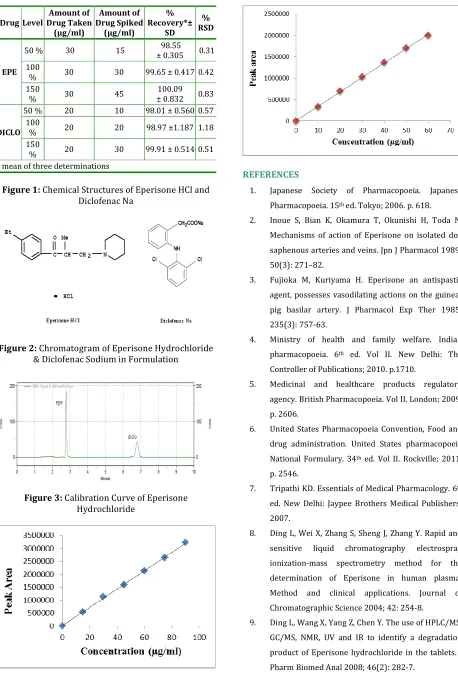
Eperisone Hydrochloride (EPE) is chemically (2RS)-1- (4-Ethylphenyl)-2-methyl-3-piperidin-1-ylpropan-1-one monohydrochloride (1:1) (Fig.1). It is an antispasmodic drug exhibiting both skeletal muscle relaxant and vasodilator properties. It is official in Japanese Pharmacopoeia [1] and potentiometric
method was described for its estimation. EPE acts on CNS, primarily at the level of the spinal cord, to relax hypertonic skeletal muscles by inhibiting spinal reflexes and by reducing muscle spindle sensitivity via reduction of γ-motor neuron efferent discharge. [2] The
vasodilatory action of EPE enhances circulation and inhibits the pain reflex pathway. [3]
Diclofenac Sodium (DICLO) is chemically
2-(2-(2,6-dichlorophenylamino)phenyl)acetic acid (Fig.1). It is official in IP, [4] BP, [5] and USP. [6] It is having
anti-inflammatory and analgesic properties. It works by inhibiting prostaglandin synthesis by inhibition of cyclooxygenase (COX), inhibiting DNA synthesis. [7]
Literature survey reveals Liquid chromatography-ESI-tandem mass spectrometry and GC-MS methods for estimation of EPE in human plasma; [8] HPLC/MS,
GC/MS, NMR, UV and IR analytical techniques to identify a degradation product of EPE in the tablets; [9]
UV and HPLC methods were available for estimation of DICLO individually. [10&11] Spectrophotometric,
HPLC and HPTLC methods were reported for simultaneous estimation of DICLO with other drugs.
[12-15] Spectrophotometric method was available for
simultaneous estimation of EPE and DICLO. [16-17] The
combination of these two drugs is not official in any Pharmacopoeia, hence no official analytical method has reported for their simultaneous estimation. The aim of the present study is to develop a simple, specific, rapid, precise and accurate RP-HPLC method for simultaneous estimation of Eperisone
A simple, specific, precise and accurate Reverse-phase High Performance Liquid Chromatographic method has been developed for the simultaneous estimation of Eperisone Hydrochloride and Diclofenac Sodium in combined pharmaceutical dosage form. The chromatographic separation was carried out on Phenomenex C18 column (250 × 4.6mm) by isocratic elution using 30mM phosphate buffer pH 2.5: methanol (20:80 v/v), as mobile phase at a flow rate of 1ml/min. Detection and quantification of all the analytes was carried out at 268 nm by using photo diode array detector. The retention time of Eperisone and Diclofenac was found to be 2.803 and 6.793 min respectively. The calibration curves of Eperisone and Diclofenac were linear over the concentration range of 15 - 90 µg/ml and 10 - 60 µg/ml with correlation of 0.9992 and 0.9994 respectively. The % amount of Eperisone and Diclofenac in capsule dosage form was found to be 99.64% and 99.27% respectively. The developed method was validated as per ICH guidelines. The limit of detection and limit of quantification were 0.45 and 1.36 µg/ml for Eperisone and 0.14 and 0.43 µg/ml for Diclofenac respectively. As there was no interference of excipients, the proposed method can be applied for the simultaneous estimation of the two drugs in routine quality control analysis of formulation.
Keywords: Eperisone Hydrochloride, Diclofenac Sodium, RP-HPLC, Validation, ICH guidelines
ABSTRACT ABSTRACT ABSTRACT ABSTRACT Aravapalli Vasavi*1,
D.Visagaperumal2
1Department of Pharmaceutical
Analysis, Bapatla College of Pharmacy, Bapatla, AP, India.
2Department of Pharmaceutical
Chemistry, Bapatla College of Pharmacy, Bapatla, AP, India.
Hydrochloride and Diclofenac Sodium in Pharmaceutical Dosage Form. The proposed method has been validated as per ICH guidelines.
MATERIALS AND METHODS
Instrumentation
AGILENT HPLC 1200 series with EZchrom Elite software containing C18 Phenomenex column (250 ×
4.6mm, 5µ) with PDA detector was employed for chromatographic separation. Digital balance (Essae) and pH Meter (ELICO LI 615) were used in the study. Chemicals and Reagents
Eperisone Hydrochloride (EPE) was kindly gifted from Triveni Chemicals, Gujarat and Diclofenac Sodium was obtained from Nicholas Piramal Industries Ltd., Mumbai. The capsule dosage form EPRY-D SR containing EPE 150 mg and DICLO 100 mg was procured from local market. Methanol (HPLC Grade, Merck, Mumbai) was used as diluent. Potassium di hydrogen phosphate and Ortho Phosphoric acid (Fisher Scientific, Mumbai) were used in the study. Method Development
Preparation of Mobile Phase
30mM potassium di hydrogen phosphate buffer (pH 2.5): methanol (20:80 v/v) was used as mobile phase. The buffer solution was prepared by dissolving 4.68 gm of potassium di hydrogen phosphate in 1000 mL water and pH was adjusted to 2.5 with 10% (v/v) OPA. The solution was filtered through 0.45 µm membrane filter.
Preparation of Standard Stock Solution
Accurately weighed 15 mg of EPE and 10 mg of DICLO were dissolved in methanol in 100 ml volumetric flask and the volume was made up to the mark with methanol to get a concentration of 150µg/ml EPE and 100µg/ml DICLO.
Optimization of RP-HPLC Method
Chromatographic conditions were optimized by injecting standard solution (45µg/ml EPE and 30µg/ml DICLO) into HPLC system and allowed to run in different mobile phases like Acetonitrile: water, phosphate buffer (pH4):methanol, phosphate buffer
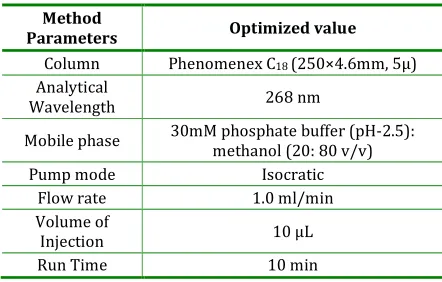
(pH2.5):methanol and phosphate buffer (pH2.5):Acetonitrile in order to find the optimum conditions for separation of EPE and DICLO. It was found that a satisfactory separation of EPE and DICLO with less tailing factor and good resolution was achieved with mobile phase of phosphate buffer (pH-2.5): methanol (20:80 v/v), maintained at 1.0 ml/min flow rate. Detection was carried out at 268 nm. Optimized chromatographic conditions were given in Table 1. Under these conditions retention times were 2.80 min and 6.79 min for EPE and DICLO respectively.
System Suitability Studies
Freshly prepared sample solution containing 45 µg/ml of EPE and 30 µg/ml of DICLO was injected six times under optimized chromatographic conditions and the parameters were studied to evaluate the suitability of the system.
Assay of EPE and DICLO in Capsule Dosage Form
A quantity of capsule powder equivalent to 15mg EPE and 10mg DICLO was accurately weighed, dissolved in 50 ml methanol and sonicated for 10 min. The volume was made up to 100 ml with methanol to get a concentration of 150 µg/ml EPE and 100 µg/ml DICLO and the solution was filtered through Whatmann filter. 3 ml of above clear filtrate was diluted to 10 ml with mobile phase to obtain a solution containing EPE 45 µg/ml and DICLO 30 µg/ml. 10µl of sample solution was injected under the optimized chromatographic conditions with the help of auto sampler and response was recorded. The amounts of EPE and DICLO were estimated by applying obtained values to the respective regression line equation. Validation of the Method
Validation of the proposed RP-HPLC method was carried out as per ICH guidelines by means of following parameters. [18]
Linearity (Calibration Curve)
to the HPLC system under the optimized chromatographic conditions and the responses were recorded. Calibration curves for EPE and DICLO were plotted using peak area versus concentration and regression equations were determined.
Precision
The precision of the proposed method was ascertained by repeatability, interday and intraday precision. Repeatability (Method Precision) of proposed method was performed by preparing and injecting the sample solution containing 45 µg/ml EPE and 30 µg/ml DICLO six times without changing the parameters of the proposed method. Intraday and Interday precision was determined by analyzing the sample solutions at different time intervals on the same day and on different days over a period of one week respectively for three different concentrations of EPE (15, 45 & 75 µg/ml) DICLO (10, 30 & 50 µg/ml). Accuracy (Recovery Studies)
The accuracy of the proposed method was determined by recovery studies using standard addition method. The % recovery studies of EPE and DICLO were carried out in triplicate at 50, 100 and 150% levels by spiking previously analyzed samples of the tablet (30µg/ml for EPE and 20µg/ml for DICLO) with known amounts of standard drug solutions of EPE and DICLO.
Limit of Detection (LOD) and Limit of
Quantification (LOQ)
As per ICH guidelines LOD and LOQ of two drugs were calculated using following equations.
LOD = 3.3 Χ σ/S LOQ = 10 Χ σ/S
Where, ‘σ’ is the standard deviation of response and ‘S’ is the slope of the calibration curve.
Robustness
Robustness of the method was evaluated by deliberate variations in the method parameters such as, flow rate variation by ± 0.1 ml/min, wavelength by ± 2 nm and composition of mobile phase by ± 2 ml organic solvent. The solution containing 45µg/ml EPE and 30µg/ml DICLO was injected under the varied
conditions and change in the responses of EPE and DICLO were noted.
Ruggedness
Sample solution containing 45 µg/ml of EPE and 30 µg/ml of DICLO was prepared and analyzed by two different analysts under same experimental conditions. The amount of two drugs was calculated and %RSD was reported.
Results and discussion
The RP-HPLC method developed for simultaneous estimation of EPE and DICLO using 30mM potassium di hydrogen phosphate buffer (pH-2.5): Methanol (40: 60 v/v) as mobile phase was validated as per ICH guidelines and results were reported below.
System Suitability Studies
The column efficiency, peak asymmetry and resolution were calculated for the standard drug solution of EPE and DICLO and the values obtained demonstrated the suitability of the system for analysis of this two drugs combination. The results were reported in Table 2.
Analysis of Marketed Formulation
Capsule dosage form was analyzed and the results of assay showed that the amount of drugs were in good agreement with the label claim of formulation as indicated by % assay, 99.64% for EPE and 99.27% for DICLO. The retention times were found to be 2.803min and 6.793min respectively (Fig.2). All the results were found to be within the limits and therefore the proposed method was found to be free from interferences from excipients. The results of analysis were reported in Table 3.
Linearity
Precision
The proposed method was found to be highly precise as the % RSD values of Repeatability, intraday and interday studies were < 2% which is under the limit as per recommendations of ICH guidelines. The results were reported inTable 4.
Accuracy
The % recovery of EPE and DICLO were found to be 98.5-100.09% and 98.01-99.91% respectively which is in the limit of 98-102%. Hence the method was said to be accurate. The results were shown in Table 5. LOD and LOQ
LOD and LOQ values of EPE and DICLO were determined from their respective calibration curves. LOD and LOQ were 0.45µg/ml and 1.36µg/ml for EPE and 0.14µg/ml and 0.43µg/ml for DICLO. The results were shown in Table 4.
Robustness and Ruggedness
Robustness studies revealed that the method was remained unaffected by the deliberate changes in wavelength, flow rate and organic phase ratio in mobile phase. The % RSD value for ruggedness studies was found to be < 2%, which shows the ruggedness of the proposed method.
CONCLUSION
A simple and economic RP-HPLC method has been developed for simultaneous estimation of Eperisone Hydrochloride and Diclofenac Sodium in combined dosage form and was found to be specific, robust, precise and accurate as well as having good reproducibility. It followed all the parameters for validation as per ICH guidelines. The excipients present in the formulation do not interfere in the analysis of EPE and DICLO in the method, hence the developed method can be applied successfully for routine quality control analysis of EPE and PCM in bulk and marketed formulation.
ACKNOWLEDGEMENTS
The author is thankful to Bapatla College of Pharmacy for providing required laboratory facilities. The
author would like to thank D.Visagaperumal for his constant guidance and support. The author thanks to Triveni Chemicals and Nicholas Piramal Industries Ltd for providing the gift samples of pure EPE and DICLO.
Table 1: Conditions of Optimized RP-HPLC method
Method
Parameters Optimized value
Column Phenomenex C18 (250×4.6mm, 5µ)
Analytical
Wavelength 268 nm
Mobile phase 30mM phosphate buffer (pH-2.5):
methanol (20: 80 v/v)
Pump mode Isocratic
Flow rate 1.0 ml/min
Volume of
Injection 10 µL
Run Time 10 min
Table 2: System Suitability Parameters of Epe and Diclo
Parameter Eperisone HClDiclofenac Na
Retention time 2.803min 6.793min
Theoretical plates 4839 8941
Tailing factor 1.293 1.029
Resolution - 22.72
Peak area 1582649 1020963
% RSD 0.328 0.264
Table 3: Analysis of Capsule Dosage Form
Drug Label claim
(mg)
Amount found (mg)
% Labeled amount
EPE 150 149.47 99.64
DICLO 100 99.27 99.27
Table 4: Parameters of the performance of proposed method
Parameter Eperisone
Hydrochloride
Diclofenac Sodium
Linearity range 15 – 90 µg/ml 10 – 60 µg/ml
Regression Equation Y = 35416x + 14618 Y = 33557x +12554
Correlation Coefficient 0.9992 0.9994
LOD (µg/ml) 0.45 0.14
LOQ (µg/ml) 1.36 0.43
Repeatability (%RSD,
n=6) 0.32 1.03
Intra-day precision
(%RSD, n=3) 0.15-0.71 0.31-0.86
Inter-day precision
(%RSD, n=3) 0.24-0.87 0.47-1.56
Table 5: Recovery studies of Epe and Diclo
Drug Level
Amount of Drug Taken
(µg/ml)
Amount of Drug Spiked
(µg/ml)
% Recovery*±
SD
% RSD
EPE
50 % 30 15 98.55
± 0.305 0.31
100
% 30 30 99.65 ± 0.417 0.42
150
% 30 45
100.09
± 0.832 0.83
DICLO
50 % 20 10 98.01 ± 0.560 0.57
100
% 20 20 98.97 ±1.187 1.18
150
% 20 30 99.91 ± 0.514 0.51
* mean of three determinations
Figure 1: Chemical Structures of Eperisone HCl and Diclofenac Na
Figure 2: Chromatogram of Eperisone Hydrochloride & Diclofenac Sodium in Formulation
Figure 3: Calibration Curve of Eperisone Hydrochloride
Figure 4: Calibration Curve of Diclofenac Sodium
REFERENCES
1. Japanese Society of Pharmacopoeia. Japanese
Pharmacopoeia. 15th ed. Tokyo; 2006. p. 618.
2. Inoue S, Bian K, Okamura T, Okunishi H, Toda N.
Mechanisms of action of Eperisone on isolated dog
saphenous arteries and veins. Jpn J Pharmacol 1989;
50(3): 271–82.
3. Fujioka M, Kuriyama H. Eperisone an antispastic
agent, possesses vasodilating actions on the
guinea-pig basilar artery. J Pharmacol Exp Ther 1985;
235(3): 757-63.
4. Ministry of health and family welfare. Indian
pharmacopoeia. 6th ed. Vol II. New Delhi: The
Controller of Publications; 2010. p.1710.
5. Medicinal and healthcare products regulatory
agency. British Pharmacopoeia. Vol II. London; 2009.
p. 2606.
6. United States Pharmacopoeia Convention, Food and
drug administration. United States pharmacopoeia
National Formulary. 34th ed. Vol II. Rockville; 2011.
p. 2546.
7. Tripathi KD. Essentials of Medical Pharmacology. 6th
ed. New Delhi: Jaypee Brothers Medical Publishers;
2007.
8. Ding L, Wei X, Zhang S, Sheng J, Zhang Y. Rapid and
sensitive liquid chromatography electrospray
ionization-mass spectrometry method for the
determination of Eperisone in human plasma:
Method and clinical applications. Journal of
Chromatographic Science 2004; 42: 254-8.
9. Ding L, Wang X, Yang Z, Chen Y. The use of HPLC/MS,
GC/MS, NMR, UV and IR to identify a degradation
product of Eperisone hydrochloride in the tablets. J
10. Khaskheli AR, Abro K, Sherazi ST, Afridi HI, Mahesar
SA, Saeed M. Simpler and faster spectrophotometric
determination of Diclofenac Sodium in Tablets,
Serum and Urine samples. Pak J Anal Environ Chem
2009; 10: 53-58.
11. Atto RA. New method for determination of
Diclofenac sodium by High Performance Liquid
Chromatography. Tikrit J Pharma Sci 2012; 8(1):
60-67.
12. Patel SA, Hariyani KP. Spectrophotometric method
for simultaneous estimation of Tolperisone
hydrochloride and Diclofenac sodium in synthetic
mixture. Int Res J pharma 2012; 3(9): 162-165.
13. Marolia BP, Vanparia DJ, Satani BH, Prajapati PB,
Shah SA, Shah DR. Application of RP-HPLC method
for simultaneous estimation of Thiocolchicoside and
Diclofenac in commercially available capsules.
American J PharmTech Res 2012; 2(3): 806-818.
14. Nayak D, Vankar K, Patnaik A. Simultaneous
Estimation of Rabeprazole Sodium and Diclofenac
Sodium by RP-HPLC method in combined tablet
dosage form. Int J PharmTech Res 2010; 2(2):
1488-92.
15. Sunil R, vidhya K. Validated HPTLC method for
simultaneous estimation of Diclofenac Sodium and
Misoprostol in bulk Drug and Formulation. Asian
journal of Pharmaceutical and Biological Research
2011; 1(1): 15-21.
16. Patel PU, Patel SK, Patel UJ. Spectrophotometric
estimation of Eperisone Hydrochloride and
Diclofenac Sodium in synthetic mixture. Int Res J
Pharm 2012; 3(9): 203-6.
17. Suthar J, Patel P, Shah N. Development and validation
of derivative spectrophotometric method for
simultaneous estimation of Eperisone Hydrochloride
and Diclofenac Sodium in combined capsule dosage
form. Novus Int J Chem 2012; 1(1): 24-32.
18. International Conference on Harmonization (ICH),
Draft guidelines on validation of Analytical
Procedure, Definition and Terminology, Federal
Register. 1995; 60: 11260.
How to cite this article: Aravapalli Vasavi, D. Visagaperumal; Development and Validation of RP-HPLC method for simultaneous estimation of Eperisone Hydrochloride and Diclofenac Sodium in Pharmaceutical Dosage Form; J. Adv. Pharm. Edu. & Res. 2013: 3(4): 550-555.