www.threatenedtaxa.org
ISSN 0974-7907 (Online) | ISSN 0974-7893 (Print) Building evidence for conservation globally
Journal of Threatened Taxa
For Focus, Scope, Aims, Policies, and Guidelines visit https://threatenedtaxa.org/index.php/JoTT/about/editorialPolicies#custom-0 For Article Submission Guidelines, visit https://threatenedtaxa.org/index.php/JoTT/about/submissions#onlineSubmissions For Policies against Scientific Misconduct, visit https://threatenedtaxa.org/index.php/JoTT/about/editorialPolicies#custom-2 For reprints, contact <[email protected]>
Communication
Bat (Mammalia: Chiroptera) diversity, dominance, and
richness in the southwestern region of Bhutan with
three new records for the country
Sangay Tshering, Dhan Bahadur Gurung, Karma Sherub, Sumit Dookia, Kuenzang Dorji & Pema Choephyel
26 January 2020 | Vol. 12 | No. 1 | Pages: 15114–15128 DOI: 10.11609/jott.4986.12.1.15114-15128
Partner
Member
Publisher & Host
Editor: Anonymity requested. Date of publication: 26 January 2020 (online & print)
Citation: Tshering, S., D.B. Gurung, K. Sherub, S. Dookia, K. Dorji & P. Choephyel (2020). Bat (Mammalia: Chiroptera) diversity, dominance, and richness in the southwest-ern region of Bhutan with three new records for the country. Journal of Threatened Taxa 12(1): 15114–15128. https://doi.org/10.11609/jott.4986.12.1.15114-15128
Copyright: © Tshering et al. 2020. Creative Commons Attribution 4.0 International License. JoTT allows unrestricted use, reproduction, and distribution of this article in any medium by adequate credit to the author(s) and the source of publication.
Funding: Rufford Small Grants Foundation and World Wildlife Fund.
Competing interests: The authors declare no competing interests.
Author submission: Hoop nets were used with precaution and extra care not to injure/harm bats during the study. No accidental death occurred during the whole
study period. We now understand that the use of hoop nets is unethical. We will not repeat this in future bat studies.
Author Details: Sangay Tshewang’s research interests are in bat conservation and environment science. Dr. Dhan Bahadur Gurung’s research interests are in the
areas of ecotourism and taxonomy with special focus on orchids, reptiles, and fishes. Karma Sherub’s research interest includes studies of mammals and birds and he is pursuing a study on bird diversity and behaviour. Dr. Sumit Dookia’s current research includes habitat use by bats in urban environments with special reference
to metropolitan areas of Delhi as well as the bat fauna of northern India, Rajasthan, Haryana, and Delhi. Kuenzang Dorji is a wildlife biologist with special interest in small mammals. Dr. Pema Choephyel is interested in environment conservation and ecology.
Author Contribution: ST developed the concept, collected data and wrote the draft. DBG improved the draft and finalized the paper. KS, SD, KD and PC provided
valuable comments in improving the documents and assisted in species identification.
Acknowledgements: The authors would like to thank Mr. Tashi Tobgyel, chief forestry officer of the Territorial Forest Division of Gedu for allowing us to conduct study
in their jurisdiction and providing necessary support during data collection. We thank Dr. Neil M. Furey, Dr. Vuong Tan Tu, Dr. Gabor Csorba, Dr. Manuel Ruedi, Mr. Rajesh Puttaswamaiah, and Mr. Sanjan Thapa for assisting us in species identification. We are indebted to Mr. Rohit Chakravarty for facilitating us with necessary research materials and helping in identification of species as well. The authors are grateful to Mr. Dawa Tenzin and Mr. Sangay Khandu for their support during data collection and Mr. Dorji Tshering and Mr. Rinchen Tshering for arranging necessary logistics. Authors are thankful to Mr. Ugyen Dorji for assisting in map generation. We extend our heartfelt appreciation to the Rufford Small Grants Foundation and World Wildlife Fund, Bhutan Program, for providing financial support.
Abstract: Bats are ecologically crucial as they are good pollinators and pest controllers, but are less known in Bhutan. We investigated bat diversity and richness in broadleaved forests of southwestern Bhutan. Fieldwork was carried out from July 2016 to April 2017 using mist nets and hoop nets. The main objective of the study was to document bat diversity and species richness. We captured 157 bats of 10 species belonging to four families. Two species (Myotis siligorensis Horsfield, 1855 and Rhinolophus affinis Horsfield, 1823) accounted for almost 52% of the total captures. Species richness of bats differed depending upon habitat types. Myotis siligorensis was captured more often from broadleaved forests whereas Rhinolophus macrotis Blyth, 1844 and Rhinolophus affinis were common around human settlements. The present study contributed three new records for Bhutan which increased the bat diversity from 65 to 68 species. We conclude that the southwestern region, especially Chukha District, could be one of the bat diversity hotspots in Bhutan.
Keywords: Chiroptera, Chukha, Dagana, Myotis, Rhinolophus, Samtse, species richness.
Bat (Mammalia: Chiroptera) diversity, dominance, and richness in the
southwestern region of Bhutan with three new records for the country
Sangay Tshering 1 , Dhan Bahadur Gurung 2 , Karma Sherub 3 , Sumit Dookia 4 , Kuenzang Dorji 5 & Pema Choephyel 6
1,2,3 College of Natural Resources, Royal University of Bhutan, Lobesa, Punakha, Bhutan. 4 University School of Environment Management, Guru Gobind Singh Indraprastha University, Sector 16- C,
Dwarka, New Delhi-110078, India.
5 Nature Study Sub-Center, Ugyen Wangchuck Institute for Conservation and Environment Research, Department of Forest and Park Services, Khebeythang , Wangdue Phodrang, Bhutan. 6 Bhutan Trust Fund for Environmental Conservation, Genyen Lam , Thimphu, Bhutan. 1 [email protected] (corresponding author), 2 [email protected], 3 [email protected],
4 [email protected], 5 [email protected], 6 [email protected]
C
o m m u n i c a t i o n
INTRODUCTION
Chiroptera are unique and true flying mammals consisting of more than 1,300 species worldwide (Fenton & Simmons 2014). They are divided into 18
families in two unequal suborders–Yinpterochiroptera and Yangochiroptera. The Yinpterochiroptera or Pteropodiformes is a suborder of Chiroptera
which includes six families: one family of fruit bats
Pteropodidae, formerly known as Megachiroptera
and five families comprising of Rhinopomatidae,
Rhinolophidae, Hipposideridae, Craseonycteridae,
and Megadermatidae. The Yangochiroptera or Vespertilioniformes is a proposed suborder of Chiroptera
that includes 12 families, most of which were previously
classified as Microchiroptera (Srinivasulu et al. 2010).
Bats constitute the second most diverse order of
mammals (Korad et al. 2007). They represent about
one-fifth of the 5,418 known mammal species (Lumsden 2004; Rajchal 2007). Bhutan has recorded 65 species which constitutes 33% of all mammal taxa of which nine species are fruit bats and 56 species are insectivorous belonging to five families (Marimuthu 2009). The most
common group of bats in Bhutan is the evening bats
(Vespertilionidae) with 34 species (Wangchuk et al.
2004; Choden 2009).
Species richness, diversity and distribution of bats have been well studied in many parts of the Indian subcontinent such as in the Western Ghats, Uttarakhand,
and parts of Marathwada region of Maharashtra (Korad
et al. 2007; Korad 2014; Sayyed 2016; Chakravarty
2017), in Kathmandu Valley of Nepal (Thapa et al. 2012)
as well as in Malaysia (Shafie et al. 2011; Hanif et al.
2015). These studies added detailed information about species. In Bhutan, such studies are lacking and absence
of baseline data has further impeded our understanding
of bat species richness, diversity and ecological benefits. Conservation of small mammals such as bats has gained
focus worldwide as they have their own ecological roles to play as pollinators, seed dispersers, and pest controllers.
The surveys by Salvo et al. (2009), Korad et al. (2007) and Raghuram et al. (2014) have added wide information
about bat habitat preferences, species richness, and disturbances. Threats to bats have also been studied
by Rajchal (2007) and Acharya & Adhikari (2010). In the context of Chukha District, such information is lacking
despite the area having undergone rapid socio-economic development due to peoples’ choice of modern
development projects over biodiversity conservation. The lack of baseline information calls for an urgent need
to generate data on bat species richness and diversity.
MATERIALS AND METHODS
Study area
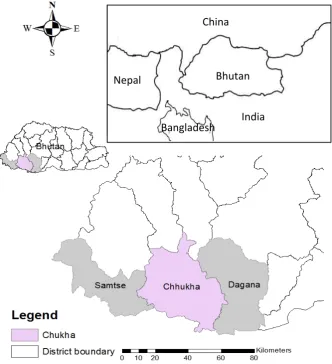
The study area covers the southwestern districts of Samtse and Dagana including Chukha covering an area of about 1,802km2. The area is predominantly covered by mixed broadleaved forest. It is situated between 27.1170N and 89.7830E (Figure 1) with elevations ranging 200–3,500 m. The landscape comprises of complex
geomorphologic features with caves, rocky outgrowths
and also man-made tunnels which are ideal roosting
habitats for bats.
It was reported that the study area is home to a number of bat species such as Eastern Bent-winged Bat
Miniopterus fuliginosus Hodgson, 1835, Intermediate
Horseshoe Bat Rhinolophus affinis Horsfield, 1823, and Blandford’s Fruit Bat Sphaerias blanfordi Thomas,
1891(Chakraborty 1975; Bates et al. 2008; Chiozza 2008; Hutson et al. 2008; Walston et al. 2008).
Chukha District has undergone rapid land use changes due to peoples’ choice of modern development
activities resulting in increased threats and disturbances to the bat populations and their habitats. Despite the
area having high economic value to the country, it has
also major conservation issues and challenges due to
ongoing hydropower projects, industries, mining, and
other development activities. These projects have huge
environmental impacts in terms of habitat disturbance,
fragmentation, and environmental pollution.
Field sampling
We divided the region into five major habitat types (forest, cave, settlement, stream, and abandoned house). Further, it was divided into four elevation categories (<1,500, 1,500–2,500m, 2,500–3,000m and >3,000m) to study the presence or absence of bats in different elevation zones. Thirty-four sites were sampled with elevations ranging from 200–3,500 m. The sites were
visited twice in each season, i.e., monsoon and winter as
it is important to sample same sites in different seasons
to assess the bat density and diversity of the region more appropriately.
Species richness and diversity of bats
Mist netting was carried out in sampling sites at various habitat types (forest, streams/water bodies, settlement) to investigate species diversity and habitat
by the field assistant all the time. Two to three mist nets of 6m and 9m length with 2.5m height of three to five shelves were erected as nets were found more successful in capturing bats in dense forest. Mist nettings
began before dusk with the use of bamboo and tree
poles. Since bats use vertical stratification and forage at various heights to reduce food competition, finding the right spot for erecting the mist nets was crucial for
successful capture.
In general, capture success was enhanced when nets were put at natural flyways such as across forest
trails. Since the study area had dense forest cover, there are chances that certain species may not have been captured at all.
Bat trappings were carried out mostly for five hours after dusk depending on capture success and weather conditions. The study was carried out from July 2016 to April 2017 in an effort of 147 trapping nights (768 mistnet hours). Four to five field assistants were involved every night to monitor the mist nets. In addition, a hoop
net was used to capture species in habitats such as abandoned houses and caves. To determine bat species richness, dominance and diversity, the following indices
were assessed: (1) Shannon-Wiener diversity index (H′) (Shannon & Wiener, 1949), (2) Simpson’s index (D), (3) Pielou’s evenness (J) and (4) Margalef’s index for species richness (R) (Margalef 1958).
Shannon index (H′) = −ΣP𝑖lnP𝑖
Where Pi = S/N
S = Number of individual of one species
N = Total number of all individuals in the sample ln = Logarithm to base e
Σ
n𝑖(n𝑖 – 1)Simpson’s index D = ––––––––––
N(N – 1)
Where N = Total number of all organisms
ni = Number of individuals of each individual
species.
Pielou’s evenness (J) compares the actual diversity
Bhutan
India
China
Nepal
Bangladesh
value (such as the Shannon-Wiener index, H′) to the maximum possible diversity value (when all species are equally common, Hmax=lnS where S is the total number of species). For Shannon-Wiener index, the Pielou’s
evenness (J) was used:
J=H′/Hmax or H′/lnS Where H′ = Shannon Wiener index value Hmax = Maximum possible diversity value S = Total number of species
Margalef’s index (R) = S – 1 / ln (N) Where S = Total number of species in the sample ln = Logarithm to base e
N = Total number of all individuals in the sample
Morphometric measurement of bats
The live-trapped bats were carefully removed from mist nets and kept in cloth bags for morphometric
measurements and identification. Using a Pesola
spring balance (100g), weights of each individual were
measured. The sex and age group of bats were recorded by classifying into juvenile or adult (Kunz & Parsons 2009; Kangoyé et al. 2015). Measurements were taken to the nearest 0.1mm accuracy using SPI dial calipers (Bates & Harrison 1997; Ith et al. 2015; Chakravarty 2017). Morphometric measurements included: HBL (head body length) following Soisook et al.(2016), Ear length (EL) from lower margin to tip of ear, FA (length of forearm including carpals), Tibia (TIB), and HF (hind foot including claws) as per Kangoyé et al. (2015). The length of metacarpals was taken excluding carpals. Measurements were taken immediately after capture at the study sites to assist identification.
Identification of bats
Bats were identified based on morphological measurements (Table 1) and qualitative characters
by comparing photographs taken and using available morphological keys. The majority of the bats were
identified based on available reference guides and keys (Bates & Harrison 1997; Csorba et al. 1999; Acharya &
Adhikari 2010; Srinivasulu et al. 2010; Menon 2014).
For species which could not be identified in the field, photographs were taken for seeking identification assistance from experts.
RESULTS
Species diversity of bats
The bat fauna in southwestern Bhutan is insectivorous
as no fruit bats of suborder Yinpterochiroptera belonging to the family Pteropodidae were captured. A total of
157 individuals belonging to 10 species were caught with the use of mist nets and hoopnets (Images 1 & 2). For this study, 17 individuals (10.83%) were captured in
hoop nets and the rest in mist nets. The Rhinolophidae
was the most diverse family contributing 59% of the bat fauna in Chukha District. The family Vespertilionidae was the second most diverse family with 32% and the least was the Miniopteridae with 0.54%. Following Wangchuk et al. (2004), species that have been reported for the first time for Bhutan are marked with double
asterisks (**) and the first time record from Chukha
District of the south-western region are marked with a single asterisk (*) (Table 2).
Table 1. Morphological measurement (in range) of bats.
Species TSS Measurements (mm)
FA HBL HF EL TIB 3mt 4mt 5mt BW
Hipposideros armiger 12 88–93.50 90.51–92.31 12.52–16.45 21.34–23.58 42.34–45.78 67–70.24 67.52–68.59 67.54–68.93 48–57.57
Myotis siligorensis 43 34–36.45 38.31–40.12 6.08–7.34 11.05–11.95 14.78–15.50 30.6–31.54 30–30.93 29.5–30.51 4.86–5.94
Myotis longipes 8 35.01–36.74 39.50–41.68 6.81–7.58 10.51–11.47 14–15.46 30–31.24 31–31.50 31.90–40.12 5.23–6.05
Rhinolophus affinis 38 53–55.51 47–49 6–70.81 17–18 24–25.5 36.50–37.83 39–40.54 40–41.71 16.20–17
Rhinolophus luctus 9 68–70.32 81–82.45 11.50–12.65 32–36 37–38.56 50–51 52.50–53.8 55–56.80 31.85–34
Rhinolophus pusillus 7 35–37.83 31–32.70 6–70.32 15.50–16.8 15–16 25–26.40 26.50–27.3 27.50–28 5–6.42 Rhinolophus lepidus 5 40.05–41 32–33.50 6.20–7.08 16–17 16.30–16.9 30.8–31.50 31–31.50 31.40–31.70 5–6.81 Rhinolophus sinicus 13 45–46.52 50.20–52.40 6–7.31 17–17.80 16.80–17.50 36.80–37.90 36–37 35.90–36.40 10.30–11.21
Rhinolophus macrotis 21 41.56–54 50–55.67 10–11.55 17.50–18.50 24–26.34 40–42.35 41–43.90 42.02–43.57 7–8.40
Miniopterus fuliginosus 1 47.85 53.54 7.52 10.32 19.67 40.15 39.51 37.64 13.94
Myotis siligorensis had the highest overall bat
count (NI=43, NIP=27.39%), followed by Rhinolophus affinis (NI=38, NIP=24.20%), and lowest for Miniopterus fuliginosus (NI=1, NIP=0.64%) (Table 2). Shannon-Wiener diversity index (H′) and Pielou’s evenness (J) were 1.97 and 0.86 respectively. The capture rate of M. siligorensis
ranged from two to six individuals per trapping night
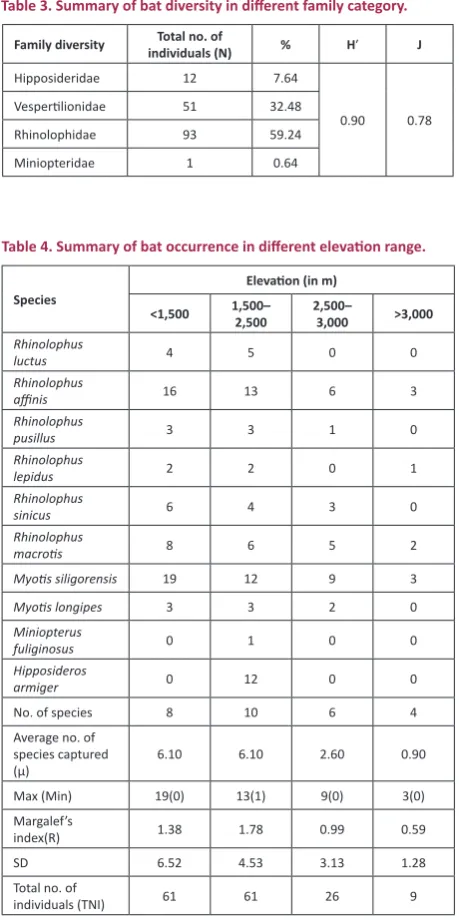
followed by R.affinis with one to five individuals. The family Rhinolophidae contained the maximum number of individuals captured (N=93, NIP=59.24%). The diversity index (H′) and Pielou’s evenness (J) were 0.90 and 0.78 for the families captured (Table 3).
Occurrence of bats at different elevations
The species richness was comparatively higher between the elevations 1,500–2,500 m and there after it decreased significantly with increasing elevation (Table 4). The majority of species (63%) were captured within the elevation range of <1,000–2,500 m. Rhinolophus affinis and Myotis siligorensis were the most common
species in an elevation range of <1,500–2,500 m. The
average species capture rate and richness were highest
between elevations of 1,500–2,500 m (μ=6.10, R=1.78, SD=4.53) followed by <1,500m (μ=6.10, R=1.38, SD=6.52) and lowest in >3,000m (μ=0.90, R=0.59, SD=1.28). The maximum total number of individuals captured was highest at elevation <1,500m and 1,500–2,500 m (TNI=61) and lowest at >3,000m (TNI=9).
Diversity of bats by habitat type
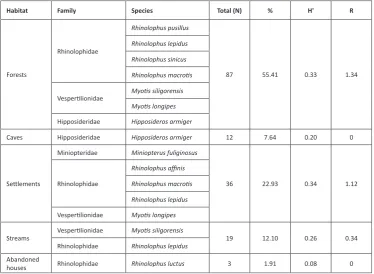
From the total of 157 bats captured, 87 (55.41%)
were captured from forests followed in order by
settlements (N=36, 22.93%), streams (N=19, 12.10%) and abandoned houses (N=3, 1.91%) (Table 5). The Shannon-Wiener diversity index (H’), however, showed that diversity among the different habitats was 1.19 and the overall Pielou’s evenness (J) was 1.03.
Bat species richness in relation to habitat types Margalef’s index showed that forest habitat had the highest species richness (R=1.34) followed by settlements (R=1.12) and the least in caves and abandoned houses Table 2. Information on the species and number of individuals caught.
Species NI NIP (%) NSC H' J D
Hipposideros
armiger* 12(M:3, F:9) 7.64 1
1.97 0.86 0.17
Myotis
siligorensis* 43(M:17, F:26) 27.39 11
Myotis
longipes** 8(M:8) 5.10 2
Rhinolophus
affinis 38(M:25, F:13) 24.20 9
Rhinolophus
luctus* 9(M:6, F:3) 5.73 2 Rhinolophus
pusillus* 7(M:2, F:5) 4.46 1 Rhinolophus
lepidus* 5(M:4, Ju:1) 3.18 2 Rhinolophus
sinicus** 13(M:9, F:4) 8.28 2 Rhinolophus
macrotis* F:12, Ju:1)21(M:8, 13.38 5
Miniopterus
fuliginosus** 1(M:1) 0.64 1
M—male | F—female |Ju—juvenile| NI—number of individuals | NIP—number of individuals in % | H′—species diversity | J—Pielou’s evenness | D—Simpson’s index |NSC—number of sites caught.
Table 3. Summary of bat diversity in different family category.
Family diversity individuals (N)Total no. of % H′ J
Hipposideridae 12 7.64
0.90 0.78 Vespertilionidae 51 32.48
Rhinolophidae 93 59.24
Miniopteridae 1 0.64
Table 4. Summary of bat occurrence in different elevation range.
Species
Elevation (in m)
<1,500 1,500–2,500 2,500–3,000 >3,000
Rhinolophus
luctus 4 5 0 0
Rhinolophus
affinis 16 13 6 3
Rhinolophus
pusillus 3 3 1 0
Rhinolophus
lepidus 2 2 0 1
Rhinolophus
sinicus 6 4 3 0
Rhinolophus
macrotis 8 6 5 2
Myotis siligorensis 19 12 9 3
Myotis longipes 3 3 2 0
Miniopterus
fuliginosus 0 1 0 0
Hipposideros
armiger 0 12 0 0
No. of species 8 10 6 4 Average no. of
species captured
(μ) 6.10 6.10 2.60 0.90 Max (Min) 19(0) 13(1) 9(0) 3(0)
Margalef’s
index(R) 1.38 1.78 0.99 0.59
SD 6.52 4.53 3.13 1.28
Total no. of
Image 1. Bat species recorded in the study area: A—Rhinolophus luctus | B—Myotis longipes | C—Miniopterus fuliginosus | D—Hipposideros armiger | E—Rhinolophus macrotis | F—Rhinolophus affinis.
A B C
D E F
(R=0) (Table 5). The total number of individuals caught was high for Rhinolophidae family (N=93) followed by other families in decreasing order: Vespertilionidae (N=51), Hipposideridae (N=12), and Miniopteridae (N=1) (Table 3). The capture rate was comparatively higher for Rhinolophidae and Vespertilionidae families.
DISCUSSION
Species diversity of bats
Studies on bats in the landlocked Himalayan country
of Bhutan is almost non-existent though it has been well studied in neighboring countries such as Nepal and India (Korad et al. 2007; Thapa et al. 2012; Korad 2014; Sayyed
2016; Chakravarty 2017). This study is the first to assess
the bat diversity in southwestern region of Bhutan (Chukha District) in which a total of 10 bat species were documented. All the species captured during the
© Sangay Tshering © Sangay Tshering
© Sangay Tshering © Sangay Tshering
© Sangay Tshering
Image 2. Bat species recorded in the study area: G—Rhinolophus lepidus | H—Rhinolophus sinicus | I—Rhinolophus pusillus | J—Myotis siligorensis.
G H
I J
current survey were insectivorous bats.
Considering the reports of bats from Bhutan
(Chakraborty 1975; Bates et al. 2008; Chiozza 2008; Walston et al. 2008), all species except Rhinolophus affinis and Miniopterus fuliginosus are new records for
the country and nine species except Rhinolophus affinis
are recorded for the first time from Chukha District. Following the studies conducted by Wangchuk et al.
(2004), however, only three of the 10 species are new to Bhutan. These are Myotis longipes, Rhinolophus sinicus, and Miniopterus fuliginosus. This indicates that
the subsequent studies (Bates et al. 2008; Chiozza 2008; Walston et al. 2008) might have over looked the study of Wangchuk et al. (2004).
Occurrence of bats at different elevations
Bat species richness was highest between the
elevations 1,500–2,500 m and thereafter decreased with increasing elevation. This finding is in contrast with
the report from Kathmandu valley by Thapa et al. (2012)
where it is mentioned that bat assemblage was rich at altitudinal range of 1,300–1,500 m. The difference in findings could be due to geographical variation, habitat types and availability of roosting sites besides food
availability (moths and insects). However, the similar
findings on the difference in distribution of bat species and their richness at different elevations were reported
by Thapa et al. (2012) and Raghuram et al. (2014).
In terms of the average number of species captured,
© Sangay Tshering © Sangay Tshering
bat assemblage was highest between 1,500–2,500 m
and lowest for >3,000m. This finding is consistent with the report of Choden (2009) mentioning bat distribution range 500–3,000 m. A decrease in species density at higher elevation was reported by Martins et al. (2015). Similar findings on different number of individuals confining to different elevation zones such as low or high elevations, some across the elevation gradient was also reported by Raghuram et al. (2014). The difference in capture rate in different elevation zones could be due to variations in habitats as well as climatic influence and disturbance in different elevation gradients.
Diversity of bats by habitat type
The highest bat diversity was from the forest with seven species (Rhinolophus pusillus, R. lepidus, R. sinicus, R. macrotis, Myotis siligorensis, M. longipes, and
Hipposideros armiger). A similar finding on abundant bat species composition in the forest was reported from Bolivia (Loayza & Loiselle 2009), Malaysia (Shafie et al. 2011) and southern Western Ghats of India (Deshpande 2012). Korad et al. (2007) and Korad (2014) also reported that bat diversity and distribution is governed by forest
types. The reason for the presence of a high diversity of
bats in the forest and around human settlement might
be due to the availability of more food such as moths
Table 5. Information on bat diversity by habitat type.
Habitat Family Species Total (N) % H' R
Forests
Rhinolophidae
Rhinolophus pusillus
87 55.41 0.33 1.34
Rhinolophus lepidus Rhinolophus sinicus
Rhinolophus macrotis
Vespertilionidae Myotis siligorensis
Myotis longipes Hipposideridae Hipposideros armiger
Caves Hipposideridae Hipposideros armiger 12 7.64 0.20 0
Settlements
Miniopteridae Miniopterus fuliginosus
36 22.93 0.34 1.12 Rhinolophidae
Rhinolophus affinis
Rhinolophus macrotis
Rhinolophus lepidus
Vespertilionidae Myotis longipes
Streams Vespertilionidae Myotis siligorensis 19 12.10 0.26 0.34
Rhinolophidae Rhinolophus lepidus Abandoned
houses Rhinolophidae Rhinolophus luctus 3 1.91 0.08 0
%—percentage | H′—species diversity | R—species richness.
and insects. It might also be due to the presence of high number of roosting sites and foraging opportunities in forests compared to other sampling sites. Other
preferred habitats are caves, abandoned houses and
human settlements (Mickleburgh et al. 2002; Korad et al. 2007; Raghuram et al. 2014). In current study,
caves and abandoned houses are seen to prefer as day
roosting sites.
In this study, use of acoustic recorders to record the echolocation call of bats was felt important due to the presence of dense forest cover. Acoustic recorder, however, was not available during the field work which is one of the limitations of this study. Further, bats use vertical stratification and forage at various heights to reduce competition for food as well as to detect prey (Plank 2011; Carvalho 2013; Marques 2015). Therefore,
there are high chances that certain species may not have been captured at all during the survey.
Hipposideros armiger was observed roosting in
caves with large openings. Species such as Rhinolophus luctus roosted in abandoned houses near cowsheds while other species such as Myotis siligorensis and
Rhinolophus lepidus were captured near streams. Some species such as Rhinolophus affinis and R.macrotis were found in disturbed areas as well as in agricultural areas
et al. (2011) found that plantations and agricultural areas provide suitable habitats for bat species. In India and Nepal (Deshpande 2012; Swamidoss et al. 2012; Thapa et al. 2012; Korad 2014) have mentioned that water bodies, farm land, human settlement, hillock,
abandoned houses, tree hollows, unused railway tunnels, canal tunnels, caves and forests are some of the most preferred habitats of microchiropteran bats.
Bat species richness in relation to habitat types In a world where conversion of forest to farmland and pastures is occurring at an accelerating rate (Loayza & Loiselle 2009), a study documenting bat species richness in forest is a critical step for bat conservation. In the
current study, bat species richness was highest in forest and least in caves and abandoned houses. The reason for the high bat species richness in forest might be due to the presence of forest clearings, trails and open areas which provide diverse refuge and foraging habitats for
bats. The weather condition and forest structure also influenced the capture success within the study areas. Heavy rain affects capture rate as the bats delay their emergence (Hanif et al. 2015). In the current study,
the capture rate was higher in the monsoon season and this could be due to more food (insects) availability compared to winter season or we might have captured more migratory bats.
CONCLUSION
With the use of mist nets and hoop nets, a bat survey
was conducted in southwestern region, Chukha District of Bhutan. The present study added three new records to
the already existing 65 species of bats in Bhutan. The rich
diversity of bats from Chukha District in southwestern Bhutan highlights the presence of diverse habitat types. Since bats provide many ecosystem services, it is required to protect their habitats to conserve them.
In addition, it is important to expand similar studies to
other parts of the country as Bhutan seems to harbor a diverse bat fauna.
REFERENCES
Acharya, P.R. & H. Adhikari (2010). Bats of Nepal: A Field Guide. Acharya, P.R., H. Adhikari, S. Dahal, A. Thapa & S. Thapa (eds.). Published by Small Mammals Conservation and Research Foundation (SMCRF), Kathmandu, Nepal, 64pp.
Bates, P. J. & D. L. Harrison (1997). Bats of the Indian Sub-continent. Harrison Zoological Museum Publications, Sevenoaks, 288pp. Bates, P., S. Bumrungsri, G. Csorba & C. Francis (2008). Sphaerias
blanfordi. The IUCN Red List of Threatened Species 2008:e. T20521A9210732. Downloaded on 01 December 2019. https://doi. org/10.2305/IUCN.UK.2008.RLTS.T20521A9210732.en
Carvalho, F., M.E. Fabián & J.O.Menegheti (2013). Vertical structure
of an assemblage of bats (Mammalia: Chiroptera) in a fragment of Atlantic Forest in Southern Brazil. Zoologia 30 (5): 491–498; https:// doi.org/10.1590/S1984-46702013000500004
Chakraborty, S. (1975). On a collection of mammals From Bhutan. Records of the Zoological Survey of India 68 (1-4): 1–20.
Chakravarty, R. (2017). A new distribution record of the European Free-tailed Bat Tadarida teniotis (Chiroptera: Molossidae) from the western Himalaya, India.Journal of Threatened Taxa 9(7):10463– 10467.https://doi.org/10.11609/jot.3462.9.7.10463–10467
Chiozza, F. (2008). Miniopterus fuliginosus. The IUCN Red List of Threatened Species 2008: e.T136514A4302951. https://doi. org/10.2305/IUCN.UK.2008.RLTS.T136514A4302951.en
Choden, S. (2009). Training in field techniques for small mammals, Bhutan. National Conservation Division,Thimphu, 5pp.
Csorba, G., S.V. Kruskop & A.V. Borissenko (1999). Recent records of bats (Chiroptera) from Nepal, with remarks on their natural history. Mammalia 63(1): 61–78. https://doi.org/10.1515/ mamm.1999.63.1.61
Curran, M., M. Kopp, J. Beck & J. Fahr (2012). Species diversity of bats along an altitudinal gradient on Mount Mulanje,southern Malawi. Journal of Tropical Ecology 28: 243–253. https://doi.org/10.1017/ S0266467412000193
Deshpande, K. (2012). Assessing diversity and distribution of bats in relation to land-use and anthropogenic threats in the southern Western Ghats, India. Final Report Submitted to the Rufford Small Grants for Nature Conservation, 30pp.
Fenton, M.B. & N.B. Simmons (2014). Bats: A World of Science and Mystery. Névraumont Publishing Company, New York, 34pp. Hanif, R.M., M.N. Aida, A . Zahirunisa, A.M. Ridwan & M. Abdullah
(2015). Contribution of regenerated forest in conservation of bats
in peninsular Malaysia. Journal of Tropical Forest Science27(4): 506–516.
Hutson, A.M., T. Kingston, S. Molur & C. Srinivasulu (2008). Myotis siligorensis. The IUCN Red List of Threatened Species 2008:e. T14203A4421951. Downloaded on 07 December 2019. https://doi. org/10.2305/IUCN.UK.2008.RLTS.T14203A4421951.en
Ith, S., S. Bumrungsri, N.M. Furey, P.J. Bates, M. Wonglapsuwan &F.A. Khan (2015). Taxonomic implications of geographical variation
in Rhinolophus affinis (Chiroptera: Rhinolophidae) in mainland Southeast Asia. Zoological Studies 54: 31.https://doi.org/10.1186/ s40555-015-0109-8
Kangoyé, N.M., A. Ouéda, L. Granjon, A. Thiombiano, W. Guenda & J. Fahr (2015). Diversity and distribution of bats (Mammalia Chiroptera) in Burkina Faso. Biodiversity Journal 6(2): 597–632. Korad, V.S. (2014). Studies on diversity, distribution, and conservation
of the bat fauna in Maharashtra State, India. Taprobanica 6(01): 32–45.
Korad, V., K. Yardi & R. Raut (2007). Diversity and distribution of bats in the Western Ghats of India. Zoos’ Print Journal 22(7): 2752–2758.
https://doi.org/10.11609/JoTT.ZPJ.1563.2752-8
Kunz, T.H. &S. Parsons (eds.) (2009). Ecological and Behavioral Methods for the Study of Bats. 2nd Edition. Johns Hopkins University
Press, Baltimore, 556pp.
Loayza, A.P.&B.A. Loiselle (2009). Composition and distribution of a
bat assemblage during the dry season in a naturally fragmented landscape in Bolivia. Journal of Mammalogy 90(3): 732–742. Lumsden, L.F. (2004).The Ecology and Conservation of Insectivorous
Bats in Rural Landscapes. Deakin University,xxiv+286pp.
Margalef, R. (1958). Temporal Succession and Spatial Heterogeneity in Natural Phytoplankton.Perspectives in Marine biology 323–347. Marimuthu, R. (2009). Training in field techniques for research and
conservation of volant and non-volant small mammals. Small Mammal Mail - Bi-Annual Newsletter of CCINSA & RISCINSA 1(2): 37. Marques, J. T., M.J. Pereira & J.M. Palmeirim (2015). Patterns in the
bats: all the action is up in the canopy. Ecography 38: 001–011;
https://doi.org/10.1111/ecog.01453
Martins, M.A., W.D. Carvalho, D. Dias, D.D. Francas, M.B. Oliveira &A.L. Peracchi (2015). Bat species richness (Mammalia, Chiroptera) along an elevational gradient in the Atlantic Forest of southeastern Brazil. Acta Chiropterologica 17(2): 401–409.
Menon, V. (2014).Indian Mammals: A Field Guide. Hachette Book Publishing India Pvt.Ltd, Delhi, 528pp.
Mickleburgh, S.P., A.M. Hutson & P.A. Racey (2002). A review of the global conservation status of bats. Oryx 36(1): 18–34.https://doi. org/10.1017/S0030605301000011
Plank, M., K. Fiedler & G. Reiter (2011). Use of forest strata by bats in
temperate forests. Journal of Zoology 286(2): 154–162. https://doi. org/10.1111/j.1469-7998.2011.00859.x
Raghuram, H., M. Jain& R. Balakrishnan (2014). Species and acoustic
diversity of bats in a palaeotropical wet evergreen forest in southern India. Current Science 107(4): 631–641.
Rajchal, R. (2007). Bats of Nepal. M Sc Thesis. Institute of Forestry, Pokhara, v+80pp.
Salvo, I.D., D. Russo & M. Sara (2009). Habitat preferences of bats in a rural area of Sicily determined by acoustic surveys. Hystrix 20(2): 137–146. https://doi.org/10.4404/hystrix-20.2-4444
Sayyed, A. (2016). Faunal diversity of Satara District,Maharashtra, India. Journal of Threatened Taxa 8(13): 9537–9561. https://doi. org/10.11609/jott.3162.8.13.9537-9561
Shafie, N.J., S.A. Sah, N.S. Latip, N.M. Azman & N.L. Khairuddin (2011). Diversity pattern of bats at two contrasting habitat types
along Kerian River, Perak, Malaysia. Tropical Life Sciences Research 22(2): 13–22.
Shannon, C.E., & W. Wiener (1949).The Mathematical Theory of Communication. Urbana, University of Illinois Press, 177pp.
Soisook, P., S. Karapan, M. Srikrachang, A. Dejtaradol, K. Nualcharoen & S. Bumrungsri (2016). Hill forest dweller: anew cryptic species
of Rhinolophus in the ‘pusillus Group’ (Chiroptera: Rhinolophidae) from Thailand and Lao PDR. Acta Chiropterologica18(1):117–139.
https://doi.org/10.3161/15081109ACC2016.18.1.005
Srinivasulu, C., P.A. Racey & S. Mistry (2010). A key to the bats (Mammalia: Chiroptera) of South Asia. Journal of Threatened Taxa 2(7): 1001-1076. https://doi.org/10.11609/JoTT.o2352.1001-76
Stevens, R.D. (2013). Gradients of bat diversity in Atlantic Forest of South America: environmental seasonality, sampling effort and spatial autocorrelation. Biotropica45(6): 764–770. https://doi. org/10.1111/btp.12056
Swamidoss, P.D., M.R. Sudhakaran & P. Parvathiraj (2012).
Habitat Preference of Microchiropteran Bats in three Districts of Tamilnadu,South India. International Research Journal of Biological Sciences 1(5): 24–30.
Thapa, S., S. Shrestha, S. Dahal, B.A. Daniel & N.B. Singh (2012). Monitoring and conservation of bats in the Kathmandu Valley, Nepal. Asian Journal of Conservation Biology 1(1): 1–4.
Walston, J., T. Kingston & A.M. Hutson (2008).Rhinolophus affinis. The IUCN Red List of Threatened Species 2008:e.T19522A8952553. Downloaded on 07 December 2019.https://doi.org/10.2305/IUCN. UK.2008.RLTS.T19522A8952553.en
Wangchuk, T., P. Thinley, K. Tshering, C. Tshering, D. Yonten & B. Pema (2004). A Field Guide to the Mammals of Bhutan. Ministry of Agriculture, Thimphu,182pp.
Weber, T.C., & D.W. Sparks (2013). Summer habitat identification of an
Appendix 1. Individual morphological measurements for all specimens of Rhinolophus affinis.
Species TNS (38) Measurements (mm)
FA HBL HF EL TIB 3mt 4mt 5mt BW
Rhinolophus affinis
1 54.31 48 6.21 17 25.11 36.9 39.8 41 16.3
2 53 47.34 6.83 17.5 24.6 37 40 40.4 16.5
3 55 48.42 7 18 25 37.4 39.8 40.35 17
4 54.2 47.9 6.61 17.21 24.33 36.67 39 40 16.75
5 53 47.11 6.54 17 24.05 36.6 39 40.5 16.25
6 55 48.54 7.32 17.87 24.98 37 40.03 41 16.85
7 53.33 47 6.04 17.51 24.66 36.77 39.22 40.56 16.43
8 53 47 6 17.06 24 36.61 39 40.01 16.4
9 54 48 7.55 17.4 24.76 36.99 40 40.5 16.77
10 54 48.03 7.6 17.8 24.91 37 40.3 40.55 17
11 55 48 7.6 17.5 25 37.22 40.4 40.7 16.2
12 53.5 47.3 6.8 17 24 36.7 39 40 16.5
13 55.43 48.6 7.35 17.78 25.04 37 40 41 17
14 55 49 7.71 18 25 37.76 40.44 41.31 16.2
15 55.51 49 7.8 17.92 25.44 37.83 40.5 41.65 17
16 53 47.21 6.33 17 24.03 36.5 39.04 40.12 16.32 17 54 47.5 6.5 17.5 24.5 36.8 39.5 40.75 16.55
18 54.06 47 6.66 17.2 24.71 37 40 41 17
19 54.21 47.91 7 17 24.96 36.99 39.62 40.84 16.45
20 54 47.5 6.65 17.43 24.61 37 40 41 17
21 53 47 6.3 17.32 24 36 39 40 17
22 55 48.76 7.54 18 25 37.67 40 41 16.5
23 54.2 47.9 6.61 17.21 24.33 36.67 39.12 40 16.75
24 54 48 7.55 17.4 24.76 36.99 40 40.5 16.77
25 55.43 48.6 7.35 17.92 25.44 37.83 40.5 41.65 17
26 54.31 48 6.21 17 25.11 36.9 39.8 41 16.3
27 53.5 47.3 6.8 17 24 36.7 39 40 16.5
28 55 48.42 7 18 25 37.4 39.8 40.35 17
29 54 47.66 7.55 17.45 24.89 37 40 41 17 30 53.55 48 6.98 17.67 24.81 36.86 39.34 40.56 16.71
31 55.51 48.91 7.81 18 25.5 37.76 40.54 41 16.85
32 54 48 7 17.45 25.5 37.83 40 41.34 17 33 53.33 47 6.04 17.51 24 36.61 39 40.01 16.4
34 55 48.54 7.32 18 25 37.67 40 41 17
35 54.2 47.9 7.55 17.4 24.89 37 39 40 16.5
36 53.5 47.3 6.3 17.32 24.05 36.5 39.04 40.12 16.32
37 55.51 49 7.78 17.89 25.53 37.83 40.54 41.71 16.92
38 53 47 6.05 17.45 24 37 39.18 40.05 16.45
Appendix 2. Individual morphological measurements for all specimens of Rhinolophus luctus.
Species TNS (9) Measurements (mm)
FA HBL HF EL TIB 3mt 4mt 5mt BW
Rhinolophus luctus
1 69 81.56 11.6 34 37.58 50.51 52.86 55.5 32.62
2 70.32 82 12.45 36 38.52 51 53 56.80 33 3 68.59 81.78 12 33.85 37.42 50 52.04 55.42 31.85
4 68 81.09 11.76 32 37 50 53.15 55 32
5 70 82.45 12.65 36 38.56 50.98 53.8 56.57 34
6 70.06 82 12.79 35.73 38 50.06 53.47 56.09 32.85 7 69.57 81 11.95 33.65 37.98 50.75 52.86 55.76 33.62
8 68.34 81.05 11.50 32.09 37.54 50.12 52.5 55.62 31.91 9 70.22 82 12.64 35.52 38 50.96 53 55.69 31.98 TSN—Total number of specimen of Rhinolophus luctus |FA—forearm | HBL—head body length | HF—hind foot | EL—ear length| TIB—Tibia | 3mt—third metacarpal | 4mt—fourth metacarpal | 5mt—fifth metacarpal |BW—body weight.
Appendix 3. Individual morphological measurements for all specimens of Rhinolophus pusillus.
Species TNS (7) Measurements (mm)
FA HBL HF EL TIB 3mt 4mt 5mt BW
Rhinolophus pusillus
1 36.76 31.81 6.5 16 15.34 25.56 26.89 27.52 5.43
2 35 31 6.23 15.5 15 25 26.59 27.5 5.98 3 37.83 32.5 7.32 16.8 16 26.34 27.3 28 6.32
4 36 31 6.23 15.95 15.81 25.54 26.5 27.59 5.87
5 35 31.11 6 15.56 15.32 25.21 26.51 27.5 5.45
6 37 32.7 7.30 16.56 15.98 26.4 27.12 27.97 6.42
7 35.06 31.21 6.09 15.9 15.11 25.54 26.5 27.32 5
TSN—Total number of specimen of Rhinolophus pusillus |FA—forearm | HBL—head body length | HF—hind foot | EL—ear length| TIB—Tibia | 3mt—third metacarpal | 4mt—fourth metacarpal | 5mt—fifth metacarpal |BW—body weight.
Appendix 4. Individual morphological measurements for all specimens of Rhinolophus lepidus
Species TNS (5) Measurements (mm)
FA HBL HF EL TIB 3mt 4mt 5mt BW
Rhinolophus lepidus
1 40.54 32.41 6.4 16.43 16.5 30.95 31.05 31.40 5.52
2 41 33.23 7 16.98 16.9 31.45 31.34 31.52 6
3 40.05 32 6.2 16.34 16.3 30.8 31 31.45 5
4 40.98 33.50 7.08 17 16.78 31.5 31.5 31.7 6.81 5 40.76 32.94 7.03 16.85 16.65 31 31.23 31.54 6.41
Appendix 5. Individual morphological measurements for all specimens of Rhinolophus sinicus.
Species TNS (13) Measurements (mm)
FA HBL HF EL TIB 3mt 4mt 5mt BW
Rhinolophus sinicus
1 45.34 51 6.5 17.45 16.98 36.9 36.56 35.98 10.54 2 45 50.2 6.23 17 16.8 36.8 36 35.91 10.3
3 46 51.5 7 17.6 17.45 37.23 37 36 11
4 45 50.66 6 17.09 16.95 36.87 36.54 35.9 10.55
5 45.87 51 6.88 17.31 17.11 36.96 36.35 36.09 10.61
6 46.52 52.4 7.31 17.67 17.5 37.9 37 36.4 11.21
7 45.09 50.35 6.23 17.72 16.86 37.21 36.89 36.35 10.83
8 45 50.23 6 17 17.09 37 36.86 36.12 11.05
9 45.9 51 6.55 17.06 17.12 36.98 36 35.96 10.89
10 46 52 7.03 17.8 17.45 37.7 36.85 36.38 10.57
11 45.86 50.2 6.23 17.6 17.45 36.88 36.73 35.99 10.85
12 46.34 52 7 17.69 17.34 37.56 36.98 36.05 10.38 13 46 52.4 7.31 17.06 17.12 37.9 37 36 11
TSN—Total number of specimen of Rhinolophus sinicus |FA—forearm | HBL—head body length | HF—hind foot | EL—ear length| TIB—Tibia | 3mt—third metacarpal | 4mt—fourth metacarpal | 5mt—fifth metacarpal |BW—body weight.
Appendix 6. Individual morphological measurements for all specimens of Rhinolophus macrotis.
Species TNS (21) Measurements (mm)
FA HBL HF EL TIB 3mt 4mt 5mt BW
Rhinolophus macrotis
1 50.53 53 11.05 17.85 25 41.5 42.53 42.65 7.5
2 45.65 50.53 10.87 17.5 24.86 41 41.57 41.98 7
3 41.56 50 10 17.59 24 40.98 41.23 42.06 7.56
4 53 54.23 11.26 18 25.45 42 43 43.51 8.40 5 54 55.67 11.55 18.5 26 42.08 43.23 43.45 7.98
6 47 53.34 10.67 17.89 25.53 41.98 42.56 43 8
7 46.91 52 11 17.78 24,96 41.90 42.45 42.97 7.40
8 53.76 54.98 11.56 17.9 25 42 43 43.43 8.40
9 50.55 51 10.87 17.83 24.97 41 41.78 42.8 7.76
10 41.56 50 10 17.5 24 40 41 42.02 7.56
11 48 51.56 11.05 17.9 25.01 41.05 42.31 42.59 8
12 54 55.67 11.55 18.5 26.34 42 43.47 43.57 8.09 13 51.89 52.87 11.48 17.97 25.67 41.67 42 42.96 7.78
14 45.65 50.53 11 17.78 24,96 41 41.57 41.98 8
15 50.53 53.76 11.25 17.83 24.97 41 42.31 42.59 7.77
16 41.56 50 10.55 17.59 24.06 41.5 42.23 42.65 8.03
17 46 51.89 53.67 17.5 24.86 41.90 42.45 42.97 7.78
18 53.80 54.98 11.46 18.06 25.65 42.35 43.90 43.45 8.04
19 43.59 50.78 10.56 17.87 24,36 41.03 41.55 42 8
20 46.11 51.43 10.98 17.58 24,26 41.62 42.15 42.58 7.01
21 51.55 51.34 10.97 17.98 24.99 41.34 41.68 42.89 8.26
Appendix 7. Individual morphological measurements for all specimens of Myotis siligorensis.
Species TNS (43) Measurements (mm)
FA HBL HF EL TIB 3mt 4mt 5mt BW
Myotis siligorensis
1 35 39.05 6.35 11.23 14.90 30.78 30.45 29.95 5.06 2 34 38.56 6.19 11.23 14.93 30.65 30.34 29.85 4.89 3 34.91 38.31 6.08 11.05 14.78 30.63 30.43 29.50 5.01 4 35.67 40.04 7 11.45 15.32 31.45 30.13 30.86 5.75
5 36.45 40.12 7.24 11.85 15.40 31.54 30.83 30.51 5.64 6 34 38.75 6.39 11.43 14.85 30.75 30.54 29.66 5.03 7 35.56 40.05 6.75 11.83 14.95 30.98 30.75 29.99 5.66 8 34.12 38.31 6.08 11.09 14.59 30.60 30.06 29.5 4.86
9 36.33 40 7.34 11.95 15.50 31.44 30.93 30.32 5.34
10 36.42 40.08 7.26 11.87 15.43 31.49 30.76 30.42 5
11 34 38 6.13 11.14 14.78 30.6 30.23 29.34 4.98
12 35.45 39.45 6.35 11.44 14.81 30.95 30.75 29.88 5.93 13 34.09 38.65 6.29 11.63 14.82 30.75 30.54 29.78 5.50 14 36.35 40.10 7.17 11.65 15.23 31.39 30.83 30.11 4.98
15 35.86 40.04 7 11.34 15.22 31.45 30.23 30.46 5 16 36.44 40.11 7.24 11.88 15.50 31.35 30.90 30.50 5.45
17 35.45 39.46 6.16 11.23 14.79 30.85 30.66 29.81 5.09
18 34 38.45 6.41 11.43 14.91 30.75 30.44 29.85 5.56
19 35.27 40.10 7.23 11.45 15.45 31.35 30.03 30.48 4.9
20 35.81 40.01 6.21 11.61 14.79 30.76 30.25 29.95 4.88 21 36.42 40.03 7.06 11.91 15.42 31.18 30.64 30.44 5.39
22 35.78 40.12 7.24 11.23 15.32 31.28 30.19 30.39 5
23 34.23 38.45 6.5 11.43 14.84 30.65 30.04 29.85 4.96
24 35 38.42 6.14 11.21 14.81 30.61 30.16 29.48 4.95
25 36.35 40.12 7.08 11.55 15.12 31.29 30.73 30.22 5.34
26 34.25 38.56 6.19 11.20 14.92 30.65 30.34 29.89 5
27 35.08 39.96 7.09 11.39 15.38 31.49 30.21 30.46 5.65 28 34 38.05 6.24 11.14 14.93 30.41 30 29.77 5.07 29 35.77 40.12 6.40 11.61 14.79 30.76 30.33 29.87 5.85
30 35.70 40 6.27 11.55 14.83 30.76 30.43 29.55 5.09 31 36.32 40.10 7.14 11.87 15.43 31.49 30.76 30.42 5.34 32 35.45 39 6.49 11.34 14.80 30.71 30.54 29.66 5.81
33 36 39.54 7.24 11.49 15.5 31.87 30.43 30.41 5.34 34 36.22 40.11 7.04 11.77 15.45 31.23 30.76 30.31 5
35 35 38.85 6.98 11.87 14.92 30.84 30.24 29.68 4.92 36 35.34 40.00 7.23 11.42 15.43 31.35 30.08 30.40 5.08
37 35.82 39.53 7.08 11.45 15.44 31 30.13 30.32 4.96 38 35.32 39.15 6.22 11.42 14.82 30.66 30.42 29.87 5.94 39 34.88 38.77 6.45 11.29 14.91 30.88 30.65 29.69 4.87
40 35.67 39 7.23 11.52 15.11 31.76 30.42 30.51 5.23
41 34.65 38.90 6.88 11.73 14.98 30.81 30.55 29.89 4.95
42 36.04 40.12 7.16 11.75 15.21 31.22 30.74 30.25 5.79 43 34.90 38.68 6.39 11.47 14.79 30.97 30.45 29.86 5.42
Appendix 8. Individual morphological measurements for all specimens of Myotis longipes.
Species TNS (8) Measurements (mm)
FA HBL HF EL TIB 3mt 4mt 5mt BW
Myotis longipes
1 35.46 40.07 6.89 10.85 14.97 30.45 31.08 31.98 5.56
2 36.54 41.26 7.31 11.06 15.35 31 31.24 40.10 6.01
3 35.01 39.50 6.81 10.56 14 30.5 31 31.95 5.23
4 35.23 39.58 6.97 10.51 14.27 30 31.34 31.90 5.98
5 36.41 41.55 7.32 11.09 15.32 31.21 31.33 40.03 6
6 36.74 41.68 7.58 11.32 15.36 31.24 31.50 40 6.05
7 35.95 39.89 6.92 10.88 14.56 30.96 31.08 31.99 5.86
8 36.65 41.59 7.52 11.47 15.46 31.09 31.45 40.12 6.04
TSN—Total number of specimen of Myotis longipes |FA—forearm | HBL—head body length | HF—hind foot | EL—ear length| TIB—Tibia | 3mt—third metacarpal | 4mt—fourth metacarpal | 5mt—fifth metacarpal |BW—body weight.
Appendix 9. Individual morphological measurements for all specimens of Miniopterus fuliginosus.
Species TNS (1) Measurements (mm)
FA HBL HF EL TIB 3mt 4mt 5mt BW
Miniopterus
fuliginosus 1 47.85 53.54 7.52 10.32 19.67 40.15 39.51 37.64 13.94
TSN—Total number of specimen of Miniopterus fuliginosus |FA—forearm | HBL—head body length | HF—hind foot | EL—ear length| TIB—Tibia | 3mt—third metacarpal | 4mt—fourth metacarpal | 5mt—fifth metacarpal |BW—body weight.
Appendix 10. Individual morphological measurements for all specimens of Hipposideros armiger.
Species TNS (12) Measurements (mm)
FA HBL HF EL TIB 3mt 4mt 5mt BW
Hipposideros armiger
1 90.09 91.32 14.55 22.51 43.86 69.32 67.86 67.91 55.75
2 89.45 90.85 13.21 22.13 42.94 68.06 67.93 67.58 53.74 3 88.38 90.51 13 21.86 41.24 67.34 67.59 67.55 49.51
4 91.76 91.84 14.76 22.69 44.01 69.53 67.91 67.95 55.82
5 88.41 90.51 12.52 21.85 42.64 67 67.83 67.54 48
6 92.09 91.89 15.17 23 45.05 69.56 68.55 68.78 57.42 7 88 90.59 12.52 21.34 42.34 67.06 67.52 67.59 50.59
8 90.56 91 14.88 22.34 44.07 69.14 68.09 68.23 56
9 93.50 92.31 16.45 23.41 45.67 70.24 68.39 68.52 57.09
10 93.49 92.30 16.38 23.58 45.78 70.21 68.59 68.93 57.57
11 89.01 91.19 12.87 21.59 42.83 67.59 67.58 67.64 49.67
12 92.54 91.98 16.32 23.09 45.12 69.95 68.81 68.90 54.71 TSN—Total number of specimen of Hipposideros armiger |FA—forearm | HBL—head body length | HF—hind foot | EL—ear length| TIB—Tibia | 3mt—third metacarpal | 4mt—fourth metacarpal | 5mt—fifth metacarpal |BW—body weight.
ISSN 0974-7907 (Online) | ISSN 0974-7893 (Print)
January 2020 | Vol. 12 | No. 1 | Pages: 15091–15218 Date of Publication: 26 January 2020 (Online & Print)
DOI: 10.11609/jott.2020.12.1.15091-15218
www.threatenedtaxa.org
in any medium by providing adequate credit to the author(s) and the source of publication.
Article
A citizen science approach to monitoring of the Lion
Panthera leo (Carnivora: Felidae) population in Niokolo-Koba
National Park, Senegal
– Dimitri Dagorne, Abdoulaye Kanté & John B. Rose, Pp. 15091–
15105
Communications
Status, distribution, threats, and conservation of the
Ganges River Dolphin Platanista gangetica (Mammalia:
Artiodactyla: Cetacea) in Nepal
– Deep Narayan Shah, Amit Poudyal, Gopal Sharma, Sarah Levine, Naresh Subedi & Maheshwar Dhakal, Pp. 15106–15113
Bat (Mammalia: Chiroptera) diversity, dominance, and richness in the southwestern region of Bhutan with three new records for the country
– Sangay Tshering, Dhan Bahadur Gurung, Karma Sherub, Sumit
Dookia, Kuenzang Dorji & Pema Choephyel, Pp. 15114–15128
The pattern of waterbird diversityof the trans-Himalayan
wetlands in Changthang Wildlife Sanctuary, Ladakh, India
– Pushpinder Singh Jamwal, Shivam Shrotriya & Jigmet Takpa,
Pp. 15129–15139
Composition, diversity and foraging guilds of avifauna in agricultural landscapes In Panipat, Haryana, India
– Parmesh Kumar & Sharmila Sahu, Pp. 15140–15153
An overview of fishes of the Sundarbans, Bangladesh and their present conservation status
– Kazi Ahsan Habib, Amit Kumer Neogi, Najmun Nahar, Jina Oh,
Youn-Ho Lee & Choong-Gon Kim, Pp. 15154–15172
Digital image post processing techniques for taxonomic publications with reference to insects
– Nikhil Joshi, Hemant Ghate & Sameer Padhye, Pp. 15173–15180
Short Communications
Description of a new species of the genus Lampropsephus
Fleutiaux, 1928 (Coleoptera: Elateridae: Elaterinae: Dicrepidiini) from Konkan, Maharashtra, India
– Amol Patwardhan & Rahul Khot, Pp. 15181–15185
Spiders (Arachnida: Araneae) from the vicinity of Araabath Lake, Chennai, India
– John T.D. Caleb, Pp. 15186–15193
Two new records of gilled mushrooms of the genus Amanita
(Agaricales: Amanitaceae) from India
– R.K. Verma, V. Pandro & G.R. Rao, Pp. 15194–15200
Notes
A first record of oviposition of Common Onyx Horaga onyx
Moore, 1857 (Insecta: Lepidoptera: Lycaenidae) in Sri Lanka and its importance in conserving a highly threatened butterfly – Chathura Udayanga Herath, Pavan Bopitiya Gamage, Iroshan Rupasinghe & Moditha Hiranya Kodikara Arachchi, Pp. 15201– 15204
Additions to known larval host plants of butterflies of the Western Ghats, India
– Deepak Naik & Mohammed S. Mustak, Pp. 15205–15207
Rhynchotechum parviflorum Blume (Gesneriaceae): a new record to mainland India
– Momang Taram, Puranjoy Mipun & Dipankar Borah, Pp. 15208–15211
Re-collection of the Luminous Lantern Flower Ceropegia lucida
Wall. (Apocynaceae) from Assam, India
– Debolina Dey, Manash Baruah, Nilakshee Devi & Jitendra Nath Borah, Pp. 15212–15215
Tetrasporidium javanicum Möbius (Chlorophyta), a rare species recorded from Arpa River in Bilaspur, Chhattisgarh, India
– Rakesh Kumar Dwivedi, Pp. 15216–15218