A Novel Modified
Delay-Based Control Algorithm with
Experimental Application
ITC 1/48
Journal of Information Technology and Control
Vol. 48 / No. 1 / 2019 pp. 90-103
DOI 10.5755/j01.itc.48.1.19066
A Novel Modified Delay-Based Control Algorithm with Experimental Application
Received 2017/09/18 Accepted after revision 2018/12/18
http://dx.doi.org/10.5755/j01.itc.48.1.19066
Corresponding author: [email protected]
Necdet S. Özbek
Department of Electrical and Electronics Engineering; Faculty of Engineering; Adana Alparslan Türkeş Science and Technology University; Saricam, Adana, Turkey; phone: +90 322 455 00 00; fax: +90 322 455 00 39;
e-mail: [email protected]
İlyas Eker
Department of Electrical and Electronics Engineering; Faculty of Engineering; Çukurova University; Balcali, Adana, Turkey; phone: +90 322 338 68 68; fax: +90 322 338 63 26; e-mail: [email protected]
In the present article, a new modified delay-based control structure is proposed to improve the closed-loop performance of control systems. The controller is designed for a second-order linear time-invariant system. The controller parameters are tuned by using the integral of the absolute error criterion. Theoretical results are simulated and experimentally applied to an electromechanical system, which is identified with an interactive system identification tool. It is shown that the present controller provides better control measures and time domain specifications compared with the classical PID and PI-PD controllers in the presence of measurement noise as well as uncertainties.
KEYWORDS: Delay-based control, electromechanical system, system identification, experimental applica-tion, proportional integral derivative (PID), stability, optimization.
1. Introduction
Analysis and control of Time-Delay Systems (TDS) have received growing interest in recent years due to their prevalence in various applications across dif-ferent areas such as industrial processes,
91 Information Technology and Control 2019/1/48
amount of research effort has been dedicated to TDS, and numerous advances have been reported on mod-elling, identification, stability analysis, and control. However, it is to be noted that well-known classical feedback control strategies and controller tuning methods cannot keep pace with the system compris-ing time-delay. In any control system, the time-delay causes a physical constraint, which can damage the closed-loop stability of the system. It gives rise to a quasi-polynomial characteristic equation with in-finite eigenspectrum [28, 34] which makes the anal-ysis and synthesis of TDS extremely difficult [28, 56]. The time delay often may deteriorate the closed-loop response by decreasing the phase margin of the sys-tem [57]. Most of the existing works on TDS aim at eliminating delay in control applications. A number of approximation techniques or expansion methods such as Taylor series, Padé approximations, and phase shift techniques can be employed. These methods may show satisfactory performance for some small delay values, however, they cannot deal with large delays due to the inherent restrictions. A number of studies elaborate on how to weaken the negative ef-fects of time-delay [34, 64, 73].
An intentional time-delay, in some cases, presents an opportunity to increase the closed-loop control performance when appropriately incorporated with the control system. A number of schemes such as fre-quency shaping, Smith predictor, delayed-control, and delayed resonator consider the stabilizing prop-erties of time-delays. A remarkable performance im-provement can be achieved by using time delay for a nonlinear dynamical system, such as chaotic motion. In fact, the counter effect of delay on the stability and performance of dynamical systems is a critical prob-lem that still needs to be carefully answered. Thus, re-cent attention has been devoted to understanding the effect of time delay on control systems. Consequently, TDS has been highly active research field with a large amount of research effort.
The present research deals with modification of delay based control scheme to achieve better control per-formance while consuming less energy, fewer com-putational burden, low design effort with respect to classical controllers. Although the general methodol-ogy introduced in [66] and [47] is used in the present research, a new Proportional Integral-Proportional Retarded (PI-PR) control scheme is proposed. In the
control scheme, a PI controller and a PR controller are combined to control a second-order system. The main idea behind the control techniques is discussed carefully including experimental applications. The contributions of the paper are:
1 describing favourable effects of delay with related
works,
2 providing an overview of delay-based control schemes,
3 modelling and experimental identification of an
electromechanical system,
4 describing a novel modified delay-based control strategy and providing the stability analysis,
5 performing an experimental implementation to
highlight the validity and capability of the pro-posed control strategy,
6 comparing the proposed controller with classical
low order control techniques with a number of per-formance measures.
The second section presents a number of favourable effects of delay with relevant literature. Some details about the experimental set-up and model development of the electromechanical system are given in the third section. The fundamental mathematical concepts, the related theoretical background, and the design proce-dure of the proposed control scheme are demonstrated in the fourth section. Stability analysis is presented in the fifth section. Simulations and real-time experi-mental results with a comparative evaluation are ad-dressed in the sixth section. Finally, the last section presents some concluding remarks and future works.
2. A Review of Favourable Effects of
Delay in Control Systems
et al. emphasized that a positive delayed feedback can stabilize an oscillatory system [1]. The benefit of utilizing delay instead of derivative terms was in-vestigated in [27, 39, 46, 47]. Introduction of delay may enhance the performance of a closed-loop sys-tem without any estimation for derivative terms [36, 46, 47, 50, 52]. The control performance of a chain of integrators is improved, when the derivative part of the controller is replaced by a delay term [36]. A number of studies address the utilization of time de-lays in state feedback control scheme to approximate integral and derivative terms [29, 30, 62]. In a recent research, Ulsoy [62] proved the positive effect of time delayed control on the disturbance rejection capabil-ity and tracking abilcapabil-ity of a single input single output (SISO) system. Delay differential equation (DDE) was solved using the Lambert-W functions. The work of Jankauskiene and Rimas presents the use of the Lam-bert-W function in the analysis of TDS [21].
In nonlinear systems area, it is stated that a remark-able performance improvement can be achieved by using time delay for controlling chaotic motion. A positive effect of time delay is reported on the de-layed resonator, which is utilized with a dede-layed po-sition feedback to enhance vibration absorber per-formance [20]. In [69], a bifurcation control problem is investigated for an Internet congestion control problem. A non-collocated vibration control exam-ple is addressed by Yang and Mote [70]. Udwadia et al. presented a number of favourable effects of time delay in control of flexible structures [61]. A robust time-delayed control scheme was proposed by Roy and Kar for a class of nonlinear uncertain systems [54]. A delayed sliding mode controller was addressed in [9], wherein the sign function was approximated by a time delay. It was shown that this realization still provides robustness of sliding mode control, while the chattering is reduced. The reported studies show that the delayed controllers have shown satisfactorily better performance in the presence of uncertainties and model mismatches.
A number of positive effects of time delay were demonstrated on tracking performance of type-I con-trol systems [26]. Pyragas proposed a novel time-de-layed feedback control algorithm, which rised a new research avenue in physics [44]. Moreover, the chat-tering phenomenon for a high-speed milling system was reduced by using time-delay in [63]. An inverted
pendulum stabilization problem was elaborated with Pyragas-type controller [6]. The research studies, known as delayed control, contain the active utiliza-tion and intenutiliza-tional introducutiliza-tion of the time-delay as a design parameter. However, it is to be noted that the parameter tuning and stability analysis issues are still challenging [39, 47].
93 Information Technology and Control 2019/1/48
dead-time controller was highlighted in [55], in which a delay was added to the integral loop of the PID control-ler. Ramirez et al. addressed a proportional integral re-tarded (PIR) control scheme and the stability analysis is derived in the sense of the algebraic geometric anal-ysis [47]. Moreover, Ramirez and Sipahi demonstrated the design of delay-based controller for stabilization of network systems [48, 49, 50]. The control structure of PIR is depicted in Figure 1.
3. Preliminaries and Experimental
Setup
Modelling and control of electromechanical systems have been greatly attracted in control community since they are encountered in a wide range of appli-cation areas. Direct Current (DC) motors have been used in various industrial control applications [11]. DC motors have various advantages like easy po-sition/speed regulation, simple structure, and low maintenance. Therefore, numerous studies are ded-icated to position and velocity control of DC motors achieving set point regulation, tracking accuracy, ro-bustness, and energy efficiency.
3.1. Modelling of the Process
Angular position and velocity are the main control variables in DC motor control applications. Thus, the control designer needs velocity measurement, which may contain a considerable amount of high-frequen-cy noise. Designer quite often adapts an appropriate low pass filter into the feedback system in order to attenuate high-frequency noise. However, employing such a filter structure may increase the complexity of the control scheme, computational burden, and ener-gy consumption.
Inserting a time delay in a motion control algorithm may offer several opportunities. Such as, a time-de-layed controller avoiding unnecessary velocity mea-surements. In other cases, if velocity measurements are not available, a derivative filter is used to estimate the velocity from position data. The dynamical equa-tions of the electromechanical system are given as in [10, 11, 13] and the schematic diagram of the system is depicted in Figure 2.
Figure 1
PIR controller [9]
P(s)
+
Reference
-+ +
- + Disturbance
Output
2 c
s as b
s e Integral
Delay P
Proportional
-Analytical tuning approaches are discussed for this new class of delay-based control scheme [47,51,52]. The aforementioned studies presented an explic-it analytical tuning strategy containing a dominant triple root assignment with the aim of producing the maximum exponential decay rate of the closed-loop system. Zalluhoglu et al. proposed different types of delayed feedback control schemes for Rijke tube thermoacoustic instability problem [72]. Cluster treatment of characteristic roots (CTCR) is utilized to meet the objectives. In [32-33], a position control problem of servo drives was elaborated by using a cascade proportional integral retarded control. An integral absolute error (IAE) optimization of a PID controller with delay was addressed by Zitek et al. [75]. A geometric approach for the stability analysis of a proportional delayed controller was highlighted in [18]. A further discussion on delay-based control design techniques was represented in [42]. That work presents an experimental comparison of PID and PIR controllers. Further, some preliminary results of the present study were addressed in [43]. A direct inte-gration technique for time-delayed control was ad-dressed in [68]. Ramirez and Sipahi proved that the using of multiple intentional delays improve the sensus control performance by facilitating fast con-sensus and reducing the noise in a multi-agent system [48, 49, 50, 51, 52].
Figure 2
The schematic diagram of the electromechanical system
The electrical and mechanical equations are de-scribed as (1)-(4):
( ) ( ) . ( ) ( )
a a d a a a m m
v t L i t R i t K t
dt ω
= + + , (1)
( ) ( ) ( ) ( ) ( )
m d m m s m m f m
J t T t T t R t T
dtω ω ω
= − = −
, (2)
( ) ( ( ) ( )) ( ( ) ( ))
s s m L s m L
T t =k θ t −θ t −B ω t −ω t , (3)
( ) ( ), ( ) ( )
m m L L
d t t d t t
dtθ =ω dtθ =ω , (4)
where, the DC motor parameters in (1-4) are given in Table 1, and the block diagram of the system is present-ed in Figure 3. The motor shaft consists of several disks, which operate different kinds of transducers. Among them, the slotted-opto transducer is employed to ob-tain shaft speed. The tachogenerator, which produces
the voltage proportional to the shaft speed is utilized as a speed transducer for control applications [14].
3.2. Real-Time Identification of the Electromechanical System
It is evident that the exact numerical values of model parameters are difficult to obtain. Therefore, a num-ber of system identification methods, wherein the mathematical models of dynamical systems are built from observed input-output data, are used to assign the model parameters easily.
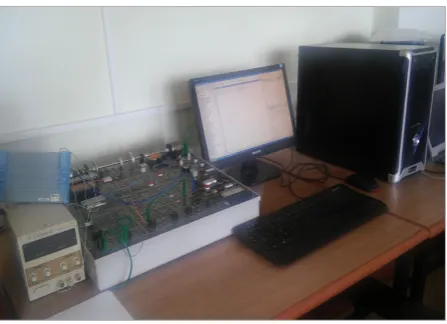
The experimental setup is linked to the computer by an Advantech data acquisition (DAQ) board in order to carry out real-time applications. The DAQ card has 16 analogue input- 4 analogue output, 48 Digital I/O, 250Ks/s-16 bit maximum sampling rate and resolu-tion. Further, a personal computer having Intel®core TM(2) Quad CPU Q850 @2.7GHz processor, 8GB RAM, 1024 MB VGA card is used. The experiment is conducted by Real-time Windows target option of Matlab/Simulink®, which is used as a software real-ization platform to generate the machine code. The schematic diagram of the experimental setup is de-picted in Figure 4 [15, 40, 41].
Table 1
DC motor model parameters
DC Motor Parameters
va Armature voltage RRM,
L
Viscous friction,
La Armature inductance, KM Torque coefficient,
Ra Armature resistance, TM Generated motor torque,
ia Armature current, Td External load disturbance,
Ts Nonlinear friction, Tf Transmitted shaft torque,
Jm,
JL
Moments of
inertia, ωωmL,
Rotational speeds
Figure 3
Block diagram of the electromechanical system
Figure 4
The schematic diagram of the experiment
COMPUTER
Electromechanical
System GENERATORTACHO
DAC
ADC
DAQ BOARD
POWER AMPLIFIER
REFERENCE
MOTOR SPEED CONTROL
SIGNAL
95 Information Technology and Control 2019/1/48
output to validate the model [11, 23]. A scene from the
laboratory is given in Figure 5. graphical user interface (GUI), which is presented in Figure 6, provides some facilities to the users.
Figure 5
A scene from the experimental set-up
The process reaction curve is a well-accepted tool to determine the characteristic properties of a system under different operating conditions. A number of dynamical properties of the system such as rise time, settling time, and time constant can be obtained di-rectly from the output data [7, 11]. In order to obtain the plant model, the armature of the DC motor is excit-ed by a step input , of magnitude 5.20 Volts, and shaft speed is measured in revolution per minute (rpm). The output voltage produced by the tachogenerator is measured to be 4.48 Volts that corresponds approxi-mately to 1200 rpm shaft speed. Then, a second-order system model is approximated as [10, 12, 13]:
2
( )
(1 d )(1 p )
K c
G s
T s T s s as b
≅ =
+ + + + , (5)
where plant coefficients are calculated from the sys-tem output to be K=0.823, Td=0.0087, Tp=0.1418. The second-order model is given as:
( ) ( ) ( ) ( ) ( )
m m m
y t = −ay t −by t +cu t +d t
, (6)
where a = an, b = bn, c = cn, and d(t) are the nominal system
parameters and disturbance, respectively. The nom-inal model parameters are obtained as an=118.1763,
bn=783.5862, cn=663.4968 [11, 12, 39, 40, 41].
An interactive software tool, which is highlighted in [14-15], is used in the present work. The proposed
Figure 6
An exemplar scene from the system identification GUI
The experimental steps (model structure, parameter estimation and validation) of the proposed methods can be observed and manipulated in the same screen. The model structure, model and measured outputs, and the modelling error are demonstrated on the right panel. The modelling error, defined as the difference between the measured output and the model output
ˆ ( ) ( )
m
y t −y t , is presented in Figure 6 such that the red line presents approximated model response, the blue line demonstrates the real system measured output, and the pink line shows the modelling error between the measured output and the model output. The com-parison of the measured output and predicted output responses shows that the model gives a satisfactory result as far as the modelling error about 2% including transient and steady-states [15].
4. Application of the Controller
applicability. However, it has a number of drawbacks. The controller gains Kp, Ki, and Kd are determined by classical controller design approaches based on a nom-inal system model obtained around a desired operating point. Thus, PID controller may show unsatisfactorily control performance for the systems subject to uncer-tainties, modelling mismatches, and disturbances. In addition, some situations such as noisy measurements may lead to unexpected performance degradation, in particular during the experimental application. The tuning of the derivative term, which may amplify the high-frequency measurement noise, is another chal-lenging task. In fact, as indicated in [53], the arguments given advise approximating the derivative term in most applications.
Several modifications of the PID control scheme have been addressed in order to overcome the drawbacks [2, 22, 53]. A PI-PD control [4], which is one of the modified forms with four parameters controller, can provide better performance especially for controlling integrating, unstable, and resonant processes [3, 4, 60]. In PI-PD control, the transfer function of the PI controller affects both its poles and zeros; however, the PD controller affects only the poles. [5, 24, 60].
4.1. Modified Control Structure
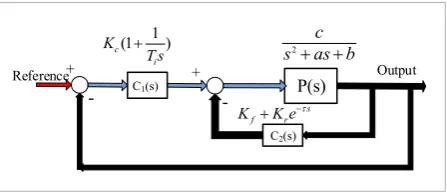
In the present control scheme, a proportional gain and a delay term are located in the inner loop for stabilizing the system and proportional integral controller is located in a forward path to reduce the steady-state error. The block diagram is presented in Figure 7. In fact, this control structure is differ-ent from the controllers presdiffer-ented in [33, 47, 65] be-cause of the delayed feedback part instead of a delay output feedback.
In spite of the alternatives available in the litera-ture, the structure of the control system and the role of time delay make the proposed control scheme an efficient and suitable for real-time experimental applications. The present study considers a novel design to obtain better tracking ability, improved noise rejection capabilities, and more applicable control signal than those utilizing classical PID and PI-PD control techniques. To the best of the author’s knowledge, until now, no work has been reported in the literature to design of the PI-PR control for an electromechanical system.
The present control technique has some advantages. First, it provides better transient response and fast con-vergence of tracking error. Further, the control signal is smoother than control signal of PI-PD and PID control. The chattering is attenuated in the presence of noisy measurements because there is no derivative term in the control structure. Moreover, this controller requires only memory registers that make it easier to implement. The designer does not need to use any estimation of the derivatives, which is a tedious task for the systems sub-ject to measurement noise and uncertainties. Hence, the computational complexity and the cost of the control-ler design will significantly be reduced. The controlcontrol-ler, which is given in Figure 7, can be presented as:
( ) i
PI P
K C s K
s
= + , (7)
( ) sh
PR f R
C s =K +K e− ,
(8)
where h>0 is the delay and Kp, Ki, Kf and KR represent
controller parameters. Thus, C1(s) and C2(s) present the conventional PI and proportional retarded (PR) controllers, respectively. The closed-loop system can be presented as:
( ) ( ) ( )
( ) 1 ( )( ( ) ( ))
PI
PR PI
G s C s Y s
R s G s C s C s . (9)
Accordingly, the following transfer function is ob-tained:
2
2
( ) ( )
( ) ( )
1
( )
p i
sh
f R p i
K s K c
Y s s s as b
R s c K s K se K s K
s s as b
−
+
+ +
=
+ + +
+
+ +
. (10) Figure 7
Block diagram of the modified control structure
P(s) +
Reference
1 (1 )
c i
K T s
C2(s)
C1(s)
s f r K K e
-+
-Output
2 c
97 Information Technology and Control 2019/1/48
Then the characteristic equation can be written as
3 2
( ) sh
f i R
s s as bs cKps cK s cK K cse−
∆ = + + + + + + (11)
As stated previously, the proposed control strategy is a different version of the one addressed in [47], how-ever, a modified delayed output feedback controller is integrated. The characteristic equation of the system is a quasi-polynomial with the model parameters a, b, c are defined in Section 2. The closed-loop stability of the control system strictly depends on the location of the roots of the characteristic equation. It should be noted that the delay-free (h=0) system is stable under the conditions are satisfied:
0,
0, 0. .
f p R
i
c c
b K c K c K
a K
+ + + >
> >
(12)
Even though it is assumed that the plant does not have any delay, the synthesis of the controller and stability analysis of the closed- loop system entails coping with infinite dimensional characteristics, thus, some algo-rithms are used for the computation of the roots [67, 74]. However, in the present work, the sketch of the stability analysis is addressed by using the technique presented in [46]. The stability regions are investigat-ed with respect to delay (h) and the proportional gain of delay (KR). A useful outline can be found in [8].
Ac-cordingly, the computation of the roots of character-istic quasi-polynomial containing an infinite number of roots is a tedious task. However, a number of algo-rithms have been developed for the computation of the roots [8, 49, 74]. It should be pointed out that the analytical tuning of the proposed controller is more difficult than the controller presented in [47]. An al-ternative and easy parameter tuning method are ad-dressed to eliminate the aforementioned challenges.
5. Stability Analysis and Parameter
Tuning
A number of tuning methods have been addressed for PI-PD control. Atherton and Boz analyse a step response with standard forms [5]. Tan highlights the stability locus boundaries for obtaining all stabili-ty regions and controller parameter [60]. The inner
control loop is designed based on the proportional de-layed (proportional retarded) control technique [66], while the outer PI control can be tuned by minimiza-tion of predetermined performance indexes such as IAE, integral of the squared error (ISE), integral of the squared control input (ISCI), and the Total Variance (TV). The performance measures are given as:
( )
IAE
=
∫
e t dt
, (13)2
( )
ISE
=
∫
e t dt
, (14)2
( )
ISCI
=
∫
u t dt
. (15)The central notion is to place a triple real dominant root for the closed-loop system [66]. It is achieved by using a spectral analysis, which provides the designer more specific information about the dominant poles. For every given desired exponential lower bound on the decay
σ
>
0
, satisfyingσ δν
>
, whereν
is the non-damped frequency andδ
is the damping factor which can be obtained from Equation (6) [66], the controller parameters are obtained as [66]:2 2 2
(
)
(1
)
,
f
v
v
K
b
σ δ
δ
−
−
−
=
(16)[
1
]
,
h
v
σ δ
=
−
(17)2
2(
)
R h
v
K
be
σσ δ
−
=
. (18)Now, the outer loop is tuned by the integral absolute error (IAE), which is a well-known minimization technique for controller parameter tuning [25]:
( )
( )d
( )d .
J
=
∫
r t
−
y t t
=
∫
e t t
(19)Information Technology and Control 2019/1/48 98
6. Simulation and Experimental
Results
The closed-loop performance of the elaborated con-trol scheme is simulated and experimentally investi-gated. A comparison with conventional feedback con-trollers is performed to highlight the advantages of the elaborated control method. The controller gains Kp, Ki, and Kd are determined by classical controller
design approaches based on a nominal system model obtained around a desired operating point. Thus, PID controller may show unsatisfactorily control perfor-mance on the systems that are subject to uncertain-ty, model mismatches as well as noise. However, the present control method outperforms classical PID and PI-PD methods in terms of some performance measures. The selected criteria to evaluate the per-formance of the strategy are the IAE, ISE, error vari-ance (EV), and ISCI. In order to visualize a better comparison, some of the performance measures are normalized. According to the simulation results, the set point response is illustrated in Figure 8 and the control signals are shown in Figure 9.
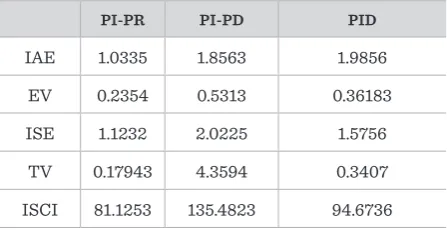
The experimental application is performed to demonstrate the effectiveness of the proposed con-troller. The performance metrics of elaborated controllers are presented in Table 3 such that the numerical results of the present control system pro-vide better performance measures. PI-PR controller shows better results in terms of IAE, EV, and ISE measures. Moreover, PI-PR control scheme performs
Figure 8
Tracking performance of the control schemes
Figure 9
Control signals
0 1 2 3 4 5
Time(sec) 0
200 400 600 800 1000 1200
Output (rpm)
PI-PR PID PI-PD Reference
0 1 2 3 4 5
Time (sec) 0
2 4 6 8 10
Volt (V)
Comparison of Control Signals
PI-PR PID PI-PD
0.46 0.48 0.5 0.52 0.54 0
5 10
Table 3
Performance comparison in terms of IAE, EV, ISE, TV, and ISCI indices
PI-PR PI-PD PID
IAE 1.0335 1.8563 1.9856
EV 0.2354 0.5313 0.36183
ISE 1.1232 2.0225 1.5756
TV 0.17943 4.3594 0.3407
ISCI 81.1253 135.4823 94.6736
Table 2
Control parameters
PI- PR PI-PD PID
Kp 2.84 Kp 7.86 Kp 6.26
Ki 82.32 Ki 25.56 Ki 3.569
KR 0.00518 Kd 1.826 Kd 1.572
Kf 16.32 Kp2 8.234
h 1.9231
σ 59.376
rpm 1203 1208 1227
99 Information Technology and Control 2019/1/48
better in terms of transient response and tracking ability. It also produces a smooth control signal in the presence of noise.
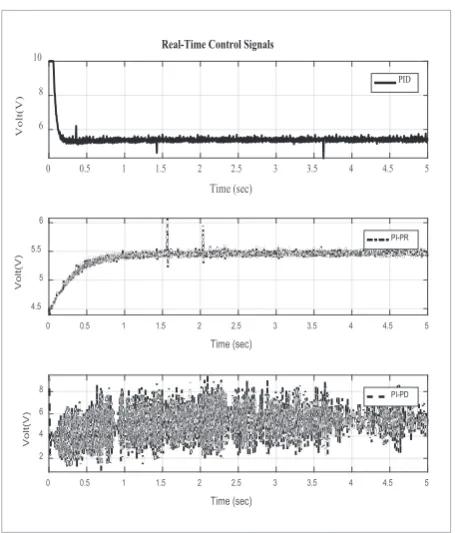
Real-time experimental results are presented in Fig-ure 10 and control signals are given in FigFig-ure 11. The simulation results and experimental tests with tabulated performance measures show that the closed-loop system enables more efficient control be-haviour, while reducing energy consumption by pro-ducing a smooth control signal in comparison with conventional PI-PD and PID control techniques. From the results, the delay-based controller provides more advantageous than conventional PID and PI-PD controllers since it requires only memory registers, which make it easier to implement [27, 46, 47]. Since the controller does not contain any derivative term it would not be noise amplification problem. Thus, it is not necessary to consider any additional fil-ter during the experimental realization [50, 51, 65, 66]. It is widely known that the control signal should be in an applicable range considering the upper and lower limits of the actuator. This constraint is considered during the real-time application, in order to avoid ac-tuator saturation and integral wind-up problem. Ac-cording to the control signals, the proposed scheme necessitates a lower value of voltage in comparison with traditional control schemes. Thus, the energy consumption of the control input has been reduced. It can be concluded that the rapid changes and oscil-lations for the PI-PR control are less than that with conventional PI-PD and PID control approaches. The Figure 10
Real-time tracking performance of controllers
0 1 2 3 4 5
Time(sec)
-200 0 200 400 600 800 1000 1200 1400
Output (rpm)
PI-PR PI-PD PID
rapid changes in control signal may reduce the life-time of the actuators by damaging its components. Because of failing to produce a smooth control input, the poorest results are obtained with the classical PI-PD controller in terms of the error variance.
7. Conclusion and Future Works
The real-time control of the electromechanical sys-tem, represented by second-order LTI model, is ad-dressed by using a novel modified delayed type con-troller. The proposed controller is compared with the conventional PI-PD and PID controllers. The algo-rithms are tested experimentally on a real benchmark electromechanical system.The proposed control scheme provides satisfactory performance in terms of performance metrics. The controller can be easily implemented for practical ap-plications. The main advantage of inserting a delay in the controller is that the closed-loop control system does not need any additional filter to attenuate noisy measurements.
Figure 11
Real-time control signals
0 0.5 1 1.5 2 2.5 3 3.5 4 4.5 5
Time (sec) 6
8 10
Volt(V)
Real-Time Control Signals
PID
0 0.5 1 1.5 2 2.5 3 3.5 4 4.5 5
Time (sec)
4.5 5 5.5 6
Volt(V)
PI-PR
0 0.5 1 1.5 2 2.5 3 3.5 4 4.5 5
Time (sec)
2 4 6 8
Volt(V)
The proposed controller may provide several advan-tages by reducing the cost, providing a simplicity, as well as improving the closed-loop performance. Table 4 presents summary of the control structures. Future works will mainly focus on analytical controller parameter tuning. Stability regions will be investigated according to delay and controller parameters changes, then robustness of the control scheme will be addressed. Table 4
Advantages and drawbacks of the controllers
Control
Scheme Advantages Drawbacks Improvements
PID
_ Simple structure
_ Easy parameter tuning
_ Fast response
_ Poor performance with wide operation
range
_ Lack of robustness
_ Cannot cope with model uncertainties
_ Parameter optimisation
and automatic tuning can be adapted
PI-PD
_ Wide operation range
_ Suitable for unstable
integrated processes
_ Larger error variance
_ Needs an exact model
_ High control input variations in the
presence of noisy measurements
_ Strong robustness can be
provided
_ Fractional controller can
be designed
PI-PR (Proposed)
_ Reduce control effort
_ Smooth control signal
_ Less energy consumption
_ Low computation cost
_ Needs no additional filter
_ To obtain analytical stability is a tedious task
_ Controller parameter tuning is a
challenge
_ Optimal parameters can
be selected
Acknowledgement
The authors would like to thank the editor and anony-mous reviewers for careful reading of the manuscript. The work of N. Sinan Özbek is financially supported by TUBITAK under the 2214-A program.
This work is financially supported by the Scientific Research Department of Çukurova University under the project numbered FDK-5088.
References
1. Abdallah, C., Dorato, P., Benites-Read, J., Byrne, R. Delayed Positive Feedback Can Stabilize Oscillatory Systems. American Control Conference, San Diego, USA, 1993, 2(12), 3106-3107. https://doi.org/10.23919/ ACC.1993.4793475
2. Åström, K. J., Hägglund, T. The Future of PID Control. Control Engineering Practice, 2001, 9(11), 1163-1175. https://doi.org/10.1016/S0967-0661(01)00062-4 3. Åström, K. J., Wittemmark, B. Computer-Controlled
Systems: Theory and Design. 3rd edition. Prentice-Hall, Englewood Cliffs, NJ, 1997.
4. Atherton, D. P. PI-PD, an Extension of Proportion-al–Integral–Derivative Control. Measurement and Control, 2016, 49(5), 161-165. https://doi.org/10. 1177/0020294016649980.
5. Atherton, D. P., Boz, A. F. Using Standard Forms for Controller Design. UKACC International Conference on Control (CONTROL ‘98), Swansea, UK, 1998, 1066-1071. https://doi.org/ 10.1049/cp:19980377.
6. Boussaada, I., Morărescu, I.-C., Niculescu, S.-I. Invert-ed Pendulum Stabilization Via a Pyragas-Type Control-ler: Revisiting the Triple Zero Singularity. IFAC Pro-ceedings Volumes, 2014, 47(3), 6806-6811. https://doi. org/10.3182/2014082 4-6-ZA-1003.02215.
7. Camacho, O., De la Cruz, F. Smith Predictor Based-Slid-ing Mode Controller for IntegratBased-Slid-ing Processes with El-evated Deadtime. ISA Transactions, 2004, 43(2), 257-270. https://doi.org/10.1016/S0019-0578(07)60035-4 8. Datko, R. A Procedure for Determination of The
101 Information Technology and Control 2019/1/48
Equations. Quarterly of Applied Mathematics, 1978, 36(3), 279-292. https://doi.org/10.1090/qam/508772 9. Efimov, D., Polyakov, A., Fridman, L., Perruquetti, W.,
Richard, J. Delayed Sliding Mode Control. Automatica, 2016, 64, 37-43. https://doi.org/10.1016/j. automatica. 2015.10.055.
10. Eker, İ. Sliding Mode Control with Pid Sliding Surface and Experimental Application to an Electromechanical Plant. ISA Transactions, 2006, 45(1), 109-118. https:// doi.org/10.1016/S0019-0578(07)60070-6
11. Eker, İ. Experimental On-line Identification of an Elec-tromechanical System. ISA Transactions, 2004, 43(1), 13-22. https://doi.org/10.1016/S0019-0578(07)60016-0 12. Furat, M., Eker, İ. Computer-Aided Experimental
Mod-eling of a Real System Using Graphical Analysis of a Step Response Data. Computer Applications in Engi-neering Education, 2014, 22(4), 571-582. https://doi. org/10.1002/cae.20482
13. Furat, M., Eker, İ. Second-Order Integral Sliding-Mode Control with Experimental Application. ISA Transac-tions, 2014, 53(5), 1661-1669. https://doi.org/10.1016/j. isatra.2014.05.030
14. Furat, M., Eker, İ. Experimental Evaluation of Slid-ing-Mode Control Techniques Kaymalı - Kutup Kontrol Tekniklerinin Deneysel Değerlendirilmesi. Çukurova Universitesi Muhendislik Mimarlık Fakültes, Dergisi, 2012, 27(June), 23-37.
15. Furat, M., Eker, İ. Chattering-Eliminated Adaptive Slid-ing-Mode Control: An Experimental Comparison Study. Turkish Journal of Electrical Engineering & Computer Sciences, 2016, 24, 605-620. https://doi.org/10.3906/ elk-1309-137
16. Gu, K., Kharitonov, V. L., Chen, J. Stability of Time-De-lay Systems, Birkhäuser, Boston, 2003. https://doi. org/10.1007/978-1-4612-0039-0
17. Hernández-Díez, J.-E., Méndez-Barrios, C.-F., Mondié, S., Niculescu, S.-I., González-Galván, E. J. Proportion-al-Delayed Controllers Design for LTI-Systems: A Geo-metric Approach. International Journal of Control, 2018, 91(4), 907-925. ttps://doi.org/10.1080/00207179.2017. 1299943.
18. Hernandez-Diez, J.-E., Mendez-Barrios, C.-F., Nicules-cu, S.-I., Gonzalez-Galvan, E.-J., Mejia-Rodriguez, G., Ramirez-Rivera, V. Closed-Loop Stability Analysis of Voltage Mode Buck Using a Proportional-Delayed troller. 25th IEEE Mediterranean Conference on Con-trol and Automation, 2017, 490-495. https://doi.org/10. 1109/MED.2017.7984165.
19. Hernandez-Diez, J. E., Niculescu, S.-I., Mendez-Barri-os, C.-F., Gonzalez-Galvan, E. J., Hernandez-Molinar, R. A Transparent Bilateral Control Scheme for a Local Te-leoperation System Using Proportional-Delayed trollers. 12th IEEE International Conference on Con-trol and Automation (ICCA), 2016, 473-478. https://doi. org/10.1109/ICCA.2016.7505322
20. Hosek, M., Olgac, N. A Single-Step Automatic Tuning Al-gorithm for the Delayed Resonator Vibration Absorber. IEEE/ASME Transactions on Mechatronics, 2002, 7(2), 245-255. https://doi.org/10.1109/TMECH.2002.1011261 21. Jankauskienė, I. Rimas, J. A Note on the Use of Step
Responses Matrix and Lambert W Function in the Dy-namics Analysis of time Delay Systems. Information Technology and Control, 2017, 46(2), 228-234, https:// doi.org/10.5755/j01.itc.46. 2.16208.
22. Johnson, M. A., Moradi, M. H. (Eds.) PID Con-trol. Springer-Verlag, London, 2005. https://doi. org/10.1007/1-84628-148-2
23. Kara, T., Eker, İ. Nonlinear Modeling and Identifica-tion of a DC Motor for BidirecIdentifica-tional OperaIdentifica-tion with Real Time Experiments. Energy Conversion and Management, 2004, 45(7-8), 1087-1106. https://doi. org/10.1016/j.enconman. 2003.08.005.
24. Kaya, İ. PI-PD Controllers for Controlling Stable Pro-cesses with Inverse Response and Dead Time. Elec-trical Engineering, 2016, 98(1), 55-65. https://doi. org/10.1007/s00202-015-0352-3
25. Kaya, İ., Tan, N., Atherton, D. P. Improved Cascade Control Structure For Enhanced Performance. Jour-nal of Process Control, 2007, 17(1), 3-16. https://doi. org/10.1016/j.jprocont. 2006.08.008.
26. Khan, A. A., Tilbury, D. M., Moyne, J. R., Favorable Ef-fect of Time Delays on Tracking Performance of Type-I Control Systems. IET Control Theory & Applica-tions, 2008, 2(3), 210-218. https://doi.org/10.1049/iet-cta:20070093
27. Kokame, H., Hirata, K., Konishi, K., Mori, T. Difference Feedback Can Stabilize Uncertain Steady States. IEEE Transactions on Automatic Control, 2001, 46(12), 1908-1913. https://doi.org/10.1109/9.975474
28. Kolmanovskii, V. B., Niculescu, S.-I., Gu, K. Delay Ef-fects on Stability: A Survey. Proceedings of the 38th IEEE Conference on Decision and Control (Cat. No. 99CH36304), Phoenix, USA, 1999, 1993-1998. https:// doi.org/10.1109/CDC.1999.830931
on Automatic Control, 1980, 25(2), 266-269. https://doi. org/10.1109/TAC.1980.1102288
30. Kwon, W. H., Won, G., Kim, W. Delayed State Feedback Controller for the Stabilization of Ordinary Systems. American Control Conference, Pittsburgh, USA, 1989, 292-297. https://doi.org/10.23919/ACC.1989.4790204 31. Lee, J., Edgar, T. F. Improved PI Controller with Delayed
or Filtered Integral Mode. Process Systems Engineering, 2002, 48(12). https://doi.org/10.1002/aic. 690481212. 32. López, K., Garrido, R., Mondié, S. Position Control
of Servodrives Using a Cascade Proportional Inte-gral Retarded Controller. IEEE International Con-ference on Control, Decision and Information Tech-nologies (CoDIT), 2017, 1-5. https://doi.org/10.1109/ CoDIT.2017.8102577
33. López, K., Garrido, R., Mondié, S. Cascade Proportional Integral Retarded Control of Servodrives. Proceedings of the Institution of Mechanical Engineers, Part I: Jour-nal of Systems and Control Engineering, 2018, 232(6), 662-671. https://doi.org/10.1177/0959651818767774 34. Michiels, W., Niculescu, S.-I. Stability, Control, and
Computation for Time-Delay Systems, PA: Society for Industrial and Applied Mathematics, Philadelphia, 2014. https://doi.org/10.1137/1.9781611973631
35. Niculescu, S.-I. Delay Effects on Stability. Springer Lon-don, 2001. https://doi.org/10.1007/1-84628-553-4 36. Niculescu, S.-I., Michiels, W. Stabilizing a Chain of
In-tegrators Using Multiple Delays. IEEE Transactions on Automatic Control, 2004, 49(5), 802-807. https://doi. org/10.1109/TAC.2004.828326
37. Ortega, M. T., Villafuerte, R., Vazquez, C., Freidovich, L. Performance Without Tweaking Differentiators via a PR Controller: Furuta Pendulum Case Study. IEEE International Conference on Robotics and Automation (ICRA), Stockholm, Sweden, 2016, 3777-3782. https:// doi.org/10.1109/ICRA.2016.7487566
38. Ortega M. T., Villafuerte, R., Vázquez, C., Freidovich, L. Proportional Retarded Controller to Stabilize Un-deractuated Systems with Measurement Delays: Furuta Pendulum Case Study. Mathematical Prob-lems in Engineering, 2017, 2017, 1-12. https://doi. org/10.1155/2017/2505086
39. Özbek, N. S. Control of Time-Delayed Systems with Experimental Applications. Çukurova University, PhD Dissertation, 2018.
40. Özbek, N.S., Eker, İ. An Interactive Computer-Aided In-structional Strategy and Assessment Methods for Sys-tem Identification and Adaptive Control Laboratory. IEEE Transactions on Education, 2015, 58(4), 297-302. https://doi.org/10.1109/TE.2015. 2412512.
41. Özbek, N. S., Eker, İ. A Novel Interactive System Iden-tification and Control Toolbox Dedicated to Real-Time Identification and Model Reference Adaptive Con-trol Experiments. 9th IEEE International Conference on Electrical and Electronics Engineering (ELECO), Bursa, Turkey, 2015, 859-863. https://doi.org /10.1109/ ELECO.2015.7394584.
42. Özbek, N.S., Eker, İ. Investigation of Time-Delayed Con-troller Design Strategies for an Electromechanical Sys-tem. 4th IEEE International Conference on Electrical and Electronic Engineering (ICEEE), Ankara, Turkey, 2017, 181-186. https://doi.org/10.1109/ ICEEE2.2017.7935816. 43. Özbek, N. S., Eker, İ. A Novel Delay-Based Control
Al-gorithm: Experimental Application to an Electrome-chanical System. 10th IEEE International Conference on Electrical and Electronics Engineering (ELECO), Bursa, Turkey, 2017, 842-846.
44. Pyragas, K. Continuous Control of Chaos by Self-Con-trolling Feedback. Physics Letters A, 1992, 170(6), 421-428. https://doi.org/10.1016/ 0375-9601(92)90745-8. 45. Ramírez, A., Garrido, R., Mondié, S. Velocity Control of
Servo Systems Using an Integral Retarded Algorithm. ISA Transactions, 2015, 58, 357-366. https://doi.org/ 10.1016/j.isatra.2015.04. 008.
46. Ramírez, A., Mondié, S., Garrido, R. Proportional Integral Retarded Control of Second Order Linear Systems. IEEE Conference on Decision and Control, Florence, Italy, 2013, 2239-2244. https://doi.org/10.1109/CDC.2013. 6760214. 47. Ramirez, A., Mondié, S., Garrido, R., Sipahi, R. Design
of Proportional-Integral-Retarded (PIR) Controllers for Second-Order LTI Systems. IEEE Transactions on Automatic Control, 2016, 61(6), 1688-1693. https://doi. org/10.1109/TAC.2015. 2478130.
48. Ramírez, A., Sipahi, R. Design of a Delay-based Con-troller for Fast Stabilization in a Network System with Input Delays via the Lambert-W function. Procedia IUTAM, 2017, 22, 83-90. https://doi.org/10.1016/j.piu-tam.2017.08.036
49. Ramírez, A., Sipahi, R. Multiple Intentional Delays Can Facilitate Fast Consensus and Noise Reduction in a Multiagent System. IEEE Transactions on Cy-bernetics, Early Access, 1-12. https://doi.org/10. 1109/ TCYB.2018.2798163.
50. Ramírez, A., Sipahi, R. Single-Delay and Multiple-Delay Proportional-Retarded Protocols for Fast Consensus in a Large-Scale Network. IEEE Transactions on Au-tomatic Control, Early Access, 1-12. https://doi.org/10. 1109/TAC.2018.2866444.
De-103 Information Technology and Control 2019/1/48
layed Output Feedback Using Elimination Theory. IF-AC-PapersOnLine, 2015, 48(12), 221-226. https://doi. org/10.1016/j.ifacol. 2015.09.381.
52. Ramírez, A., Sipahi, R., Mondié, S., Garrido, R. An An-alytical Approach to Tuning of Delay-Based Control-lers for LTI-SISO Systems. SIAM Journal on Control and Optimization, 2017, 55(1), 397-412. https://doi. org/10.1137/ 15M1050999.
53. Romero-Segovia, V., Hägglund, T., Åström, K. J. Mea-surement Noise Filtering for Common PID Tuning Rules. Control Engineering Practice, 2014, 32, 43-63. https://doi.org/10.1016/j.conengprac. 2014.07. 005. 54. Roy, S., Kar, I.N. Robust Time-Delayed Control of a Class of
Uncertain Nonlinear Systems. IFAC-PapersOnLine, 2016, 49(1), 736-741. https://doi.org/10. 1016/j.ifacol.2016.03.144. 55. Shinskey, F.G. PID-Deadtime Control of Distributed Pro-cesses. Control Engineering Practice, 2001, 9(11), 1177-1183. https://doi.org/10.1016/S09670661(01)00063 -6. 56. Sipahi, R., Niculescu, S.-I., Abdallah, C. T., Michiels,
W., Gu, K. Stability and Stabilization of Systems with Time Delay. IEEE Control Systems, 2011, 31(1), 38-65. https://doi.org/10.1109/MCS.2010.939135
57. Sipahi, R., Vyhlídal, T., Niculescu, S.-I., Pierdomenico P. Time Delay Systems: Methods, Springer, Heidelberg, 2012. https://doi.org/10.1007/978-3-642-25221-1 58. Suh, I. H., Bien, Z. Proportional Minus Delay Controller.
IEEE Transactions on Automatic Control, 1979, 24(2), 370-372. https://doi.org/10.1109/TAC. 1979.1102024. 59. Suh, I. H., Bien, Z. Use of Time-Delay Actions in the
Controller Design. IEEE Transactions on Automatic Control, 1980, 25(3), 600-603. https://doi.org/10.1109/ TAC.1980.1102347.
60. Tan, N. Computation of Stabilizing PI-PD Control-lers. International Journal of Control, Automation and Systems, 2009, 7(2), 175-184. https://doi.org/10.1007/ s12555-009-0203-y.
61. Udwadia, F. E., Kumar, R. Time Delayed Control of Structural Systems. Earthquake Engineering & Struc-tural Dynamics, 2003, 32(4), 495-535. https://doi. org/10.1080/ 00207179408921490
62. Ulsoy, A. G., Time-Delayed Control of SISO Systems for Improved Stability Margins. Journal of Dynamic Sys-tems, Measurement, and Control, 2015, 137(4), 041014. https://doi.org/10. 1115/1.4028528.
63. van de Wouw, N., van Dijk, N. J. M., Nijmeijer, H. Pyra-gas-Type Feedback Control for Chatter Mitigation in High-Speed Milling. IFAC-PapersOnLine, 2015, 48(12), 334-339. https://doi.org/ 10.1016/j.ifacol.2015. 09.400.
64. Zhong, Q.-C. Robust Control of Time-Delay Systems., Springer-Verlag, London, 2006. https://doi.org/10. 1007/1-84628-265-9.
65. Villafuerte, R., Medina, F., Vite, L., Aguirre, B. Tuning of Time-Delayed Controller for a Genaral Class of Sec-ond-Order LTI Systems with Dead-Time. IET Control Theory and Applications, 2019, 13(3), 451-457. https:// doi.org/10. 1049/iet-cta.2018.5082.
66. Villafuerte, R., Mondie, S., Garrido, R. Tuning of Pro-portional Retarded Controllers: Theory and Experi-ments. IEEE Transactions on Control Systems Tech-nology, 2013, 21(3), 983-990. https://doi.org/10. 1109/ TCST.2012.2195664.
67. Vyhlidal, T., Zitek, P. Mapping Based Algorithm for Large-Scale Computation of Quasi-Polynomial Zeros. IEEE Transactions on Automatic Control, 2009, 54(1), 171-177. https://doi.org/10.1109/TAC.2008.2008345 68. Wen, Z., Ding, Y., Liu, P., Ding, H. Direct Integration
Method for Time-Delayed Control of Second-Order Dynamic Systems. Journal of Dynamic Systems, Mea-surement, and Control, 2017, 139(6), 061001. https:// doi.org/10.1115/1. 4035359.
69. Xiao, M., Cao, J. Delayed Feedback-Based Bifurcation Control in an Internet Congestion Model. Journal of Mathematical Analysis and Applications, 2007, 332(2), 1010-1027. https://doi.org/10.1016/j.jmaa.2006.10.062 70. Yang, B., Mote, C. D. Vibration Control of Band Saws:
The-ory and Experiment. Wood Science and Technology, 1990, 24(4), 355-373. https://doi.org/10.1007/BF00227056 71. Youcef-Toumi, K., Ito, O. A Time Delay Controller for
Systems with Unknown Dynamics. Journal of Dynamic Systems, Measurement, and Control, 1990, 112(1), 904-911. https://doi.org/10.1115/1.2894130
72. Zalluhoglu, U., Kammer, A. S., Olgac, N. Delayed Feed-back Control Laws for Rijke Tube Thermoacoustic In-stability, Synthesis, and Experimental Validation. IEEE Transactions on Control Systems Technology, 2016, 24(5), 18 https://doi.org/10.1109/TCST.2015.2512938 73. Hong, Q.-C. A Delay-type PID Controller. IFAC 2002,
IFAC World Congres. Barcelona: IFAC; 2002:4-9. https://doi.org/10.3182/20020721 -6-ES-1901.00125 74. Zitek, P., Fišer, J., Vyhlídal, T. Dimensional Analysis
Ap-proach to Dominant Three-Pole Placement in Delayed PID Control Loops. Journal of Process Control, 2013, 23(8), 1063-1074. https://doi.org/10.1016/j.jprocont.2013.06. 001. 75. Zitek, P., Fišer, J., Vyhlídal, T. IAE Optimization of PID
![Figure 1PIR controller [9]](https://thumb-us.123doks.com/thumbv2/123dok_us/8763824.1753388/4.595.305.532.571.680/figure-pir-controller.webp)