World Maritime University
The Maritime Commons: Digital Repository of the World
Maritime University
World Maritime University Dissertations Dissertations
2001
Comparative analysis for choosing a single gateway
of seafreight in Scandinavia : a project for Schenker
International
Van Vinh Thai
World Maritime University
Follow this and additional works at:http://commons.wmu.se/all_dissertations
This Dissertation is brought to you courtesy of Maritime Commons. Open Access items may be downloaded for non-commercial, fair use academic purposes. No items may be hosted on another server or web site without express written permission from the World Maritime University. For more
Recommended Citation
Thai, Van Vinh, "Comparative analysis for choosing a single gateway of seafreight in Scandinavia : a project for Schenker International" (2001).World Maritime University Dissertations. 168.
W
WO
OR
RL
LD
D
M
MA
AR
RI
IT
TI
IM
ME
E
U
UN
NI
IV
VE
ER
RS
SI
IT
TY
Y
Malmö, Sweden
C
C
O
O
M
M
P
P
A
A
R
R
A
A
T
T
I
I
V
V
E
E
A
A
N
N
A
A
L
L
Y
Y
S
S
I
I
S
S
F
F
O
O
R
R
C
C
H
H
O
O
O
O
S
S
I
I
N
N
G
G
A
A
S
S
I
I
N
N
G
G
L
L
E
E
G
G
A
A
T
T
E
E
W
W
A
A
Y
Y
O
O
F
F
S
S
E
E
A
A
F
F
R
R
E
E
I
I
G
G
H
H
T
T
A
A
N
N
D
D
A
A
I
I
R
R
F
F
R
R
E
E
I
I
G
G
H
H
T
T
I
I
N
N
S
S
C
C
A
A
N
N
D
D
I
I
N
N
A
A
V
V
I
I
A
A
-
A
A
p
p
r
r
o
o
j
j
e
e
c
c
t
t
f
f
o
o
r
r
S
S
c
c
h
h
e
e
n
n
k
k
e
e
r
r
I
I
n
n
t
t
e
e
r
r
n
n
a
a
t
t
i
i
o
o
n
n
a
a
l –
l
By
T
TH
H
AI
A
I
V
VA
A
N
N
V
VI
IN
NH
H
V
Viieettnnaamm
A dissertation submitted to the World Maritime University in partial fulfillment of the requirements for the award of the degree of
M
MA
AS
ST
TE
ER
R
O
OF
F
S
SC
CI
I
EN
E
NC
CE
E
In
M
MAARRIITTIIMMEEAAFFFFAAIIRRSS
(Port Management)
2
2000011
D
DE
EC
CL
LA
AR
RA
AT
TI
IO
O
N
N
I certify that all the material in this dissertation that is only my own work has been
identified, and that no material is included for which a degree has previously been
conferred on me.
The contents of this dissertation reflect my own personal views, and are not
necessarily endorsed by the University.
……….. (Signature)
………. (Date)
Supervised by: Dr. Shuo Ma
Position: Vice Rector and Academic Dean/Professor of Shipping Management and
Port Management
Institution/organization: World Maritime University
Assessor: Dr. Bernard Francou
Position: Professor of Port Management
Institution/organization: World Maritime University
Co-assessor: Mr. Gerhardt Muller
Position: Professor of Marine Transportation Department.
A
AC
CK
KN
NO
OW
WL
LE
ED
DG
GE
EM
ME
EN
NT
TS
S
It would not have been possible for this study to be compiled and completed
without the great help and assistance of a number of people and organizations to
whom I would like to sincerely express my indebted acknowledgements:
G First, to my beloved mother, my dear girlfriend and my relatives who have always been encouraging and inspiring me in my life,
G To the German organization "Carl Duisberg Gesellschaft" (CDG), which financed my studies at WMU,
G To WMU itself and its staff for accepting me as a student and providing me not only professional knowledge but also international friendship and solidarity,
G To Professor Shuo Ma for accepting to instruct and supervise my modest work as well as providing me with his fatherly valuable and esteemed advice and guidance,
G To Captain Jan Horck, Professor Bernard Francou and Professor Patrick Donner for their great assistance, advice and encouragement,
G To Professor Gerhardt Muller as the external assessor of this study,
G To WMU’s library staff, especially Mrs. Cecilia Denne and Mrs. Susan Wangeci-Eklöw for their help and counsel in library research,
G To WMU’s English lecturers, Mr. Clive Cole and especially Mrs. Inger Battista for their guidance and language correction of this study,
G To Mr. Philip Moding as WMU’s visiting Professor for his valuable and kind-hearted guidance and assistance since the project was still an inception,
G To Mr. Jan Nordh, Head of the Business Processes Development Department at Schenker, for his great help, guidance and kindness,
G To Mr. Carsten Jorgensen, Mr. Peter Lindgren, Mr. Erik Lenormand, Ms. Yurina Sedano Garcia and others of Schenker International and Schenker Land Transport for
their kind co-operation and assistance,
G And finally, to all my international friends from Tanzania, Indonesia, Bangladesh, Ethiopia, Sri Lanka, China, Cape Verde… for sharing knowledge and for their help
A
AB
BS
ST
TR
RA
AC
CT
T
Title of Dissertation: Comparative analysis for choosing a single gateway of
seafreight and airfreight in Scandinavia - A project for
Schenker International
Degree: MSc
The research paper is the study of the choice of location for a regional
gateway/distribution center of sea-freight and airfreight, inbound and outbound cargo
flows in the whole Nordic region of Germany-based freight forwarding, logistics
service company Schenker International by analyzing a number of considerations
and comparing possible alternative locations. The right choice of location will have
significant meanings to the company since it affects the company’s competitive
advantages through optimized cargo routing and handling, cost-saving…
A brief look on fundamental concepts of logistics is introduced at the
beginning to place academic grounds for the study. The question of whether it is
advisable to have a single gateway/distribution center for the whole Nordic region is
answered after examining current tendencies in European logistics and analyzing
historical, economic and social perspectives of the Nordic region.
The research is then dealing with the issue of site selection for the regional
gateway/distribution center. This is solved from two sequential levels: from general
geographical area to specific site within the chosen area.
=
In the first level, the centre of gravity principle is applied to pinpoint the general geographical area of the regional gateway.principle or least total distribution cost principle is deployed after analyzing the company’s operating practices and data to build the excel-based
simulation.
A number of recommendations will also be made in the last chapter
concerning the application of the study for the best use of it.
KEY WORDS: logistics, distribution center, centre of gravity, Schenker
TABLE OF CONTENTS
Page
Declaration ii
Acknowledgments Iii
Abstract iv
Table of Contents vi
List of Tables ix
List of Figures x
List of Abbreviations xii
1. Introduction 1
1.1 Background 1
1.2 Problem definition at Schenker International 2
1.3 Objectives of the study 2
1.4 Scope of the study 3
1.5 Research methodology 5
1.6 Limitations 5
2. Tendencies of logistics and distribution in Europe and the
need for a regional distribution center for the Nordic region 6
2.1 Basic concepts about logistics and distribution 6 2.1.1 Concept of logistics and physical distribution 6 2.1.1.1 Logistics and logistics components 6 2.1.1.2 What is physical distribution? 8 2.1.2 The total distribution cost concept 8 2.1.3 Nodes and links 9 2.1.4 Warehouses and distribution centers 10 2.1.4.1 Definition of warehouse and distribution center 10 2.1.4.2 The importance of depots rationalization
and location 12 2.2 Tendencies of logistics and distribution in Europe 13
2.2.1 Growing concentration through mergers, acquisitions
and alliances 13
2.2.2 Tendency of outsourcing logistics and distribution
2.2.3 Consolidation trend in production, logistics
and distribution 19
2.3 Nordic region as a single market 22 2.3.1 From historical perspective 22 2.3.2 From economic perspective 23 2.3.3 From social perspective 26
3. Dianogsis of location for the Nordic regional gateway/distribution center from the general geographical area level 27
3.1 Principle of centre of gravity 27 3.1.1 Centre of gravity in physics 27 3.1.2 Application of CoG in shaping the general geographical
area of the gateway for the optimization of transport
logistics 29 3.2 Choosing future regional gateway for the Nordic region from
general geographical level by the application of CoG 29 3.2.1 Population distribution 29
3.2.2 Population growth 34
3.3 The Öresund region as the place for Nordic regional distribution center 36
3.3.1 Geographical location 36 3.3.2 Population and labor force 37
3.3.3 Economic indicators 38
3.3.4 Infrastructure 39
3.3.5 Education, research and development (R & D) 42
4. Current operating practices of Schenker International in the Nordic region and alternative locations for the regional distribution center 43
4.1 Introduction about Schenker International and its parent
company 43
4.1.1 History of the company 44 4.1.2 Key figures of Schenker AG 44 4.1.3 Schenker International in the Nordic region 44 4.2 Current distribution patterns being deployed 45
4.2.1 For Sweden 46
4.2.2 For Denmark 46
4.2.3 For Norway 47
4.2.4 For Finland 47
4.5 Alternatives identifications 51
4.5.1 Customers proximity 51
4.5.2 Seaports and airports services 58 4.5.2.1 Airport services 58 4.5.2.2 Seaport services 60
5. Optimization of location for the regional gateway/distribution
center of Schenker International from specific site selection level 64
5.1 Business-environment related considerations 64 5.2 Optimization of location from different alternatives 65
5.2.1 Theoretical model for specific site selection within a
chosen general geographical area 66 5.2.2 Basic prerequisites for the simulation 69 5.2.3 Optimization by excel-based simulation 70 5.2.3.1 Solution for seaports/airports used 70 5.2.3.2 How is the integration of total distances
transport with given relevant volumes
calculated? 71
5.2.3.3 Findings of the simulation 72 5.3 The choice of best location 74
6. Conclusion and recommendations 76
6.1 Conclusion 76
6.2 Recommendations 79
References 81
Appendix A: Milestones in history of Schenker A.G 85
Appendix B1: Comparison of the integration of total distances transport and
relevant volume – Solution 1 87 Appendix B2: Comparison of the integration of total distances transport and
relevant volume – Solution 2 93 Appendix B3: Comparison of the integration of total distances transport and
relevant volume – Solution 3 99 Appendix B4: Comparison of the integration of total distances transport and
relevant volume – Solution 4 105
Appendix C: Summary of the comparison 111
LIST OF TABLES
Table 1 Cross-border mergers, acquisitions and alliances 13
Table 2 Multiple strategies to enter international market 14
Table 3 Selected acquisitions by European mail operators 14
Table 4 Population of Nordic countries in 2000 30
Table 5 Population of major Nordic regions and cities in 2000 and
projection to 2010 31
Table 6 Participation rate in the labor market 37
Table 7 Employees by educational level, 1999 in % of labor force 38
Table 8 PPP-corrected GDP per capita in the Öresund, 1996 39
Table 9 Transit time in major European airports, 1998 41
Table 10 Key figures of Schenker AG, 2000 44
Table 11 Customer service levels of Schenker International 48
Table 12 Import flows through Göteborg gateway to various locations 52
Table 13 Import flows through Oslo gateway to various locations 52
Table 14 Import flows through Helsinki gateway to various locations 52
Table 15 Export flows from various locations to Göteborg gateway 52
Table 16 Export flows from various locations to Oslo gateway 52
Table 17 Export flows from various locations to Helsinki gateway 52
Table 18 Copenhagen airport and Göteborg Landvetter airport 60
Table 19 Direct regular sailings from the port of Göteborg 61
Table 20 Direct regular sailings from Copenhagen-Malmö port 61
Table 21 Direct regular sailings from the port of Stockholm 62
Table 22 Sailing schedule from Göteborg to Hongkong of MaerskSealand 62
Table 23 Sailing schedule from Copenhagen to Hongkong of MaerskSealand 63
Table 24 Ranking table of the best three alternative gateways in relation with
LIST OF FIGURES
Figure 1 Key components of logistics 7
Figure 2 Elements of total distribution cost 9
Figure 3 Nodes and links in a physical distribution system 10
Figure 4 Distribution channel 11
Figure 5 Own-account versus outsourced European Distribution Centers 17
Figure 6 European logistics market 18
Figure 7 Concentration of inventory before and expectation after 1993 of
PHILIPS 20
Figure 8 Tendencies of logistics and distribution in Europe 21
Figure 9 Shuttle and block train system in the Nordic region 25
Figure 10 Centre of gravity model 28
Figure 11 Population proportion of Nordic countries 30
Figure 12 Population of major Nordic cities and regions in 2000 31
Figure 13 Population of major Nordic cities and regions in 2010 32
Figure 14 Population of major Nordic regions by index 32
Figure 15 Nordic towns and cities > 5000 inhabitants 33
Figure 16 Demographic development in Nordic region 1980-1992 including
population of 1992 35
Figure 17 The Öresund region 36
Figure 18 Delivery time in Sweden and Norway from a distribution center in
Copenhagen 40
Figure 19 Schenker International in the Nordic region 45
Figure 20 Distribution pattern in Sweden 46
Figure 21 Distribution pattern in Denmark 46
Figure 22 Distribution pattern in Norway 47
Figure 24 Economic implications of current distribution patterns on
country-based strategy 50
Figure 25 Inbound and outbound flows through Göteborg gateway 53
Figure 26 Inbound and outbound flows through Oslo gateway 53
Figure 27 Inbound and outbound flows through Helsinki gateway 53
Figure 28 Import sea-freight flows through gateways 54
Figure 29 Export sea-freight flows through gateways 55
Figure 30 Import airfreight flows through gateways 56
Figure 31 Export airfreight flows through gateways 57
Figure 32 Business environment-related considerations 65
Figure 33 Customers’ locations and alternative gateways in the theoretical
model
67
Figure 34 Distribution of best alternative gateways under different solutions
of seaport/airport
73
Figure 35 Gravity model applied for Schenker International with some
representative customers’ locations
LIST OF ABBREVIATIONS
APL : American President Line
BIMCO : Baltic and International Maritime Council
CoG : Centre of gravity
DKK : Danish Krone
EC : European Commission
EU : European Union
EUR : Euro
GDP : Gross Domestic Product
IATA : International Air Transport Association
IT : Information Technology
ITU : Intermodal Transport Unit
LCL : Less than container load
MSC : Mediterranean Shipping Company
OECD : Organization for Economic Co-operation and Development
PPP : Purchasing Power Parity
R & D : Research and Development
RDC : Regional Distribution Center
RO/RO : Roll on/Roll off
SEM : Single European Market
TQM : Total Quality Management
UK : United Kingdom
USA : United States of America
CHAPTER 1
INTRODUCTION
1. 1. Background
Through the last decade Europe has been changing substantially. The
European market itself has expanded not only to the East but also to the North and
therefore placed Nordic countries as Sweden and Denmark in the primary
geographical position for international companies planning their current and future
regional distribution set-up for the whole region. In fact, the introduction and
development of the European Union (EU) into a unified market has created a
regional-based market structure where the Northern part of the EU is always seen as
one region (Nordic region) in not only economy but also culture and society
perspectives since the countries share common features. In turn, this regionalization
of markets has created a demand for a centralized distribution system in each of these
regions. The Northern region of Europe, or the Nordic region, is one the most
interesting and quickest developing regions in Europe.
Taking this background into account, one of the main tendencies of logistics
and distribution in the world and in Europe today is the regional consolidation of
distribution centers. Schenker International as one of the biggest freight forwarding
and logistics companies in the world is considering this trend to regionalize its
distribution networks in the Nordic region for the sake of maximizing long-term
profit, optimizing transport and minimizing the total logistics cost with given levels
advantages for the company to exist and develop in the fierce competition
environment in this field of business.
Formal research about this topic is, therefore, very essential to conduct a full,
comprehensive understanding about the company’s strategy in the new market
environment, to define the best optimum location for the future regional distribution
center, and to help the company in its decision-making process for gaining the
mentioned business objectives. From an academic perspective, the research is very
necessary to understand the importance of the issue of the location of warehouses
and distribution centers in the whole logistics chain.
1. 2. Problems definition at Schenker International
‘’A problem defined is the problem half solved’’ (Ma, 2000). With the
background described in the above part, there were two main questions at Schenker
International regarding the topic of this research:
?
?
?
?
Is it reasonable for the company to place only one single gateway/distribution center of inbound and outbound sea-freight and airfreight cargoes flows for thewhole Nordic region?
?
?
?
?
If yes, where should it be located?The future gateway/distribution center should be the best solution to optimize
cargo handling, cargo routing in order to obtain present business objectives.
1. 3. Objectives of the study
The main objectives of this study can be described as follows:
?
?
?
?
To analyze the main current tendencies of European logistics and distribution as the base for Schenker International’s changing strategy of regional consolidation ofwarehouses and distribution centers in its distribution network.
?
?
?
?
To analyze and explain the reasons why the Nordic region should be considered as a single market and can be served by a single distribution center.?
?
?
?
?
?
?
To examine current operating practices of Schenker International, pinpoint main economic implications of such system, analyze and identify possible alternativelocations for the required gateway/distribution center.
?
?
?
?
To make a comparison of these alternatives based on an excel-file simulation model with different airports/seaports solutions in order to select the best location forthe future regional gateway/distribution center.
The study is, by achieving these objectives, believed to be of significance for
the company to gain competitive advantages.
1. 4. Scope of the study
The Nordic region mentioned in this study, to the world at large, will be
understood as Scandinavia to comprise Sweden, Denmark, Norway and Finland to be
suitable to current operations of Schenker International. The study is structured in six
main chapters as follows:
?
?
?
?
Chapter one: This is the introduction of the study. This chapter describes the background of the study, defines the problems of the targeted company, sets out mainresearch objectives as well as states the research methodology and limitations of the
work.
?
?
?
?
Chapter two: In this chapter, a general theoretical framework about logistics and its main components will be mentioned and described to place firm grounds forthe following research. The first question of the study regarding reasons for
considering the Nordic region as a single market will also be diagnosed and analyzed.
?
?
?
?
Chapter three: This chapter will answer the second question of the study from a general geographical area level. A theoretical model on the principle of centre ofgravity will be introduced as the base for analyzing some considerations of
population distribution and population growth for shaping the area of the future
gateway/distribution center.
?
?
?
?
Chapter four: First of all, some features about the company will be mentioned, followed by deep analysis of its current operating practices in the Nordiccarefully. The chapter will end with possible alternative gateway’s locations in
relation with different airports/seaports used solutions identified after a number of
considerations and analysis on some important indicators.
?
?
?
?
Chapter five: With the preparation from chapter four, this chapter will answer the second question of the study from specific site selection level. Atheoretical model on minimized the integration of total distance transport with
relevant volume in combination with the centre of gravity principle and the least total
distribution cost will be introduced first, followed by the excel-based simulation on
this model to compare between alternatives and select the best solutions.
?
?
?
?
Chapter six: This is the wrap-up chapter. General conclusion will be drawn out from the diagnosis, analysis and comparisons made. Possible recommendationswill also be proposed for the best use of the study.
SCOPE OF THE STUDY
CHAPTER 1
General introduction – research methodology
CHAPTER 2
Theoretical framework – Reasons for the single Nordic
region market
CHAPTER 3
The general geographical area of the gateway/distribution center
CHAPTER 4
CHAPTER 5
CHAPTER 6
Current operating practices and alternatives
identifications The specific site selection of
location for gateway/distribution center
1. 5. Research methodology
In order to achieve objectives set out in the study, a number of research
methodologies were deployed in which the near-far approach is the overwhelming
strategy. Other methods can be described as follows:
?
?
?
?
Literature review: This strategy is considered compulsory and extremely essential before the research work was begun. In this study, not only materials in thelibrary of World Maritime University but also the library at 4ROOMS, a foundation
owned by Schenker, were used as food for thoughts.
?
?
?
?
Interviews: With the support from Mr. Jan Nordh, a number of interviews were made with some key staff of both Schenker International and Schenker-BTL tograsp the most necessary data for the empirical research. Interviews were also made
with the Customs Office of Southern Sweden and the City Council in Malmö to
understand and analyze the environment in which Schenker International is doing its
business as well as advantages and disadvantages in choosing the gateway’s location.
?
?
?
?
Data processing and analysis: Data provided by Schenker International and Schenker-BTL, as well as from other sources (books, internet and so on) were thenprocessed and analyzed to make the best usage for the research work.
?
?
?
?
Comparison: Comparison was deployed not only by analyzing information on social, economic indicators but also by concrete calculation based on excel-filesimulation on computer.
1. 6. Limitations
The combination between the scopes of a Master’s thesis and practical issues
of the company required lots of refined work. Nevertheless, the best essence and total
quality mentality is always what the author has been searching for during this
research. The author also widely welcomes all comments and contribution from
readers in order to improve this research in the new socio-economic scenarios which
CHAPTER 2
TENDENCIES OF LOGISTICS AND DISTRIBUTION IN
EUROPE AND THE NEED FOR A REGIONAL DISTRIBUTION
CENTER FOR THE NORDIC REGION
This chapter aims at introducing the overall picture about logistics and
distribution in Europe, especially in the Nordic region from the standpoint of
logistics companies, and answering the question of the need for the future regional
distribution center for the Nordic region. Some basic concepts about logistics and
distribution will be introduced first, followed by analysis and assessment about
tendencies of logistics and distribution in Europe. After that, the question of the need
for the future regional distribution center for the Nordic region will be answered.
2.1. Basic concepts about logistics and distribution
2. 1. 1. Concept of logistics and physical distribution
2. 1. 1. 1. Logistics and logistics components
During the last few decades, the term logistics has been mentioned and
studied many times with the increasing recognition about its importance to
enterprises, organizations as well as national economy. For example, a recent study
carried out by Michigan State University in the USA showed that logistics alone
represented between 10-15% GDP of most major North American, European and
Asian/Pacific economies (Rushton, Oxley & Croucher, 2000). In fact, there have
Logistics is the process of planning, implementing and controlling the efficient, effective flow and storage of goods, services and related information from point of origin to point of consumption for the purpose of conforming to customer requirements.
(The Council of Logistics Management).
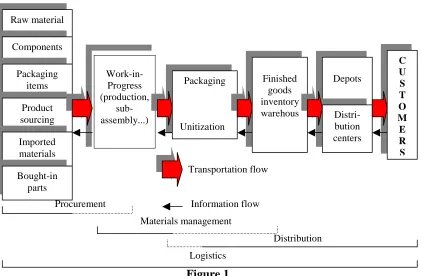
The key components of logistics are also shown in the following figure.
KEY COMPONENTS OF LOGISTICS
Transportation flow
Procurement Information flow
Materials management
Distribution Logistics
Figure 1
Source: Adapted from Rushton, A & Oxley, J & Croucher, P. (2000).
The basic of logistics is well understood as the management of the physical
and information flows of materials or goods from the point of origin to the point of
consumers. With the increasing demand from customers, it is important in a logistics
chain to get ‘’the right goods to the right place, at the right time, in the right form and
at the right cost’’.
In short, logistics plays a very important economic role for companies. To
keep logistics cost to the minimum is always an essential target so that companies
can gain their competitive advantage by minimizing the costs of products or services
and increasing their quality.
2. 1. 1. 2. What is physical distribution?
The term ‘physical distribution’ describes a wide range of activities taking
place after the production of goods and before they reach customers or end users.
These activities include materials handling, storage and warehousing, packaging and
unitization, transportation from plants to depots/distribution centers and later to
customers/final users. Figure 1 in the previous part shows that physical distribution is
a part of the whole logistics chain.
In fact, what physical distribution is aiming at is to ‘bridge the gap between
the producer and consumer’ (Benson & Whitehead, 1985). If the task of marketing is
to create customers demand, then the objective of physical distribution is to satisfy
them. In order to achieve this, the companies will strive to reduce the lead-time (the time from when products are ordered until they are actually delivered to customers).
Actually, as far as the physical distribution is concerned then during this period the
companies will deal with a lot of activities from order processing,
goods-picking/sorting, packing, etc, and transportation of goods to customers. It is very
transparent to see that any improvement to reduce time in any of the above activities,
for example goods-sorting by bar-coding or order picking lift-truck, rationalization of
inventory and reducing transport time by good planning, will lead to reduction in
total lead-time, and hence the companies can meet their customers’ requirements
satisfactorily. Most of these activities are taking place in warehouses/distribution
centers, and therefore a rationalization of them in terms of quantity as well as size,
level of automation, equipment and handling techniques used etc will definitely
affect the customers’ satisfaction.
2. 1. 2. The total distribution cost concept
So far the concept of physical distribution has been devised. However, the
notion of total distribution cost is very important when assessing the whole physical
distribution process for the sake of meeting customers’ requirements.
Basically, the total distribution cost includes warehousing (storage) cost,
inventory cost, depots (warehouses or distribution centers) operating cost (order
processing, information etc) and transportation costs (transport from airports or
delivery cost). Each cost element in the total distribution cost has a close relationship
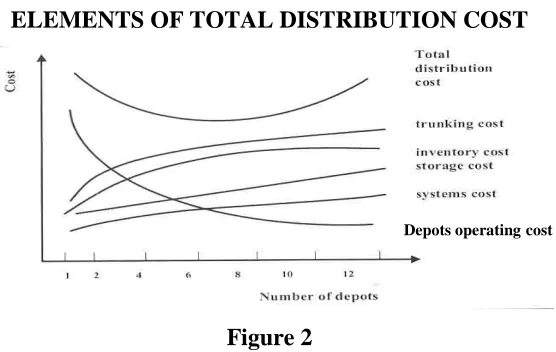
with the number of depots concerned as shown in the following figure.
ELEMENTS OF TOTAL DISTRIBUTION COST
Figure 2
Source: Adapted from Rushton, A & Oxley, J & Croucher, P. (2000).
Therefore, the inventory, storage and depot operating costs will tend to
increase when the number of depots increases whereas the transportation cost will
decrease in the same situation: goods in many depots will reach the markets faster in
shorter distances. It can also be seen from the graph that the minimum point of the
total distribution cost curve represents the lowest cost solution in relation to the
optimum number of depots.
In general, a few large depots will be internally large-scale and efficient
because the companies can take advantage from economies of scale. However, the
depots will be situated some distances from the customers. On the other hand, a
greater number of depots will be not economies of scale, but they will reduce the
distances from the depots to the customers. The matter here is to establish the best
configuration of depots to achieve the least total distribution cost.
2. 1. 3. Nodes and links
For logistics companies, it will be insufficient and not thorough if physical
distribution is examined without relation to the concept of nodes and links. According to the previous parts, it becomes clear that the activities taking place
within the premises of warehouses or distribution centers such as order picking,
storage, goods sorting, assembly, cross-docking etc have a very close relationship
with the transportation activity. In fact, they are all major parts in a distribution
network.
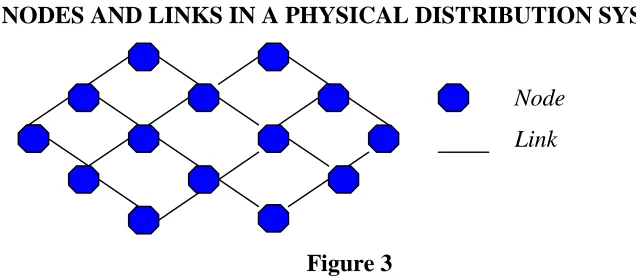
The physical distribution network of a logistics company comprises nodes
and links, representing the movements of finished goods, information and resources (Hultkrantz, 1999). A node is a place where goods are stopped and added value by some additional activities such as warehousing, kitting and assembly, labeling,
cross-docking etc before reaching the final customers. In this sense, a node can be a warehouse or a distribution center where there are postponed manufacturing
activities following customers’ demands. In order to connect the flow of goods from
one node to another, links are used to provide the transportation process. By this perception, a link is understood as the transfer of flows of goods among nodes and involves both the transport assets (trucks, ships, airplanes etc) and the time spent to
perform such transfer. Figure 3 shows nodes and links in the physical distribution system.
NODES AND LINKS IN A PHYSICAL DISTRIBUTION SYSTEM
Node Link
Figure 3
Source: Adapted from Hultkrantz, O. (1999)
2. 1. 4. Warehouses and distribution centers
Warehouses and distribution centers, or nodes, are one of the major parts in the physical distribution system and they need thorough study to place a firm ground
for later chapters when the question of rationalization and location is raised.
2. 1. 4. 1. Definition of warehouses and distribution centers
In general, warehouses can be defined as the company’s facilities where
goods can be safely stored and cared for until they are required. Warehouses are
integral parts of the whole logistics and supply chain because goods do not normally
flow immediately from the suppliers to final end users without any stop. The term
The activity of warehousing is to store goods which may be necessary for
companies for several reasons. First, companies want to take advantage of
transportation economies when they can ship the goods in large quantities. Secondly,
a warehouse is needed when companies want to buy a large quantity of goods to
benefit from purchase discount. Maintaining a source of supply is very essential, and
therefore warehouses are necessary for many companies for this purpose. Other
reasons are to cover seasonal fluctuations, to provide a wide range of different
products from different suppliers in one location or to cover for planned or
breakdown production shutdown, to facilitate order assembly, kitting, cross-docking
requirements etc.
A general conclusion that could be drawn is that distribution centers are often
in the post-production process, whereas warehouses, with the basic function of
storage, are normally used after the goods have been completed. Distribution centers,
furthermore, play a very important role in managing the inventories to the minimum
and creating more value added to finished goods, such as kitting and assembly,
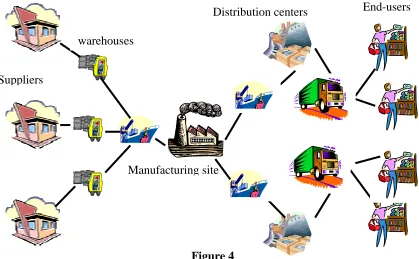
cross-docking etc as mentioned in previous parts. The following figure indicates such an
important role of warehouses and distribution centers.
DISTRIBUTION CHANNEL
Suppliers
Manufacturing site
Distribution centers End-users
warehouses
2. 1. 4. 2. The importance of depot rationalization and location
In the previous part about warehouses and distribution centers and their
importance, it is clear that there are a number of reasons explaining their existence.
The question of suitable number, size and location of depots in the companies’
distribution network is always complicated, thus a variety of variables such as
current distribution patterns, patters of product flows, customers analysis, costs
analysis etc needs to be considered. However, it is widely recognized that this
question is very important to all companies.
Although depots are an integral part in the whole logistics and supply chain,
it does not mean that the distribution network will become both more convenient to
customers and at the same time efficient to the companies when there are many
depots surrounding the customers’ region. It is easy to understand that such kind of
network can reduce the local delivery cost, but on the other hand it makes other costs
such as inventory, storage, depot operating and even trunking cost increase
dramatically. It is therefore essential that the number of depots should be rationalized
based on interrelated elements of the companies’ distribution system as well as the
cost elements attached to them. From the psychological point of view, it seems to be
reasonable to place depots as close to customers as possible to have the best possible
customer service. However, this would be a very expensive solution because the
companies then have to hold adequate stocks of all the goods customers may require.
For the sake of cutting cost and gaining efficiency in the distribution network, it is
vital to rationalize the number of depots, size and their location.
It is worth noticing that not all companies consider this question at the
beginning; the question has just arisen along with the development of a company’
distribution network and that means the question is considered when there is an
existing system. Clearly, the best solution is sometimes not the most reasonable one
because companies have to change drastically the existing system (depots, vehicles
etc), and it could be very expensive and uneconomical. Hence, it is necessary to have
a compromise between the two with a given customer service level.
In short, it can be said that through some major basic concepts about
logistics and distribution scenario was devised. To continue this flow of logic for a
clearer scenario in a specific marketplace in Europe, the following part about trends
of logistics and distribution will also be further studied.
2. 2. Tendencies of logistics and distribution in Europe
Nowadays, Europe is seen as a very important logistics and distribution
marketplace especially since the European Union (EU) was formed in 1993. The
completion of SEM (Single European Market), as a matter of fact, also leads to some
tendencies of logistics and distribution in Europe including the Nordic region.
2. 2. 1. Growing concentration through mergers, acquisitions and alliances
Mergers, acquisitions and alliances are the current developing phenomenon in
the world economy with the influential impact from globalization. In fact, there are
many driving factors behind mergers, acquisitions and alliances and the most
attractive for companies to follow this trend is to enjoy the economies of scale due to
being big status. In the EU scenario, the following table devised a rough picture of
cross-border merger and acquisition activities in 1988 and 1989:
Table 1: CROSS-BORDER MERGERS, ACQUISITIONS AND ALLIANCES
Buying region $Billion % No. of deals % EC sales in 1988
Other EC country 11.2 35 547 65
Total 31.6 100 847 100
EC sales in 1989
Other EC country 24.0 53 770 61
Total 45.5 100 1256 100
Source: Cooper, J and Browne, M and Peters, M. (1991).
From the table above it can be seen that the number of international deals in
the EC grew from 847 – worth $31.6 billion in 1988 to 1256 – worth $45.5 billion in
1989. Just seven years later in 1996 after the formation of EU these figures increased
to 2857 deals with nearly $131 billion according to a survey of KPMG Corporate
Finance. In fact, this trend is to continue with a faster speed and more substantial in
terms of volume and value in the global scale. Also according to one recent survey of
KPMG Corporate Finance, for example, the global cross-border mergers,
acquisitions and alliances in 1998 rose by more than 60% over 1997 to a record
US$544.31 billion comprised from over 5000 cross-border mergers, acquisitions and
This tendency has also been considered as one of many effective strategies to
enter international markets. A recently revealed survey of the largest 18 third-party
logistics companies in Europe showed this as follows:
Table 2: MULTIPLE STRATEGIES TO ENTER INTERNATIONAL MARKETS
Strategy Number of companies Direct investment 14
Alliances with foreign companies 13 Acquisition of foreign companies 10
Source: Containerization International, April 1999
Among logistics service providers, mail operators are the most predominant
consolidators. In Europe, they have motivated aggressively the consolidation trend
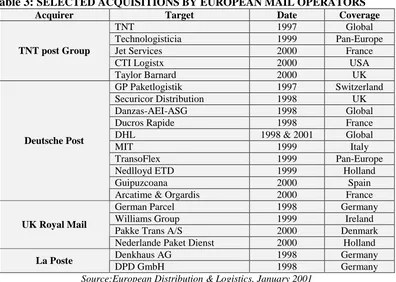
through mergers, acquisitions and alliances. The following table shows roughly the
picture of what is going on today and the continuous trend tomorrow:
Table 3: SELECTED ACQUISITIONS BY EUROPEAN MAIL OPERATORS
Acquirer Target Date Coverage
TNT 1997 Global
Technologisticia 1999 Pan-Europe Jet Services 2000 France CTI Logistx 2000 USA
TNT post Group
Taylor Barnard 2000 UK GP Paketlogistik 1997 Switzerland Securicor Distribution 1998 UK Danzas-AEI-ASG 1998 Global Ducros Rapide 1998 France DHL 1998 & 2001 Global
MIT 1999 Italy
TransoFlex 1999 Pan-Europe Nedlloyd ETD 1999 Holland Guipuzcoana 2000 Spain
Deutsche Post
Arcatime & Orgardis 2000 France German Parcel 1998 Germany Williams Group 1999 Ireland Pakke Trans A/S 2000 Denmark
UK Royal Mail
Nederlande Paket Dienst 2000 Holland Denkhaus AG 1998 Germany
La Poste
DPD GmbH 1998 Germany
Source:European Distribution & Logistics, January 2001
Today, companies once thought of as being “big” are being acquired by
competitors twice or 3 times their size. In addition, giant companies once considered
“untouchable” are in the process of merging. For example, Danzas and AEI, both of
whom were billion-dollar companies on their own, were each acquired by the
which owns MSAS, announced plans to merge with another UK-based giant logistics
company, NFC.
The consolidation trend through mergers, acquisitions and alliances is not
over. In fact, more mergers, acquisitions and strategic alliances in the logistics and
distribution sector are on the way.
The above figures and illustrations may have little meanings if they stand
alone. However, if putting them in close relationship between manufacturing and
logistics and distribution, the implications of such a trend on logistics and
distribution are tremendous as it impacts directly on the business of this sector. The
mergers, acquisitions and alliances among manufacturers can be either opportunity or
threat to logistics services providers, such as road hauliers, shipping lines or airlines.
The big question mark here is that what will happen when there are two companies
which have been using different transport companies so far merging together.
Very often the case is the new company will consider rationalizing its
activities and reducing the number of current service suppliers, a move that allows
companies to concentrate more volume with preferred providers, thereby maximizing
leverage. It comes to the point that the company has to select its new transport
companies or logistics services providers among the ones before the merger, and this
means the business of those companies can be lost or retained according to the
selection.
As analyzed above the concentration trend in manufacturing leads to the fact
that manufacturers have to think and act globally and their strategy should be beyond
the single country-based (rather along the production line than the country). As
logistics and distribution go hand in hand with manufacturing, logistics services
providers also have to follow this logic to meet all the necessary requirements by
their customers, and this means that they themselves have to seek for co-operation
and co-ordination in one form or another, including mergers, acquisitions and
alliances, to rationalize their operations. In the EU scenario, this philosophy is even
more obvious as logistics companies, both European and others placed elsewhere are
making progress to build a Pan-European service network which serves Europe,
can be seen from the case of Schenker International. The cooperative relationship
between Schenker International and its parent company, Stinnes AG, and Sweden’s
BTL AB has created a European logistics giant employing more than 20,000 people
in over 30 European countries with annual revenues of more than $3.5 billion.
In short, the growing concentration through mergers and acquisition in the
manufacturing sector has a direct effect and lead to the same trend in logistics and
distribution, especially in Europe since the EU was formed in 1993. The logic of
such a trend is that logistics companies will get bigger in size, more sophisticated and
wide-range in service coverage and operate with global strategy taking into account
the rationalized regional basis.
2. 2. 2. Tendency of outsourcing logistics and distribution from manufacturers
In the manufacturing sector, the willingness to outsource logistics and
distribution together with a wide range of other non-core businesses is growing
among manufacturers and retailers, and this tendency brings about great opportunity
as well as challenge to logistics providers. Indeed, the trend of outsourcing, for one
more time, reaffirms the fact that logistics companies will be freer and more
self-control in the application of regional-based inventory and distribution policies.
The nature of the trend is that manufacturing companies will just concentrate
all their resources to some core businesses, and leave the non-core ones such as
warehousing or distribution to third-party logistics providers. This can be seen as a
strategy to make the best use of corporate assets, or in other words, simply to
concentrate on what the companies can do best. In fact, the manufacturing companies
may have a number of reasons to outsource the running of their own warehouses or
distribution function, but the most special importance could be their need for
financing for expansion. Indeed, when a company wants to expand rapidly the first
thing it needs is all the internal capital to fund the growth. With the outsource of
non-core activities the company can open up the internal sources of funds, for example,
the capital will no longer be tied up in the trucking fleet or warehouses if the
company contracts out these functions. In addition to allowing manufacturing and
retail companies to concentrate on their primary areas of activities, logistics and
large number of staffs on distribution requirements. With the regional perspective,
the logistics companies will have to consider rationalization of all resources given by
their customers.
If putting these elements in the EU scenario, the trend of outsourcing is seen
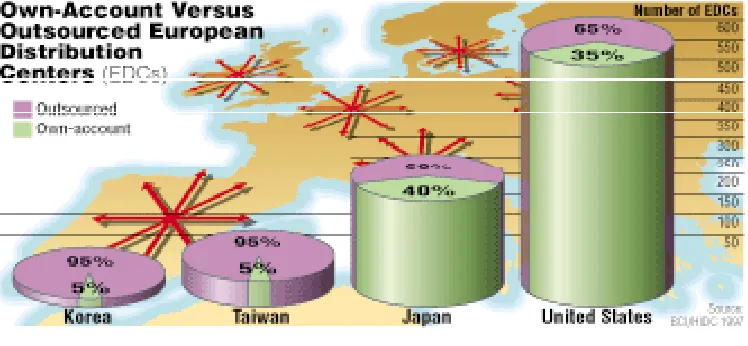
clearly. The following figure indicates a comparison between the number of
own-account and outsourced distribution centers for Europe of many non-European
companies doing their business in this marketplace. The figure shows that the
majority (60-65%) of American and Japanese companies’ distribution centers were
outsourced and they counted for a big proportion in the total number of distribution
centers for Europe. It can also be seen from the figure that international companies
have considered the EU as a whole which can be divided on regional basis, in that
the Nordic region can be served by a regional distribution center.
Figure 5
Source: Carding, T. (1998).
In fact, the trend of extending outsourcing functions beyond basic
transportation and warehousing functions to the third-party logistics is rapidly
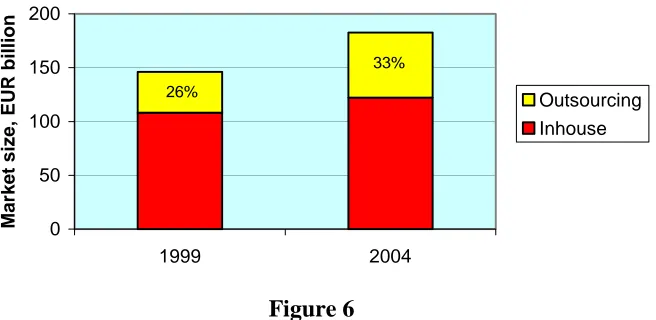
growing. In 1999, the European third-party logistics market is estimated to be worth
EUR 146 Billion in revenue, of which about 26% is outsourced to third-party
providers. By the year 2004, this proportion will increase to 33% expressed as
EUROPEAN LOGISTICS MARKET
0 50 100 150 200
1999 2004
Market siz
e
, EUR billion
Outsourcing Inhouse
26%
33%
Figure 6
Source: Adapted from European Distribution & Logistics, January 2001
The logistics providers are, therefore, doing much more than transport and
warehousing management. Indeed, they can carry out series of value-added services
for their customers such as customizing, kitting and assembly, cross-docking, repair
and testing of products etc and so much more. With the increasing trend of
outsourcing from manufacturers, those functions are considered to be very
competitive for logistics companies and hence they must have sufficient market
coverage, expertise and flexibility to take care of all requirements from their
customers. The flexibility can be understood in the sense that whenever the logistics
company cannot provide the required service itself then it can go to other quality
service providers and put the package in the same way required by their initial
customers. It is therefore necessary to have the regional distribution centers where all
functions supporting to cargo can be conducted in the most efficient and cost saving
way.
The increasing trend of outsourcing from manufacturers has indeed impacted
the business and strategy of logistics services providers, as can be seen from the
analysis above. Together with the growing concentration through mergers,
acquisitions and alliances, it opens a new way of thinking and doing for those
companies to escape from the traditional strategy on specific country basis. The logic
2. 2. 3. Consolidation trend in production, logistics and distribution
It is said that the consolidation trend in production, logistics and distribution
in Europe is the clearest and most predominant move of the economy in the reaction
to the establishment of the EU. Before the EU, many manufacturing companies
operated throughout Europe but without the benefits of scale due to complex
transport and product regulations. The consequence was that there were too many
stocks held in too many warehouses (Cooper, Browne & Peters, 1991).
In fact, legal and regulatory changes in the EU will undoubtedly drive large
manufacturers to consolidate their European logistics operations. In Europe, it has
become more common for companies to develop just several distribution centers on
regional basis, for example, Northern (Nordic region), Eastern, Southern and
Western Europe. The fact in Europe today is that there are many companies which
historically have had country-based distribution centers and are now focusing on
regional-based ones. Certainly, they no longer need to maintain manufacturing and
distribution operations in every country in which they sell their products due to the
harmonization of product standards across the EU, the elimination of most customs
formalities between EU countries and the need for multinational manufacturers to
manage inventory regionally or globally via a single information system.
Besides, the consolidation of production, logistics and distribution will
facilitate better quality control, create more opportunities for more rapid product
innovation due to centralized Research and Development, and above all else, the
company will benefit from economies of scale and lower total cost. According to
Gooley (1999), for example, an American manufacturer of medical equipment which
used to operate 13 warehouses in Europe, but then changed to manage all its
inventory, warehousing, and distribution functions in Europe from a single
purpose-built, highly automated distribution center in Belgium. The positive result is that in
the first two years after the new operation pattern, inventory levels dropped by nearly
half, stock-outs were reduced by more than 75% and total distribution cost fell by
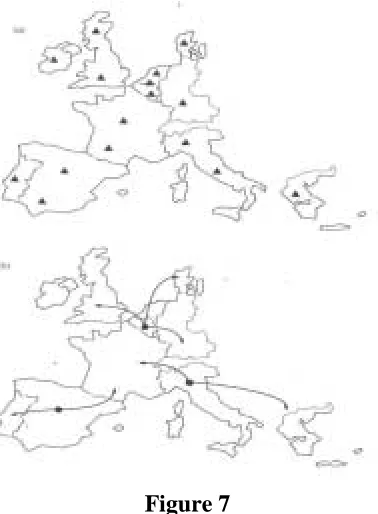
more than 20%. The case of the Netherlands-based Philips describes this trend
clearer. When the company changed its strategy after the formation of the EU, the
CONCENTRATION OF INVENTORY BEFORE & EXPECTATION AFTER
1993 OF PHILIPS
Figure 7
(a) Stock warehouses organized on a national basis
(b) Expected stock warehouses after 1993 – concentration and rationalization
Source: Cooper, J and Browne, M and Peters, M. (1991).
Generally speaking from the theory of logistics and distribution, the
consolidation of production at fewer sites will increase transport cost because
products have to be carried further to markets. In this case, the transport operation
will need to be faster and more reliable to maintain the customer service levels.
However, the principle of cost trade-off will be applied here. First of all, due to the
fact that the number of depots/distribution centers is reduced, the storage cost will
also be lower. Secondly, the consolidation will lead to the saving in inventory cost as
the greater consolidation of inventory implies a smaller overall inventory
requirement (Cooper, Browne & Peters, 1991), the overall cost of operating the
warehouses tends to fall due to economies of scale in warehousing (Lambert, Stock
& Ellram, 1998), the administrative costs (order processing, invoicing etc) will tend
to decline when inventory is held in fewer places and the capability to apply
Information Technology in supporting distribution. Furthermore, saving can be
achieved through better consolidation of outbound shipments and better vehicle’s
center to significantly reduce the inventory levels. With the increasing trend of
outsourcing from the manufacturing sector analyzed in the previous part, the logistics
companies will have more chances to enhance their business by taking the parts
contracted out by their customers and for the sake of optimizing their customers’
resources.
As manufacturers have close relationship with logistics services providers,
the consolidation trend in the former can also be observed in the latter. In order to
satisfy their customers’ requirements, third-party logistics providers today also have
to consider possibilities to apply the regional distribution centers strategy instead of
the country-specific basis and minimize the total distribution cost.
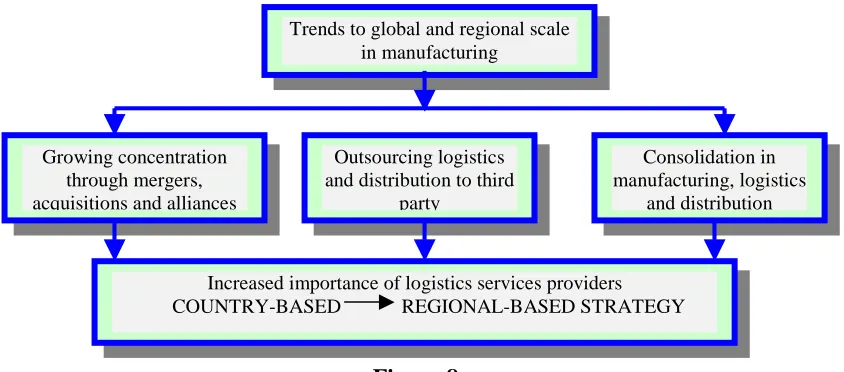
To conclude due to the trends of concentration through mergers, acquisitions
and alliances, outsourcing and consolidation of logistics and distribution the
importance of logistics service providers is increasing substantially together with
their new strategy of locating distribution centers on regional basis as devised in
Figure 8. This should be applied as guidelines when the Nordic region can be
considered as a single market and therefore a regional distribution center can be
placed there to serve this marketplace.
TENDENCIES OF LOGISTICS AND DISTRIBUTION IN EUROPE
Figure 8
Trends to global and regional scale in manufacturing
Growing concentration through mergers, acquisitions and alliances
Outsourcing logistics and distribution to third
party
Consolidation in manufacturing, logistics
and distribution
2. 3. Nordic region as a single market
So far, some basic concepts and notions about logistics and distribution, as
well as current trends of logistics and distribution in Europe have been explained.
Because Europe, as being seen so far, is considered as a single market, the
Northern part of it (Nordic region) cannot be studied separately from country to
country. Moreover, because logistics companies today are changing their strategy
from country-based to region-based, there is growing practice that the Nordic region
should be considered as a single market seen under the angle of the logistics and
distribution chain. The nodes in the physical distribution network of logistics companies should therefore be established for the use of the region instead of any
specific country.
The question then is where the future distribution center(s) for the Nordic
region should be placed. This will be answered based on a number of considerations
within the Nordic region, and the issue of site selection will be dealt with later in
coming chapters when it comes to the case study of Schenker International.
The philosophy and strategy of considering the Nordic region as a single
market are growing among international logistics companies doing logistics and
distribution in this region. In fact, there are a number of reasons explaining this from
historical, economical and social perspectives.
2. 3. 1. From historical perspective
One of the reasons to consider the Nordic region as a single market is that
Nordic countries in the past have had historical bounds and more than once
established some forms of union, alliance and the like. Although it seems not to be
the main deciding factor, it does place a necessary and firm ground for other
considerations because it is really a pre-requisite for co-operation and co-ordination
in many other areas among countries in the region.
It may be ironical that in the past there were many struggles and wars among
neighboring countries in the Nordic region, such as a long period from 1523 to the
early 19th century when the Nordic region was split between Sweden and Finland in an alliance and Denmark, Norway, Iceland, Greenland and the Faroe Islands in
co-operate and reinforce the common Nordic entity. The earliest action in that respect is
the Kalmar Union (1397-1521) between three Nordic kingdoms (Sweden, Denmark,
Norway). The union treaty stated that the countries in the union would act as a single
kingdom vis-à-vis other countries and assist each other. Another clear example of the
historical bounds among Nordic countries is the Currency Union among Denmark,
Sweden and Norway in the period 1873-19142. By the end of 19th century, trade increased drastically within the region thanks to developments in railway traffic and
shipping. In order to facilitate trade, it was decided that the three countries would use
a common currency unit, and the krone was applied as a result of the co-operation for
joint-development among Nordic countries at that time. Another example can be
mentioned here is the formation of the Nordic Council in 19523 between Denmark, Sweden and Norway with later participation of Finland in 1956. The Council was
established to enhance the co-operation in the future legislation in the region and
allow Nordic parliamentarians to play a larger role to do that. And last but not least, a
symbol of co-operation for development among Nordic countries for the sake of a
single Nordic entity is the existence of the Nordic Council of Ministers since 1971 up
to nowfollowing the adoption of the Helsinki Treaty4. It was clearly said in the treaty that the Council would act as the official joint-operation body for the Nordic
governments for further integration among countries in the region in all aspects of
politics, economics, social activities.
Clearly, it can be seen from the above that with historical and traditional
bounds existing in the past, the Nordic countries are moving ahead in the integration
process, making the region itself a single entity in terms of political and
environmental forum, and especially marketplace. Analysis from a historical
perspective is therefore valid to consider the Nordic region as a single market.
2. 3. 2. From economic perspective
The second important reason to consider the Nordic region as a single market
is from the advantageous economic scenario existing in the region.
In the previous parts, it became clear that the EU nowadays is moving ahead
in the process of integration, and the EU itself is being considered to be a single
marketplace from the viewpoint of many international companies because there are
common product standards, no customs barriers and other tendencies in the
manufacturing and logistics and distribution sectors.
As Sweden, Denmark and Finland joined the EU, they are also benefiting the
advantages brought about by the Union, in that requirements about products
harmonizing with the EU standards, customs administration and regulations are
uniformed with the ones of the EU. As far as the Customs issues are concerned,
interviews were made at both the Swedish Customs Authority in Malmö, and Danish
Customs specialist of Schenker A/S in Copenhagen5. The general outcome of these interviews is the harmonization of customs requirements in the Nordic countries with
the EU. For example, if a company has five containers coming into the EU, it is
much easier to customs clear the lot at one point rather than at four different
locations in four different countries. Once cargo is cleared in one of the EU member
states, then it can move freely within the EU borders without any stop. For instance,
a container imported from China through the port of Rotterdam and bound for
Finland, which is an EU member, after being cleared at Rotterdam can be
cross-docked at a distribution center in Copenhagen or Malmö, and then shipped to various
customers in Helsinki or elsewhere. Although Norway is not yet an EU member,
cargo bound for this country can still be easily dealt with transit status and without
any cumbersome documentation. Moreover, there has been very close co-operation
between customs authorities and companies, facilitating the companies’ business. For
example, the interviews revealed that all warehouses and distribution centers can be
connected by network directly with customs office, and all declarations can be done
through the system.
5 Interviews with Ms. Marie-Louise Schildt, Customs Information Department, Customs office of Skåne region and Ms. Lotta
Another angle which can be seen from is the transportation infrastructure of
the Nordic region. In fact, this region has a sophisticated transportation system
including road, rail, sea and air. The transport within countries and between countries
in the region is facilitated with a massive infrastructure of motorways, railways,
airports and seaports. In the region, Copenhagen and Stockholm airports are the
major ones in Europe in that Copenhagen airport is the largest in the Nordic region.
The Port of Göteborg and the Port of Copenhagen are the major gateways to the
region with state-of-the-art handling equipment ensuring fast transit time for cargo
moving in the Nordic countries. The Port of Trelleborg is also the most important
RO/RO port in the region serving the ferry traffic from Sweden to Germany and
other Baltic states such as Poland, Estonia, Lithuania and Latvia. Figure 9 shows a
rough picture of transportation infrastructure in the Nordic region.
SHUTTLE AND BLOCK TRAIN SYSTEM IN THE NORDIC REGION
Figure 9
In the past, the Nordic region except Denmark was said to be separated from
the European continent because there was no link between Denmark and Sweden
over the Öresund Strait. By July 2000 when the Öresund fixed link linking
Copenhagen in Denmark and Malmö in Sweden was opened, it also opened a new
era in the history of the Nordic region as it facilitates the transportation between the
European continent and the Northern European countries. A lot of papers have been