World Maritime University
The Maritime Commons: Digital Repository of the World
Maritime University
World Maritime University Dissertations
Dissertations
2000
Cargo handling equipment productivity analysis of
the Chittagong Port Authority [Bangladesh]
A.S.M. Shahjahan
World Maritime UniversityFollow this and additional works at:
http://commons.wmu.se/all_dissertations
This Dissertation is brought to you courtesy of Maritime Commons. Open Access items may be downloaded for non-commercial, fair use academic
Recommended Citation
Shahjahan, A.S.M., "Cargo handling equipment productivity analysis of the Chittagong Port Authority [Bangladesh]" (2000).World Maritime University Dissertations. 320.
WORLD MARITIME UNIVERSITY
Malmö, Sweden
CARGO HANDLING EQUIPMENT
PRODUCTIVITY ANALYSIS OF THE
CHITTAGONG PORT AUTHORITY
By
A S M SHAHJAHAN
Bangladesh
A dissertation submitted to the World Maritime University in partial fulfilment
of the requirements for the award of the degree of
MASTER OF SCIENCE
in
PORT MANAGEMENT
2000
DECLARATION
I certify that all the material in this dissertation that is not my own work has been
identified, and that no material is included for which a degree has previously been
conferred on me.
The contents of this dissertation reflect my own personal views, and are not
necessarily endorsed by the University.
……….. (Signature)
……….. (Date)
Supervised by:
Name: R. Prasad
Office: Lecturer, Port Management
World Maritime University
Assessor:
Name: Bernard Francou
Office: Associate Professor, Port Management
World Maritime University
Co-assessor:
Name: Patrick M. Alderton
Office: Former Resident Professor, Ports and Shipping Administration
ACKNOWLEDGEMENTS
All praise to almighty Allah who has given me the opportunity to study at the World
Maritime University to achieve the knowledge of different fields of the maritime
industry.
My sincere thanks to the management of Chittagong Port Authority for nominating
me, and to the Tokyo Foundation, Japan for providing me with the fellowship to
participate and study at WMU.
I am grateful to all the academic and non-academic staff of this university, visiting
professors and different organizations who contributed generously
Special thanks to my supervisor, all professors and lecturers of Port Management,
who closely offered assistance for me to complete this dissertation on time.
I wish to express my gratitude to all of my colleagues and friends at WMU and
others in distant places including my country who helped me by providing
information and advice regarding this dissertation.
Last but not least, I wish to remember the tremendous sacrifices made by my family,
ABSTRACT
Title of Dissertation: Cargo handling equipment productivity analysis ofthe
Chittagong Port Authority
Degree: MSc
The dissertation is a study of port cargo handling equipment and its productivity in
order to find out the possible solutions to improve the efficiency of equipment and
the port as well.
Ports are the key points of the global transport network. Presently, world sea borne
trade constitutes more than 90% of world trade in volume. Hence, the importance of
ports for handling cargo is unanimously recognized. In the present era of
competition, a cost-effective and reliable cargo handling service at Chittagong port is
important not only for the port but also for the economy of the country as a whole.
Containerization is an important revolution in the maritime field. With the rapid
technological developments, many state-of-the-art techniques and innovations are
contributing enormously to this phenomenon. Chittagong port is also influenced by
this global and regional trend. The introduction of Information Technology (IT),
dedicated container terminals, sophisticated cargo handling equipment, skilled
manpower and a sound environment can ensure and enhance the performance of
Chittagong Port Authority (CPA) in the future.
The present situation of the cargo handling equipment is not satisfactory for various
reasons, from an improper inventory of the equipment to problems in maintenance
and operation, insufficient facilities and other such influencing factors that are the
The concluding chapters of the dissertation carefully examine the present
drawbacks of port cargo handling equipment and try to find solutions and
recommendations in this regard.
TABLE OF CONTENTS
Declaration ii
Acknowledgements iii
Abstract iv
Table of Contents vi
List of Tables x
List of Figures xii
List of Abbreviations xiii
1 Introduction 1.1 An overview 1 1.2 Identification of problems 4 1.3 Importance of analysis 5 1.4 Dissertation objectives 5 1.5 Research methodology 6 1.6 The scope of analysis 6 1.7 Organization of the dissertation 7 2 Cargo handling equipment and its management at CPA 8
2.1 Introduction 8 2.2 Cargo handling equipment systems 9
2.3 Organization 12
2.4 Equipment 14
2.4.1 Equipment Management 14
2.4.3 Types of equipment 17
2.4.4 Facilities at Inland Container Depot (ICD) 20
2.4.5 Other related facilities 20
2.4.6 New equipment and facilities 21
2.5 Equipment maintenance 22
2.5.1 Methods and procedures 22
2.5.2 Maintenance by local workshops 25
2.6 Equipment booking and operation 26
2.6.1 Booking and operation system 26
2.6.2 Working procedure and working time 26
2.7 Analysis of equipment performance and productivity 27
2.7.1 Maintenance performance 27
2.7.2 Operational performance 31
2.7.3 Cost-benefit of equipment 34
2.8 Training and human resources development 35
2.8.1 Present position of training 36
2.8.2 Short comings in the training system 36
2.9 Conclusion 37
3 Factors influencing equipment productivity 39
3.1 Introduction 39
3.2 Port and Equipment Management 40
3.3 Factors directly affecting equipment maintenance /operation 41
3.4 Traffic forecasting 50
3.5 Congestion at the Port 53
3.6 PEST Analysis 55
3.7 Inter departmental Coordination and co-operation 57
3.8 Port Management Information system 58
3.9 Government interference 60
4 Comparisons with other ports 61
4.1 Introduction 61
4.2 Localports 62
4.3 Regional ports 62
4.4 European ports 66
4.5 SWOT Analysis 68
4.5.1 Local Port (MPA) 69
4.5.2 Regional Ports 70
4.6 Conclusion 72
5 Solutions 73
5.1 Introduction 73
5.2 First Solution: Maintaining a proper equipment Inventory 73
5.2.1 Advantages 79
5.2.2 Constraints 79
5.3 Second Solution: Improving performance of 79
maintenance and operation
5.3.1 Advantages 89
5.3.2 Constraints 89
5.4 Third Solution: Giving more autonomy to the port 89
5.4.1 Advantages 90
5.4.2 Constraints 91
5.5 Conclusion 91
6 Conclusion and recommendations 92
6.1 Conclusion 92
References 97
Appendices 102
Appendix 1 Map showing location of the Port 102
Appendix 2 Map showing import–export cargo movement 103
Appendix 3 Organizational chart of the port 104
Appendix 4 Container handling equipment categories 105
Appendix 5 Prices of different types of container handling equipment 106
Appendix 6 Daily equipment position of CPA 107
Appendix 7 Annual inspection and testing of forklift 108
Appendix 8 Growth of world sea borne trade 109
Appendix 9 Growth of trade is higher than GDP 110
Appendix 10 Map showing container ports of South Asia 111
Appendix 11 Key economic ratio (South Asia) 112
LIST OF TABLES
Table 1 CPA cargo and container handling throughput 2
Table 2.1 Features of different types of container handling equipment 11
Table 2.2 State of container handling equipment 18
Table 2.3 State of general cargo handling equipment 19
Table 2.4 Related facilities for cargo handling in GCB and CCT 20
Table 2.5 Facilities to be created in CPA by 2001/2002 and 2005/2007 22
Table 2.6 Preventive maintenance schedule of forklift truck 24
Table 2.7 Downtime, availability, and utilization rate of general 27
Cargo handling equipment by type
Table 2.8 Downtime, availability, and utilization rate of container 28
handling equipment by type
Table 2.9 Demand availability of container handling equipment 30
Table 2.10 List of holidays and leave in CPA 31
Table 2.11 Performance indicators of CPA from 1995/96 to 1998/99 32
Table 2.12 Hourly operating cost (in USD) of equipment 34
Table 2.13 Training courses for mechanical branch 36
Table 2.14 Revenue surplus of CPA 37
Table 3.1 Effect of equipment inventory 42
Table 3.2 Economic life calculation of a 3 -ton forklift truck 43
Table 3.3 Projected container throughput from previous study reports 51
Table 3.4 Container throughput forecast upto 2005 52
Table 3.5 Key economic ratios, Bangladesh 53
Table 3.6 Dwell time of containers at CPA 55
Table 4.1 Comparison of throughputs of regional ports 63
Table 4.2 Nepal transit through CPA 64
Table 4.3 Comparison of data with different regional ports 64
Table 4.5 Throughput in Hamburg-Le havre range 66
Table 4.6 Comparison of equipment performance (CPA & Europe) 67
Table 4.7 Annual operating costs comparison with European ports 68
Table 5.1 Moves calculation for required container handling equipment 76
Table 5.2 Requirements of container handling equipment 77
Table 5.3 Requirements of general cargo handling equipment 78
Table 5.4 Requirement of container and general cargo berths 86
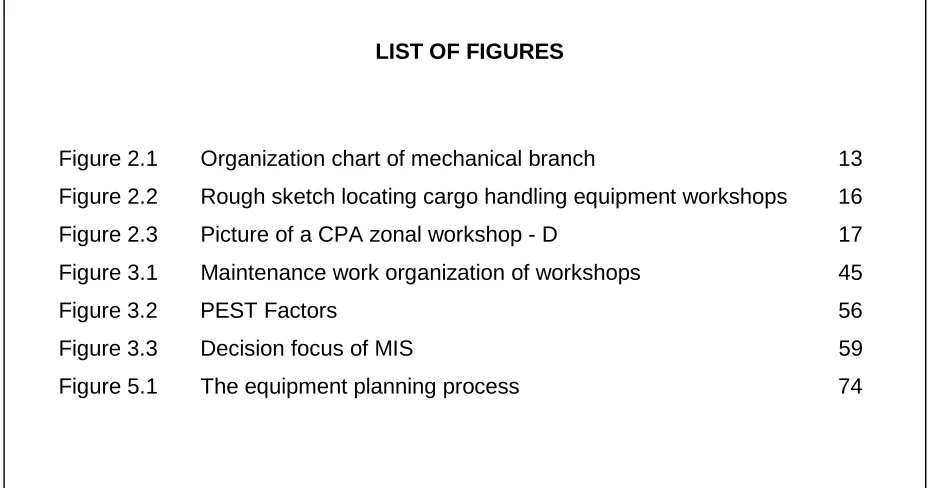
LIST OF FIGURES
Figure 2.1 Organization chart of mechanical branch 13
Figure 2.2 Rough sketch locating cargo handling equipment workshops 16
Figure 2.3 Picture of a CPA zonal workshop - D 17
Figure 3.1 Maintenance work organization of workshops 45
Figure 3.2 PEST Factors 56
Figure 3.3 Decision focus of MIS 59
LIST OF ABBREVIATIONS
CCT Chittagong Container Terminal
CEPZ Chittagong Export Processing Zone
CFS Container Freight Station
CPA Chittagong Port Authority
DFI Direct Foreign Investment
EMIS Equipment Management Information System
EPZ Export Processing Zone
FCL Full Container Load
GCB General Cargo Berth
GDP Gross Domestic Product
GNP Gross National Product
ICD Inland Container Depot
IT Information Technology
JNPT Jawaharlal Neheru Port Trust
LCL Less Container Load
MBWA Management By Wandering Around
MIS Management Information System
MPA Mongla Port Authority
MTBF Mean Time Between Failures
MTTR Mean Time To Repair
OMIS Operation Management Information System
PEST Political, Economical, Social and Technical
PSA Port of Singapore Authority
SWOT Strengths, Weaknesses, Opportunities and Threats
TEU Twenty Feet Equivalent Unit
CHAPTER 1
INTRODUCTION
1.1 An overview
Chittagong Port Authority (CPA) is a technical and economical entity and is used as
an interface, a link, a gateway and a logistic platform for facilitating national and
international trade. Cargo handling equipment of CPA occupies an important
position in port operations and needs to be analyzed for its improvement.
CPA is the state-owned service organization. It is the biggest port in Bangladesh,
situated on the right bank of Kornafully, at a distance of about 9 nautical miles from
the shore line of Bay of Bengal, at Chittagong, in the south-eastern part of the
country (Appendix 1).
Although the port is not located at a strategic position compared to the main
East-West sea route, it has endless possibilities to grow in the future because of its own
big market and regional traffic. The attractiveness of ports is no longer based on
strategic location but on the provision of efficient and prompt services and on their
being linked to efficient land and sea transport net works [United Nations
Conference on Trade and Development (UNCTAD), Newsletter, November 1999].
Also political stability and strong commitment of the government is the key factor for
its development. CPA handled about 14 million tonnes of cargo including container
throughput of 366,000 TEUs in 1998-99. So, the port occupies a position amongst
the top hundred container ports in the world. Trade through both general cargo and
the continuously increasing growth rate of containers identical to the global trend of
containerization. Table 1 illustrates percentage growth of container throughput at
the port from 1990 to 1999.
Another port of the country, Mongla Port Authority (MPA) lies at the south-western
part of the country about 150 nautical miles from CPA. A newly constructed river
container terminal near the capital city of Dhaka is going into operation by the end of
this year.
Chittagong port handles about 80 % of the country’s import-export and its qualitative
and quantitative impact through direct, indirect and induced effect on the national
economy is quite high. Its hinterland for distribution of cargoes to and from the port
covers major portions of the country (Appendix 2). The major import cargoes are
food grain, cement, petroleum, sugar, salt, fertilizer, textile, machinery, iron
materials, chemicals etc. and exports are jute/jute products, tea, frozen fish,
garments, leather, fertilizer etc.
Source: CPA
The port was not prepared to handle such an amount of growth as stated above.
Port forecasting like shipping is sometimes unpredictable. In the1980s, for example,
global container traffic was forecast to be 115 million TEUs in the year 2000 a figure
which was passed several years ago. Similarly, in 1994, the CPA forecast traffic
Table1 CPA cargo and container handling throughput (1990-1999)
Fiscal year Total cargo handled % Total container handled % starts in thousand tons growth in thousand TEUs growth from 1st July import export total import export total
1990-91 6280 920 7200 -- 51 51 102
--1991-92 6270 770 7040 --2.00 61 60 121 19.8
1992-93 6500 1120 7620 8.23 76 74 150 23.96
1993-94 6730 1170 7900 3.68 89 86 175 16.67
1994-95 8900 1350 10250 29.75 115 113 228 30.28
1995-96 8850 1450 10300 0.40 127 124 251 10.08
1996-97 9120 1440 10560 2.43 146 144 290 15.54
1997-98 9560 1530 11090 5.12 163 166 329 13.45
1998-99 12210 1700 13910 25.33 184 182 366 11.25
275,000 TEUs in 2000, was already passed in 1996-97. This growth is the result of
severe competition among ports and the economic developments of countries.
Like shipping companies, it now appears that port authorities and stevedoring
companies are following the path of globalization and economies of scale by
enlargement. The emergence of fourth generation ports is the new concept where
large port or terminal operators are entering into partnership or alliance to operate
the ports on a bigger scale with increased benefits and competition. Hutchinson
Port Holdings and Port of Singapore Authority (PSA) corporations, for example,
operate 17 and 7 ports respectively in different regions of the world.
Of course, such types of merging and competition are driven by two forces:
dedicated container terminal and sophisticated cargo handling equipment. The
major capital investments of a port are spent in these two fields in order to optimize
port profitability. Developing ports, like CPA, have no alternative other than these
two main aspects to improve efficiency. In this context, port cargo handling
equipment performance should be analyzed carefully and action taken accordingly.
Bangladesh is one of the least developing countries of South Asia. More than 126
million people in a land of 144,000 sq. km. need rapid development of its economy
for survival. This can only be possible by developing its maritime fields: ports,
shipping and other related activities. In the present world, the leading maritime
countries Japan, Netherlands, Singapore have developed their economies by
improving ports, shipping and creating many value added activities in the related
fields.
In this context, CPA as a premier port of Bangladesh could be a source of economic
power by improving its performance in every aspect and creating a lot of value
added activities to generate huge indirect employment. The port is a big
organization headed by a chairman and consists of 15 departments responsible for
different port functions. An organizational structure of the port has been placed in
The traffic/operation department and mechanical branch are mainly responsible for
cargo handling equipment operations.
Cargo handling equipment is the main component of cargo handling operations. It is
estimated that 40% of a port’s capital budget is spent on the procurement and
maintenance of cargo handling equipment. So, it is most important for port
management to put the required emphasis on maintaining a proper inventory and
maintenance of the equipment.
The political and economic situation of the country and inter departmental
co-operation influence a port’s functions enormously. Another important influencing
factor is the government interference in major investment in the port. As mentioned
above, there is a rising cargo handling trend, which could be accelerated if there is
no interference from the government to create facilities at the port in time.
This dissertation aims at describing and analyzing the cargo handling equipment
productivity/performance of the Chittagong Port Authority based on identification of
the problems/influences of maintenance and operation of the equipment and other
related factors in order to find the useful solutions in this regard.
1.2 Identification of problems
No problems can be solved without their identification in the first place. This is also
true in the case of port cargo handling equipment. However, the normal tendency
of port and equipment management personnel is that they try to solve the symptoms
rather than the problems without concentrating on the root causes. Equipment is a
sensitive item in port operations. Maintenance of equipment and its operation
involve a lot of factors at different stages which need to be solved in time in order to
avoid any breakdowns which may affect the chain of operations. During
identification, the following points require attention so that the problems can be
handled and solved quickly:
1. What problems exist in relation to equipment maintenance?
3. How can equipment performance be improved?
1.3 The importance of the Analysis
In the maritime field, ships and ports are the two fields competing with each other
fiercely to cope with the innovations and technological changes day by day. If a port
fails to follow the changes in shipping, in time it will fall behind the competition. The
changes in ports are mainly in connection with port cargo handling techniques and
construction of dedicated terminals. This changing technology involves a huge
amount of investment and needs proper maintenance and supervision.
Secondly, any improvement in this field demands careful observation. Particular
factors and how much they influence the activities of operation and maintenance of
equipment can be easily identified if the segments of activities are analyzed
minutely. For example, if the performance of maintenance work in one month falls
significantly compared to the previous month, there can be number of reasons
behind this. They should be analyzed so that measures can be taken promptly.
Thirdly, the probability of occurrence of breakdown decreases if the faults are
analyzed thoroughly and actions are taken on the basis of the findings.
Similarly, the behavior and skills of manpower, such as that concerns the operators
and technicians, should be analyzed periodically for training needs assessment.
Finally, efficiency, which is the key word of operation and maintenance of
equipment, can be improved by analyzing every piece of work. For this reason,
comparison with similar ports or a standard is also essential.
1.4 Dissertation
objectives
The objectives of this dissertation are as follows:
• To discuss the productivity and cost benefit of the equipment
• To analyze the problems/factors related with maintenance and operation • To find out the training needs of the employees
• To compare the equipment performance and related activities with other ports • To identify the management role in equipment productivity
• To identify awareness needs among the employees about importance of port cargo handling equipment
• To suggest possible solutions and recommend some measures to eliminate the problems of equipment in order to improve the port efficiency
1.5 Research methodology
In order to achieve the above objectives, the following methods were followed during
the research period.
• Conducting research study at WMU library, Internet and other possible sources. • Exchanging ideas and views with different personnel of CPA.
• Collecting data from the mechanical branch and other departments of CPA. • Consultation with resource persons of World Maritime University (WMU)
including both staff and students.
• Consultation with experts at some developed ports in Europe and Japan during field studies.
• E -mail correspondence with different personnel and organizations.
1.6 The scope of the analysis
For this analysis the present situation of cargo handling equipment and the related
factors are studied. It is observed during research that different ports do not
provide the detailed data of cargo handling equipment and productivity. However,
efforts were made mainly to find out the CPA’s present position with regards to other
developed and growing ports in the region and Europe and how difficulties and
1.7 Organization of the dissertation
This dissertation is organized into six chapters in order to describe, identify, and
analyze port cargo handling equipment and its productivity and to find out the
possible solutions and recommendations to achieve the desired standard.
Chapter One is an introduction, which provides a general overview of the port in
relation to basic study including the objectives, importance of study, research
methodology, limitation of the analysis and its organization.
Chapter Two provides information about the present situation of port cargo handling
equipment at CPA. It states the current equipment management, facilities,
maintenance procedures, training system of the employees, equipment booking and
operational procedures, present performance/ productivity.
Chapter Three identifies the main problems of equipment maintenance and
operation, influencing factors of equipment productivity. These are in the areas of
port and equipment management, management related with operation, stores and
human resources development, management information system,
inter-departmental coordination and co-operation and PEST (i.e. Political, Economic,
Social and Technical) factors.
Chapter Four compares CPA with different ports. For this reason, local ports,
regional ports and European ports are selected. Comparisons with local ports and
other ports are done with a view to focus on the present position of CPA.
Chapter Five provides the possible solutions to the present and future needs of
cargo handling equipment and explains the merits and constraints of each solution.
Finally, Chapter Six draws a conclusion with some recommendations. To conclude
the analysis, all previous chapters are highlighted by key points. Recommendations
are given to adopt suitable measures on short, medium and long-term bases to
CHAPTER 2
CARGO HANDLING EQUIPMENT AND ITS MANAGEMENT AT CPA
2.1 Introduction
Like in any port, cargo handling equipment of the Chittagong Port Authority plays a
vital role in operations. The main objective of the port is to ensure good and
effective services to its customers at minimum cost. Good services are mostly
offered by the equipment, facilities and the management. The total cargo handling
area of CPA is divided into two main parts: General Cargo Berth (GCB) and
Chittagong Container Terminal (CCT).
The cargo handling of CPA has been increasing day by day since 1977, when the
first container handling operation was started with private equipment at the port.
This was thanks to the contribution of private shipping lines such as Cobra
Consortium, US Lines, Maersk Lines, APL, Sea Land, Container and Terminal
services and others who used their own equipment to handle the containers when
CPA had no container handling equipment of its own. With growing demand from
the shipping companies and increased traffic in the country, CPA engaged M/S
Mounsell consultant of Australia in 1980, to study different aspects of cargo handling
including containerization in CPA. Based on the recommendations of the
consultants, the Port Authority developed interim container handling facilities for
containers in GCB area in 1984 and simultaneously built new multipurpose berths in
1986. But the berths could not be brought into full use for want of back-up facilities
such as container handling equipment, workshop for running operation and
maintenance of cargo handling equipment and container terminal. CPA had
that, due to political unrest and lack of sufficient autonomy, it could not acquire and
/or replace equipment in time.
However, at present CPA owns different types of equipment (general cargo and
container handling) as seen in the list in Tables 2.2& 2.3. Due to the shortage of
equipment, the port entered into a contract three years earlier with a private
company to operate and maintain 4 more straddle carriers on lease. CPA has
another cargo handling operation activity at ICD (Inland Container Depot) in Dhaka.
ICD was established in 1987 by CPA and has been considered as a part of CPA,
which serves as a cargo consolidation or de-consolidation centre transporting cargo
to and from inland destinations.
CPA is going to procure, by 2001/2002, a number of cargo handling equipment
including gantry crane, investing USD 60.4 m from its own budget. Work on a
project has already started and will be implemented in two phases.
It is noticed that the equipment management is lacking in capability to use the
available facilities efficiently due tovarious constraints. There are also bottlenecks
in equipment operation and the maintenance system. Manpower related with the
system requires more skills and knowledge to perform the work to the required
standards. This chapter attempts to introduce the cargo handling equipment system,
describe and explain the existing facilities, future procurement, maintenance and
operation systems, equipment productivity including the training position of the port.
2.2 Cargo handling equipment system
Port management throughout the world are becoming more conscious about the
need to provide modern equipped berths with the additional capital intensive cargo
handling techniques involving low labour contents as a means of their general
competitiveness and encouraging trade through their ports (Branch, 1986, p.86).
resources available including land, labour and equipment, weather conditions,
competitive situation compared with other ports, types of vessels, distribution
arrangements, tidal conditions, inter-modal transport facilities etc.
Presently, containerization is booming in the shipping and port industry. Modern
container handling equipment is the main discussion point over all other equipment
and facilities. Although CPA has both conventional and modern types of container
handling equipment such as forklifts and straddle carriers, it is old and inadequate.
CPA is going to procure more sophisticated equipment including gantry cranes both
for quays and yards.
Today, different types of cargo handling system are in use for container handling.
Container handling system starts at the quayside where containers can be handled
to and from the ships by the jib cranes, multipurpose cranes, gantry cranes and
even mobile cranes. Quay transfer may be done by tractor-trailers, by straddle
carriers or by heavy duty lift trucks. In the container yard, stacking and de-stuffing
may be carried out by straddle carriers, yard gantry cranes or a variety of lift
trucks/reach stackers. Receipt and delivery operations may also involve these
equipment types as well as tractor-trailer systems.
So, the shore handling operation can mainly be grouped into four different container
handling sub-systems:
1. The Tractor-trailer system in which containers are both handled and stored on ‘’over the road’’ chasis or terminal trailers, and are moved around terminal by
heavy duty tractor units.
2. Heavy duty Forklift or Front end loader system, in which heavy duty forklift trucks are used to perform quay transfer and yard operation, called directsystem
or in combination with other equipment called relay system.
3. Straddle carrier system, in which quay transfer, stacking and other duties are performed by straddle carrier, called direct system. Straddle carriers are used for
in yard stacking while quay transfer and other movements are performed by
4. Gantry Crane system, in which the container is equipped with Rubber Tyred Gantry or Rail Mounted Gantry crane for stacking and unstacking with
tractor-trailers for quay transfer and other movements.
The features of different types of container handling systems with advantages and
disadvantages are shown in Table 2.1. The classification of container handling
equipment categories and prices are shown in Appendix 3,4.
Table 2.1 Features of container handling equipment systems - summary
Source: Container terminal development, Improving port performance, UNCTAD, 1986.
The Cargo handling system at CPA consists of two types: Forklift system and
straddle carrier direct system. In the Forklift system, forklifts fitted with top-lift
spreaders, are used in the yards located in the GCB area while transfer of System Tractor/chasis Straddle carrier Straddle Carrier Yard Gantry Front-end Features System Direct System Relay System Crane System Loader System
Land Very poor: Good: Good: Very good: Poor:
utilization 180 TEU/hector 385 TEU/hector 385 TEU/hector 750 TEU/hector 275 TEU/hector
Terminal Very low: high Medium: hard - Medium: hard - High: high load High: heavy
development quality surfacing wearing surface wearing surface bearing surface wear on terminal
Costs not necessary needed needed (or rails) needed surface for crane wheels
Equipment High: large Moderate: six Moderate: four High: expensive, Moderate:
cost-costs number of chasis straddle carriers to five straddle specially rail effective for low is required per ship-shore carrier per ship- mounted crane throughputs
crane shore crane
Equipment Low: good avai- High: mainten- High: mainten- Low: very good Medium: familiar
maintenance lability record; ance expensive ance expensive maintenance technology,
costs easily maintained and short opera- and short oper- record good maintenance tional life tional life record & long life
Manning levels High: 28 men, Low: 22 men, High: 28 men, High: 29 men, Medium: 26 men,
(for two-crane but low skill but high skill with medium-high with medium-high with medium skill
operation) requirement requirement skill requirement skill requirement requirement Good accessibility High flexibility, High flexibility, Good land use, Versatile equipment
Operating low demage to good stacking moderate scope for easily deployed
factors containers,simple features capital automation. Fle- in all locations on terminal organ. investment xibility restricted. terminal
containers between the quay side and yard are done by tractor-trailers. In the
Straddle carrier system, a Straddle carrier is used in CCT for both yard operations
as well as transfer between quayside and yards.
Straddle carriers are chosen as the handling system in CCT considering the
versatility and flexibility of the equipment, the need for a high level of container
selectivity and relative economy of the land use compared to forklifts.
CPA has been using forklifts effectively from the initial stage of container handling
since1985. These are used in container yards of the GCB area which are small in
size and irregular shapes. Their bearing capacity is insufficient for the current
requirements. The consequence is that both the yards and equipment are damaged
frequently. Empty containers are handled in both GCB and CCT areas by light duty
forklifts with side shift spreader.
2.3 Organization
All cargo handling equipment of CPA is under the direct control of the
Electrical/Mechanical department. It is headed by a director. This department has a
big organizational structure, and is subdivided into two main branches: Mechanical
and Electrical. Among the four deputy heads of the department, three are
responsible for mechanical branch, especially for cargo handling equipment and the
other is responsible for the electrical branch. Under the deputy heads, designated
under different names, there are executive engineers in charge of different
workshops and other functions. 500 employees comprising staff and officers work in
different shifts.
There are four different workshops for the maintenance and operation of the
equipment. The organization chart of mechanical branch has been shown together
with some indication of major functions (Figure 2.1). Since the transport of CPA
under mechanical branch is not included in cargo handling equipment, this will not
come in to the discussion. The present organizational structure is working better
performed under one central workshop. Due to a decentralization of functions of the
mechanical branch, the previous central workshop under a new structure split into
one central workshop and three zonal workshops in different locations of the port
protected area. This is the result of an increased volume of work in the mechanical
branch due to the continuous growth in traffic.
Figure 2.1 Organization chart of mechanical branch
NOTE: XEN= EXECUTIVE ENGINEER, MECH= MECHANICAL, Z= ZONAL WORKSHOP EQPT.= EQUIPMENT, R & M= REPAIR AND MAINTENANCE
Source: Mehanical branch, CPA DIRECTOR
(ELECTRICAL-MECHANICAL)
MECHANICAL BRANCH ELECTRICAL BRANCH
DEPUTY CHIEF ENGINEER ADMINISTRATION PROCUREMENT CELL TRANSPORT WORKSHOP
WORKSHOP MANAGER CENTRAL WORKSHOP
R&M OF GENERAL CARGO HANDLING
EQUIPMENT
PLANT MANAGER ZONAL WORKSHOPS R & M OF CONTAINER HANDLING EQPT. AND OPERATION OF ALL EQPT.
XEN(MECH) TRANSPORT
XEN (MECH) PROCUREMENT CELL
XEN (MECH) R & M
XEN (MECH)
STORE
XEN (MECH) Z- A/B
XEN (MECH) Z-C
2.4
Equipment
2.4.1 Equipment Management
Management of equipment is accomplished by a group of people as shown in the
organization chart. The main functions related to the equipment management are as
follows:
• To set objectives and performance standards for the department.
• To plan and forecast the equipment necessary for efficient cargo handling operation in CPA.
• To take appropriate measures to maintain proper equipment inventory.
• To prepare cost-effective budget for management and maintenance of the equipment
• To organize and supervise the overall maintenance of the equipment to ensure equipment availability at all times.
• To arrange and implement continuous training and motivation schemes for the employees.
• To maintain discipline in order to achieve the smooth functioning of all activities. • To measure and ensure quality in maintenance and all other related functions by
controlling, reviewing and monitoring the activities and applying standard
procedures and techniques with respect to set objectives and standards.
In addition, the management of mechanical branch has to perform other functions
including maintaining a close relationship with port management and other
departments. All functions as stated above are not accomplished by the equipment
management properly due to different constraints and managers working under
equipment management are not equally capable of supporting all functions.
2.4.2 Existing facilities
As said earlier, quality of cargo handling equipment is one of the key factors of port
productivity. The equipment owned by the CPA at present is broadly divided into
two categories: general (break bulk) cargo and container handling equipment.
Facilities of different kinds have been created to maintain the equipment and to keep
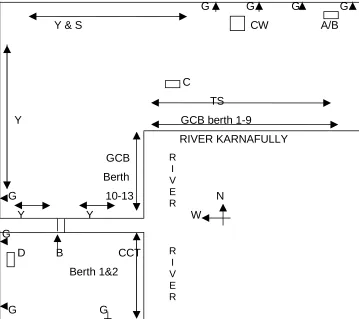
central workshop are important among the facilities. The locations of the workshops
have been shown in Figure 2.2.
• Zonal and central workshops
Three zonal workshops (A/B, C & D) have been established in port protected areas
at almost equal distances from one another so that the equipment can go back and
forth from the operations point to the workshops within the shortest possible time so
as to give quick response during any operational failure/accident or maintenance
problem. The central workshop is not placed at center point of the three workshops.
Originally the idea was that all major repairs such as engine and transmission
overhauling, fuel pump testing and repairs, etc. could be done in this workshop.
Later on, however, considering that the two zonal workshops (C & D) are will be
more useful so that they can be used directly for the maintenance and operation of
container handling equipment, the central workshop is now only used for major
repairs and the maintenance of general cargo handling equipment.
Zonal workshop A/B accounts for all general cargo handling equipment. Facilities available in this workshop include a dedicated area for preventive maintenance and
running maintenance, open pavement space for preserving different types of
equipment, fuel tank and pumps, distilled water making plant, equipment booking
and other administrative offices.
Zonal workshops C and D account for all container handling equipment, and are used for parking, booking and maintenance of this equipment. Workshop-D was
established as a container handling equipment workshop jointly with Chittagong
Container Terminal. So, this workshop is better equipped, with repair and
maintenance facilities, than workshop-C.
Facilities available at workshop D are overhead crane, servicing bay, diesel pumps,
machine shop, equipment repairing areas, tyre repairing shop, battery charging
room, electrical maintenance room, sub-store for spares, welding facilities, engine
overhauling room and a covered shed for corrective maintenance. Moreover,
different offices, a training room and a prayer room and the ground floor is used for
equipment booking room, operator and technician's rest room. Zonal workshop C
has similar facilities as workshop D except the overhead crane, dedicated servicing
bay, machine shop and sufficient space for repair and maintenance.
Figure 2.2 Rough sketch indicating location of cargo handling
equipment workshops and other main facilities in CPA
G G G G
Y & S CW A/B
C
TS
Y GCB berth 1-9
RIVER KARNAFULLY
GCB
Berth
G 10-13 N
Y Y W
G
D B CCT
Berth 1&2
G G
Note: Zonal workshops: A/B, C & D, Central workshop : CW Container yard: Y Shed : S Gate : G Bridge : B, Transit shed: TS
General Cargo Berth: GCB, Chittagong Container Terminal: CCT
Source: Author
The central workshop is provided with almost all facilities as described above for workshop C and D and has sufficient open space protected by steel fencing for
placing and repairing different types of equipment at one time.
Figure 2.3 CPA zonal workshop-D shows straddle carriers and other
equipment
Source: CPA
2.4.3 Types of equipment
There are different types and models of equipment for handling general/break-bulk
cargoes and containers in CPA. There are some attachments, which are used in
general, cargo handling to expedite and safe handling of various types of cargo such
as jute bale, drums etc. The total equipment position of CPA under the mentioned
workshops is shown in Tables 2.2 & 2.3.
Analysis of the Tables2.2 & 2.3
It appears from the two tables that a large amount of equipment has been proposed
for scrapping, but this has to wait for a long period for disposal. About 50% of 237
surpassed their economic lives. The economic life of equipment is that period
during which it can be operated at minimum average annual total cost.
Table 2.2 State of CPA container handling equipment, December 1999
Source: Mechanical branch, CPA
Moreover, both categories as stated above, are creating problems in daily operation
and maintenance work. However, the equipment having lost its economic life has
not been declared for scrapping for two main reasons:
1) to meet the growing demand of traffic till new equipment is procured;
2) for the non-disposal of scraped equipment.
Table 2.2 shows that the main container handling equipment, straddle carrier has
very low inventory compared to present requirement. Similarly, forklifts (32-35 ton &
25-28 ton) and tractors-trailers have low inventory and about 50% of them are still in
use with high downtime. The origin of all container handling equipment is in Europe
which have been procured from well-known manufacturers, Valmet-Sisu (Finland),
Kalmar (Sweden) and Fantuzzi Reggiane (Italy).
Type of Capacity Equipment Nos. in working condition Nos pro- Economic
equipment (ton) inventory life under life life above posed for life
5 yrs 5-10 yrs 10 yrs scrapping yrs
Straddle 35 8 4 4 -- -- 12
carrier
Forklift truck 38-42 9 7 -- -- 2 8
Forklift truck 32-35 2 -- 2 -- -- 8
Forklift truck 25-28 6 2 -- 2 2 8
Forklift truck for 9-16 9 6 -- 3 -- 8
empty handling
Tractor 50 50 12 27 5 6 10
Trailer 20'-40' 36 11 14 11 -- 10
Total 120 42 47 21 10
Percentage 35 39 18 8
Source: Mechanical branch, CPA
Table 2.3 shows that about 50% of the mobile cranes have passed their economic
lives but still they are in use due to shortage of inventory. Forklifts (5-ton) have
good inventory and these are also used for handling empty containers. Forklifts
(3-ton) have considerable inventory but more than 30% of them crossed their useful
lives and about 30% have been proposed for scrapping. So, the existing machines
are not fulfilling the present requirements. Although low mast forklifts (2.5-ton) have
been shown with general cargo handling equipment, these are used for container
stuffing/destuffing purpose, and have insufficient inventory. More than 50%
tractor-trailer units are aged and do not satisfy the operational needs. Most of the shore
cranes have passed their useful lives but still they are giving better services. Among
these equipment, 90% forklifts are of Japanese origin and all cranes have been
procured from well-known manufacturers, Coles (U.K) and Locatelly (Italy).
Table 2.3 State of break bulk/general cargo handling equipment on December, 99 Type of Capacity Equipment Nos. in working condition Nos pro- Economic
equipment (ton) inventory life under life life above posed for life
5 yrs 5-10 yrs 10 yrs scrapping yrs
Mobile crane 20-30 5 -- -- 5 -- 8
Mobile crane 6-10 23 8 2 7 6 8
Forklift truck 5 21 13 -- 7 1 8
Forklift truck 3 66 16 7 23 20 8
Forklift truck 2.5 16 -- 16 -- -- 8 ( low mast)
Tractor 20-25 23 -- -- 13 10 10 Trailer 6-25 52 -- -- 39 13 10 Shore crane 2-3 31 -- -- 25 6 15
Total 237 37 25 119 56
Percentage 16 10 50 24
of inventory
Attachment for break bulk cargo handling
JCBC attachment for jute carpet bale handling 7 Bale handling attachment 9
Fork extension 1
2.4.4 Facilities at the Inland Container Depot (ICD)
The equipment facilities at ICD have been arranged by a private company since
1997 under lease contract. Prior to that time, CPA had been operating ICD
container handling operation with its own equipment since its establishment in 1987.
Presently, two big container handling forklifts (32 &36 ton) and 5 small forklifts (3 &
8 ton) are handling about 40,000 TEUs per year. It has area of 50,000-sq. m. for
container storage. ICD is serving the needy port users of distant places and
contributing as a part of the overall transport chain.
2.4.5 Other related facilities
There are some other facilities, which are directly or indirectly connected with
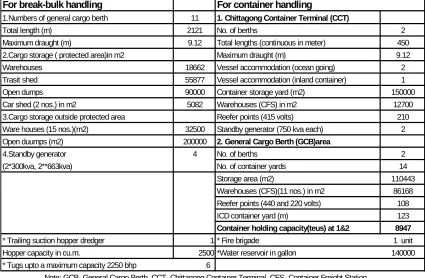
equipment handling. The main facilities related to equipment are shown in Table
2.4. It is found from the table that CPA has different facilities for cargo and its
handling.
Table 2.4 Related facilities for cargo handling in GCB and CCT area
For break-bulk handling For container handling
1.Numbers of general cargo berth 11 1. Chittagong Container Terminal (CCT)
Total length (m) 2121 No. of berths 2
Maximum draught (m) 9.12 Total lengths (continuous in meter) 450 2.Cargo storage ( protected area)in m2 Maximum draught (m) 9.12 Warehouses 18662 Vessel accommodation (ocean going) 2 Trasit shed 55877 Vessel accommodation (inland container) 1 Open dumps 90000 Container storage yard (m2) 150000 Car shed (2 nos.) in m2 5082 Warehouses (CFS) in m2 12700 3.Cargo storage outside protected area Reefer points (415 volts) 210 Ware houses (15 nos.)(m2) 32500 Standby generator (750 kva each) 2 Open duumps (m2) 200000 2. General Cargo Berth (GCB)area
4.Standby generator 4 No. of berths 2
(2*300kva, 2**663kva) No. of container yards 14 Storage area (m2) 110443 Warehouses (CFS)(11 nos.) in m2 86168 Reefer points (440 and 220 volts) 108 ICD container yard (m) 123
Container holding capacity(teus) at 1&2 8947
* Trailing suction hopper dredger 1 * Fire brigade 1 unit Hopper capacity in cu.m. 2500 *Water reservoir in gallon 140000 * Tugs upto a maximum capacity 2250 bhp 6
Both the GCB and CCT areas are provided with berths, storage area and standby
generator etc. Other facilities include: dredger for regular maintenance dredging in
channel, tugs for pilotage, fire brigade and provision for water supply to ships.
There are several special berths and storage facilities for dry and liquid bulk cargoes
outside the CPA protected area operated by other companies.
2.4.6 New Equipment and facilities
Shortage of equipment is the burning question of the port today. If the equipment is
not procured or replaced after a definite interval on the basis of traffic forecast, a
catastrophic disaster might happen in port operations in the future. This kind of
situation has been faced by the port several times and it influences the port itself
and national economy greatly. However, it is expected that port is soon going to buy
a number of containers handling equipment including gantry crane, by 2001/2002,
and to construct a new container terminal with back up facilities by 2005/2007.
Work on two projects, named as ''Procurement of container handling equipment
including gantry crane’’ and ‘’ Construction of a container terminal at the New
mooring area of Chittagong Port” has already started. An International tender for
the first project has been invited and for the other project will be invited soon. The
equipment to be procured and facilities to be created are shown in the Table 2.5.
From the table it is seen that CPA is going to procure new sophisticated equipment
such as quay gantry crane and rail mounted gantry crane by 2001/2002 and rubber
mounted gantry crane by 2005/2007. Moreover, reach stacker is also going to be
added to the CPA equipment inventory. Obvious benefits of the reach stacker
include its ability to reach out, its relatively low overall height and its ability to rotate
and come in at an angle to the stock (PDI, March 2000). The new straddle carrier
will be 4 high (1 over 3 units) instead of the existing 3 high (1 over 2 units).
Inevitably, all this equipment will contribute greatly in handling the growing traffic
Table 2.5 New facilities to be created by 2001/2002 and 2005/2007
Source: Project proforma, CPA, 1999
2.5 Equipment maintenance
Maintenance of equipment is the most important aspect of equipment productivity.
Equipment deteriorates and fails to attain its economical life because of poor
maintenance. Due to technological growth of equipment handling systems, much
sophisticated equipment has been procured by numerous ports to improve their
productivity. This equipment needs proper maintenance and management. In a
modern container terminal, the total equipment budget can amount to 45 % total
terminal budget operations (Toubhans, 1999, p. 45). CPA has both conventional
and modern equipment. As mentioned earlier, it has a big organizational structure
for the maintenance and management of equipment.
2.5.1 Methods and procedures
There are three broad categories of maintenance: 1) Preventive maintenance, 2)
Corrective maintenance, and 3) Designing-out maintenance.
Preventive maintenance is mainly based on routine inspection of equipment at
scheduled time in order to avoid major breakdown of the equipment. *C o n s t ru c t io n o f N e w M o o rin g c o n ta in e r te rm in a l b y 2 0 0 5 /2 0 0 7
L e n g th o f th e b e rth s (m ) 1 0 0 0 S to ra g e a re a (m 2 ) 2 2 0 0 0 0
*E q u ip m e n t w ill b e p ro c u re d b y 2 0 0 1 /2 0 0 2 2 0 0 5 /2 0 0 7 p h a s e - 1 p h a s e -2
Corrective maintenance involves mainly breakdown repairs resulting from irregular
component failures and damages due to accidents, which are caused by defective
components and human errors.
Designing-out maintenance is mainly set out to remove the need for maintenance.
At the CPA both preventive and corrective maintenance are done at its own
workshops. Designed-out maintenance is done rarely when there is a necessity to
improve/design a system in order to upgrade or prevent it from failure. Another type
of maintenance concerns attending very frequently to solve the running defects
during operation. This is called running maintenance.
• Preventive maintenance
This maintenance for all types of equipment is done according to a monthly
schedule prepared by the engineer in-charge at the end of every month. All
equipment is grouped by type and model in order to list out maintenance tasks to
prepare weekly, monthly, quarterly, half-yearly and yearly schedules according to
the manufacturers recommendations. These schedules are printed in ready-made
forms for instant use. Technicians assigned for doing maintenance work are
instructed by the supervisor giving instructions in a repair book where name, type of
maintenance (weekly or monthly, for example), and time of starting work are noted.
The repair book is used as a document instead of a job card for giving instructions to
the technicians and keeping records of all types of repairs. After finishing the work,
the technician fills out the respective form and deposits it with the supervisor with
the repair book, filling the columns of spare parts used, completion time and
signature.
Importance is given to perform this type of maintenance according to the time
schedule so that no equipment is left without maintenance. But, practically, due to
various constraints such as shortage of employees, absenteeism etc. only 60-70%
of the work is performed every month. The preventive maintenance schedule of a
general type is shown below (Table 2.6). This table shows how different tasks are
performed according to weekly, monthly, quarterly, half yearly and yearly schedules.
Table 2.6 Preventive maintenance schedule of forklift truck
TASKS SCHEDULE SCHEDULE SCHEDULE SCHEDULE SCHEDULE A B C D E WEEKLY MONTHLY QUATERLY HALF- YEARLY YEARLY
Washing & P P P P P Cleaning
Air filter element C C R R R
Air compressor -- -- CL CL CL
Lift chain and A A & L A & L A & L A & L Chain wheel
Tyres and Rims W W W W W & I
NOTE: P = PERFORM C = CHECK AND/ OR CLEAN R = CHANGE OR REPLACE A = CHECK AND ADJUST CL = CHECK LEAKAGES L = CHECK A ND LUBRICATE W = CHECK WEAR AND DEMAGE I = INTERCHANGE Source: Mechanical branch, CPA
• Corrective maintenance
This is done in the same way as preventive maintenance by writing necessary
instructions in different column of the repair book. But in this case, no printed
schedule is prepared. The repair book acts as a job card to the technicians.
Generally, breakdowns such as failures of the steering system or brake system of
equipment are reported by the operation supervisor to the maintenance supervisor
in writing. According to this report, instruction for corrective maintenance is given to
the technicians.
• Running maintenance
This maintenance is often performed during operation. Mobile workshops and small
forklifts are used by the technicians to attend to the running problems of equipment
in different locations. Problems include: tyre punctures, oil leakage, abnormal sound
from engine or other systems, excessive emission of smoke etc. If the operator has
a good technical knowledge and is experienced, he can report correctly to the
workshop shift -in -charge to solve the problem quickly. Otherwise, delays occur for
• Working hours
The daily working hours of the maintenance staff are 8 hours, called general shift
from 7-30 to 16-30hrs excluding one-hour interval for lunch. Generally,
maintenance work is done during the general shift, but some maintenance staff are
booked in two shifts, 6.00 to 14.00 and 14.00 to 22.00 hrs to attend to emergencies
and the running repairs of two shift operations. Since CPA does not have sufficient
and good equipment to meet the traffic demand of everyday, some maintenance
staff has to be booked daily including on weekly and government holidays on
overtime to attend to the breakdown of equipment.
• Spares and stores
Spares and stores are the key points of maintenance. All spare parts issued are
entered in the register as per requisition slip/form from the maintenance supervisor
to store keeper. About 95% of spare parts are imported mainly from equipment
suppliers in foreign countries and the remaining spares are procured locally from
local suppliers. Demand for the foreign spares is placed in the beginning of the year.
It takes a minimum of 6 months to 1 year or even more to procure the spares, which
disturbs the maintenance work badly. Computerization of all spare parts is going on
in different workshops but not in a planned manner.
2.5.2 Maintenance by local workshops
There are shortages of some special categories of skilled people and facilities in
CPA workshops. Sometimes assistance such as machining works and special tools
are needed from the out sources to perform engine and transmission overhauling,
fuel pump repairs and other special jobs. Engine machining work is done on a
yearly contract basis by the local workshops. Some spare parts are manufactured
by some local reputed workshops in an emergency, though the longevity of these
2.6 Equipment booking and operation
2.6.1 Booking and operation system
The booking of Cargo handling equipment is done from respective zonal workshops.
The traffic department of CPA is mainly responsible for the operation of equipment
after booking. According to the requisition received from the traffic department,
equipment is booked to specific locations. The daily booking position is sent to
higher management and operation department (Appendix 5).
Before putting into operation, each equipment operator has to check the equipment,
called pre-operational checks, as specified in the check list book. The main items of
checklist book are physical condition of the equipment such as condition of tyres,
battery, any oil leakage, functions of different levers and switches of panel board
inside operator’s cabin including brakes, steering, lifting systems and all oil and fuel
levels in the tanks.
2.6.2 Working procedures and working time
Operators are under the direct control of mechanical branch but they have to obey
the orders and instructions of traffic officers during operation. If there is any
requirement for repairs and maintenance during the operational period, the
equipment operator sends a message to the shift in-charge at the workshop by
wireless set fitted on the equipment. The shift in-charge takes the necessary step
for repairs either by sending a technician to the site or bringing back the equipment
to the workshop. Two mobile workshops are available at two zonal workshops to
attend running repairs at the sites.
Cargo operations are carried out in two shifts (day and night) but there are
provisions for doing work after shifts, called evening through and morning through.
Since the port is open for 24 hours, the operators have to do this work as overtime
during emergency periods such as the sailing schedule of ships, exporting
perishable goods or importing emergency spares or raw materials for industries.
2.7 Analysis of equipment performance and productivity
Equipment performance and productivity are closely related. According to Francou
(1999), performance means the total optimization of all elements related to the
equipment to get the desired productivity. Productivity of equipment is mainly based
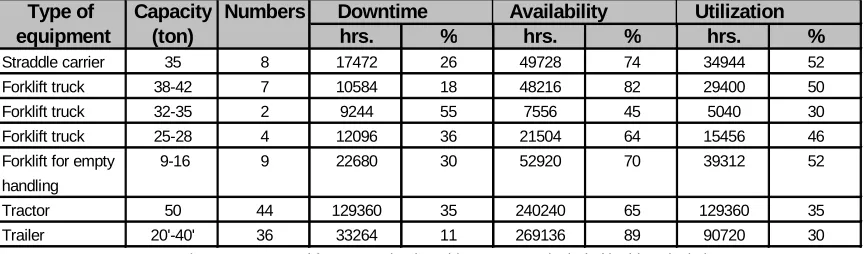
on performance of maintenance and operation. The yearly maintenance
performance and utilization of general and container handling equipment for 1999 is
summarized in the Tables 2.7 & 2.8. Another Table 2.9 shows the demand availability of container handling equipment. The tables are discussed in the
following sections of maintenance and operation performance.
Table 2.7 Downtime, availability and utilization rate of each type of
general cargo handling equipment in 1999.
Source: Mechanical branch, CPA
2.7.1 Maintenance performance
Maintenance performance of equipment is looked at using the following parameters:
Equipment Downtime: The total time in hours when each or type of equipment is
not available for operation due to breakdown repairs, preventive maintenance,
waiting for spares and other reasons. It is calculated for a given period by using the
formula:
Type of Capacity Numbers Down time Availability Utilization
equipment (ton) hrs. % hrs. % hrs. %
Mobile crane 20-30 5 31500 75 10500 25 8400 20 Mobile crane 6-10 17 52836 37 89964 63 57120 40 Forklift truck 5 20 33600 20 134400 80 80640 48 Forklift truck 3 46 200928 52 185472 48 123648 32 Forklift truck 2.5 16 30912 23 103488 77 64512 48 Tractor 20-25 13 61152 56 48048 44 38220 35 Trailer 6-25 39 117936 36 209664 64 127764 39 Shore crane 2-3 25 54600 26 155400 74 94500 45 Note: *Equipment, proposed for scrapping in table 2.3, are not included in this caculation.
Downtime = (Downtime in hrs. /possible machine hrs.) * 100, where possible
machine hours are the number of hours that berths in the port are scheduled to work
in that period. In CPA, berths for general cargoes and containers are open for 24
hours and the maximum days available in a year are 350 excluding closed holidays,
strikes and labour unrest. So, the possible machine hours per year are 8400.
Table 2.8 Downtime, availability and utilization rate of each type of
container handling equipment in 1999.
Source: Mechanical branch, CPA
Equipment Availability: This is a measure of the proportion of the time that each or
type of equipment is accessible for berth operations. It can be calculated for a given
period by using the formula:
Availability = (available machine hours / possible hours) * 100, where available
machine hours are calculated by subtracting downtime from possible machine
hours.
Demand Availability: This is a measure of the time that equipment is available when
requisitioned by the traffic/operation department. It can be calculated for a given
period using the formula:
Demand availability = (No. of machines supplied/ No. of machines demanded)*100
Equipment Utilization: This is a measure of proportion of the time that a machine is
actually engaged in work. It has been calculated by using the formula:
Type of Capacity Numbers Downtime Availability Utilization
equipment (ton) hrs. % hrs. % hrs. %
Straddle carrier 35 8 17472 26 49728 74 34944 52 Forklift truck 38-42 7 10584 18 48216 82 29400 50 Forklift truck 32-35 2 9244 55 7556 45 5040 30 Forklift truck 25-28 4 12096 36 21504 64 15456 46 Forklift for empty 9-16 9 22680 30 52920 70 39312 52 handling
Tractor 50 44 129360 35 240240 65 129360 35
Trailer 20'-40' 36 33264 11 269136 89 90720 30 Note: *Equipment, proposed for scrappping in Table 2.2 are not included in this calculation
Utilization = (Recorded machine hours/possible machine hours) * 100, where the
recorded machine hours are the number of hours is actually worked by the machine
in a given period.
Mean Time Between Failure (MTBF): This denotes reliability of the equipment and
is expressed as duration of time the equipment is utilized before failure occurs.
MTBF = worked hours/frequency of failures.
Mean Time To Repair (MTTR): This measures the average duration of time the
equipment is laid up for repair, which also denotes the maintainability of the
equipment. MTTR = breakdown time/frequency of failures.
The last two parameters are not measured in CPA. The data collected from the
mechanical branch are not sufficient enough to calculate the performance
parameters with 100% accuracy. Because, every machine is not fitted with hour
meters to record the actual working hours; some data collected from logbooks are
based on assumptions. Some missing data are taken on average based on past
records.
From the two tables (2.7 & 2.8) it is found that the availability of both categories of
equipment is not satisfactory. Table 2.7 stipulates that mobile cranes of 20-30 ton
capacity have very poor availability and excessive use of available equipment cause
many breakdowns and create pressure on maintenance work. Similarly, 3 ton
forklifts and tractors indicate excessive downtime and low availability. The position
of shore crane is satisfactory. Though it is very old but it’s electrically operated
systems cause less breakdown. Its present availability is enough for shore handling
operation.
Table 2.8 illustrates that availability of container handling equipment is in a better
position than general cargo handling equipment, but still much below the standard
(85-90% for straddle carriers, 90% for forklifts -Thomas & Roach,1993). Due to
insufficient inventory, straddle carriers and forklifts (38 - 42T and 9 -16T) have been
calculated with respect to actual available hours per year (available machine hours –
non-working hours for lunch/dinner) rather than possible machine hours per year.
The two tables clearly show that both types of equipment have considerable
downtime. The causes of downtime are mainly due to aged machines, lack of
workshop performance, bad driving practices, shortage of spare parts, working
environment, weather condition etc. On the other hand, poor utilization of some of
the equipment categories of both types is due to excessive idle time. Idle time is the
available hours that are lost due to administrative procedures, bad weather,
spending more time by the operators and labours for lunch/dinner etc.
On the other hand, Table 2.9 shows that during 6 months period almost all
categories of equipment have less supply against demand which indicates
considerable shortage of operable equipment in CPA.
Table 2.9Demand availability of container handling equipment, April-Sept./99
Note: Generally demand has been placed based on existing inventory. It does not truly reflect the needs
Source: Mechanical branch, CPA
All machines for cargo handling have been procured under perfect competition from
reputed manufacturers as said before. Satisfactory performances have been found
from most of the machines and after sales services of the manufacturers were good.
But because of many factors that will be discussed latter, timely maintenance of
engines, transmissions, lifting systems, etc. according to manufacturer’s
recommendations, is not performed which increases downtime and reduces the
performances of these systems substantially.
Equipment Capacity Total demanded Total supplied % Availability
type (ton) numbers numbers against demand
Straddle carrier 35 2280 1506 66
Forklift truck 38-42 2244 1740 78
Forklift truck 32-35 744 144 19
Forklift truck 25-28 2232 1158 52
Forklift truck 9-16 1860 738 40