United States Patent
[19]Lipcon
[54] TESTER FOR COLLISION-DETECI' CIRCUITRY
[75] Inventor: Jesse B. Lipcon, Harvard, Mass.
[73] Assignee: Digital Equipment Corporation, Maynard, Mass.
[21] Appl. No.: 292,003
[22] Filed: Aug. 11; 1981
Related U.S. Application Data
[63] Continuation-in-part of Ser. No. 267,394, May 26, 1981.
[51] Int. Cl.3 ... H04B 17/00 [52] U.S. Cl •... 455/67; 455/226; 371/3; 371/57; 371/60; 370/85; 370/94; 340/825.5 [58] Field of Search ... 455/58, 73, 78, 67, 455/226;370/85,93,94,95;375/36; 340/825.5, 825.51,870.13,870.15; 371/48, 57, 60, 23, 25, 3; 307/97; 358/257
[56]
[11]
[45]
Referenc~ Cited
4,380,088
Apr. 12, 1983
U.S. PATENT DOCUMENTS
4,063,220 1211977 Metcalfe et al ... 340/825.5
Primary Examiner--John C. Martin Assistant Examiner-Albert W. Watkins Attorney, Agent, or Firm-Cesari and McKenna
[57] ABSTRACf
A tester for the collision detector of a transceiver for a mUltiple access data communications network using carrier-sense collision detection for controlling access to the network. A squelch circuit is employed in the transceiver's transmitter for enabling and disabling the transmitter output. An end-of-transmission detector monitors the squelch circuit to detect the termination of a transmission. Upon termination of a transmission, a collision simulator circuit supplies to the transceiver's receiver a signal of predetermined amplitude and dura-tion, to simulate the input the receiver gets when a collision actually occurs. If the receiver is working properly, it signals a collision to the host (i.e., computer, terminal, etc). If it does not receive the collision signal at the appointed time, the host knows that either the transceiver's collision detection circuit or the tester is not working.
'----28---'
I
25
II
GUARD
- -
II
SWITCH
I
I
TIMER(S)
I
I I
I
I
L_ ___ ___
_ _ _ _ _ _ _ _ _ _ _ _ -1 I20
16
BUFFER
enable
12A.--_ _
-.
32
12B ...
1 _-+-_....J14
r---'
I
END-OF-
I
TRANSMISSION
COLLISION
I
®
I
DETECTOR
SIMULATOR
I
36
34
38
L_
__________________ -1
- - ITRANSMITTER
I
1
f
SQUELCH
ill
Fig. f
c
.
CI:l
.
~
~
(1)::s
!"""t-~
!'1
..-p
-\0
00
Vol
en
::J'"
o o
...
-o
...
00
.J:::;..
'"
Vol
00
o
'"
o
I00
Fig.
3
+9.4V
to
+15.75V
LOW-PASS FILTER
)
52
62
44
BAND-PASS FILTER
·74
DC-to-DC
178
CONVERTER40
AMPLIFIER
70
48
10
MHzOSCILLATOR
56
Fig.
2
SHUNT
REGULATOR
76
-5.2V
L _ _ _
r - - - 4 - - - + . - - - - -
-10.2V
58
c
.
CI'J
.
~
~
f"'t-CD
::s
f"'t-;l>
'0
=-'
...-..N
...-\0
00 Vol
(,I)
:T (D (D
....
N
o
....,
00
~
Fig.
4
j116~
128 14
14-8
, - - - ,
I
20
I
I --- J
1
J
I
96
1650
1%
-5.2V
2490
1%
II
-J9.2V
I
J
I
J
I
~---~
~
oC
o
o
r - - - -
-7
I24
I
-I
I
I
192A 928
1
L ______
?
861181Pf
c
.
til
.
~
~
('t)
::s
I"""t->
"0
!'"'
..-J'>
..-\0
00
W
V:l
::r
(D (D...
w
o
....,
00
~
,.
W
00
P
, 0
25C
25B
25A
r---f---T----T---f---T----T---f---.----,
~~----~---I--~ I I I I
I
lOOK
~
i
J\ :
~
j
11
:
!
J
~1K ~
!
J
I
I I
1000
-10.2V
I
:
I 26B
I I
I
~-
-- -roo
I~B
I
I
I
I
II
I I . I I
I
I
I
lOOK
-10.2V
I
I __ oJ
r---
100
I J"v
I
I
I
8~F
118
+
-10.2V
, I
I I
...
---
- - ;
28A
2.4K
L _ _ _ _ _ _ _ _ _ _ _ _
-1- _ _ _ _ _ _ _ _ _ _ _ _ _ -1._1 _ _ _ _ _ _ _ _ _ _ _ _ _ _ _ _ _ ...1Fig.
5
0
~
V'.l
.
~
~ ~
(1)
~ ~
).
"0
!"1
-,.N
-\0
00
Vol
en
::r
(I) (I)...
+:0-o
~
00
~
--
w
00
o
--
o
c
E
0
J!
152
430
150;!:;:" I
~158
---1
T
430
1200
~2K
1K
1K
3830
pF
1%
-10.2V
-10.2V
v
36
Fig. 6
1178ilOOK
174
I
/172
I
,'y
I t V , t"'-...J'\r
-S.2V
is.21
-10.2V
~
"
38
of
c
.
en
.
~
P'
f""'t-(t)
~
f""'t->
"0
:""
...
~
...
1.0
00
w
en
::r
0 0
...
Ul
0
""1')
00
~
\a
Vol
00
o
\a
o
COAX
SHIELD
r
I
214
"V'Fig.
7
5100 [
L:
232
r:n~'OIl6~I
~ . , /~
I
1K
26:-1
113K~02.2K
O:Wo
268
y
L
\'~j I~- -J".-..!
1K
1K~I
206
-5.2V
-5.2V
•
Ir
-5.2V
Ir
252
.01~
•
oB
K
208
-10.2 V
-10.2
58\
_
[
+
~4300
430
~120
....LL120
Io/PF
c:
.
en
.
~
~
(b:::s
~
;I>
"0
:;
...
N
...
\0
00
W
en
::r0 0
...
0"1 0....,
00
~
....
W
00
o
....
o
10
pF .
I
K
1
318
.316
""'"- I
306
314
.NV;... ,
(K...
J
ILo
1K ~
V
BB
1
-5.2V
-5.2V
-10.2V
Fig.
8
Ro
J
J
J
r
U?=J
r r;
4.3V
1%
J362/[ I
_ u1.0I5~FI
tp o
-210pF
B
1
=r
!
j
3~0
~1K
I
1
-5.2V
48
~
-[RECEIVED
SIGNAL
J
J
)11
+
l
l'
Fig. 10
c
.
c.n
.
~
~
(D::s
t'"'t-~
"'0
:-;
-N
~
-\0
00 Vol
rJ)
::r
('D ('D...
---l
o
1'-1')
00
+:0-'"
w
00
o
'"
o
u.s.
Patent
Apr. 12, 1983
PWR +9.4-
+15.75V
2.2pH
N
+
•
Tl~F
PWR~
RETURN
-=
4.3V
5'1.
2K
200
2W
6800
Sheet 8 of 8
4,380,088
352
1.5K
'----+---+-.-<:) R.01
'-74
1
4,380,088
2
device does not impair the usability of the network by other stations. Several transceiver failure modes can be foreseen as "bringing down" the network. Among these is a collision detector failure. If a transceiver cannot
TFSI'ER FOR COLLlSION·DETECf CIRCUITRY
CROSS-REFERENCE TO RELATED APPLICATIONS
This application is a continuation-in-part of my co-pending application Ser. No. 267,394, filed May 26, 1981, titled Transceiver for Local Network Using Car-rier Sense Multiple Access/Collision Detection.
5 properly detect collisions, it must not be used to trans-mit.
This application also relates to the following com-monly assigned co-pending applications:
Accordingly, it is an object of the present invention to provide an improved transceiver for use in such networks, with greatly enhanced reliability and protec-.
10 tion against recognizable failure modes which would adversely affect the network.
Ser. No. 292,004, filed herewith, titled Reliability Enhancements For Transceivers For Local Data Net-works Using Carrier Sense MUltiple Access/Collision Detection, Ser. No. 292,005, filed herewith,. titled Cur-rent Source Transmitter Output Stage For Local Data Networks and Ser. No. 292,006, filed herewith, entitled Precision Setting of Currents and Reference Voltages.
It is a further object of the invention to provide a transceiver having integral means for simulating colli-sions to test the collision mechanism in its receiver, to
15 insure its proper operation.
Yet another object of the invention is to provide a collision-detect tester which is invisible to other stations in the network.
FIELD OF THE INVENTION These and other, further objects, features and advan-20 tages of the present invention will be understood from This invention relates to the field of data communica- the following description.
tions, and, more particularly, to a transceiver for a mul-ti-access communications system which employs carrier sense multiple access/collision detection techniques for
distributed control. 25
BACKGROUND OF THE INVENTION In multi-access communication systems, or networks, for interconnecting multiple devices or stations in a communications network, means must be provided for 30 controlling access of the devices to the communications channel. It has previously been proposed to provide a network using a single coaxial cable to interconnect devices for communication with each other. Of course, only one device can transmit at any given time over 35 such a cable, if all devices operate at the same fre-quency. One form of control which has evolved for such networks is referred to as carrier-sense mUltiple access with collision detection ("CSMA/CD"). With this technique, each device controls its own access to 40 the coaxial cable channel. Each device which uses the channel interfaces to the cable through a transceiver which includes apparatus for transmitting a signal onto the channel as well as apparatus for receiving a signal from the channel placed thereon by another device's 45 transceiver. The transceivers each include a collision detector for generating a collision signal whenever a signal transmitted on the cable by another transceiver is detected at the same time the transceiver itself is trans-mitting onto the channel. Each transceiver sends the 50 collision signal back to its host device and in response both hosts stop transmitting. Both then retry transmis-sion after the channel is clear.
Each device that wants to use (i.e., transmit on) the channel, first "listens" to the receiver in its transceiver 55 to hear if any other station is transmitting. If it detects no other host transmitting, the station starts its transmis-sion, while receiving at the same time. Another station also might start transmitting, though. If that happens, both detect the collision and stop, as noted above. To 60 avoid repeated collisions, each then waits a pseudoran-dom interval and tries again. On each retry, the pseudo-random delay is increased.
Such a system is illustrated, for example, in U.S. Pat. No. 4,063,220, issued Dec. 13, 1977 to Robert M. Met- 65 calfe et al.
SUMMARY OF THE INVENTION
In accordance with this invention, a transceiver for use with a CSMA/CD system utilizing a coaxial cable channel incorporates circuitry for guarding against the possibility of transceiver failure interfering with net-work operation. The protection circuitry includes means for testing the collision detection circuits in the transceiver by simulating a collision at the end of every transmission. It further includes means for isolating the transceiver from the coaxial cable so that short circuits in the transceiver do not short circuit the coaxial cable. Guard circuitry also is provided in the transceiver's transmitter, to prevent the transmitter from becoming stuck on and monopolizing the coaxial cable channel. The guard circuitry includes a timer which turns on switches to short out the transmitter output a predeter-mined time after the start of each transmission.
The collison detector tester monitors the transmit-ter's squelch signal; at the end of a transmission, that squelch signal changes state. This change of state is detected and used to tum on a circuit which generates a signal simulating a collision. In tum, the collision simulation signal is fed to the receiver. If the receiver is operating properly, it detects the "collision" and so signals the host. The host, however, knows that the collision detected right after the end of a transmission is merely the result of a test. Conversely, if no collision is signalled, the host knows the test has been failed; it can then take appropriate action to avoid and prevent use of the transmitter until the collisiondetect circuit is re-paired or the transceiver is replaced.
To facilitate assembly and reduce cost, the trans-ceiver is implemented in emitter-coupled logic. This, however, creates compliance problems for the current source which the transmitter uses as a cable driver. Emitter-coupled logic (ECL) generally requires a -5 volt power supply. When a current source is made from ECL, there is a limit to how low the output voltage can be pulled before the circuit becomes a voltage source instead of a current source. This point is referred to as the compliance limit of the source. Typically, an ECL current source has a two and one-half volt compliance limit relative to the supply voltage; that is, it cannot be In such CSMA/CD networks, care must be taken to
ensure that the failure of one transceiver or one host
3
4,380,088
CSMA/CD system, that creates a problem since the transmitter output must be able to swing about 6-7 volts due to the presence of a collision and the voltage drop across the transmitter output isolation circuit. Conven-tional circuit design wisdom most likely would suggest 5that emitter-coupled logic could not be used, in view of this problem. Operation of the ECL current source between -5.2 and -10.2 volts, rather than the conven-tional range of 0 to -5 volts, however, solves this prob-lem, when the receiver input circuitry and the collision 10
detect circuitry are operated on the -5.2 volt supply. Another way to state the problem is that this arrange-ment provides a means to ensure that the output current source does not saturate when transmitting into the cable at the same time as another transmitter's signal is 15
present. If it did, the collision would not be detected, as the cable voltage would not be lowered enough to trig-ger collision detection.
A further feature of the invention is that the current source generates a staircase waveform instead of an 20 abrupt transition when changing logical states. This reduces the high frequency components in the transmit-ter's output and therefore reduces the size of the filter capacitors needed, thereby minimizing phase distortion
of the zero-crossings. 25
This invention is pointed out with particularity in the appended claims. A more thorough understanding of the above and further objects and advantages of this invention may be obtained by referring to the following detailed description, which should be read in conjunc- 30
tion with the accompanying drawings.
BRIEF DESCRIPTION OF THE DRAWINGS FIG. 1 is a block diagram of the transmitter portion of the transceiver of the present invention; 35
FIG. 2 is a block diagram of the receiver portion of the transceiver of the present invention;
FIG. 3 is a block diagram of the power supply for the transceiver of the present invention;
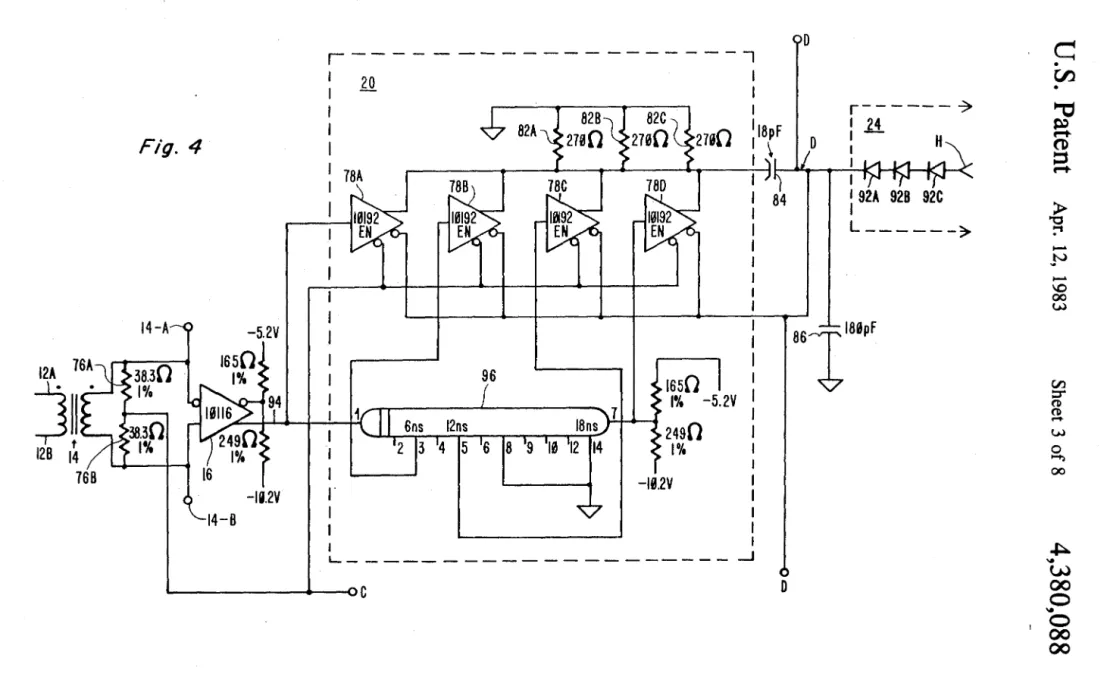
FIG. 4 is a schematic circuit diagram of the signal-40
generating portion of the transmitter of FIG. 1; FIG. 5 is a schematic circuit diagram of the guard
circuitry 25 of FIG. 1; ,
FIG. 6 is a schematic circuit diagram of the transmit~
ter squelch, end-of-transmission detector and collision- 45
detect simulator blocks of FIG. 1;
FIG. 7 is a schematic circuit diagram of the collision detect, receive squelch and threshold setting portions of the receiver of FIG. 2;
FIG. 8 is a schematic circuit diagram of the band-pass 50 filter and amplifier portions of the receiver of FIG. 2;
FIG. 9 is a schematic circuit diagram of the d.c.-to-d.c. converter of FIG. 3; and
4
The cable driver 20 is a current source which gener-ates the transmit signal applied to the coaxial cable 22 through an isolation circuit 24.
-The transmitter squelch circuit 18 monitors the
sec-ondary winding of transformer 14 to determine whether the host is sending any signal for transmission. When no signal is being supplied, transmitter squelch 18 disables cable driver 20 so that no spurious information will be transmitted.
Isolation circuit 24 prevents a short circuit in the transmitter from shorting out the cable. As will be ap-parent from the discussion below, other circuitry in the transceiver intentionally may short out the transmitter or a component failure may do so.
To protect against the possibility of either the cable driver 20 or the host getting stuck on in an active, trans-mitting mode (which would, of course, prevent other transceivers from gaining access to the cable 22), one or more guards circuits 25 are placed across the output of cable driver 20. The purpose of guard circuits 25 is to short circuit the output of cable driver 20 after the time allotted for a transmission packet, so that the transmitter does not continue to transmit into the network.
Although a single guard circuit should be adequate, multiple guard circuits may be employed for redun-dancy and high reliability. If more than one guard cir-cuit is used, all are wired in parallel.
Each guard circuit includes a guard switch 26 and a guard switch timer 28. Each guard switch is separately controlled by an individual guard switch timer 28; all of the guard switch timers, however, are controlled by a single guard driver circuit 32.
The rules of such a network (i.e., its communications protocol) normally define a maximum transmission packet length, at least partially for the purpose of insur-ing that one user does not monopolize the channel. If
the host device at a particular station violates this rule for some reason, or the cable driver sticks on and trans-mits noise or a d.c. level after the host has stopped supplying a message, guard switch timers 28 and guard switches 26 provide a means for disconnecting the in-volved transceiver from the network so that other users are not unduly inconvenienced. This isolates the prob-lem to the station which has caused it. To this end, guard driver 32 uses the transmitter squelch signal as an indicator of transmitter activity and starts the guard switch timers running at the start of each transmission. After the time defined by the guard switch timers 28,
the guard switches 26 are turned on, shorting the output current of cable driver 20 to ground and thus effectively removing the transmitter from the network.
The transceiver is further provided with circuitry for testing its collision detection circuitry. This is done by a collision detect or test mechanism 34. The collision FIG. 10 is a schematic circuit diagram of the power
supply regulator of FIG. 3.
DETAILED DESCRIPTION OF AN ILLUSTRATED EMBODIMENT
55 detector test mechanism functionally comprises an end-of-transmission detector 36 and a collision simulator 38. The end-of-transmission detector 36 monitors the trans-mitter squelch signal for a change of state indicating the Referring now to FIG. 1, there is shown a block
diagram of the transmitter portion of the transceiver of 60
the present invention. The computer or other host de-vice (not shown) which communicates via the trans-ceiver supplies information to be transmitted over lines
12A and 12B to the primary winding of an input trans-former 14. The secondary winding of transtrans-former 14 65 feeds a buffer amplifier 16 and a transmitter squelch . circuit 18. Buffer 16, in turn, feeds a cable driver circuit 20.
5
4,380,088
and the transceiver should not be used for transmission until it is repaired.The receiver section of the transceiver is illustrated in FIG. 2, in block diagram form. As shown there, the receiver 40 interfaces with the network cable 22 5 through an isolation circuit 42. There are two signal processing paths in the receiver, both fed from the out-put of the isolation circuit 42. The first path includes a band pass filter 44, an amplifier 46 and an output trans-former 48. The second path includes a low-pass filter 52, 10 a collision detector 54 and a 10 MHz oscillator 56 which is controlled by the collision detector 54 to signal colli-sion detection. The output of the oscillator 56 feeds a transformer 58 through which it signals the host. (All signals to or from the host must be transformer-coupled 15
due to the need for electrical isolation among hosts.) A receiver squelch circuit 62 interconnects the two paths, and gates on the receiver only in the presence of a valid signal.
Low-pass filter (LPF) 52 time-averages the received 20 signal, to provide a d.c. signal indicative of whether information is being transmitted on the cable 22. The output of the collision simulator 38, since it mimics the presence of more than one transmitter signal on the line, is supplied as a second input to LPF 52. Collision detec- 25 tor 54 is a threshold detector which monitors the output of low pass filter 52. If the LPF output exceeds a prede-termined threshold, corresponding to the presence of more than one active transmitter, a collision is indicated and the 10 MHz oscillator 56 is then turned on to signal 30 collision detection.
Receiver squelch circuit 62 also responds to the out-put of LPF 52 by providing a squelch signal to amplifier 46. The squelch signal turns off amplifier 46 when the output of the LPF 52 is so low as to indicate that no 35 signal is being received.
It will be appreciated that the proper operation of collision detector 54 and receiver squelch circuit 62 require the use of stable, accurate thresholds. They are provided by a threshold setting network 64. In addition 40 to the threshold voltages supplied to the collision detec-tor and receiver squelch, the threshold setting network 64 also provides a feedback signal (at point B) whose value is proportional to the threshold signal. This feed-back signal is sensed by a comparision amplifier 72 in 45 the power supply 70 (shown in FIG. 3), to control one of the two power supply output voltages.
Power supply 70, in FIG. 3, employs a d.c.-to-d.c. converter 74 to generate a -10.2 volt d.c. supply from a host power supply of +9.4 to + 15.75 volts. In addi- 50 tion, a shunt regulator 76 provides a -5.2 volt supply derived from the -10.2 volt source. The shunt regula-tor 76 is controlled by a comparison amplifier 72 which compares a voltage established by zener diode 78 with the feedback voltage generated at point B in the thresh- 55 old setting network 64 of FIG. 2. Thus, the actual out-put level of the nominally - 5.2 volt supply is adjusted and regulated so as to maintain the feedback voltage at point B equal to the voltage established by zener diode 78. Consequently, the output of regulator 76 may be 60 greater or less than - 5.2 volts, as required to provide precision setting of the threshold by the threshold set-ting network 64.
FIG. 4 shows the basic circuitry for the transmitter of the transceiver. The signal to be transmitted is applied 65 to the primary winding (Le., leads 12A and 12B) of a transformer 14. The secondary winding of transformer 14 provides the input of a buffer amplifier, or line
re-6
ceiver 16. A pair of matched resistors 76A and 76B are also connected in series across the secondary winding of transformer 14, for impedance matching. A center tap is
provided at the junction of the two resistors 76A and 76B, and is labelled point C. Point C is connected to a similarly labelled point on FIG. 6, at the output of the squelch circuit. The non-inverting output of buffer am-plifier 16, on line 94, provides the signal input to the cable driver 20.
Cable driver 20 is a current source which may be turned on and off to drive the coax cable channel with a binary waveform. The output from cable driver 20, however, is not simply a square wave type of output. It
has been found desirable to provide a staircase ramp rather than an abrupt leading and falling edge transition. Thus, from a square wave input, the cable driver 20 generates a well-controlled symmetric trapezoid wave-form, through a two-pole RC network which gives a 25
ns rise-time. This gets rid of much of the high frequency energy in the binary waveform without phase-distorting the zero crossings. If a square wave had been used, rather than a staircase, larger filter capacitors would have been needed; thus causing unacceptable phase distortion.
In the exemplary embodimentin FIG. 4, cable driver 20 is implemented with four stages, 78A-78D, provid-ing four steps to the risprovid-ing and fallprovid-ing staircase. Of course, a different number of steps also can be em-ployed; the number of stages to be used is at the design-er's discretion, and four has simply been found conve-nient. Each of the stages is a differential current switch having a signal input, non-inverted and inverted out-puts, and a control (Le., enable/disable) input. Except for the signal inputs, the current switches 78A-78D are connected in parallel, with like terminals connected to each other. Their non-inverted outputs are all con-nected to a resistors 82A-82C, which connect to ground, and to one lead of a first filter capacitor 84. The inverted outputs of current switches 78A-78D are con-nected to the other lead of capacitor 84, which connec-tion also provides the cable driver output, at point (or node) D. There are four other connections to node D, as well: (1) a second filter capacitor 86, connected be-tween node D and the transceiver ground; (2) a series string of three diodes 92A-92C connected between node D and the coaxial cable, comprising isolation cir-cuit 24; (3) guard switches 26, connected from node D to ground; and (4) a transmit bias current switch, shown in FIG. 6.
The enable/disable terminals of the current switches 78A-78D· receive an enable/disable signal at point C, from the transmitter squelch circuit of FIG. 6.
In isolation circuit 24, three diodes are connected in series to protect against the possibility of one, or even two diodes short circuiting. Should point D be grounded, diodes 92A-92C become back-biased (open circuits) during other hosts' transmissions, thereby iso-lating the transmitter from the network. Conversely, the sole result of an open diode is to cause single station failure, while leaving the network intact. The isolation network provides important protection, because the transceiver is direct coupled to the network cable.
7
4,380,088
8
driver 20 and effectively disconnecting it from the ca-ble. At the end of an "unstuck" transmission, transistor 112's emitter goes high, turning switch 26A Oil, also recharging capacitor 118 via diode 116 in preparation for a subsequent transmission.
Turning now to FIG. 6, there is shown the remainder of the transmitter circuitry, including squelch and other control circuits.
Amplifiers 152 and 154 plus the associated compon-entry form the transmit squelch circuit. This is a con-ventional type of squelch circuit whose operation will be readily understood from the drawing by those skilled in the art. Accordingly, a detailed explanation is unnec-essary to the understanding of this invention. The times at, for example, 6 nanoseconds, 12 nanoseconds
and 18 nanoseconds of delay. The 6 nanosecond delay provides -the input to the second stage current switch 78B, to tum it on 6 nanoseconds after current switch 7SA was turned on. Similarly, the 12 nanosecond tap is 5 connected to the input of third stage 78C and the 18 nanosecond output drives the fourth stage 78D. Be-cause the current switches 78A-78D are connected in parallel and draw current through the same load, they provide additive outputs, with the amplitude of the 10 output signal increasing each time another one of those switches is turned on in their machine-gun firing se-quence, thereby providing the staircase signal. Resistors 82A-82C and capacitors 84 and 86 provide a two-pole
RC fIlter for smoothing the output signal. 15 squelch circuit monitors the transmit signal from the host (which appears across points 14-A and 14-B, the secondary leads of transformer 14) and provides two outputs, the cable driver enable/disable signal which is Referring now to FIG. 5, guard circuits 25A-25C for
shorting the output of the cable driver 20 are shown. The guard circuits comprise a plurality of switches 26A-26C connected in parallel, each having one termi-nal connecting to the transceiver ground and the other 20 terminal connected to node D. The switches are all controlled by a common driver 32 (gate 108 and transis-tor 112); and the driver is operated by a signal supplied at point E, which indicates the start of each
transmis-sion. 25
In the exemplary embodiment, the transceiver uses three guard circuits 25A, 25B and 25C, connected in parallel. The guard circuits are identical to one another. The number of guard circuits employed is at the design-er's discretion, since multiple guard circuits merely 30
provide redundant protection and reduce the statistical probability of functional failure in the transceiver which "brings the network down." When three guard circuits are employed, of course, the chances of them all being out of commission is much lower than the chance for 35
one guard circuit alone being out of commission. Since all of the guard circuits are identical, only guard circuit 25A will be explained in detail, it being understood that the same explanation applies with
re-spect to the other guard circuits. 40
Guard circuit 25A comprises a guard switch 26A and a guard switch timer 28A, which includes transistors l02A, 104A and 106A, plus their associated compo-· nents. Guard switch transistor 26A is connected as a simple common emitter switch with its emitter attached 45 to the transceiver ground and its collector attached to the node D of FIG. 4. When actuated, the switch tran-sistor 26A shorts out node D to ground. It is open only when there is a valid signal to transmit. A guard circuit driver comprising ORINOR gate 108 and transistor 112 50 controls the operation of guard switch timer 28A.
A "stuck on" current switch 78A-78D will draw current from the guard switch(es) rather than the net-work.
When the signal at connection point E from the trans- 55 mitter squelch circuit of FIG. 6 changes state to indicate the beginning of a transmission (i.e., it goes high), tran-sistor 112 emitter goes low and diode 116 becomes back biased, allowing resistor 122 to discharge capacitor 118. Resistor 122 controls the rate at which capacitor 118 60 discharges. When capacitor 118 is discharged suffi-ciently, the voltage across it turns off transistor 104A. Transistors 104A and 106A are an emitter-coupled pair, so when transistor 104A turns off, transistor l06A turns on, activating switch 26A and driving transistor 26A 65 into saturation. Thus, a predetermined time after the . beginning of a "stuck" transmission, all of the guard switches are turned on, shorting the output of cable
provided on line 156 (point C) and the complement to that signal which is provided on line 158.
Transistors 162 and 164 comprise an emitter-coupled pair. The base of transistor 162 is driven by the nonas-serted output of amplifier 154, on line 156. The collector of transistor 162 supplies an output signal at connection point E, which connects to a similarly labelled point on FIG. 4 to drive the guard circuit driver. The signal at point E is essentially an inverted and level-shifted repre-sentation of the signal on line 156.
Transistor 164 is driven at its base by the asserted output of amplifier 154, on line 158. The collector of transistor 164 provides a transmit bias which is con-nected to point D on FIG. 4. During transmission, tran-sistor 162 is turned off and trantran-sistor 164 is turned on. The signal on line 158 from amplifier 154 also feeds transistor 172 through capacitor 174 and resistors 176 and 178. At the end of a transmission, when the squelch changes state, a spike or pulse approximately one micro-second wide is produced at the emitter of transistor 172 due to the effect of differentiation produced by capaci-tor 174. This turns on transiscapaci-tor 182 for a like duration and produces a collision test signal at the collector of transistor 182, which is shown as a point F to be con-nected to a similarly marked point on FIG. 7, in the low-pass filter of the receiver.
The collision test signal simulates the effect of a colli-sion by drawing excess current through the receiver input at the end of every packet transmitted. Transistor 204 isolates the collision test signal from the network, so it is not seen by other stations; only the transmitting station responds to it. Further, this collision test does not suffer from "single point of failure" problem. The host, of course, must check at the end of each transmis-sion for the presence of the "collitransmis-sion signal" generated by the collision test signal.
Attention is now directed to the aforesaid FIG. 7, which illustrates the low-pass filter, receiver squelch, collision detector, collision oscillator and threshold setting circuits. Connection point H is the receiver input from the coaxial cable (and, of course, the transmitter output, as well). It is attached to a fusible resistor 202 which provides protection against a short circuit in transistor 204 having any adverse impact on the net-work. Transistor 204 is connected as a unity gain emit-ter-follower. A current source comprised of transistor 206 and resistor 208 biases transistor 204 so that it is always conducting.
9
4,380,088
provide an emitter-follower circuit configured as a three-pole low-pass filter; The output of the low pass filter; on line 232, represents the average value of the signal on the cable, offset by the base-emitter voltage drops of transistors 204 and 214. The signal on line 232 5 is compared against two thresholds. One threshold is used to determine whether there is a single signal on th'! cable (in which event the receiver squelch should be turned off) and another threshold is used to determine whether there are two or more signals on the cable (in 10 which event a collision is indicated). These thresholds are applied, respectively, to the inverting input 234 of a differential line receiver which is used as a comparator Z36 and to the inverting input Z38 of a similar compara-tor 142. The signal on line 232 is supplied ~o the non- 15 inverting input Z44 of comparator Z36 and, through a resistor Z46 to the non-inverting input Z48 of compara-tor 142.The two thresholds are set by a precision current source comprising transistor 252 plus a compensation 20 circuit comprising transistors 258 and 262. The base of transistor ZS2 is connected to the - 5.2 volt supply and its emitter is connected to the -10.2 volt supply through a resistor 264. Resistor 264 is a high precision resistor; the voltage across it sets the emitter current of 25 transistor 252. The power supply adjusts the precise value of the regulted output (which is nominally -5.2
volts) to achieve the desired current through resistor
264. To this end, the voltage at the emitter of transistor
252 is sensed by the power supply and a connection to 30
the power supply is shown at a point labelled B. Tran-sistor 258 is connected as a similar current source with an emitter resistor 266 having the same value as resistor
264, to produce the same emitter current.
Transistor 262 is the load for current source 258 and 35
its sole purpose is to draw a base current into transistor
262 which will raise the current drawn through resis-tors 268 and 272 by an amount which very nearly equals the difference between the collector current and emitter current of transistor 252. Thus, transistor 262 is in- 40 tended to compensate for the fact that transistor 252 has a finite current gain as a result of which its collector current does not exactly equal its emitter current, by pulling a current through resistors 268 and 272 which is very close to the emitter current through resistor 264. 45
Preferably, transistor 252 and 262 will be provided on -the same substrate so as to provide matching current gain, and thereby set the current in resistors 268 and 272
exactly equal to the emitter current of transistor 252.
The actual threshold voltages are developed across 50 resistors 268 and 272 plus the sum of the base-emitter drops across transistors 254 and 256. Transistors 254
and 256 are used to match the corresponding base-emit-ter drops of transistors 214 and 204.
Preferably, transistors 256 and 204 will be provided 55 on the same substrate so that their base-emitter voltage drops will match and transistors 254 and 214 will also be provided on the same substrate, for the same reason.
The signal provided on line 232, to be compared with the reference thresholds, is produced by filtering the 60
sum of the signal received over the coaxial cable and the collision simulation test signal supplied at point F.
The comparator 236 drives a buffer amplifier 274, the output of which provides the receiver squelch signal at point K, which is connected to the similarly labelled 65
point in FIG. 8.
The comparator 142 detects whether the collision threshold has-been exceeded. In turn, it drives a buffer
10
amplifier 276 which turns on and off a 10 MHz oscilla-tor formed by ORINOR gate 278, capacitors 282 and 284, inductor 286 and resistor 288. The OR/NOR gate
278 provides a balanced output for driving a trans-former 292 through which a collision presence signal is supplied to the host device.
Turning now to FIG. 8, the receiver circuitry will be explained in detail. The receiver gets its input at point L, the emitter of transistor 204 in FIG. 7. Resistor 302
and capacitor 304 filter out the high frequency compo-nents in the received signal. Transistor 306 is an emitter follower which acts as a buffer and provides a low impedance output to drive a high pass filter comprising capacitor 308 and resistor 312, on the non-inverting input of a differential line receiver amplifier 314.
The output of amplifier 314 feeds another buffer am-plifier stage 316. The receiver squelch signal from am-plifier 274 (connection point K) is also connected to the output of buffer amplifier 316. Since this is emitter-cou-pled logic, if the output of either amplifier 274 or ampli-fier 316 is high, then their common connection (point K) is high. Thus, the output of amplifier 316 is squelched, or turned off, by maintaining the output of amplifier 274 high.
The output of amplifier 316 also feeds the non-invert-ing input of another amplifier stage 318, which then feeds an OR/NOR gate 320. Gate 320 provides gain and also presents a balanced differential output signal to drive a transformer 322 through which the receive signal is communicated to the host device.
In FIG. 9, circuitry is provided for a d.c.-to-d.c. con-verter useful in the power supply of the present inven-tion for converting +9.4 to + 15.75 volt power from the host or other source to -10.2 volts. The details of the d.c.-to-d.c. converter are unimportant in terms of understanding the present invention; other converter circuits could be employed just as well and the design of power supplies, including the design of such converten, is well-developed in the electrical arts. Thus, for pur-poses of this explanation, it is sufficient to note that the d.c.-to-d.c. converter 74 receives a positive voltage at terminal M relative to an input power return, or ground, at terminal N and that it supplies an output voltage at a terminal P relative to an isolated transceiver ground at terminal R. A co-operating voltage regulator shown in FIG. 10, is connected to terminals P and R. This volt-age regulator also supplies a feedback signal to a point S in the converter, responsive to which the d.c.-to-d.c. converter adjusts its output voltage.
Turning now to FIG. 10, the regulator circuitry is shown 'for taking the unregulated voltage supplied at terminal P, regulating it at -10.2 volts and providing a further regulated output of - 5.2 volts at point T.
A 4.3 volt zener diode 78 is connected across the 10.2 volt supply through a series 590 ohm resistor 358, to provide a precise reference point 4.3 volts above (i.e., more positive than) the nominally -10.2 volt supply, at the non-inverting input 359 of operational amplifier 360.
A precision resistive divider network 362 and 364 is designed to provide 4.3 volts at the inverting input 366 of amplifier 360 when the voltage across terminal points R and P is precisely 10.2 volts. The output of amplifier
11
4,380,088
12
differs from 10.2 volts. The d.c.-to-d.c. converter 74 responds to the feedback signal at point S by adjusting its output so-as to eliminate any error signal.
The 4.3 volt signal across zener diode 78 is also ap-plied to the non-inverting input of comparision ampli- 5 fier 72, as a reference for the - 5.2 volt supply. Unlike the -10.2 volt supply, however, the output of the -5.2 volt supply is not forced to bear a definite relationship to the zener diode voltage. Rather, a particular point in the threshold circuit (powered from the - 5.2 volt sup- 10
ply) is forced to have a definite relationship to that voltage. The inverting input of amplifier 72 receives the signal generated at point B of FIG. 7, the current source for the threshold-setting network. The output of ampli-fier 72 controls a shunt regulator comprised of transis- 15
tors 372 and 374, as well as capacitors 376, 378, 382 and 384, to provide a regulated -5.2 volt output at point T.
The resulting precise regulation is at point B, where it has direct effect on the precision of threshold-setting.
Amplifier 72 senses a point remote to the power sup- 20 ply itself, where a specific voltage (equal to the zener diode voltage) should appear; it compares the sensed voltage with the reference voltage established by the zener diode and drives the shunt regulator output to force the remote, monitored voltage to equal the refer- 25
ence voltage. Any deviation between the two produces an error signal which causes either transistor 372 or 374 to be driven harder, thus shifting the electrical position of their emitter connections relative to the 10.2 volt
supply. 30
This circuit thus permits a single zener diode refer-ence to be used to regulate two different supply volt-ages, one in the power supply and the other in one of the circuits powered by the supply.
3S
40
45
50
55
60
Having thus described the invention, it will be appar-ent that various modifications, alterations, and improve-ments will readily occur to those skilled in the art. Ac-cordingly, it is intended that such alterations, modifica-tions and improvements as are obvious herefrom be included within the scope of this invention. The inven-tion is intended to be limited only as defmed in the appended claims, the foregoing description being iIlus-trative only, and not limiting.
Having illustrated and described my invention, I claim:
1. In a transceiver for connecting a host device to a multiple access data communications network of the type employing carrier-sense collision detection control techniques, and wherein the transceiver includes a transmitter and a receiver, the transmitter including a squelch circuit for providing a squelch signal to control the enabling and disabling of the transmitter output, and the receiver including means for detecting collision-s-Le., mUltiple transmitters simultaneously transmit-ting, the improvement comprising:
(a) end-of-transmission detector means responsive to the squelch signal, for providing an end-of-trans-mission signal at the conclusion of a transend-of-trans-mission; and
(b) collision simulation means, responsive to the end-of-transmission signal, for providing to the receiver a signal simulating a collision,
whereby the means for detecting collision is tested automatically at the end of every transmission. .2. The apparatus of claim 1 wherein the signal pro-vided to the receiver by the collision simulator means is a pulse of predetermined amplitude and duration.