Eidgenbssische
Technische
Hochschule
Zurich
Niklaus Wirth
Institut
fur
Informatlk
Programming
languages:
what to demand and
how to assess them
EfiQafiAMMING ~ANGUAGES:
.wtlal ill
UE.M.AND.
ruiD. J:iD..WIII
~~lliU.
N. Wirth. ETH Zurich
The software inflation has led to a software crisis which has
stimulated a search for better methods and tools. This includes
the design of adequate system development languages.
This paper contains some hints on how such languages should be
designed and proposes some criteria for judging them. It also
contains suggestions for evaluating their implementations. and
emphasizes that a clear distinction must be made between a
language and its implementation. The paper ends with concrete
figures about a Pascal implementation that may be used as
yardstick for objective evaluations.
Paper presented at the Syrnp03ium on Software Engineering.
rOOGAAMMING LANGUAGES;
~ III
DEMAND
ANQ HUW IIIASSESS
lliEM
The cost of computing power offered by modern hardware is about
1000 times cheaper than i t was 25 years ago. As a consequence,
computer methods are applied to much more complicated and
sophisticated problems. The result is the manufacture of very
complex and large programs. In this phenomenon of Software
Inflation~ operating systems took the lead. but there are
indications that many application oriented programs, including
data management systems, are bound to become at least as l~rge
and complicated.
In their struggle to build such complex systems, in their
continual fight against logical mistakes and unforeseen
difficulties. against unexpected growth of code and unreached
performance figures, against cost overrun and deadlines,
engineers are groping for more adequate methods and tools. They
range from management and programming principles to testing
techniques and programming larguages. The important role of
programming languages in the design of large systems is now
being recognised [41. In fact, they are indispensible. As a
consequence, interest in bette~ programming languages is
revived, and industrial, governemental, and military circles are establishing committees to design such languages. The programmer and engineer is confronted with the urgent question: what should
we ask of these languages, and what can we expect from them?
This paper will deal primarily with programming languages. But I
am tempted to convey some observations from the hardware front
that reveal a strong analogy to happenings in the area of
language development.
After the first generation of computers had evolved into some
truly large-scale machines, a second generation emerged, the
so-called minicomputers. By that time, the larger machines were
already progrmmed primarily in "higher-level" languages, such as
Fortran. But the minicomputers threw programmers back into the
dark age of assembly coding and bit pushing, consequently
offsetting much of the cost savings in hardware by increasing
cost in program preparation and upkeep. The reason for this
regress was not so much the fact that the minicomputers' stores
were too small to hold a compiler, but that their structure,
order code, and architecture were determined in such an
excruciatingly intelligent way that an automatic compiler was at
a decided disadvantage compared to the cunning machine code
programmer. Now we witness the emergence of the third generation of com put e r s , the so -c all e d m i c ro -p ro c e s so r s • The sam e
phenomenon is repeating itself. Minicomputers have advanced to
the state where most people realise that hand-coding is an
arduous, hazardous, and costly business, and therefore prefer to
trickery is transferred to microprocessors, advertised, taught,
and sold under a new heading: microprogramming. Again, the
primary reason for this movement is the unnecessary and
undesirable complexity that microprocessor designers mould into
their chips during their flights of fancy. The first
commercially available microprocessor is indeed of appalling
baroQueness. Naturally, competitors try to outdo this very
complexity, with the result that successors will in all
probability be worse. Perhaps pocket calculators will repeat
this story a third time.
Why don't manufacturers produce powerful but simple processors?
Because complexity has proven to be a sure winner in attracting
customers that are easily impressed by sophisticated gadgets.
They haven't sufficiently reaslised that the additional
performance of a complex design is usually much more than offset
by i t s intransparency or even unreliability, difficulty of
documentation, likelihood of misappliction, and cost in
maintenance. But we shall probably have to wait for a long time,
until simplicity will work as a sales argument. To be sure,
"simple" must not be equated with "simple-minded", or
"unsophisticated", but rather with "systematic" and
"un com promi sing
to.
A simple de sign re Qui re s much mo re thought ,
experience, and sound judgement, the lack of which is so easily
desiguised in complexity. And here we hit the source of our
dilemma: a simple design that requires more development labor
than a complex design isn't very attractive to a trade-secret
oriented organization in a profit-oriented society.
LANGUAGES
La
INSTRUCTUB III
CONSTRUCT MACHINES?The same phenomenon is chiefly responsible for a similar
development in programming languages. Here, the temptation to
accumulate facilities for specialised tasks is overwhelming, and
the difficulties in finding generally useful, practical, yet
systematic and mathematically appealing concepts are even
greater. They require wide 8xp8rience, ranging from familiarity
with diversified application ar8as, through intimate knowledge
of programming techniques, t~ inSight in the area of hardware
design. Simplicity appears as even less glamorous, and the
possibilities to mend and cover up defects or inconsistencies
are unparallelled. The cost is enormous, when these cover-up
activities have reached their limits. These costs, however, are
usually carried by the customer rather than the designer.
In addition to the general gross underestimation of the
difficulties of good lanquage desqin, there appears to be a lack
of understanding of its' purpose. Dijkstra once remarked that
most programmers adhere to the old-fashioned view that ~
purpQse ~L ~~ programs ~ ~ instruct ~ machines, whereas the
modern proqramml3r knows that ~ OLJrppce
.of.
..c..lU: machinesU
.t..Ilconsider both views as leqitimate, dependinq on the circumstance. A considerable step in the riqht direction will be
taken, when desiqners ~~ proqrammers become actively conscious
of these two views and their fundamental difference.
Unfortunately, so far very few have been aware of them. Let me
therefore dwell somewhat lonqer on this point.
I t has by now become widely accepted that the primary goal of
proqramminq languages is to allow the programmer to formulate
his' thouqhts in terms of abstractions suitable to his problem
rather than in terms of facilities offered by his hardware. Yet
we encounter the phenomenon that most programmers, although
using higher-level languages, know the representation of their
program and data in terms of computer code to a surprising level
of detail. The result is that their programs often make active
use of this hardware-oriented knowledge and cannot be understood
without i t . One is tempted to conclude that these programmers
have not recognized the true objective of their language: To
allow the precise, formal specification of abstract machines.
But the languages too must take part of the blame. Most
programmers today start their career ~y learning a higher level
language, for example Fortran. After a few attempts at program
testing, the programmer finds out that knowledge of the
computer's architecture, instruction code, and - above all - its
data representation is a necessary ingredient of this
profession. For, i f something "unexpected" happens, the computer
replies not in the programmer's language - i.e. in Fortran - but
in terms of its own, which consists of cryptic words and octal
or hexadecimal numbers. This leads the novice into the "real
world" of computing, and he realises that the constructs
properly described in his manual are but a small subset of what
the computer can actually do. For example
1. logical values are represented like numbers, and space can be saved by packing many of them into one "word". Selection of
individual bits can be achieved by appropriate arithmetic,
since the language doesn't really know whether the data
represent a set of logical values or a single number.
2. an array element with index 0 can be simulated by declaring a Simple variable one line ahead of the array which starts with index 1. The zero index elemen·t can then for example be used as a sentinel in a linear search through the array.
3. the control variable in a DO statement after termination has
a value which is equal to the DO-limit plus 1 (if the step is
as usual - unity).
4. a modulo operation on an integer variable by a power of 2 can
be programmed by an .AND. opera tion (i f the in tege r is
5.
1~ characters are packed into one word and can be extractedby suitable arithmetic and .AND. operations. For instance7
two such 1~-tuples can be compared by a single subtraction
(and the result is correct, if both operands start with a
letter or a digit less than 51).
In all these cases, the main culprit is the language that does
not provide suitable constructs to represent in a proper astract
way those features that the computer itself possesses. I t is
only natural that language designers therefore aim at
introducing these facilities in newer languages. This leads to
the introduction of a richer set of data structures, strings,
sequences, etc.7 but unfortunately we also find features that
are patently machine-oriented 'rather than corresponding to any
well understood mathematical abstractions and objects. For
example:
1. the label l i s t (called switch)7 permitting an indexed jump,
and the label variable permitting "assigned go to".
2. the address 7 reference, or pointer to variables and points in the program7 and the use of ordinary arithmetic operations to manipulate them.
3. the interrupt as an event or "on-condition".
4. the bit-string as a set of logical values7 denoted by octal
numbers.
5.
the Equivalence statement permitting the sharing of store fordifferent sets of variables (supposedly used during disjoint
intervals of the computation).
Now what could be wrong with these features? I t is the fact that
they neither help the pro~rammer to think in terms of structures
suitable to his problem, nor enable a compiler to double-check
the legality of the progra~ statements within a well-defined
framework of abstraction. I~stead7 they merely represent
structures suitable to the machine disguised in the costume of a high-level language7 and they leave the task to find appropriate applications up to the programmer. Hence, the advantage of using
a language with these features over using assembly code is only
marginal. rerhaps i t increases a programmer"s productivity, if
measured in lines of code per day. But the far more important
task of increasing a programmer"s ability to find structures
most appropriate to the original problem, to find inherently
effective solutions, and to design reliable programs, is
affected to a much lesser degree.
In order to illustrate this subtle but important point let me
offer you the following language constructs as alternatives to
1. Instead of a label l i s t and an indexed go to statement, introduce a selective statement. It not only eliminates the need for explicit labels and jumps, but makes the choice of precisely one of several statements much more obvious.
switch G - L1, L2, L3, L4:
~ S[ i+l1 :
L1: statement-0: ~ L5:
L2: statement-1:
Jl..C...t.c
L5:L3: statement-2: ~ L5:
L4: statement-3: ~~ L5:
L 5:
~ i
.c..t:
0: statement-0: 1: statement-1: 2: statement-2: 3: statement-3
.aw1
In the above pieces of programs, one of four statements is to be
executed, namely statement-0 in the case of variable i having
the value 0, statment-1 in case i=1, etc. This is concisely and
naturally expressed by a case statement [81 • Instead.,. the
Algol-60 program at the left uses a goto statement referring to a
switch declaration, in analogy to an indexed branch instruction
in assembler code.
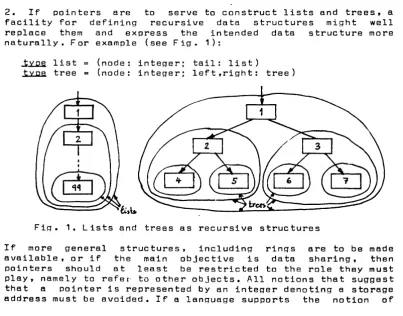
2. If pointers are to serve to construct lists and trees, a
facility for defining recursive data structures might well
replace them and express the intended data structure more
naturally. For example (see Fig. 1):
~~ l i s t
~ tree
=
(node: integer: tail: l i s t )
(node: integer: left,right: tree)
Fig. 1. Lists and trees as recursive structures
If more general structures, including rings are to be made
available, or if the main objective is data sharing, then
pointers should at least be restricted to the role they must
play, namely to refer" to other objects. All notions that suggest
that a pointer is represented by an integer denoting a storage
[image:7.543.66.470.292.608.2]data types, each pointer should be restricted to point to one
type of object only. This permits an inexpensive compile-time
check to prevent many common and costly errors 1n the use of
pointers [9]. For example:
DECLARE
1 TREE_NODE CONTROLLED (CURRENT)
2 KEY FIXED BINARY, 2 . (LE F T ,R I G H T ) POI N T E R ,
1 LIST_NODE CONTROLLED (CURRENT) 2 KEY 1 FIXED BINARY"
2 (NEXT ,TREE) POINTER" ROOT POINTER STATIC
~ treenode
-record key: integer: left,right: treenode
.w::u1 :
listnode
-record key: integer: next: listnode: tree: treenode
.aru1 :
~~ root: listnode
The above pieces of program" expressed in PL/r at the left and
Pascal at the right, allow to generate a data structure
consistinQ of a ring of listnodes which are the roots of binary
trees (see FiQ. 2). The danger of the PL/I formulation lies in
the circumstance that treenodes may be inserted inadvertantly in
place of listnodes and vice-versa, and that a reference to one
kind of node is possible under the misbelief that i t is a node
of the other kind. Such an error cannot even be detected at the
time of node generation. In the Pascal version, this kind of
confusion would already be detected at compile-time" because of
the distinction of pointers to listnodes from pointers to
treenodes.
F1n.2. Rinq of tree strur.tures
3. An interrupt is a hiqhly machine-oriented concept that allows
a Single proc~ssor to participate in the execution of several
interrupt has no place as a concept, or i t is desipned to express the concurrency of several sequential processes. In this
case a suitable form of synchronization opp-rations must be
found, but aqain the interrupt as a concept is inappropriate,
because i t refers to 0 processor (machine) instead of a process
(conceptual unit of the abstract algorithm).
4. The bitstrinp or word, i f used as a set of logical values
could well be represented as a Boolean array with indices
ranginq from 1 to w (where w is the wordlength of the computer).
However, the denotation of constants of this type is usually by
octal or hexadecimal numbers, which are conceptually foreiqn to
the notion of loqical values. A more natural concept that can
very well be implemented by bitstrings is the ~ (of integers
between 1 and w) •
.Q.i.ll b b :
=
1328:I I
b [4] .tb..wlb1
.a.ru.t
b2~ s: set
s := {2,4,5,7}
.if.
4 ~ s.th..e.n
s1
*
s2 (set intersection)5. The dangers of a facility like the Equivalence statement to
share store lie not so much in the conceptual realm as in the
pitfalls of its application. I t is too easy to forget the fact
that the different stets of variables should be mutually
exclusive in time. Hence, a facility that does not necessarily
advertise shared use of store, but instead implicitly allocates
and frees store as needed, would be preferable by far. This is
precisely the effect achieved by the facility of variable
declarations local to procedures of Algol 60. I t enables a
compiler to guarantee that inadvertant use of the variable under the wrong name is impossible.
COMMON A ,8
EOUIVALENCE A ,B .,gro ced u re p1( )
:
SUBROUTINE S 1 ( ~a: T 1 :
.
.
.
A.
..
.ll..aiU..n.
••• a ••• .aru1 :END
SUBROUTINE S 2( r;H:!::I!;
a
d !.,u: ~ P 2( ):
B ~ b: T 2:
END ~ ••• b ••• !Uli!
I believe that there will be no real progress until programmers
learn to distinguish clearly between a language (definition) and its implementation in terms of compiler and computer. The former
must be understood without knowledge of the latter. And we can
only expect programmers to understand this vital distinction, i f
language designers take the lead, and when implementors and
manual writers follow that lead.
Hence, we conclude that the first criterion that any future
programming language must satisfY7 and that prospective
customers must ask for, is ~ ~mplete definition withOyt
reference ~ comoiler ~ ~omDuter. Such a definition will
inherently be of a rather mathematical nature.
To many hardcore programmers, this demanu perhaps sounds
academic and (nearly) impassible. I certainly have nat claimed
that' i t is easy! I only claim that i t is a necessary condition
for genuine progress. I even have considerable sympathy for
abjections and reservations. Given a particular problem and
confronted with one's installed hardware, one is often close to
the paint of despair when trying to maintain these high
aspirations. I t is therefore precisely the criterion where most
language designers - often unconsciously - compromise and fail.
One may argue legitimately that there will always remain certain
aspects of hardware that will be particular i f nat peculiar and
that ~ be utilized and programmed as well (evidently
enforcing the "old view" upon the programmer). We mainly think of interfaces to peripheral equipment, input/output devices,
on-line sensors, or machinery to be controlled. But even in this
area we must aim at a much higher standard of functional
definition. Until this is widely achieved, language designers
are well-advised to provide a facility to delineate modules
within which certain device dependent language features are
admitted and protected from access from elsewhere in a program.
Such a facility, i f well designed, would obviate the hitherto
common practice of using several languages of different "levelS"
in deSigning a large system. This is a point of considerable
practical importance, because interfacing between different
languages (and operating systems) is precisely the occasion that
most frequently forces programmers to step down to the "bit
pattern level" as the only cOmmon ground of all implementations.
Hence, I recommend that a future language must provide a
mpdylarization facility 1Lhi.c.h ·"ntrpduces .wuI. encapsylates A..Q
abstract ~pnceot. Such concepts can then be built out of
concepts defined in lower level modules, and will express
composite objects and actions on higher levels. This
modularization facility is instrumental in keeping the size of a
language - measured in terms of the number of data types,
operators, control structures, etc. - within reasonable bounds.
Without i t , the temptation to include an additional feature each time a new application comes to mind is enormous. I t can hardly
be resisted, i f there is no provision for expressing i t in a
closed and protected form within the 1anpuage.
This leads us to another criterion for judginq future language
proposels: their ~. We have witnessed t h e ' traumatic effects
of languages of extreme size, whose descriptions comprise
the disguised purpose to disguise confusion. A journey through
the world of programminrr lanquage manuals is indeed a soberinq
experience. The failure to distinguish between language
definition and compiler description, between the meaning of
language constructs and restrictions imposed by an
implementation, between essential and incidential, has already
been mentioned. But I must point out a common deficiency of even
more fundamental nature: poor mastery of (natural) language.
This phenomenon is unfortunately very widespread not only in
manuals but also in the prolific computer science literature. I t
is not my intention to recommend the practice of embellishing
imprecise thoughts with artful language, but I advise any author
to straighten out his thoughts until simple words suffice to
express them. In programming, we are dealing with complicated
issues, and the more complicated an issue, the simpler must be
the lanquage to describe i t . Sloppy use of language - be i t
English, German, Fortran, or PL/1 - is an unmistakable symptom
of inadequacy.
Hence, our next demand addressed to future language designers is
conciseness ~ ~larity ~ description, and sound ~~ ~
langyage. To give a concrete figure, the definition of a
language, comprising its syntax specifying the set of
well-formed sentences, and its semantics defining the meaning of
these sentences, should not extend over more than 50 pages. This
primary document should be accompanied by separate documents
describing implementations, their limitations, effectiveness,
and their reactions to ill-formed programs. The total length of
these documents should be not more than 25 pages, and they ~
~ written
in
~ ~, devoid ~ ill-defined technicaljargon. Anything else is unacceptable, regardless of the
hiqh-level committees sponsoring the product, the pressing ecomonic
reasons, the urging of politicians to promote international
cooperation, governmental blessing, or even commercial
advertisement campaigns. On the contrary, the appearance of such decor must be taken as a call for extra vigilance.
Technical ~riteria £~ jydging ~ langyage implementation
My insistence on separating the language, its syntax, and i t s
semantics as an abstract entity on the one side, and its
implementation as a concrete tool on the other Side, should not
be interpreted as emphasis of ·the abstract at the expense of
technical realities. We cannot close our eyes to the fact that
programs are developed exclusively either to be executed by
computers or as academic exercises. Hence. to most people a
language is at most as good as its compiler. My point is that we
should not waste our time evaluating a compiler until we have
closely examined the language. However, i f a language has shown
to be conceptually sound, what are the criteria to judge a
The compiler ~ ~~ totally reliable. This requirement is three
fold. First, i t implies that every program is checked against
~ ~~ ~~
A£
~ha ~anguage, that no formally incorrectprogram be allowed to pass without an indication. Second~ i t
implies that any correct program is translated correctly. All
efforts of systematic design, program verification, etc. rely on
total compiler correctness. Third, no incorrect program can be
allow~d to cause the compiler to crash. These are very stringent
conditions not only, for the compiler engineer, but also for
the language designer. For, under this rule the hardships of the
former grow exponentially with the generosity of the latter.
Consider, for example, the case where a language definition
contains the rule that there may be no procedures exerting
so-called side-effects on non-local· variables. Then we ask that a
compiler be able to detect such side-effects.
Inspite of i t s exhaustive checking facilities, a compiler must
compile ~ reasonable ~. This is particularly important when
constructing large programs, such as operating systems and
compilers themselves. The figure of one second per page of
source program is a reasonable figure for a medium size
computer. An efficient compiler makes all desire for so-called
interactive or incremental compilation disappear, and reduces
the need for separate compilability of program parts
significantly. I f part compilation is provided, then the
compiler must be able to maintain full checks for all allowed
interfaces, be they parameters (type compatibility) or global
variables. Otherwise part compilation is a mixed blessing.
The next requirement of a good compiler is that i t generate
efficient ~~. This does not mean that every single odd
facility of the hardware has to be utilised at all cost. But i t
implies the selection of reasonably obvious code, and in
particular the lack of virtually any kind of run-time support
routines. A most crucia} point is an effective code for
procedure calls.
A related requirement is that t~',e execytion ~ of the code be
reasonably predictable. There must be no circumstances where a
language construct suddenly becomes drastically more expensive,
if used in a certain special context. The programmer should have
the possibility to understand the approximate costs of all
language constructs. The same holds for the storage space
consumed by code and - even more important for data. For
example, an implementation where the efficiency of access to
indexed variables depends on the lower index boend being 0 or
not, is rather undesirable. So is a system where the storage
requirements of the two rectanqular arrays
a1: array[1:2, 1:1~001 ~ inteqer
are very different.
The compiler itself should also be reasonably ~omQact. Bulky
compilers are u5ually inefficient too. particularly because
loadino is costly and inconvenient, and because the job priority
will be lower - assuming a fair scheduling policy - if a large
store is requested. This point is even more essential in
interactive environments, where a system's swappinp activity is
greatly increased by colossal compilers.
Once again. let me emphasise the feedback on lanquage design:
these requirements postulate nothing less than that the deSigner
must be intimately familiar with all techniques and details of
implemen ta tion •
A compiler must provide a simple ~ effective interface ~ ~
environment. its file system, and/or its input and output
devices. This places the requirement on the language design that i t should reflect such objects in a decent way. The compiler and
its code should not impose any adoitional overhead through such
an interface, as for example ~xtra buffering of transmitted
da ta.
All preceding reqUirements concern the programmer directly.
There are additional ones. stemming "from considerations of
compiler maintenance problems. One is that the compiler ~
written
in
~ ~ langyage (always assuming that we areconcerned with a general purpose programming language). A
compiler written completely in a high-level language is
immeasurably easier and safer to adapt to changing environments
and demands. Only such a description enables you to pinpoint
possible mistakes in a short time and to correct them
immediately. Moreover, i t is the best guarantee that the
implementor has taken care to produce a good compiler; not only
because sloppy work becomes much more subject to scrutiny by
customers. but also because an effort to generate efficient and
compact code immediately pays off in increased performance of
the compiler itself.
If a language and i t s compiler are both of sufficient quality to
define and process themselves, i t also becomes economical to
abandon the concept of "binary program libraries" and to collect and retain proprams in their source form alone.
All these requirements more or less directly influence the
design of a language itself. They all suggest a great deal of
restraint of the designer against his flights of fancy. The most
important argument for this point comes from the compiler
engineer: ~ develooment ~~ ~£ 2 compiler should stand in a
proper relationship to the advantages gained by the use of the
language. ~ ~ ~~ ~ individyal langyage features.
amount of effort neoded to implement a feature under the presence of various other features. Very often such costs cannot be indicated without consideration of context.
For example:
1. The cost of implementation of dynamic arrays is negligible,
if arrays cannot occur as components of other structures. If
they can, the problem is very much more complex.
2. Packed data structures are relatively straight-forward to
implement, if all structures are static, i.e. if all their
characteristics are constant and known at compile-time. The
difficulties multiply, if dynamic structures are allowed, or
if merely a static packed structure can be passed as 3
parameter to a subroutine, in which its size is unknown.
3~ Implementation of sequential files becomes drastically
complex, if the file elements are allowed to vary in
(size), whereas this freedom has l i t t l e effect on
complexity of compiling arrays.
more type the
Hence, omitted
a proper design is characterised
as by what is included.
equally by what is
~ these ~riteria Q~ m~
I have suggested a number of criteria by which to juqge present
and future language designs and implementations of them. I"admit
that they are rather stringent. I t is important to examine them
critically and, if one has agreed with them, to uphold them,
even i f perhaps one has to abandon some of one's pet ideas on
features that a language should contain.
Postulating stiff criteria i s , however, an easy matter, and
practicing programmers have learned to be suspicious of
academics who preach high- spirited ideals. So perhaps I owe a
proof that i t is indeed pnssible to achieve these postulated
merits by a single language. 1 am prepared to do so by providing
a few figures and facts about the programming language Pascal •
I offer this language only as a yardstick, in full awareness
that Pascal is not the ultimate wisdom in language design,
definition, and documentation. After all, a yardstick that
cannot be surpassed would i l l serve as an encouragement for
future efforts.
First, a brief sketch of the language: Pascal offers a set of
program structuring facilities supporting the concepts of
structured programming. I t includes well-known forms of
conditional, selective, and repetitive statements. Its
subroutines can all be activated recursively, and there are
several kinds of parameters: expressions (by value), variables
declared to be of a fixed type. There nre thn standard types
intener, real, Boolean, and character. In addition, new types
can be defined within the lanquaqe. A scalar type is defined by
enumeratinq i t s possible values, a structured type is defined by
indicatinn i t s structurinn scheme and the type(s) of i t s
components. There are four basic structurinn schemes: arrays,
records, sets, and (sequential) files. In Q~dition, dynamic
structures of any pattern can be constrvcted with the aid of
pointers, with comprehensive and inexpensive checks of the
validity of their use. The lanquaqe is defined by a concise
report of ~n parTes [11,141, and nn attempt has been made to
define i t s semantics by rinorous axioms [1~q •
~econd, a brief sketch of the compiler (developed at ETH for the
COC
():J::n
COMputer family): I t performs A complete check ofsyntax and type compatibility rules. Errors are accurately
pinpointed and care is taken to avoid spurious messar,es. Great
care is taken to qenerate effective cod~. For example
1. neqisters are used in a hiqh:.y efficient \'lay.
2. Address co~putation of components of structured variables is
performed at compile time wherevet possible.
3.
Multiplications and divisions by po~crs of 2 are implementedas shifts.
Lan[Juaqe rules that cannot be checked at compilo-time are
verified at run-time. This incJudes checkinq of indox bounds, of
case expressions, of as~innment compatibility to subranqc
variables, etc. IJpon detection of an illeqal operption, a
SYMbolic post-mortem dump i3 prnviden, listinq currently
accessible VAriables by name and current value.
The cornpiler sUPrJort:; the dC'ltn po.ckinrr facility of PClsco.l. rn a cor r] put e r \'J i t h I a r q c \'/0 r dIe n f1 t h, t his can '.., e 11 1 end t 0 5 a v i. n ~ s a f
stornqe by sizeable factors (up to ~~ on the CO~ system). The
compiler itself profits by this, althnu~h the routines to
implement packed data representations are extensive and
complicated.
~oreover, the compiler provides a smooth interface to the
resident file systen. Files used in a pronran nnd existinG
before and/or after execution' arc clenrly listed as pnrnmeters
in a pro,ram hcadtn~. The co~piler nonorntns standnrd
reJocntable code and allows linkaqe with separately compiled
proceduros.
The sinc:;le-pass compiler requires 2~~;~C words (= 16a~'10 bytes)
for codn and data tn compile small pronra~s, and 23n0C words to
recompile i t s e l f . (ry comparison, the s·tandflrdFortran compiler
requires 2000~ words.) Tho efficiency of the COMpiled corle is
compilation speed is 110 lines of source code per second
(measured when compiling the compiler). Compiling, loading, and
executing the null-program takes 0.3 seconds. These figures have
been obtained on a CDC 6400 computer (roughly equivalent to IBM
370/155 or Univac 1106).
The entire compiler is programmed exclusively in Pascal itself
(16] • There is no assembly code interspersed in the Pascal text.
Every program is supporied by a small run-time routine package
that provides the interface to the computer·s peripheral
processors and the operating system. This nucleus is programmed
in assembly code and occupies just 500 words. Conversion
routines for numeric input and output (including floating-point
conversion) are also described fully in Pascal.
The compiler itself is about 7000 lines long. Hence, i t takes
only 63 seconds of processor time (on a CDC 6400) to recompile
the compiler. By comparison, a cross-reference generator, also
programmed entirely in Pascal, takes 30 seconds to produce an
alphabetically ordered cross-reference table of the co~piler
program.
The latest compiler (ag~n for the CDC 6400) was developed by a
single expert programmer in 16 (full-time equivalent) months
(1,2] • This figure excludes work on the small support package
and the I/O conversion routines. I t was developed according to
rigid discipline and the top-down, stepwise refinement technique
(15]. Its remarkably high reliability is primarily due to i t s
systematic design and the use of a suitable language for coding
i t .
Last but not least, the language Pascal was designed~ ~
ago. The first compiler was operational in late 1970. Since then
the language has undergone extensive use and scrutiny (6,12].
Sufficient practical experience is available to make an
objective assessment of its utility (17], many other compilers
have been or are being developed on other computers (5,13], and
Pascal has already spurred further developments in the direction
of multiprogramming
(3].
So much about Pascal. I t should suffice to convince that the
afore postulated criteria are more than wishful thinking, but
objectives that ~ be achieved, because they already ~ been
achieved to ~ fair degree. My primary conclusion is that Pascal
is a language which already approaches the system complexity,
beyond which lies the land of diminishing returns. One should
therefore be rather critical about new language proposals that
usually start from scratch and rapidly build up to even greater
complexity. I have provided this information and these. figures
in order that future languages - no matter where they come from
1. 1\~1"[1nn 7 11.7 The mnthllL! of structurod proqrummin!1 appliod to
' )
c •
the c1 eve 1 0 rJrn e n t 0 f a c a HI p i 1 e r • I n t rJ r n i) t ion a 1 Com put i n ,~
S Y m PO s i u m 1 r; 7 3 7 f\.. r, un t t \ e r o t i1 1 • ,
r
d s ., r! 0 r t h -f 1 0 1 1 i 1 n d( 1 C; 7·1 ) •
[)io [ntwicklunn nine's f"li1sc:ll-ror'I~Llors nOlcll dar "etllOric des strukturiortr:n Proqramrnir;rens. ETH-Ois:-.• S4~6 (1tJ7S).
3. £lrinch Hansen, P., Tho proqramminn lf1nauDqe Concurrent Pascal, IEEE Trans. on ~oftware Enqineerinn ~, 2, 1r;9-2~7
(1975).
'4. Pronks, F.P. J r . , Thp. r~ythicRI rOan-month. Essays on Software Ennineerinrr, I'.drlison-'."r,slcy 7 !leadinq (1975).
s. Frioslf1nd, G. ot a l . , A Pascal Compiler bootstrapped on a
r
E C -f1 y 5 t C 11 1;', L 0 c t u rc t! 0 t e s i n Com put 0 r r, c ion c n, J., 1 (] 1 -1 1 3(f)prin<;cr-Vorlan 1c)7,1).
6. Habermann, A .~,! ., C ri ticnl commGnts on the proqramminq lanquaqc Poscal, Acta Informatica
J,
47-57 (1r;73).7. Hoare, C.A.n., 'luicksnrt, Computor Journal
.2,
1, 1~-15 (1962).G. --- Case Expressions, Al('To1. flulletin 1n.3.7. pp. 20-22 (Oct.
1964).
9. Record Handlinq, in "Prorrramminrr Lanquaqes", F. Genuys, ed., ACC1.demic Press (1964).
1 {] • and '.'J i r t h 7 t,J • , A n a x i 0 mat i c d 8 fin i t ion 0 f the programming lanquaqe Pascal, Acta Informatica
g,
335-355(1973).
1 1. J ens en, K. and "/ i r t h 7 ~J., PAS CAL - LJ s e r ~. ~ an u a 1 a n rl Rep 0 r t 7
L e c t u r e ~J n t e s i n Com put e r Sci en c e, Vol. 1
n
(1 g 7 4 ) 7 and Sprin!1er Study Edition (1975), both Sprinqer-Verlaq.12. Lecarme, O. and Desjardins, P., More comments on the programminq lanquage Pascal, Acta Informatica ~7 231-243
(1975).
1 3. \" e 1 s h, J • and r:) u inn, C., A Pas c a I com pi 1 P. r for the I C L 19
a :::
series computers, Software - Practice and Experience ~, 73-77 (1972).
14. ~I.lirth, N., The proqramming lanquage Pascal, Acta Informatica
.1,
35 -63 (1 97 1 ) •15. Program development by stepwise refinement, Comm. ACM ~, 4, 22.1 -227 (A p r i 1 1 97 1 ) •
16. - - - The desiqn of a Pascal compiler, Software - Practice anr:! Experience
1,
309-333 (1971).17. An assessment of the ~ro!1ramming language Pascal, IEEE Trans. on Software Engineering 1, 2, 192-19n (1975), and SIGPLAN Notices
JZ,
6, 23-3~ '(1975).A..Qknowledgement
APPENDIX
PASCAL .I~ £rggrams
The purpose of the followinq sample proqrams is to convey an
impression of the character of the proqramminq lanquaqe Pascal,
and to provide some performance fiqures for comparative studies.
These fiqures were obtained on a CDC 64ee computer with the
SCOPE 3.4 operatinq system. The statements "writeln(clock)"
i n die ate the poi n t s w fi ere the tim e was t a ken •
1. G en e ra t e ~ .:tM.l..a ,Q.f. .Q~ .Il.f
.z
This proqram computes the exact values of 2**k and 2**(-k) for
k=1 ••• n, and prints them in the form
2 1 .5
4 2 .25
[] 3 .125
16 4 .0625
32 5 • ~13125
64 6 .015625
orggram powersoftwo(output):
~ m = 3 J: n
=
C) ~ : (* m > = n *10 q ( 2) *)~ exp,i,j,l: intener:
c , r , t : interIer:
d: array
[C ••
m] .Q£ inteaer: f: arrGY [1 •• nl,QL
inteqer:(*positive powers*) (*nenativc powRrs*)
.lli:l£Lin.
1 :=
~~; r : = 1; dr
~~1 • -
1;wri teln (clock):
.f..a..r: e x p :
=
1 .i.cJ. n r1Jlbcnin (*conpute and print 2**exp *)
Lw: i ::; :: ..to. 1
.llil
QQllin t := 2*d[il + c;.if.
t >=
1a
.:tlliln.
.h~ d [ i
1 . -
t -1 :;: c.-~.o.Q ~
Q.a..ui.n d
r
i1 . -
t: c . - 7J~n.Q
.if. c > ~ .!Jl.e..n
ll.lli!.i..o.
1 := 1+1; d[ll := 1~nQ
c . - ~~:
.f..!:U: i : = m dor:nto 1 .Q.o. wri te (. '):
f..Q..r: i : = 1
lill.llil..t.u
~~ Q.Q. \'J r i t B (d [ i1 :
1 ) :writf)(8xP:5,' . ' ) :
(*compute and print 2**(-exp) *) for j
:=
1 ..to. exp-1 Q.Q.lJ.llil.i..o. r :
=
1:~ *r + f [.il :
Wex~1
:= 5; writeln('5'); r := 0 end :wri teln (clock)
.wJJ1 •
This program uses integer arithmetic exclusively. Execution time
for computing the powers of 2 (n-90) was measured as 916 (813)
msec. The finure in parentheses is obtained when run-time index
bound checks are disabled.
2. Palindromic sQyares
A number is a palindrome, if i t reads the same from both ends.
Find all integers between 1 and 1~000 whose squares are
palindromes! For example: sqr(11) 121, sqr(22) 484 7
sqr(2002)
=
40C8C04.program pa1indromes(output);
~~ i , j , l , n , r , s : integer; p: boolean:
d: ~ [1 •• 101 ~L integer:
~ n := 0; '1lriteln(clock):
reo eat n :
=
n + 1; s :=
n *n: 1 : = 0: repeat 1:=
1+1: r:=
s ~~ 1~;d [11 . - s - 1 0 *r; s : = r
~ s = 0; i := 1; j := 1;
rep eat p : = d [ i
1
=d [ j1 ;
i := i+1: j := j-1
..!m..til. (i >= j)
w::
.wU
P:
1£
p ~ writeln(n7n*n)~~ n
=
10000;wri teln (clock)
..aLll1 •
Execution time was measured as 3466 (2695) msec.
3. Qyicksort
This program sorts an array of 10000 integers according to the
method .ca11ed Quicksort [71 • I t uses a recursive procedure. The maximum depth of recursion is In(10000).
prOgram quicksort(output);
~ n
=
10000:~ i,z: integer:
a: ~ [ 1 •• n
1
~L in t e g e r ;orocedyre sort(l,r: inteqer):
..!2ill;:;.i.o. (*quicksort with recursion on both partitions*)
i :=1; j : = r ; x :=o[(i+j).du21;
re oea t
~ u[i1 < x ~~
1Lhill x < CI [il
r:u
.if. i <
=
.i .t.llQ.n~n VI :
=
ar
i1 ;
i := i+1; j :=~.rill
until i > j :
i
.
-.i
.
-a [ i
1
j -1
i l 1 < j
il:!..ill:l
sort (1 ,.i ) ;.i.f i < r
..:tl:uill.
30 r t (i ,r ) ~.n.d (*sort*) :i +1 :
.i -1
:
,
-
o[ :i1
a[il
'-be~in z
:=
1729: (*nenernt8 random soquencn*)~ i := 1 ~~ n Q~
\,. , , ,
.!:ul.£L.in
z : = (1 3 1 ~~ 7 1 * z ) .m.!l.!1 2 1 tl 71ln
3 (-, 4 7: a [ i 1 . - z .lmJj ;wri tel n (clock); so rt ( 1 ,n ) : writeln(clock)
.e.ru1 •
Execution time: 409~ (2061) msec.
4. Count characters ~n £ ~
The followinq proqram copies a text (file of charact8rs) and
counts the transmitted blanks, letters, dinits, special eymbol~,
end li08s. I t also inserts a printer control character at the
be~inning of each line.
Rr00ram countcharacters(input,output);
~ ch: char:
c3,c1,c2,c3,c4: inteqer: (*counters*)
beGjn writeln(clock): linelimit(output, -1): c ~ :
=
~: c 1 :=
0: c 2 . - 0: c 3 :=
0; c4 :=
n;
~ n.tl.t eof (input) .d.a
begin write(' '); c3 := c0+1;
~ ~ eoln(input) ~
~ read(ch); write(ch);
.i.f ch
= '
'.:tb..e.n c1 := c1+'/ ~i.f ch
.in [
'a' •• 'z'1 ..tl:l.lID c2 ,- c2+1 ~.i.E
chi.r:l
['0' .. '9'1..tl:l.lID
c3 .- c3+1 ~ c4 := c4+1~:
readln; writeln ~;
writeln(clock):
writelo(c~,' lin8s');
writeln(c~,' special characters'): w ri tel n (c 10 c k )
~
.
Execution time was measured as 4345 msec for a file with 1794
lines, 23441 blanks, 27331 letters, 1705 digits, and 9516
special characters. This results in an average of 0.068 msec per
character, or 14680 characters per second.
5.
l.L1.wLt
.wll1.
gut 0 y t .l:lL.n
urn b e r sThe next sample proQram generates a file f of 25000 real
numbers, and computes their sum s. Then the file is reset and
read, and a checksum is computed.
~rQgram numericIO (f,output):
cgnst n
=
25000: d a 0.12345:~ i: integer: X,s: real:
f:
.f.i.l.a
.o..E rea 1 :~ writeln(clock):
x := 1.0: s := 0: rewrite(f):
.t:w::
i :.. 1..to.
n .tUl~ write(f,x): s
:=
s+x: x .- x+d.e.ru1 :
writeln(clock, s): re se t (f ): s ::11 0: while .n~ eof(f)~.l:l
begin read(f,x): s
:=
s+x ~:writeln(clock, s)
~
.
I t took 1230 msec to generate the file, and 980 msec to read i t .
This corresponds to 49 usec to write, and 39 usec to read per
number.
The amount of time increases drastically, i f a decimal
representation of the numbers on the file is requested. This is
easily accomplished, namely by declarinQ the file to consist of
characters instead of real numbers: f: ~ .elf. char
In this case, the read and write statements include a conversiun
operation from decimal to binary and vice-versa. Generating the
file then takes 28185 msec, reading takes 30313 msec. This
corresponds to an increase by a factor of 23 in writing and 31
in reading. (Each number is represented by 22 characters on the
6. E..iY.h..t .ll.wle.ll.S
This propram finds all 92 positions of
n
queens on a chessboardsuch that no queen checks another queen [151. The backtrackino
algorithm is recursive.
program ei~htqu88ns(output):
~ i integer:
a ~ [ 1 •• 0 1 ~f boolean:
b array [ 2 .. 161 o..f boolean:
c ~ [ -7 •• 7 1 ~f boolean;
x ~ [ 1 •• 8 ] ~f inteoer:
safe : boolean:
procedure print:
JLfl.l.: k: inte~er: begin write(' '):
.fJ.u: k := 1..to. 8..d~ writc(x[kr.~:2): writeln
.e.n..Q. :
orocedure trycol (j : interIer):
~ i : inteqer:
prgcedure setqueen:
ll.w:I.in a[i] .- false; b[i+j1 .- false: c[i-jl .- false
J;:.nQ :
prgcedure removequeen:
121Uli...o.
a [ i1 :
=
t rue: b [ i + j ] :=
t rue; c [ i -j ] :=
t rue~:
reDeat i := i+1: safe := a[ i1 2..Q..Q b[ i+j] ~ c[ i-j] :
..if: safe .:t.b..e..n
.h..lliI.in set queen ; x[ jl := i :
iL
j < 8 ~ trycol(j+1) ~ print: remove queen!ID.ct
JJn..t.i.l
i=
8beg i n .f..o.I: i :
=
1.:to.
B QQ. a [ i] :=
t rue :.L.P..I:
i := 2 ~ 16 Q.Q b[il := true:.f.o..I: i :
= -
7 j;~ 7 Q.Q. c [ i] :=
t rue : writeln(clock); trycol(1): writeln(clock).an.d •
Run-time: 1017 UJ79) msec.
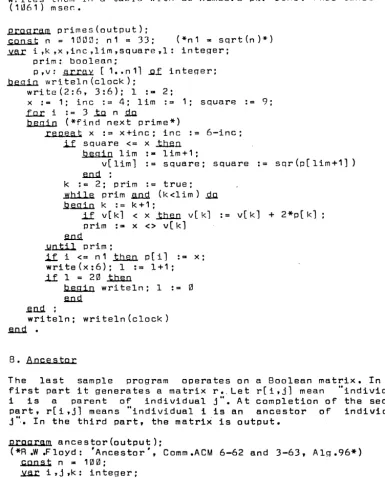
Proqram primlJs computes the first HliHl prime numbers, and writes them in a table with 2~ numbers per line. This takes 1347
(H161)mser..
prggram primes(output);
~ n
=
10aa; n1=
33; (*n1 :0: sqrt(n)*)~ i,k,x,inc,lim,square,l: integer:
prim: boolean;
p ,v: ~ [ 1 •• n 11 Jl.f in t e q e r :
~~ writeln(clock);
wri te (2: 6, 3: 6): 1 : .. 2:
x :a 1; inc := 4: lim := 1: square := 9:
.f..w: i :
=
3.t.a
n!i.e.
~ (*find next prime*)
~~ x
:=
x+inc: inc := 6-inc:1£
square <= x ~n~ lim :- lim+1:
v[lim1 .- square: square .- sqr(p[lim+1])
~:
k
:=
2: prim := true:~~ prim ~ (k<lim)
.Q.a.!U.n. k :
=
k + 1 :.if v[k1 < x .ihSUl v[ k1 := v[ k] + 2*p[ k] prim
:s
x <> v[k]~ ..!In.t.i.l p ri m :
.if.
i <= n1..tlliuJ.
p[i1 := x: write(x:6): 1 := 1+1:I I
1 = 2 0 .t.b..e.n.~ writeln: 1
:=
0Wli1 .aru1 :
writeln: writeln(clock)
.arut •
8. A.ocestor
The last sample program operates on a Boolean matrix. In i t s
first part i t generates a matrix r •. Let r ( i , j ] mean "individual
i is a parent of individual j". At completion of the second
part, r[i,j1 means "individual i is an ancestor of individual
j .... In the third part, the matrix is output.
program ancestor(output):
(*R.W .Floyd: 'Ancestor', Comm.ACM 6-62 and 3-63, Alq.96*)
~ n ... 100:
~ i , j , k : integer:
r: U~ [ 1 •• n, 1 •• n] .Q..f. boolean: ~
(*
r [ i , j ] - "i is a parent of j"*).f..a..t: i : .. 1 ~ n ~
[image:23.553.60.445.93.570.2].uu:
i : = 1.to.
n .d..c.1.f.
i ~ 1~ <> ~.tb..ao. r[i,i+11 :z: true: wri teln (clock):.fJ:u: i : - 1
..t.a
n ..dJl.uu:
j : - 1 .t1l n .Q.c..1.f.
r [ j , i1
.lli.e.n.f.c...t: k : = 1
..t.c.
n .t1.c.1.f.
r[ i ,k 1 .:t..h..ao r[ j ,k 1 :"" true: writeln{clock):.t:..cJ:
i : = 1.:to.
n .!1c.begin write(' '):
.f.c.I: j : ... 1 .t1l n .&1Jl write(chr(ord(r[i,j1 )+ord('~'»): writeln
.wll! :
writeln(clock)
.wui •
I t takes 291 msec to generate the matrix, 1667 msec to execute
the ancestor algorithm, and 578 msec to output the matrix. Since
the matrix consists of 100 * 10~ elements, 100~0 (60-bit) words
of store are needed. If r is declared as
r: Racked array [1 •• n, 1 •• n1 ~L Boolean
then the required store is only 200 words, or 50 times less. The
execution times are then 406 msec to generate, 2126 msec to
computed, and 642 msec to output the matrix. This is only 1.3
times more than in the case of the unpacked matrix
representation.
A second version of the algorithm uses the Pasrial set structure
instead of a Boolean matrix. The relation r[i,j1 is expressed as "j in r[i1". Since the Pascal 6000-3.4 compiler restricts sets
to have at most 59 elements, the following performance
comparison is based on the case n
=
50.~rogram an~estor(output):
(*ancestor algorithm usinn sets instead of boolean matrix*)
~ n
=
53:~ i , j : integer:
r: array [ 1 •• n 1
.c.f.
J;id .Q.f. 1 •• n:begin (* j in r[i1 = "i is a parent of j"*)
Dll:
i : = 1 .t1l n .d..c.i l
i m.w1 10 <> 0 .t.WllL r[ i1 :
=
[i+11 ~ r[ i1 :
= [1: wri teln (clock):.f.l:u:
i : = 1.:t.c.
n .d..I:l. .f.c..J::: j : = 1 .t.ll n .Q.Q.if
i ..in r [ j1
.tb..wl r [ j1 . -
r [ i1
+r [ j1
writeln(clock):
.f.o..l: i :
=
1.to.
n Q.Q.Q~ writr.(' '):
Du: j :
=
1 j;~ n Ji.ll.iL j.ill r[il..tb.tw. writr.('1') ~ write('.');
wri teln
writpln(clnck)
.a.ru1 •
Extract from
PROFESSOR CLEVERBYTE'S ~ ~U HEAVEN
N. Wirth, ETH Zurich
Abstract
The following fable is a grotesque extrapolation of past and
current trends in the design of computer hardware and software.
I t is intended to raise the uncomfortable Question whether these trends signify real progress or not, and suggests that there may exist sensible Limits of Growth for software too.
When I had been dead for several weeks, I began to get a l i t t l e anxious. I had been hovering around, first experimenting with my
novel facilities and freedom from all earthly limitations.
Perhaps I ought to mentien at this point that I had been a
manager of a software house, and my decease had been a direct
consequence of our decision to introduce both a new programming
language and a new operating system at the same time. The
ensuing difficulties were enormous and responsible for my
spending the rest of my life on the job.
So I was disappointed to see how l i t t l e difference my absence
made, in spite of the fact that I had been the only one
intimately familiar with all the details of these new systems. I
realized that a l i t t l e more or less confusion didn't really
matter.
Hence I became anxious to direct my course upwards. FortunatelY
I remembered the report of Mark Twain's Captain Stormfield , and
therefore was neither surprised by my exhilaratino rush through
I expected that i t would be a place of unlimited opportunities
where nothinq was impocsible. This expectation i s , of courS8,
Quite typical of 8 man from the software profession.
Heaven is a complex place, and i t is also astonishinqly modern:
I was taken aback to discover larqe hoards with liqht-displays
and computer terminals used to find your present location as
well as the shortest path to any desired location or department.
The boards l i s t all possible subjects you may think of. They
continually expand as new departments with imaginative names
emerge, one about every second. I readily found Software
Engineering - merely the 0 had been misspelled as an a, perhaps
by a German clerk - and I headed off in i t s direction. As B new
department, i t was located at heaven's periphery, and I marched
for several days.
When I finally reached my blessed destination with sore feet, I
found the Quarters almost deserted. But as luck would have i t ,
shortly thereafter I spotted a man carrying a deck of punched
cards. I was overjoyed when I recognised him as myoId friend
Jonathan- Flagbit who several years ago had switched from
computing to life insurance. "You here, inspi te of all!" I exclaimed: "You don't seem to have kept up with progress" I sneered referring to his card deck.
"Don't jump to rash conclusions, Cleverbyte, I've gone through
all the stages up here, and we've got he most modern equipment
you haven't even dreamt of".
Beinq Quite excited at this prospect, I asked: "May I see your modern equipment?"
"Of course you may, everything is possible up in heaven and even
more so in the Software Department ofer there. All you need is
to make a wi sh, and i t shall be ful filled" •
I told him grudgingly that I could have spared my sore feet had
I known this beforehand, and he replied:
"Every newcomer indulges in wishing, but soon they get tired of i t . I t ' s deceiving in the long run. Too often there are small
bugs, and you get something different. So wishing i s n ' t as
wonderful as i t first soundS."
I was pondering about this point, thSn decided that I wasn't
really eager to admire their equipment. Instead, I asked: "What about programminq lanquaqes?"
languaqes, and some of them are so sophisticated that no amount
of paper woeld suffice to hold a complete listing, so they are
permanently kept on Womm, and you enquire only about what you
need at the moment".
"What is Womm?" I asked, now suddenly being aware that i t was me
who was behind. But Flagbit didn"t scorn my ignorance, or at
least he concealed i t magnificently and replied:
"That is our new word organising mass memory device. I t is the first o.F i t s kind having an infinite capacity. Its access speed and transfer rates are s t i l l slow, but they are working on i t . I t has revolutionised our entire business and opened the door to a new generation of programming languages".
"I bet. But, I beCT your pardon for asking, what are the goals in
designinq all these languages? After a l l , languages were
invented to raise the quality, reliability, efficiency of
systems, and to reduce the cost of their production", I
suggested cautiously.
"Now, come on, Cleverbyte! That sounds pretty old-fashioned,
even by earthly standards! I reckon you had a problem with
unemployment lately too: up here i t is one of major proportions.
To be quite frank, i t is directly responsible for the software
explosion. Producing languages to make programming easier and
simpler would be counterproductive. On the contrary, these
languages are ideally suited to keep uncounted people on their
intellectual toes, content and busy, and to maintain an image of
progress and sophistication. We have whole armies of clerks
writing manuals: and they love i t " .
I wasn"t quite prepared for a sermon of such length, and i t took me some time to digest this philosophy. So I asked naively:
"But have you discovered a way to comprehend these languages and pro f i t by the i r use?"
"One never understands the whl,le thing. I t is another of those
stifling high-brow dogmas that one should be able to understand
The Whole. When yoe are to solve a problem, you study the
relevant sectio~s of your l~nguage, and i f you can"t follow i t , you take a course or have somebody write another manual for you.
There are lots of souls waiting for attractive suggestions to
teach a course or write a manual. Naturally, this will take too
lonq if you have a genuine desire to get some problem really
solved. Then you qo back to first principles and simple means
"And how dn YOU think this will be in the future? More mount.=tins
of manuals?"
"We don"t really worry about the future, but if you care to know, just make a wish to be transferred to some lanquaqe desiqn
committee", Flaqbit remarked. We agreed that this was the best
way to obtain a representative picture, for Flaqbit had assured
me that in the future all this was going to be done by
committee. There followed a slight tremor, we were whisked away
and found .ourse1ves in the midst of a select group of obvious
experts in full action. The scenery was splendid, a phantastic
combination of seaside and mountain resort, mak~ng i t
particularly difficult for me to follow the subsequent
discussion.
W: "The problem is one of coerc lons rather than types".
H: "CoerCions can give one an clmount of uni form reference which is beneficial".
I: "But the semantics change with uniform reference, that i s , one has punning".
G: "Visibility is important and i t must be taught as a practical concept".
I: NVisibility is conceptually hard".
0: "Visibility is tough, because of its interaction with block
structure" •
I: "Let us now discuss partial visibility'" L: "A variable is like a capability".
G: "To beliebe that every variable is a reference is inaccurate.
If we have sorted out visibility, then partial visibility
will be easy".
A: "Algol 68 has the notion of possessing'and referencing". K: "A name cannot possess a reference'"
G: "All visibility should be coupled to compilation units".
I soon got restless for I could hardly perceive that they were
talking about our subject at all. I was just about to voice my
complaints when all of a sudden the whole region fairly rocked
under the crash of four thousand and ninetysix thunder blasts.
"There, that"s the Professor'" Flaggy whispered.
"Then let"s be moving along", I urged, being anxious to leave
this committee where I felt uncomfortably incompetent.
"Keep your seat, Cleverbyte", Flagbi t said, "he is only just telegraphed".
"How?' "