APRIL-MAY, 2015. VOL. II/IX www.srjis.com Page 2234
HUMAN DIMENSION OF DEVELOPMENT AND CLIMATE CHANGE:
NEEDS NEW MODEL OF DEVELOPMENT?
Dr. Mohinder Kumar Slariya, Associate Professor,
Environmental Sociologist, Govt. PG College, Chamba, Himachal Pradesh University
To make life more comfortable, since ages, man has been altering the nature in the name of
development. In the era of rapid industrialization consciously or unconsciously, he unscientifically utilize the
natural resources and resulting into the major problems of 21st century including environmental pollution and
global warming on the one hand and creating more problems to the human beings by ignoring human
dimensions which get accelerated in context of climate change. Hydroelectric power development is one such
developmental initiative which is sine-quo-none of any development and instrumental to achieve desired goals
of any society or any economy. But such developments at what cost? Human dimension of such development has
remained unaddressed and today it is becoming alarming. This question has been analyzed in present paper.
The present paper is based on micro study, exploratory in nature, conducted in 22 villages by dividing
in 5 research clusters and interviewing 200 respondents in NHPC owned Chamera-I power project. It is an
analytical analysis of deprivations received because of it’s construction and put the people in psychological
trauma. The impact can be divided in two broad categories; one, project affects people (PAP), who got
displaced and got compensation, jobs in NHPC and resettled somewhere in the part of the district or state. The
second category; who have not affected as per the revenue/policy document of NHPC and can be called as Not
Project Affected People (Not-PAP). But in real sense, they are the people who are facing ill effects of this
developmental activity and at present, they are dying every moment, every hour and every day and moreover,
their concerns have never listened and never answered by state govt. as well as by the executors. To address the
issue existing Lobbyist Pressurized Model of development should be replaced by Benefit Sharing Participatory
Model of development
Keywords: Development, Hydroelectric Power Projects, Displacement, Psychological trauma, PAP & Not-PAP, Benefit Sharing Participatory Model.
APRIL-MAY, 2015. VOL. II/IX www.srjis.com Page 2235
Introduction
Existing literature defined the concept of development as value laden and as a process of desired change. The changed which have been desired and required at national and international level is the main thrust of development. It further implies the process of planning development, which is required for any futuristic approach of development. Among many such approached of development, water based approach has got attention of policy maker, which become more imperative in context of climate change, water based development is not an exception. Water is ever-increasingly becoming the single most precious and essential item that sustains life in this world, enabling all humanity as well as nature to survive. We perceive water as a crucial element of civilization. In this regard, the Turkish proverb “Water brings life" has a special place in our culture. Without doubt, the future of life and civilization on earth depends on water. Year 2009 has been recorded as a year during which all the progress made on water-related topics since the Rio Conference, Agenda 21, UN Millennium Development Goals and the 2002 Johannesburg Plan of Implementation has been reviewed and new initiatives discussed. The year 2009 will also mark the halfway point of the 2005-2015 UN Decade of Water for Life.
Since the inception of human civilization man has been involved in make his life more comfortable and in this process, he aims to achieve rapid economic growth which further planned and implemented number of developmental projects at state as well as at national level. These projects include construction of mega irrigation dam, power project, industries, mining operation etc. undoubtly, these projects have provided irrigation to thirsty lands, energy for growing economies on the one hand and displaced millions of people and affected lives of people on the other. Various studies confirmed that more than 75 percent displaced people have not rehabilitated and their income and livelihood has not restored to earlier conditions (Fernades; 1991).
APRIL-MAY, 2015. VOL. II/IX www.srjis.com Page 2236 during that period leadership of third world has realized that irrespective of satisfactory economic growth, trickle down effects failed to incorporate other aspects of development particularly human dimension has been considered (SL Sharma, 1986).
After the independence, planned development has been started in form of five-year plan and new factories, mega dams, mining etc. called as temples of modern India (Kaviraj, 1996). Gradually with the coming up of these projects, they become temples of doom for the uprooted people in the name of development. Because of the fact that they have changed the land-use pattern, water, forest, natural resources and deprived off the people who are living in the vicinity of these developmental mills and forced them to be displaced (Goyal; 1996). There is no official statistics
* author is working as Associate Professor in the Department of Higher Education, Govt. of Himachal Pradesh, presently posted at Govt. PG College, Chamba, HP Univeristy, Shimla. The present paper is based on recently submitted research project entitled, “Displacement: A Psychological Trauma” to UGC
about the displacement (Jyanta; 2006), few conservative estimates between 1951-90 suggested that more than 213 lakh people have been displaced by various development projects (Fernades and Paranjepe; 1997), however these figures are based on PAPs having revenue record and if Not-PAP includes in estimate then it would increase many fold (Slariya; 2011), Kothari (1996) called it secondary displacement and he estimated it up to four crores in India (Kothari; 1996). The irony is the people displaced by dams (164 lakh) is huge number and thousands of people are still struggling for justice and waiting to be re-settled even after more than 50 years of dam construction and their displacement. Many eyes have been closed in the wait of justice. Following is the table which suggest displacement in India because of developmental initiatives during 1951-90:
APRIL-MAY, 2015. VOL. II/IX www.srjis.com Page 2237
Source: (Fernades & Parnajapu, 1997)
Existing model of development: the existing model of development put more pressure on the resources and compelled the government to plan more developmental projects to meet out the growing need of the people. The need of any sort is to be fulfilled only by the exploitation of natural resources which are less in number and to be finished very soon at the present pace of its utilization. Every natural resource has been heavily targeted for the exploitation.
During the course of study it has been observed and investigated that the most important ideas of alternative approaches have been emerged from popular struggles of affected people. Developmental and planning era has been evidenced by so many developmental struggles. People affected as well as native have been involved in such types of developmental struggles and struggled/ struggling for their dues. The only reason responsible for these struggles is that the concerns of local people either displaced or people who are living in the vicinity of developmental projects have been ignored in the process of decision making and implementation. The voices of the people coming from different movement advocates to strengthen the efforts, visions, plans and approaches of development so that the prevailed problems can be solved.
The growing need of energy and electricity has been increased with the development of civilization. In view of the present need lot of countries including India are suffering from severe shortages and even crises. All of them face very real and very difficult questions of how to meet these needs. Energy generation through hydropower dam in the Himalayas has been found as a solution to meet a substantial part of these requirements.
Undoubtedly, these projects generate thousands of units of electricity, but at what cost?
Developmental Initiative People Displaced(in lakh)
Mining operations 025.5
Parks and wildlife 006.0
Industries 012.5
Dams 164.0
Other projects 005.0
APRIL-MAY, 2015. VOL. II/IX www.srjis.com Page 2238 The cost in terms of economic calculation has been calculated by the policy makers as well as by the executors and these calculations has been made public. But at the same time, the cost of the projects in terms of social, environmental, livelihood, health, psychological and cultural impacts, impacts on the lives of local indigenous people living in the remote valleys of the Himalayas have always been ignored. The projects in Himalayan region are threatening the identity and culture.
Developmental projects-under the pressure of lobbyist:
Projects are being pushed forward under the pressure of lobbyists, unmindful of these social, environmental and cultural impacts, impacts that have not been fully and properly assessed.
No say in the decision making:
Unfortunately, the people who have been/will be most severely affected have had little say in the planning, design and implementation and have no place in the decision-making structures. And social, environmental, psychological and cultural issues as compare to financial and economic are not even important, so that they may be taken into considerations in the decision-making process.
The big dam planners seems to have adopted an ostrich-like attitude to the impacts of dams on the Himalayan region.
Invitation to disaster:
Pushing ahead such a massive dam-building program in the fragile Himalayan region without proper social and environmental assessments and safeguards, and ignoring the likely impacts of these projects including climate change, may have catastrophic and unanticipated consequences. The recent devastation caused by the breach in the embankments of the KosiRiver in Nepal and the subsequent change of course that wreaked havoc with the lives of millions of people is an indication of what lies in store if we undertake far-reaching interventions in sensitive regions of the Himalayas without fully evaluating the possible consequences.
Evidences of Developmental projects: Case studies from Northern Western Himalayas
APRIL-MAY, 2015. VOL. II/IX www.srjis.com Page 2239 is imperative to electrify thousands of houses and provide energy to hundreds of industries. The policy makers are calculating it in economic term and forgetting the other aspects/dimensions which should be taken care of. Existing model of development is not considering the local issues and primarily focusing on national interest only (vital interest) but the fact is, people who are living in the vicinity of such developmental mills are being ignored at the time of planning as well as execution. People are being compelled to push to psychological trauma and compelled them to be traumatized for whole life and generations to come. They are facing problems which they never dreamt of, they have been living with dignity since ages, but developmental activities has doomed and dooming their lives, which is the outcome of existing model. To prove this, case studies from Himachal Himalayas in ravi basin has been conducted, which is as follows:
Status of Hydro industry in Himachal Pradesh:
The hydro-electric power potential in Himachal Pradesh is estimated at 20,386 MW, which is 24.27% of India’s total potential. Of this, 6,045 MW [29.65%] has been harnessed so far, 2720.5 MW [13.34%] is under execution. Techno-economic feasibility studies are complete for 3,011 MW and in the process of completion for 3,671.5 MW. Survey has been completed for 4187 MW. Him Urja, an agency administers micro-hydel projects in the state (table: 2).
Table: 2 Showing Pressure of Hydro-power generation in Himachal Pradesh
Basin Currently
operational (in MW)
Under Execution
(in MW)
TEFR Ready
(in MW)
TEFR not Ready
(in MW)
Survey completed
(in MW)
Total
(in MW)
Yamuna 0211.52 0110.00 0231.00 0000.00 0039.00 0591.52
Satluj 3150.25 1280.50 1402.00 2227.50 1360.50 9420.25
Beas 1634.50 1330.00 0736.00 0856.50 0025.00 4582.00
Ravi 1043.50 0000.00 0642.50 0348.00 0260.00 2294.00
Chenab 0005.30 0000.00 0000.00 0240.00 2503.00 2748.30
Total 6045.07 2720.50 3011.50 3671.50 4187.50 19636.07*
APRIL-MAY, 2015. VOL. II/IX www.srjis.com Page 2240
Source: author’s compilation from HP State Electricity Board
The Satluj basin is targeted for heaviest exploitation with 9420 MW projects spread over 37 locations. Beas basin comes next with 4,582MW, spread over 26 locations. Ravi and Chenab basins in chamba district, account for 5042MW spread over 46 locations together. Yamuna basin straddles two states (Himachal and Uttaranchal) and accounts for 591.5MW spread over 12 locations.
Displacement because of Hydroelectric Power development:
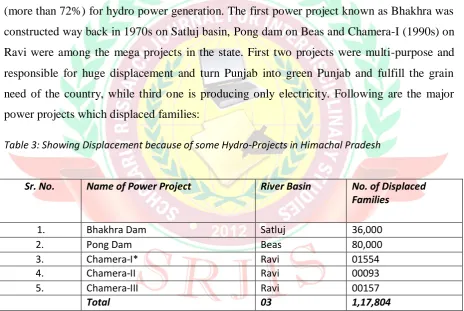
[image:7.595.68.533.272.583.2]As it has been depicted in table: 1, Satluj, Ravi and Beas basin have been heavily targeted (more than 72%) for hydro power generation. The first power project known as Bhakhra was constructed way back in 1970s on Satluj basin, Pong dam on Beas and Chamera-I (1990s) on Ravi were among the mega projects in the state. First two projects were multi-purpose and responsible for huge displacement and turn Punjab into green Punjab and fulfill the grain need of the country, while third one is producing only electricity. Following are the major power projects which displaced families:
Table 3: Showing Displacement because of some Hydro-Projects in Himachal Pradesh
Source: author’s compilation from different sources.
*studied for the purpose of this paper, paper is an essence of recently completed UGC Minor Research Project.
As per table above 1,17,804 families have been displaced because of the constriction of only five projects in Himachal Pradesh, though there is no official record of displaced families and more importantly, in websites, executors shows their achievements not the concerns of oustees, even not enlisted. Even after the execution of first mega project in the state (in 1962, survey for which were conducted in 1948 immediate after independent) and was second in
Sr. No. Name of Power Project River Basin No. of Displaced
Families
1. Bhakhra Dam Satluj 36,000
2. Pong Dam Beas 80,000
3. Chamera-I* Ravi 01554
4. Chamera-II Ravi 00093
5. Chamera-III Ravi 00157
APRIL-MAY, 2015. VOL. II/IX www.srjis.com Page 2241 India after Hirakund (Orissa), to-date state has not listed even the displaced people. However, some data is lying with revenue department at district level which is also not possible to access (researcher got the number only with great difficult after convincing the authorities that the data will be used for the research purpose and is mandatory to complete the assignment). After Bhakhra, pong dam just 145 kms in Beas basin in the downstream, was created in 1974 by displacing 80,000 families, totaling 1, 16, 000 families were displaced to convert Punjab into Green Punjab and contributed a lot to green revolution and these multipurpose dams solved the problem of food in India.
Rationale behind the selection:
To see the impact of hydroelectric power generation on the lives of people after commissioning the power project, Chamera-I power project owned by NHPC in Chamba district of Himachal Pradesh has been taken. Rationale behind the selection of this project was, 29-km long reservoir and village situated on the bank of reservoir, who are affecting badly with the ill-effect of hydro power generation. The villages situated on both sides of reservoir have been interviewed by the researcher. Generally it is a fact that only displaced got effect of the construction of power projects because they have been displaced and compelled to left their native land and all sort of belongings which they are using since their birth (even before their birth all these are being used by their forefathers and it is very difficult to leave which belongs to them and very difficult to re-settled somewhere else). The people who fall in the demarked geographical area, were called as PAP but people who reside even at the distance of less than one meter are compelled to face the ill-effects of power projects and does not fall in the category of PAP, researcher call them Non-PAP. To see the impacts on the lives of Non-PAP, 22 villages diving in 5 categories and selecting 200
APRIL-MAY, 2015. VOL. II/IX www.srjis.com Page 2242 respondents (table: 5) have been selected to see the impact on human dimension. However, many studies have been conducted by the different scholars round the world, but study of human dimension on such developmental projects in western Himalayan region is new (atleast not known to the researcher). The study has been initiated with hope that it will prove beneficial to the policy makers and executor to resolute the conflictual situation arises and moreover will address the unlisten concerns of the Non-PAP.
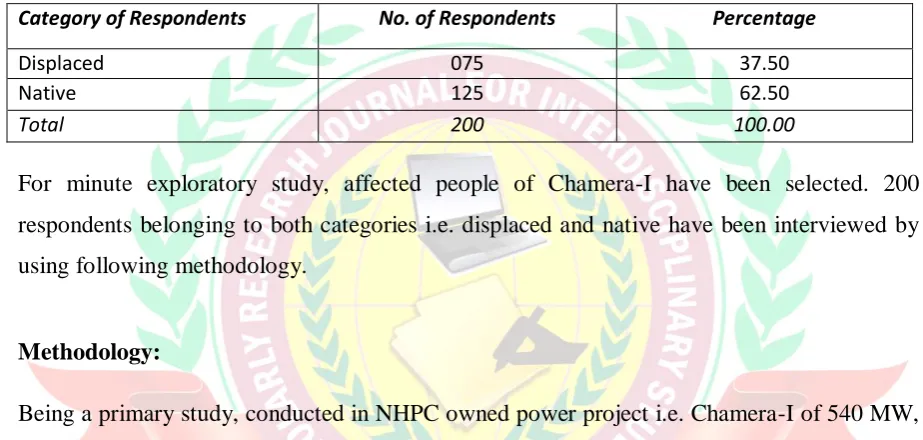
Table 4: Category of Respondent wise Distribution of the Respondents
For minute exploratory study, affected people of Chamera-I have been selected. 200 respondents belonging to both categories i.e. displaced and native have been interviewed by using following methodology.
Methodology:
Being a primary study, conducted in NHPC owned power project i.e. Chamera-I of 540 MW, two categories of respondents have been interviewed (table: 4). On the basis of result of earlier project completed by the research (Ecology of Power Projects: An Environmental Study, submitted to UGC in 2006), the newly investigated category of the affected people i.e. Not-PAP have been studied by giving them name of native in this project, because it has been observed and concluded earlier that this category is worse affected as they are living in the vicinity of this developmental project and facing the ill-effects. The displaced have left their villages and got employment and resettled somewhere else because they had legal PAP title, but after a demarcated line by the executors with the consultation of state revenue department (who are in-charge of providing compensation and responsible for their rehabilitation) [Slariya, 2006]. Villages situated in both sides of 29 km long reservoir have been interviewed in category of native and villages scattered in other places in the district in category of displaced. Being an exploratory and descriptive study, both primary and secondary data have been used by administrating interview schedules on 200 respondents. Collected data codified, tabulated, interpreted. This paper is an essence of the findings particular related to
Category of Respondents No. of Respondents Percentage
Displaced 075 37.50
Native 125 62.50
APRIL-MAY, 2015. VOL. II/IX www.srjis.com Page 2243 hypothetical variable i.e. people are satisfied with the development being brought because of power projects in Ravi basin. The respondents in different categories have been interviewed and analyased as per the following scheme:-
Table 5: Table Showing Classification of Village wise Distribution of the Respondents and Number of Villages
Result, interpretation and Conclusion (Psychological Deprivation in Chamera-I)
The deprivations received by the displaced as well as the people who are living in the vicinity of the reservoir have received a considerable amount of trauma after the installation of this project. People, whose land has been acquired by the executing agency way back in 1990s, are still waiting for the compensation. The impact on the local people can be divided in two broad categories; one, PAP, who have got displaced and got compensation, jobs in NHPC and resettled somewhere in the part of the district or state. The second category is of those who have not affected as per the revenue/policy document and can be called as Not-PAP.But in real sense, they are the people who are facing ill effects of this developmental activity and at present, they are dying every moment, every hour and every day and their concerns have never listened and never answered. However the first category has also received a considerable amount of impact on their socio-cultural milieu but the second category affected comparatively more than the first category.
To measure the impact (psycho-traumatic)and know the real pace of problem, four-point standardized tool i.e. extreme, severe, moderate and neutral has been used. Both categories of respondents i.e. displaced and native have been included in the study sample. Responses Sr.
No.
Classification of the village Number of
villages
Number of Respondents
Percentage of total sample 1. Village situated in the vicinity of
reservoir
04 66 33.00
2. Submerged villages in the reservoir 10 82 41.00
3. Village situated in the downstream 04 29 14.50
4. Village situated in the vicinity of reservoir where the oustees have been resettled
03 13 06.50
5. Village where oustees resettled 01 10 05.00
APRIL-MAY, 2015. VOL. II/IX www.srjis.com Page 2244 received through this scale on different sample variables such as; feeling at the time of displacement or living in the vicinity of reservoir; feelings of the respondents after being displaced;symptoms of trauma as indicators of trauma; measures to overcome from the symptom of trauma; measures taken by the respondents to overcome from the feelings of trauma and each broad sample variable has been divided further in sub variables to get more acquaintance with the phenomena/ trauma being faced by the people of the chamera-I.
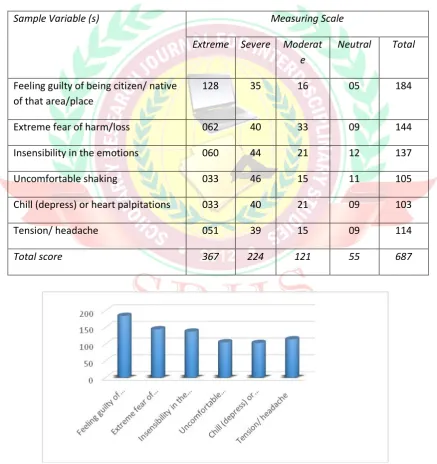
Table 6: Showing Feeling at the time of displacement/ by living in the vicinity of reservoir:
Sample Variable (s) Measuring Scale
Extreme Severe Moderat e
Neutral Total
Feeling guilty of being citizen/ native of that area/place
128 35 16 05 184
Extreme fear of harm/loss 062 40 33 09 144
Insensibility in the emotions 060 44 21 12 137
Uncomfortable shaking 033 46 15 11 105
Chill (depress) or heart palpitations 033 40 21 09 103
Tension/ headache 051 39 15 09 114
[image:11.595.79.517.247.712.2]Total score 367 224 121 55 687
APRIL-MAY, 2015. VOL. II/IX www.srjis.com Page 2245 As data in the above table: 5 indicated that in all six sub-variables people of the study area have experienced extreme situation scoring 367, which is highest and followed by this severe has scored 224, moderate 121 and neutral 55. These are the clear evidences that the people either displaced (interviewed at their new place of residence) or native, have been traumatized by the installation of power project i.e. Chamera-I hydroelectric power project, which is more evident from figure-1which shows that respondents are feeling guilty of being an Indian as they are not being listened and also having fear of loss, which further resulted into tension and headache
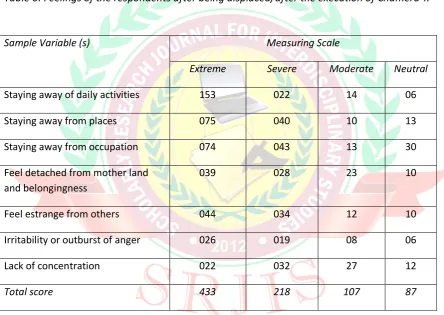
Table 6: Feelings of the respondents after being displaced/after the execution of Chamera-I:
To assess the feelings of the respondents after being displaced or after the execution of chamera-I, seven sub-variables have been constructed i.e. staying away of daily activities, staying away from places, staying away from occupation, feel detached from motherland and belongingness, feel estrange from others, irritability or outburst of anger and lack of concentration. The responses indicated in the table, shows a decreasing trend from 433 points of extreme, 218 points to the severe and 107 points to the moderate and finally 87 score to the neutral. It shows that the people living in the vicinity or who have been displaced have
Sample Variable (s) Measuring Scale
Extreme Severe Moderate Neutral
Staying away of daily activities 153 022 14 06
Staying away from places 075 040 10 13
Staying away from occupation 074 043 13 30
Feel detached from mother land and belongingness
039 028 23 10
Feel estrange from others 044 034 12 10
Irritability or outburst of anger 026 019 08 06
Lack of concentration 022 032 27 12
APRIL-MAY, 2015. VOL. II/IX www.srjis.com Page 2246 suffered very badly and have been the victims of this developmental initiative. It was the local people who got nothing but pains. The executors and policy makers may prove it beneficial in the vital interest of the nation, but without listening to their concerns it cannot be justified.
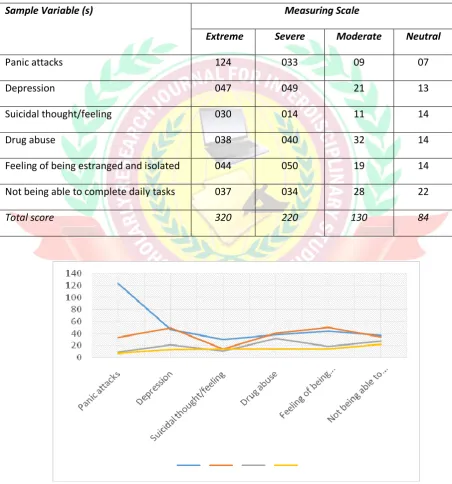
Table 7: Showing the Experience of the symptom (s) as indicators of trauma, after
being displaced/living in vicinity of dam:
Sample Variable (s) Measuring Scale
Extreme Severe Moderate Neutral
Panic attacks 124 033 09 07
Depression 047 049 21 13
Suicidal thought/feeling 030 014 11 14
Drug abuse 038 040 32 14
Feeling of being estranged and isolated 044 050 19 14
Not being able to complete daily tasks 037 034 28 22
Total score 320 220 130 84
APRIL-MAY, 2015. VOL. II/IX www.srjis.com Page 2247 As data indicated in table 7 and in graphical presentation in figure 2, collected on the experience of the symptom (s) as indicators of trauma after being displaced or by living in the vicinity of reservoir of chamera-I suggested that both types of respondents i..e.displaced as well as natives have been traumatized to the extreme end followed by this they have been severely affected and then moderately and finally neutral response has got least score in the research data. To see the impact, six sub-variables have been identified in pilot survey and used in the research and recorded the responses on extreme, moderate, severe and neutral scales. In this variable the first point extreme has got 320 score, moderate 220, severe 130 and neutral 84, which shows the intensity of the problem.
[image:14.595.74.521.274.679.2]In other words this developmental activity has hammered the socio-psycho and cultural milieu of the study area and people have been affected very severely, they are wit hout their traditional occupations, without their land, without their ways of earning of livelihood, without their neighborhood moreover without a system having a provision of eco-system services. The eco-system service which is being provided by the nature have been hammered and are no more now in study area.
Table 8: Measures taken by Respondents to Overcome from the Symptom (s) of trauma:
Sr. No.
Measure (s) taken to overcome from the symptom (s) of trauma
Measuring Scale
Extreme Severe Moderate Neutral Total
1. By talking about the incident 90 33 14 08 145
2. By talking with the people who care about you
51 51 23 10 135
3. Maintain the normal schedule and routine as much as possible
68 69 23 13 173
4. Be with someone and have a drink 20 32 21 25 098
5. By playing kaudi/card or any other game 24 27 12 17 080
Total score 253 212 93 73 631
APRIL-MAY, 2015. VOL. II/IX www.srjis.com Page 2248 173 points on four point scale. Followed by this sub-variable no. 1 i.e. by talking about the incident has scored 145 points and number 2 has scored 135 points and become third choice of the respondents. Remaining number 4 have been scored 98 points and lastly the sub-variable which indicate playing kaudi/card or any other game by the respondents as a measure to come over the trauma become last choice and scored 80 points. In other words, the most preferred measure as taken by the respondent is by maintaining the normal routine schedule and routine as much as possible, which has been suggested by the most of respondents to come over the situation.
Figure 3: Showing Measures taken by Respondents to Overcome from the Symptom (s) of trauma
APRIL-MAY, 2015. VOL. II/IX www.srjis.com Page 2249 methods/measures adopted by them are of high relevance for them and had successfully mitigated the traumatic conditions faced by them.
[image:16.595.73.513.252.649.2]*Kaudi, is a game played with four players traditionally in hills since ages. It is just like chess of modern times. People in the hills are playing during their leisure and it is a healthy way of recreation as well as social cohesiveness and also a good mental exercise.
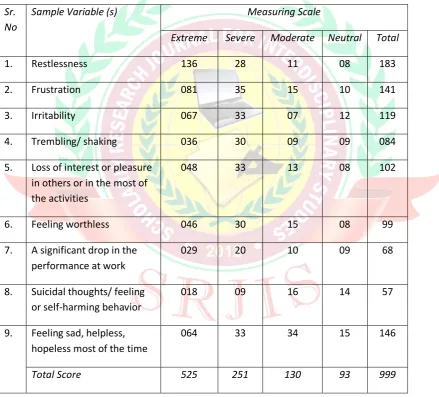
Table 9: Showing the Feeling (s) of the Respondents at the time of displacement/
living in the vicinity of dam:
Sr. No
Sample Variable (s) Measuring Scale
Extreme Severe Moderate Neutral Total
1. Restlessness 136 28 11 08 183
2. Frustration 081 35 15 10 141
3. Irritability 067 33 07 12 119
4. Trembling/ shaking 036 30 09 09 084
5. Loss of interest or pleasure in others or in the most of the activities
048 33 13 08 102
6. Feeling worthless 046 30 15 08 99
7. A significant drop in the performance at work
029 20 10 09 68
8. Suicidal thoughts/ feeling or self-harming behavior
018 09 16 14 57
9. Feeling sad, helpless, hopeless most of the time
064 33 34 15 146
Total Score 525 251 130 93 999
APRIL-MAY, 2015. VOL. II/IX www.srjis.com Page 2250 of score calculated on four point scale while figure number 8 shows the sum-total number of responses collected on the basis of four point scales (extreme, severe, moderate and neutral).
Figure 4: Showing response to the feeling of the respondents at the time of displacement/living in the vicinity of dam
As per the data indicated in the table as well as in the figure indicates that feeling of restlessness and feeling sad, helpless, hopeless most of the time have score maximum score i.e. 183 and 146 respectively. The feeling of frustration has scored 141 points, loss of interest or pleasure in others or in the most of the activities 102 points, feeling worthless 99 points and significant drop in the performance of work has scored 68 points.
APRIL-MAY, 2015. VOL. II/IX www.srjis.com Page 2251
Table 10: Showing the Measures taken by the Respondents to Overcome from the feelings of Trauma:
Sr. No.
Sample Variable (s)
Measuring Scale
Extreme Severe Moderate Neutral Total
1. Trembling* 134 26 14 06 180
2. Shaking 062 32 15 06 115
3. Crying 064 37 13 09 123
4. Sweating 040 33 17 09 099
5. Breathing Deeply 049 41 17 08 115
6. Laughing 034 23 17 08 082
7. Just Forget it 034 36 19 16 105
8. Being Strong 059 25 16 17 117
9. Taking a Pill 011 07 10 23 051
Total score 487 260 138 102 987
*to shake involuntarily, as from anger; quake; here this term has been used to indicate one of the copping mechanism in which respondent feel shaking out of anger and try to restore themselves in situation of helplessness against the powerful corporate (NHPC) and by being a small displaced or native they cann’t do anything and compelled to live in such situation.
APRIL-MAY, 2015. VOL. II/IX www.srjis.com Page 2252 families has been the worse victim, because he has been the witness of the situation since its inception.
Figure 5: Showing the Measures taken by the Respondents to Overcome from the feelings of Trauma
As the bars of the figure 5 indicates that trembling has scored maximum score on extreme scale of measurement followed by this shaking and crying and being strong have been the preferable choices of the respondents to cope the situation. Breathing deeply, just forget, crying, shaking have been the second preference as a coping measure of the respondents on severe point of measurement, while moderate has the third and neutral has been fourth choice of the respondents as a coping measure to mitigate and win the situation.
APRIL-MAY, 2015. VOL. II/IX www.srjis.com Page 2253 deprived off all eco-system services, there are no water-mill at present where they can grind their grain, there are no pasture where they can graze their cattle, the increased temperature in summer and cold/fog in winter are making their life hell etc. all these situation pulled them in psycho-traumatic situation and compelled to say that it is nation’s gain for local’s pain.
Benefit Sharing Participatory Model: An Answer!
The above description emphatically stressed that existing model of development in hydro power development i.e. lobbyist pressurized model of development resulted into the deprivation for the people, unscientific exploitation of natural resources specifically and putting human survival at a stake in general. People living in the vicinity of these developmental mills are feeling deprived off of age-old traditions, customs, lost playground, watermills in specific and live supporting system in general. In short, existing model of development remains unable to safeguard the interests of the people as lakhs of people are waiting for justice even decades of commissioning of such developmental projects.
Why it is needed:
The whole dam building programme in each river basin in Himalayas needs a comprehensive review. The existing data suggested that an alternative approach/model is being required to fulfill the required energy need of any country in sustainable manner. The choices are not easy, and the process will be difficult because the decision to adopt such type of approach/ model is to be taken by the policy makers and by the leadership in the respective countries.
Involvement of local people in decision making:
APRIL-MAY, 2015. VOL. II/IX www.srjis.com Page 2254 The interests of the local people must be given priority along with national interests as they are the custodians of a treasure that is the common heritage of the entire world – the Himalayas.
Proposed model of development:The approach in my research is to find a strategy for long-term optimal benefit from natural resources promoting a sustainable growth path. Two questions appear:
First, how to utilize the resources, e.g. with what pace should the resources be exploited?
Secondly, how to get benefit from the exploitation of resources with the participat ion of local stakeholders, e.g. how should the earnings be used for the benefits of the local people as well as to sustain the local environment?
I propose to concentrate on Benefit Sharing Participatory Model of development (BSPM) as an answer to the existing Lobbyist Pressurized Model of development. Along with this I propose to include SIA (Social Impact Assessment), LIA (Livelihood Impact Assessment), PIA (Psychological Impact Assessment) and HIA (Health Impact Assessment), CIA (Cultural Impact Assessment) in EIA (Environment Impact Assessment). Environment does not mean physical environment, the term environment should be used in comprehensive manner. On the basis of these assessments, stakeholders of proposed developmental project should be involved in the process of decision making. Monetary benefits drawn out the developmental initiative should be shared with the affected as well as with the native people of the area concerned. A minimum percentage out of the profit earned should be agreed upon and be disbursed among stakeholders so that the real fruits of development can be reaped. I propose to develop a tool, through which above mentioned aspects can be measured and participation of the affected community can be ensured. This would help the decision makers to make better decisions when, where, and how to deploy the development initiatives in Himalayas as well as in any part of the world.
Conclusion:
APRIL-MAY, 2015. VOL. II/IX www.srjis.com Page 2255 long reservoir is situated just beside the dam are dying every minute, every day and seeing no hope for their solution in coming time, because they cannot leave their places of residence, as they don’t have sufficient money to re-settled somewhere else by leaving their homes, land and belongings. This usually transformed in form of scapegoating and the family members including wife and children become the victims of the wrath of the bread-earner. It might be needed for the Greater National Goods but it is proving doom for the natives who are living there since decades.
It is emphatically recommended that the people whose names are not in the category of PAP because of the fact that they are living just one meter from the demarcated line or living at even less than one meter line, must be included in the category of PAP and all benefits must be given to them which are being given to displaced and should be included in the category of displaced or PAP. It is not the only case where such types of deprivations are being faced by the natives but the situation is almost alike in all development projects in India as well as in the world. Right from the inception of project, from planning phase to execution and afterward, native have never consulted and listened to their problems neither by executing agencies nor by the state/central government. They should be included in the process of rehabilitation so that they can feel that they are also citizen of India, because in the developmental process they have been excluded. On the basis of recommendations of many studies conducted worldwide in different socio-geographical and culture setting, including WCD studies, the concerns of the native must be listened and taken care of and to resolve/mitigate the situation, post-traumatic centre must be opened where people facing the trauma can be treated. At policy level, their concerns must be listened and resolved by visiting the local sites where such types of developmental activities have been either proposed or executed.
Bibliography and References:
Bandhopadhyay, Jayanta (1986) ―The Economics of Large Dams in India’ in E. Goldsmith and N. Hildyard (eds.), Vol. 2.
APRIL-MAY, 2015. VOL. II/IX www.srjis.com Page 2256 Basu, Malika (1996) `Basic Needs Approach in Displacement Situations’. Mainstream, July-August.
Cernea, Michael M. (1988) Involuntary Resettlement in Development Projects: Policy Guidelines in World Bank-Financed Projects, World Bank Technical Paper No. 80. World Bank, Washington, D.C.
——— (1995) ‘Understanding and Preventing Impoverishment from Displacement: Reflections on the State of Knowledge’. Social Action, April– June.
——— (1999) `Why Economic Analysis is Essential to Resettlement: A Sociologist’s View in Michael M. Cernea (ed.).
——— (ed.) (1999) `The Economic of Involuntary Resettlement: Questions and Challenges’. World Bank, Washington D.C.
Eriksen, John H. (1999) `Comparing the Economic Planning for Voluntary and Involuntary Resettlement’ in Micheal M. Cernea (ed.)
Freeman, A. Myrick (1993) The Measurement of Environmental and Resource Values: Theories and Methods. Resources for the Future Washington, DC
Eriksen, John H. (1999) `Comparing the Economic Planning for Voluntary and Involuntary Resettlement’ in Micheal M. Cernea (ed.)
Freeman, A. Myrick (1993) The Measurement of Environmental and Resource Values: Theories and Methods. Resources for the Future, Washington, D.C.
Goldsmith E. and N. Hildyard (eds.) (1986) The Social and Environmental Effects of Large Dams, Vol. 2: Case Studies. Wadebridge Ecological Centre , Cornwall.
Goldsmith, E. and N. Hildyard (eds.) (1984) The Social and Environmental Effects of Large Dams, Vol. 1: Overview. Wadebridge Ecological Centre, Cornwall.
APRIL-MAY, 2015. VOL. II/IX www.srjis.com Page 2257 Gutman, P. (1993) Involuntary Resettlement in the Hydro-power Projects: A Review of Bank Performance during 1978–1992. Industry and Energy Department. World Bank, Washington, D.C.
Hardin, G. (1968) `The Tragedy of the Commons’. Science, 162:1243-48.
Himachal Pradesh State Electricity Board, Govt. of Himachal Pradesh, Shimla
Kalpavriksh and the Hindu College Nature Club (1986) `The Narmada Valley Project: Development or Destruction?’ in E. Goldsmith and N. Hildyard (eds.), Vol.2.
Kornai, J. (1981) `Some Properties of East European Growth Pattern, World Development Report Vol. 91
Koutsoyiannis,A. (1979) Modern Microeconomics, Second Edition. Macmillan, London and Basingstoke.
Layard,Richard (ed.)(1972) Cost-Benefit Analysis: Selected Readings. Penguin,
Harmondsworth Ministry of Irrigation (1980) Guidelines for Preparation of Detailed Project Reports for Irrigation and Multipurpose Projects, Govt. of India, New Delhi
Paranjpye, Vijay (1988) Evaluating the Tehri dam: An Extended Cost-Benefit Appraisal. Indian National Trust for Art and Culture (INTACH), New Delhi.
Paranjpye, Vijay (1990) High Dams on the Narmada: A Holistic Analysis of the River Valley Projects. INTACH, New Delhi.
Parasuraman, S. (1999) The Development Dilemma: Displacement in India. Institute of Social Studies, The Hague. Pearce, David W. (1999) `Methodological Issues in the
Economic Analysis for Involuntary Resettlement Operations’ in Michael M. Cernea (ed.)
——— and C.A. Nash (1981) Social Appraisal of Projects: A Text in Cost-Benefit Analysis. Macmillan, London.
APRIL-MAY, 2015. VOL. II/IX www.srjis.com Page 2258 Roy, Arundhati, (1999). The Greater Common Good, Bombay: India Book Distributors
Ltd.
Singh, Shekhar, Ashish Kothari and Kulan Amin (1992) `Evaluating Major Irrigation Projects in India’ in E. Ganguly Thukral (ed.) Big Dams Displaced People, Sage Publications, New Delhi
Sinha, Basawan and Ramesh Bhatia (1982) Economic Appraisal of Irrigation Project in India. Agricole Publishing Academy, New Delhi.
Sinha, B.K. (1996) ‘Draft National Policy for Rehabilitation: Objectives and Principles’. Economic and Political Weekly, June 15.
Slariya,Mohinder Kumar,"The Other Side of Hydroelectric Power Development:-A Study of NHPC Owned Power Projects" (pdf). Government PG College, Chamba Himachal Pradesh. http://www.openmeeting2009.org/pdf_files/Pdf%20papers/Slariya%20day3.pdfRetrieved 2010-04-14.
Slariya, Mohinder; 2006; Ecology of Power Projects: An Environmental Study,
unpublished Project Report, submitted to University Grants Commission New Delhi
Todaro, Michael, P. (1989) Economic Development in the Third World, Fourth Edition. Longman, New York.
UNIDO (United Nations Industrial Organisation) (1972), Guidelines for Project Evaluation. UNIDO, Vienna.
World Bank (1994) Resettlement and Development: The Bank-wide Review of Projects Involving Involuntary Resettlement1986-1993. Environment Department Paper, World Bank, Washington, DC