http://dx.doi.org/10.4236/apm.2015.511062
Mean-Value Theorems for Harmonic
Functions on the Cube in
n
Petar Petrov
Faculty of Mathematics and Informatics, Sofia University, Sofia, Bulgaria Email: [email protected]
Received 4 August 2015; accepted 13 September 2015; published 16 September 2015 Copyright © 2015 by author and Scientific Research Publishing Inc.
This work is licensed under the Creative Commons Attribution International License (CC BY).
http://creativecommons.org/licenses/by/4.0/
Abstract
Let
( )
{
n}
n i
I r = x∈ x ≤r i, =1, 2,,n be a hypercube in n. We prove theorems concerning
mean-values of harmonic and polyharmonic functions on In
( )
r , which can be considered asnat-ural analogues of the famous Gauss surface and volume mean-value formulas for harmonic func-tions on the ball in n
and their extensions for polyharmonic functions. We also discuss an ap-plication of these formulas—the problem of best canonical one-sided L1-approximation by
har-monic functions on In
( )
r .Keywords
Harmonic Functions, Polyharmonic Functions, Hypercube, Quadrature Domain, Best One-Sided Approximation
1. Introduction
This note is devoted to formulas for calculation of integrals over the n-dimensional hypercube centered at 0
( )
{
}
: : n , 1, 2, , , 0,
n n i
I =I r = x∈ x ≤r i= n r>
and its boundary Pn:=P rn
( )
:= ∂In( )
r , based on integration over hyperplanar subsets of In and exact forLet us remind that a real-valued function f is said to be harmonic ( polyharmonic of degree m≥2) in a given domain Ω ⊂n if f∈C2
( )
Ω(
f ∈C2m( )
Ω)
and ∆ =f 0(
m 0)
f
∆ = on Ω, where ∆ is the Laplace operator and ∆m is its m-th iterate
(
)
2
1 2
1
: , : .
n
m m
i i f
f f f
x
−
=
∂
∆ = ∆ = ∆ ∆
∂
∑
For any set D⊂n, denote by H
( )
D(
m( )
, 2)
D m≥
H the linear space of all functions that are har- monic (polyharmonic of degree m) in a domain containing D. The notation dλn will stand for the Lebesgue
measure in n.
2. Mean-Value Theorems
Let
( )
{
(
)
}
1 2 2 1
: n : n
n i i
B r = x∈ x =
∑
=x ≤r and Sn( )
r :={
x∈n x =r}
be the ball and the hypersphere in n with center 0 and radius r. The following famous formulas are basic tools in harmonic function theory and state that for any function h which is harmonic on B rn
( )
both the average over Sn( )
r and the average over B rn( )
are equal to h 0( )
.The surface mean-value theorem.If h∈H
(
B rn( )
)
, then( )
(
)
( ) 1( )
1
1
d ,
n n
S r n n
h h
S r σ
σ −
−
=
∫
0 (1)where dσn−1 is the
(
n−1)
-dimensional surface measure on the hypersphere Sn( )
r .The volume mean-value theorem.If h∈H
(
B rn( )
)
, then( )
(
)
( )( )
1
d .
n n
B r n n
h h
B r λ
λ
∫
= 0 (2)The balls are known to be the only sets in n satisfying the surface or the volume mean-value theorem. This means that if Ω ⊂n is a nonvoid domain with a finite Lebesgue measure and if there exists a point x0∈ Ω such that
( )
( )
01
d n n
h h
λ
λ
Ω=
Ω
∫
x for every function h which is harmonic and integrable on Ω, then Ω is an open ball centered at x0 (see [4]). The mean-value properties can also be reformulated in terms of quadrature domains [5]. Recall that Ω ⊂n is said to be a quadrature domain for H
( )
Ω , if Ω is a connected open set and there is a Borel measure dµ with a compact support Kµ ⊂ Ω such that fd n K fdµ
λ
µ
Ω =
∫
∫
for every λn -integrable harmonic function f on Ω. Using the concept of quadrature domains, the volume mean-value property is equivalent to the statement that any open ball in n is a quadrature domain and the measure dµ is the Dirac measure supported at its center. On the other hand, no domains having “corners” are quadrature domains [6]. From this point of view, the open hypercube In is not a quadrature domain. Nevertheless, it is proved in Theorem 1 below that the closed hypercube In is a quadrature set in an extended sense, that is, we find explicitly a measure dµ with a compact support Kµ having the above property with Ω replaced byn
I but the condition Kµ ⊂In is violated exactly at the “corners” (for the existence of quadrature sets see [7]). This property of In is of crucial importance for the best one-sided L1-approximation with respect to H
( )
In(Section 3).
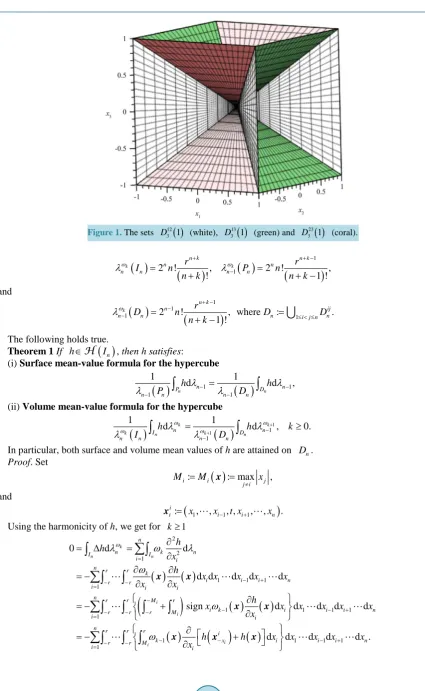
Let us denote by Dnij the
(
n−1)
-dimensional hyperplanar segments of In defined by( )
{
}
: : , , , 1 ,
ij ij
n n n k i j
D =D r = x∈I x ≤ x = x k≠i j ≤ < ≤i j n
(seeFigure 1). Denote also
( )
(
max{
1, 2 , ,}
)
: , 0,
!
k n k
r x x x
k k
ω x = − ≥
and d k : d
m k m ω
Figure 1. The sets 12
( )
3 1D (white), 13
( )
3 1D (green) and 23
( )
3 1D (coral).
( )
2 !(
)
, 1( )
2 !(
1)
,! 1 !
k k
n k n k
n n
n n n n
r r
I n P n
n k n k
ω ω
λ = ++ λ− = + −+ −
and
( )
1(
1)
1 2 ! , where : 1 .
1 !
k
n k
n ij
n n n i j n n
r
D n D D
n k ω
λ − + −
− = + − =
≤ < ≤The following holds true.
Theorem 1 If h∈H
( )
In , then h satisfies: (i) Surface mean-value formula for the hypercube( )
1( )
11 1
1 1
d d ,
n n n n
P D
n n n n
h h
P
λ
Dλ
λ
−λ
−− −
=
∫
∫
(3) (ii) Volume mean-value formula for the hypercube( )
1( )
111
1 1
d k d k , 0.
k In n k Dn n
n n n n
h h k
I D
ω ω
ω λ ω λ
λ λ + −+
−
= ≥
∫
∫
(4)In particular, both surface and volume mean values of h are attained on Dn.
Proof. Set
( )
: : max ,
i i j
j i
M M x
≠
= x =
and
(
1 1 1)
: , , , , , , .
i
t = x xi− t xi+ xn
x
Using the harmonicity of h, we get for k≥1
( ) ( )
(
)
( ) ( )
( )
( )
( )
2
2 1
1 1 1
1
1 1 1 1
1
1 1
0 d d
d d d d d
sign d d d d d
d
k
n n
i i
i i
n
n k n
I I
i i
n r r
k
i i i n
r r
i i i
n r r M r
i k i i i n
r r r M
i i
n r r r
i
k x i
r r M
i i
h h
x h
x x x x x
x x
h
x x x x x x
x
h h x
x ω
λ ω λ
ω
ω
ω
=
− +
− −
=
−
− − +
− − −
=
− −
− −
=
∂
= ∆ =
∂
∂ ∂
= −
∂ ∂
∂
= − +
∂
∂
= − +
∂
∑
∫
∫
∑∫ ∫
∑∫ ∫ ∫
∫
∑∫ ∫ ∫
x x
x x
x x x dx1 dxi−1dxi+1 d .xn
Hence, we have
( ) ( )
( ) ( )
{
}
1 1 11
0 d d d d
i i
n r r
i i i i
r r M M i i n
r r i
h − h + h − h + x x− x+ x
− −
=
= −
∑∫ ∫
x + x − x + x (5) if k=1 and( )
( )
( )
(
) (
) (
)
2 1 1 1
1
1 1 1 1
1
0 d d d d d
d d d d
i i
i i i
n r r r
i
k x i i i n
r r M i
n r r
i i i
k M M M i i n r r
i
h h x x x x x
h h x x x x
ω ω − − − + − − = − + − + − + − − = = − + + +
∑∫ ∫ ∫
∑∫ ∫
x x x
x x x
(6)
if k≥2.
Clearly, (5) is equivalent to (3) and from (6) it follows
2 1
1
0 d k d k 2 d k ,
n n n n n n
I h Ih Dh
ω ω ω
λ
λ
−λ
−−
= ∆
∫
=∫
−∫
(7) which is equivalent to (4). □Let M:=M
( )
x : max= 1≤ ≤i n xi . Analogously to the proof of Theorem 1 (ii), Equation (7) is generalized to:Corollary 1 If h∈H
( )
In and 2[ ]
0,
C r
ϕ ∈ is such that
ϕ
( )
0 =0 andϕ
′( )
0 =0, then(
)
(
)
(
)
10 d d 2 d .
n n n n n n
I
ϕ
r M hλ
Iϕ
′′ r M hλ
Dϕ
′ r M hλ
−=
∫
− ∆ =∫
− −∫
− (8)The volume mean-value formula (2) was extended by P. Pizzetti to the following [2] [3] [8].
The Pizzetti formula.If g∈Hm
(
B rn( )
)
, then( )
(
)
( )
2 1 2 2 0d π .
!
2 2 1
n k k m n n n k B r k g r g r k n k λ − = ∆ =
Γ + +
∑
∫
0Here, we present a similar formula for polyharmonic functions on the hypercube based on integration over the set Dn.
Theorem 2 If g∈Hm
( )
In , m≥1, and ϕ ∈C2m[ ]
0,r is such thatϕ
( )k( )
0 =0, k=0,1,, 2m−1, then the following identity holds true for any k≥0:( )
(
)
1 ( )(
)
2 2 1 1
1 0
d 2 d ,
n n
m
m s m s
n n
I D
s
r M g r M g
ϕ λ − ϕ + − − λ
− =
− =
∑
− ∆∫
∫
(9)where ( )
( )
d( )
d j j j t t t ϕϕ = .
Proof. Equation (9) is a direct consequence from (8):
(
)
( )
(
)
( )(
)
( ) ( )
1 1 2 1
1 1
2 1 1 2 1 0
0 d
2 d d
2 d d .
n n n n n m n I m m n n D I m
s m s m
n n
D I
s
r M g
r M g r M g
g g
ϕ λ
ϕ λ ϕ λ
ϕ λ ϕ λ
− − − − + − − − = = − ∆ = − − ∆ + − ∆ = = − ∆ +
∫
∫
∫
∑∫
∫
3. A Relation to Best One-Sided
L
1-Approximation by Harmonic Functions
Theorem 1 suggests that for a certain positive cone in C I
( )
n the set Dn is a characteristic set for the best one-sided L1-approximation with respect to H( )
In as it is explained and illustrated by the examples presented below.For a given f ∈C I
( )
n , let us introduce the following subset of H( )
In :(
In,f)
:{
h( )
In h f on .In}
− = ∈ ≤
H H
A harmonic function *f
(
,)
n
(
)
* 1
1 for every , , f
n
f −h ≤ f −h h∈H− I f
where
1: In d .n g =
∫
gλ
Theorem 1 (ii) readily implies the following ([6] [9]).
Theorem 3 Let f ∈C I
( )
n and *f(
,)
n
h ∈H− I f . Assume further that the set Dn belongs to the zero set of the function f −h*f . Then h*f is a best one-sided L1-approximant from below to f with respect to H
( )
In .Corollary 2 If 1
( )
n
f∈C I , any solution h of the problem
(
)
|Dn |Dn, |Dn |Dn, n, ,
h = f ∇h = ∇f h∈H− I f (10)
is a best one-sided L1-approximant from below to f with respect to H
( )
In .Corollary 3 If
( )
( )
(
2 2)
21i j n i j
f x =g x
∏
≤ < ≤ x −x , where g∈C I( )
n and g≥0 on In, then *f( )
0h x ≡ is a best one-sided L1-approximant from below to f with respect to H
( )
In .Example 1 Let n=2, r=1 and f1
(
x x1, 2)
=x x12 22. By Corollary 2, the solution(
)
1 4 2 2 4
* 1 2 1 1 2 2
3
, 4 4
2
f
h x x = −x + x x −x of the interpolation problem (10) with f = f1 is a best one-sided L1- appro-ximant from below to f1 with respect to H
( )
I2 and 1 *1 1 8 45f
f −h = . Since the function f1 belongs to the positive cone of the partial differential operator
4 4
2,2 2 2 1 2
:
x x
∂ =
∂ ∂
(that is, 4 2,2 1f >0
), one can compare the best harmonic one-sided L1-approximation to f1 with the corresponding approximation from the linear sub-
space of C I
( )
2 :( )
( ) (
)
1( )
( )
2,2
2 2 1 2 0 1 2 1 2 1 0
: , j j j j .
j
I b C I b x x a x x a x x
=
= ∈ = +
∑
B
The possibility for explicit constructions of best one-sided L1-approximants from 2,2
( )
2 IB , is studied in [10]. The functions 1
1 * f f −b and
1 * 1 f
f −b , where 1 *
f b and
1 * f
b are the unique best one-sided L1-approximants to f1
with respect to 2,2
( )
2 IB from below and above, respectively, play the role of basic error functions of the cano- nical one-sided L1-approximation by elements of 2,2
( )
2 I
B . For instance, 1 *
f
b can be constructed as the unique interpolant to f1 on the boundary ◊ =:
{
(
x x1, 2)
∈I2 x1 + x2 =1}
of the inscribed square and1 1 *
1 14 45 f
f −b = (Figure 2).
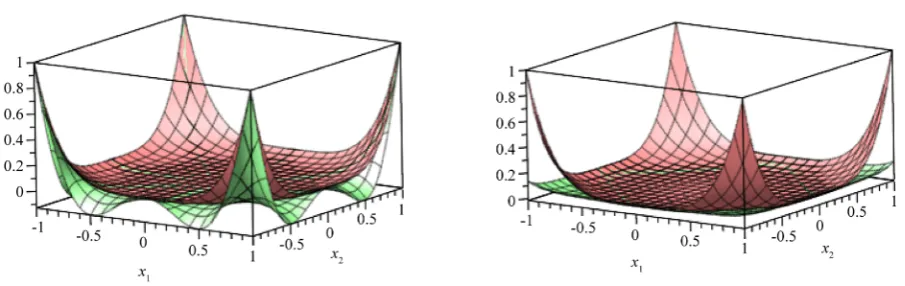
Example 2 Let n=2, r=1 and
(
)
8 4 4 82 1, 2 1 14 1 2 2
f x x =x + x x +x . The solution
(
)
(
)
2 8 8 6 2 2 6 4 4 * 1, 2 1 2 28 1 2 1 2 70 1 2
f
h x x =x +x − x x +x x + x x of (10) with f = f2 is a best one-sided L1-approximant from below to f2 with respect to H
( )
I2 and 2 *2 8 75f
f −h = . It can also be verified that 2
2 * 121 900 f
f −b =
[image:5.595.107.527.549.683.2](seeFigure 3).
Figure 2. The graphs of the function f x x1
(
1, 2)
=x x12 22 (coral) and its best one-sided L 1-approximants from below,
1
*
f
h with respect to H I
( )
2 (left) and 1*
f
b with respect to 2,2
( )
2I
Figure 3. The graphs of the function
(
)
8 4 4 8 2 1, 2 1 141 2 2f x x =x + x x +x (coral) and its best one-sided L1-approximants from below, 2
*
f
h with respect to H
( )
I2 (left) and2
*
f
b with respect to 2,2
( )
2I
B (right).
Remark 1 Let ϕ ∈C2
[ ]
0,r is such thatϕ
( )
0 =0,ϕ
′( )
0 =0, and ϕ′ ≥0, ϕ′′ ≥0 on[ ]
0,r . It follows from (8) that Theorem 3 also holds for the best weighted L1-approximation from below with respect to H( )
Inwith weight
ϕ
′′ −(
r M)
. The smoothness requirements were used for brevity and wherever possible they can be weakened in a natural way.References
[1] Helms, L.-L. (2009) Potential Theory. Springer-Verlag, London. http://dx.doi.org/10.1007/978-1-84882-319-8
[2] Pizzetti, P. (1909) Sulla media dei valori che una funzione dei punti dello spazio assume sulla superficie della sfera.
Rendiconti Linzei—Matematica e Applicazioni, 18, 182-185.
[3] Courant, R. and Hilbert, D. (1989) Methods of Mathematical Physics Vol. II. Partial Differential Equations Reprint of the 1962 Original. John Wiley & Sons Inc., New York.
[4] Goldstein, M., Haussmann, W. and Rogge, L. (1988) On the Mean Value Property of Harmonic Functions and Best Harmonic L1-Approximation. Transactions of the American Mathematical Society, 305, 505-515.
[5] Sakai, M. (1982) Quadrature Domains. Lecture Notes in Mathematics, Springer, Berlin.
[6] Gustafsson, B., Sakai, M. and Shapiro, H.S. (1977) On Domains in Which Harmonic Functions Satisfy Generalized Mean Value Properties. Potential Analysis, 71, 467-484.
[7] Gustafsson, B. (1998) On Mother Bodies of Convex Polyhedra. SIAM Journal on Mathematical Analysis, 29, 1106- 1117. http://dx.doi.org/10.1137/S0036141097317918
[8] Bojanov, B. (2001) An Extension of the Pizzetti Formula for Polyharmonic Functions.Acta Mathematica Hungarica, 91, 99-113. http://dx.doi.org/10.1023/A:1010687011674
[9] Armitage, D.H. and Gardiner, S.J. (1999) Best One-Sided L1-Approximation by Harmonic and Subharmonic Functions. In: Haußmann, W., Jetter, K. and Reimer, M., Eds., Advances in Multivariate Approximation, Mathematical Research (Volume 107), Wiley-VCH, Berlin, 43-56.