http://dx.doi.org/10.4236/jsea.2014.78068
Open-Access Framework for Efficient
Object-Oriented Development of Video
Analysis Software
Dimitris K. Iakovidis, Dimitris Diamantis
Department of Computer Engineering, Technological Educational Institute of Central Greece, Lamia, Greece Email: [email protected]
Received 19 May 2014; revised 15 June 2014; accepted 10 July 2014
Copyright © 2014 by authors and Scientific Research Publishing Inc.
This work is licensed under the Creative Commons Attribution International License (CC BY). http://creativecommons.org/licenses/by/4.0/
Abstract
The increasing use of digital video everyday in a multitude of electronic devices, including mobile phones, tablets and laptops, poses the need for quick development of cross-platform video soft-ware. However current approaches to this direction usually require a long learning curve, and their development lacks standardization. This results in software components that are difficult to reuse, and hard to maintain or extend. In order to overcome such issues, we propose a novel ob-ject-oriented framework for efficient development of software systems for video analysis. It con-sists of a set of four abstract components, suitable for the implementation of independent plug-in modules for video acquisition, preprocessing, analysis and output handling. The extensibility of each module can be facilitated by sub-modules specifying additional functionalities. This architec- ture enables quick responses to changes and re-configurability; thus conforming to the require-ments of agile software development practices. Considering the need for platform independency, the proposed Java Video Analysis (JVA) framework is implemented in Java. It is publicly available through the web as open-access software, supported by a growing collection of implemented mo- dules. Its efficiency is empirically validated for the development of a representative video analysis system.
Keywords
Object-Oriented Framework, Efficient Software Development, Video Analysis, Java
1. Introduction
applications such as scene, object or event recognition [1], and video summarization [2]. Considering that digital video is becoming more and more a part of our everyday life through portable devices such as mobile phones, tablets and laptops, the interest in video analysis systems is growing both in the market and in the research land-scape. IndicativelyFigure 1 illustrates the (almost linear) increase of the number of scientific publications on video analysis in the last decade.
Developing video analysis systems is usually a demanding task not only in terms of computational complexity but also in terms of developer’s specialization, requiring both knowledge of dedicated application programming interfaces (APIs) and elements of theoretical concepts mainly from the sphere of digital signal processing and data mining. Most of the current approaches to the development of video analysis software focus on specific ap-plication domains, and result in system components that are hardly generalizable, maintainable and extensible. Considering also the diversity of the video-enabled electronic devices the need for a platform-independent soft-ware development framework for video analysis is posed.
A variety of frameworks have been proposed to describe in a general way video analysis methodologies im-plemented in software. These include a modular video analysis framework for feature extraction and video seg-mentation [4], a framework for object retrieval and mining [5], and several domain-specific frameworks, many of which address biomedical [6] and security applications [7]-[9]. However, the focus of these frameworks is on methodological issues of video analysis, rather than on software construction issues.
Graphical frameworks have been proposed for the quick development of image analysis (or image mining) systems. The IMage MIning (IMMI) plugin of the Rapidminer software [10] implements such a framework ena-bling the assembly of pipelines for image analysis using icons that are dragged and dropped into a graphical en-vironment. This high-level programming approach enables quick implementation of applications; however, its capabilities are constrained by the provided templates and specific libraries. A similar framework, called B-Ima- ge, also based on Rapidminer, is available as a commercial product [11].
Several software libraries for computer vision, image/video processing and analysis are also available and can be used for the development of video analysis software. These include OpenCV [12], JavaCV [13], and BoofCV [14], and FFMpeg [15] with its Java wrapper Xuggler [16]. These programming tools provide rich APIs ena-bling management acquisition, processing, and delivery of media data; however, they cannot be considered as software development frameworks, since they address mainly the low-level implementation aspects of these pro- cesses rather than structural and integration aspects of a whole video analysis system.
A software development framework can be considered as a set of prefabricated software building blocks that programmers can use, extend, or customize for specific computing solutions [17]. An object-oriented approach to framework design provides modularity, reusability, extensibility and inversion of control, i.e., it enables ca-nonical application processing steps to be customized by event handling objects that are invoked via the frame-work's reactive dispatching mechanism. Such a design typically includes a collection of classes providing an ab-straction that can be used to describe a whole family of problems.
[image:2.595.176.454.545.671.2]A framework for development of multimedia software systems is the Java Media Framework (JMF) [18]. JMF was released in the nineties, and for a long time it was considered as a standard for the development of
Figure 1. Number of scientific publications on “video analysis” per year in the last decade, based on the results retrieved with Scopus literature search engine on April 2014 [3]. The dashed line represents the respective linear trend.
100 200 300 400 500
2003 2004 2005 2006 2007 2008 2009 2010 2011 2012 2013
Number of publications
Y
ea
multimedia systems in Java. It includes a rich library and protocols for acquisition, processing, and delivery of time-based media data, complex class hierarchies and patterns, and it is adaptable by inheritance and method overriding. However, it is only partially applicable for the implementation of a typical video analysis workflow, since it does not include any building blocks for information extraction, and due to its complexity, it requires a long learning curve by average developers. In the same spirit, a more recent, open source alternative of JMF for Java is Freedom for Media in Java (FMJ) [19]. Both JMF and FMJ have been replaced by a JavaFX, which is simpler and a more general framework, in the sense that it includes an API for graphics, rendering, animation, etc. [20]. However, JavaFX still does not support the information extraction approaches required for video analysis. A representative framework, similar to JMF, for C++ is MET++ [21]. MET++ is based on the object- oriented application framework ET++ [22], which integrates user interface building blocks, basic data structures, and support for object input/output with high level system components.
Pygame [23], is another multimedia software development framework with focus on game programming. It provides graphical, audio and input functions that enable quick development of video games based on the Sim-ple Direct media Layer (SDL) [24], which is a cross-platform development library designed to provide low level access to audio, keyboard, mouse, joystick, and graphics hardware. Pygame adopts a data-driven approach which achieves adaptation by object creation and setting of object properties, and it includes delegation mecha-nisms, such as object chaining. It is easier to learn than JMF; however, it is also insufficient for the implementa-tion of a complete video analysis workflow.
Other object-oriented approaches to multimedia software development include Object-oriented Modeling of Multimedia Applications (OMMMA) [25], which mainly aims to the modeling of the structure and the dynamic behavior of multimedia systems, and the Multimedia Modeling Language (MML) [26], which is based on UML 2.0, and it enables the application of the paradigm of Model-Driven Development for multimedia applications. Software development frameworks have been proposed also in peripheral contexts, e.g., the C++ Library for Audio and Music (CLAM), which is an object-oriented framework for efficient and rapid development of cross- platform audio applications [27] [28], a framework for the development of mobile applications [29], a frame-work for the development of interactive digital television (IDTV) [30], and a framework for the development of multi-agent systems [31].
To the best of our knowledge none of the current frameworks explicitly addresses the development of video analysis software systems. In order to bridge this gap, we have designed and implemented the Java Video Analysis (JVA) framework, which is presented in this paper. JVA is an object-oriented, cross-platform frame-work, with an easy to use application programming interface (API) written entirely in Java. It enables the de-velopment of video analysis software systems in a standard, reusable, maintainable and extensible way. The JVA API provides the necessary abstraction for the implementation of various video acquisition, preprocessing, analysis and visualization methodologies, which can be based on external software libraries such as JavaCV, or other frameworks such as JMF, and be integrated under an easily tunable modular architecture.
The rest of this paper is organized in five sections. Section 2 describes the architecture of the proposed framework. Its utility for the development of a representative video analysis system is explained in Section 3. Details on the open-access availability of the framework and its modules are described in Section 4. Section 5 presents the results from its assessment in terms of software development efficiency. The last section summa-rizes the conclusions that can be derived from this study as well as future research directions.
2. Framework Architecture
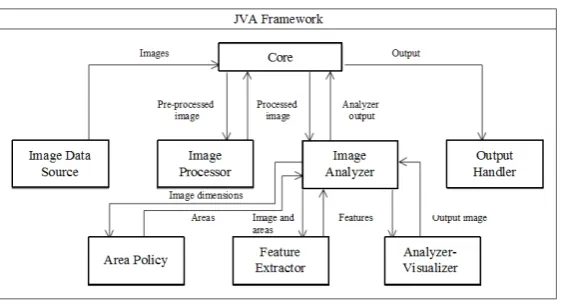
Figure 2. A high-level block diagram of the proposed JVA framework. Image data source, image processor, image analyzer and output handler are four in-dependent modules that can be implemented as plug-ins, by utilizing its main abstract components. Area policy, feature extractor and analyzer-visualizer represent peripheral plug-ins of image analyzer.
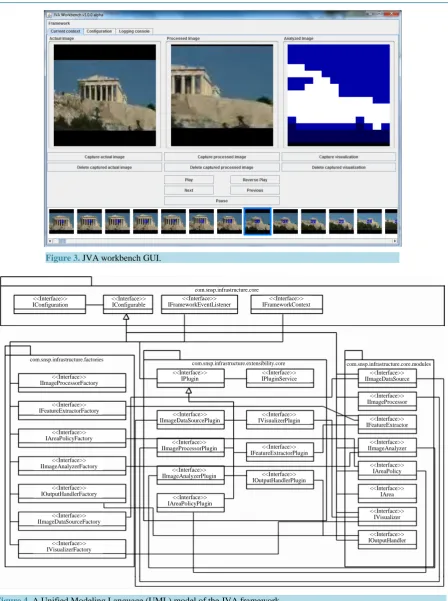
The implementation of the plug-ins can be supported by a GUI-enabled debugging utility, called JVA Work-bench, which provides output and error logging capabilities, direct access to the parameters and visualization of the intermediate test results obtained during development time. This GUI consists of three main panels. The left panel displays the output of the IDS module, the central panel displays the output of the IP module, and the right panel displays the output of the IA module, which is handled by OH. It includes controls for navigation within the video, frame grabbing, parameter configuration, and error logging options. A snapshot of the JVA Work-bench is illustrated in Figure 3. The left panel displays a video frame acquired from a video clip of the Acropo-lis; the central panel displays that frame after the application of a set of preprocessing operations that include cropping, scaling and color transformation; and the right panel displays the result of a clustering analysis process which implements the segmentation of the preprocessed video frame into areas of different color (the specific implementations of these JVA modules used are described in Section 3).
In the following paragraphs we provide details on the framework core and on the associated modules.
2.1. Framework Core
The core of the proposed framework consists of four packages of Java interfaces, as illustrated inFigure 4. These packages are interdependent and inseparable, forming a single library. The organization of the interfaces into packages is conceptual with respect to their functionality, mainly for presentation purposes.
Figure 3.JVA workbench GUI.
Figure 4. A Unified Modeling Language (UML) model of the JVA framework.
on Start: in the beginning of the whole video analysis process, 2) onNewImage: once a new image is provided by the IDS module, 3) afterImageProcessing: once the IP module finishes image processing, 4)
lysis: once the IA module finishes image analysis, 5) afterOuputHandled: once OH finishes output handling, and 6) onFinish: once the whole video analysis process finishes.
Package com.snsp.infrastructure.core.modules contains all the interfaces of the independent modules of the framework. Package com.snsp.infrastructure.extensibility.core, contains a set of respective factories (interfaces named after the modules with the suffix “Plugin”, as illustrated inFigure 4), whose role is to instantiate and configure these modules, i.e., whenever an instance of a module is needed, the factory will undertake its con-struction. All factories inherit an initialization method from IPlugin interface that is called immediately after object instantiation, and receive an IConfiguration object in order to provide the object with re-configurability. The IPluginService interface is used for the discovery of the factories of the plug-ins. This interface defines methods that return the default factories for each module and also a collection of each discovered type of mod-ule, for future use; for example a GUI application that will use this collection to provide the user with the ability to choose a plug-in from a list of available plug-ins. The framework includes a default implementation ( Default-PluginService) of this interface that loads the factories of the plug-ins from a physical directory. However, the users can provide their own implementation of an alternative plug-in discovery and instantiation process; for example, they can develop a plug-in service able to discover plug-ins from a web service, to download and to use them automatically, or another plug-in service able to provide factories that utilize the Java Remote Method Invocation (Java RMI) technology.
Package com.snsp.infrastructure.factories,contains a set of factory interfaces for each module, other than those in com.snsp.infrastructure.extensibility.core, in order to decouple the discovery and instantiation of each module from the framework core. The framework provides a default implementation for all the factories utiliz-ing the IPluginService in order to discover and instantiate the modules. By using this approach the framework is not coupled with the plug-in infrastructure. In case of an implementation without the plug-in infrastructure, cus-tom implementations of those factories can be provided to the framework directly. This way the modules can be provided to the framework without using the plug-in infrastructure, and the time overhead introduced by the plug-in discovery process is avoided (Figure 4).
2.2. Framework Modules
An IDS module implements IImageDataSource interface, which is intended for the image acquisition processes. Images can be acquired from any video file, visual sensor, local folder or remote image repository, and they are made available to the rest of the framework modules. IImageDataSource, provides a convenient means to iterate through the input images by extending the native interface java.lang.Iterable with an image type. It extends the IConfigurable interface, to enable re-configurability of the module’s parameters; for example, the developer may define the video frame acquisition rate as a tunable parameter from a text file. This interface is extended by the interfaces of all other modules.
An IP module implements the IImageProcessor interface, which is intended for preprocessing of the input images, i.e., for their processing before they enter the analysis phase. Once the images are processed, they are made available to the rest of the modules. An IA module implements IImageAnalyzer interface, which is in-tended for the analysis of the acquired images. The main functionalities supported by JVA include image sam-pling, feature extraction, and visualization. Image sampling involves acquisition of sub-images from the input images, according to a specified sampling policy.
IImageAnalyzer extends IConfigurable interface for re-configurability purposes. The implementation lifecycle is handled by IImageAnalyzerPlugin interface. The same approach is followed by the interfaces IVisualizer, IAreaPolicy and IFeatureExtractor. The instances of IVisualizer, IAreaPolicy and IFeatureExtractor are pro-vided to IImageAnalyzer through the framework core, and each one has its own lifecycle management.
An Output Handler (OH) module implements IOutputHandler interface, which is intended for image/video display and storage and also for possible transfers to remote destinations such as web servers and databases. The architecture of the core framework, provides the flexibility to have multiple instances of IOutputHandler im-plementations at the same time, and each of them is treated as an output observer which is informed whenever an output is available.
3. JVA System Development
In order to demonstrate the procedure for the development of a video analysis system with the JVA framework, we describe the implementation of a representative, well-known, methodology for segmentation of video frames based on data clustering, using publicly available software libraries.
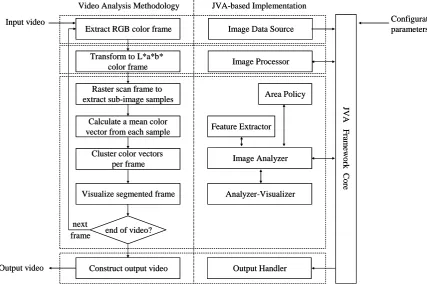
Data clustering aims at the discovery of similarities between data so as to organize them into groups. By dis-covering similarities between sub-images sampled from a video frame it is possible to localize frame areas that correspond to different semantics; for example, in Figure 3 the rightmost image in the GUI displays the result of such an analysis where the displayed video frame is segmented into three semantic areas namely, “Sky”, “Acropolis” and “Border”, based on their color. The utility of such a methodology spans in a variety of applica-tions based on image segmentation [32]. This methodology proceeds as illustrated on the left part ofFigure 5. For each step the respective component of the JVA framework that should be implemented is indicated on the right part of the same figure.
[image:7.595.93.521.400.687.2]Initially, a video frame is extracted from an input video file. This requires an IDS module implementation, i.e., an implementation of IImageDataSource interface, overriding only one method that sets up the image acquisi-tion process, and an implementaacquisi-tion of the standard Java interface Iterator, capable to iterate though the frames
Figure 5. Video frame segmentation implemented using the JVA framework. A flow chart of the methodology is illustrated on the left of the dividing line (the arrows indicate control flow), and the respective JVA implementation is illustrated on the right (the arrows indicate interaction between components as described in Figure 2).
Extract RGB color frame
Video Analysis Methodology JVA-based Implementation
Transform to L*a*b* color frame
Raster scan frame to extract sub-image samples
Calculate a mean color vector from each sample
Cluster color vectors per frame
Visualize segmented frame
end of video?
Image Data Source
Image Processor JV A F ra m e w o rk C o re Image Analyzer Feature Extractor Area Policy Analyzer-Visualizer
Construct output video Output Handler Input video Output video Configuration parameters next frame
Extract RGB color frame
Video Analysis Methodology JVA-based Implementation
Transform to L*a*b* color frame
Raster scan frame to extract sub-image samples
Calculate a mean color vector from each sample
Cluster color vectors per frame
Visualize segmented frame
end of video?
Image Data Source
Image Processor JV A F ra m e w o rk C o re Image Analyzer Feature Extractor Area Policy Analyzer-Visualizer
extracted from the input video. The extraction of the video frames from the input video is implemented into the iterator methods by exploiting the API of the Xuggler library.
A video frame extracted from the input video is represented in Red-Green-Blue (RGB) color space. However, due to the high correlation between the RGB color components, RGB is usually not preferred for color image segmentation. By transforming the pixel values from RGB to L*a*b* color space, whose components are ap-proximately decorrelated to each other, it is possible to separate luminocity L* from the chromatic components a* and b*. In this way the different colors of an image will be more separable in the two-dimensional a*-b* space than in the three-dimensonal RGB space [33]. Such a non-linear transformation of the pixel values is an image processing operation that should be implemented within the IP module of the JVA framework.
In order to analyze the contents of the input image, the processed image is sampled and decomposed into a set of sub-images by sampling (if the IP module is not implemented, the input image is directly analyzed). A well-known technique to obtain samples from the whole image is the raster scanning approach, where overlap-ping square samples are uniformly acquired from the whole image with a user-specified spatial frequency. Such a raster-scanning or any other sampling policy should be defined in the AP module of IA. This module accepts an image and an IConfiguration object, and its responsibility is to return to the framework core a list of areas in the form of IArea objects (Figure 4) through a respective accessor method. IArea is an interface that acts as a Data Transfer Object (DTO) with position and scale information about the sampled image area.
Considering that each image sample carries a significant amount of information on its pixels, focusing only on the color information contained in each of the sampled sub-images, requires that each area is represented by a set of features capable of discriminating color information. A simple approach is to calculate mean (a*, b*) vec-tors from each sub-image. This feature extraction process should be implemented in the FE module of IA. FE must implement two methods: a method for object initialization, and a method for the implementation of the calculations necessary for feature extraction from the list of areas provided in the form of IArea objects. FE should also include mutator and accessor methods for the IConfiguration object and the extracted features data. The necessary calculations for color feature extraction can be implemented by exploiting the API of the well-known ImageJ library [34].
The feature vectors extracted from the image by the FE module are passed to the AV module. AV includes two main methods: one performing the analysis and one for the visualization of the results in a new image. In the example system described in this section, image analysis is performed by data clustering of the feature vec-tors into K clusters. Clustering can be performed using the API of the well-known Weka library [35]. In the ex-ample illustrated inFigure 2, we have used the expectation maximization (EM) clustering algorithm [36] im-plemented in this library using three target clusters (K = 3). The clustering results can be visualized as a new segmented image. This can be implemented by assigning different colors to the sub-images sampled during the sampling process. The colors can be selected to depict the membership of each sub-image to a cluster. The re-sulting image will be like the one illustrated in the rightmost panel of the GUI illustrated inFigure 2.
The IA module coordinates the AP, FE and AV modules, whereas it also provides a state through the whole video analysis task, i.e., the same IA object can be reused for the analysis of each video frame until the stream of input video frames reaches its end. The interface implemented by the IA module defines mutator and accessor methods for property injection purposes to be utilized by the framework core in order to inject the AP, FE and AV modules into the IA object. The analysis process is initiated by calling a triggering method of that object. In case of supervised classification, the IA object also provides mutator and accessor methods for training data.
The last step in the development of a video analysis system using JVA is the construction of an OH module implementing the IOutputHandler interface. This module will be subscribed to the framework core as an output listener in order to handle the output display or storage of the system. Whenever an output image is ready, OH will iterate it through all the subscribers (IOutputHandler implementations) by an output handling method. Output display and storage can be implemented by exploiting the API of Xuggler library.
In all the afore-mentioned implementations, the parameters can be set so as to be externally configurable by an accessor method call to the IConfiguration object; for example, such parameters could include the path to a source input file, the sampling frequency, and the target number of clusters.
738
in the system development times is expected. In order to support this approach a growing collection of modules is provided open-access, as described in the following section.
4. Open-Access Framework
The JVA framework is publicly available as open-access software and it can be downloaded from its website1. This website includes documentation and a growing repository of JVA module implementations. Currently the available implemented modules are representative and open-source. They can be used directly for the develop-ment of a simple video analysis system, such as the one described in the previous section or for the developdevelop-ment of more complex systems such as systems for panoramic image construction from video frames [37] [38] and visual odometry [39]. The open-source implementations facilitate also as models for quick development of any other video analysis system, by example.
Currently available implementations of the IDS module include: a) FrameGrabber, for input from standard video files; b) LiveGrabber, for input directly from vision sensors; c) FileSystemImageDataSource, for input from a local or remote image repository. An implementation of IP module is available for color space transfor-mations, image cropping etc. Implementations of the IA module and of its sub-modules (AP, FE, VA) are pro-vided for image sampling according to the raster scanning policy, for color and Speeded Up Robust Features (SURF) [40] extraction (FEs), and for clustering and visualization as described in section 3 and in [37] [38].
Three implementations of OH are also available through the JVA website: a) a default implementation of which is capable of composing a video from its frames; b) LivePlayer, which can be used to display the output video to the screen, and c) DiskHandler, which comes along with LivePlayer and can be used to save the output video to the local storage.
5. Evaluation Methodology and Results
Considering that the proposed framework mainly aims to improve the efficiency of developing video analysis systems, we performed a set of experiments to assess this improvement with quantifiable metrics. The empirical evaluation methodology adopted and the results obtained are described in the following paragraphs.
5.1. Methodology
We organized a software development challenge. The objective of this challenge was the development of a video analysis system for automatic segmentation of video frames. For the purposes of this challenge, the soft-ware development was led with the eXtreme Programming methodology (XP), which is intended to improve software quality and responsiveness to changing user requirements [41]. In order to simulate such changes in the user requirements and investigate the efficiency of the JVA-based system development in this context, a two- phase hypothetical use case scenario was considered: a) in the first phase, the users would like to have a soft-ware that is able to segment the video frames into different areas according to their color content; b) in the sec-ond phase, the users included the requirement that the software should be able to identify the areas that corre-spond to the sky within the video frames; for example, this could be useful in a robot navigation situation [42]. The methodology to solve the problem posed in the first phase is the one described in Section 3, whereas the methodology to solve the problem posed in the second phase, requires that the unsupervised clustering algorithm be replaced by a supervised classification algorithm. Such an algorithm needs to be trained with a set of samples from frames of different videos accompanied with annotations that indicate which areas in the video frames represent or do not represent the sky. Therefore, the handling of the training data and the classifier training process need to be implemented as well.
Three groups of developers participated in this challenge. Group A consisted of ten of the best students of our computer engineering department that have taken courses on advanced object-oriented programming and digital image processing. Students are relatively close to the population of interest since they are the next generation of software professionals which can quickly adopt new usable tools and technologies [43] [44]. Group B, consisted of ten researchers having two to five years of experience in Java programming. We have included this group because researchers comprise a significant population of potential developers, considering the increasing interest of the scientific community in this topic (Figure 1) and the fact that there are still plenty of unresolved issues related to emerging video analysis applications, e.g., in the area of computer vision for robotics. Group C,
sisted of ten professional Java programmers with experience in the software industry.Table 1 summarizes the experience of all participants in Java programming, in terms of years and in Non-Commented Lines of Code (NCLOC) of their biggest project. The three groups were introduced to the APIs of ImageJ, Weka and Xuggler libraries in three four-hour hands-on seminars, one for each library. These seminars were focusing on function-alities that were necessary for the implementation of the described system, and aimed to provide the participants with common background knowledge on this topic.
The groups did not have any previous knowledge about the JVA framework. They were asked to develop the system initially with, and then without the framework. They were allowed to use the libraries to which they have been introduced, and the respective online documentation provided through the web. The participants were not allowed to copy code from one implementation to the other.
Since the scale of the project was small, some XP practices, such as pair programming, were omitted. The participants developed their own code individually, and used the Eclipse Integrated Development Environment (IDE) with the ActivitySensor plug-in installed, in order to monitor their activities during the software develop-ment process [45]. The completion of this process was split into two development cycles, one for each phase, and the intermediate releases were submitted to a Sub-Version Repository (SVN).
5.2. Results
The software development efficiency was assessed in terms of the effort spent by each programmer to develop the system. A simple but informative approach is to measure the absolute time required for the development. However, the total development time spent on programming can be divided into active and passive time. The active time is when a programmer types, and the passive time is when a programmer performs other activities concerning a project. If he knows what to do and which part of the source code is to be changed, the fraction of passive to total time is smaller [46]. We were able to capture both of these times with the use of the Activ-itySensor Eclipse plug-in; considering that a switch from active to passive time happens after 15 seconds of a programmer’s inactivity (the threshold was proposed by the activity sensor authors). After 15 minutes of inac-tivity, the passive time counter is stopped until a programmer hits a key.
All participants managed to complete their project. The development times required for the completion of the project, either with or without the use of the JVA framework, were correlated with the programming experience of the participants in years. The overall time spent for the completion of the first cycle was higher than the time spent for the completion of the second cycle, regardless of the approach considered. This is reasonable since the task in the second cycle requires changes in a subset of the code written in first cycle, implementing a specific functionality of the target system.
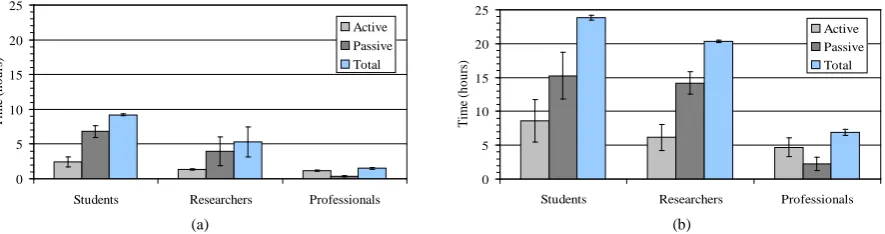
The results obtained from the time measurements in the first and in the second development cycle are illus-trated inFigure 6 andFigure 7, respectively.
[image:10.595.89.541.644.717.2]It can be observed that during the first development cycle the use of the JVA framework resulted in a signifi-cant reduction of the software development time. This reduction across all participants is estimated to be 46.1% ± 5.9% on average, with a peak of 62% reduction achieved in the case of a professional developer with eight years of experience. The framework provides a generic scheme which has already resolved many of the design and implementation issues involved; for example, how to iterate through the video frames, communication be-tween components, representation of feature vectors etc. Consequently, both the active and the passive times needed for development using the framework were shorter. Furthermore, it can be observed that the passive times obtained with the use of the framework for all participants, were in all cases shorter than 50% of the total cycle times of the participants (i.e., the passive times were shorter than the active times), although they included some time for the adaptation of the developers to the use of the libraries. Without the use of the framework, the
Table 1. Java Programming experience of the participants in our empirical study.
Group A: Students Group B: Researchers Group C: Professionals
min max min max min max
Programming experience (years) 1 1 2 5 8 10
[image:11.595.98.536.82.201.2]
(a) (b)
Figure 6. Average times per group, required for the development of the unsupervised video frame segmentation system dur-ing the first development cycle. (a) Usdur-ing the JVA framework; (b) Without usdur-ing the JVA framework.
(a) (b)
Figure 7. Average times per group, required for the development of the supervised video frame segmentation system during the second development cycle. (a) Using the JVA framework; (b) Without using the JVA framework.
passive time spent by the students and researchers exceeded 50% of the respective total cycle time, whereas this was not the case for the professionals. This can be justified by the fact that the latter ones, due their longer ex-perience, coped with design and implementation issues of the software faster.
In the second development cycle all participants had already knowledge about the framework and its use, so they used this knowledge to change their source codes according to the user requirements of the second experi-mental phase. As in the first cycle, the use of the framework resulted in a significant reduction of the time re-quired for the implementation of the changes, which is estimated to be 71.2% ± 8.7% on average across all par-ticipants. The maximum reduction was approx. 80%. It was observed in two cases; in the case of a researcher and in the case of a professional with two and ten years of experience, respectively.
Passive times are generally larger than active times in the second cycle for students and researchers, either using or not using the framework. This could be attributed to the fact that the time needed for implementation of the changes was shorter than the time needed to think how to implement them. However, there are some inter-esting observations, which could provide additional clues in the interpretation of the results. The average active times obtained with and without the use of the framework are 1.6% ± 0.7% and 6.5% ± 2.0%, respectively. This shows that using the framework, all users required significantly less effort to write and debug the code, with a rather small variance across developers of different skills.
It can also be observed that in the case of professionals the passive times were shorter than the active times. Since all participants had the same level of background knowledge about the use of the libraries, this implies that the longer times in the cases of students and researchers were mainly due to their shorter programming ex-perience, especially on the substantial use of abstraction and inheritance, as confirmed by debriefing after the experiments. These concepts are usually more difficult for students to learn [47], and since the framework is composed of Java interfaces a good knowledge of such concepts is a prerequisite. The results obtained indicate that the framework can be learned faster by more advanced developers familiar with these concepts, and can re-sult in very quick responses to changes in the user requirements.
A closer look at the resulting source codes indicate that the quicker response to changes with the use of the framework were mainly due to the modular architecture, which led the developers to make targeted changes mainly to the VA module. Although the systems developed were approximately similar in terms of functionality, there were observable differences between implementations done without the use of the JVA framework; for
0 20 40 60 80 100 120
Students Researchers Professionals
T im e ( hour s) Active Passive Total 0 20 40 60 80 100 120
Students Researchers Professionals
T im e ( hour s) Active Passive Total 0 5 10 15 20 25
Students Researchers Professionals
T im e ( hour s) Active Passive Total 0 5 10 15 20 25
Students Researchers Professionals
[image:11.595.95.538.238.355.2]example, the systems produced by seven of the non-professional developers without the framework were not able to handle large video clips, whereas there was a significantly higher (by 42%) variance in the time-perfor- mance of the video analysis software produced without the use of the framework.
6. Conclusions
We presented a novel open-access object-oriented framework, which unlike current frameworks it explicitly ad-dresses, the development of video analysis systems. The proposed framework has a generic modular architecture that can be easily maintained, extended and adapted to changes of user requirements by incorporating different modules as independent plug-ins. It builds on well-established architectural and design patterns which make it easily and quickly adoptable by software developers. A default implementation of the framework is provided in Java, considering the market needs for cross-platform software systems.
The framework provides a default implementation that handles all the communication between its abstract modules. This way the developers can take advantage of these already implemented parts of a video analysis process, and will rarely need to override their default implementation, although the framework is capable to. As a result, the overall development time can be reduced.
Another advantage of the generic architecture of the proposed framework is that is easily modifiable for the analysis of other data types as well, e.g. documents in the context of text mining. However, what makes it par-ticularly suitable for video analysis is that it inherently considers video frames as the main structural compo-nents of the input data, and the processing pipeline can be applied either globally or locally per video frame. This does not mean that processing is only serial. The IOuputHanlder and IImageDataSource interfaces can be implemented so that they enable looking-ahead and looking-behind from a current frame, which is necessary, for example, in the analysis of motion patterns across video frames.
Experimentation for video analysis e.g. testing different parameters for optimization, can be very time con- suming as the length and the resolution of the video files increase. The JVA framework can reduce the effort required for experimentation by enabling external parameterization, e.g. through text files; thus significant time can be saved from repetitive code compilations. Furthermore, the same code could be externally reconfigured (without editing any source code) for different video analysis tasks; for example, by changing training data, pa-rameters or even pre-compiled modules. Therefore, the time required for developing software systems based on the same principles can be significantly reduced, and the coding time could even be eliminated.
In order to further support quick system development, extensive documentation and a collection of open-ac- cess (and open-source) plug-in modules are available through the web. These modules can be used as examples for the developers to quickly understand the concepts of the framework and to develop other modules. The new modules can also be provided through the web, thus continuously extending the available video analysis func-tionalities.
We performed an empirical study on the use of the proposed framework by developers with different levels of experience. Main conclusions that can be derived include:
The use of the framework can reduce the development effort and speed up the development process, espe-cially after a first cycle of development.
The software produced with the use of the framework exhibits more stable time performance.
Considering the open-access availability of plug-in modules, the effort required for learning the framework, and developing a video analysis system is expected to be even smaller than the effort measured in our study. Future work includes extension of the framework to be able to handle multiple independent modules of the same kind simultaneously, and adaptation to inherently support parallel video analysis. The collection of JVA framework modules will continue to increase with contributions not only from our research group, but also from developers worldwide, through the dedicated website, which will be serving as a public module repository.
Acknowledgements
We would like to thank all subjects who participated in our study for their engagement.
References
[1] Leman, K., Ankit, G. and Tan, T. (2005) PDA Based Human Motion Recognition System. International Journal of
[2] Iakovidis, D.K., Tsevas, S. and Polydorou, A. (2010) Reduction of Capsule Endoscopy Reading Times by Unsuper-vised Image Mining. Computerized Medical Imaging and Graphics, 34, 471-478.
http://dx.doi.org/10.1016/j.compmedimag.2009.11.005
[3] Scopus (2014) http://www.scopus.com
[4] Correia, P. and Pereira, F. (1998) Proposal for an Integrated Video Analysis Framework. Proceedings of International
Conference on Image Processing, 2, 488-492.
[5] Anjulan, A. and Canagarajah, N. (2009) A Unified Framework for Object Retrieval and Mining. IEEE Transactions on
Circuits and Systems for Video Technology, 19, 63-76. http://dx.doi.org/10.1109/TCSVT.2008.2005801
[6] Park, S., Sargent, D., Spofford, I., Vosburgh, K., A-Rachim, Y. (2012) A Colon Video Analysis Framework for Polyp Detection. IEEE Transactions on Biomedical Engineering, 59, 1408-1418.
http://dx.doi.org/10.1109/TBME.2012.2188397
[7] Wang, Y.F., Chang, E.Y. and Cheng, K.P. (2005) A Video Analysis Framework for Soft Biometry Security Surveil-lance. Proceedings of the 3rd ACM International Workshop on Video Surveillance & Sensor Networks, 71-78.
[8] San Miguel, J.C., Bescós, J., Martínez, J.M. and García, Á. (2008) DiVA: A Distributed Video Analysis Framework Applied to Video-Surveillance Systems. Proceedings of the 9th Workshop on Image Analysis for Multimedia
Interac-tive Services, Klagenfurt, 7-9 May 2008, 207-210.
[9] Czyżewski, A., Szwoch, G., Dalka, P., Szczuko, P., Ciarkowski, A., Ellwart, D., Merta, T., Łopatka, K., Kulasek, Ł. and Wolski, J. (2011) Multi-Stage Video Analysis Framework. Video Surveillance, 147-172.
[10] Masek, J., Burget, R. and Uher, V. (2013) IMMI: Interactive Segmentation Toolkit. Engineering Applications of
Neu-ral Networks, Communications in Computer and Information Science, 383, 380-387.
http://dx.doi.org/10.1007/978-3-642-41013-0_39
[11] BurgSys Corporation (2014) Image Analysis Software. http://www.burgsys.com/image-analysis-software.php
[12] Bradski, G. and Kaehler, A. (2008) Learning OpenCV: Computer Vision with the OpenCV Library. O’Reilly Media, Incorporated, Sebastopol.
[13] JavaCV (2013) Computer Vision Library. http://code.google.com/p/javacv/
[14] Abeles, P. (2012) Resolving Implementation Ambiguity and Improving SURF. Computer Research Repository (CoRR).
http://boofcv.org
[15] Bellard, F. (2006) FFMpeg Multimedia System. http://www.ffmpeg.org/
[16] Xuggler (2013) Video Coding Library. http://www.xuggle.com/xuggler
[17] Fayad, M. and Schmidt, D.C. (1997) Object-Oriented Application Frameworks. Communications of the ACM, 40, 32- 38. http://dx.doi.org/10.1145/262793.262798
[18] Sullivan, S., Winzeler, L., Brown, D. and Deagen, J. (1998) Programming with the Java Media Framework. John Wiley & Sons, Inc., Hoboken.
[19] Larson, K. (2014). FMJ: Freedom for Media in Java. http://fmj-sf.net/
[20] Lyon, D. (2012) The Java Tree Withers. Computer, 45, 83-85. http://dx.doi.org/10.1109/MC.2012.30
[21] Ackermann, P. (1996) Developing Object-Oriented Multimedia-Software: Based on MET++ Application Framework. Dpunkt-Verlag, Heidelberg.
[22] Weinand, A., Gamma, E. and Marty, R. (1988) ET++ An Object-Oriented Application Framework in C++. ACM
Sig-plan Notices, 23, 46-57. http://dx.doi.org/10.1145/62084.62089
[23] Idris, I. (2013) Instant Pygame for Python Game Development How-to. Packt Publishing Ltd.,Birmingham.
[24] SDL (2013) Simple DirectMedia Layer. http://www.libsdl.org/index.php
[25] Sauer, S. and Engels, G. (1999) OMMMA: An Object-Oriented Approach for Modeling Multimedia Information Sys-tems. Proceedings of the 5th International Workshop onMultimedia Information Systems (MIS), Indian Wells, 64-71.
[26] Pleuß, A. and Hußmann, H. (2007) Integrating Authoring Tools into Model-Driven Development of Interactive Multi-media Applications. Lecture Notes in Computer Science, 4550, 1168-1177.
[27] Amatriain, X., Arumi, P. and Garcia, D. (2008) A Framework for Efficient and Rapid Development of Cross-Platform Audio Applications. Multimedia Systems, 14, 15-32. http://dx.doi.org/10.1007/s00530-007-0109-6
[28] Amatriain, X. and Arumi, P. (2011) Frameworks Generate Domain-Specific Languages: A Case Study in the Multime-dia Domain. IEEE Transactions on Software Engineering, 37, 544-558. http://dx.doi.org/10.1109/TSE.2010.48
[29] Gavalas, D. and Economou, D. (2011) Development Platforms for Mobile Applications: Status and Trends. IEEE
Software, 28, 77-86. http://dx.doi.org/10.1109/MS.2010.155
Developing Interactive Applications on Digital Television Environments. Journal of Network and Computer
Applica-tions, 33, 503-511. http://dx.doi.org/10.1016/j.jnca.2010.01.002
[31] Bellifemine, F., Caire, G., Poggi, A. and Rimassa, G. (2008) JADE: A Software Framework for Developing Multi- Agent Applications. Lessons Learned. Information and Software Technology, 50, 10-21.
http://dx.doi.org/10.1016/j.infsof.2007.10.008
[32] Agarwal, S., Madasu, S., Hanmandlu, M. and Vasikarla, S. (2005) A Comparison of Some Clustering Techniques via Color Segmentation. International Conference on Information Technology: Coding and Computing, 2, 147-153. [33] Plataniotis, K.N. and Venetsanopoulos, A.N. (2000) Color Image Processing and Applications. Springer, Berlin.
http://dx.doi.org/10.1007/978-3-662-04186-4
[34] Rasband, W. (2012) ImageJ: Image Processing and Analysis in Java. Astrophysics Source Code Library, 1, Article ID: 06013.
[35] Hall, M., Frank, E., Holmes, G., Pfahringer, B., Reutemann, P. and Witten, I.H. (2009) The WEKA Data Mining Soft-ware: An Update. ACM SIGKDD Explorations Newsletter, 11, 10-18. http://dx.doi.org/10.1145/1656274.1656278
[36] Jin, X. and Han, J.W. (2010) Expectation Maximization Clustering. In: Sammut, C. and Webb, G.I., Eds.,
Encyclope-dia of Machine Learning,Springer, Berlin, 382-383.
[37] Iakovidis, D.K., Spyrou, E. and Diamantis, D. (2013) Efficient Homography-Based Video Visualization for Wireless Capsule Endoscopy. Proceedings of the 13th IEEE International Conference on Bioinformatics and Bioengineering, Chania, 10-13 November 2013, 1-4. http://dx.doi.org/10.1109/BIBE.2013.6701598
[38] Spyrou, E., Diamantis, D. and Iakovidis, D.K. (2013) Panoramic Visual Summaries for Efficient Reading of Capsule Endoscopy Videos. Proceedings of the 8th IEEE International Workshop on Semantic and Social Media Adaptation
and Personalization, Bayonne, 12-13 December 2013, 41-46.
[39] Iakovidis, D.K., Spyrou, E., Diamantis, D. and Tsiompanidis, I. (2013) Capsule Endoscope Localization Based on Visual Features. Proceedings of the 13th IEEE International Conference on Bioinformatics and Bioengineering, Cha-nia, 10-13 November 2013, 1-4. http://dx.doi.org/10.1109/BIBE.2013.6701570
[40] Bay, H., Ess, A., Tuytelaars, T. and Van Gool, L. (2008) Speeded-Up Robust Features (SURF). Computer Vision and
Image Understanding, 110, 346-359. http://dx.doi.org/10.1016/j.cviu.2007.09.014
[41] Beck, K. and Andres, C. (2004) Extreme Programming Explained: Embrace Change. Addison-Wesley Professional, Boston.
[42] Shen, Y. and Wang, Q. (2013) Sky Region Detection in a Single Image for Autonomous Ground Robot Navigation.
International Journal of Advanced Robotic Systems, 10, 362. http://dx.doi.org/10.5772/56884
[43] Kitchenham, B.A., Pfleeger, S.L., Pickard, L.M., Jones, P.W., Hoaglin, D.C., El Emam, K. and Rosenberg, J. (2002) Preliminary Guidelines for Empirical Research in Software Engineering. IEEE Transactions on Software Engineering, 28, 721-734. http://dx.doi.org/10.1109/TSE.2002.1027796
[44] Tichy, W.F. (2000) Hints for Reviewing Empirical Work in Software Engineering. Empirical Software Engineering, 5, 309-312. http://dx.doi.org/10.1023/A:1009844119158
[45] Activity Sensor Project (2013) http://www.e-informatyka.pl/sens/Wiki.jsp?page=Projects.ActivitySensor
[46] Madeyski, L. and Szala, L. (2007) Impact of Aspect-Oriented Programming on Software Development Efficiency and Design Quality: An Empirical Study. IET Software, 1, 180-187. http://dx.doi.org/10.1049/iet-sen:20060071
[47] Liberman, N., Beeri, C. and Kolikant, Y.B.D. (2011) Difficulties in Learning Inheritance and Polymorphism. ACM
currently publishing more than 200 open access, online, peer-reviewed journals covering a wide range of academic disciplines. SCIRP serves the worldwide academic communities and contributes to the progress and application of science with its publication.
Other selected journals from SCIRP are listed as below. Submit your manuscript to us via either
![Figure 1. Number of scientific publications on “video analysis” per year in the last decade, based on the results retrieved with Scopus literature search engine on April 2014 [3]](https://thumb-us.123doks.com/thumbv2/123dok_us/8080244.782070/2.595.176.454.545.671/figure-number-scientific-publications-analysis-results-retrieved-literature.webp)