Binding Ability of Corn Cobs Hemicellulose
toward Cadmium
Muchlisyam1*, Urip Harahap1, Jansen Silalahi1, Zul Alfian2
1Faculty of Pharmacy, University of North Sumatera, Medan, Indonesia
2Department of Chemistry, Faculty of Mathematics and Natural Sciences, University of North Sumatera, Medan, Indonesia
Email: *[email protected]
Received March 27, 2013; revised April 28, 2013; accepted June 15, 2013
Copyright © 2013 Muchlisyam et al. This is an open access article distributed under the Creative Commons Attribution License, which permits unrestricted use, distribution, and reproduction in any medium, provided the original work is properly cited.
ABSTRACT
Non-Starch Polysaccahride (NSP) is an agricultural byproduct containing of cellulose, hemicelluloses, and lignin. Hemicellulose has a hydroxyl functional group and carboxylic function on the monomer hemicellulose used as a bind-ing ability for cadmium ion and hence as a pharmaceutical active bind-ingredient to prevent cadmium toxicity. The purpose of this study is to isolate and evaluate hemicelluloses from corn cobs as a binding ability toward cadmium ion. The study is conducted by isolating the corn cobs in such way using 0.2 M NaOH, characterization of hemicellulose from corn cobs produced by Infra Red Spectrofotometry. Binding ability of corn cobs hemicellulose (CCH) was done in 3 ways. The first, it was by titrimetric with cadmium 3 mg/cm3 as a titrant and indicator of 0.05 N NaOH. The second, it
was by in vitro test at pH 2 as a comparison to use pectin. The third, the in vivo test was conducted in 3 variations of treatment covering CCH 10 mg, 100 mcg of cadmium for 10 weeks. Assay of cadmium was conducted using atomic absorption spectrophotometry with flame at a wavelength of 228.8 nm. The research result showed that the highest yield of hemicellulose (12.04%) was obtained from delignication with 0.03 M NaOH in 60% ethanol and 3% H2O2,
hemicellulose isolation with 500 cm3 of 0.2 M NaOH, and precipitation with 1:4 ratio of 10% acetic acid in 95%
etha-nol. Characteristics of CCH on infrared vibration methods provide vibrational hemicellulose in the region of 1820 - 1600 cm−1. It meant that the functional group carbonyl was present, and the vibration widened near 3400 - 2400 cm−1.
It indicated that there was the functional group vibration region of hydroxyl. It also meant that there was carboxylic group and finger print at 1500 - 500 cm−1. Test results of the titrimetric holding ability showed that CCH was binding
100 mg of cadmium (46.17 ± 0.9256) mg or 46.17%. Binding ability test results at pH 2 showed that 300 mg of CCH yield was binding 30 mg cadmium of (26.68 ± 0.1490) mg or 88.93%. The results of in vivo tests showed that cadmium levels decreased by 95.05%. Based on the exposure, it can be concluded that the CCH isolation yields of 12.04% and can reduce cadmium levels in the blood. It means that the CCH can be used as a chelating agent of cadmium ions by in vitro and in vivo.
Keywords: Corn Cobs; Hemicellulose; Cadmium Solution; Binding Ability; In Vitro; In Vivo
1. Introduction
Cadmium is a heavy metal in a certain amount of time and can affect the development of neural and biological function, and health in general as well. Cadmium toxicity depends on several factors such as the way of how to get into the body, numbers, time exposed to body, age, and health condition of a person. Body exposure to cadmium can be through food, drink, medicine, environment, or at work [1]. Cadmium metal is a dangerous element because it tends to undergo a process of bioaccumulation. The po- tential toxic amount accumulates within sensitive organs
and tissues. In humans, poisoning by most of these met- als causes severe dysfunction in the kidneys, reproduc- tive system, liver, brain, and central nervous system [1-3]. The occurrence of various types of diseases above is caused by the levels of cadmium in the body that are above the average level. In relation to this, it needs to be done to reduce the body’s exposure to cadmium using the supplemental inert material with no pharmacological effect, meanwhile has the ability to reduce cadmium levels. One effort that can be developed to reduce the amount of cadmium in the body is to harness the potential of natural resources such as agricultural by-product in Indonesia, which acts as a chelating agent for toxic metal in the body.
Non-Starch Polysaccarides (NSP) is a byproduct of the agricultural material processing which is amounted to around 30% - 50% of the total number of processed ag- ricultural products. The largest component of the NSP is the fiber, consisting of components and non polysaccha- ride, hetero-polysaccharides such as cellulose (20% - 35%), hemicellulose (20% - 35%), pectin, alginate and lignin (10% - 25%). By conducting the process of extrac- tion and careful fractionation of biomass byproduct of this material, it will result in various compounds which can be converted into high value products [4,5]. He- micellulose in the pharmaceutical field could poten- tially be developed as a dietary supplement or as a drug formulation excipient such as chelating agents, disinter- grator, thickeners, and stabilizers. In addition, several important applications of hemicellulose have been done by making the derivatives which have pharmacological effects such as lowering cholesterol, and inhibitors of HIV [5-8].
Several researchers have investigated the functional group in organic compounds which are present in nature, such as amine and hydroxyl groups in chitosan, hydroxyl carboxylate groups of sodium alginate, and pectin-con- taining carboxylic and hydroxyl groups found to adsorb various metals such as aluminum, iron, lead and copper [9-11]. Hemicellulose is one of the most abundant poly-mer after cellulose. However, its potential has yet to be completely recognized. Hemicellulose comprises a vari- ety of monomers including xylose, mannose, arabinose, glucose, glukoronic acid having carboxylic and hydroxyl group on each monomer [12]. In the qualitative chemical analysis of organic compounds, the hydroxyl group in both cyclical aliphatic will be able to bind to the metal in order to formcomplex salts.
Corn cob contains a considerable resource of hemicel- lulose. It contains approximately 12.5% of hemicellulose and is the largest amount in comparison with other spe- cies [12]. Several researches have been performed to- ward the separation of hemicellulose from different plant byproduct with different methods of isolation. The lig- nification process was conducted among others by NaOH in 70% ethanol, chlorine, sodium hypochlorite and 30% H2O2. The Isolation of hemicellulose used alkaline com-
pounds such as KOH or NaOH with various concentra- tions, whereas hemicellulose was used for purification of HCl and 90% ethanol [5,6,12].
Based on the terms described above, it is necessary for the research groups found on Corncobs hemicellulose (CCH) to do with an infrared spectrophotometer [13]. Further testing of the groups bonded ability of CCH as binding metal ions, the acid-base titration between cad-mium and hemicellulose at alkaline pH using 0.05 N NaOH indicators [14]. The study made use of hydroxyl
and carboxylic groups at corn cobs hemicellulose as a ligand to the metal ion to test its ability as a binding abil-ity towards cadmium ions at pH 2 compared to the pectin, through determination of cadmium levels in the super-natant which was performed by the method of atomic absorption spectrophotometry (AAS) with flame at a wavelength of 228.8 nm [3,15,16].
Furthermore, this study will also be conducted with trial CCH binding ability in vivo toward cadmium using a rabbit for a period specified [17].
2. Experimental
2.1. Materials
Corn Cobs were obtained from local corns in Medan, Indonesia. Pectin Technical grade (China), NaOH (E. Merck), 35% hydrogen peroxide (E.Merck), 96% ethanol (E.Merck), acetic acid 98% (E.Merck), cadmium sulfate (E.Merck), Cadmium ion 1000 ppb/cm3 (E.Merck), and
all other chemicals used were of analytical grade.
2.2. Methods
2.2.1. Isolation of Hemisellulose from Corn Cobs The extraction method was modified from the combina- tion methods described by [5,6,12]. The corn cobs pow- der of 50 grams was added to 500 cm3 of 0.03 M NaOH
in 70% ethanol and heated at 60˚C, then stirred for 2 hours to dissolve the lignin. The suspension was allowed to cool to room temperature and filtered through What- man filter paper. The precipitate was added 500 cm3 of
0.2 M NaOH and stirred for 8 hours at room temperature to dissolve hemicellulose, and then filtered. The filtrate was heated at a temperature of 65˚C, and added 137 cm3
of 3% H2O2 in stages. Each addition of 1 cm3 3% H2O2 to
the filtrate was stirred constantly. Stirring was performed until the entire 3% of H2O2 was used and continued to a
clear solution. Solution of 10% acetic acid in 95% etha- nol with a ratio of 1:4 (v/v) was added to the sample so- lution and left at room temperature for 6 hours until the precipitate was formed. The suspension was centrifuged at a rate of 10.000 rpm for 15 minutes, and the filtrate was discarded. The precipitate was washed with 96% ethanol, and dried in vacuum dryer. The washed precipi- tate is hemicellulose.
2.2.2. Characterization of Corn Cobs Hemicellulose Using Infrared Spectrophotometry (FTIR) Weighed amount of 1 mg hemicellulose and added 200 mg of potassium bromide, ground to a homogeneous, then analyzed the vibration in the range of wave number 4000 - 500 cm−1, Infrared spectra recorded the fingerprint
2.3. Test to CCH Power Strap Respect for Cadmium (Cd) Ion with Titrimetric in the pH Bases
Procedure:
The CCH was weighed 100 mg and then put in six er- lenmeyer, then dissolved in 1 cm3 of 0.05 N NaOH, di-
luted with distilled water to 10 cm3, and titrated with a solu-
tion 3 mg/cm3 cadmium ion. The end point of the titration
is indicated by the formation of white precipitate [14].
2.4. Identify the Cadmium CCH Titration Results with the Color Reaction
The results of titration with cadmium 10 mg/cm3 were
centrifuged at 10,000 rpm for 15 minutes. Then, the fil- trate was separated from sediment, and the sediment was washed with aquades. After that, it was suspended in 1 cm3 of concentrated nitric acid and diluted with 10 cm3 of
distilled water and stirred for 2 minutes, then centrifuged and separated. The results of hemicellulose filtrate titra- tion appear and the first reaction solution of potassium sulfide is added to cadmium forming a yellow color [16].
2.5. Identification by FTIR
Procedure:
Titration of the resulting solution was centrifuged and the filtrate was used for identification power strap ability of cadmium by as many as 10 cm3 hemicellulose. Titra-
tion results with fried dryer and dry powder weighed as much as 1 mg and were identified by FTIR. The results were compared to the yield of vibrational CCH with infra red.
2.6. Cadmium Absorption
The absorption method was modified from the methods described by [10]. The hemicellulose and pectin respec- tively weighed 100 mg, 200 mg and 300 mg. Then, each was dissolved into erlenmeyer containing 25 cm3 solu-
tion 30 mg/cm3 of cadmium in 0.1 N nitric acid and the
pH adjusted to acid pH was performed at pH 2. The solu- tion was stirred with a magnetic stirrer at room tempera- ture for 2 hours.
Then, each was centrifuged at 10,000 rpm for 30 min- utes. The supernatant was taken and diluted with 0.5 cm3
to 50 cm3 aquabidest; then 0.25 cm3 of dilution was taken
and diluted to 25 cm3 with aquabidest and cadmium lev-
els were measured. The cadmium in the supernatant were estimated using flame atomic absorption spectroscopy (Hitachi Analyst 100) at 228.8 nm [3,15,16]. The results are presented as mean values ± standard deviation.
2.7. The in Vivo CCH Testing in Rabbits
The test is performed with the following steps:
1) As many as 15 rabbits were weighed and their blood was drawn to determine the initial level of cadmium in Blood.
2) Rabbits were divided into 3 groups and each group consisted of 4 rabbits. They were given to drink 3 cm3
aquabides and then treated as follows: Group I
Rabbits were given 100 mcg of cadmium orally every 2 days for 2 weeks and then as much as 3 cm3 of it was
drawn. A total of 1 cm3 was used to determine the levels of
cadmium in the blood. Furthermore, it was given 10 mg CCH together with 100 mcg of cadmium every 2 days. After 2 weeks, as much as 3 cm3 of blood was drawn. It is
used to test the results of the implementation of this by checking the cadmium levels in blood samples. And it was held for 10 weeks.
Group II
Rabbits were given 10 mg CCH and 100 mcg of cad- mium through their mouths every 2 days for 2 weeks and as many as 3 cm3 of blood were drawn to determine the
results of treatment by determining the levels of cadmium. The treatment was carried out for 10 weeks.
Group III
Rabbits were given 10 mg CCH through their mouths every 2 days for 10 weeks and as many as 3 cm3 of blood
were taken every 2 weeks to determine the results of treatment by determining the levels of cadmium. The treatment was carried out for 10 weeks.
Determination of Cadmium Levels in Blood of Rabbits One cm3 of blood was added to 5 cm3 of concentrated
nitric acid and heated on a hot plate at a temperature of 150˚C for 30 minutes. Then, it was added 0.2 cm3 of 50%
perchloric acid solution and 0.4 cm3 of concentrated sul-
furic acid and heated in a row at a temperature of 150˚C, 200˚C and 250˚C respectively within 15 minutes. Once it was heated at a temperature of 320˚C for 20 minutes. The results were obtained by the destruction of the white and absorbed in 6 N HNO3 (v/v) at a temperature of 90˚C for
30 minutes until dissolved, and cooled and diluted with mineral-free water [15]. The determination of cadmium levels in a sample of the destruction was done by flame AAS at a wavelength of 228.3 nm [3,16,17].
3. Results and Discussion
3.1. Isolation of Hemicellulose
The modified isolation of corn cobs hemicellulose used 500 cm3 of 0.03 M NaOH in 70% ethanol and
3.2. Characterization of Corn Cobs Hemicelluloses
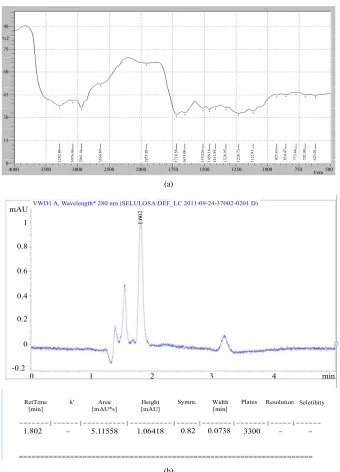
The characterization of corn cobs hemicellulose includes functional groups and vibrational fingerprint with FTIR and retention time, peak height, area and type symetris by high performance liquid chromatography [12,14,18]. The results can be seen in the Table 1.
FTIR characterization of the hemicellulose in Table 1 above shows that the sample of the insulation has a C=O group and OH group. The functional group is present in the monomer on the hemicellulose and the right catch-ment area of 1500 - 500 cm−1 is an absorption area of
fingerprint region [14] and the sample gives the of vibra-tions in the fingerprint region which is shown in Figure 1(a).
The HPLC characterization in Table 1 above shows that the sample of retention time, peak height, area and symetric which in Figure 1(b).
At the characterization by HPLC in Table 1 is illus- trated in Figure 1(b) indicates that the yield of hemicel- lulose appears to have hydrophilic properties of hemi- cellulose by HPLC testing using aquabidest as mobile phase, using a C18 column, with a flow rate of 0.8 cm3/
min and Ultra Violet light detector at a wavelength of 280 nm produces retention time of 1.8, peak height of 5.11558 and symmetrical area of 0.82.
3.3. The CCH Bind Power Test Results for Cadmium (Cd) with Titrimetric in the Bases pH
The test of CCH ability as a chelating agent metal ti- trimetric with titration was done indirectly and as a sol- vent, 0.05 N NaOH as much as 1 cm3 was used. This is
based on hemicellulose of hydroxyl groups that react
Table 1. Characterization of corn cob hemicelluloses with Solubility, FTIR and HPLC.
Aquadest Poorly soluble
Hot water Dissolve
1% HCl Poorly soluble
Solubility
1% NaOH Dissolve
Hydroxyl
Carbonyl
FTIR Functional groups
Carboxylate
Retention time 1.802
Peak height 1.06418
Area 5.11558 HPLC
Symetric 0.82
with the sodium salt into alkaline salts which are soluble in water. This is in accordance with the legal principles that reactions between Lewis acids and bases will form water-soluble salts [16,19]. The titration results of CCH bond between the metal ions cadmium are shown in Ta- ble 2.
Based on Table 2, it appears 100 mg of CCH was bond cadmium at (46.88 ± 0.5094) mg. That’s mean, that the cadmium ions can release sodium from hemicellulose. Because based on their group in the periodic system, the sodium contained in the class 1A and had a low electro- negativity compared to cadmium ions in group II. This is reinforced by laws developed by [19], the law of the Hard Soft Acid Base stating the bonding that occurs in hemicellulose also occurs at hydroxyl groups contained in the carboxylate groups and hydroxyl CCH. Although the reaction between sodium, a strong acid and a hy- droxyl compound of hemicellulose, a strong base can be replaced by other cations, there are soft acid such as cadmium ions [16].
This indicates that the titration performed in the alka- line pH of the hemicellulose can bind cadmium with en- dpoint white precipitation of Cd(OH)2.
3.3.1. The Identification of Cadmium CCH Bond with Color and FTIR
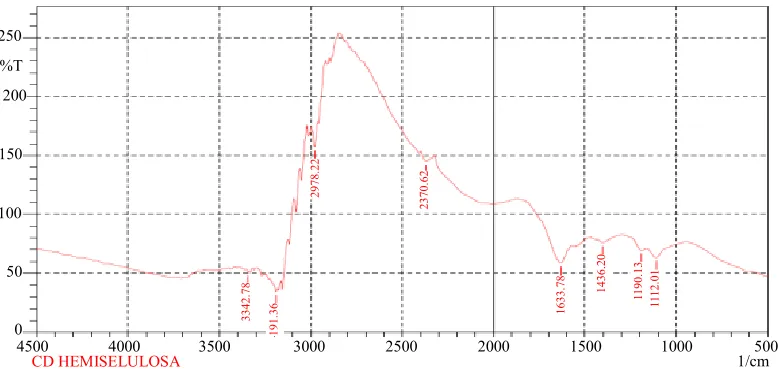
The titration reaction of cadmium with CCH was tested through the identification of specific reactions to cad- mium, filtrate, precipitate and the final titration [14]. It appears that there has been a reaction between cadmium and hemicellulose as indicated by the specific reaction of cadmium in the filtrate titration results. Filtrate titration results indicate that sediment has specific color for cad- mium. This proves that there has been an ionic bond be- tween the cadmium and CCH and they form water- soluble complexes. This is also evidenced by the sedi- ment test titration results showing a similar reaction. It means that the deposits were formed in the precipitate titration of cadmium hydroxide. The comparison between infrared vibrational forms of CCH and the vibrations reaction of CCH with cadmium can be seen in Figures 1(a) and 2.
Based on Figure 2, it appears that there is a change in the form of vibrations of the corn cobs hemicellulose before (Figure 1) and after the reaction with cadmium (Figure 2). This shows that the inclusion of cadmium ions at CCH will change the layout of existing vibrations in the corn cobs hemicellulose group. Thus, it generates the vibration of the bonds between hemicellulose and cad- mium. OH vibrations in the region of 3700 cm−1 to 3000
cm−1 change the amount of vibration and the vibration
between hemicellulose bond and cadmium in the form of vibrations extends to 3382.84 cm−1 which is a carboxylate
4000
3282.
84
3076.
46
2941.
44
2636.
69
1953.
89
1718.
58
1653.
00
1510.
26
1458.
18
141
1.
89
1328.
95
1226.
73
1112
.9
3
925.
83
854.
47
773.
46
702.
09
623.
01
3500 3000 2500 2000 1750 1500 1250 1000 750 1/cm 500
0 15 30 45 60 75 90
%T
(a)
1.802 0
5.11558 1.06418 0.82 0.0738 3300 -0.2
0 0.2 0.4 0.6 0.8 1 mAU
1 2 3 4 min
RetTime
[min] k' [mAU*s]Area [mAU] Height Symm. Width [min] Plates Resolution Seletibity
VWD1 A, Wavelength* 280 nm (SELULOSA\DEF_LC 2011-09-24-37002-0201.D)
1.602
(b)
[image:5.595.129.469.80.552.2]Figure 1. (a) Characterization infra red vibration of corn cobs hemicellulose; (b) Characterization corn cobs hemicellulose by high performance liquid chromatography (HPLC).
Table 2. Titration results corn cobs hemicellulose with cadmium 3 mg/cm3 as a titrant.
No. Corn Cobs Hemicellulose (mg) Volume 3 mg/cm3 Cd (cm3) Percentage (%)
1 100.4 15.65 46.51
2 100.7 16.05 47.46
3 101.4 16.20 47.23
4 101.7 15.90 46.11
5 101.9 16.35 47.20
6 101.7 16.15 46.80
[image:5.595.60.539.607.735.2]250
%T
200
150
CD HEMISELULOSA
4500 100
50
0 3342.
78
4000 3500 191. 3000 2500 2000 1500 1000
36
2978.
22
2370.
62
1633.
78 1436.
20
1190.
13
11
12.
01
[image:6.595.104.493.84.269.2]500 1/cm
Figure 2. Characterization infrared vibration of CCH and cadmium complex.
between hemicellulose and cadmium. It means that car- boxylic groups on the hemicellulose has been filled with cadmium bond vibrations present in areas adjacent to 3623.44 cm−1 and 3677.45 cm−1 [13] showing that there is
a reaction of carboxylic functional groups on the corncobs hemicellulose with cadmium.
3.4. Chelating Ability of Corn Cobs
Hemicellulose and Pectin toward Cadmium in pH 2
Chelating ability of corn cobs hemicellulose and pectin toward cadmium ion is shown in Table 3. The admini- stration of chelating agent to bind distinct cadmium in the pH 2 gives different results.
[image:6.595.310.537.325.426.2]From Table 3, it can be seen that there is an influence of the type and weight of chelating agent applied. But, in contrast to pectin, with the addition of pectin, the con- centration will also increase properly the strap to cad- mium ions. On the 100 mg pectin, there has a binding ability of (20.86 ± 0.3924) mg cadmium ion or 69.53%, but the 200 mg pectin will give a greater ability around (25.30 ± 0.6599) mg cadmium ion or 84.33% and 300 mg of pectin bound by an increase of (26.89 ± 0.5817) mg of cadmium ions or 89.63%. Compared to corn cobs hemicellulose, the average increase of the binding ability is around 4.33% - 6.61%. The overall number of in- creased binding ability of pectin is still below the binding ability. It means that a chelating effect of the corn cobs hemicellulose is greater than pectin. The higher the amount of chelating agent showed the higher increase of chelating agent ability. But, in corn cobs hemicellulose, the increase was not in proportional with its amount. It is in accordance with the principle of absorption that the absorption process will end if there is equilibrium be- tween the absorbents combination [18]. Therefore, the weight does not affect a significant absorbance with the
Table 3. Various binding effect of CCH and pectin for 30 mg in 25 cm3 cadmium ions.
Chelating agent Weight
Cadmium content in chelating
agent (mg)
Percentage cadmium ion in chelating
agent (%) 100 mg 24.41 ± 0.6185 81.36 200 mg 25.65 ± 0.4279 85.50 CCH
300 mg 26.68 ± 0.1490 88.93 100 mg 20.86 ± 0.3924 52.75 200 mg 25.30 ± 0.6599 81.20 Pectin
300 mg 26.89 ± 0.5817 93.47
increasing amount of binding ability of corn cobs hemi- cellulose for each treatment.
On statistical calculations [20,21], it can be seen that the addition of corn cobs hemicellulose will give an in- crease to binding effect for cadmium ion. But, it can be proved here that the CCH given as binding ability to a solution of 30 mg in 25 cm3 of cadmium causes a decline in cadmium content in the solution, meaning that there is a chemical function of the CCH that can bind cadmium ions. This suggests that the hydroxyl and carboxylic group of the corn cobs hemicellulose causes attraction for cadmium ions to be present in solution.
Based on Table 3, it can be stated that the levels of cadmium are tied with chelating agent in the treatment of the type of interaction and the variation of weight. The chelating agent type shows the same thing with the sole influence on the differences that in chelating agent type there is also difference in the binding of cadmium levels and can be maximized by a given weight of 300 mg.
Based on Figure 3 above it can be seen that with the weight of 300 mg, pectin has the ability to absorb cad- mium ions greater than the CCH. But, in the terms of pharmacology, pectin is used as anti-diarrhea only in doses below 165 mg, and if given in doses of 300 mg weight, constipation most likely occurred. Besides as a fiber, CCH has pharmacological effects to improve the digestive system and is not toxic.
3.5. Binding Ability Corn Cobs Hemicellulose toward Cadmium with in Vivo
The corn cobs hemicellulose test with three treatments was carried out for 10 weeks and the results of the test treatments A1, A2 and A3 are shown in Table 4.
0 5 10 15 20 25 30
100 mg 200 mg 300 mg
C a d m i u m ( m g ) … Weight Hemicellulose Pectin Pectin Hemicellulose
[image:7.595.60.284.271.389.2]100mg 200mg 300mg 30 25 20 15 10 5 0 Ca dm iu m ( m g)
[image:7.595.58.285.456.696.2]Figure 3. Charts comparison of CCH and pectin bind to cadmium ions.
Tabel 4. Effect of treatment for 10 weeks on the average blood cadmium levels.
Week Treatment N Weight (ppm) Standard of deviation
A1 4 2.42 0.2902
A2 4 2.37 0.1127
0
A3 4 3.09 0.1676
A1 4 4.32 0.5048
A2 4 3.96 0.3347
2
A3 4 4.46 0.2936
A1 4 3.08 0.2927
A2 4 3.34 0.7862
4
A3 4 2.69 0.1706
A1 4 0.39 0.1578
A2 4 0.79 0.3126
6
A3 4 0.59 0.3624
A1 4 0.21 0.0150
A2 4 0.50 0.2435
8
A3 4 0.42 0.3738
A1 4 none none
A2 4 0.35 0.3070
10
A3 4 0.04 0.0526
A1: 100 mcg of cadmium, every two days for two weeks and then continued
100 mcg of cadmium and 10 mg hemicellulose. A2: 100 mcg of cadmium and
10 mg hemicellulose every two days. A3: 10 mg hemicellulose every two
days.
Based on the Table 4, it appears from the blood sam- ples taken prior to treatment (W0 ) that the average blood
cadmium level is at(2.63 ± 0.3893) ppm/cm3, and after
the third treatment every other day for 2 weeks there was a decrease in blood cadmium levels as proved in treatment A1, A2 and A3. This is caused by the influence of carrots
eaten an average of 200 grams per day has contained cadmium at 0.02 ppm. Thus, if affects the content of cadmium in the blood of rabbits. Under the same condi- tions, the examination of the fourth week of a decline in cadmium levels in all treatments showed a decrease of blood cadmium levels in rabbits. In other same condi- tions, results showed a decline in cadmium levels and continued until measurements in ten weeks. The treat-ment was then stopped because the results of the analysis of blood cadmium levels in some rabbits were not de-tected and the mean cadmium levels were (0.13 ± 0.2299) ppm/cm3. This means that the administration of 10 mg
corn cobs hemicellulose for 10 weeks can reduce cad- mium levels of 2.50 ppm or 95.05%. On the other hand, F test [21] results show that the statistical analysis before treatment (W0) to check on W10 shows no significant
difference. This means that the process of the treatment of three types of treatment for 10 weeks can reduce blood cadmium levels in rabbits. In other words, corn cobs he- micellulose can be used as an ingredient to reduce cad-mium levels in the blood as shown graphically in Figure 4.
Based on the Figure 4, it appears that duration of treatment affects the levels of cadmium in the blood. The results of blood tests at the end of W2 show an increase in
levels of cadmium on, A1, A2 and A3 treatment. But, in the
W4 week there had been a decrease in the blood and the
decline continued until the W10. Treatment was stopped
due to blood cadmium levels in several rabbits are not detected meaning that the administration of 10 mg corn cobs hemicellulose with a period of 10 weeks can reduce exposure to cadmium levels in the blood. It also means
0 2 4 6
0 2 4 6 8 10
C a d m i u m ( p p m ) week A1 A2 A3 6 Ca dm iu m ( pp m
) 4
A1
2 A2
A3 0
[image:7.595.311.534.553.655.2]0 2 4 6 8 10 week
when corn cobs hemicellulose is given in greater weight, it will affect the essential minerals needed by the body in large quantities such as calcium, iron, zinc, sodium, po- tassium, etc. Therefore, it is worried that it would also reduce levels of these essential minerals.
4. Conclusions
Modified isolation of corn cobs hemicellulose yields 12.04% of hemicelluloses and characteristics of the hy- droxyl group with vibrational infrared (FTIR) methods providing vibrational hemicellulose in the region of 1820 - 1600 cm−1. The carbonyl group provides vibrational
hemicellulose widened near 3400 - 2400 cm−1 and has
finger print at 1500 - 500 cm−1. Corn cobs hemicelluloses
have the ability to bind cadmium in pH 2 and to increase ability influenced by the weight. The highest ability is shown by the 300 mg corn cobs hemicelluloses with binding ability at (26.68 ± 0.1490) mg to 30 mg of cad- mium solution, or 88.93%. Corn cobs hemicellulose can be used as a chelating agent of metal ions.
The results of in vivo tests showed that 10 mg of CCH, given every other day for 10 weeks, was able to reduce cadmium levels of 2.50 ppm or 95.05% from the initial levels of (2.63 ± 0.3893) ppm/cm3. It means that corn
cobs hemicellulose can be used to reduce levels of blood cadmium.
REFERENCES
[1] W. C. Prozialeck, J. R. Edward, W. N. Nebert, J. M. Woods, A. Barchowsky and W. D. Atchison, “The Vas- cular System as a Target of Metal Toxicity,” Toxicology Sciences Journal, Vol. 102, No. 2, 2008, pp. 207-218. doi:10.1093/toxsci/kfm263
[2] S. J. Casas and J. Dan Sordo, “Lead Chemistry, Analyti- cal Aspects,” Environmental Impact and Health Effects, 2006, pp. 3-5.
[3] S. Jickel and A. Negrusz, “Clarke’s Analytical Forensic Toxicology,” 3th Edition, Pharmaceutical Press, Chichago, 2008.
[4] R. Caprita, A. Caprita and C. Dan Julean, “Biochemical Aspect of Non-Polysaccarides,” Animals Sceinces and Bio- technologies, Vol. 43, No. 1, 2010, pp. 1-4.
[5] A. M. Karaaslan, M. A. Tshabalala and D. G. Buschle, “Wood Hemisellulose/Chitosan-Basedsemi-Interpenetra- ting Networks Hydrogels: Mechanical, Swelling and Con- trol Drug Release Properties,” Journal of Bioresources, Vol. 5 No. 2, 2010, pp. 1036-1054.
[6] M. P. Yadav, D. B. Johnston and K. B. Hicks, “Structural Characterization of Corn Fiber Gums from Coarse and Fine Fiber and a Study of Their Emulsifying Properties,” Journal of Agricultural and Food Chemistry, Vol. 55, No.
15, 2007, pp. 6366-6371. doi:10.1021/jf070024q
[7] C. B. Saha, “Hemicellulose Bioconversion,” Journal of Microbiologie Biotechnologie, Vol. 30 No. 16, 2003, pp. 279-291.
[8] A. E. Silva, H. R. Marcelino, M. C. S. Gomes, E. E. Oli- veira, T. Nagashima Jr. and E. S. T. Egito, “Xylan, a Pro- mising Hemicellulose for Pharmaceutical Use,” Products and Applications of Biopolymers Journal, 2008, pp. 60- 82.
[9] E. Purwoningsih, “Effect of Molecular Weight Chitosan against Levels Plumbum (Pb) Blood and Enzyme Activ- ity-Alad δ (Delta Aminolevulinic Acid Dehydratase) Al- bino Mice (Mus Musculus L) Healthcare,” Master Thesis, University of North Sumatra, Medan, 2008.
[10] I. M. Tarigan, “Analysis of the Applicability of Chitosan and Chitosan Beads as Adsorbents Standard Solution to Lower Levels of Iron (Fe) and Aluminum (Al) by Atomic Absorption Spectrophotometry,” Master Thesis, Univer- sity of North Sumatra, Medan, 2008.
[11] W. W. Wong, F. M. A. Abbas, M. T. Liong and M. E. Azhar, “Modification of Durian Ring for Improved Bio- sorbent Ability,” International Food Research Journal, Vol. 15, No. 3, 2008, pp. 363-365.
[12] S. Dumitriu, “Polysaccharides: Structural Diversity Dan Functional Versatility,” Marcel Dekker, New York, 2005. [13] N. Richana, T. T. Irawadi and A. M. Nur, “The Extraction
of Hemicellulose from Corn Cobs,” Postharvest Journal, Vol. 4, No. 1, 2007, pp. 38-43.
[14] H. G. Britthin, “Spectroscopy of Pharmaceutical Solids,” Center for Pharmaceutical Physis Taylor and Francis Group, New York, 2006. doi:10.1201/9780849361333
[15] C. A. Moffat, D. M. Osellton and B. Widdop, “Clarke’s Analysis of Drugs and Poisons,” Pharmaceutical Press, London, 2005.
[16] J. Szkoda and J. Zmudzki, “Determination of Lead and Cadmium in Biological Material by Graphite Furnace Ato- mic Absorption Spectrometry Method,” Buletin Veteri- nairInstitute, Vol. 49, 2005, pp. 89-92.
[17] J. B. Smith and S. Mangkoewidjojo, “The Maintenance, Breeding and Use of Experimental Animals in the Trop- ics,” University of Indonesia Publisher, Jakarta, 1988. [18] J. Basset, R. C. Denny, B. H. Jeffrey and J. Mendham,
“Vogel’s Textbook of Quantitative Inorganic Analysis Including Elementary Instrumental Analysis,” Translation, EGC Book Medical Publishers, Jakarta, 1994.
[19] W. Haryadi, “Analytical Chemistry,” PT Gramedia, Ja- karta, 1990.
[20] R. G. Pearson, “Chemical Hardness and Density Func- tional Theory,” Journal of Chemicals Sciences, Vol. 117, No. 5, 2005, pp. 369-377. doi:10.1007/BF02708340 [21] R. G. D. Steel and J. H. Torrie, “Principles and Procedures