Variability in Working Memory Performance Explained
by Epistasis vs Polygenic Scores in the
ZNF804A
Pathway
Kristin K. Nicodemus, PhD, MPH; April Hargreaves, MSc; Derek Morris, PhD; Richard Anney, PhD; Michael Gill, MD; Aiden Corvin, MD, PhD; Gary Donohoe, DClinPsych, PhD; for the Schizophrenia Psychiatric Genome-wide Association Study (GWAS) Consortium and The Wellcome Trust Case Control Consortium 2
IMPORTANCEWe investigated the variation in neuropsychological function explained by risk alleles at the psychosis susceptibility geneZNF804Aand its interacting partners using single nucleotide polymorphisms (SNPs), polygenic scores, and epistatic analyses. Of particular importance was the relative contribution of the polygenic score vs epistasis in variation explained.
OBJECTIVES To (1) assess the association between SNPs inZNF804Aand theZNF804A polygenic score with measures of cognition in cases with psychosis and (2) assess whether epistasis within theZNF804Apathway could explain additional variation above and beyond that explained by the polygenic score.
DESIGN, SETTING, AND PARTICIPANTSPatients with psychosis (n = 424) were assessed in areas of cognitive ability impaired in schizophrenia including IQ, memory, attention, and social cognition. We used the Psychiatric GWAS Consortium 1 schizophrenia genome-wide association study to calculate a polygenic score based on identified risk variants within this genetic pathway. Cognitive measures significantly associated with the polygenic score were tested for an epistatic component using a training set (n = 170), which was used to develop linear regression models containing the polygenic score and 2-SNP interactions. The best-fitting models were tested for replication in 2 independent test sets of cases: (1) 170 individuals with schizophrenia or schizoaffective disorder and (2) 84 patients with broad psychosis (including bipolar disorder, major depressive disorder, and other psychosis).
MAIN OUTCOMES AND MEASURESParticipants completed a neuropsychological assessment battery designed to target the cognitive deficits of schizophrenia including general cognitive function, episodic memory, working memory, attentional control, and social cognition.
RESULTS Higher polygenic scores were associated with poorer performance among patients on IQ, memory, and social cognition, explaining 1% to 3% of variation on these scores (range, P= .01 to .03). Using a narrow psychosis training set and independent test sets of narrow phenotype psychosis (schizophrenia and schizoaffective disorder), broad psychosis, and control participants (n = 89), the addition of 2 interaction terms containing 2 SNPs each increased theR2for spatial working memory strategy in the independent psychosis test sets from 1.2% using the polygenic score only to 4.8% (P= .11 and .001, respectively) but did not explain additional variation in control participants.
CONCLUSIONS AND RELEVANCEThese data support a role for theZNF804Apathway in IQ, memory, and social cognition in cases. Furthermore, we showed that epistasis increases the variation explained above the contribution of the polygenic score.
JAMA Psychiatry. 2014;71(7):778-785. doi:10.1001/jamapsychiatry.2014.528 Published online May 14, 2014.
Supplemental contentat jamapsychiatry.com
Author Affiliations:Author affiliations are listed at the end of this article.
Group Information:The Schizophrenia Psychiatric Genome-wide Association Study (GWAS) Consortium and The Wellcome Trust Case Control Consortium 2 investigators are listed at the end of the article.
Corresponding Author:Kristin K. Nicodemus, PhD, MPH, Neuropsychiatric Genetics Group, Department of Psychiatry, Trinity College Dublin, St James Hospital, Dublin 8, Ireland ([email protected]).
G
enome-wide association studies (GWASs) have been at the forefront of identifying candidate genes for schizo-phrenia. One of the genetic variants achieving genome-wide significance for psychosis was rs1344706 in the zinc fin-ger binding protein 804A (ZNF804A).1Several independentreplication studies2,3and a recent meta-analysis4have
sup-ported an association between schizophrenia and the risk al-lele of this single nucleotide polymorphism (SNP). The gene
ZNF804A, which is expressed in the brain, is believed to en-code a protein with a C2H2 zinc finger domain. This suggests a role in the regulation of gene expression through DNA and/or RNA binding.5The geneZNF804Ahas been reported to show
an association with brain activity and structure.6,7A recent
study by Hill et al8assessed the effects of its knockdown on
the cellular transcriptome, which linkedZNF804Ato cell ad-hesion molecules, suggesting a role in neural migration, neu-rite outgrowth, and synapse formation, which are hypoth-esized to be aberrant in schizophrenia.
Several studies have linkedZNF804Ato cognition, based on imaging studies,6,9traditional neuropsychological
measures,10-12and measures of social cognition.13,14The
re-sults of these studies deviate from what would be expected in that while the rs1344706 risk allele appears to convey impair-ments in cognition in control individuals based on behavioral and imaging studies,11,15-17the literature points to preserved
cognition in patients.10,12,18,19Although some studies suggest
thatZNF804Ais associated with impaired social cognition in control participants, it is uncertain whetherZNF804Amight also confer a disadvantage to patients because only 1 study14
has assessed patients. IfZNF804Aconfers risk for psychosis, why does the risk allele–carrying patient population show pre-served cognitive function? The answer may lie in the impact ofZNF804Aembedded within its functional pathway. The de-velopment of complex traits, such as psychosis, is likely to in-volve the contribution of a large number of independent and/or interacting genetic variants, mostly of modest effect.20,21In
case-control analyses, polygenic scores (a simple or weighted summation of the top sets of SNPs) have been shown to pre-dict case status in related disorders and explain a significant percentage of variability.22Limiting this polygenic risk score
to include variants within genes shown to be altered by
ZNF804Aknockdown,8we investigated whether more of the
variance in patients’ neuropsychological function can be ex-plained than is exex-plained by single variants. We used theP val-ues and odds ratios from the Schizophrenia Psychiatric GWAS Consortium 1 (PGC1) schizophrenia case-control analysis23to
rank SNPs for inclusion in the polygenic score. As variation in complex traits is thought to include both polygenic and epi-static components, we examined whether epistasis between SNPs within theZNF804Apathway could explain variation above that explained by the polygenic score alone. We used half of the narrow psychosis (schizophrenia and schizoaffec-tive disorder) set as a training set to test for pairwise epistasis among all SNPs included in the polygenic score, then as-sessed whether adding these interactions to the regression model containing the polygenic score increased theR2among
3 independent test sets including (1) additional narrow psy-chosis cases, (2) broad psypsy-chosis (bipolar disorder, major
de-pressive disorder, and psychosis not otherwise specified), and (3) healthy control participants.
Methods
Participants
Four hundred twenty-four cases and 89 healthy participants who completed a full neuropsychological assessment battery and for whom GWAS data were available were included. Cases were clinically stable patients with aDSM-IVdiagnosis of schizophrenia (n = 282), schizoaffective disorder (n = 58), bi-polar disorder (n = 61), major depressive disorder with psy-chotic features (n = 11), or psychosis not otherwise specified (n = 12) recruited from 5 sites across Ireland (Table 1). Inclu-sion criteria required that participants were clinically stable at neuropsychological assessment, aged 18 to 65 years, had no history of comorbid psychiatric disorder, no substance abuse in the preceding 6 months, no prior head injury with loss of consciousness, and no history of seizures. Diagnosis was con-firmed by trained psychiatrists using the Structured Clinical Interview forDSM-IV-TR.24Additional diagnostic details and
clinical sample characteristics, including symptom severity (Scale for the Assessment of Negative Symptoms/Scale for the Assessment of Positive Symptoms)25,26and medication
dos-age, are detailed elsewhere.10Healthy control participants were
recruited via online and poster advertising. They were aged 18 to 65 years, with no history of substance abuse in the pre-ceding 6 months, no prior head injury with loss of conscious-ness, no history of seizures, and no personal history of psy-chosis or in their first-degree relatives. All assessments were conducted in accordance with the relevant ethics commit-tees’ approval from each participating site. All participants had 4 grandparents born in Ireland and provided written in-formed consent.
Cognitive Assessment
Participants completed a neuropsychological assessment bat-tery designed to target the cognitive deficits of schizophrenia including general cognitive function, episodic memory, work-ing memory, attentional control, and social cognition. Gen-eral cognitive functioning (IQ) was measured using selected subtests (Vocabulary, Similarities, Block Design, and Matrix Reasoning) from the Wechsler Adult Intelligence Scale,27
yield-ing a full-scale, verbal, and performance IQ. Episodic memory was assessed using the logical memory subtest from the Wechs-ler Memory Scale III.28Working memory was assessed using
the spatial working memory task (SWM) from the Cambridge Neuropsychological Test Automated Battery29and
letter-number sequencing from the Wechsler Memory Scale III.28
Attentional control was assessed using the Continuous Per-formance Task–Identical Pairs version,30the
Intradimensional-Extradimensional shift task (IDED) (Cambridge Neuropsycho-logical Test Automated Battery),29and the Sustained Attention
to Response Task.31Social cognition was assessed using the
Reading the Mind in the Eyes Task32and the Internal,
Per-sonal, and Situational Attributions Questionnaire (IPSAQ),33
in-dicates a propensity to attribute positive events to oneself rather than to other people, and a personalizing bias, which indicates a propensity to attribute negative events to other people rather than to situational factors.
Genotyping
Genotyping was conducted on DNA extracted from blood in patients and saliva in control participants. Single nucleotide polymorphism data were obtained from a recent GWAS using the Affymetrix SNP Array 6.0 platform, conducted as part of the Wellcome Trust Case Control Consortium 2, described in detail elsewhere.34
Statistical Analysis
Polygenic scores22for variants located within theZNF804A
path-way were calculated starting with all available SNPs within 20 Kb of genes in theZNF804Apathway8(eTable 1 in
Supple-ment). Target alleles at these SNPs were identified as risk asso-ciated based on the PGC1 GWAS. Two polygenic scores for each individual were calculated. The count polygenic score was based on the simple sum of the number of risk-associated alleles they carried averaged across the total number of valid genotypes for that individual. The weighted polygenic score was based on the count polygenic score, with the exception that each SNP was weighted by the log of the odds ratio from the PGC1. We used 3
Pvalue thresholds from the PGC1 case-control analysis as ar-bitrary thresholds as in a previous polygenic analysis22
(thresh-olds and number of SNPs:P< 1.0e-05, n = 10;P< .05, n = 218; and P< .50, n = 1525). As individualZNF804ASNPs have been as-sociated with cognition, we examined whether an association observed between the pathway-based polygenic score re-mained after removing allZNF804ASNPs (n = 27). A subset of the Wellcome Trust Case Control Consortium 2 sample was in-cluded in the PGC1 schizophrenia case-control analysis, thus the
samples are not entirely independent. However, the outcome of interest in the PGC1 was case status, whereas in the present study the outcome of interest was cognition in cases with psychosis. As suggested in the supplementary materials of the original polygenic score report,22we used all genotyped SNPs
in genes within theZNF804Apathway without pruning for linkage disequilibrium.
Association Analysis
Polygenic ScoresAssociations betweenZNF804Apolygenic score and the phe-notypes of IQ, episodic memory, working memory, attention, and social cognition were tested in multiple regression analy-ses implemented in SPSS version 1735or the R Statistical
Com-puting Environment.36In each case, scores for each
neuro-psychological phenotype were entered as dependent variables, controlling for age and sex as necessary.
Polygenic Scores Plus Epistatic Effects
[image:3.612.69.419.80.324.2]To test whether additional variation could be explained by epis-tasis beyond that explained by the polygenic score, we devel-oped a novel approach within the context of the regression models previously described. To reduce multiple testing, we restricted our search for epistasis to the models where the poly-genic score accounted for a small, but significant, amount of variation in the neuropsychological phenotype in broad or nar-row psychosis including SWM strategy, IPSAQ-EB, and perfor-mance IQ. First, we created equal-sized training and test sets from the narrow psychosis cases (n = 170). Second, to obtain a stable and consistent estimate of thePvalue from 2-SNP in-teractions, we took 100 bootstrap samples with replacement from the narrow psychosis training sample and performed lin-ear regression analysis for all possible pairs of SNPs falling un-der the threshold at hand (SWM thresholdP≤ .05, SNPs:
Table 1. Participant Demographics and Neurocognitive and Clinical Measures
Characteristic
Patients
Healthy Participants (n = 89) Psychosis Narrow
(n = 340)
Psychosis Broad (n = 424)
Psychosis subtype, No. NA
Schizophrenia 282 282
Schizoaffective disorder 58 58
Bipolar disorder 61
Major depressive disorder 11
PNOS 12
Male:female ratio 2.6:1 2.2:1 1.4:1
Age, mean (SD), y 41.3 (12.2) 41.3 (12.4) 36.27 (12.8)
Age at onset, mean (SD), y 22.8 (7.2) 23.2 (7.5) NA
Chlorpromazine equivalent, mean (SD), mg/d
589.8 (562.4) 555.5 (540.7) NA
SAPS/SANS, mean (SD) NA
Manic −0.18 (0.95) 0.04 (1.09)
Depression 0.16 (1.07) 0.23 (1.06)
Positive −0.02 (0.99) −0.12 (0.95)
Disorganized −0.22 (0.76) −0.31 (0.78)
Negative 0.39 (0.9) 0.32 (0.87)
Cognition: full-scale IQ, mean (SD) 89.6 (17.8) 90.3 (18.3) 124.6 (13.3)
n = 218; IPSAQ-EB and performance IQ thresholdP< 1.0e−05,
SNPs: n = 10). For performance IQ and IPSAQ-EB, the 10 SNPs were all on chromosome 10 and in tight linkage disequilib-rium (range,r2= 0.6-1.0), which led to collinearity in the
in-teractions and were not tested further. For SWM, the linear re-gression model in the training data contained the unweighted polygenic score plus an epistatic term, which was the prod-uct of the risk-associated alleles at 2 SNPs. The unweighted polygenic score was used so the alleles comprising the score were on the same scale of measurement as those used in the interactions; however, the use of the weighted score did not change the results (discussed below). The averagePvalue from the 100 replicates was used to determine which interactions would be evaluated using the 3 independent test sets, using an uncorrectedP< .05 threshold estimated from the training set. To account for linkage disequilibrium, a further condi-tion was that only the interaccondi-tion with the smallestPvalue con-taining a particular SNP would be tested for replication in the independent test sets and all other interactions containing that SNP would not be considered for replication due to collinear-ity. This led to 3 significant 2-SNP interaction terms, indepen-dent of one another, being brought forward for replication in the 3 test sets.R2values on the independent test sets were
cal-culated as the square of the correlation between the fitted val-ues for the test set based on the model estimated from the train-ing data and the observed values from the test set.
Results
Demographic and Clinical Measures
Demographic and clinical characteristics for patients and healthy participants appear in Table 1. The characteristics of the broad psychosis group were compared with the narrow psy-chosis group and with the control group usingttests. No sig-nificant differences were observed between the narrow and broad psychosis groups for age, sex, age at onset, full-scale IQ, medication dosage as measured by chlorpromazine equiva-lents, or positive and negative symptoms, with the exception of the mania factor where the broad psychosis group scored significantly higher. The patient group contained
signifi-cantly more men than the healthy group, was signifisignifi-cantly older at the time of assessment, and had a significantly lower full-scale IQ.
ZNF804A
Pathway Polygenic Score
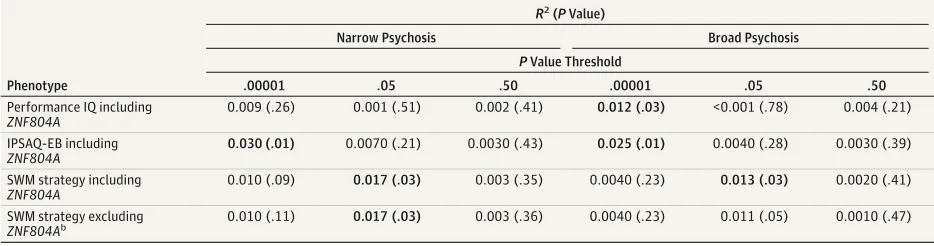
ZNF804Aweighted polygenic scores were associated (uncor-rectedP< .05) with measurements of both general and social cognition, including SWM, IPSAQ-EB, and performance IQ, al-though the effect size was moderate (1.2%-3%) (Table 2; re-sults for all phenotypes are in eTable 2 in Supplement). Larger
ZNF804Apolygenic scores were predictive of poorer perfor-mance on perforperfor-mance IQ in the broad psychosis group at the threshold ofP= 1.0e−05, but did not predict performance IQ
in the narrow psychosis group (Table 2). The IPSAQ-EB dem-onstrated significant association with theZNF804A poly-genic score among broad and narrow psychosis at a threshold ofP= 1.0e−05. Patients with psychosis who had greater
poly-genic scores demonstrated a decreased IPSAQ-EB score, sug-gesting that these patients were less likely to show what is known as a self-serving bias: the adaptive tendency to attri-bute causality for negative events to external factors and posi-tive events to oneself. Among both narrow and broad psycho-sis groups, a higherZNF804Apolygenic score led to significantly poorer performance on SWM strategy at a thresh-old ofP= .05.
To determine whether the polygenic score results were powered byZNF804ASNPs, we excluded all variants in
ZNF804Aand reassessed association with the polygenic score; the results were virtually unchanged (Table 2), with the ex-ception of SWM strategy, which showed a slightly reducedR2
and largerPvalue in the narrow psychosis set (results for all phenotypes are in eTable 3 in Supplement).
Epistasis Within the
ZNF804A
Pathway
[image:4.612.76.543.82.205.2]As just described, we tested for additional variation in SWM explained by 2-SNP epistasis in the narrow psychosis training set. Because of linkage disequilibrium, 112 averagePvalues across 100 bootstrap samples of the training set were less than .05; however, of these, only 3 were completely independent of the other sets and thus only these 3 interaction terms were brought forward for replication in the 3 independent test sets.
Table 2. Significant Variance Explained (R2) and AssociatedPValues forZNF804APolygenic Score Regression on Neuropsychological Phenotypesa
Phenotype
R2(PValue)
Narrow Psychosis Broad Psychosis
PValue Threshold
.00001 .05 .50 .00001 .05 .50
Performance IQ including
ZNF804A
0.009 (.26) 0.001 (.51) 0.002 (.41) 0.012 (.03) <0.001 (.78) 0.004 (.21)
IPSAQ-EB including
ZNF804A
0.030 (.01) 0.0070 (.21) 0.0030 (.43) 0.025 (.01) 0.0040 (.28) 0.0030 (.39)
SWM strategy including
ZNF804A
0.010 (.09) 0.017 (.03) 0.003 (.35) 0.0040 (.23) 0.013 (.03) 0.0020 (.41)
SWM strategy excluding
ZNF804Ab
0.010 (.11) 0.017 (.03) 0.003 (.36) 0.0040 (.23) 0.011 (.05) 0.0010 (.47)
Abbreviations: IPSAQ-EB, Internal, Personal, and Situational Attributions Questionnaire–Externalizing Bias; SWM, spatial working memory.
aBolded numbers indicateP< .05.
b
Beginning with SWM strategy, adding the most significant in-teraction (rs17186340:rs140512) to the model containing the polygenic count score led to an increase of 1.4% in the narrow psychosis test set (P= .05), 3.7% in the broad psychosis test set (P= .04), and a combined case test set increase of 2.3% (P= .006) (Table 3). Although adding this interaction in-creased the variation explained in 2 independent sets of cases, it did not increase variation explained in control participants (R2= 0.0069,P= .45). Adding a second interaction term to the
model (rs2295984:rs34138673) further increased the varia-tion explained in cases: in the narrow psychosis test set, the
R2increased by 1.3% (P= .02) to a total of 4.0%; in the broad
psychosis test set, theR2increased further by 1.2% (P= .04)
for a total variation explained of 6.2%; and in the combined set of cases, theR2increase was 1.3% (P= .001) for a total of
4.8%. In control participants, adding the second interaction did not increase the variation explained (R2= 0.001,P= .77).
The third epistatic term did not increase theR2values in any
independent test set and thus was not considered further. To test whether the increase inR2was attributable to
strongly associated SNPs contained in the interactions them-selves, interaction SNPs were tested individually for associa-tion with SWM strategy in a model containing the polygenic count score. Two SNPs were associated with SWM strategy at an uncorrectedP< .05 and both were in the second interac-tion term (rs17186340:rs34138673). The improvement inR2
val-ues from the narrow psychosis training set model containing the polygenic count score plus rs17186340 on the narrow psy-chosis, broad psypsy-chosis, and total test cases set were 5.89e−06,
9.1e−04, and 8.0e−05, respectively. Results for the same
analy-sis using rs34138673 were 0.0056, 0.013, and 0.0079, respec-tively, indicating that the interaction term explained more variation than either single SNP.
To see whether the type of polygenic score influenced the amount of variation explained, the weighted polygenic score was substituted for the count polygenic score andR2values
were calculated for the case test sets. In the narrow psychosis test set, the use of the weighted polygenic score in the 3 mod-els (polygenic only, 1 and 2 interactions) increased theR2value
by 9.1e−04− 0.001 vs models containing the count polygenic
score, whereas the use of the weighted polygenic score in broad psychosis reduced theR2value by 4.7e−04− 0.0061 vs the count
polygenic score, suggesting the choice of polygenic score was trivial in this instance. When strongly associated SNPs with very large or very small effect sizes (odds ratios) are present, we
would expect to see differences between using the count or weighted score.
Discussion
We used polygenic scores to investigate whetherZNF804A
pathway schizophrenia risk–associated alleles were associ-ated with neuropsychological function among 424 patients with psychosis. HigherZNF804Apolygenic scores were sig-nificantly associated with poorer performance in IQ, working memory, and biased social cognition and explained 1% to 3% of the variation in these measures, consistent with estimates previously reported in general intelligence in control individuals.37Removal of the SNPs withinZNF804Areduced
theR2values only slightly, suggesting the combined
contri-bution of genes within the pathway was driving the associa-tion. Furthermore, we showed that considering epistasis along with the polygenic score resulted in more than 3 times the amount of variation explained in 2 independent test sets of cases (range, totalR2= 4.0%-6.2%). Because the SNPs
partici-pating in interactions were not inZNF804A, we provide fur-ther evidence that this gene was not the key contributor to our pathway-based results. Thus, our findings are not inconsis-tent with previous studies showing preserved cognitive func-tion in cases is associated withZNF804A. Although the poly-genic score explained a similar amount of variation in control participants, improvements due to epistasis were specific to psychosis cases.
Although previous studies have shown that the risk allele ofZNF804Ars1344706 shows differential effects in cases and control participants,10-19we showed that, at the pathway level,
the effect of the combination of schizophrenia risk alleles leads to poorer performance in patients with psychosis on mea-sures of intelligence, working memory, and social cognition. The 4 SNPs participating in epistasis that increased theR2
val-ues in our test sets were nearSTAC(rs17186340),MAPK8IP2
(rs140512), and flanking either side ofFAM46A(rs2295984 and rs34138673). In mice,Stacis expressed in the brain, neurons, and postsynaptic densities; within the brain, the expression is highest in the hippocampus and cerebellum.38,39AStac
knockout mouse model showed reduced social interaction, impaired learning, and deficits in exploration of novel environments.39MAPK8IP2is located within the Chr22q13.3
[image:5.612.65.537.92.169.2]deletion region associated with autism spectrum disorders and
Table 3. Increase inR2
Values Using Epistasis in Conjunction WithZNF804APolygenic Scores Across the Narrow Psychosis Test Set and Broad Psychosis Seta
Model
Narrow TrainR2 PValue
Narrow TestR2 PValue
Broad
R2 PValue
Total Test
CaseR2 PValue ControlR2 PValue
Polygene count score 0.017 .12 0.013 .17 0.013 .34 0.012 .11 0.03 .11
Polygene count
score + rs17186340T:rs140512A
0.13 6.70e−005 0.027 .05 0.05 .06 0.035 .006 0.0069 .45
Polygene count
score + rs17186340T: rs140512A + rs2295984T:rs34138673G
0.16 2.70e−005 0.04 .02 0.062 .04 0.048 .001 0.001 .77
Phelan-McDermid syndrome, which is characterized by de-velopmental delay. Also known as JIP2, it is a scaffold protein that is necessary for N-methyl-D-aspartic acid receptor func-tion and modulates signal transducfunc-tion.40FAM46Ais
ex-pressed in adult human brain and shows higher expression in human fetal brain.41The SNPs participating in the second
in-teraction term, rs2295984 and rs34138673, are located on either side ofFAM46A, approximately 19.5 kbp apart, possibly indi-cating a promoter and/or enhancer role.
How can we reconcile previous research that has shown the risk allele atZNF804Ars1344706 is associated with less impaired cognition in patients with psychosis with the results of the present study, which showed that the poly-genic score from theZNF804Apathway was associated with poorer performance IQ, working memory, and social cogni-tion? ThePvalues from the PGC1 were used to select SNPs for inclusion in the polygenic score, and the smallest
ZNF804A Pvalue was .002 for rs1344706. Therefore, the set with the most stringent threshold did not include any
ZNF804ASNPs, and this set was negatively associated with IQ and social cognition. For working memory, the removal of theZNF804ASNPs at a threshold ofP= .05 would have included 12 of the 27 SNPs withPvalues ranging between .002 and .05. We have shown that the removal of these SNPs did not lead to significant differences in the magnitude of association between the polygenic score and working memory. The use of the weighted polygenic score would have ensured a weak contribution of these SNPs because they were not strongly associated with schizophrenia in the PGC1 and they comprised only 5.5% of the total number of SNPs at that threshold. Interestingly, the PGC1Pvalues for the 4 SNPs participating in epistasis ranged between .007 (rs2295984) and .04 (rs17186340), showing that although they are marginally associated with schizophrenia, they would not have been considered for follow-up. As was the case with the previous use of the polygenic score,22we
showed that the polygenic score and epistatic models based on a narrow psychosis training sample were able to signifi-cantly account for variation in working memory in 2 inde-pendent psychosis samples, but they were not able to pre-dict variation in control participants. Although the control sample size was modest (n = 89), the broad psychosis sample was of a similar size (n = 84) so a lack of statistical power cannot fully explain the inability to account for addi-tional variation in control participants.
Interestingly, the 10 SNPs in linkage disequilibrium that comprised the most strongly associated polygenic score for IPSAQ-EB and performance IQ included 5 SNPs inCNNM2and 5 SNPs either 3′ or 5′ of the gene. This gene is strongly associ-ated with schizophrenia23,42,43and we and other groups have
shown variation within the gene is associated with gray mat-ter volume in patients with schizophrenia44,45and with
attri-butional style.45Our results support a polygenic contribution
of variation within and around this gene weakly contributing to attributional style and performance IQ.
We have introduced a novel method to evaluate the com-bined effect of the polygenic score and epistasis, which is both simple and computationally tractable. The addition of the epi-static terms also increased the interpretability of the model, as it is difficult to determine which genes were contributing signal to the polygenic score. We showed that the results estimated on the training sample were generalizable to 2 independent test sets of patients—one with narrow psychosis and the other with non-schizophrenia psychosis—similar to previous studies’ use of the polygenic score.22In both instances, the variation explained by
our epistatic terms was much larger than that explained by the polygenic score itself: the polygenic score explained 1.2% to 1.3% of variation, whereas increases inR2using our novel approach
in the test sets were between 2.7% and 4.9%. Epistasis is thought to be a key element in complex phenotypes20,21and has been
shown to influence the risk for schizophrenia and inefficient dor-solateral prefrontal cortex processing during a working memory task in healthy control individuals.20,21,46,47The potential
limi-tations of our study included modest sample sizes and the fact that we may not have captured all variation (especially rare varia-tion) in the genes in theZNF804Apathway because of our reli-ance on SNPs from a GWAS.
Conclusions
To our knowledge, this study is the first to investigate the role of theZNF804Apathway in the cognitive decline commonly observed among patients with psychosis. We have identified 3 new candidate genes for working memory in theZNF804A
pathway:STAC,MAPK8IP2, andFAM46A. Perhaps more criti-cally, we introduced an improvement in the use of polygenic scores by adding an epistatic component that explained addi-tional variation in working memory that was specific to cases with psychosis.
ARTICLE INFORMATION
Submitted for Publication:November 21, 2013; final revision received January 9, 2014; accepted February 18, 2014.
Published Online:May 14, 2014. doi:10.1001/jamapsychiatry.2014.528.
Author Affiliations:Neuropsychiatric Genetics Group, Department of Psychiatry, Trinity College Dublin, St James Hospital, Dublin, Ireland (Nicodemus, Hargreaves, Morris, Anney, Gill, Corvin, Donohoe); Centre for Genomic and Experimental Medicine, Institute of Genetics and Molecular Medicine, University of Edinburgh,
Edinburgh, Scotland (Nicodemus); School of Psychology, National University of Ireland Galway, Galway, Ireland (Donohoe).
Author Contributions:Dr Nicodemus had full access to all of the data in the study and takes responsibility for the integrity of the data and the accuracy of the data analysis. Dr Nicodemus and Ms Hargreaves contributed equally to this work. Study concept and design:Nicodemus, Hargreaves, Anney, Gill, Corvin, Donohoe.
Acquisition, analysis, or interpretation of data:All authors.
Drafting of the manuscript:Nicodemus, Hargreaves, Donohoe.
Critical revision of the manuscript for important intellectual content:Nicodemus, Morris, Anney, Gill, Corvin, Donohoe.
Statistical analysis:Nicodemus, Hargreaves, Anney, Donohoe.
Obtained funding:Nicodemus, Gill, Corvin, Donohoe.
Administrative, technical, or material support: Morris, Anney, Corvin, Donohoe.
Study supervision:Corvin, Donohoe.
(grant 08/IN.1/B1916) and the Wellcome Trust Case Control Consortium 2 project (grants 085475 /B/08/Z and 085475/Z/08/Z) and the Wellcome Trust (grants 072894/Z/03/Z, 090532/Z/09/Z, and 075491/Z/04/B), respectively. This publication has emanated from research conducted with the financial support of SFI and the Marie-Curie Action COFUND under grant 11/SIRG/B2183 to Dr Nicodemus. Dr Donohoe’s work is generously supported by grant funding from the Health Research Board (HRA_POR/2012/54) and SFI (12.IP.1359).
Role of the Sponsor:The funding bodies had no role in the design and conduct of the study; collection, management, analysis, and interpretation of the data; preparation, review, or approval of the manuscript; and decision to submit the manuscript for publication.
Group Information:The Schizophrenia Psychiatric Genome-wide Association Study (GWAS) Consortium investigators include Stephan Ripke, Alan R. Sanders, Kenneth S. Kendler, Douglas F. Levinson, Pamela Sklar, Peter A. Holmans, Dan-Yu Lin, Jubao Duan, Roel A. Ophoff, Ole A. Andreassen, Edward Scolnick, Sven Cichon, David St. Clair, Aiden Corvin, Hugh Gurling, Thomas Werge, Dan Rujescu, Douglas H. R. Blackwood, Carlos N. Pato, Anil K. Malhotra, Shaun Purcell, Frank Dudbridge, Benjamin M. Neale, Lizzy Rossin, Peter M. Visscher, Danielle Posthuma, Douglas M. Ruderfer, Ayman Fanous, Hreinn Stefansson, Stacy Steinberg, Bryan J. Mowry, Vera Golimbet, Marc De Hert, Erik G. Jönsson, István Bitter, Olli P. H. Pietiläinen, David A. Collier, Sarah Tosato, Ingrid Agartz, Margot Albus, Madeline Alexander, Richard L. Amdur, Farooq Amin, Nicholas Bass, Sarah E. Bergen, Donald W. Black, Anders D. Børglum, Matthew A. Brown, Richard Bruggeman, Nancy G. Buccola, William F. Byerley, Wiepke Cahn, Rita M. Cantor, Vaughan J. Carr, Stanley V. Catts, Khalid Choudhury, C. Robert Cloninger, Paul Cormican, Nicholas Craddock, Patrick A. Danoy, Susmita Datta, Lieuwe de Haan, Ditte Demontis, Dimitris Dikeos, Srdjan Djurovic, Peter Donnelly, Gary Donohoe, Linh Duong, Sarah Dwyer, Anders Fink-Jensen, Robert Freedman, Nelson B. Freimer, Marion Friedl, Lyudmila Georgieva, Ina Giegling, Michael Gill, Birte Glenthøj, Stephanie Godard, Marian Hamshere, Mark Hansen, Thomas Hansen, Annette M. Hartmann, Frans A. Henskens, David M. Hougaard, Christina M. Hultman, Andrés Ingason, Assen V. Jablensky, Klaus D. Jakobsen, Maurice Jay, Gesche Jürgens, René S. Kahn, Matthew C. Keller, Gunter Kenis, Elaine Kenny, Yunjung Kim, George K. Kirov, Heike Konnerth, Bettina Konte, Lydia Krabbendam, Robert Krasucki, Virginia K. Lasseter, Claudine Laurent, Jacob Lawrence, Todd Lencz, F. Bernard Lerer, Kung-Yee Liang, Paul Lichtenstein, Jeffrey A. Lieberman, Don H. Linszen, Jouko Lönnqvist, Carmel M. Loughland, Alan W. Maclean, Brion S. Maher, Wolfgang Maier, Jacques Mallet, Pat Malloy, Manuel Mattheisen, Morten Mattingsdal, Kevin A. McGhee, John J. McGrath, Andrew McIntosh, Duncan E. McLean, Andrew McQuillin, Ingrid Melle, Patricia T. Michie, Vihra Milanova, Derek W. Morris, Ole Mors, Preben B. Mortensen, Valentina Moskvina, Pierandrea Muglia, Inez Myin-Germeys, Deborah A. Nertney, Gerald Nestadt, Jimmi Nielsen, Ivan Nikolov, Merete Nordentoft, Nadine Norton, Markus M. Nöthen, Colm T. O’Dushlaine, Ann Olincy, Line Olsen, F. Anthony O’Neill, Torben F. Ørntoft, Michael J. Owen, Christos Pantelis, George Papadimitriou, Michele T. Pato, Leena Peltonen,
Hannes Petursson, Ben Pickard, Jonathan Pimm, Ann E. Pulver, Vinay Puri, Digby Quested, Emma M. Quinn, Henrik B. Rasmussen, János M. Réthelyi, Robert Ribble, Marcella Rietschel, Brien P. Riley, Mirella Ruggeri, Ulrich Schall, Thomas G. Schulze, Sibylle G. Schwab, Rodney J. Scott, Jianxin Shi, Engilbert Sigurdsson, Jeremy M. Silverman, Chris C. A. Spencer, Kari Stefansson, Amy Strange, Eric Strengman, T. Scott Stroup, Jaana Suvisaari, Lars Terenius, Srinivasa Thirumalai, Johan H. Thygesen, Sally Timm, Draga Toncheva, Edwin van den Oord, Jim van Os, Ruud van Winkel, Jan Veldink, Dermot Walsh, August G. Wang, Durk Wiersma, Dieter B. Wildenauer, Hywel J. Williams, Nigel M. Williams, Brandon Wormley, Stan Zammit, Patrick F. Sullivan, Michael C. O’Donovan, Mark J. Daly, and Pablo V Gejman.
The Wellcome Trust Case Control Consortium 2 investigators include Peter Donnelly, Ines Barroso, Jenefer M. Blackwell, Elvira Bramon, Matthew A. Brown, Juan P. Casas, Aiden Corvin, Panos Deloukas, Audrey Duncanson, Janusz Jankowski, Hugh S. Markus, Christopher G. Mathew, Colin N. A. Palmer, Robert Plomin, Anna Rautanen, Stephen J. Sawcer, Richard C. Trembath, Ananth C. Viswanathan, Nicholas W. Wood, Chris C. A. Spencer, Gavin Band, Céline Bellenguez, Colin Freeman, Garrett Hellenthal, Eleni Giannoulatou, Matti Pirinen, Richard Pearson, Amy Strange, Zhan Su, Damjan Vukcevic, Cordelia Langford, Sarah E. Hunt, Sarah Edkins, Rhian Gwilliam, Hannah Blackburn, Suzannah J. Bumpstead, Serge Dronov, Matthew Gillman, Emma Gray, Naomi Hammond, Alagurevathi Jayakumar, Owen T. McCann, Jennifer Liddle, Simon C. Potter, Radhi Ravindrarajah, Michelle Ricketts, Matthew Waller, Paul Weston, Sara Widaa, and Pamela Whittaker.
The affiliations for the group members can be found in the eAppendices in the Supplement.
Additional Contributions:We sincerely thank all patients who contributed to this study and all staff who facilitated their involvement.
REFERENCES
1. O’Donovan MC, Craddock N, Norton N, et al; Molecular Genetics of Schizophrenia Collaboration. Identification of loci associated with schizophrenia by genome-wide association and follow-up.Nat Genet. 2008;40(9):1053-1055.
2. Riley B, Thiselton D, Maher BS, et al. Replication of association between schizophrenia and ZNF804A in the Irish Case-Control Study of Schizophrenia sample.Mol Psychiatry. 2010;15(1): 29-37.
3. Steinberg S, Mors O, Børglum AD, et al; Genetic Risk and Outcome in Psychosis. Expanding the range of ZNF804A variants conferring risk of psychosis.Mol Psychiatry. 2011;16(1):59-66.
4. Williams HJ, Norton N, Dwyer S, et al; Molecular Genetics of Schizophrenia Collaboration (MGS) International Schizophrenia Consortium (ISC), SGENE-plus, GROUP. Fine mapping of ZNF804A and genome-wide significant evidence for its involvement in schizophrenia and bipolar disorder. Mol Psychiatry. 2011;16(4):429-441.
5. Donohoe G, Morris DW, Corvin A. The psychosis susceptibility gene ZNF804A: associations, functions, and phenotypes.Schizophr Bull. 2010;36 (5):904-909.
6. Esslinger C, Walter H, Kirsch P, et al. Neural mechanisms of a genome-wide supported psychosis variant.Science. 2009;324(5927):605.
7. Donohoe G, Rose E, Frodl T, et al. ZNF804A risk allele is associated with relatively intact gray matter volume in patients with schizophrenia.Neuroimage. 2011;54(3):2132-2137.
8. Hill MJ, Jeffries AR, Dobson RJ, Price J, Bray NJ. Knockdown of the psychosis susceptibility gene ZNF804A alters expression of genes involved in cell adhesion.Hum Mol Genet. 2012;21(5):1018-1024.
9. Rasetti R, Sambataro F, Chen Q, Callicott JH, Mattay VS, Weinberger DR. Altered cortical network dynamics: a potential intermediate phenotype for schizophrenia and association with ZNF804A.Arch Gen Psychiatry. 2011;68(12): 1207-1217.
10. Walters JT, Corvin A, Owen MJ, et al. Psychosis susceptibility gene ZNF804A and cognitive performance in schizophrenia.Arch Gen Psychiatry. 2010;67(7):692-700.
11. Esslinger C, Kirsch P, Haddad L, et al. Cognitive state and connectivity effects of the genome-wide significant psychosis variant in ZNF804A. Neuroimage. 2011;54(3):2514-2523.
12. Becker J, Czamara D, Hoffmann P, et al. Evidence for the involvement of ZNF804A in cognitive processes of relevance to reading and spelling.Transl Psychiatry. 2012;2:e136.
13. Walter H, Schnell K, Erk S, et al. Effects of a genome-wide supported psychosis risk variant on neural activation during a theory-of-mind task.Mol Psychiatry. 2011;16(4):462-470.
14. Hargreaves A, Morris DW, Rose E, et al. ZNF804A and social cognition in patients with schizophrenia and healthy controls.Mol Psychiatry. 2012;17(2):118-119.
15. Voineskos AN, Lerch JP, Felsky D, et al. The ZNF804A gene: characterization of a novel neural risk mechanism for the major psychoses. Neuropsychopharmacology. 2011;36(9):1871-1878.
16. Balog Z, Kiss I, Kéri S. ZNF804A may be associated with executive control of attention. Genes Brain Behav. 2011;10(2):223-227.
17. Lencz T, Szeszko PR, DeRosse P, et al. A schizophrenia risk gene, ZNF804A, influences neuroanatomical and neurocognitive phenotypes. Neuropsychopharmacology. 2010;35(11):2284-2291.
18. Van Den Bossche MJ, Docx L, Morrens M, et al. Less cognitive and neurological deficits in schizophrenia patients carrying risk variant in ZNF804A.Neuropsychobiology. 2012;66(3):158-166.
19. Chen M, Xu Z, Zhai J, et al. Evidence of IQ-modulated association between ZNF804A gene polymorphism and cognitive function in
schizophrenia patients.Neuropsychopharmacology. 2012;37(7):1572-1578.
20. Lvovs D, Favorova OO, Favorov AV. A polygenic approach to the study of polygenic diseases.Acta Naturae. 2012;4(3):59-71.
21. Shao H, Burrage LC, Sinasac DS, et al. Genetic architecture of complex traits: large phenotypic effects and pervasive epistasis.Proc Natl Acad Sci U S A. 2008;105(50):19910-19914.
schizophrenia and bipolar disorder.Nature. 2009; 460(7256):748-752.
23. Ripke S, Sanders AR, Kendler KS, et al; Schizophrenia Psychiatric Genome-Wide Association Study (GWAS) Consortium. Genome-wide association study identifies five new schizophrenia loci.Nat Genet. 2011;43(10):969-976.
24. First M, Spitzer R, Gibbon M, Williams J. Structured Clinical Interview for DSM-IV-TR Axis I Disorders, Research Version, Patient Edition (SCID-I/P): Biometrics Res.New York, NY: New York State Psychiatric Institute; 2002.
25. Andreasen N.Scale for the Assessment of Negative Symptoms (SANS).Iowa City, IA: University of Iowa; 1984.
26. Andreasen N.Scale for the Assessment of Positive Symptoms (SAPS).Iowa City, IA: University of Iowa; 1984.
27. Weschler D.Weschler Adult Intelligence Test, Third Edition (WAIS-III).San Antonio, TX: Harcourt Assessment; 1997.
28. Weschler D.Weschler Memory Scale, Third Edition (WAIS-III).San Antonio, TX: Harcourt Assessment; 1997.
29. Robbins TW, James M, Owen AM, Sahakian BJ, McInnes L, Rabbitt P. Cambridge
Neuropsychological Test Automated Battery (CANTAB): a factor analytic study of a large sample of normal elderly volunteers.Dementia. 1994;5 (5):266-281.
30. Cornblatt BA, Risch NJ, Faris G, Friedman D, Erlenmeyer-Kimling L. The Continuous
Performance Test, identical pairs version (CPT-IP), I: new findings about sustained attention in normal families.Psychiatry Res. 1988;26(2):223-238.
31. Robertson I.Sustained Attention to Response Task (SART).Dublin, Ireland: Trinity College Dublin; 1994.
32. Baron-Cohen S, Wheelwright S, Hill J, Raste Y, Plumb I. The “Reading the Mind in the Eyes” Test revised version: a study with normal adults, and adults with Asperger syndrome or high-functioning autism.J Child Psychol Psychiatry. 2001;42(2): 241-251.
33. Kinderman P, Bentall RP. A new measure of causal locus: the Internal, Personal and Situational Attributions Questionnaire.Pers Individ Dif. 1996; 20:261-264.
34. Irish Schizophrenia Genomics Consortium and the Wellcome Trust Case Control Consortium 2. Genome-wide association study implicates HLA-C*01:02 as a risk factor at the major histocompatibility complex locus in schizophrenia. Biol Psychiatry. 2012;72(8):620-628.
35. SPSS.SPSS 16.0 Command Syntax Reference. Chicago, IL: SPSS Inc; 2008.
36. R Development Core Team. R Foundation for Statistical Computing. www.r-project.org. Accessed February 18, 2013.
37. Davies G, Tenesa A, Payton A, et al. Genome-wide association studies establish that human intelligence is highly heritable and polygenic.Mol Psychiatry. 2011;16(10):996-1005.
38. Suzuki H, Kawai J, Taga C, et al. Stac, a novel neuron-specific protein with cysteine-rich and SH3 domains.Biochem Biophys Res Commun. 1996;229 (3):902-909.
39. Giza J, Urbanski MJ, Prestori F, et al. Behavioral and cerebellar transmission deficits in mice lacking the autism-linked gene islet brain-2.J Neurosci. 2010;30(44):14805-14816.
40. Kennedy NJ, Martin G, Ehrhardt AG, et al. Requirement of JIP scaffold proteins for NMDA-mediated signal transduction.Genes Dev. 2007;21(18):2336-2346.
41. Lagali PS, Kakuk LE, Griesinger IB, Wong PW, Ayyagari R. Identification and characterization of C6orf37, a novel candidate human retinal disease gene on chromosome 6q14.Biochem Biophys Res Commun. 2002;293(1):356-365.
42. Bergen SE, O’Dushlaine CT, Ripke S, et al. Genome-wide association study in a Swedish population yields support for greater CNV and MHC involvement in schizophrenia compared with bipolar disorder.Mol Psychiatry. 2012;17(9):880-886.
43. Aberg KA, Liu Y, Bukszár J, et al.
A comprehensive family-based replication study of schizophrenia genes.JAMA Psychiatry. 2013;70 (6):573-581.
44. Ohi K, Hashimoto R, Yamamori H, et al. The impact of the genome-wide supported variant in the cyclin M2 gene on gray matter morphology in schizophrenia.Behav Brain Funct. 2013;9:40.
45. Rose EJ, Hargreaves A, Morris D, et al. Effects of a novel schizophrenia risk variant rs7914558 at CNNM2 on brain structure and atrributional style. Br J Psychiatry. 2014;204(2):115-121.
46. Nicodemus KK, Law AJ, Radulescu E, et al. NRG1, ERBB4 and AKT1 epistasis increases schizophrenia risk and is biologically validated via functional neuroimaging in healthy controls.Arch Gen Psychiatry. 2010;67(10):991-1001.