Decision analysis for earthquake prediction
methodologies: fuzzy inference algorithm for trust
validation
P. K. Dutta
Advanced Digital Embedded System Labaratory, Electronicsand Telecommunication Department, Jadavpur University, Kolkata -700032,
India
O. P. Mishra
Geological Disaster Division, SAARC Disaster Management Centre (SDMC), Delhi-110002,India &
Central Geophysics Division, Geological Survey of India (CHQ), Kolkata 700016, India
M. K. Naskar
Electronics andTele-Communication Department, Jadavpur University, Kolkata -700032, India.
ABSTRACT
To identify a set of earthquake precursors for predicting earthquakes in different tectonic environments, a series of geo-scientific tools and methodologies based on rigorous assessment of multi-parameters have been developed by different researchers without complete success in earthquake prediction. The aim of earthquake forecasting involve multi-components analysis in implementing probabilistic forecasts that resolves decision-making in a low-probability environment. The proposed work analytically examined some of the modern seismological earthquake algorithms used for analyzing seismo-electro-telluric-geodetic data used across the globe. The present study develops a fuzzy inference model by correlating evaluatory parameters by surveying analytical work of the data sets used,numerical experimentation done in analysis and the global application and success rate of 18 of the most viable earthquake prediction algorithms developed by mutually comparing different models in earthquake predictability experiments. Using qualitative analysis in probabilistic information, an efficient trust model has been implemented through fuzzy inferencing rules. Trust validity through information is an aggregation of consensus in earthquake occurrence given a set of past success rate and the methodologies involved in prediction.
General Terms
Decision Analysis, Geo -Science, Survey, Fuzzy Inference
Keywords
precursors;algorithms;component; trust; efficiency;prediction
1.
INTRODUCTION
Earthquake prediction is one of the most important unresolved problems in geosciences. Many researchers across the world especially of U.S.A[Shimazaki and Stuart,1985; Dmowska,1997],Japan[Asada,1982],Italy[DragoniandBoschi 1992], Turkey [ Vogel and Itsikara,1982], China[Shih-jung,1993], Netherlands [Kisslinger ,1986], India[Guha and Patwardhan,1985] have long been monitoring earthquake patterns and clusters. Over the past decade, earthquake prediction research[Kellis Borok and Soloviev,2003] has been revitalized and predictability experiments are currently active worldwide. The advent of new seismic monitoring resources and instrumentation has also seen researchers from fields apart from geology and geophysics pursue their study in earthquake forecasting. In order to explain the relevance of
decomposed parts yield linguistic data to comprehend and synthesized and solved as a complex analysis.
Table 1: Procedures of fuzzy usability evaluation process
in trust evaluation for algorithms
2.
GENERAL SCHEME OF
PREDICTION IN EARTHQUAKE
ALGORITHM
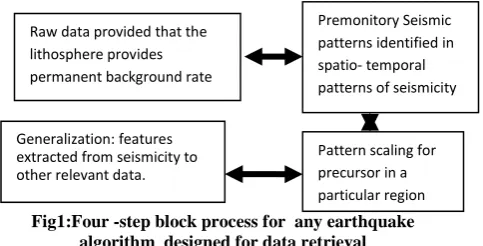
Fig1:Four -step block process for any earthquake algorithm designed for data retrieval
The dynamics of the lithosphere from the point of decision making involves a relevant field in a certain area prior to time of occurrence of event based on spatio-temporal patterns of seismicity. On the other hand, it is found that premonitory increase of the earthquakes’ correlation range; these chains are the dense, long, and rapidly formed sequences of small
and medium earthquakes. An earthquake fault is a grouping of topologically complex fault segments having significant mutual interactions due to elastic and stress transfer at all scales. Activity of the faults is closely related and display space time correlations of the composed system. Numerical simulation allows us to integrate physics of earthquakes along all scales. Simulated earthquake begins when force on a block due to plate motions reaches a static threshold that is needed to be identified by all.
.
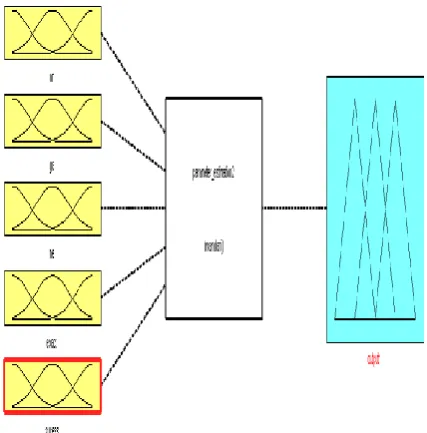
Fig 2: Data Model Simulation for Flow Diagram Analysis
The purpose of this study is to improve the state of knowledge, through a parametric search of earthquake algorithms for the purpose of aiding decision makers in reducing seismic hazards. This includes various modeling designs based on social domain S as a tuple of the form (an, ga, ne, exact, success) ground motion modeling, and design and experimentation. The present study designs a trust validation scheme for the types of algorithms and their field of relevance through a data model simulation flow diagram in fig 2. The algorithms that have been implemented so far have studied the physical process behind earthquake dynamics by examining the effects of earthquake nucleation and fault system geometry on earthquake occurrence. Evaluation of strong clustering through spatial and time series analysis, corresponding to foreshocks, aftershocks and occasionally large-earthquake pairs. They determine that fault system geometry acts as the primary control of earthquake recurrence statistics. The system also involves need for using computational fault system earthquake simulators[Rundle et al.,2000] to define the empirical probability density distributions for use in regional assessments of earthquake probabilities. Based on the above analytic surveys, classification analysis of algorithms based on the same physical behavior in Table 1 in order to test simultaneously the occurrence of earthquakes on all of them through a weak but universally acceptable hypothesis[Keilis-Borok and Malinovskaya,1964].
Procedure Description
Utility of analytical
evaluation process
Prior to the execution of other procedures, the utility of prediction algorithm needs to be identified. The process must have positive impact on the target system (quality, satisfaction, robustness of information, efficiency, reliability etc.)
Level of evaluation
Global
Group of homogenous systems will have higher reliability.System having higher efficiency and trust parametrics are likely to survive global scale evaluations.
Numerical experiments
.
After definition of the empirical scale and equipping the rule base based on hazard parameters with expert knowledge, criteria on the conditional occurrence rate by numeric score of each criterion..
Exploration with active forecast
After performing all evaluations for the forecast structure that optimizes the information in t to compare results to find the best alternative or analyze how different classes of users evaluate selected systems.
Raw data provided that the lithosphere provides permanent background rate of seismicity
Premonitory Seismic patterns identified in spatio- temporal patterns of seismicity
Pattern scaling for precursor in a particular region Generalization: features
[image:2.595.55.297.568.691.2]Table 2: Mode of Analysis by earthquake algorithms in different environments
3. DISCUSSION OF ALGORITHMS
In data-driven expert systems, it might happen that the data and the algorithm design is such that the two or more rules analytic rules concurrent in the earthquake prediction usage may become dependable and concurrently fireable. The proposed work present a brief analysis of the modern
algorithms from a comparative viewpoint of trust analysis of data-driven framework utilized by the algorithms. Most of the algorithm information has been collected and compiled from various internet resources and have then been analyzed for linguistic data in a fuzzy inferene model design. All the algorithms have been studied and analyzed for their robustness and also significant limitations for analysis. A comparative estimation for trust validation based on fuzzy inference rules is presented in the algorithmic study and there.This makes fuzzy control particularly useful if no linear parametric model of the process under control is available.
Fig 3:Fuzzy Controller design in trust validation analysis using source parameters
4. DESIGN OF A FUZZY EXPERT
SYSTEM DESIGN
The trust based fuzzy inference algorithm for parametric study has been utilized in system analysis for trust validation schemes:
Identify the parameters that best suits the problem requirement for trust based validation by analyzing the earthquake prediction algorithm for choice of the type of fuzzy system for inputs, states, and the outputs reducing its complexity and making it more comprehensible.
Partition the universe of discourse or the interval spanned by each variable in the assumed parameter of relevance into a number of fuzzy subsets, assigning each a linguistic label
Assign or determine a membership function for each fuzzy subset
Assign the fuzzy relationships between the inputs’, states’ fuzzy subsets on the one hand and the outputs’ fuzzy subsets on the other hand, to form the rule base
Definition of the set of heuristic fuzzy rules. (if– then rules).
Choose appropriate scaling factors for the input and output variables in order to normalize the parameter variables to the [0, 1] or the [−1, 1] interval
FORMULATION
APPROACH
ALGORITHM DEFINED
Computational modeling
RELM[Jordan et
al.,2010],ANN[Giacinto et al.,1997],SHA[Field et al,2003],VC[Rundle et al,2008], Pattern
recognition[Morales- Esteban et al.,2010], Satellite and GPS[Goetz et al.,2006;Vogel et al.,1979], Non -Poisson hidden markov models[Ebel et al.,2007].
Physical processes originating within fault systems in the earthquake genesis model
EEPAS[Rhoades and
Evison,2007],MEE[Sobolev et al.,1997],
Crustal-block[Ishiguro, 1981], Accelerating seismicity [Papazachos et al.,2002], Load/Unload[Yin et al.,1995], Seismic Cycle [Bufe and Varnes,1993], Deformation rate[Wyss et al.,1990b] Statistical modeling
and time series based modeling
Smoothed Seismicity[Kagan and Jackson,1999],
RTA[Kellis Borok et al.,2004], M8 [Keilis-Borok and
Kossobokov, 1990a],CN [Keilis-Borok and
Rotwain,1990],Presis[Wolfe, 2006], MSc [Kossobokov et al., 1990],Fuzzy Expert System [Andalib et al,2007] Geophysical and
precursory approaches
NSE[Vorobieva and Levshina,1994], VAN[Mulargia and Gasperini,1992], Electro-telluric[Rikitake and Yamazaki,1967] , Radon[Walia et al,2005], Animal
[image:3.595.319.533.193.410.2] Fuzzify the inputs to the controller
Use fuzzy approximate reasoning to infer the output contributed from each rule
Aggregate the fuzzy outputs recommended by each rule
Apply defuzzification to form a crisp output A single fuzzy if-then is of the form, if x is A then y is B where A and B are linguistic variables defined by fuzzy sets on the ranges X and Y, respectively. The ’if’ part of the rule is called the antecedent or premise and the ’then’ part of the rule is called consequent or conclusion.
Evaluatory results from a series of combiner o/p and a protocol for parameters is designed for combining the results into a fuzzy inference base. In the analysis a rule-based fuzzy expert system is analyzed for the trust validation scenario of the the earthquake prediction domain based on a number of parametric approaches in domain meets the general conditions under which a fuzzy solution provides a domain where approximate solutions are acceptable. Every decision rule represents the one fuzzy relation between the Analytical Work, Global Application ; Numerical experimentation Exploration with actual forecast& observation ; Success achieved in declaring alarm and and the system output that remains as the algorithm efficiency. The decision rules are given in the form of the logical implications. Analytical work (AN) Global approach(ga) Numerical Experimentation (ne) Exploration with active forecast(exact) and Success rate(success).
5.WORK AND RESULTS
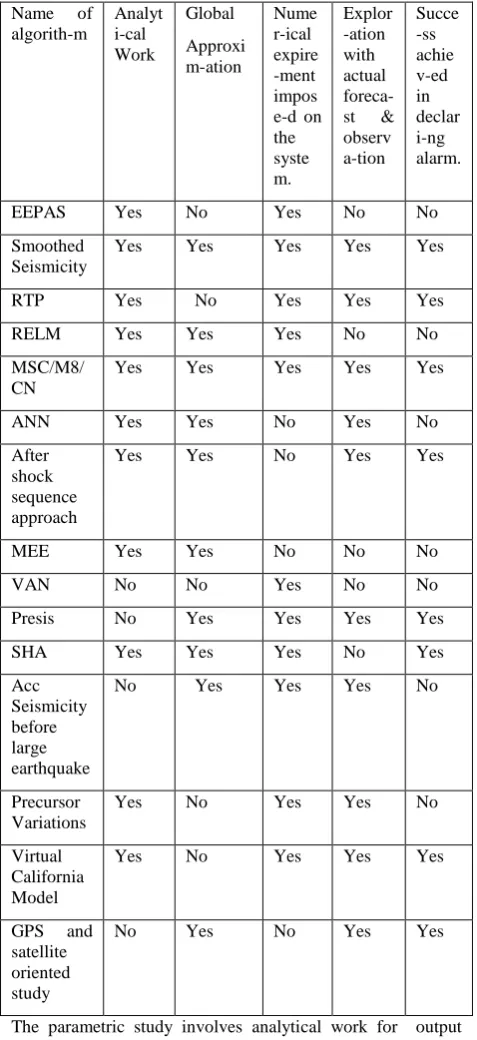
In prediction of a trust based framework, information I(t) is chosen and transformed in such a way as to detect characteristic patterns premonitory to individual target events. An algorithm efficiency lies in its ability for detection of rare events which may not depend on a detailed seismicity model .The ideal means is to identify a risk of occurrence of a larger event based on study of the parameters defined in the above chart that will help in computational algorithms knowledge base engine for earthquake study in the future as provided in Table 2. Using these approach, the problem of modeling r(t, g, M) is equivalent to constructing a model of the seismic process in the phase space (t, g, M) in terms of conditional rate where M is the magnitude of the earthquake expected to occur in the bin dg× dt with some probability P(dg, dt). Successful occurrences of earthquake records can be predicted using statistically significant algorithms[Boschi,2007] and applying data mining methodologies to an existent database ranking score for each attribute showing the relevance (predicting power) for each class. Efficiency of the algorithm(ψ)=I(t)*r(t, g, M) where I(t) is the information rate for all the technical data provided by the algorithm and r(t, g, M) is the function of space time and a certain magnitude threshold M of the earthquake. We find that efficiency of an algorithm depends on its ability to determine a rare event and success rate achieved by the parallel application of the earthquake algorithm in different regions. The algorithm efficiency is dictated by the trust index and depends parametrically on the quality of the precursor. There is a need to test information gain in the reduction of entropy(uncertainty) about the classification/clustering of a test class based on observation of a particular variable. We form a chart based on our perceptions of records provided of different earthquake algorithms in Table 2. Development of
[image:4.595.310.549.166.687.2]trust implies a dedicated study in the time dimension of relationships.An algorithm in the long term development for the region is likely to garner more information gain associated returning a probability distribution over the possible class labels as an array of system with numerous signals overlaying each other in time.
Table 2: Comparison between various earthquake algorithms on the basis of five comparing parameters
Name of algorith-m
Analyt i-cal Work
Global Approxi m-ation
Nume r-ical expire -ment impos e-d on the syste m.
Explor -ation with actual foreca-st & observ a-tion
Succe -ss achie v-ed in declar i-ng alarm.
EEPAS Yes No Yes No No
Smoothed Seismicity
Yes Yes Yes Yes Yes
RTP Yes No Yes Yes Yes RELM Yes Yes Yes No No MSC/M8/
CN
Yes Yes Yes Yes Yes
ANN Yes Yes No Yes No After
shock sequence approach
Yes Yes No Yes Yes
MEE Yes Yes No No No VAN No No Yes No No
Presis No Yes Yes Yes Yes SHA Yes Yes Yes No Yes Acc
Seismicity before large earthquake
No Yes Yes Yes No
Precursor Variations
Yes No Yes Yes No
Virtual California Model
Yes No Yes Yes Yes
GPS and satellite oriented study
No Yes No Yes Yes
this section we apply the previously introduced fuzzy rule-based inference schemes to control a dynamic process in a closed-loop configuration. We follow this up with numerical experimentation having low deviation(L_dv) medium deviation(M_dv) and positive deviation(p_dv).The study follows up exploration with active forecast for high(HP) low(LP) and zero probability(ZP) values. Finally an analysis of the success rate can be made based on the Low negative probability(LNP), low probability(LP) zero probability(ZP) positive probability(PP) and high positive(HP) probability values. The membership functions of these fuzzy variables are as follows.
Fuzzy rule base is defined as follows :
If an is LNO or ga is very low or ne is LP or exact is HP or sucess is low or sucess is LNP then efficiency low
If an is MNO or ga is very medium or ne is LP or exact is LP or sucess is NP then o/p is low
If an is ZO or ga is high or sucess is LP then o/p is medium If an is MPO or ga is medium or ne is mdv or exact is LP or sucess is NP then o/p is low
If an is VPO or ga is high or ne is Pdv or exact is ZP or sucess is NP then o/p is medium
If an is VPO and ga is high and ne is Pdv and exact is HP and sucess is NP then o/p is high
If an is MPO and ga is medium and ne is mdv and exact is not ZP and sucess is HP then o/p is low
The evaluation process, analyzed and validated results and demonstrated possible conclusions; truthfulness, completeness, and bias scores and argue that these must be calculated relative to the user to be meaningful. Let P(c) be the belief in a claim c that a data set is relevant to the above found claim. The system computes truthfulness of a collection of characteristic equivalent to certain function validated by the algorithm I(c, P(c)) is the importance of a claim given its
truth as
. Next, if a collection C purports to cover a base t, and A is the collection of all claims in the table 2 cited above, completeness with respect to t can be computed as
where R(c, t) is the [0, 1] relevance of a given claim c to the topic t. Evaluating this probabilistic mode of study for check of the algorithm efficiency, it is found that EEPAS, Msc and RTP are presently the best algorithms designed. However, MSc following a theoretical oriented approach makes EEPAS and RTP the most plausible earthquake algorithms. They are more useful as they also serve the purpose of monitoring earthquakes and seismicity at different levels of long, mid and short term analysis. However all analytic methods involved in interpreting physical process of earthquakes, computational processes for survey, statistical and time series based forecasting studies and geophysical precursory analysis have their own merits in certain locationbasedanalysis.
6. CONCLUSION
The trust evaluation metric based on fuzzy based inference is especially convenient to use in the systems where more dependent variables have to be considered and their macroscopic behavior is needed to be studied. Mathematical interpretations of genesis mechanism of earthquake occurrence and precursory behavior has been at large been neglected although the domain promises new techniques that will combine many approaches(Dutta et al,2011a,b) The
concept of the knowledge basis is in operation with the fuzzy variables. In other words, the knowledge basis is developed as the fuzzy system and used for the trust pattern evaluation definition. The linguistic variables of the model have different distance between the points having maximum degree of membership. However our basic observation and analytic overview requires that a collective decision is taken to interpret the single most important pattern or anomaly that presides an earthquake. There is a need to discover more empirical precursory relations and implement better information retrieval approaches and inference frameworks which involves not just compiling the observation collected but trying to analyze by conducting experiments and observations in situ. Future work in the area could focus on multiple research directions. The study will be enhanced with more complex models on crustal dynamic mapping analysis that guarantees the possibility of a large earthquake being triggered by another observable strain release event. Currently most of the work deals with simple situations where there are information providers and claims provided by information providers. But in real world situations, there are a lot of entities which interact with each other where an elaborate semantic analysis needs to be conducted to deduce real time inferential framework.
7. REFERENCES
[1] Andalib, A., Zare, M. and Atry,F., A fuzzy expert system for earthquake prediction, case study: the zagros range, ICMSAO, 2009.Crossref
[2] Asada, T., ,Earthquake prediction techniques. – Their application, in Japan, University of Tokyo Press, pp- 317 ,1982.CrossRef
[3] Asaravala A., Earth's Tides Set Off Quakes. Wired.com .http://www.wired.com /science/discoveries/ news/2004/ 10/65442
[4] Atzemoglou,A., Kondopoulou, D., Papamarinopoulos, S.,Dimitriadis, S., Paleomagnetic evidence for block rotations in the Western Greek Rhodope. Geophysical Journal International,118(1),221-230,doi:10.1111/j.1365-246X.1994. tb04685.x,1994.
[5] Boschi, E., Statistical Seismology: Physical and Stochastic Modeling of Earthquake Occurrence and Forecasting In: 28th workshop of the International School of Geophysics, 2007.Crossref
[6] Bufe C.G. and Varnes D.J., Predicted modeling of the seismic cycle of the greater San Francisco Bay region, J. Geophys. Res., 98, 9871- 9883, doi:10.1029/93JB00357.,1993.
[8] Di Giovambattista R. and Tyupkin Y., Seismicity patterns before the M=5.8 2002, Palermo (Italy) earthquake: seismic quiescence and accelerating seismicity., Tectonophysics, 384, pp. 243-255,doi: 10.1016/j.tecto.2004.04.001,2004.
[9] Dmowska R., Earthquake prediction--state of the art, Pageoph Topical Volumes
[10] Max Wyss Ed., Birkhäuser Verlag, Basel ; Boston, USA, 1997.Crossref
[11]Dragoni, M., and E. Boschi (ed.), Earthquake prediction: proceedings of the International School of Solid Earth Geophysics, 5th course, Il Cigno Galileo Galilei edizioni di arte e scienza, Rome, 1992. Crossref
[12]P. Dutta, M. Naskar and O. Mishra, "Test of Strain Behavior Model with Radon Anomaly in Seismogenic Area: A Bayesian Melding Approach," International Journal of Geosciences, Vol. 3 No. 1, 2012, pp. 126-132. [13]P.K. Dutta, M.K. Naskar and O.P. Mishra,Test of strain
behavior model with Radon anomaly in earthquake prone zones.HIMALAYAN GEOLOGY (Journal):Vol 33 (1), 2012,pp-23-28.
[14]Ebel J. E., Chambers D. W., Kafka, A. L. and Baglivo J. A., Non-Poissonian earthquake clustering and the hidden markov model as bases for earthquake forecasting in California, Seismological Research Letters; v. 78(1); p. 57-65; DOI: 10.1785/gssrl.78.1.57,2007.
[15]Field E.H., Jordan T.H. and Cornell C.A., Developing Community-Modeling Environment for Seismic Hazard Analysis.Seismological Research Letters; v. 74; no. 4; p. 406-419; DOI: 10.1785/gssrl.74.4.406, 2003.
[16]Gabrielov A., Levshina T.A. and Rotwain I.M., Block model of earthquake . Phys. Earth Planet. Int., 61:18-28, doi:10.1016/0031-9201(90)90091-B, 1990.
[17]Giacinto G., Paolucci R. and Roli F., “Application of neural networks and statistical pattern recognition algorithms to earthquake risk evaluation,” Pattern Recognition Letters, vol. 18, pp. 1353–1362, doi>10.1016/S0167-8655(97)00088-3,1997.
[18]Goetz S.J., Fiske G.J., Bunn A.J., Using satellite time-series data sets to analyze fire disturbance and forest recovery across Canada, Remote Sensing of Environment 101 352–365, 2006.Crossref
[19]Guha S. K. and Patwardhan A. M., Earthquake prediction : present status : proceedings of symposium held at the Department of Geology, University of Poona, Pune : University of Poona Pub., Pune, India, 1985.Crossref
[20]Ishiguro, M., A Bayesian approach to the analysis of the data of crustal movements., J. Geod. Soc. Japan, 27, pp. 256-262, 1981.
[21]Jackson D. D. and Kagan Y. Y., Testable earthquake forecasts for 1999, Seismol. Res. Lett. 70, 393–403, 1999.Crossref
[22]Jordan T.H. and THE RELM WORKING GROUP, Pure Appl. Geophys. 167, 859–876 DOI 10.1007/s00024-010-0081-5, 2010.
[23]Keilis-Borok V.I. and Malinovskaya L.N., One regularity in the occurrence of strong earthquakes. J. Geophys. Res. 69(14):3019–24, 1964.Crossref
[24]Keilis-Borok V.I. and Kossobokov V.G., Premonitory activation of earthquake flow: algorithm M8. Phys. Earth Planet. Inter. 61:73–83, 1990. DOI: 10.1146/annurev.ea.19. 050191.001403.
[25]Keilis-Borok V. I. and Kossobokov V. G., Times of increased probability of strong earthquakes (M>=7.5) diagnosed by algorithm M8 in Japan and adjacent territories., J. Geophys. Res., 95, B8, pp. 12413 – 12422, doi:10.1029/JB095iB08p12413,1990a.
[26]Keilis-Borok V.I. and Rotwain I.M., Diagnosis of time of increased probability of strong earthquakes in different regions of the world: algorithm CN., Physics of the Earth and Planetary Interiors, 61, pp. 57-72, DOI: 10.1016/0031-9201(90)90095-F,1990a.
[27]Keilis-Borok V., Shebalin P., Gabrielov A. and Turcotte D., Reverse tracing of short-term earthquake precursors., Physics of the earth and planetary interiors., 145, pp. 75-85, DOI: 10.1016/j.pepi.2004.02.010, 2004.
[28]Kellis-Borok V. I. and Soloviev A. A.,(eds.), Nonlinear Dynamics of the Lithosphere and Earthquake Prediction(Springer-Verlag, Berlin-Heidelberg),337 p, 2003.Crossref
[29]Kisslinger C., Practical Approaches to Earthquake Prediction and Warning., Kluwer Academic Pub., Amsterdam, Netherlands, 1986.Crossref
[30]Kossobokov V.G.,Kellis-Borok V.I. and Smith S.W.,Localization of intermediate-term earthquake prediction.J.Geophysics.Res.,95(B12):19763-19772, 1990. Crossref
[31]Kolvankar V.G., RF Emissions, Types Of Earthquake Precursors: Possibly Caused By The Planetary Alignments J. Ind. Geophys. Union Vol.11, No.3, pp.147-160, 2007.Crossref
[32]Molchan G.M., Strategies in strong earthquake prediction. Phys.Earth Planet. Inter. 61 (1–2),84–98, DOI: 10.1016/0031-9201(90)90097-H,1990.
[33]Mohsin J.S. and Azam F., Computational seismic algorithm comparison for earthquake prediction. International Journal of Geology. Volume 5(3), 2011.Crossref
[34]Morales- Esteban A., Martinez-Alvarez F., Troncoso A., Justo J.L. and Rubio-Escudero C., Pattern recognition to forecast seismic time series, , Experts System with
Application 37 8333 – 8342,
doi>10.1016/j.eswa.2010.05.050,2010.
[35]Mulargia F. and Gasperini P., Evaluating the statistical validity beyond chance of VAN earthquake precursors, Geophys. J. Int., 111, 33-44, 1992.Crossref[ps]
[36]Papazachos C.B., Karakaisis G.F., Savvaidis A.S. and Papazachos B.C., Accelarating seismic crustal deformation in the Southern Aegean area., Bull. Seism. Soc. Am., 92, 570-580, DOI: 10.1785/0120000223,2002 [37]Riedel K.S.,Statistical Tests for Evaluating Earthquake
[38]Rikitake T. and Yamazaki Y., Small Earth strains as detected by electrical resistivity measurements., Proc. Japan Acad., Vol. 43, pp. 477 – 482,1967.Published in Surveys in Geophysics Volume 3( 2), 123-142, DOI: 10.1007/BF01449189,1977.
[39]Rhoades D. A. and Evison F. F., Long-range earthquake forecasting with every earthquake a precursor according to scale, Pure Appl. Geophys. 161(1), 47-72, DOI: 10.1007/s00024-003-2434-9,2004.
[40]Rundle J., Klein W., Tiampo K. and Donnellan A.,Strategies for the detection and analysis of space-time patterns of earthquakes on complex fault systems. In: Proceedings of the 2003 international conference on Computational science: PartIII. ISBN:3-540-40196-2,2003.
[41]Rundle J.B., Turcotte D.L. and Klein W., Geocomplexity and the Physics of Earthquakes, Geophysical MonographVol 120, doi: 10.1029/GM120,American Geophysical Union, Washington, DC,2000.
[42]Rundle A.B.,Aalsburg J.V., Rundle P., Turcotte D. and Morein G.,Computing earthquake forecast probabilities using numerical simulations of the physics of realistic fault systems (Virtual California), Geophysical Research Abstracts,Vol. 10, doi:EGU2008-A-01955,2008. [43]Shimazaki K. and Stuart W., Earthquake prediction,
Birkhäuser Pub., Basel ; Boston, USA,1985.Crossref [44]Shih-jung M.,Introduction to earthquake prediction in
China, Ti chen chiu pan she Pub., Pei-ching, China,1993 [45]Sidorin Y., Search for earthquake precursors in
multidisciplinary data monitoring of geophysical and biological parameters Nat. Hazards Earth Syst. Sci., 3, 153-158,2003.Crossref
[46]Sobolev G. A., Tyupkin Y. S. and Zavialov A., Map of Expectation Earthquakes Algorithm and RTL Prognostic Parameter: Joint Application. The 29th General Assembly of IASPEI, Thessaloniki, Greece, Abs:77,1997.Crossref
[47]Thanassoulas C. and Tselentis G., Periodic variations in the earth’s electric field as earthquake precursors: results from recent experiments in Greece., Tectonophysics Volume: 224, Issue: 1-3, Pages: 103-111,1993.Crossref [48]Varotsos P., Eftaxias K., Vallianatos F. and Lazaridou
M., Basic principles for evaluating an earthquake prediction method, Geophys. Res. Lett., 23(11), 1295– 1298, doi:10.1029/96GL00905,1996.
[49]Vogel A., Itsikara A. M., Multidisciplinary approach to earthquake prediction: International Symposium on Earthquake Prediction in the North Anatolian Fault Zone (1980 : Istanbul, Turkey), proceedings of the International Symposium on Earthquake Prediction in the North Anatolian Fault Zone, held in Istanbul, March 31-April 5, 1980., F. Vieweg Pub., Braunschweig, Germany, 1982.
[50]Vogel A., Terrestrial and Space techniques in earthquake prediction research. Proc. Int. Workshop on monitoring Crustal dynamics in earthquake zones, Strasbourgh, 29 Aug. – 5 Sept.1978, Friedr. Vieweg and Sohn, Braunschweig, Germany, 1979.
[51]Vorobieva I.A. and Levshina T.A., Prediction of a second large earthquake based on aftershock sequence. In: Computational Seismology and Geodynamics, 2:27– 36. Washington, DC: Am. Geophys. Union, 1994. [52] Walia V.,Virk H.S. and Bajwa B.S., Radon Precursory
Signals for Some Earthquakes of Magnitude > 5 Occurred in N-W Himalaya: An Overview ,Pure and Applied Geophysics ,Vol 163(4), 711-721, DOI: 10.1007/s00024-006-0044-z,2005.
[53]Wolfe C.J.,On the Properties of Predominant-Period Estimators for Earthquake Early Warning Bulletin of the Seismological Society of America, Vol. 96(5), pp. 1961– 1965, doi: 10.1785/0120060017, 2006.
[54]Wyss M., Slater L. and Burford R. O., Decrease in deformation rate as a possible precursor to the next Parkfield earthquake, Nature 345, 428–431, doi:10.1038/ 3454 28a0,1990b.
[55]Yin X., Xuezhong C., Ziping S. and Can Y., A New Approach to Earthquake Prediction – The Load / Unload Response Ration (LURR) Theory, PAGEOPH, Vol. 145, No. 3 / 4, 701-715, DOI: 10.1007/BF00879596, 1995.
8. AUTHORS PROFILE
P.K..Dutta is presently working under the guidance of Dr Mrinal Kanti Naskar and Dr O. P. Mishra in studying the effect of interdisciplinary studies in catastrophic analysis and risk mechanism in Advanced Digital and Embedded System Labaratory, Jadavpur University. The major focus of research is the study of complex processes involved in Earthquake Genesis Mechanism Validation and Warning System Design. In order to make an analytical study to identify precursors in space and time by conducting a thorough and detailed study of the past and present earthquake / seismicity catalogues. His research interests include computational intelligence, operating system ,statistical analysis, image processing. He has done this work by studying various algorithms related to earthquake algorithms tried and tested by researchers across the globe for analysis of seismogenesis behavior mechanism.
Dr O.P. Mishraobtained Doctor of Science (D.Sc.) in 2004 from Geodynamics Research Center, Ehime University, Japan for his work in the field of seismic tomography and tsunami generating mechanism in north-east Japan and Indian regions.
He has degree of Master of Science & technology (M.Sc. Tech) in the Applied Geophysics from Indian School of Mines, Dhanbad in 1990, besides B.Sc (Hons) in Chemistry from the University of Burdwan, West Bengal.
He is an expert of Applied Geophysics and solid earth science dealing with seismological research and disaster risk management system. Authors of more than 100 peered
Dr M .K Naskar received his B.Tech (Hons.) and M.Tech from E&ECE Dept., IIT Kharagpur in 1987 and 1989 respectively and Ph.D. from Jadavpur University in 2006. He served as a faculty member in NIT, Jamshedpur (then RIT Jamshedpur) and NIT, Durgapur (REC Durgapur) from 1991-1996 and 1991-1996-1999 respectively. Currently he is a Professor