© 2018, IRJET | Impact Factor value: 6.171 | ISO 9001:2008 Certified Journal
| Page 1475
CROP RECOMMENDATION SYSTEM USING NEURAL NETWORKS
Tanmay Banavlikar
1, Aqsa Mahir
2, Mayuresh Budukh
3, Soham Dhodapkar
41234
Dept. of Computer Engineering, NBN Sinhgad School of Engineering
---***---Abstract
-Agriculture is India’s prime occupation. It plays amajor role in Indian economy and provides a lot of employment opportunities for the people of the nation. Nowadays, farmers do not choose the correct crop to cultivate in that specific soil. This directly affects the crop yield, and hence farmers in India face extreme losses on the monetary front. Nowadays, there are many parameters that should be considered while cultivating a certain kind of crop, on a specific type of soil. A crop recommender system, takes in consideration the various parameters of the soil, to predict the best kind of crop to be cultivated. This specific recommender system model, will take into consideration, the parameters like soil moisture content, humidity and temperature. In this specific model of recommendation, neural networks would be used to predict the best type of crop. A certain dataset containing pre taken values would be used to train the model after which, the model would be able to predict the type of crop on its own. The type of crop, also affects the total yield, which makes recommender systems, even more beneficial.
Key Words:
Agriculture, Crop Recommender System, Crop
Yield, Humidity, Neural Networks, Soil Moisture, Temperature, Training Dataset1. INTRODUCTION
Farming is the primary and most important occupation in India. Almost 50% of India’s manpower has their occupation directly or indirectly linked to agriculture. India is hence rightfully called as an agricultural country. Agriculture provides almost 20% contributions to the Gross Domestic Product. India has exported agricultural goods worth $25 billion until November 2017.
India is one of the leading countries worldwide in terms of farm output. Even after being a leading producer of agricultural products, India still lacks farm productivity. Farmers have very less income because of the lack of farm productivity. There needs to be an increase in productivity, in order to get more income for the farmers. To increase productivity, farmers should know which crop would suit the specific piece of land. If the right type of crop is cultivated in that piece of land, then automatically, the yield of the crop will increase. Hence, crop recommendation systems can be very beneficial for farmers. Recommendation systems need to be very accurate and explicit [5]. If not, it may result in vast amount of loss on the monetary and materialistic front. Various machine learning methods can be used to create recommendation systems. However, this paper proposes a system, which uses neural networks to build a powerful, accurate and an unambiguous
recommendation system [3]. In this specific model of recommendation system, certain climatic parameters will be taken into consideration.
These parameters would be temperature, soil moisture content and humidity. These mentioned parameters would help the recommendation system to give an accurate prediction regarding the most suitable crop to be cultivated [4].
2. PROPOSED SYSTEM ARCHITECTURE
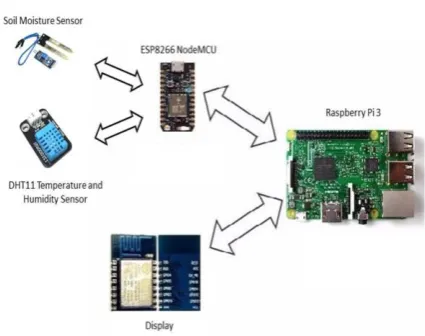
In this paper, a model would be presented wherein; some types of sensors would be deployed. These sensors would be a soil moisture sensor, a temperature sensor, and a humidity sensor to detect the humidity of the area around the field. The sensors in this model are the most important component. The work of the sensors is to detect the physical parameters of the soil, and send these parameters to the ESP8266 in a digital format. The sensors provide us with readings upon which the entire model is going to work. The sensors will detect the different parameters of the soil, and send these readings to the ESP8266 Wi-Fi Module.
The ESP8266 Wi-Fi Module collects the data sent by the sensors. The main job of the ESP8266 would be to collect the data from the deployed sensors, and aggregate the collected data to the Raspberry Pi using the MQTT Protocol.
The MQTT (Message Queuing Telemetry Transport) is a protocol which would be used by the ESP8266 to send the data collected by it to the Raspberry Pi 3. MQTT is an ISO standard messaging protocol, and it works on top of the TCP/IP protocol. MQTT is an extremely light weight protocol, which is a boon for a recommendation system, like the one mentioned in this paper.
© 2018, IRJET | Impact Factor value: 6.171 | ISO 9001:2008 Certified Journal
| Page 1476
Fig - 1: Proposed System Architecture3. COMPONENTS
In this paper, a model would be presented wherein; some types of sensors would be deployed. These sensors would be a soil moisture sensor, a temperature sensor, and a humidity sensor to detect the humidity of the area around the field.
3.1 ESP8266
The ESP8266 is a 32 bit microcontroller. It was manufactured by Espressif Systems, which a Shanghai based company, which is in China. It has an 80 MHz or 160 MHz CPU. It has 16 GPIO pins. It has 32 KiB instructions RAM, 32 KiB instruction cache RAM, 80KiB user data RAM, 16 KiB ETS system data RAM. The ESP8266 module is a small module, which enables microcontrollers to connect to a Wi-Fi network and also make simple TCP/IP connections. Various Software Development Kits (mostly open source) like Node MCU and Arduino can be used with ESP8266. Node MCU is a LUA based firmware and Arduino is a C++ based firmware. The ESP8266 module can simply be mounted upon an Arduino board, and the Arduino board can have Wi-Fi access. It offers almost same, or probably more functionality than a simple Wi-Fi shield. One of the major advantages of ESP8266 is that it is extremely cost effective.
3.2 Raspberry Pi 3
The Raspberry Pi is a series of small, single board minicomputers. In this model of recommendation, Raspberry Pi 3 will be used. Raspberry Pi 3 has a 4*ARM Cortex A-53 CPU, which has a 1.2 GHz processor. It has Broad Com Video IV GPU to process advanced graphics. Raspberry Pi 3 has 1GB LPDDR2 RAM. The Raspberry Pi 3 is an upgrade over the earlier versions. The main features of this model are Bluetooth and Wi-Fi connectivity, which make this the most important component of the entire model.
3.3 Arduino IDE Tool
Arduino IDE is an integrated development environment or the software through which the code is uploaded onto the Arduino board, or in this case to the ESP Module. Arduino IDE contains a text editor, a message area, and a toolbar. The code which is uploaded on the text editor of the Arduino IDE is called as a sketch. Arduino IDE comes with some readymade sketches which are available in the toolbar, but you can make your own code using the text editor. There is a separate message area which pops up with different messages like error messages. The code can be uploaded onto the Arduino Board or other compatible devices like the ESP8266 with the help of the USB connection.
3.4 Sensors
Sensors are devices which are used to measure parameters of various substances. Sensors can be used to measure the temperature of air, measure the amount of electricity passing through a conductor etc. In this recommendation system, sensors play a very important role. The first and the most important job of the sensors in this model would be to collect different parameters of the soil, and convert them into a format, fit for humans to read. The two types of sensors which would be used for detection of climatic and soil parameters would be a temperature and humidity sensor, and a soil moisture sensor.
1) Soil Moisture Sensor: Soil moisture sensor is used
for measuring the content of the water that the soil is holding. The two probes of the sensor, detect the content of water in the soil. There is a lot of fluctuation in the water level of the soil, as the plants in that specific soil take some water, and also due to the phenomenon of evaporation. Nevertheless, the sensor detects the values accurately. Soil moisture sensors are very cost effective.
2) Humidity Sensor: The sensor which will detect the humidity and the temperature would be the DHT11 sensor. The amount of water vapour, present in the surrounding air, is called as humidity. The ratio of the amount of vapour that the air has currently, to the maximum amount of vapour it can hold, is called as relative humidity. DHT11 sensor detects relative humidity. DHT11 sensor is capable of recording extremely accurate readings.
3.5 MQTT Protocol
© 2018, IRJET | Impact Factor value: 6.171 | ISO 9001:2008 Certified Journal
| Page 1477
MQTT has a certain topology. This topology includes the [image:3.595.55.271.179.339.2]MQTT server and the MQTT client. MQTT protocol works with the help of control packets. These control packets compress data which is to be sent over the network [6]. Every control packet has a particular function, and is of a different type. Some of the control packets are, CONNECT, SUBSCRIBE, UNSUBSCRIBE and PUBLISH.
Fig - 2: MQTT Protocol
4. MACHINE LEARNING
4.1 Definition of Machine Learning
Machine learning is a part of computer science, wherein, computers can learn from previous experiences, and give an output based on the previous experiences [1]. In other words, we can say that the computers have the ability to learn. Arthur Samuel is known to be the father of Machine Learning. A generic machine learning model has a machine learning algorithm, and the algorithm helps the machine to learn from a training dataset. Machine learning has 3 types. Supervised, Unsupervised and Semi Supervised are the three forms of Machine Learning.
4.1.1 Supervised Machine Learning
Supervised Machine Learning: Most machine learning models are based on the supervised learning approach. Supervised machine learning is analogous to a teacher teaching a student, and a student learning. In supervised learning, the algorithm learns from a training dataset. In supervised learning, there are input variables (A) and an output variable (B). The objective of the algorithm is to learn the function which maps the input variable to the output variable [1]. Examples of supervised learning are linear regression for regression model and support vector machines for classification problem.
4.1.2 Unsupervised Machine Learning
Unsupervised Machine Learning: Unsupervised learning algorithms do not have a teacher; neither do they have any correct answer. In unsupervised learning, only the input
variable (A) is available, and no output variable is available. The objective of unsupervised learning is to find more knowledge about the given data. Clustering and Association problems are unsupervised machine learning types.
4.1.3 Semi Supervised Machine Learning
Semi-Supervised Machine Learning: This type of machine learning falls somewhere in between Supervised and Unsupervised Machine Learning. In this type, there is huge amount of input data whereas only one output data. An example of this type would be an archive of certain documents, where some of them are labelled according to their names, while some are not.
4.2 Artificial Neural Networks
A human brain typically contains millions of neurons. These neurons interact with each other, and send information. This interaction is carried out by sending out electrochemical signals. Synapse, is the part of a neuron, which helps it to connect to other neurons. The electrochemical signals pass through the synapses.
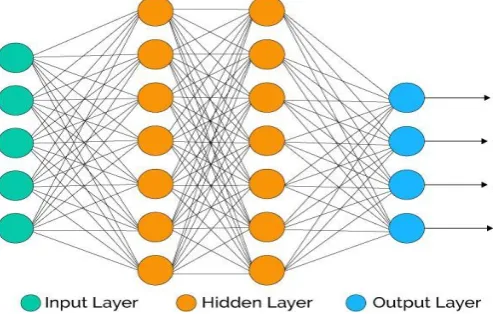
Artificial Neural Networks are an important concept of machine learning. Neural networks are based on the human central nervous system. A human brain consists of several neurons which are interconnected, and in an artificial neural network, huge number of processing units are connected to each other [2]. These artificial neurons (processing units), are capable of processing huge amounts of data, and derive a pattern or logical inference from it. Artificial Neural Network are used in many applications of data mining and machine learning, due to its ability of processing vast amount of information. Mostly neural networks can be used for classification, because of its ability to process the training datasets very fast. An artificial neural network usually consists of 3 layers. These layers are the input layer, hidden layer and the output layer.
[image:3.595.311.558.552.709.2]© 2018, IRJET | Impact Factor value: 6.171 | ISO 9001:2008 Certified Journal
| Page 1478
4.2.1 Input LayerInput Layer: The input is given a vector format, each of which represents an attribute under consideration. Along with input, a desired output is also given to check the accuracy of the neural network.
4.2.2 Hidden Layer
This contains weights and thresholds, which enhance the attributes. In this layer, two operations occur. Firstly, multiplication of weights and attributes and summation of all such resultants. Secondly, an integral over sigmoid function (exclusively for binary inputs) is used to generate the output.
4.2.3 Output Layer
Comparison occurs in this layer, between the desired and the actual output, to check the accuracy of the neural network. If much dissimilarity is found, the feedback is given to the hidden layer. Further, permutation and combination of the weights and attributes take place, to achieve better accuracy.
4.3 Types of Artificial Neural Networks
4.3.1 Perceptron
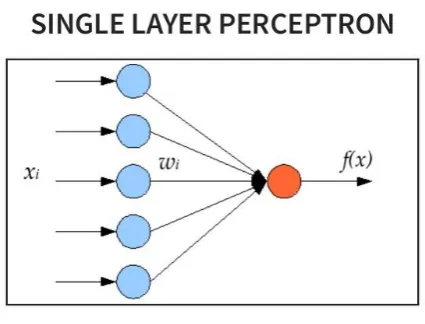
[image:4.595.316.562.65.204.2]It is a single level neural network which has two binary inputs and an activation function which can be a sigmoid or a step function. Numbers of parameters are limited to two or three for each.
Fig - 4: Single Perceptron
4.3.2 Multilevel Perceptron
[image:4.595.314.553.454.618.2]Multilevel Perceptron: The number of attributes increases exponentially, so does the amount of input vectors. MLP is an approach which is a supervised learning technique, for its training. It uses nonlinear activation function.
Fig - 5: Multilevel Perceptron
4.4 Training Mechanism Using Neural Networks
4.4.1 Forward Propagation
The data flow in forward propagation is unidirectional. It is always in the direction of output. In forward propagation, no feedback is available; hence checking the accuracy becomes extremely tedious.
4.4.2 Back Propagation
Back propagation trains itself continuously by looping the comparison between, actual and desired output. This difference is fed to the error function. Error function is responsible to change the weights in the hidden layer. It is also responsible for practically reducing the difference to minimum (ideally zero).
Fig - 6: Feed Forward Neural Network with feedback
4.5 Activation Functions in the Hidden layer
[image:4.595.55.268.478.640.2]© 2018, IRJET | Impact Factor value: 6.171 | ISO 9001:2008 Certified Journal
| Page 1479
4.5.1 Sigmoid FunctionTo use sigmoid functions, values need to be under 0 and 1. Probability of any event is minimum 0 to maximum 1. This makes sigmoid function a useful aspect when it comes to predicting probability of certain events. We can find the derivative of the sigmoid function. The derivative of the sigmoid function is a curve between two points.
Fig - 7: Sigmoid Function
4.5.2 Softmax Function
Machine Learning and probability theory go hand in hand. It is almost similar to the sigmoid function, but in the Softmax function, the values of the output are divided such that, the values all sum to 1 [7]. Let us say that it is like a probability distribution of the output values.
Fig - 8: Softmax function
4.5.3 RELU Function
Nowadays, instead of sigmoid, ReLU are being used. If the output is a value which is lesser than zero then the output will be zero. If the value of the input is greater than zero then the output value and input value are equal. It is the most used activation function in machine learning.[7]
Fig - 9: RELU Function
4.5.4 Input Bias
Bias terms are values, which are added to the input values before the use of activation function. These values go hand in hand with the weights of the input. The model learns both the values, that is, the input bias as well as the weights [7].
4.6 Software
4.6.1 TensorFlow
TensorFlow: TensorFlow is one of the libraries used in applications of machine learning like neural networks. It is
an open source library. Along with Python Programming language computing of numeric functions becomes extremely fast. The subpart of machine learning is deep learning, and TensorFlow is extensively used in deep learning. Along with Python, it can also be used with C++, Java and Haskell. The company under which TensorFlow was developed was Google.
4.6.2 Keras
Neural networks have many libraries, but one of them, which is an open source library, is Keras, and it supports TensorFlow, and is one of the most crucial libraries in the implementation of neural networks. It has various implementations of components of neural networks, like activation functions and optimizations.
4.7 Optimization
In machine learning, optimization is the process of continuously evaluating the weights and this process is called gradient descent. There are other different processes as well, but gradient descent is the most common method of optimization.
4.7.1 Stochastic Gradient Descent
In stochastic gradient descent, the entire input set is not considered. Any random numbers of input variables are considered, which are less than the actual number of input variables.
4.7.2 Full Gradient Descent
Full Gradient Descent: In full gradient descent, the whole set of input is used while looping, which increases the number of computations exponentially. Hence, the running time increases. For example, there are 500 input variables, and hence there would be 500 different iterations.
5. WORKING OF THE SYSTEM
© 2018, IRJET | Impact Factor value: 6.171 | ISO 9001:2008 Certified Journal
| Page 1480
6. CONCLUSIONS AND FUTURE SCOPE
Nowadays, it has become a necessity, for farmers to leave the traditional methods of farming behind, and accept the modern scientific and technological ways of agriculture. This paper focused on the prototype of a recommendation system, which worked on a relatively small dataset. This same prototype can be worked upon, and can be made compatible for datasets with up to millions of readings. Similarly, it can be worked upon, and used in an irrigation system. The sensors can detect the amount of water in the soil, and if the water level is below a certain threshold, then the farm can be irrigated automatically, from a water reservoir in the farm. Similarly, we can use data routing, by various protocols, for data transfer. All these scenarios come under ‘Smart Farming’.
REFERENCES
[1] Karandeep Kaur (April 2016),”Machine Learning:
Applications in Indian Agriculture”, IJARCCE[Online].
[2] Subhadra Mishra, Debahuti Mishra, Gour Hari
Santra(October 2016), Indian Journal of Science and Technology.
[3] S. Pudumular, E. Ramanujam, R. Harine Rajashree, C. Kavya, T. Kiruthika, J. Nisha, “Crop Recommendation System for Precision Agriculture” presented at the 2016 IEEE Eight International Conference on Advanced Computing, January, 2017.
[4] S. Veenadhari, Dr. B. Mishra, Dr. CD. Singh,”Machine Learning Approach for forecasting crop yield based on climatic parameters”, 2014 International Conference on Communication and Informatics, Coimbatore, India, January, 2014.
[5] E. Manjula and S. Djodiltachoumy(March 2017)On A
Model for Prediction of Crop Yield, International journal of Computational Intelligence and Informatics, Vol. 6.
[6] Dipa Soni and Ashwin Makwana,”A Survey on MQTT: A
Protocol of Internet of Things(IOT)”, presented at the International Conference on Telecommuniation, Power Analysis and Computing Techniques, Chennai, India, April 2017.
[7] Prajit Ramchandra, Barret Zoph and Quoc. V. Le,