Munich Personal RePEc Archive
Forecasting methods: a comparative
analysis
Iqbal, Javed
Karachi University
2001
Online at
https://mpra.ub.uni-muenchen.de/23856/
Proc. Eighth Stat. Sem. 2001, K.U. ISBN-969-8397-07-8-(189-197)
FORECASTING METHODS: A COMPARATIVE ANALYSIS
Javed Iqbal
ZYXWVUTSRQPONMLKJIHGFEDCBA
D e p a r t m e n t o f S t a t i s t i c s , U n i v e r s i t y o f K a r a c h i
ABSTRACT
Forecasting is an important tool for management, planning and administration in various
fields. In this paper forecasting performance of different methods is considered using time series data of
Pakistan's export to United Sates and money supply. It is found that, like other studies of this nature, no
single forecasting method provides better forecast for both the series. The techniques considered are
ARIMA, Regression Analysis, Vector Autoregression (VAR), Error Correction Model (ECM) and
ARCH/GARCH models.
1.
INTRODUCTION
Forecasting is a probabilistic estimate or a description of a future value or condition, which
includes a mean, range and probability estimate of that range. There is a considerable literature on
forecasting in business and economics. Some are aimed at forecasting a particular variable of interest
e.g. stock prices, money demand, exchange rates etc. for example Chan and Lee (1997), Kumar (1992),
Bhawnani and Kadiyala (1997), Bleaney (1998). Others focus on a comparison of different models or
techniques of forecasting, LeSage (1990), Stock and Watson (1996), Fair (1973). This study is of later
style. A distinguishing feature of this study is the presentation of forecast confidence intervals besides
mean forecasting. The models considered are univariate as well as multivariate. To broaden the scope,
the time series considered are quarterly as well as annual. The annual data (1972-1999) for forecasting
State Bank's money supply (M2) is used. Forecasting this variable is important for potential investors
since money supply affects interest rate and consequently investment. It also has an impact on prices.
An estimate of this variable is important for Central Bank itself so that to achieve its target of
stabilizing the economy, some alteration in historical pattern of money supply could be made. Secondly
quarterly data (1988:1 -1999:4) for forecasting Pakistan's export to U.S., a major trading partner of
Pakistan, is considered. The export function involves a variable of economic activity of trading partner
(U.S. in this case for which the data are available) instead of the home country. This variable is chosen
keeping in view the availability of quarterly data. Since macroeconomic models usually involve a
variable of real economic activity such as GDP, or its component. Unfortunately quarterly data for
Pakistan on these real variables are not available. The data are collected from various issues of State
Bank's monthly bulletin and IMP's International Financial Statistics. The results of almost all studies of
this nature indicates that no single model camouflage as the best for out-sample forecasting of different
series. This study also provides such an evidence.
Export Function:
E=f(YA,RP, V) (1.1)
Where E: Pakistan's export to U.S (millions of U.S $), YA: United State's GDP (Billions of U.S.$
consumer price index. V: Exchange rate volatility computed as in Ariz and Shwiff (1998) as an eight
quarter moving standard deviation i.e.
ZYXWVUTSRQPONMLKJIHGFEDCBA
( 1 . 2 )
Where RI is the exchange rate (Rs per U.S.$) and RI is its forecasted value (ARIMA model has been
used to forecast it)
Expected signs of the coefficients of the explanatory variables are as follows:
ZYXWVUTSRQPONMLKJIHGFEDCBA
d E > 0 d E < 0 d Y A 'd R P ,
d E < 0
av
'
Money Demand function:
M = f(Y, I) (1.3)
M: Money balances (M2) (millions of 1981 RS), Y: GDP (millions of RS) at 1981 prices, I: Nominal
interest rate on 2-3 years deposits. Expected signs are as follows:
d M > 0 d M < 0 d Y , d l
FOllowing this introduction, section 2 describes forecasting models considered in this study.
Out-sample forecasting is compared in section 3 and section 5 provides conclusion and comments.
2. FORECASTING MODELS
a) ARIMA One of the most popular univariate forecasting model proposed by Box and Jenkins
(1970). For a stationary time series
Yh
an ARMA(p,q) model is expressed as( 2 . 1 )
where e , is a white noise disturbance term normally and independently distributed with mean
0
andvariance C J2 •
This model can be expressed as weighted sum of disturbances e , as
(2.2)
Where IJIweights are functions of the modal parameters <p's and f)' s .
An h-step ahead forecast error variance FEV (h) for y is given by
A 95% forecast confidence interval for h-step ahead forecast is given by
Yr+h
ZYXWVUTSRQPONMLKJIHGFEDCBA
±1.96~
FEV(h) (2.4)b) Regression Analysis A general linear regression model is given by:
(2.5)
Which in matrix form is given by
Y =
ZYXWVUTSRQPONMLKJIHGFEDCBA
x /3 +e .Where the dimensions of y is nx
l , that of x is nx
k, of13
is kx
1 ande
is an n
x
1 vector of white noise errors with covariance matrixL
= a2ILet Xo
=
[ 1 X02X03... xod' be the vector of values for which forecast is required, then Y O ! x O=
x ~ /3 .Forecast error variance F E V (h) is given by
(2.6)
c) ARCWGARCH model The autoregressive conditional hetroskedasticity (ARCH) model
introduced by Engle
(1982)
is extensively used to model financial time series which are believed tohave varying conditional variance or volatility e.g. stock prices, interest rate, inflation etc. In this
method, mean and variance are modeled simultaneously. An ARCH model of order q is expressed
as
Y r = x r Y + £ r Where e, -N(O,a/) and
(2.7)
ARCH model were generalized by BoIIerslev (1986) as GARCH (Generalized ARCH), in
which the conditional variance depends on past value of itself. The conditional variance in a GARCH
(p,q) model is expressed as
(2.8)
The most widely used of these models is GARCH (1,1) for which the conditional variance is given by
(2.9)
The forecast error variance in GARCH models is given by ar2
d) Vector Autoregression (V AR) V AR introduced by Sim (1980), is used to model interrelated time
series simultaneously. This model, unlike structural multi-equation econometric models, relies little on
economic theory. Each variable in the model is expressed as function of the lagged values of all the
endogenous variables in the system. A V AR of order p is given by
Y ,
rqponmlkjihgfedcbaZYXWVUTSRQPONMLKJIHGFEDCBA
==A l Y ,_ IZYXWVUTSRQPONMLKJIHGFEDCBA
+ A 2 Y ,-2 + + A p Y ,_ p +c,
(2.10)Where e , - N (O,Q) is a vector of white noise errors with covariance matrix Q. The errors are assumed
to be serially independent in each equation but they may be contemporaneously correlated across
equations. Ai'S (i =1 ,2, ... ,p) are the matrices of the coefficients to be estimated. Yt is a vector
endogenous variables. For our export model Yt
=
[E, Y A, RP, V)'. A V AR model, unlike structuralmulti equation modes, does not require the knowledge of explanatory variable for forecast period.
An h-step ahead forecast of Yt is
Y t+ h == A I Y t+ h - 1 + A 2 Y t+ h -2 + + A p Y '+ h _ p (2.11)
Where Y t+ h - I , , Y t+ 1 are forecasted using similar scheme. For a YAR (1), we have
Y t+ h == A Y ,+ h - 1 and forecast error variance (as given in Clement and Hendry (1993» is
h - i
FEV(h) == L A jQ ( Aj)'. With normality assumption, we can derive simple expression for the forecast
j=O
intervals for individual time series by considering the diagonal elements of FEV (h) matrix.
e) Error Correction Model (RCM) It is widespread in modem econometric literatu~e that a
regression involving non-stationary time series variables may be spurious or misspecified unless the
variables are Co-integrated. The time series XII and x2, each integrated of order 1, are said to be
co-integrated if any linear combination.if these e.g.
Cz,
==a lx l, + a2x 2 ,) is stationary. The concept ofco-integration in statistics is equivalent to stable long run relationship in economics. The short run
disequilibrium can be modeled as an error correction model.
To get the idea lets consider a time series regression
Y , = = a + f3 'x ,
+c,
(2.12)Where Y , is the dependent variable and x , is a vector of independent variables. If Y , and x , are in
equilibrium, then the error Y , - a - f3 'x , will equal zero. However in disequilibrium it will be non-zero.
This quantity measures the extent of di equilibrium between Y ,and x , and hence is called
disequilibrium error. In disequilibrium Y ,can be assumed to be related with x , and the lagged values
of Y ,and x " one typical form of which is
(2.13)
Subtracting Y ,_ I from each side of eq (2.13) above and reparametezing we get
(2.14)
Where the parameter J..I. depends on parameters in eq (2). The term in bracket is called the error
correction term, which incorporates past period's disequilibrium. Eq (2.14) is an example of error
· long run equilibrium relationship between non-stationary variables is estimated. In our present case this
would be the regression E
=
f (Y A, RP, V) for export function, In the second step ECM model eq(2.14) is estimated using residuals lagged one period from the long run regression. Forecasting of y can then be performed using the ECM model and the forecast error variance is given as eq (2.6).
3-
FORECAST COMPARISON
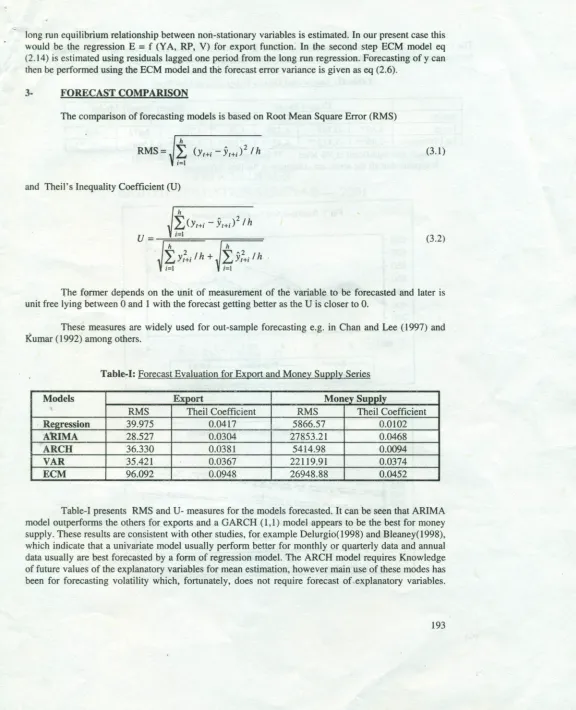
The comparison of forecasting models is based on Root Mean Square Error (RMS)
(3.1)
and Theil's Inequality Coefficient
ZYXWVUTSRQPONMLKJIHGFEDCBA
( U )(3.2)
The former depends on the unit of measurement of the variable to be forecasted and later is
unit free lying between 0 and 1 with the forecast getting better as the
U
is closer toO.
These measures are widely used for out-sample forecasting e.g. in Chan and Lee (1997) and
[image:6.616.13.589.20.730.2]Kumar (1992) among others.
Table-I:
Forecast Evaluation for Export and Money Supply SeriesModels
Export
Mone
RMS Theil Coeffici ent RMS
Regression
39.975 0.0417 5866.57A'RIMA
28.527 0.0304 27853.21ARCH
36.330 0.0381 5414.98VAR
35.421 0.0367 22119.91ECM
96.092 0.0948 26948.88Table-I presents RMS and U- measures for the models forecasted. It can be seen that ARIMA
model outperforms the others for exports and a GARCH (1,1) model appears to be the best for money
supply. These results are consistent with other studies, for example Delurgio(1998) and Bleaney(1998), which indicate that a univariate model usually perform better for monthly or quarterly data and annual
data usually are best forecasted by a form of regression model. The ARCH model requires Knowledge
of future values of the explanatory variables for mean estimation, however main use of these modes has been for forecasting volatility which, fortunately, does not require forecast of ,explanatory variables.
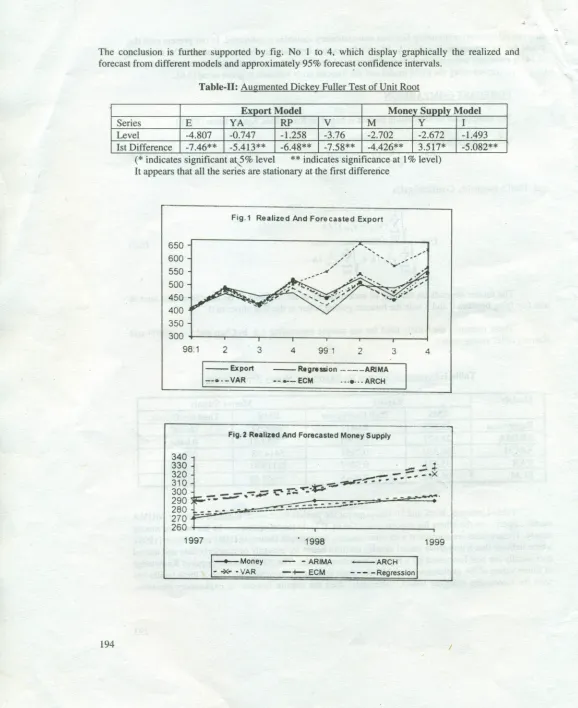
The conclusion is further supported by fig. No I to 4, which display graphically the realized and forecast from different models and approximately 95% forecas! confidence intervals.
Table-II: Augmented Dickey Fuller Test of Unit Root
Export Model Monev Sunnlv Model
Series E YA RP
ZYXWVUTSRQPONMLKJIHGFEDCBA
V M Y ILevel -4.807 -0.747 -1.258 -3.76 -2.702 -2.672 -1.493
1st Difference -7.46** -5.413** -6.48** -7.58** -4.426** 3.517* -5.082**
(* indicates significant at.2% level ** indicates significance at 1% level) It appears that all the series are stationary at the first differerice
F i g . 1 R e a l i z e d A n d F o r e c a s t e d E x p o r t
650 600 550 500 450 400 350
300
+---~----,----.----.-__~
~~~
98:1
, ,
2 3 4 991
2
3
- - E x p o r t - - • • - V A R
- - R e g r e s s i o n . • • . - - A R I M A - - • . •- E C M .·-e·· -A R C H
F i g . 2 R e a l i z e d A n d F o r e c a s t e d M o n e y S u p p l y
340
330 ~ ..:.
.+
320 _ - ~~ _oX
310 _
ZYXWVUTSRQPONMLKJIHGFEDCBA
- - .r : ~ .- ....
300
~F-- -:-;:::-
.•
- = ' ; ; ~ ; : : .- - : - ~ • • . • . . - _ .290'-
.~----280
=-.= __
. - -~-
----270
..-260
+---.---,
1997 . 1998 1999
I
_ M o n e y- - x - · V A R- - A R I M A
- + - E C M
- A R C H I - - - - R e g r e s s i o n I
F i g , 3 : 9 5
rqponmlkjihgfedcbaZYXWVUTSRQPONMLKJIHGFEDCBA
%F o r e c a s t I n t e r v a l s F r o m D i f f e r e n t M o d e l s O f E x p o r tRegression ARIMA
800 800
700 700
600 600
500 500
400 400
300 300
200 200
tOO tOO
0 0
98t 99't 9 8 : 1 2 3 4 9 9 : 1 2 3 4
VAR ECM
800 600
700 700
600 600
500 500
400 400
300 300
200 200
tOO tOO
0
0
98't 99't ~3:1 2 3 4 9 9 : 1 2 3 4
ARCH
800
700
600 500 400 300 200 tOO
0
98t 991
Regression
ZYXWVUTSRQPONMLKJIHGFEDCBA
F i g . 4 : 9 5 % F o r e c a s t I n t e r v a l ! ' F r o m D i f f e r e n t M o d e l s O f M o n e y S u p p l y
rqponmlkjihgfedcbaZYXWVUTSRQPONMLKJIHGFEDCBA
·350 340 330 320
~~
---~-r---=======::
~t:t=====::=====:;
270 260~1997
~---ARIMA
JSO 340 330
. - A 320
310
-
300 290-
280 270 260 7,501999 1997 1996 9
1998 ARCH JSO ~ ~ 320 ~ ~==:=:=:==========:~:::=============~=-=-===-===::--1997 1998 ECM 350 . J40 330 320 310 300 290 280 170 260 z s o
1997 1998 1999
196 199!l VAR JSO ~ ~ 3JO 320
il
270 260 ~ .4.
CONCLUSIONS
A comparison of forecasting performance of different time series econometric models is
considered using data from Pakistan's .macroeconomy. Like previous studies no single model appeared
the best for both the variables forecasted. The message revealed by the study is that to forecast a
particular variable one should not rely on a single forecasting method rather performance of different
competing models should be checked, then forecast should be performed from the best models from the
comparison.
REFERENCESZYXWVUTSRQPONMLKJIHGFEDCBA
I .
Ariz, A.C. and Shwiff, S.S. (1998). Does exchange rate volatility affects import flows in G-7
countries, evidece from Co-integration model.
ZYXWVUTSRQPONMLKJIHGFEDCBA
A p p l i e d E c o n o m i c s ,30, 1269-1276
2.
Bhawnani, V. and Kadiyala K.R(1997).
-Forecasting foreign exchange rates indeveloping
economies.
A p p l i e d E c o n o m i c s ,29, 51-62
3.
Bleaney,M.F. (1998). Exchange rate forecasts at the long horizon:Are error correction models
superior?
C a n a d i a n J o u n a l o f E c o n o m i c s ,31(4), 853-864
4.
Bollersev, T. (1986).
Generalized Autoregressive Conditional Hetroskedasticity.
J o u r n a l o fE c o n o m e t r i c s ,
31, 307-327
5.
Box, G.E.P. and Jenkins C.M. (1970). Time Series Analysis, forecasting and Control. Holden
day, San Francisco.
6.
Chan, H.L. and Lee, S.K. (1997). Modelling and forecasting the demand for coal inchina.
E n e r g yE c o n o m i c s ,
19,271-287
7.
Clements, M.P. and Hendry, D.F. (1993). On the limitation of Comparing Mean Square
forecasting error.
J o u r n a l o f F o r e c a s t i n g ,12,617-637
8.
Delurgio, S.A. (1998). Forecasting Principles and Application. IrvinIMcGraw Hill, Singapore.
9.
Enble, RF. and Granger, C.W.G. (1987). Co-integration and Error Correction: Represenration,
Estimation, and Testing.
E c o n o m e t r i c a ,55,251-276
10.
Engle, RF. (1982). Autoregressive conditional Hetroskedasticity with estimation of variance of
U.K. Inflation.
E c o n o m e t r i c a ,50,987-1008
11.
Engle, RF. and Yoo, B.S. (1987). Forecasting and testing in Co-inegrating system,
J o u r n a l o fE c o n o m t r i c s ,
35, 143-159
12.
Fair, R. (1973). A comparison of alternative estimation of macro models.
I n t e r n a t i o n a l E c o n o m i cR e v i e w ,
14,(2),261-273
13.
Gujrati, D.N. (1995).
B a s i c E c o n o m e t r i c s .Mc-Graw Hill
14.
Johansen, S. (1988). Statistical Analysis of Co-inegration Vectors.
J o u r n a l o f E c o n o m i cD y n a m i c s a n d C o n t r o l ,
12,231-254
15.
Kumar, M.D. (1992). The forecasting Accuracy of Crude Oil Futures prices.
I M F S t a f f P a p p r e s ,39(2), 432-461
16.
LeSage, J.P. (1990). A comparison of the forecasting ability of ECM and VAR models.
R e v i e wo f E c o n o m i c s a n d S t a t i s t i c s .