Differential Evolution based Multiobjective
Optimization-A Review
Deepa Sreedhar
Department of Computer science Sree Chitra Thirunal College of Engineering
Thiruvananthapuram
Binu Rajan M .R
Department of Computer science Sree Chitra Thirunal College of Engineering
Thiruvananthapuram
ABSTRACT
Multiobjective differential evolution(MDE) is a powerful, stochastic multi objective optimization(MOO) algorithm based on Differential Evolution(DE) that aims to optimize a problem that involves multiple objective functions. The MDE has many applications in the real world including supply chain planning and management. This paper presents a review of some multi objective (back propagation) differential evolu-tion algorithms.
General Terms
Algorithms.
Keywords
Differential Evolution, Non-dominated sorting, orthogonal crossover, Fitness sharing, random selection, elitist selection.
1.
INTRODUCTION
Multiobjective optimization (Vector optimization) algorithms have great impact in solving many real world problems espe-cially from the field of engineering. It concentrated on optimi-zation problems involving more than one objective functions to be optimized at the same time. Differential Evolution(DE) is a simple, stochastic, yet powerful population based optimi-zation approach for faster optimioptimi-zation. It was introduced by Storn and Price in 1996. After the success of DE algorithm, several variants of it is introduced. It was effective in solving single objective optimization problems. All of the optimiza-tion problems might not be single objective type. Some opti-mization problems involve two or more objective functions, that is multi objective where comes the importance of MOO. Due to the conflicting nature of objectives in MOO problems, when value of one objective increases the other degrades. That results in different optimal solutions. Which forms pare-to optimal set. All the solutions in this set are non- dominating each other which means no solution in this set is better than any other solution in the same set in terms of value of the objectives. The former approach for solving multi objective optimization was converting the problem in to single objective by using penalty function method or weighing factor method.
The rest of this paper is organized as follows: Section 2 de-scribes, Differential Evolution, Section 3 presents Multiobjective Optimization, Section 4 presents different types of Differential evolution based multiobjective optimiza-tion, Section 5 presents Conclusion, Section 6 describes the references.
2.
DIFFERENTIAL EVOLUTION (DE)
DE is a simple, powerful, stochastic, and population based evolutionary algorithm for fast optimization. It was originated by Price and Storn in 1997 [6]. Unlike conventional genetic
algorithm, it uses real numbers for representing each of the decision variables present in the chromosome. The approach proceeds by creating an initial population P of random indi-viduals. Then create candidate solution (child) for each parent in the population. If the candidate is better than the parent, replace the parent with new candidate. Otherwise the candi-date is discarded. Each parent in the population is selected for candidate creation. For creating the child, select a main parent and three different parents randomly from the population and perform mutation. The mutation is done by adding the deci-sion variable’s value of one parent with the weighted differ-ence of values of corresponding decision variable of other two parents. Then apply objective function on main parent and newly created child to determine who will pass to the next generation. Obviously, the member having best cost is trans-ferred to the next generation. This process continues until the maximum size of the population (NP) is reached. The signifi-cant parameters which control DE are: NP (size of the popula-tion), CR(crossover rate) and F(mutation rate which is the weight applied during mutation process). Several variants of DE have been proposed and successfully applied to many complex and non-linear applications.
3.
MULTIOBJECTIVE OPTIMIZATION
(MOP)
MOP is an area of Multiple Criteria Decision Analysis that optimizes problems that involves multiple objectives to be optimized simultaneously. Due to the conflicting nature of the objectives, the solution obtained does not satisfy all the objectives simultaneously. So there exist a finite set of solutions termed as pareto optimal (non dominated) solutions. All the solutions in pareto optimal set are non-dominating each other, that is none of the solutions are better in terms of value of the objective function than at least one solution in the set. A back propagation optimization problem can be formulated as
Min/Max fk(y), k=1,2,………..M
Where M is the number of objectives, y is the decision varia-ble. We need to optimize f(y). That is the goal of MOP is to compute a set of Pareto optimal (non-dominated) solutions to the MOP problem. Let u = (u1; : : : ; uk), and v = (v1; : : : ; vk), be two vectors. Then, u dominates v if and only if,
ui ≤vi, i=1,2….M
and ui <vi, ; for at least one i:
another solution y such that f(y) dominates f(x). The pareto optimal set is the set of all non-dominated solutions of an MOP problem. The non-dominated vectors are collectively known as pareto front (see Figure 1). Figure 1 shows a bi-objective minimization problem. Here the set of solutions are represented as circles in which the non-dominated solutions are labeled by a,b,c.
4.
DEFFERENTIAL EVOLUTION
BASED MOP
The earliest way to solve MOP problems are by using Penalty function method or weighing factor method. The former method is applied to solve biobjective problem [1]. Here consider one objective as constraint and thus converting the multi objective optimization in to single objective. Before the evaluation of the objective function, the latter method multiplies weight to each of the objectives based on the relative importance of the objectives. Then form a new objective function by summing the weighted objectives. Thus it converts multi objectives in to single objective. The two aspects that the researchers have been considered that resulted in the extension of DE to back propagation optimization are:
How to promote diversity in the population?
How to perform elitism? These two aspects are explained as follows:
4.1 Promoting Diversity
Promoting diversity indicate the closeness of the individuals within the population that may be obtained through the se-lection process by means of mechanisms based on some quali-ty measures. The two most important quality measure for promoting diversity are Crowding distance and fitness shar-ing.
4.1.1 Crowding distance
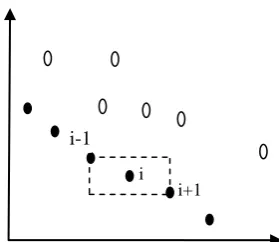
The crowding distance factor gives us an idea of how crowded is the closest neighbors of a given individual in the objective function space [14]. This measure estimates the perimeter of the cuboid formed by using the nearest neighbors as the verti-ces (see figure 2). The filled circles in figure 2 represent solu-tions of the same dominated front.
4.1.2 Fitness sharing
As a result of resource sharing of an individual with others, the fitness of the individual is degraded in proportion to the number and closeness to individual that surround it within a certain perimeter. A neighborhood of an individual is defined
in terms of a parameter called Rp that indicates the radius of the neighborhood. Such neighborhoods are called niches (see Figure 3) [14]. For each individual a niche is defined. The individual whose niche is less crowded are preferred [14].
4.2 Performing Elitism
The elitism can be implemented by maintaining best individu-al of each generation to conform the next population. One of the most important approaches for selecting the best individu-al of the combined population of parent and child is cindividu-alled non dominated sorting approach.
5.
MULTIOBJECTIVE DE
ALGORITHMS
This paper deliberates some of the DE based MOP algorithms to solve back propagation problems.
5.1
Multi objective DE for Constrained
Optimization (DE-MOC)
The main characteristics of this approach (DE-MOC) are that it makes use of orthogonal design method with quantization to create an initial population [4]. Also, a new constrained han-dling method is incorporated, which is based on the Constraint first Objective next model [14]. In this model, the constraint leads the objectives because the feasibility of x is more im-portant than minimization of F(x). The method (DE-MOC) helps to locate good points for further exploration in succeed-ing iterations. It can also use to generate the initial archive and initial evolutionary population (EP). A new crossover operator called orthogonal crossover, is employed to enhance the local search ability and accelerate convergence speed of this ap-proach, which selects the best individual to replace one indi-vidual randomly chosen from the population. A hybrid selec-tion mechanism is proposed in this approach, which is a
com-Rp Rp
i i+1 i-1
f2
f1
a
b
[image:2.595.372.512.146.267.2]c
Figure 2:Estimation of crowding distance.
[image:2.595.70.276.176.346.2]bination of random selection and elitist selection. In elitist selection, the base parent is chosen randomly from the archive and chooses other two parents from the EP. A selection pa-rameter λ is used to regulate the selection pressure.
Selection= Random selection, if eval<(λ*max_eval) (1)
Elitist selection, Otherwise.
where, eval is the current number of fitness function evalua-tions (NFFEs), and max_eval is the maximal NFFEs prede-fined by the user [4]. If one or more of the variable in the new solution, which are generated by the original DE scheme, are out of bound, i.e xi ϵ[li, ui], then the following repair rule is applied.
xi= li + rndi[0, 1] × (ui - li) if xi < li (2)
ui - rndi[0, 1] × (ui - li) if xi > ui
Where, randi is the uniform random integer in the interval [0,1] in each dimension[4].The main procedure of DE-MOC is as follows:
The algorithm starts by generating an orthogonal initial popu-lation by using orthogonal design method. Then produce new offspring by employing original DE scheme. If the offspring and the parent are non-dominated to each other, then the off-spring is added to the temporary child population (CP). Ap-pend the offspring in to the archive using ϵ-dominance con-cept [4]. This step repeats until NP number of offspring is created. If the population has enlarged truncate it for the next step of the algorithm. The truncation mechanism performs non dominated sorting on combined set (initial population plus child population) to find best individual among them. The performance of this approach is evaluated on thirteen benchmark problems. The results demonstrate that this ap-proach has a substantial capability of handling various COPs and its solution quality is quite robust and stable.
5.2
Multi objective Differential Evolution
(MODE)
The MODE algorithm is a variants of DE, in which best indi-vidual is adopted to create new offspring [5]. Also pareto based approach is introduced to implement the selection pro-cess. In MODE, randomly generate an initial population. Then a non-dominated sorting of current population members are applied after each generation. The purpose of this process is to remove all dominated points from the population and to give a better direction to the algorithm towards pareto front. Also, it adopts a (µ+λ) selection, pareto ranking and crowding distance in order to produce and maintain well distributed solutions. The working principle of MODE can be shown in Fig:5. In order to confirm the robustness and performance of MODE algorithm, six different benchmark test problems are applied to it. It is found that MODE can handle all type of back propagation problems.
5.3
Pareto based Differential Evolution
(PBDE)
In PBDE algorithm, DE is extended to back propagation op-timization by incorporating non dominated sorting and rank-ing selection procedure [2]. Here new candidates are obtained using DE operators which are combined with existing parent population and then choose best individuals from the com-bined population. The algorithm is not compared with any other approach and is tested on different unconstraint prob-lems performing 250 evaluations. The algorithm is tested on
test suite of problems (MOP1-7) which is described in [2]. The result shows that the algorithm performs well in all cases.
5.4
Vector Evaluated DE for MOP (VEDE)
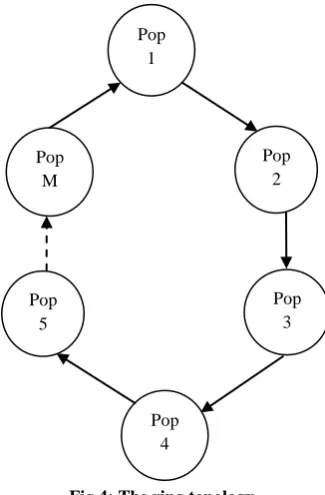
VEDE is a parallel, multi population DE algorithm which is inspired by vector evaluation genetic algorithm (VEGA) [11] approach. A number of M subpopulations are considered which is in ring topology (see Figure:3). Each subpopulation is evaluated using one of the objective functions at hand. Con-sider there are k objective functions and k<M, then ith popula-tion is evaluated with respect to jth objective, where
j= i mod k, if i≠rk, r=1,2….. (3)
k, Otherwise, i=1,2,….M
Also the best individual obtained from the ith population in every generation is allocated to (i+1)th population of the ring. That is best individual is used by the (i+1)th population to produce mutation vector in the (G+1)th generation. Using migration operator the information is exchanged among the population. Also, a domination selection procedure is incorpo-rated which is described in the equation (4). The equation determines, whether the vector Ui
G+1
should be a member of the population including the next generation by comparing it with the vector Xi
G .
XiG+1= UiG+1, if f(UiG+1) dominates f(XiG)
Xi G
, Otherwise (4)
Here f denotes the objective function under consideration. Four well known bench marking problems are used to evalu-ate the performance of VEDE [10]. This approach is com-pared with VEGA approach. The result shows that the VEDE outperforms VEGA in all cases.
5.5
Non-Dominated Sorting DE (NSDE)
It is a simple extension of NSGA-II [12]. The main difference between this method and NSGA-II is in the method of gener-ating new offspring. In NSGA II, real coded mutation and crossover operator is applied. But in NSDE, it is replaced by
Pop M
Pop 2 Pop
1
Pop 5
Pop 3
Pop 4
[image:3.595.326.489.438.686.2]the operators of DE itself. The main procedure of the algo-rithm are : initially it will set the main parameters i.e the F, CR, NP (number of populations) and max_gen-maximum number of generations of NSDE, then randomly initialize the population points within the bounds of decision variables, after that NSDE creates a new child population of size N from a parent population of size N. The child is entering in to the population only if it dominates the parent. The crossover and mutation operator of the algorithm is same as that of DE. Af-ter that combine the two populations (child and parent popula-tion) and apply non dominated sorting to it based on the dom-ination level that produces a non-dominated set. The member of this set is not dominated by any other element in the popu-lation. After non dominated sorting we will get better individ-uals which are allocated to next generation. The performance of this approach is evaluated on rotated problems. The result was that NSDE maintains a significantly better convergence, coverage and spread than the NSGA-II. The result also shows that the NSDE consistently converged closely to the Pareto-optimal front, independent of the degree of rotation.
5.6 Differential Evolution for
Multi-Objective Optimization (DEMO)
DEMO was proposed in [8]. Unlike original DE algorithm, this algorithm adopts an additional mechanism called trunca-tion which combines the non-dominated sorting and crowding distance metric to keep best N individuals in the population. Also a child replaces the parent only when it dominates the parent. DEMO maintains only one population and it is ex-tended when newly created candidates take part immediately in the creation of subsequent candidates. By selecting newly created candidate for reproduction that highlights the elitism in reproduction. That results in a fast convergence towards the true Pareto front, while the use of non-dominated sorting and crowding distance (derived from the NSGA-II [10]) of the extended population promotes the uniform spread of solutions [8]. DEMO is compared in five high-dimensionality uncon-strained problems outperforming in some problems to the NSGA-II, PDEA, PAES, SPEA and MODE. DEMOwSA [7] is a version of DEMO. The difference is that in DEMOwSA a self-adaptation mechanism for adjusting the values of control parameters such as F (mutation control parameter) and CR (crossover control parameter) is incorporated in the algorithm so that the values of the parameters can be adjusted to appro-priate values in the evolutionary process. Unlike DE, the val-ue of F is different for trial vector i in each generation which is adjusted based on the value of F for i in previous genera-tion([FG]i. The new value of F for trial vector i in the genera-tion G+1(Fi,G+1) can be obtained by the following formula: Fi,G+1 =[FG]i*e
TN(0,1)
(5) Where [FG]i = Fi,G+ Fr1,G+ Fr2,G+Fr3,G (6)
4
Similarly the new value of CR for trial vector i in the genera-tion G+1 can be obtained by the formula:
CRi,G+1 =(CRG)i*eTN(0,1) (7) (CRG)i = CRi,G + CR r1,G + CRr2,G + CRr3,G (8)
4
For details refer [7]. The performance of this algorithm is assessed from the result acquired after running it on 19 test functions using four performance metrics. The result illus-trates that the algorithm performed better for all functions except three functions.
5.7 Elitist Multi objective DE (E-MODE)
This approach involves the processing of initial population of size NP [9]. In order to generate a new vector, select three vectors randomly, which are Xa, Xb, Xc. The weighted differ-ence of Xa and Xb and are added to the vector Xc, which is termed as noisy random vector. Crossover is applied to gener-ate a Trial vector(Xc’) from noisy and Target vectors. Then the parent population is sorted to get non-dominated solutions. Let the number of non-dominated solutions be Q. The Q number of dominated solution obtained after non-dominated sorting is combined with the initial parent popula-tion NP to get a combined populapopula-tion (NP+Q). Again perform repeated non-dominated sorting on (NP+Q) number of solu-tions to classify the solusolu-tions as different fronts like front1,front2…..frontN. All of these fronts are’t copied to the next generation. Only NP numbers of solutions are to be cop-ied to the next generation. To ensure this, a crowded tourna-ment selection operator is used [9]. This operator helps to win a solution i with another solution j if any one of the following conditions met:
1. If the solution i has better rank.
2. If the solutions have same rank, but solution i has better crowding distance than the solution j (ri=rj and di>dj).
While adding fronts to the next generation (NPt+1), the last considered front may exceed the limit on the number of solu-tions allowable for NPt+1. Then that fronts aren’t inserted in to NPt+1 and perform crowded distance sorting on that front. The crowding distance represents how the solutions are close to the reference point. The best solution obtained from the sort-ing is copied to NPt+1. This process continues till the conver-gence criterion is met.
This algorithm is applied on well-known test problems. The result obtained are compared with the results of MODE algo- rithm. The result shows that E-MODE can give better spread and diversity in solutions.
5.8 Multi objective based DE(є-MyDE)
The main motivations for this algorithm [3] are two common and effective mechanisms, namely, pareto ranking and crowd-ing distance. The selection criteria and the concept of є domi-nance allows the good spread of solutions. Also this technique does not allow a difference less than є in the ith
objective for two solutions to be non-dominated with regard to each other. Also this algorithm maintains two populations: a main popula-tion and secondary populapopula-tion. The main populapopula-tion is the initial population from which parents are selected to generate offspring. The non-dominated solutions obtained are stored in the secondary population. This algorithm represents the chro-mosome (solution) as a vector of real numbers. Each number denotes the decision variable of the problem. The algorithm starts by generating an initial population.
infeasi-ble solution to interfere during recombination so that it helps to solve the constrained optimization problem in a more effi-cient way.In order to evaluate the performance of є-MyDE, it is compared to other algorithms namely NSGA-II and PDA, also some test functions and specialized metrics are adopted. The result shows that є-MyDE was the best overall perform-er.
5.9
Pareto Differential Evolution(PDE)
PDE is also a back propagation optimization approach[2]. The main points of this algorithm are: the algorithm generate an initial population according to Gaussian distribution N (.5,.15), then all dominated solutions are removed from the population, carry out crossover only with non-dominated tions at each generation, if the number of non-dominated solu-tions exceeds the limit, then find out distance metric relation D(x) between non-dominated solutions in order to remove one which is closer to any of the non-dominated solution in the set and for producing new child, randomly select three parents from the population. The newly generated child replaces the main parent in the population only if it dominates the main parent. The algorithm was tested on two bench mark problems which contain two objective function and thirty variables. The solutions of the two test problem, provided by PDE algorithm, are compared with 12 other multi objective evolutionary algo-rithms (MEAs). Out of 12 algoalgo-rithms no algorithm produces optimal result. PDE is significantly better than some of the MEAs. But there is no single crossover rate for which PDE is superior than all other algorithms.
6.
CONCLUSION
We have presented the review of nine back propagation dif-ferential evolution algorithms that are used to solve multi objective optimization problems. Each of these algorithms is compared with multi objective evolutionary algorithms (MEAs) and the result was that in most of the cases MDE algorithm was superior.
7. REFERENCES
[1] B.V Babu, and Mathew, L. J. 2003. “Differential Evolu-tion for Multi-Objective OptimizaEvolu-tion”. (Dec 2003), 2696–2703.
[2] Nateri, K. M. 2002. “Multiobjective Optimization Using a Pareto Differential Evolution Approach”. (May 2002), 1145–1150.
[3] Luis, V. S. and Carlos, A. C. C. 2005. “An Algorithm Based on Differential Evolution for Multi-Objective Problems”. 151–169.
[4] Wenyin, G. and Zhihua C. A. 2008. “Multiobjective Differential Evolution Algorithm for Constrained Opti-mization”. 182-188.
[5] Ashish, M. G. B V Babu. Improved Strategies of objective Differential Evolution (MODE) for Multi-objective Optimization.
[6] R. Storn and K. Price. 1995 “Differential evolution: a simple and efficient adaptive scheme for global optimiza-tion over continuous spaces”.
[7] Ales Z, Janez B, Borko B, and Viljem Z. 2007. “Differ-ential Evolution for Multiobjective Optimization with Self Adaptation”. 3617-3624.
[8] Tea R and Bogdan F. 2005 “DEMO: Differential Evolu-tion for Multiobjective OptimizaEvolu-tion.pages”. 520-523.
[9] B. V. Babu, Ashish M. G. 2007. “Elitist- Multi-objective Differential Evolution(MODE) algorithm for Multi-objective Optimization. 441-456.
[10]K.E. Parsopoulos, D.K. Taoulis, N.G. Pavlidis, V.P. Plagianakos, and M.N. Vrahatis. 2004. “Vector Evaluat-ed Differential Evolution for Multiobjective Optimiza-tion”. (June 2004), 204–211.
[11]J. D. Schaffer. 1984.“Multiple Objective Optimization With Vector Evaluated Genetic Algorithms”.
[12]Antony W. L. and Xiaodong L. 2004. “Solving rotated multi-objective optimization problems using differential evolution”. 861–872.
[13]Kalyanmoy, D. Amrit, P. Sameer, A. and T. Meyarivan. “A Fast and Elitist Multiobjective Genetic Algorithm: NSGA-II”. (April 2002) , 182-197.
[14]Efren M.M, Margarita R.S.,Carlos A. C. C.
“
Multi-Objective Optimization using Differential Evolution: A Survey of the State-of-the-Art”.19
Initial Population
Xc
Xb Xc
Target vector Xi
X
a Xb Xc+ -
F
F(Xa-Xb)
Noisy random vector Xc’=Xc+ F(Xa-Xb)
Trial vector for both objectives
Xt
N
Y
Pareto optimal solutionsFig 5: Working rule of MODE algorithm
Evaluate the cost function for all objectives
Carry out non dominated sorting and pass the resulting solutions as population to DE generators
CR
X
tIs either
Xi > Xt