Optimal Load and Mobility Aware MAC Protocol for
Wireless Sensor Networks
Sai Madhavi D
Asst Professor, Department of CSE RYM Engineering College
Y.S Kumar Swamy
Sr. Professor & HOD Department of MCA,
Dayanand Sagar College of Engineering
ABSTRACT
In mobile environment of wireless sensor networks (WSN), the fixed frame of MAC protocol causes performance degradation such as packet collision due to overloading etc. In this paper an optimal load and mobility aware MAC protocol for WSN is proposed. Each node measures the received signal strength (RSS) from the receiver by monitoring the acknowledgement packets and based on the RSS value, the link quality and mobility of the node can be predicted. Depending on the predicted link quality and mobility, the relay node selection process is initiated. In relay node selection process the neighbors with minimum load and good RSSI values is selected as the relay node. The moving source then transmits the packets through this relay node. This protocol reduces the packet drop due to overload and weak link quality. By simulation results, it is shown that the proposed approach minimizes the energy consumption.
Keywords
Wireless Sensor Networks (WSN), MAC Protocol, Link Quality Prediction, Received Signal Strength (RSS), Relay Node Selection (RNS)
1. INTRODUCTION
1.1 Wireless Sensor Networks
The wireless sensor networks (WSNs) include the enormous count of sensor nodes which is deployed in a compact manner. The sensor nodes are small sized and they function in restricted processing speed with reduced power and minimum bandwidth. The process of monitoring and gathering data or identification of events as well as localization and communication are performed by each sensor. Then the node swaps information among neighbors and does some operation to find the way of routing data as per required applications. [3] The wireless sensor network finds its application in defense and scientific fields, habitat monitoring, climate control and disaster management [1]
1.2 Mobility in Sensor Networks
1.2.1 Weak Mobility
The high network dynamics are contained in the sensor networks. There may be possibility that hardware malfunctioning and energy consumption cause node failure and further the new nodes get attached to the network. This will affect the network topology and this changes results in weak mobility.
1.2.2 Strong Mobility
Due to the movement that occurs in the medium like water or air or movement that occurs in the mobile hardware, the sensor nodes actually shift from their location. This simultaneous occurrence of node links or failures as well as movement of nodes results in strong mobility. [2]
1.3 Mobility Issues of Wireless Sensor
Networks
Each communication node in the applications of mobile sensors will be in motion and mobility ranges alter based on time duration. Most of the existing protocols do not build new connections in a faster manner which results in the network performance degradation. Thus it is necessary to maintain the quality of service (QoS) in order to save energy. [4]
The mobile nature of the sensor networks creates the following issues
1) Consideration of space and time during data collection.
2) User and event mobility are to be considered during data processing.
3) Location of sensor need to be measured during the on-demand configuration.
4) Necessity of the effectual and adaptable positioning system
5) Sensor network needs modal and multi-querying capability. [6]
The resource administration, coverage, routing protocols, and security are the challenges faced with respect to the nodes mobility. In every protocol stack of sensor networks, mobility is supposed to be handled in efficient manner. The mobility criteria of WSN constitutes the major impacts in the region of topology and energy management [6]
As communication is mainly influenced by the mobility, the medium access control (MAC) and routing layers play a major role in handling mobility. Besides MAC and routing protocols holding incoming and outgoing nodes, they should also offer a technique in order to provide a continuous end-to-end communication link. [5]
The protocols need to be selected in such a way that they function effectively in both stationary and mobile conditions. It must be conscious about mobility and adaptable to speed of mobile sensors. During the stationary situations, they must function in order to save sensor’s energy whereas during the mobile scenarios they should offer satisfactory performance level. [4]
In mobile environment of WSN, the fixed frame of MAC protocol causes performance degradation such as packet collision due to overloading etc. They are described as follows.
The mobile nodes are required to stay for a longer duration when joining a new neighbor prior to data transmission.
The significant collisions of the packets are caused in the contention based MAC protocols.
the accuracy of the protocol in schedule based MAC protocols.
The above problems can be handled by the dynamic frame time which is inversely proportional to the mobility range. [2]
1.4 Problem Identification
By analyzing previous papers [5], [7] related to mobility aware MAC protocol, it was found that the relay nodes are selected randomly. But there may be a situation that randomly selected relay node may be overloaded or it can be moving, leading to data loss and repeated retransmissions. So it is necessary to develop an efficient technique for relay node selection.
Hence an optimal load and mobility aware MAC protocol with efficient relay node selection is proposed in this paper.
2. RELATED WORK
Tang Zhiyong et al [5] proposed a mobility-aware MAC protocol for wireless sensor networks. It is mainly focused in estimating mobility while communication still goes on and seamlessly initiating a handover when the link quality deteriorates. The drawback in this approach is that the model is unreliable, and this approach does not allow the implementation of XMAC which implies that it is difficult to define small size strobes to minimize the cost of preamble packets.
Mrs. Aditi.P.Khadilkar et al [6] proposed medium access control protocol for mobile sensor network. The advancement of WSNs lead to new class of WSNs called as Mobile sensor networks (MSNs), in which nodes are moving in order to cover the geographical area under observation. They are used in robotics, military, habitat monitoring and surveillance applications. From this paper, it is observed that average energy consumption increases as mobility increases.
Lynn Choi et al [7] proposed a new link management protocol called M-MAC that can dynamically measure and predict the link quality. By projecting the error rate and the node mobility associated with each link, M-MAC employs three different transmission control techniques, i.e. dropping, relaying, and selective forwarding. M-MAC can be easily incorporated into low-cost GPS-free sensors since it does not require position awareness.
Muneeb Ali et al [8] proposed MMAC, a mobility-adaptive, collision-free medium access control protocol for mobile sensor networks. MMAC caters for both weak mobility (e.g., topology changes, node joins, and node failures) and strong mobility (e.g., concurrent node joins and failures, and physical mobility of nodes). Allowing transmission at particular time-slots makes MMAC a scheduling-based protocol, thereby guaranteeing collision avoidance. With high network dynamic nature, MMAC outperforms existing MAC protocols in terms of energy-efficiency, delay, and packet delivery.
Ricardo Silva et al [9] proposed and evaluated a comprehensive set of mechanisms essential to assure the support of mobility in WSNs, composed of a) a dynamic energy-efficient mechanism for node and service discovery, b) a mechanism for soft handoff, based on the determination of the link quality, and c) an MIPv6 adaptation model for lowPANs. In future, adaptation model for MIPv6, in line with the latest work of the 6lowPAN WG will be considered. However the proposed approach can be deployed in controlled environments.
3. OPTIMAL LOAD AND MOBILITY
AWARE MAC PROTOCOL
3.1 Overview
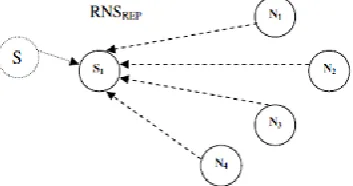
In this paper, an optimal load and mobility aware MAC protocol for wireless sensor network is proposed. Each node measures the received signal strength (RSS) from the receiver by monitoring the acknowledgement (ACK) packet and based on the RSS value, the link quality and mobility of the node can be predicted. If link quality is less and RSS is more, the node tends to move. Hence it initiates the relay node selection (RNS). Initially the source node broadcasts the RNS request message to all its neighbor nodes at predefined time interval t1. Upon
receiving the request message, the neighbor nodes wake up from sleep state and compute the current load. The neighbor node sends the RNS reply message to the source node which includes the computed load. When more than one RNS reply is received, the node with minimum load and maximum RSS is chosen as relay node. When no RNS reply message is received within next predefined time interval t2, source node enters into
sleep state in order to avoid inefficient communication and to save energy. Then, source starts to transmit the packets to relay node.
3.2
Link Quality Prediction
In order to maintain the status of the link, each node records the time and Received Signal Strength Indicator (RSSI) whenever it receives valid frame from its neighbor. This recorded information is stored in RSSI table which contains the status of the previous communication over that link and also the node can view its neighbor status using the stored information.
RSSI is inversely proportional to the square of the physical distance between sender and receiver and it is represented as a function of distance and transmission power as per following equation.
RSSIP =
p ra txa tx
L
D
H
H
P
*
)
*
*
*
*
(
2 2(1)
Where RSSIP = power received at distance d.
Ptx = transmitted signal power
= transmitter gain
= receiver gainD = distance from the transmitter Lp = path loss
Htxa = transmitter antenna height
Hra = receiver antenna height
The speed of a mobile node is calculated using the Equation (1) by applying the RSSI values.
The noises in the network fluctuates the link quality. But the quality of link becomes worse due to the movement of mobile node to certain direction at the constant speed before it changes its direction.
The link quality estimation scheme is as follows.
Each node measures the RSSIP (using equation 1) from the
receiver by monitoring the ACK packets and based on the P(RSSI) value, the link quality is predicted. The link quality (Lq) is predicted using the following formulae
Where Rpr = rate of received packet. It is chosen since it
depends on the actual capacity of the channel to deliver the packets
RSSIP is the mean RSSIP and it is within the range of[-100,-40] dBm.
The normalization of the
RSSIP is defined using thefollowing equation
norm (
RSSIP) =60
100
60
P
RSSI
(3)
The normalization is in the range of [0, 1] and Rpr and
RSSIPare combined in a fair way. Thus the link quality metric is able to distinguish links with the same Rpr using
RSSIP and samemean in the grey zone using Rpr values.
If link quality is less and RSSI is more, the node tends to move. Hence it initiates the relay node selection. Let Thmin be the
minimum threshold value for link quality and RSSIpmax is the
maximum value of RSSIP.
(i.e.)
If Lq <Thmin and RSSIp > RSSIpmax
Then
Relay node selection algorithm is triggered.
The algorithm for relay node selection is explained in the following section.
3.3 Load Estimation
The technique by which the each node measures the load (L) depending on the capacity utilization is termed as load estimation. Since network traffic keeps varying, sensor nodes has a necessity to compute L over appropriate time interval t. In order to perform the computation, the load update interval (tL)
is utilized.
Li =
r fi ai
r L
fi ai L
c
R
R
c
t
R
R
t
(
)
(
)
(4)
Where Rai = nodes arrival rate
Rfi = nodes forwarding rate
cr= radio capacity
= capacity utilization factor.3.4 Algorithm for Relay Node Selection
(RNS)
Let t1, t2 ….tn are predefined time intervals.
Let S and {Ni},i=1, 2…..k be the source and neighbor nodes respectively.
Let RNSREQ and RNSREP represent relay node selection
request and reply messages respectively. RNSREP includes the
estimated load value along with the status of the link. Let Lmin represent the minimum load
Let RSSIpmax represent maximum RSSI value
Let RN be the relay node. 3.3.1 At t1,
S
RNS
REQN
i 3.3.2 If Ni receives RNSREQ from S,Then
Ni wakes up from sleep state
Ni computes L (using eqn. 4)
End if
3.3.3 After computing of L, Ni feedbacks RNSREP to
S
S
RNS
REPNi, t <t2
3.3.4 If S receives RNSREP from Ni
Then
S computes RSSIp (Ni) (equation 1)
End if 3.3.5 If i > 1 Then
RN = N [Lmin, RSSIpmax]
End if
3.3.6 If no RNSREP is received during t<t2
Then
S enters into sleep state to avoid inefficient communication and to save energy.
End if
3.3.7 Source starts to transmit the packets to relay node.
[image:3.595.328.539.76.254.2] [image:3.595.318.495.430.523.2]3.5 Architecture for Relay Node Selection
Figure 1 represents the architecture for relay node selection4. SIMULATION RESULTS
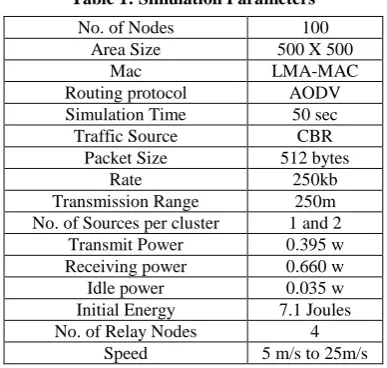
The proposed Load and Mobility Aware MAC (LMA-MAC) protocol is evaluated through NS2 [10] simulation. A random network of 100 sensor nodes deployed in an area of 500 X 500m is considered. Two sink nodes are assumed to be situated 100 meters away from the above specified area. In the simulation, the channel capacity of mobile hosts is set to the same value: 2 Mbps. The simulated traffic is CBR with UDP source and sink. The speed of the mobile sensor node is varied from 5m/s to 25m/s. The number of relay nodes is selected as 4 for two different scenarios.
[image:4.595.318.531.83.361.2]Table 1 summarizes the simulation parameters used
Table 1: Simulation Parameters
No. of Nodes 100
Area Size 500 X 500
Mac LMA-MAC
Routing protocol AODV
Simulation Time 50 sec
Traffic Source CBR
Packet Size 512 bytes
Rate 250kb
Transmission Range 250m No. of Sources per cluster 1 and 2
Transmit Power 0.395 w Receiving power 0.660 w
Idle power 0.035 w
Initial Energy 7.1 Joules
No. of Relay Nodes 4
Speed 5 m/s to 25m/s
4.1 Performance Metrics
The performance of LMA-MAC is compared with the normal 802.11 MAC protocol. The performance is evaluated mainly, according to the following metrics.
Average end-to-end delay: The end-to-end-delay is averaged over all surviving data packets from the sources to the destinations.
Average Packet Delivery Ratio: It is the ratio of the number .of packets received successfully and the total number of packets transmitted.
Energy: It is the average energy consumed for the data transmission.
4.2 Results
Scenario-1In the initial experiment, one set of source is taken which will send data to the sink, through a set of relay nodes. The node speed is varied as 5 to 25m/s for CBR traffic.
Speed Vs Delay (Scen-1)
0 2 4 6
5 10 15 20 25
Speed
D
e
la
y
(S
e
c
)
802.11
[image:4.595.73.267.218.402.2]LMA-MAC
Figure 2: Speed Vs Delay
Speed Vs Delivery Ratio (Scen-1)
0 0.5 1 1.5
5 10 15 20 25
Speed
D
e
li
v
e
ry
R
a
ti
o
802.11
LMA-MAC
Figure 3: Speed Vs Delivery Ratio
Speed Vs Energy (Scen-1)
0 1 2 3 4 5
5 10 15 20 25
Speed
E
n
e
rg
y
(J
)
802.11
LMA-MAC
Figure 4: Speed Vs Energy
Figure 2 gives the average end-to-end delay when the speed is increased. It shows that the proposed LMA-MAC protocol has lower delay when compared to 802.11.
Figure 3 gives the packet delivery ratio when the speed is increased. It shows that the proposed LMA-MAC protocol achieves good delivery ratio when compared to 802.11.
Figure 4 gives the energy consumption when the speed is increased. It shows that the proposed LMA-MAC protocol utilizes lower energy when compared to 802.11.
Scenario-2
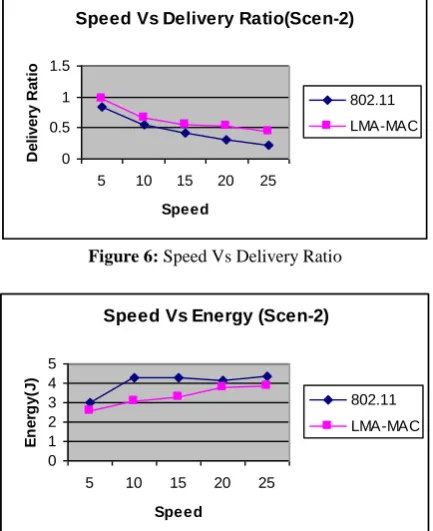
In the second experiment, two sets of sources are taken which will send data to the sink through a set of relay nodes. The node speed is varied as 5 to 25m/s for CBR traffic.
Speed Vs Delay(Scen-2)
0 2 4 6 8
5 10 15 20 25
Speed
D
e
la
y
(S
e
c
)
802.11
[image:4.595.317.532.552.669.2]LMA-MAC
[image:4.595.69.272.641.753.2]Speed Vs Delivery Ratio(Scen-2)
0 0.5 1 1.5
5 10 15 20 25
Speed
D
e
li
v
e
ry
R
a
ti
o
802.11
[image:5.595.62.279.77.343.2]LMA-MAC
Figure 6: Speed Vs Delivery Ratio
Speed Vs Energy (Scen-2)
0 1 2 3 4 5
5 10 15 20 25
Speed
E
n
e
rg
y
(J
)
802.11
LMA-MAC
Figure 7: Speed Vs Energy
Figure 5 gives the average end-to-end delay when the speed is increased. It shows that the proposed LMA-MAC protocol has lower delay when compared to 802.11.
Figure 6 gives the packet delivery ratio when the speed is increased. It shows that the proposed LMA-MAC protocol achieves good delivery ratio when compared to 802.11.
Figure 7 gives the energy consumption when the speed is increased. It shows that the proposed LMA-MAC protocol utilizes lower energy when compared to 802.11.
5. CONCLUSION
In this paper an optimal load and mobility aware MAC protocol for WSN is proposed. Each node measures the RSSI from the receiver by monitoring the acknowledgement packets and based on the RSS value, the link quality and mobility of the node can be predicted. If link quality is less and RSSI is more, the node tends to move which initiates the relay node selection (RNS) phase. When the neighbor nodes receive the RNS request message from the source, it recovers from sleep state and computes the current load. When more than one RNS reply is received, the node with minimum load and best RSSI is chosen as relay node. Then, source starts to transmit the packets to relay node. By simulation results, it has been shown that the proposed approach minimizes the energy consumption. The advantage of the approach is that it reduces packet drop due to overloading and weak link quality.
6. REFERENCES
[1] Rajesh Yadav, Shirshu Varma, N Malaviya, “A Survey of MAC Protocols for Wireless Sensor Networks”, UBICC Journal, Volume 4, Number 3, August 2009.
[2] M. Ali, T. Suleman and Z. Uzmi, “MMAC: A Mobility-Adaptive, collision-Free MAC Protocol for Wireless Sensor Networks,” Proceedings of 24th IEEE Performance, Computing, and Communications Conference, 2005, pp. 401-407
[3] Azni Haslizan Ab.Halim, Kartinah Zen,” MAC Protocol to Reduce Packet Collision in Wireless Sensor Network”, Proceedings of the International Conference on Computer and Communication Engineering, pp13-15, May 2008.
[4] Huan Pham, Sanjay Jha,” An adaptive mobility-aware MAC protocol for sensor networks (MS-MAC)”, IEEE International Conference on Mobile Ad-hoc and Sensor Systems, pp 558 – 560, 2004.
[5] Tang Zhiyong and Waltenegus Dargie,” A Mobility-Aware Medium Access Control Protocol for Wireless Sensor Networks”, IEEE GLOBECOM Workshops (GC Wkshps), pp 109 – 114, 2010.
[6] Mrs. Aditi .P. Khadilkar , Prof. Nitin G. Palan, “ Media Access Control Protocol for Mobile Sensor Network- Modelling Using OMNeT++ -MiXiM Network Simulator”, International Journal of Computer Science and Information Technologies, pp 1154-1159, Vol. 2 (3) , 2011.
[7] Lynn Choi and Sang Hoon Lee, Hyohyun Choi "M-MAC: Mobility-Based Link Management Protocol for Mobile Sensor Networks", Software Technologies for future dependable distributed systems, 2009
[8] M. Ali, Z. A. Uzmi, "Medium access control with mobility-adaptive mechanisms for wireless sensor networks," International Journal of Sensor Networks, Vol. 1, Nos.3/4 pp. 134 - 142, 2006.
[9] Ricardo Silva, Jorge Sá Silva and Fernando Boavida,” Towards Mobility Support in Wireless Sensor Networks”, 10th Portuguese Conference on Computer Networks, 2010