http://dx.doi.org/10.4236/jss.2014.29026
A Knowledge Maturity Model for Aerospace
Product Development
Qian Jia, Jingyuan Bi, Liwei wang, Yukun Yang
China Academy of Launch Vehicle Technology, Beijing, China Email: [email protected]
Received March 2014
Abstract
At present, China's aerospace product development mission are characterized by mammoth task and high responsibility, in which situation, the role of knowledge in business process is particularly prominent. Although we have realized the importance of the problem, and embarked on the accumulation job, the problem faced is that we lack the criteria to judge our harvest, which spon- taneously caused that we cannot define the quality and practical value of accumulated knowledge. Focusing of above problems, the paper puts forward a knowledge maturity model for aerospace product development, which divides knowledge maturity into 6 levels according to development process. Criteria of each level as well as translation condition to next grade is elaborated, assess-ment note is specially stated, aiming at offering enterprises a potent method for knowledge sys-tem construction and evaluation.
Keywords
Knowledge Management, Maturity Model, Assessment, Aerospace Product
1. Introduction
The research and development of aerospace product is a job with high complexity, which demands and gene-rates huge amount of knowledge at the same time. In recent years, with the increasing of volume and complica-cy in business, knowledge generated in development process grows rapidly. In order to define its quality, relia-bility and distribution areas, we urgently need a knowledge maturity assessment tool, which can make qualita-tive evaluation for knowledge, and provide a reference framework for enterprise knowledge improvement.
For aerospace product development, knowledge maturity assessment can contribute to the following two as-pects:
Provide a measurement method for knowledge, which can promote its continuous improvement.
A certain time is needed from knowledge generating to widely spread and application, Knowledge maturity assessment model can identify the current knowledge state in the process, to provide guidance for continuous improvement and application.
Reflect the distribution of the ability status, which can promote capacity building.
There-fore, knowledge maturity assessment model will provide a quantitative reference for capacity-building, thus help to enhance the core competence.
2. Current Research
At present, the main research directions of knowledge maturity can be attributed to two categories, practice gle and appearance angle. Practice angle mainly emphasize on actual effect of knowledge, while appearance an-gle focuses more on its structured degree.
2.1. Practice Angle
Christian Johansson team [1] in Sweden point that knowledge maturity should learn the idea of technology ma-turity and Capability mama-turity assessment, that is, judge knowledge mama-turity by several descriptive levels, and each criterion is the satisfaction degree of knowledge to expected targets. In this guiding ideology, Christian Jo-hansson team proposed a assessment table [2], dividing the knowledge maturity into 5 levels: primary, uncertain, acceptable, good and excellent. Using this model, project team can clearly recognize current overall state of knowledge assets, including the advantages of knowledge and lack of knowledge, on this basis, the project team can take measures to meet the expectations of the knowledge assets, thus enhance the whole ability of the team.
2.2. Appearance Angle
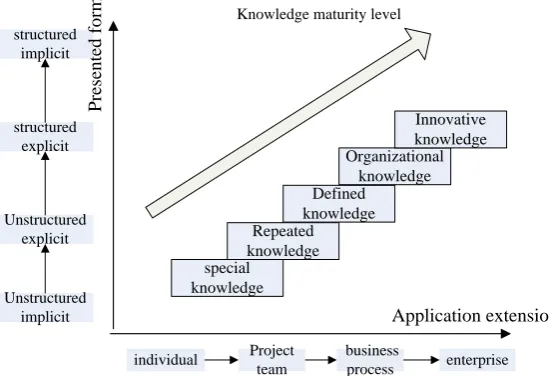
From the perspective of knowledge appearance, some domestic scholar divides the knowledge maturity into 5 grades [3], which are respectively special knowledge, repeated knowledge, defined knowledge, organizational knowledge and innovative knowledge. It’s not necessary to display detailed explanations here, which can be found in the reference paper. These five levels can be described by the following Figure 1.
The abscissa represents application extension of knowledge; while the vertical axis represents the presented form of knowledge, The conclusion can be summarize that with the expansion of applying extension as well as enhancement of structured degree, the knowledge maturity level improves correspondingly.
3. Knowledge Maturity Model for Aerospace Product Development
3.1. Knowledge Maturity Model [image:2.595.174.449.513.701.2]We used proposed a primary and sweeping knowledge maturity model [4] earlier, which has no directed aim. But with the in-depth study, we realized that the knowledge model should connect close to aerospace product development, so, on the basis of other maturity models, the paper argues that knowledge maturity model for aerospace product development should have the following characteristics:
Figure 1. Knowledge maturity model in appearance angle
Application extension
individual Project team
business
process enterprise Unstructured
implicit Unstructured
explicit structured
explicit structured
implicit
special knowledge
Repeated knowledge
Defined knowledge
Organizational knowledge
Innovative knowledge
Presented form
Main line of the model is aerospace product development process, with the in-depth research; knowledge ma-turity level should improve accordingly;
The model should be described as several mature levels, covering knowledge resources from generation to extremely mature life cycle;
Each Levels of the model should be defined by certain requirements, which has clear boundaries with adja-cent grade, and at the same time can reflect growing trend of knowledge.
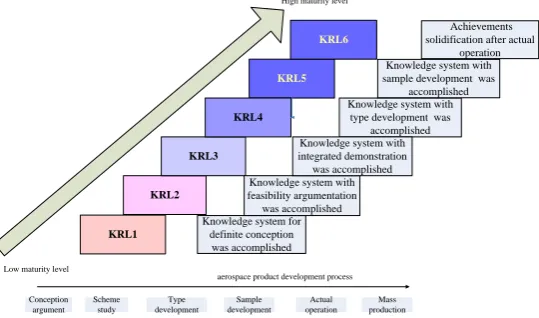
Under the guidance of above ideas, combined with the characteristics of knowledge resources for researching target, knowledge maturity model for aerospace product development is proposed in Figure 2.
Each level of the model is described below. It is worth mentioning that the evaluated object should be the knowledge system in a certain direction, rather than a single piece of knowledge resources. This paper argues that, for a term of specific knowledge, especially the fact-based or experience-based knowledge resources (such as advices, best practices, etc.), its maturity in isolation rating of little significance, because the maturity of a single piece of knowledge has little persuasion to the risk identifying, while the evaluation on knowledge system representing a certain technology can reflect the its supportive degree to aerospace product development.
KRL1:
The basic technical concepts and applications for aerospace product development are cleared, key technolo-gies has been put forward.
As for the knowledge system, a lot of useful external knowledge should be accumulated, achievements for technical concepts and its verification process should be formed, including research reports, papers, test reports, etc, which can be summarized as follows:
Domestic situation and development trend of similar products; Basic Principles verification methods;
Key technologies to be solved. KRL2:
Key technologies for the aerospace product have been verified in laboratory, technical solutions and ap-proaches are clarified. The project can continue in-depth study.
As for the corresponding knowledge system, in terms of design, all ideas and thoughts during the key tech-nologies overcoming process should be recorded; in terms of trial, test environment, data as well as results for principle experiment should be congested. The main knowledge accumulated in this stage should include:
Key technology research methods, tools, experience;
Environment, methodology as well as analysis of results for principle experiment. KRL3:
The product integration and demonstration has been completed, prototype functionality can meet the design requirements in a typical simulation environment.
[image:3.595.180.450.547.706.2]As for the corresponding knowledge system, in terms of design, performance data, coordinating and inte-grated methods for demonstrate prototype should be recorded; in terms of trial, the demonstration conditions and data should be particularly highlighted. If the initial design revision is needed according to the demonstration
Figure 2. Knowledge Maturity Model for aerospace product development.
aerospace product development process
Conception argument
Scheme study
Type development
Sample development
Actual operation
Mass production High maturity level
Low maturity level
KRL1
KRL5 KRL6
KRL2 KRL3
KRL4
Knowledge system for definite conception
was accomplished Knowledge system with feasibility argumentation
was accomplished
Knowledge system with type development was
accomplished Knowledge system with sample development was
accomplished
Knowledge system with integrated demonstration
was accomplished
Achievements solidification after actual
result, revision history and revision reasons should be recorded thoroughly. The main knowledge accumulated in this stage should include:
Prototype design and optimization methods; Prototype assembly technology and processes;
Environment, authentication methods and analysis results for demonstration experiment. KRL4:
Type development for the aerospace product has been completed, with the condition of next phase transfer. Correspondingly, knowledge perfection of last stage and accumulation of current stage should be completed, which can support sample development of the project.
In this stage, the knowledge system should be more mature, internal outcomes generated should increase greatly. Failure cases and experiences generated in the tests should be noted exhaustively, taboo, detailed fi-nishing, best practices should be formed after validation. The main knowledge accumulated in this stage should include:
Coordination methods for overall and subsystems;
Rapid production and assembly procedures for engineering prototype; Environment, test methods, test results for ground test.
KRL5:
The sample development has been completed, with the condition of actual operation. Correspondingly, knowledge perfection of last stage and accumulation of current stage should be completed, which can enable actual operation of the aerospace product.
The sample development stage may pay more attention to test verification, by which the early design scheme is improved continuously. Therefore, the reason for the improvement, methods and results should be recorded in detail, a large amount of experience taboo should be formed, at the same time, resources such as best practices, sharing models should be supplemented.
The main knowledge accumulated in this stage should include:
The criteria and methods to be followed in system reliability, compatibility and adaptability which are summed up from the large butt, coordinated, integrated test;
Rapid production and assembly procedures for production prototype;
Launch environment, prototype testing procedures and rules for the operation; Environment, test methods, test results for flight test.
Reliability growth method. KRL6:
At this level, the default target has been validated by actual operation, with the condition of large-scale pro-duction, hence all the knowledge should be classified and transfer to some achievements, such as standards, pa-pers, patents and so on. Knowledge system at this time should be complete in structure, full and accurate in con-tent, and have passed verification wholly, which can support mass production and re-use, and can also provide support for other similar aerospace product.
3.2. Conversion Conditions between Adjacent Grades
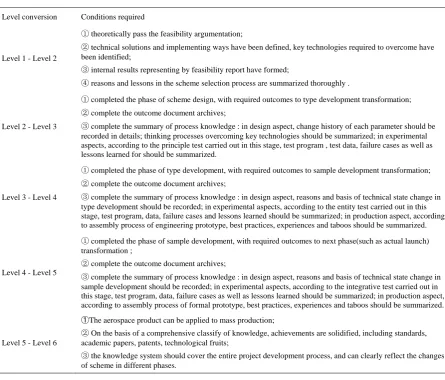
Grade advancing of above maturity model is consistent with aerospace product development process, as the project developed in depth, maturity of knowledge systems increases correspondingly. After all, there are some obvious conditions for advancing between adjacent levels, as specified in Table 1.
4. Assessment Notes
Of particular note is that the assessment of knowledge maturity should be aiming to specific target. For the knowledge system in a certain direction, it may have a higher maturity level to the pre-set target A, because the knowledge system can fully support the completion of the task. But if the same body of knowledge is transferred to target B, despite the similarity of technical principles, the constraints and boundary conditions may change more or less, so that the knowledge system’s maturity level to target B is very may be reduced. As shown in
Figure 3 if the pre-set target is the development of aerospace product A, its engine ignition technology may de-pend on a lot of knowledge.
Figure 3. Schematic correlations between knowledge maturity and pre-set target.
Table 1. conversion conditions of each LeveL.
Level conversion Conditions required
Level 1 - Level 2
① theoretically pass the feasibility argumentation;
② technical solutions and implementing ways have been defined, key technologies required to overcome have been identified;
③ internal results representing by feasibility report have formed;
④ reasons and lessons in the scheme selection process are summarized thoroughly .
Level 2 - Level 3
① completed the phase of scheme design, with required outcomes to type development transformation;
② complete the outcome document archives;
③ complete the summary of process knowledge : in design aspect, change history of each parameter should be recorded in details; thinking processes overcoming key technologies should be summarized; in experimental aspects, according to the principle test carried out in this stage, test program , test data, failure cases as well as lessons learned for should be summarized.
Level 3 - Level 4
① completed the phase of type development, with required outcomes to sample development transformation;
② complete the outcome document archives;
③ complete the summary of process knowledge : in design aspect, reasons and basis of technical state change in type development should be recorded; in experimental aspects, according to the entity test carried out in this stage, test program, data, failure cases and lessons learned should be summarized; in production aspect, according to assembly process of engineering prototype, best practices, experiences and taboos should be summarized.
Level 4 - Level 5
① completed the phase of sample development, with required outcomes to next phase(such as actual launch) transformation ;
② complete the outcome document archives;
③ complete the summary of process knowledge : in design aspect, reasons and basis of technical state change in sample development should be recorded; in experimental aspects, according to the integrative test carried out in this stage, test program, data, failure cases as well as lessons learned should be summarized; in production aspect, according to assembly process of formal prototype, best practices, experiences and taboos should be summarized.
Level 5 - Level 6
①The aerospace product can be applied to mass production;
② On the basis of a comprehensive classify of knowledge, achievements are solidified, including standards, academic papers, patents, technological fruits;
③ the knowledge system should cover the entire project development process, and can clearly reflect the changes of scheme in different phases.
Lessons
Patents or new ideas
standards
Optimized practice
engine ignition technology for product A Can effectively
support
Passed actual operation Knowledge
maturity level :6
An improved version of product A
?(effect unknown)
Knowledge maturity level can be judged as 2 or 3
The typical design scheme for some
historical model
Foreign intelligence information Foreign advanced
technology
accomplished knowledge system construction
[image:5.595.86.532.341.721.2]b) Lessons summed up by tests;
c) Patent or new ideas presented in some papers;
d) A relevant standard specifications, including design criteria, technics regulation, etc;
e) The typical design scheme for some historical model.
If product A has completed its development and passed actual operation, and the construction of knowledge system has been accomplished accordingly, we can conclude that the knowledge maturity for product A has reached grade 6. But if we transfer the same knowledge system into an improved version of product A (which we called product B), although the technology is based on the same principle, but the design scheme may need some adjusting, key experimentations may need carrying out again, although some achievements can be directly applied and so the work difficulty can be reduced greatly. On considering factors above all, we can judge the knowledge maturity level for product B to 2 or 3.
5. Summary
Although current researches are relatively rare, knowledge maturity assessment is extremely necessary for en-terprise. On one hand, current knowledge state can be identified and improved, on the other hand, capability dis-tribution can be reflected and the core capacity-building can be promoted.
Based on the analysis of the relevant research home and abroad, the paper built a knowledge maturity model for aerospace product development, which can provide a quantitative judgment for knowledge system construc-tion. On follow-up work, we will study the knowledge maturity assessment process; promote the actual landing of maturity assessment, facilitating the construction and optimization of knowledge system in practice.
References
[1] Johansson, C., Hicks, B. and Larsson, A.C., et al. (2011) Knowledge Maturity as a Means to Support Decision Making During Product-Service Systems Development Projects in the Aerospace Sector. Project Management Journal, 3, 32- 50.
[2] Johansson, C., Larsson, A., Larsson, T., et al. (2008) Gated Maturity Assessment: Supporting Gate Review Decisions with Knowledge Maturity Assessment. CIRP Design Conference.
[3] Knowledge Maturity Model (2007) http://www.amteam.org/k/ITSP/2004-8/481203.html