An Improved order independent parallel thinning
algorithm for Image thinning
A.Jagna
1,K.Bhima
21
Department of CSE 2
Department of IT
Padmasri Dr. B V Raju Institute of Technology Narsapur, Medak (Dt), A.P, India – 502 313
ABSTRACT
This paper addresses an order-independent parallel thinning algorithm. This algorithm is a two-pass, iterative and parallel processing. In pass-1 the entire image is thinned uniformly to two-pixel thick. In pass-2 the two-pixel thick image is further thinned to one pixel thick image without leaving any two pixels in the resultant image. The thinning process is based on weight-values. The weight-value of a non-zero pixel is evaluated by analyzing neighboring pixels. The experimental results of the proposed algorithm are shown to be computationally more efficient in terms of thinning and preserving the connectivity.
Keywords
Parallel, order independent, weight-values, thinning, efficient
1.
INTRODUCTION
Parallel thinning is playing a vital role in thinning and skeletonization, due to the ever increasing growth of availability of parallel architectures and the real possibility of realizing machine vision systems. Recently, its interest has also increased both in design and objective standpoint; this has lead to parallel thinning algorithms. The parallel thinning algorithms are characterized by the representation of a simultaneous deletion process of all the “deletable“contour points; to be efficient, the number of repetitions or iterations should be ideally equally to half of the maximum width of the figures present in. Of course, the less time-units and iterations the algorithm spends the more it is efficient under the constraint of remaining the 8-connected as perfect as possible and preventing excessive erosion. To deal with the later processing each iteration of the parallel thinning algorithm is subdivided into n iterations. In parallel thinning, all the points in an image can be processed simultaneously and the operation on each point depends on the values of its neighbors. Parallel thinning algorithms with a one-iteration have the disadvantage that they may yield no connected or even empty medial lines for connected images; the case where a two-pixels-wide straight stroke is entirely eliminated by a single iteration is widely known [2]. Based on these considerations and computational requirements, we propose a thinning algorithm with 2-iteration which is able to
1) Minimizing the number of sub-iterations and the time taken to execute each iteration
2) Produce a exactly 8-connected thinned image
3) Prevent the excessive noise and excessive erosion. The meaning of these objectives will be clarified in the next sections. According to the algorithm, describe in section 4, a pixel is deletable by analyzing the values of its neighboring
pixel with in the area of (3 X 3) pixels in the first iteration and an area of (3 X 3) in the second iteration. The algorithm is characterized by the fact that the first iteration is used to remove boundary elements of an object in all directions, while the second iteration is used to remove corners and diagonal boundary elements in the North East, North West, South West, and South East directions. The isotropic behavior allows the generation of more regular skeletons and better qualitative results. Experimental results in terms of degree of 8-connectedness, degree of erosion, stability under rotation, boundary noise sensitivity are also discussed in this paper..
2.
LITERATURE REVIEW
The algorithm proposed in [Kwon, Woong and Kang, 2001] is an enhanced algorithm which aims at obtaining skeletons of one-pixel width along with maintaining 8-connectivity which are the major drawbacks of ZS and LW algorithms[T. Y. Zhang and C. Y. Suen, 1984 ][ H.E.Lu and P. S. P. Wang, 1985 ].
The Ahmed and Ward (AW) algorithm proposed in [Ahmed and Ward, 2002] addresses the problems of ZS algorithms discussed earlier. It is a rule based algorithm and aims at rotation invariance property of skeletons. A pixel is deleted if any one of the proposed 20 rules is matched. The main drawback of this algorithm is that it is constrained only for thinning character digital patterns. Besides this restriction, it produces skeletons of two-pixel wide for some of the character patterns.
The Peter Rocket proposed an improvement to Ahmed and Ward (AW) algorithm in [Rockett, 2005]. In first pass, the skeleton obtained by using the AW algorithm which may contain parts of two-pixel width lines. This algorithm constructs an undirected graphs excluding the candidate pixel in the 8-neighborhood. This undirected graph can be represented as an adjacency matrix. This procedure is followed to reduce two-pixel thick lines to one-pixel thick lines.
An efficient quick thinning algorithm was proposed in [Xingwei, Xiang, Xiaojun and Wenyu, 2008]. This algorithm is based on both weight values and templates. The pixels that can be removed safely are divided into groups based on weight values (BP) ranging from 2 to 7. In the first pass, based on the computed weight value, only the corresponding templates are matched. The pixels that are matched are deleted until the image is thinned to two-pixel wide. The two pixel wide lines are tackled in the later pass to make it single pixel thick. However the algorithm is image based.
definitions for endpoints. Han proposed an order among these definitions from more restrictive to less restrictive. The definitions are as follows
Exactly one 8-neighbor foreground point (BP = 1).
Two pixels in 8-neighbor and two pixels are 4-connected (BP = 1 and AP = 1)
Two pixels in 8-neighbor and two pixels are 8-connected (BP = 1 and CP = 1)
Based on these definitions, the authors proposed three parallel thinning algorithms. All of them produce the same skeletons if the input image is a large object with fine grained boundaries. But if the object is small then these three algorithms produce different skeletons. Thus all the three algorithms are different. These algorithms produce spurs but are having less impact on later processing steps of the application.
3.
BASIC NOTATIONS
Definition 1: The pixels P1, P2, ., P8 are the 8-neighbors of Pi and are collectively denoted by N(P). They are said to be 8-adjecent to P. The number of black pixels in N(P) is denoted by B(P), i.e., B(P) = ∑I € N(p) Xi.
Definition 2: The pixels P1, P3, P5, and P7 are the 4-neighbors of P and are said 4-adjecent to P.
Definition 3: A sequence of points Z1, Z2,…..Zn is called an 8-(or 4-) path if Zi+1 is an 8-(or 4-) neighbors of Zi for i=1, 2,.., n-1.
Definition 4: A subset C of a picture P is 8-(or 4-) connected if for every pair of points (x, y) in C there exists an 8-(or 4-) path from x to y consisting of points in C.
Definition 5: The number of transitions from a white point to a black point vice-versa (when the points in n(p) are crossed, for examples in a counter clock wise order) is called Rutowitz number and defines as
A(P) = ∑i=1to 8 | xi+1-xi|, where x9 = x1.
Based on the previous common definitions a lot of algorithms where stated. These algorithms are widely considered to be a well assisted set for benchmarking parallel thinning [T. Y. Zhang and C. Y. Suen, 1984].
4.
THE PROPOSED ALGORITHM
4.1
Basic Definition
The binary images have black and white pixels. In this paper, the black pixel is represented as 1 and the white pixel is represented as 0. The proposed algorithm uses 3x3 masks as shown in figure-1(a). P1, P2, P3, P4, P5, P6, P7 and P8 are the 8-neighbours of the candidate pixel (Pi).
Figure-1: Representation of Zero-to-One and One-to Zero Patterns
The weight value, is defined as the number of black pixels in the 8-neighbourhood of Pi. We define P1, P3, P5 and P7
pixels are four connected, representing the background and P2, P4, P6 and P8 pixels are eight connected, representing the object. The number of one -to-zero or zero-to-one patterns (P2, P3, …, P8, P1) and the non-zero neighbors of candidate pixel Pi are computed [T. Y. Zhang and C. Y. Suen, 1984].
4.2
Principal followed in the Algorithm
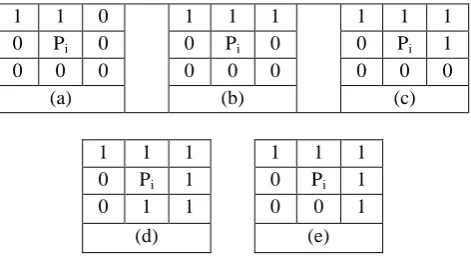
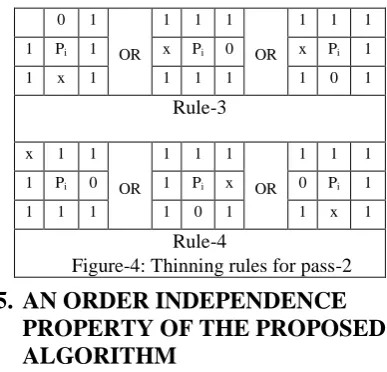
The Proposed algorithm is a two-pass iterative parallel thinning algorithm. In this we adopt a two-pass thinning procedure which checks whether any black pixel can be removed (made to be white) safely or not. In the proposed algorithm, there are two passes. In pass-1, we propose a 23 rule procedure and in pass-2, we propose a 4-rule procedure. In pass-1, as a first step, it counts the number of non-zero neighbors and one–to-zero or zero-to-one transition around the candidate pixel Pi [T. Y. Zhang and C. Y. Suen, 1984]. We derive the thinning rules from the masks shown in figure-2, which satisfy the rule -1 and rule-2 of pass-1 as shown in figure-2. The proposed rules are derived by rotating each mask by one bit (circular rotation) from left to right or right to left for one complete rotation to achieve the thinning rules. The rule-3 to rule-23 in pass-1 and rule-3 and rule-4 in pass-2 are nothing but the exhaustive list of alternatives possible based on rule-1 and rule-2 of pass-1
Figure-2: Masks used to derive thinning rules
[image:2.595.312.548.363.495.2]found then the 2-pixel wide lines (if any) in the provisional skeleton produced by the pass-1, will be further thinned to one pixel wide skeleton, without compromising the connectivity of the skeleton. Transitions from one-to-zero or zero-to-one are exactly If this number is in the range of two-to-six (rule-1) and either zero-to-one or one-to-zero transition is exactly one (rule-2), or then it will check for the rule 3 to 23 as listed in figure-3. If one of the rules from 3 to 23 is satisfied then the pixel under consideration is deleted. This process is repeated until no more changes occur in 1. At the end of the pass-1, the out put image posses two-pixel wide skeleton.
In pass-2, we initially check for two rules namely, whether the non-zero neighbors are in the range of 3 to 6 (rule-1) and the number of transitions from one-to-zero or zero-to-one is exactly one (rule-2). If these two conditions are satisfied, then we check for the rules 3 and 4 as listed in figure-4. If match is one (rule-2). If these two conditions are satisfied, then we check for the rules 3 and 4 as listed in figure-4. If match is found then the 2-pixel wide lines (if any) in the provisional skeleton produced by the pass-1, will be further thinned to one pixel wide skeleton, without compromising the connectivity of the skeleton.
P1 P2 P3 1 1→ ↓0
P8 Pi P4 1 Pi 1
P7 P6 P5 1 1 1
(a) (b)
1 1 0 1 1 1 1 1 1
0 Pi 0 0 Pi 0 0 Pi 1
0 0 0 0 0 0 0 0 0
(a) (b) (c)
1 1 1 1 1 1
0 Pi 1 0 Pi 1
0 1 1 0 0 1
[image:2.595.58.272.639.692.2]Rule-1: All pixels of value 1 whose number in eight neighbor pixels is in the range of two to six.
Rule-2: The number either zero-to-one or one-to-zero patterns in eight neighbor pixels is exactly one.
4.3
Steps in the Algorithm
Pass-1:
Step-1: If Rule-1 and Rule-2, are satisfied then, check the Rule-3 to 23, if match found then process the pixel under consideration.
Step-2: Repeat the step-1 until no more change take place in pass-1, else go to pass-2.
Pass-2
Step-3: If Rule-1 and Rule-2 are satisfied then, check the Rule-3 and Rule-4. If both the rules are satisfied then process the pixel under consideration.
Step-4: Repeat the step-3 until no more change; take place in
pass-2. Else stop thinning process.
5.
AN ORDER INDEPENDENCE
PROPERTY OF THE PROPOSED
ALGORITHM
To establish the robustness of the proposed thinning algorithm to rotation, an original image has been rotated by 90 degrees, 180 degrees 270 degrees. The resulting images have been thinned using proposed thinning algorithm. The proposed algorithm can produce size and translation invariance for different rotations as demonstrated in figure-5. All these thinned images preserve their connectivity and the thinned patterns have one pixel thickness.
[image:3.595.318.512.112.298.2]The image topology is also maintained although the shape and geometry of the image may differ marginally in very few image examples. The order independence property of the algorithm is achieved by rotating the thinning mask into all the directions and these masks are converted into the rules. These rules are used to thin the image from all the directions without leaving any part of the image is un-thinned. Moreover there are no two pixels thick lines as shown in figure-5.
Figure-5: An order independent property of the proposed
algorithm
6.
RESULTS AND COMPARISONS
Image thinning has been performed on a few sample images using different image thinning algorithm like KWK, AW, KNP and proposed image thinning algorithm. The results show that KWK and AW algorithm is not able to thin the image comprehensively as shown in figure-6; the legs of the
0 0 1 0 0 1 0 1 1
0 Pi 1 0 Pi 1 0 Pi 1
0 0 0 0 1 1 0 0 1
Rule-3 Rule-4 Rule-5
1 1 1 0 0 0 0 0 0
1 Pi 0 0 Pi 1 0 Pi 1
0 0 0 0 0 1 1 1 1
Rule-6 Rule-7 Rule-8
1 1 1 0 1 0 0 0 0
0 Pi 1 x Pi 0 0 Pi 0
0 0 0 0 0 0 1 1 0
Rule-9 Rule-10 Rule-11
0 0 0 0 0 0 0 0 0
0 Pi 1 1 Pi 0 1 Pi x
0 0 x 1 1 1 0 0 0
Rule-12 Rule-13 Rule-14
0 0 0 0 0 x 1 0 0
0 Pi 0 0 Pi 0 1 Pi 0
0 1 1 0 1 0 1 1 0
Rule-15 Rule-16 Rule-17
1 1 0 1 0 0 0 0 0
1 Pi 0 1 Pi 0 1 Pi 0
1 0 0 0 0 0 1 0 0
Rule-18 Rule-19 Rule-20
1 1 0 0 1 1 1 1 1
0 Pi 0 0 Pi 0 1 Pi 1
0 0 0 0 0 0 x 1 x
Rule-21 Rule-22 Rule-23
[image:3.595.317.540.471.645.2]Figure-3: Thinning rules for pass-1 Where x=1||0
0 1
OR
1 1 1
OR
1 1 1
1 Pi 1 x Pi 0 x Pi 1
1 x 1 1 1 1 1 0 1
Rule-3
x 1 1
OR
1 1 1
OR
1 1 1
1 Pi 0 1 Pi x 0 Pi 1
1 1 1 1 0 1 1 x 1
Rule-4
duck image is merged for KWK algorithm. The upper part of the tail of the image is not appearing for AW and KNP algorithms, which means that it is leaving some parts of the image is un thinned. In most of the cases, the edges and the corner points are not processed. In KWK, AW and KNP algorithms there is excessive erosion and discontinuities in some of the thinned pattern are also observed, where as proposed algorithm is processing the entire image and producing the exact skeleton for the given input image. These observations are illustrated as in figure-6. A unique advantage of the proposed algorithm is that this algorithm does not change the topological properties of the connectivity and the shape of the thinned image as compared to the other existing algorithm.
Figure-6: An order independent property of the proposed
algorithm
The thinning results are compared based on the thinning ratio, thinness, execution time, connectivity and sensitivity. The result comparison are based on the input image duck is shown in figure-6 and their results are shown in the table-1. The proposed algorithm results are superior then the other thinning algorithms. The execution time of the proposed algorithm is also much superior then the other thinning algorithms.
5.1
Thinning Ratio
Thinning ratio specifies the degree to which the input image is thinned. Larger thinning ratio indicates high degree of thinning. It can be measured based on the following formula referred in [Luping, Zhang, Liffeng and Xiaorong, 2007].
5.2
Thinness
Another way of measuring thinness is based on triangles counts in the 8-neighborhood of the candidate pixel as referred in [Ng, Zhou and Quek, 1994]
5.3
Connectivity
The endpoints and discrete points are fixed and should be the same for the original input image and the skeleton obtained. If either the endpoints and/or the discrete points are more for the obtained skeleton, compared to its input image indicates more
disconnections. Thus as referred in [Ng, Zhou and Quek, 1994]
5.4
Sensitivity
[image:4.595.55.279.228.422.2]This can be measured by counting the number of cross points. Fewer cross points indicates higher noise sensitivity. Sensitivity of the resultant skeleton measured as referred in [Ng, Zhou and Quek, 1994].
Table 1: The result comparisons of input image figure 6.
7.
CONCLUSION
We have proposed an order independent parallel thinning algorithm. Implementation of this algorithm has been carried out and we have also compared its results with other standard thinning algorithms in terms of thinning time, thinning ratio, excessive erosion, connectivity, endpoint preservation, and visual quality. Results indicate that the proposed algorithm is very efficient and effective. The robustness of the proposed thinning algorithm has been established across heterogeneous image examples.
8.
REFERENCES
[1] [Jun-Sik Kwon, Jun-Woong Gi and Eung-Kwan Kang, 2001], “An Enhanced Thinning Algorithm Using Parallel Processing”, IEEE, pp.no.752-755.
[2] [T. Y. Zhang and C. Y. Suen, 1984], A fast parallel algorithm for thinning digital patterns, Comm. ACM, vol. 27, no. 3, pp. 236-239.
[3] [H.E.Lu and P. S. P. Wang, 1985], An improved fast parallel algorithm for thinning digital patterns, Proc. of the IEEE Conf. on Computer Vision and Pattern Recognition, pp. 364-367.
[4] [Ahmad and Ward, 2002], A Rotation Invariant Rule-Based Thinning Algorithm for Character Recognition, IEEE, Trans. Patt.Anal.Machine Intll., Dec, Vol. 24.No.12. pp. 1672-1678.
[6] [Luping Ji, Zhang Yi, Liffeng, and Xiaorong Pu, 2007], Binary Fingerprint Image Thinning Using Template-Based PCNNs, IEEE Transactions on Systems, Man, and Cybernetics-Part-b, Cybernetic, Oct, Val.37,No.5, pp.no. 1407-1412.
[7] [Gabor Nemeth and Kalman Palagyi, 2009], Parallel Thinning Algorithm Based on Ronse’s Sufficient Conditions for Topology Preservation, Research Publishing Service, pp.no.1-12, Aug.16.
[8] [Saad Harous and Ashraf Elnagar, 2009], Handwritten Character-Based Parallel Thinning Algorithm: A
Comparative Study. Univ. of Sharjah Journal of pure & Applied Sciences, Feb, Vol.6, no.1. Pp.no.81-100. [9] [G.S.Ng, R.W.Zhou and C.Quek, 1994], A Noval Single
Pass Thinning Algorithm, Sep, IEEE Transaction on system Man and Cybernetics.