An Efficient Location based Reactive Multi-path
Routing Protocol for MANET
1
Indu Kashyap &
1R.K. Rathy
1
MRIU Faridabad
,
Diwaker Pandey
CCS University, Meerut
ABSTRACT
A mobile ad hoc network consists of wireless nodes that move frequently. Movement of nodes results in a change in routes, requiring some mechanism for determining new routes. In this paper we propose an approach to utilize location information to improve performance of routing protocols for ad hoc networks. We propose a node-disjoint location based multi-path routing protocol (Location-BMP) for mobile ad hoc networks to reduce the number of broadcast multi-path route discoveries and the average hop count per path from the source to the destination. During route discovery process, the intermediate nodes include their location information along with the distance in the Route-Request (MP-RREQ) packet. The destination node selects a set of node disjoint paths from the MP-RREQ packet received and sends a Route-Reply (MP-RREP) packet on each of the node-disjoint paths.
1.
INTRODUCTION
In mobile ad hoc networks, whenever source node wants to have a route to destination node, source node broadcasts RREQ packet to its neighbor nodes in search for destination node. The RREQ packet which source node broadcasts to its neighbor doesn’t contain the direction parameter in its data-structure, therefore each neighbor, whether lies or doesn’t lie in the direction of destination node replies to the RREQ packet and further broadcasts the RREQ packet in search for destination node. This will flood the network with control packets like RREQ packet, RREP packet and RERR packet. Therefore, in high mobility scenario, when that single path fails, End-to-End delay can become significantly high and PDF ratio and overall throughput of the network decreases sharply.
In order to alleviate above mentioned problems, we must need a mechanism to restrict the flooding of control packets in the network, by including the direction of the destination node in RREQ packet. In this only the nodes which lie in a small sector in the direction of destination node play part in routing mechanism and other nodes ignore the messages. Therefore, in this protocol we include direction-destination parameter in control packet. Further, exploring the multiple paths during a single route discovery process and maintaining multiple paths simultaneously helps in routing. As if one path fails the secondary path will always be available in the route cache.
It is needless to say that reducing of control overheads is extremely important in developing efficient reactive routing protocols. Using location awareness and GPS enabledness of
the nodes, we have tried in the proposed protocol to limit the flooding of the control packets in the direction of the destination node. Moreover we have also used shortest as well as alternate paths for transmission of the data packets to improve the performance of the proposed routing protocol. The performance of these protocols tends to increase with node density; at higher node densities, a greater number of alternate paths are available. In such protocols, link failures in the primary path, through which major data transmission takes place, cause the source to switch to an alternate path instead of initiating another route discovery process. A new route discovery process becomes necessary only when all pre-computed paths break. This approach results in reducing end-to-end delay since packets do not need to be buffered at the source when an alternate path is available
Therefore, we have attempted to provide an approach which gives optimized multiple stable routes considering the location of the destination thereby reducing flooding in the network providing low network overhead. Thus, we propose Location-Based stable Multipath reactive routing protocol namely, Location-BMP routing protocol.
2. RELATED WORKS IN MULTIPATH
AND LOCATION AWARE ROUTING
PROTOCOLS
Adhoc On-demand Multipath Distance Vector (AOMDV) is an extension to the AODV protocol for computing multiple loop-free and link-disjoint paths. To keep track of multiple routes, the routing entries for each destination contain a list of the next-hops as well as the corresponding hop counts.
approach in this protocol is therefore not adaptive to the changes in the network topology.
Lee Sung-Ju and Mario Gerla [2] proposed a scheme to calculate alternate paths such that when a link failure occurs, the intermediate node searches for an alternate path to circumvent the broken link. The basic assumption made in this protocol was that all the nodes are in promiscuous mode and that they could overhear every transmission within their range. This protocol, however, has a number of limitations. First, it assumes that several nodes are within transmission range of each other. Also, constant mobility of the nodes is not taken into account. Further, the protocol assumes that a node that offers the alternate route around a broken link does not move away and remains within range of the two nodes between whom the link has broken. Moreover, the utilization of promiscuous mode greatly increases the power consumption of each node.
Lee Sung-Ju and Mario Gerla [3] proposed an on-demand routing scheme, called Split Multipath Routing (SMR), which establishes and utilizes multiple routes of maximally disjoint paths. They attempted to build maximally disjoint routes to prevent certain links from becoming congested and to efficiently utilize the available network resources. The SMR protocol is a variation of the DSR protocol and makes use of source routing to cache pre-computed alternate routes.
Ko Y. and N. Vaidya [4] introduced the concept of Location-Aided Routing (LAR) which is an example of restricted directional flooding routing protocols. However, partial flooding is used in LAR for path discovery purpose. Hence, LAR utilizes the use of position information to enhance the route discovery phase of reactive Adhoc routing. The expected zone starts from the source node and is determined on the basis of available position information (e.g., from a route that was established earlier).
A request zone comprises of as the set of nodes that should forward the route discovery packet. The request zone typically includes the expected zone (zone in which the destination node lies). They proposed two request zone schemes. The first scheme is a rectangular geographic region. In this case, node forwards the route discovery packet only if they are within that specific region. In LAR scheme 2, the source or an intermediate node forwards the message to all nodes that are closer to the destination than itself. Thus the node that receives the route request message checks if it is closer to the destination than it was in the previous hop. If so, it retransmits the route request message otherwise, it drops the message. In order to find the shortest path in the network level, instead of selecting a single node as the next hop, several nodes are selected for managing the route request message and each of them puts its own IP address in the header of the request packet. Therefore, the route through which the route request packet passes is saved in the header of the message; message size thus grows for far from the source resulting in increase in the routing overhead.
Wang C and Yuanapos Liu [5] proposed position-based routing protocols, such as Most Forward within distance R (MFR), in which they attempted to minimize the number of hops by selecting the node with the largest progress from the neighbors. Wherein, they defined the progress as nearness to the destination node. In MFR source S will choose the node say A as the next hop since it has the largest progress to the destination D. As other greedy forwarding protocols, MFR has the shortcomings of either not guaranteeing to find a path
to the destination or finding a path which is much longer than the shortest path. Moreover, nodes should broadcast periodically the beacons to announce their positions and enable the other nodes to maintain a one-hop neighbor table. MFR is an important progress-based algorithm competitive in terms of hop count.
LAR is basically a source routing algorithm like DSR with the entire hop-by-hop routing path in the header of each packet. The advantage it has over DSR is that it is location aware and tries to find routes with minimal flooding using the information available about the positions of source node and destination node. As mentioned earlier, by multi-path we mean caching of alternate paths between the source and destination and not the use of simultaneous multiple paths between the source and destination which can lead to out of order packet delivery problems.
3. PROPOSED LOCATION-BMP
ROUTING PROTOCOL
We have proposed the multipath variant of Location Aware Routing protocol using reactive protocol approach of AODV and the protocol is referred to as Efficient Location-BMP protocol.
In Location-BMP routing protocol we cache all received routes in the order of occurrence and stability. The reason for this is that in the cases of high mobility, the most recently received route having higher stability value is likely to be more successful. Of the two routes in the Location-BMP cache, the stable route will be selected as the primary route if it was a newer route. If both the routes enter in cache at approximately the same time, the route having higher stability value is preferred. Here we also check for the degree of link or node disjointedness of two different paths, and also apply checks for loop free route or whether one route is a sub-route of another, or if one route is identical to the route already in the cache.
The multi-path extension of Location-BMP works as follows: When a source node S wants to send data to the destination node D and does not know any path to reach the destination, the source broadcasts a Multi-path Route Request (MRREQ) message throughout the network. The location and mobility information of the intermediate forwarding nodes are recorded in the MRREQ messages as a sequence of Position Update Information (PUI). When the destination node receives several MRREQ packets and it uses local node-disjoint path selection algorithm 5.1 to identify the set of node-disjoint paths, and re-orders them in the decreasing order of their stability. The destination sends out the Multi-path Route Reply (MRREP) messages to the source node along reverse path of each of the chosen node-disjoint paths. The source receives these MRREPs and stores the set of node-disjoint paths (NDP-Set) in its local cache for further reference.
of node-disjoint paths based on the PUI collected in the latest broadcast discovery procedure. The destination predicts the current location of the nodes and locally constructs a predicted graph. The node-disjoint path selection heuristic is then run on this graph and a set of predicted node-disjoint paths are determined.
The destination sends a sequence of Location-BMP-RREP messages to the source along each of these predicted paths. If a predicted path does not exist, an intermediate node (on the predicted path) cannot forward the Location-BMP-RREP message further towards the source and instead sends a Location-BMP-RERR message back to the destination. If the destination receives Location-BMP-RREP-RERR messages for all the Location-BMP-RREP messages sent, it discards the PUI and waits for the source to initiate a new broadcast route discovery procedure. If the destination does not receive the Location-BMP-RREP-RERR message for a particular Location-BMP-RREP message, it means the corresponding predicted path does actually exist at the current time. If the source receives at least one Location-BMP-RREP message, it stores them the corresponding path in its NDP-Set. For data propagation, the source follows the same procedure of using the paths in its updated NDP-Set in the decreasing order of stability. If the source does not receive even one Location-BMP-RREP message within a certain timeout period, the source then initiates a new broadcast discovery procedure.
3.1 Route Request Algorithm
The source maintains an increasing sequence number for the broadcast route discoveries it initiates to find the node-disjoint multi-paths. Each node, except the destination, on receiving the first MRREQ of the current broadcast process (i.e., a MRREQ with a sequence number greater than those seen before), which includes its Position Update Information, PUI, in the MRREQ message. The PUI of a node comprises the following: node ID, its position X, Y co-ordinates, and Current velocity. The node ID is also appended on the “Route Record” field of the MRREQ message. Upon receiving a MRREQ message, the intermediate node checks if it has path of the destination, if it does not have the path, it further determines from angle-sector information that whether it is required to forward the MRREQ packet. If no, it ignores the message. If yes, it rebroadcast the MRREQ doesn’t immediately generate a MRREP message to the source, even though it might know of one or more routes to the destination. We intentionally do this so that we could collect the latest PUI of each node in the network through the MRREQ messages and also able to determine the set of valid of node-disjoint paths that really exist at the time of the broadcast multi-path route discovery process. The following is the Structure of the Multi-path Route Request (MRREQ) Packet:
1. Source ID 2. Destination ID 3. Sequence Number
4. Route Recorded (List of Node IDs) 5. Position Update Information 6. Angle-Sector for propagation
Determination of the Set of Node-Disjoint Paths using the MRREQ Messages: When a destination receives a MRREQ message, it extracts the path traversed by the message (sequence of Node IDs in the Route Record) and the PUI of the source and the intermediate nodes that forwarded the message. The destination stores the path information in a set, RREQ-Path-Set, maintained for every source with which the destination is in communication. The paths in the
RREQ-Path-Set are stored in the decreasing order of their stability. Ties between paths with the same stability are broken in the order of their time of arrival at the destination node. The PUI are stored in the PUI-Database maintained for the latest broadcast (identified by sequence number) route discovery procedure initiated by the source. The heuristic makes sure that in the set of node-disjoint paths, except the source and the destination nodes, a node can serve as an intermediate node in at most only one path. A RREQ-ND-Set (set of Node-Disjoint paths) is initialized and updated with the paths extracted from the RREQ-Path-Set satisfying this criterion.
Algorithm 1
Input: RREQ-Path-Set // set of paths traversed by the MP-RREQ messages received
Output: RREQ-ND-Set // set of node-disjoint paths to be extracted from the RREQ-Path-Set
Initialization: RREQ-ND-Set ←Φ
Auxiliary Variables: candidate-Path // used to store information whether a path extracted from RREQ-Path-Set can be added to RREQ-ND-Set or not
Begin RREQ-ND-Path-Selection Step1: while (RREQ-Path-Set ≠ Φ) do
Step2: Extract the first path P in RREQ-Path-Set // basically removes path P from RREQ-Path-Set
Step3: candidate-Path ←True
Step4: for (every intermediate node u∈ P) do
Step5: for (every node-disjoint path ND-P in RREQ-ND-Set) do
Step6: if (u is an intermediate node of ND-P) then Step7: candidate-Path ← False
Step8: end if Step9: end for Step10: end for
Step11: if (candidate-Path is set to True) then Step12: RREQ-ND-Set ←RREQ-ND-Set U {P} Step13: end if
Step14: end while
Step15: return RREQ-ND-Set End RREQ-ND-Path-Selection
The heuristic traverses through the RREQ-Path-Set in the order of the paths stored in it (in the increasing order of the hop counts). A path P in the RREQ-Path-Set is added to the RREQ-ND-Set only if none of the intermediate nodes in P are already part of any of the paths in the RREQ-ND-Set. Once the RREQ-ND-Set is formed, the destination sends a Multi-path Route Reply (MP-RREP) message for every Multi-path in the RREQ-ND-Set.
3.2 Route Reply Algorithm
An intermediate node receiving the MP-RREP message from destination node or an intermediate node updates its routing table by adding the neighbor that sent the message as the next hop on the path from the source to the destination. The MP-RREP message is then forwarded to the next node towards the source as indicated in the Route Record field of the message. The MRREP message consists of the following information:
1. Originating Source ID of the MRREQ 2. Targeted Destination ID of the MRREQ 3. Sequence Number of the MRREQ
4. Route recorded in the MRREQ (List of Node IDs) 5. Angle-Sector for propagation
3.3
Multipath
Route
Maintenance
Algorithm
If a link failure occurs due to the two nodes constituting the link drifting away, the upstream node of the broken link informs about the broken route to the source node through a Multi-path-Route-Error (MRERR) message, consist of following information.
1. Node originating the MRERR packet 2. Source ID of the data packet dropped 3. Destination ID of the data packet dropped 4. Sequence number of the data packet dropped 5. Intermediate node with which the link failed The source node on learning the route failure will remove the failed path from its NDP-Set and attempt to send data packet on the next stable path in the NDP-Set. If this path is actually available in the network at that time instant, the data packet will successfully propagate its way to the destination. Otherwise, the source receives a MP-RERR message on the broken path, removes the failed path from the NDP-Set and attempts to route the data packet on the next stable path in the NDP-Set. This procedure is repeated until the source does not receive a MRERR message or runs out of an available path in the NDP-Set. In the former case, the data packet successfully reaches the destination and the source continues to transmit the next data packet at the next scheduled time. In the latter case, the source is not able to successfully transmit the data packet to the destination.
Before initiating another broadcast route discovery procedure, the source will wait for the destination node to inform it of a
new set of node-disjoint routes through a sequence of MP-Link-BMP-RREP messages.
4. ILLUSTRATIVE EXAMPLE FOR
LOCATION-BMP ROUTING
PROTOCOL
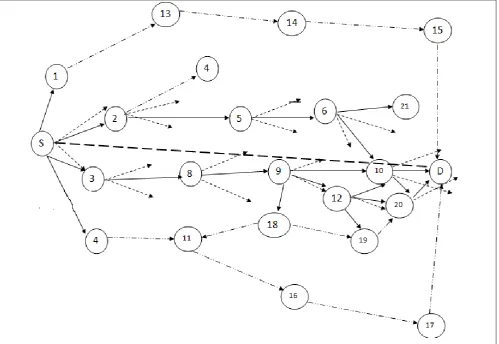
We are illustrating our proposed protocol with the help of an example shown in Figure 1. Here we have taken 20+ (S+D) nodes in our example. In this the solid lines indicate that they are sending MRREQ Packets. Dotted lines indicate the directions within which MRREQ packets are propagated. We have used directional propagation of MRREQ packets in the direction of the destination node. The angle-sector (shown with dotted lines) information in the packet indicates that those neighboring nodes which are within this angle-sector are required to participate in routes establishments and the others should ignore the MRREQ packets.
[image:4.595.50.550.400.744.2]We assume that source node S does not have route to destination node D. Therefore, S broadcasts MRREQ packet to its neighbors i.e. nodes 1, 2, 3, 4. Since nodes1, 4 do not lie within the direction of Destination i.e. (Angle-sector of 90) and they were not lying within angle therefore they will not respond to MRREQ and will discard the packet. Nodes 2 and 3 will respond to MRREQ message by further broadcasting the packet as they were lying in the angle. Nodes 4, 5 and 8 will receive the MRREQ from nodes 2 and 3, respectively. Since node 4 doesn’t lie in the angle therefore node 4 will discard the MRREQ packet. Nodes 5 and 8 will respond to route request by further broadcasting the MRREQ packet to its neighbors.
Further, from node 5 the node 6 will get request packet and from node 8, the node 9 will get the request packet. As these nodes were lying in the angle therefore they will also broadcast MRREQ packet. From node 6 node 10 will receive MRREQ packet and from node 9 node 10, node12 and node 18 will receive MRREQ. But since node18 doesn’t lie in the angle therefore it will discard the MRREQ packet. Next, node 10 and 12 will further broadcast request packet and finally from node10 node D will get the MRREQ packet. From node 12, node 20 will receive the MRREQ packet and node 20 will further broadcast the packet to node D. Thus D has receives 3 MRREQ packets from source node S. The destination node D will stores all these paths in its candidate paths and will run Node disjoint algorithm to determine the node disjointness of the paths and further stores these paths in its RREQ-Path-set in decreasing order of stability. Here we see that D has two paths in its local cache (RREQ-Path-set) i.e. S-2-5-6-10-D and S-3-8-9-12-20-D.
Further, D sends MRREP packet along these paths, as D will have an idea of latest position of each node through PUI stored in MRREQ packet. When source node receives the MRREP packets along these paths source stores them in its local cache i.e. NDP-Set and starts transmitting data
6.
RESULTS AND CONCLUSION
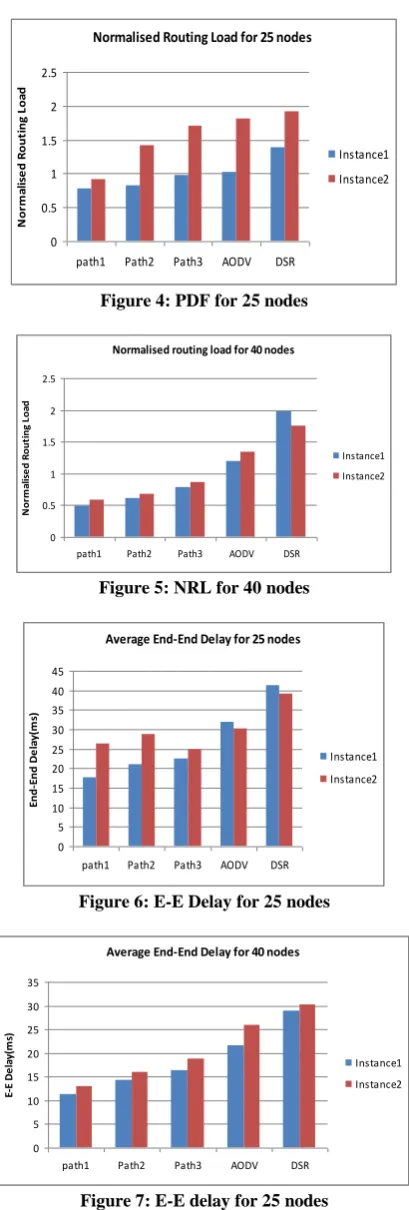
Packet Delivery Fraction for 25 nodes
0 10 20 30 40 50 60 70 80
path1 Path2 Path3 AODV DSR
P ac ke t D e liv e ry Fr ac ti on (% ) Instance1 Instance2
Figure 2: PDF for 25 nodes
Packet Delivery Fraction for 40 nodes
0 10 20 30 40 50 60 70 80 90 100
path1 Path2 Path3 AODV DSR
[image:5.595.326.531.65.671.2]P a ck e t D e li v e ry Fr a ct ion( % ) Instance1 Instance2
Figure 3: PDF for 40 nodes
Normalised Routing Load for 25 nodes
0 0.5 1 1.5 2 2.5
path1 Path2 Path3 AODV DSR
N or m a li se d R out ing L oa d Instance1 Instance2
Figure 4: PDF for 25 nodes
Normalised routing load for 40 nodes
0 0.5 1 1.5 2 2.5
path1 Path2 Path3 AODV DSR
N or m al is e d R out ing L oa d Instance1 Instance2
Figure 5: NRL for 40 nodes
Average End-End Delay for 25 nodes
0 5 10 15 20 25 30 35 40 45
path1 Path2 Path3 AODV DSR
End -E nd D e la y( m s) Instance1 Instance2
Figure 6: E-E Delay for 25 nodes
Average End-End Delay for 40 nodes
0 5 10 15 20 25 30 35
path1 Path2 Path3 AODV DSR
E-E D e la y( m s) Instance1 Instance2
Figure 7: E-E delay for 25 nodes
[image:5.595.66.262.338.653.2]Thus the proposed protocol has higher efficincy almost on all performance parameters
7.
REFERENCES
[1] Marina M. K. and S. R. Das: On-demand Multipath Distance Vector Routing for Adhoc Networks. Proc. of the 9th IEEE Inter. Conf. on Network Protocols, pp. 14-23, 2001.
[2] Lee S. J. and M. Gerla: AODV-BR: Backup routing in Ad Hoc networks. Proceedings of IEEE WCNC 2000. Chicago, IL, 2000.
[3] Lee S. J. and M. Gerla: Split multipath routing with maximally disjoint paths in ad hoc networks. IEEE International Conference on Communications, Helsinki, 2001.
[4] Ko Young and N. Vaidya: Location-Aided Routing in mobile adhoc networks. Wireless Networks, Vol. 6, pp: 307-321, 2000.
[5] Wang C. and Yuanapos Liu: The Performance Analysis of MFR Routing Strategy in Adhoc Networks. Proceedings of Network and Communication Technology (ICCT 2003), Vol. 2, pp: 1274-1277, 2003.
[6] S. Capkun, et al., “GPS-free Positioning in Mobile Ad-Hoc Networks”, Cluster Comp., vol. 5(2), 2002, pp. 157-167.
[7] S. Basagni, et al., “A Distance Routing Effect Algorithm for Mobility”, Proc. ACM MOBICOM, 1998, pp. 76-84.
[8] M. Mauve, et al., “A Survey on Position-Based Routing in Mobile Ad-hoc Networks”, IEEE Network, vol. 15(6), 2001, pp. 30-39.
[9] A. Crespo, and H. Garcia-Molina. “Routing Indices for Peer-to-peer Systems”, Proc. IEEE ICDCS, 2002, pp. 23-34.