Exploiting Reflection in
Mobile Computing Middleware
Licia Capraa Gordon S. Blairb Cecilia Mascoloa
Wolfgang Emmericha Paul Graceb
aDepartment of Computer Science, University College London, London, UK
bDistributed Multimedia Research Group, Computing Department, Lancaster University, Lancaster, UK
The increasing popularity of portable devices and recent advances in wireless networking technologies facilitate the engineering of new classes of applications, which present chal-lenging problems to designers. Mobile devices face temporary and unannounced loss of network connectivity when they are moved, they are likely to have scarce resources, and they are required to react to frequent changes in the environment. To accommodate these new requirements imposed by mobility, middleware platforms for mobile computing must be capable of both deployment-time configurability and run-time reconfigurability. We illus-trate how reflective techniques can be exploited by middleware designers to address these requirements. We discuss two complementary approaches: CARISMA, where reflection is used to support dynamic adaptation of middleware behaviour to changes in context, and ReMMoC, which uses reflection to accommodate heterogeneity requirements imposed by both applications and underlying device platforms.
I. Introduction
The increasing popularity of portable computing de-vices, such as mobile phones, personal digital assis-tants, digital cameras and the like, and recent advances in wireless networking technologies are facilitating the construction of new classes of distributed and mo-bile applications. These applications pose a number of new challenges for middleware technology. In par-ticular, the middleware that supports the construction of such applications has to be light-weight, in order to run on resource-constrained devices; middleware has also to support context-awareness, as mobile ap-plications need to adapt to variations in the context of execution, such as fluctuating network bandwidth, de-creasing battery power, changes in location or device capabilities, and so on. Finally, the problem of
inter-operating with heterogeneous middleware
technolo-gies that exist in different locations needs to be over-come; for example, middleware might provide differ-ent asynchronous communication paradigms that may be used to cope with the frequent and unannounced disconnections that are typical of the mobile environ-ment.
Unfortunately, the current generation of main-stream middleware is, to a large extent, heavyweight, monolithic and inflexible and, thus, fails to properly address these requirements. The main reason is that traditional middleware systems have been built adher-ing to the principle of transparency: implementation
details are hidden from both users and application de-signers and are encapsulated inside the middleware it-self, so that the distributed system appears to applica-tion developers as a single integrated computing facil-ity. Although having proved successful for building traditional distributed systems, this approach suffers from severe limitations when applied to the mobile setting where it is neither always possible, nor desir-able, to hide all the implementation details from the user. Such black box systems are inevitably heavy-weight, have built-in mechanisms and policies that are not suitable for mobile computing and cater for the common case rather than the high levels of hetero-geneity intrinsic in mobile environments. In addition, applications may have valuable information that could enable the middleware to execute more efficiently.
In order to cope with these limitations, many re-search efforts have focused on designing new middle-ware systems capable of supporting the requirements imposed by mobility (see section II). As a result of these efforts, a pool of mobile middleware systems has been produced. However, none of the solutions developed to date supports the necessary level of mid-dleware configurability and reconfigurability that is required to accommodate mobile computing. In our opinion, a more systematic, principled and dynamic solution is needed.
support-ing both introspection and adaptation (see section III). The technique hence supports more configurable and reconfigurable middleware (e.g., [5]). This means that a middleware core with only a minimal set of functionalities can be installed on a mobile device. Context information can be maintained by the mid-dleware and through reflective mechanisms applica-tions can acquire information about their execution context and tune the middleware behaviour accord-ingly. No specific communication paradigm is related to the principle of reflection, so this issue is left un-specified and depends on the particular middleware system built.
The remainder of the paper is structured as follows: Section II describes the state of the art of mobile com-puting middleware and points out gaps in current ap-proaches. Section III defines the concept of reflec-tion, and how it applies to mobile computing middle-ware. In Section IV, two projects that exploit reflec-tion to build mobile computing middleware are pre-sented: CARISMA (Context-Aware Reflective mId-dleware System for Mobile Applications), that aims at enhancing the development of context-aware applica-tions, and ReMMoC (Reflective Middleware for Mo-bile Computing), that aims at overcoming the prob-lem of heterogeneity in mobile middleware technol-ogy. We then briefly discuss related work before con-cluding the paper and pointing out some future open issues.
II. Mobile Computing Middleware
In this section we look in turn at state of the art mid-dleware, including traditional middleware types used in the mobile domain and new classes of middleware built specifically for mobility. However, an exhaustive review of all existing mobile computing middleware is beyond the scope of this paper and we refer the inter-ested reader to [27].
II.A. Existing Middleware Standards
and Platforms
There have been attempts to adapt traditional object-oriented middleware, including CORBA, DCOM and Java RMI, to mobile settings, mainly to allow mo-bile devices to interoperate with services within ex-isting fixed networks. For example, IIOP (the Internet Inter-ORB Protocol) has been successfully ported to the mobile setting, presenting a layered architecture that ensures an IIOP connection remains established transparently [19]. Similarly, RAPP [39] and DOL-MEN [25] offer alternative methods for supporting
CORBA object invocations in the wireless environ-ment. Mobile DCE [37] is another early platform that successfully demonstrated that remote procedure calls could be utilised by mobile applications. However, the synchronous communication paradigm assumes a permanent connectivity that cannot be guaranteed in most mobile computing settings. Adaptations of tra-ditional object-oriented middleware to mobile scenar-ios are therefore usually targeted to nomadic settings where cell hand-overs allow mobile devices to roam while being connected.
Although extensions to established platforms have illustrated that they can be utilised in wireless net-works, they do not support the most natural interac-tion paradigm for this setting. The characteristics of wireless communication media (e.g., low and variable bandwidth, frequent disconnections, etc.) favour a de-coupled and opportunistic communication paradigm: decoupled in the sense that computation proceeds even in the presence of disconnections, and oppor-tunistic as it exploits connectivity whenever it be-comes available. Therefore, middleware that supports asynchronous communication has been proposed as being more suitable for developing mobile
applica-tions. These generally take the form of
publish-subscribe platforms and tuple spaces. Notably, how-ever, Rover [20] was an initial platform in this area that implemented an asynchronous remote procedure call paradigm.
Within the publish-subscribe paradigm, interaction takes the form of event notification; namely, con-sumers subscribe to events they are interested in and are notified when they are published. Logically, the two parties do not have to be connected simultane-ously to interact, therefore, suiting the mobile envi-ronment. Examples of these are Elvin [38], SIENA [8] and iBus [42]. However, these platforms were de-signed specifically for fixed networks and do not take into account the dynamic connection of mobile hosts. This has enforced the emergence of some preliminary solutions. For example, Elvin has been extended to in-corporate proxy servers to support the persistence of events, so that clients who disconnect repeatedly do not lose events. Nonetheless, it requires that clients connect to the same proxy, which cannot be
guar-anteed in mobile networks. Another alternative is
Although not initially designed for this purpose (their origins go back to Linda [18], a coordination language for concurrent programming), tuple space systems have been shown to provide many useful fa-cilities for communication in wireless settings. Tuple spaces act as a repository of data structures called tu-ples that processes can concurrently access. Commu-nication is de-coupled in both time and space: senders and receivers do not need to be available at the same time, because tuples have their own life span, inde-pendent of the process that generated them, and mu-tual knowledge of their location is not necessary for data exchange, as the tuple space looks like a globally shared data space, regardless of machine or platform boundaries. These forms of decoupling assume enor-mous importance in a mobile setting, where the par-ties involved in communication change dynamically due to their migration or connectivity patterns. Exam-ples include, Lime [31], TSpaces [45] and L2imbo [14]. With the exception of L2imbo, these systems do not address the issue of dynamic adaptation of mid-dleware to changing context.
The range of middleware types described illus-trates the level of middleware heterogeneity that oc-curs within the mobile domain (i.e., the platforms that mobile services are advertised and implemented by, change as the device roams). As previously stated, reflection does not assume or require any particular communication paradigm. A reflective middleware can therefore provide any communication style (e.g., tuple space), or better, can provide different communi-cation paradigms (e.g., RPCs, events, messages, etc.) among which applications can dynamically choose the one that best suits their current needs.
II.B. New Approaches
We hypothesise that the range of asynchronous mid-dleware paradigms such as publish/subscribe and message oriented systems will play a key role in the success of mobile computing middleware. However, communication is not the only aspect that middleware should tackle: other important aspects such as data sharing and context awareness need to be addressed.
Middleware must support mobile applications to be aware of the context in which they are being used in order to enable applications to adapt to heterogene-ity of hosts and networks, as well as variations in the user’s environment. User context includes, but is not limited to: location, with varying accuracy depending on the positioning system used; relative location, such as proximity to printers and databases; device charac-teristics, such as processing power and input devices;
physical environment, such as noise level and band-width; user activity, such as driving a car or sitting in a lecture theatre.
Context-aware computing is not a new computing paradigm; it was first proposed a decade ago [36] and many researchers have studied and developed systems that collect context information, and adapt to changes. In particular, location has attracted a lot of attention and many applications exploit location information to offer travellers directions, such as the Shopping Assis-tant [2] and CyberGuide [26]; to find out neighbouring devices and the services they provide, such as Tele-porting [3]; to send messages to anyone in a specific area, such as a Conference Assistant [15]; and so on. Most of these systems interact directly with the un-derlying network OS to extract location information, process it, and present it in a convenient format to the user. One of their major limitations concerns the fact that they do not cope with heterogeneity of coordinate information, and therefore different versions have to be released that are able to interact with specific sen-sor technologies, such as the Global Positioning Sys-tem (GPS) outdoors, and infrared and radio frequency indoors.
To enhance the development of location-based ser-vices and applications, and to reduce their develop-ment cycle, middleware systems have been built that integrate different positioning technologies by provid-ing a common interface to the different positionprovid-ing systems, thus solving heterogeneity issues. Exam-ples include Oracle iASWE [33], Nexus [17], Alter-nis [1], SignalSoft [40], and CellPoint [10]. Interest-ingly enough, few contexts other than location have been actually used to date.
An exception can be found in [44], where an archi-tecture is proposed that reports changes in the environ-ment to interested applications. Changes are modelled as asynchronous events that are dispatched to envi-ronment aware applications through an event delivery mechanism that separates event detection from deliv-ery, so that event producers and consumers are effec-tively decoupled. Events are hierarchically organised, and can be extended in order to deal with a variety of changes happening in the environment (e.g., differ-ent location, memory availability, network connectiv-ity, etc.). However, changes in the environment affects only the application behaviour, and are not used to dy-namically adapt middleware behaviour.
giving users access to replicas; they differ in the way they ensure that replicas move towards eventual con-sistency, that is, in the mechanisms they provide to de-tect and resolve conflicts that naturally arise in mobile systems.
We assert that a reflective middleware may enhance the development of context-aware services and appli-cations. Through reflection, application-specific in-formation can be exploited, for example, to dynam-ically instruct middleware on which positioning sys-tem to use (if more than one is available). More gen-erally, a reflective middleware would provide appli-cations with context information that they can use to optimise (i.e., dynamically reconfigure) middleware, as well as their own behaviour, counter balancing, for example, the scarce resource availability.
III. Reflection
Reflection is a technique that first emerged in the pro-gramming language community to support the design of more open and extensible languages (e.g., see [21]). The key to the approach is to offer a meta-interface supporting the inspection and adaptation of the un-derlying virtual machine (the meta-level). The ser-vice offered by this interface is then referred to as the meta-object protocol. Access to this meta-level is provided through a process of reification. Reifi-cation effectively makes some aspect of the internal representation explicit and hence accessible from the application (the base-level). The opposite process is then absorption where some aspect of meta-system is altered or overridden.
The approach is nicely summarised by the follow-ing quote from Brian Cantwell Smith, the originator of the early work on reflection [41]:
”In as much as a computational process can be constructed to reason about an external world in virtue of comprising an ingredient process (interpreter) formally manipulating representations of that world, so too a com-putational process could be made to reason about itself in virtue of comprising an ingre-dient process (interpreter) formally manipu-lating representations of its own operations and structures”.
Reflection is now widely adopted in language de-sign, as witnessed for example by the Java Core Re-flection API and also the meta-object protocol defined in CLOS [21]. Reflection is also increasingly being applied to a variety of other areas including operating
system design [46], concurrent languages [43], and in-creasingly distributed systems, as in [29] or [32]. Cru-cially, there is now a growing community working on the area of reflective middleware [4]. The main moti-vation for this research is to provide a principled (as opposed to ad-hoc) means of achieving openness (of the underlying middleware platform). For example, reflection can be used to inspect the internal behaviour of a platform (introspection). By exposing the un-derlying implementation, it becomes straightforward to insert additional behaviour to monitor the imple-mentation, e.g., performance monitors, quality of ser-vice monitors, or accounting systems. Reflection can also be used to alter the internal behaviour of the mid-dleware (adaptation). Examples include replacing or changing the implementation of the underlying trans-port protocol to operate more optimally over a wire-less link, introducing an additional level of distribu-tion transparency in a running computadistribu-tion (such as migration transparency), or inserting a filter compo-nent to reduce the bandwidth requirements of a com-munication stream.
In middleware platforms, two (complementary) styles of reflection have been used, namely structural and behavioural reflection.
• Structural reflection is concerned with the under-lying structure of objects or components, e.g., in terms of interfaces supported. This is similar, for example, to the introspection features found in Java 1.2 and associated technologies, such as JavaBeans [30]. More advanced features may also be offered, such as the ability to adapt the structure of an object (e.g., to add new behaviour at run-time). Similarly, some systems provide chitectural reflection, whereby the software ar-chitecture of the system can be reified and al-tered [5, 9], e.g. in terms of components and con-nectors. This can be applied to the very structure of the middleware platform itself, allowing the customisation of the architecture for the current environmental conditions. Finally, meta-data or context can be viewed as a form of structural re-flection, providing additional (meta)information about the underlying system, e.g. physical loca-tion, current battery levels or performance of the network.
of invocation and the subsequent insertion of pre-or post- actions. Other systems provide similar capabilities through dynamic proxies [30]. Fi-nally, some research has been carried out on pro-viding access to underlying resources and associ-ated resource management, e.g. through the reifi-cation of a set of logical tasks and enabling the customisation of resource allocation and man-agement policies [16].
There has also been research on overall architectures that encompass the various forms of reflection [5].
IV. Projects
IV.A. CARISMA
In order to allow applications that execute on portable devices to adapt to frequent and unannounced changes in the environment, middleware systems must support context awareness. By context, we mean everything that can influence the behaviour of an application, from resources within the device, such as memory, battery power, screen size and processing power, to resources outside the physical device, such as band-width, network connection, location and other hosts within reach.
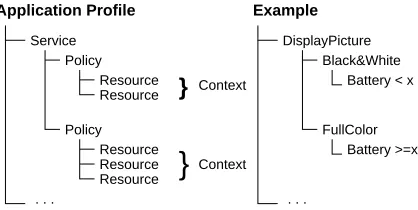
CARISMA, a project carried out at University Col-lege London, is a middleware that uses both structural and behavioural reflection to enable context-aware in-teractions between mobile applications. The middle-ware is in charge of maintaining a valid representation of the execution context, by directly interacting with the underlying network operating system. Depending on the current context, applications may require the middleware to behave in specific ways. For exam-ple, an image processing application may ask the mid-dleware to display pictures in black and white when battery power is low, using full-size, full-colour pic-tures when battery power permits. In CARISMA, the middleware can be seen by applications as a dynam-ically customisable service provider. This customisa-tion takes place by means of applicacustomisa-tion profiles.
Resource Resource
Resource Resource Resource
DisplayPicture Black&White
Battery < x
FullColor Battery >=x
Example
. . . Policy
Service
Policy
Application Profile
Context Context
}
}
[image:5.612.74.283.624.729.2]. . .
Figure 1: Structure of an application profile.
As shown in Figure 1, each application profile de-fines associations between the services that the mid-dleware delivers, the policies that can be applied to de-liver the services, and the context configurations that must hold in order for a policy to be applied. In the example above, an association is defined between the service ‘DisplayPicture’, the ‘Black&White’ policy, and a context where the resource ‘Battery Power’ is low, and another one between the same service ‘Dis-playPicture’, the ‘FullColour’ policy, and a context where ‘Battery Power’ is high. Profiles are passed down to the middleware; each time a service is in-voked, the middleware consults the profile of the ap-plication that requests it to determine which policy can be applied in the current context. Our model assumes that at each time the behaviour of the middleware with respect to a particular service is determined by one and only one policy, that is, a service cannot be de-livered using a combination of different policies. If different policies need to be combined, a new name must be assigned to the combined policy, and this name must be used in the profile. For example, the display of an image can be done using a ‘B&W-Low’ policy, that is a combination of ‘Black&White’ and ‘LowResolution’.
As both the needs of the user and the context change quite frequently, we cannot expect an application to fix its own profile once and for all at the time of in-stallation and never change it after. We therefore need to provide the middleware with an initial profile, and then grant the application dynamic access to it. Here is where (structural) reflection comes into play. The middleware configuration with respect to current con-text is reified by means of application profiles, and al-tered through a reflective API that allows applications to read their own profile (introspection of middleware behaviour), and to dynamically modify the meta-data that is encoded in the profile (adaptation of middle-ware behaviour). If we consider once again the dis-play picture example, an application may restrict the use of the ‘FullColour’ policy from a context where battery power is high to a context where both battery power and memory are high, due to a considerable drop in memory availability.
apply (recall that we made the assumption that a ser-vice can be delivered using only one policy at a time). Different policies deliver different quality of service, and consume different amounts of (usually scarce) re-sources.
The resolution is based on an auction protocol where middleware plays the role of the auctioneer, ap-plications are the bidders and policies are the goods they are competing for [7]. The main rule of the game is very simple: each bidder submits a single sealed bid, and the ‘winner’ is the bidder who bids highest. Bids are computed based on non-functional concerns, such as availability, security, performance. Reflection is used to allow applications (i.e., bidders) to dynam-ically change the set of non-functional requirements they care about; as a result, the same conflict may be resolved in different ways in different context, thus resulting in different middleware behaviours and dif-ferent resources allocation.
We have implemented a prototype of our reflective middleware in Java, and developed a conferencing ap-plication and an instant messaging apap-plication on top of it. Application profiles have been encoded using the eXtensible Markup Language (XML). We chose to use XML as this meta-language enhances context-aware and user-driven interactions between middle-ware and applications, supporting a representation of information that is both easily manipulatable by ma-chines and readily understandable by humans.
Performance evaluation of CARISMA is
ongo-ing work. Preliminary results obtained running
CARISMA on top of Compaq iPAQ PDAs running Linux, and connected using WaveLAN, have shown that it takes less than 200ms to start a local service, and less than 400ms for a remote service. We have also measured the overhead introduced by the conflict resolution mechanism; in case a conflict exists, the amount of time required to start a service increases by 10% for a local service, and of 20% for a remote one. In both cases, the there is no human perception of the delay as most of the time is taken by the loading and provisioning of the service. Further experiments will be run on multiple services, and compared with a sys-tem that does not use reflection. For a more complete discussion of CARISMA, please refer to [6, 7].
IV.B. ReMMoC
The ReMMoC project, being carried out at Lancaster University in collaboration with Lucent Technologies, is examining the use of reflection and component technology to overcome the problems of heteroge-neous middleware technology in the mobile
environ-ment. Mobile applications and services are imple-mented upon a range of middleware platforms (e.g., RPC, message-oriented and event-based paradigms) and are advertised using different service discovery protocols. Therefore, developing mobile applications upon fixed middleware types is unsuitable; rather the middleware on the mobile device should be able to dy-namically change its structure and behaviour so that it can discover and interoperate with all services avail-able in the current environment.
SLP Services
PDA PDA
Event Broker SOAP Server
Print Service
Sport News Channel Tourist
Guide Service
Lancaster University (802.11 bNetwork) Lancaster City Centre (802.11 bNetwork) UPnP Services
PDA PDA PDA
SLP Services
SOAP Server
Sport News Service
CORBA Server Print Service Tourist
[image:6.612.317.541.188.276.2]Guide Service
Figure 2: Heterogeneous mobile services.
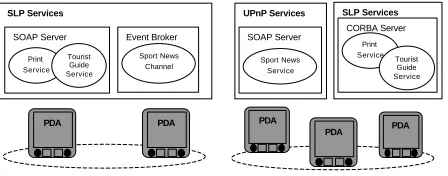
To illustrate this, a typical mobile scenario is pre-sented in Figure 2. Two possible locations in the ses-sion of a mobile user and the mobile services that can be interacted with via the given mobile device are il-lustrated. It can be seen that the same three mobile ap-plication services are available to the user in the differ-ent locations, but the platforms presdiffer-enting them differ. For example, the sport news service is implemented as a publish-subscribe channel on the university campus network and as a SOAP service in the town centre. If fixed middleware were to be used, then two separate applications and middleware implementations would be needed on the device. Similarly, the print service and tourist guide service are implemented across
dif-ferent middleware types. However, this is not the
only level of heterogeneity in the scenario; the ser-vices themselves must first be discovered by the mo-bile device before interaction can occur. Neverthe-less, in this setting the service discovery technologies themselves are different, i.e., the services available to campus users are discoverable using the Service Lo-cation Protocol (SLP), while the services across the city centre can be found using both the Universal Plug and Play (UPnP) protocol and SLP. If the middleware can only perform one type of service discovery then it may miss some available resources and in the worst-case scenario find none of them.
con-figuration of components whose structure can be al-tered via a meta-object protocol. This meta-object protocol provides the ability to i) inspect and invoke the interfaces available within the framework, ii) view and alter the component architecture and, finally, iii) insert interceptors to dynamically add new behaviour. The current platform consists of two key compo-nent frameworks for binding and service discovery, whose behaviour can be dynamically altered using the previously described reflective techniques. The bind-ing framework can be re-configured between different types of interaction protocols (e.g., CORBA, SOAP, publish-subscribe, etc.). Similarly, the service dis-covery framework can change between one or more of the different service discovery technologies (e.g., SLP, Jini, UPnP, etc). Therefore, possible configura-tions could be SLP at one time, but changed to SLP and UPnP at another; this will allow services adver-tised by both technologies to be found. The infor-mation obtained from performing service discovery drives the reconfiguration of the binding framework to the appropriate interaction protocol. We are also cur-rently exploring the use of XML to allow the applica-tion’s requirements to be described independently of the underlying middleware technologies. ReMMoC will then base its adaptation upon meeting these re-quirements.
We have implemented the ReMMoC platform upon our own OpenCOM Light component model. Open-COM Light has been developed for use on devices running the Windows CE Operating System, with the aim of creating a minimum component platform for devices of limited resources. The size of this ponent platform is currently 41 Kbytes and the com-ponents created upon it are on average 8 Kbytes in
size. The platform is closely based on Microsoft
COM but enhanced with richer reflective facilities. More information about the OpenCOM model can be found in [12]. Furthermore, we have implemented middleware functionality for SOAP, IIOP and pub-lish/subscribe to support dynamic binding and we are working on SLP and UPnP implementations of ser-vice discovery behaviour.
IV.C. Relationship between the two
plat-forms
The two platforms described previously are closely re-lated, in that they use reflection to support two key requirements of mobile middleware. Firstly, ReM-MoC presents the ability to develop applications inde-pendently from specific middleware technologies that may be encountered over time, by allowing the service
discovery and communication implementation to be adapted dynamically. However, the control of adapta-tion needs to be based upon context informaadapta-tion from both the environment and the device, in order for the middleware to offer the best level of service. The management of the underlying platform changes over time can be controlled by the properties offered by CARISMA. Therefore, a reflective framework, where policy and mechanism co-exist and can both be altered dynamically, provides support to mobile application developers to solve a host of problems.
V. Related Work
The principle of reflection has already been inves-tigated by the middleware community during the past years, mainly to achieve flexibility and dy-namic reconfigurability of the Object Request Bro-ker (ORB) of CORBA. Examples include, but are not limited to, OpenCorba [24], dynamicTAO [23] and
OpenORB [5]. However, the platforms developed
to experiment with reflection were based on standard middleware implementations (except Open ORB as shown in section IV.B), and therefore targeted to a wired distributed environment.
Other approaches that specifically target the mo-bile setting include: Universally Interoperable Core (UIC [34]), a minimal reflective middleware for mo-bile devices where a pluggable set of components al-lows developers to specialise the middleware to suit different devices and environments, thus solving het-erogeneity issues. The configuration can also be au-tomatically updated both at compile-time and run-time. Personalities can be defined to have a client-side, server-side or combined behaviours. Personali-ties can also define the server type for an interaction (i.e., CORBA or Java RMI): single personalities allow the interaction with only one type, while multi person-alities allow interaction with more than one type. In the case of multi personalities the middleware dynam-ically chooses the right interaction paradigm. The size of the core goes from 16KB for a client-side CORBA personality running on a Palm OS device to 37KB for a client/server CORBA personality running on a Windows CE device. UIC offers similar capabilities to the ReMMoC platform to overcome middleware heterogeneity. However, unlike ReMMoC, it concen-trates on synchronous communication paradigms, less suited to mobile settings, and does not directly address the key property of heterogeneous service discovery.
“What You Need Is What You Get”, that is, the system dynamically reconfigures itself to provide the func-tionality required by each particular entity. An en-tity may vary from users, to software components to devices. At any time, only a minimal set of com-ponents required for executing the user applications in the most efficient way is loaded, without carrying around non-utilised modules.
On top of this framework, Gaia [11] has been devel-oped adding support for dynamic adaptation to con-text conditions. Gaia converts physical spaces and the ubiquitous computing devices they contain into active spaces, that is, programmable computing sys-tems with well-defined behaviour and explicitly de-fined functionality. The goal of an active space is to provide a generic model that hides the complexity as-sociated to its internal status and exports a standard programming interface independent of the underlying physical space. Gaia then adapts application require-ments to the properties of its associated active space, without having the application to explicitly deal with the particular characteristics of every possible physi-cal space where they can be executed.
VI. Conclusion and Future Work
We have argued why the principle of transparency that has driven the design of traditional middleware sys-tems may not be optimal for mobile settings. Im-plementation details have to be made available to the above running applications to allow dynamic recon-figuration of the underlying system, based on different context conditions and varying application needs.
We propose reflection as a principle to accommo-date the variety of requirements imposed by mobil-ity. In order to provide the best service to the applica-tion, the middleware must be aware of its context and current behaviour and then alter according to environ-mental changes. The two properties of openness and adaptation provided by reflective middleware is par-ticularly well suited to this. We have shown examples that support this hypothesis. In particular, we have il-lustrated two projects: CARISMA, where reflection is used to allow applications to dynamically customise middleware behaviour, and ReMMoC, where reflec-tion is used to deal with heterogeneous middleware technology in mobile environments. We have shown that these are two complementary techniques that are closely related and that together they can support the development of mobile applications.
Some major drawbacks of the reflective approach are performance, integrity and security issues. When
developing a reflective mobile middleware, the fol-lowing questions must therefore be addressed care-fully: how much are we willing to trade-off between flexibility and performance? What is the scope of
changes when reconfiguring the system? And,
fi-nally, what happens if malicious programs enter into our system and use the reflective mechanism to mis-configure the middleware?
Despite being a powerful means to build mobile computing middleware, reflection alone is not enough. The devices are not able to know a-priori which com-ponents they are going to need in which situation, and which other devices they are going to encounter. De-vices cannot load all the possible behaviours, due to memory constraints; moreover, new behaviours may be delivered from time to time to cope with unforeseen context configurations and new application needs. We propose a combination of reflection and different mo-bile code paradigms (e.g., code on demand, remote evaluation, etc.) to enhance the adaptability of mobile computing applications and introduce the required level of dynamism and flexibility into the middleware.
References
[1] Alternis S.A. Solutions for Location Data Medi-ation. http://www.alternis.fr/.
[2] A. Asthana and M. Cravattsand P.
Krzyzanowski. An indoor wireless system
for personalized shopping assistence. In
Proceedings of IEEE Workshop on Mobile Computing Systems and Applications, pages
69–74, Santa Cruz, California, December 1994. IEEE Computer Society Press.
[3] F. Bennett, T. Richardson, and A. Harter. Tele-porting - making applications mobile. In Proc. of
the IEEE Workshop on Mobile Computing Sys-tems and Applications, pages 82–84, Santa Cruz,
California, December 1994. IEEE Computer So-ciety Press.
[4] G. S. Blair, R. Campbell, F. Costa, and
F. Kon. Proceedings of First International
Workshop on Reflective Middleware (RM2000). http://www.comp.lancs.ac.uk/computing/RM2000/, April 2000.
[5] G. S. Blair, G. Coulson, A. Andersen,
Special Issue on Reflective Middleware, 2(6),
2001.
[6] L. Capra, W. Emmerich, and C. Mascolo. Reflective Middleware Solutions for
Context-Aware Applications. In Proc. of
REFLEC-TION 2001. The Third International Conference on Metalevel Architectures and Separation of Crosscutting Concerns, volume 2192 of Lecture Notes in Computer Science, pages 126–133,
Ky-oto, Japan, September 2001. Springer Verlag.
[7] L. Capra, W. Emmerich, and C. Mascolo. A Micro-Economic Approach to Conflict
Reso-lution in Mobile Computing. In Proceedings
of the 10th International Symposium on the Foundations of Software Engineering (FSE-10),
Charleston, South Carolina, USA, November 2002. ACM Press. To appear.
[8] A. Carzaniga, D. S. Rosenblum, and A. L. Wolf. Design and evaluation of a wide-area event no-tification service. ACM Transactions on
Com-puter Systems, 19(3):332–383, August 2001.
[9] W. Cazzola, W. Savigni, A. Sosio, and F. Tisato. Rule-based Strategic Reflection: Observing and Modifying Behaviour at the Architectural Level. In 14th IEEE International Conference on
Au-tomated Software Engineering (ASE99), pages
263–266, Cocoa Beach, Florida, USA, October 1999.
[10] CellPoint, Inc. The CellPoint System.
http://www.cellpt.com/thetechnology2.htm, 2000.
[11] R. Cerqueira, C. K. Hess, M. Roman, and R. H. Campbell. Gaia: A Development Infrastructure for Active Spaces. In Workshop on Application
Models and Programming Tools for Ubiquitous Computing (held in conjunction with the UBI-COMP 2001), September 2001.
[12] M. Clarke, G. S. Blair, G. Coulson, and N.
Parla-vantzas. An Efficient Component Model for
the Construction of Adaptive Middleware. In
IFIP / ACM International Conference on Dis-tributed Systems Platforms (Middleware’2001),
pages 160–178, Heidelberg, Germany, Novem-ber 2001.
[13] G. Cugola, E. Di Nitto, and A. Fuggetta. Ex-ploiting an event-based infrastructure to develop
complex distributed systems. In 19th
Inter-national Conference on Software Engineering (ICSE98), pages 261–270, 1998.
[14] N. Davies, A. Friday, S. Wade, and G. S.Blair. L2imbo: A Distributed Systems Platform for Mobile Computing. ACM Mobile Networks and
Applications (MONET), Special Issue on Pro-tocols and Software Paradigms of Mobile Net-works, 3(2):143–156, 1998.
[15] A. K. Dey, M. Futakawa, D. Salber, and G.D. Abowd. The Conference Assistant: Combining Context-Awareness with Wearable Computing. In Proc. of the 3rd International Symposium on Wearable Computers (ISWC ’99), pages 21–28,
San Franfisco, California, October 1999. IEEE Computer Society Press.
[16] H. Duran-Limon and G. S. Blair. A Resource Management Framework for Adaptive
Middle-ware. In 3rd IEEE International Symposium
on Object-oriented Real-time Distributed Com-puting (ISORC’2K), Newport Beach, California,
USA, March 2000.
[17] D. Fritsch, D. Klinec, and S. Volz. NEXUS
Positioning and Data Management Concepts for Location Aware Applications. In Proceedings of
the 2nd International Symposium on Telegeopro-cessing, pages 171–184, Nice-Sophia-Antipolis,
France, 2000.
[18] D. Gelernter. Generative Communication in
Linda. ACM Transactions on Programming
Lan-guages and Systems, 7(1):80–112, 1985.
[19] M. Haahr, R. Cunningham, and V. Cahill. Sup-porting CORBA Applications in a Mobile Envi-ronment (ALICE). In 5th Int. Conf. on Mobile
Computing and Networking (MobiCom), pages
36–47. ACM Press, August 1999.
[20] A. Joseph, A. deLespinasse, J. Tauber, D. Gif-ford, and M. Kaashoek. Rover: A Toolkit for Mobile Information Access. In 15th Symposium
on Operating Systems Principles (SOSP ’95),
pages 156–171, Colorado, U.S, December 1995.
[21] G. Kiczales, J. des Rivires, and D.G. Bobrow. The Art of the Metaobject Protocol. MIT Press, 1991.
[22] F. Kon, R.H. Campbell, M.D. Mickunas,
Hetero-geneous Environments. In 9th IEEE
Interna-tional Symposium on High Performance Dis-tributed Computing, pages 201–210, Pittsburgh,
August 2000. IEEE Computer Society Press.
[23] F. Kon, M. Rom´an, P. Liu, J. Mao, T. Yamane, L.C. Magalh aes, and R.H. Cambpell. Monitor-ing, Security, and Dynamic Configuration with the dynamicTAO Reflective ORB. In
Interna-tional Conference on Distributed Systems Plat-forms and Open Distributed Processing (Mid-dleware’2000), pages 121–143, New York, April
2000. ACM/IFIP.
[24] T. Ledoux. OpenCorba: a Reflective Open
Bro-ker. In Reflection’99, volume 1616 of
Lec-ture Notes in Computer Science, pages 197–214,
Saint-Malo, France, 1999. Springer Verlag.
[25] M. Liljeberg, K. Raatikainen, M. Evans, S. Fur-nell, K. Maumon, E. Veldkamp, B. Wind, and S. Trigila. Using CORBA to Support Terminal Mobility. In TINA ’97, 1997.
[26] S. Long, R. Kooper, G.D. Abowd, and C.G. Atkenson. Rapid prototyping of mobile context-aware applications: the Cyberguide case study. In Proceedings of the Second Annual
Interna-tional Conference on Mobile Computing and Networking, pages 97–107, White Plains, NY,
November 1996. ACM Press.
[27] C. Mascolo, L. Capra, and W. Emmerich.
Mid-dleware for mobile computing (a survey). In
Tutorial Proceedings of the International Con-ference of Networking 2002, Lecture Notes in
Computer Science. Springer Verlag, May 2002. To appear.
[28] C. Mascolo, L. Capra, S. Zachariadis, and
W. Emmerich. XMIDDLE: A Data-Sharing
Middleware for Mobile Computing. Int.
Jour-nal on PersoJour-nal and Wireless Communications,
21(1):77–103, April 2002.
[29] J. McAffer. Meta-Level Architecture Support for Distributed Objects. In G. Kiczales, editor,
Re-flection 96, pages 39–62, San Francisco, 1996.
[30] Sun Microsystems. Java reflection.
http://java.sun.com/j2se/1.3/docs/guide/reflection/index.html, 2002.
[31] A. L. Murphy, G. P. Picco, and G.-C. Roman.
LIME: A Middleware for Physical and
Logi-cal Mobility. In Proceedings of the 21st
In-ternational Conference on Distributed Comput-ing Systems (ICDCS-21), pages 524–533, May
2001.
[32] H. Okamura, Y. Ishikawa, and M. Tokoro. AL-1/D: A Distributed Programming System with Multi-Model Reflection Framework. In
Work-shop on New Models for Software Architecture,
November 1992.
[33] Oracle Technology Network.
Or-acle9i Application Server Wireless.
http://technet.oracle.com/products/iaswe/content.html, 2000.
[34] M. Roman, F. Kon, and R. Campbell. Reflec-tive Middleware: From your Desk to your Hand.
IEEE Communications Surveys, 2(5), 2001.
[35] M. Satyanarayanan. Mobile Information
Ac-cess. IEEE Personal Communications, 3(1):26– 33, February 1996.
[36] B. Schilit, N. Adams, and R. Want. Context-Aware Computing Applications. In Proc. of the
Workshop on Mobile Computing Systems and Applications, pages 85–90, Santa Cruz, CA,
De-cember 1994.
[37] A. Schill, B. Bellmann, W. Bohmak, and S. Kummel. System Support for Mobile
Dis-tributed Applications. In 2nd International
Workshop on Services in Distributed and Net-worked Environments (SDNE), pages 124–131,
Whistler, British Columbia, June 1995. IEEE Computer Society Press.
[38] W. Segall and D. Arnold. Elvin Has Left the Building: A Publish/Subscribe Notification Ser-vice with Quenching. In Australian UNIX Users
Group 97, Brisbane, Australia, September 1997.
[39] J. Seitz, N. Davies, M. Ebner, and A. Friday. A CORBA-based Proxy Architecture for Mobile Multimedia Applications. In 2nd IFIP/IEEE
In-ternational Conference on Management of Mul-timedia Networks and Services (MMNS ’98),
Versailles, France, November 1998.
[40] SignalSoft. Wireless Location services.
http://www.signalsoftcorp.com/, 2000.
[41] B.C. Smith. Reflection and Semantics in a
Pro-cedural Programming Language. Phd thesis,
[42] Softwired. iBus Mobile.
http://www.softwired-inc.com/products/mobile/mobile.html, April
2002.
[43] T. Watanabe and A. Yonezawa. Reflection in an Object-Oriented Concurrent Language. In
OOP-SLA 88, volume 23, pages 306–415. ACM Press,
1988.
[44] G. Welling and B. Badrinath. An Architecture for Exporting Environment Awareness to Mobile Computing. IEEE Transactions on Software
En-gineering, 24(5):391–400, 1998.
[45] P. Wyckoff, S. W. McLaughry, T. J. Lehman, and D. A. Ford. T Spaces. IBM Systems Journal, 37(3):454–474, 1998.
[46] Y. Yokote. The Apertos Reflective Operating
System: The Concept and Its Implementation. In
OOPSLA92, volume 28, pages 414–434. ACM