Context-aware Applications
Christos Efstratiou
M.Sc. (Lancaster 1998)
Diploma (Patras, Greece 1996)
Computing Department
Lancaster University
United Kingdom
SUBMITTED IN PARTIAL FULFILLMENT OF THE REQUIREMENTS FOR THE DEGREE OF
DOCTOR OF PHILOSOPHY
Coordinated Adaptation for Adaptive Context-aware
Applications
Christos Efstratiou
Computing Department
Lancaster University
Submitted for the degree of Doctor of Philosophy.
May 2004.
The ability to adapt to change is critical to both mobile and context-aware
applica-tions. This thesis argues that providing sufficient support for adaptive context-aware
ap-plications requires support for coordinated adaptation. Specifically, the main argument
of this thesis is that coordinated adaptation requires applications to delegate adaptation
control to an entity that can receive state information from multiple applications and
trigger adaptation in multiple applications. Furthermore, coordination requires support
for reconfiguration of the adaptive behaviour and user involvement. Failure to support
coordinated adaptation is shown to lead to poor system and application performance and
insufficient support for user requirements.
An investigation of the existing state-of-the-art in the areas of adaptive and
context-aware systems and an analysis of the limitations of existing systems leads to the
es-tablishment of a set of design requirements for the support of coordinated adaptation.
Specifically, adaptation control should be decoupled from the mechanisms
application or the support platform.
This thesis presents the design of a platform derived from the aforementioned
re-quirements. This platform utilises a policy based mechanism for controlling adaptation.
Based on the particular requirements of adaptive context-aware applications a new
pol-icy language is defined derived from Kowalsky’s Event Calculus logic programming
formalism. This policy language allows the specification of policy rules where
condi-tions are defined through the expression of temporal relacondi-tionships between events and
entities that represent duration (i.e. fluents). A prototype implementation of this design
allowed the evaluation of the features offered by this platform. This evaluation reveals
This thesis has been written by myself, and the work reported herein
is my own. Many of the ideas in this thesis were the product of
discus-sions with my supervisors Prof. Nigel Davies and Dr. Adrian Friday.
The work reported in this thesis has not been previously submitted for
a degree in this, or any other form.
My most sincere thanks are due to my first supervisor Prof. Nigel Davies. Throughout
my work his remarkable ability to see beyond the obvious and his insightful comments
helped me get passed some difficult obstacles in my research. I want to thank him for
his patient supervision and most importantly the dedicated support he offered me during
the writing of this thesis. Moreover, I owe him thanks for the research opportunities he
offered me beyond the strict field of my Ph.D. I consider it an honour to have worked
with and known him.
I would like to express my deepest thanks to my second supervisor Dr. Adrian
Fri-day. His ability to boost my moral, his technical guidance and supportive supervision
were invaluable throughout my Ph.D. His technical knowledge and his ability to suggest
feasible solutions to complex problems helped me overcome difficult design and
imple-mentation issues. I owe him thanks for his enthusiasm and his constructive criticism
over the past few years.
Thank you to my colleagues in the Computing Department at Lancaster, for helping
to create a pleasant and friendly work environment. Particular thanks are due to Dr.
Keith Cheverst who guided me during the first years of my Ph.D. I want to thank him for
his guidance in research document writing and his valuable suggestions on my research.
I would also like to thank Prof. Gordon Blair and Dr. Lynn Blair for their interest in
my work over the past few years. Moreover, I would like to thank Dr. Keith Mitchell
and Dr. Matt Storey for their comments and discussions over research and non-research
related issues. Thanks to all the guys in the the Skylab that I worked with: Maomao
Wu, Oliver Storz, Fahd Al-Bin-Ali, Prasad Boddupalli.
I would like to thank in particular my colleague and dear friend Dimitris Pezaros.
He has been both a person that I could chat with and complain about my work, but most
I would like to express my gratitude to all those beyond the department that made
my time at Lancaster so enjoyable, especially Dr. Antonis Sapountzis for the nights
we’ve spent chatting and drinking ouzo.
Special thanks are due to Vassia Markidou for her emotional and moral support
Abstract i
Declaration iii
Acknowledgements iv
Contents vi
List of Tables xii
List of Figures xiii
1 Introduction 1
1.1 Adaptive and Context-Aware Applications . . . 2
1.2 Motivation . . . 3
1.3 Road Map for the Thesis . . . 9
2 Adaptive and Context-aware Systems 12 2.1 Overview . . . 13
2.2 The Emergence of Adaptive Systems . . . 13
2.2.1 Adaptive Network Protocols . . . 13
2.2.2 Distributed Multimedia . . . 14
2.2.3 Mobile Systems . . . 15
2.2.4 Context-aware systems . . . 16
2.2.5 Application Aware Adaptation . . . 17
2.3 Overview of Existing Adaptive Systems . . . 18
2.3.2.2 Extensibility . . . 21
2.3.2.3 Reconfigurability . . . 22
2.3.2.4 User Involvement . . . 22
2.3.3 Independent Adaptive Applications . . . 23
2.3.4 Middleware-based Systems . . . 24
2.3.4.1 Coda . . . 24
2.3.4.2 Odyssey . . . 25
2.3.4.3 MOST . . . 27
2.3.4.4 Rover . . . 28
2.3.4.5 TACOMA/TACOMA Lite . . . 29
2.3.4.6 Bayou . . . 30
2.3.4.7 Mobiware . . . 31
2.3.4.8 Puppeteer . . . 32
2.3.4.9 TAO . . . 33
2.3.4.10 Open-ORB . . . 34
2.3.4.11 OpenCORBA . . . 36
2.3.5 Context-aware Systems . . . 37
2.3.5.1 Guide . . . 37
2.3.5.2 Cyberguide . . . 38
2.3.5.3 PARC Tab . . . 38
2.3.5.4 Context toolkit . . . 39
2.3.5.5 Cooltown . . . 41
2.4 Discussion . . . 42
2.5 Summary . . . 44
3 Analysis 45 3.1 Overview . . . 46
3.2 Challenges in Adaptation . . . 46
3.2.1 Coordinated Adaptation . . . 46
3.2.1.1 Scenario . . . 46
3.2.2.2 Analysis . . . 49
3.2.3 Extensibility . . . 49
3.2.3.1 Scenario . . . 49
3.2.3.2 Analysis . . . 50
3.2.4 User Involvement . . . 51
3.2.4.1 Scenario . . . 51
3.2.4.2 Analysis . . . 51
3.2.5 Conclusions . . . 52
3.3 Requirements . . . 53
3.3.1 RQ1. Decouple Adaptation Control and Adaptive Actions . . 54
3.3.2 RQ2. Export Application State . . . 54
3.3.3 RQ3. Export Adaptive Mechanisms . . . 55
3.3.4 RQ4. Enable Modification of Adaptive Behaviour . . . 55
3.4 Summary . . . 56
4 Design 57 4.1 Overview . . . 58
4.2 Architectural Discussion . . . 58
4.3 Architectural Overview . . . 63
4.4 Application Interface and Communication . . . 65
4.4.1 Background . . . 65
4.4.1.1 Corba . . . 66
4.4.1.2 Java/RMI . . . 67
4.4.1.3 Web Services . . . 68
4.4.2 Application Interface Design . . . 68
4.4.2.1 Service Interface Definition . . . 70
4.4.3 Application Manager . . . 73
4.5 Internal Communication Layer . . . 75
4.5.1 Background . . . 75
4.5.1.1 Jini . . . 75
4.5.1.5 Event Heap . . . 78
4.5.2 The Design of the Event Manager . . . 79
4.6 System Manager Design . . . 81
4.6.1 Background . . . 81
4.6.1.1 Ponder . . . 82
4.6.1.2 PDL . . . 83
4.6.2 Policy Manager . . . 84
4.7 Policy Language . . . 85
4.7.1 Choosing a Policy Language . . . 86
4.7.2 The Event Calculus . . . 87
4.7.3 The Event Calculus Policy Language . . . 88
4.7.4 Examples . . . 95
4.8 Summary . . . 99
5 Implementation 100 5.1 Overview . . . 101
5.2 Platform Configuration . . . 101
5.2.1 Non Distributed with Local Applications . . . 101
5.2.2 Non Distributed with Remote Applications . . . 102
5.2.3 Partially Distributed Platform . . . 103
5.2.4 Fully Distributed Platform . . . 103
5.3 Prototype . . . 104
5.3.1 Component Overview . . . 105
5.3.2 Application Registry . . . 107
5.3.3 Application Controller . . . 108
5.3.4 Event Dispatcher . . . 111
5.3.5 System Manager . . . 113
5.3.5.1 Evaluation of Policy Rules . . . 114
5.3.5.2 Policy Evaluation Example . . . 119
5.3.6 Application Stub . . . 121
5.4.2 Application Initialisation . . . 126
5.4.3 State Change Notification . . . 126
5.4.4 Adaptation . . . 127
5.5 Summary . . . 127
6 Evaluation 128 6.1 Overview . . . 129
6.2 Qualitative Evaluation . . . 129
6.2.1 Applications and Monitoring Tools . . . 130
6.2.1.1 Video Player . . . 130
6.2.1.2 Web Browser . . . 132
6.2.1.3 E-mail client . . . 134
6.2.1.4 Network Interface . . . 136
6.2.1.5 Power Monitor . . . 137
6.2.1.6 Location Monitor . . . 137
6.2.1.7 User Awareness Module . . . 138
6.2.1.8 Applications Summary . . . 139
6.2.2 Coordination . . . 139
6.2.3 Conflict Resolution . . . 143
6.2.4 Extensibility . . . 147
6.2.5 User Involvement . . . 150
6.2.6 Qualitative Evaluation Summary . . . 152
6.3 Performance Evaluation . . . 153
6.3.1 Methodology . . . 154
6.3.2 Number of Applications . . . 155
6.3.3 Number of Rules . . . 156
6.3.4 Rule complexity . . . 157
6.3.5 Rules per event . . . 159
6.3.6 Performance Summary . . . 160
7.2 Contributions . . . 165
C1. The Problem of Uncoordinated Adaptation . . . 165
C2. An Architecture for Supporting Coordinated Adaptation . . . 166
C3. A Policy Language Supporting Temporal Relationships . . . 167
C4. Feasibility of Coordinated Adaptation . . . 169
7.3 Future Work . . . 170
7.3.1 Support Conflict Detection . . . 170
7.3.2 Policy Management . . . 171
7.3.3 Application to Ubiquitous Computing . . . 172
7.4 Concluding Remarks . . . 173
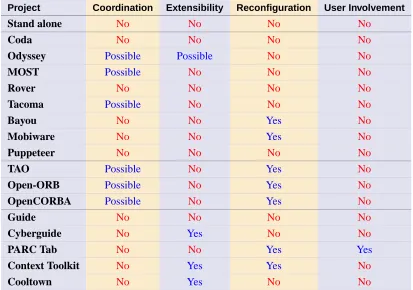
2.1 Current adaptive and context-aware systems . . . 42
5.1 Finite State Automata representing Event Calculus Predicates . . . 118
5.2 Evaluation walk through for a sample policy rule . . . 120
6.1 Video Player: Adaptation Interface . . . 131
6.2 Web Browser: Adaptation Interface . . . 133
6.3 E-mail: Adaptation Interface . . . 135
6.4 Network Interface: Adaptation Interface . . . 136
6.5 Power Monitor: Adaptation Interface . . . 137
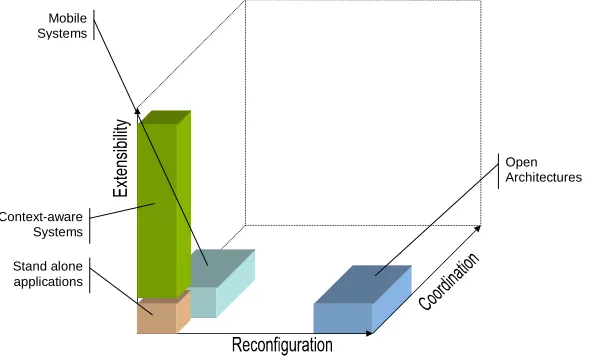
1.1 Relationship of context-aware adaptive systems . . . 5
2.1 Block diagram of a feedback control system . . . 18
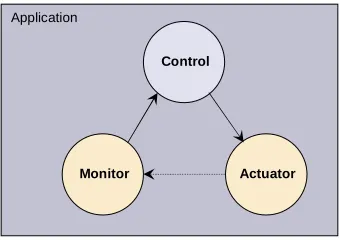
2.2 Basic adaptation cycle . . . 19
2.3 The Coda state transition diagram . . . 24
2.4 The Odyssey system . . . 26
2.5 The Puppeteer system . . . 32
2.6 Supporting multiple triggers, coordination and reconfiguration. . . 43
4.1 Basic adaptation cycle . . . 59
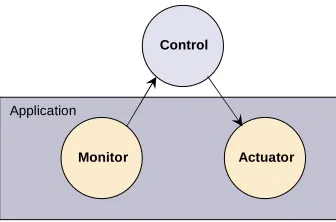
4.2 Decouple adaptation control and adaptation action . . . 60
4.3 Externalise application state . . . 61
4.4 Externalise application adaptive mechanisms . . . 61
4.5 Architecture for supporting adaptive context-aware applications . . . . 64
4.6 A request passing from client to object implementation. . . 67
4.7 Sample XML description of an adaptive web browser . . . 72
4.8 Application Managers for multiple communication protocols. . . 74
4.9 A sample policy rule . . . 94
5.1 Platform configurations . . . 102
5.2 Platform component overview . . . 106
5.3 Application registration . . . 107
5.4 Forwarding notification events trough the Event Manager . . . 112
5.5 Application stub . . . 121
5.6 Value Tree for variable notifications . . . 122
5.7 Application stub API . . . 123
5.8 Sample code: using the application stub . . . 124
5.9 Operation of the coordinated adaptation platform . . . 126
6.1 System setup for the evaluation of the adaptation platform . . . 130
6.5 Overhead in relation to the number of applications . . . 155
6.6 Overhead in relation to the number of rules . . . 156
6.7 Overhead in relation to the complexity of the rules’ . . . 158
Introduction
Contents
1.1
Adaptive and Context-Aware Applications
During the last decade we have witnessed a significant shift of the computing industry’s
focus towards the mobile user. A range of handheld computers with varying
capabili-ties are now widely available and technologies providing wireless communication are
offered in many forms (e.g. GSM [Adams95, Mouly92], IEEE 802.11 [IEEE97],
Blue-tooth [BlueBlue-tooth99a, BlueBlue-tooth99b]) as required by different application domains. This
increasing interest in mobile computing has highlighted the fact that the characteristics
of mobile environments have significant differences compared to those of traditional
desk-top computing. In particular, mobile environments are tightly coupled with the
notion of change [Davies98c]. Indeed, mobility is by definition related to changes in
users’ environments as they move. Moreover, the characteristics of mobile devices
im-ply changes related to the availability and quality of resources, such as power supim-ply and
connectivity. These facts have been one of the main drives for research in the area of
mobile computing. From this broad area two dominant research themes have emerged of
interest to this thesis: the support for mobile adaptive applications and the development
of context-aware systems/ applications.
Adaptation became an important research issue during the first half of the ’90s when
efficient support for streaming multimedia applications was one of the leading research
targets [Campbell94, Diot95]. Most of the knowledge acquired during this time was
transferred into the mobile world where the requirement for adaptation was further
in-tensified by the variation in resource availability such as network connectivity and power
supply. Indeed, in mobile environments adaptation has been applied not just for
multi-media applications, but rather for every system component.
The “birth” of context-aware applications was stimulated by Mark Weiser when his
vision of ubiquitous computing required context-aware functionality to be offered by
future mobile systems [Weiser93]. Following the increasing interest of the computing
industry in mobile computing, a range of new technologies (handheld computers,
envi-ronment sensing technologies, etc.) offered new possibilities for applications that can
monitor the user’s environment and modify their behaviour accordingly.
At a high level, these two trends may appear like two independent parallel paths
dealing with different aspects of mobility. The former, driven by the inherent restrictions
the development of adaptive applications as a solution for offering the best utilisation of
resources. The latter, motivated by the availability of new environment monitoring
tech-nologies (location tracking, service discovery, etc.) is focusing on enriching the mobile
user’s experience through the development of applications capable of modifying their
behaviour according to the mobile user’s context without direct interaction. However,
in this thesis we identify that the underlying principles for both categories of systems is
the same: applications that modify their behaviour due to external changes1
Even though present researchers have tended to focus on one of these domains, it is
reasonable to conceive that future mobile systems will combine both of these
charac-teristics (adaptation triggered by changing network QoS, power availability, user
con-text, service availability, etc.). Therefore, each individual mobile application will allow
adaptation triggered by a variety of different system or contextual attributes. The
con-sideration of a system that supports such adaptive applications is the main target of this
thesis.
1.2
Motivation
The importance of adaptation in distributed systems, and in particular mobile distributed
systems, has been identified by a number of researchers [Davies94b, Noble95, Katz94].
In [Badrinath00] a conceptual framework for network and client adaptation that fits
most currently available mobile adaptive systems is described. In this framework,
adap-tation is illustrated as a mechanism where application-specific adapters are triggered to
perform modifications on a network stream when certain changes are monitored in the
system’s environment or the availability of resources. This high level description of
net-work adaptation, where the behaviour of the system is modified according to changes in
the system’s environment bears many similarities with the behaviour of context-aware
systems.
Context-aware computing was first defined by Schilit and Theimer [Schilit94b] in
1994 to be software that “adapts according to its location of use, the collection of nearby
people and objects, as well as changes to those objects over time”. This early definition
was based on a quite limited notion of context (location and proximity). Dey offers a
broader definition of context :
Definition 1: Context is any information that can be used to characterise the situation
of an entity. An entity is a person, place, or object that is considered relevant to the
interaction between the user and the application, including the user and the applications
themselves.[Dey01]
This definition of context can practically include any kind of information that can
characterise the situation of a participant in an interaction, be that the availability of
resources or the quality of a network channel. In this sense, any application defined as
adaptive in traditional terms, is actually a context-aware application.
It may be quite clear that adaptive applications are actually a sub-set of context
aware applications, however not all context aware applications can fit in the conceptual
framework describing adaptive systems. Indeed, context-aware applications can support
features such as [Dey01]:
• presentation of information and services to a user.
• automatic execution of a service for a user.
• tagging of context to information for later retrieval.
This list includes possible ways that context can be used for the development of
context-aware applications. The second feature identifies the way that applications can
respond to changes by modifying their behaviour. This is a functionality that has clear
similarities to the operation of an adaptive system: changes make an application modify
its behaviour.
In order to explicitly specify the target domain of this thesis and also, avoid conflicts
with terminology, it is necessary to define adaptive context-aware applications:
Definition 2: Adaptive context-aware applications are applications that modify their
behaviour (adapt) according to changes in the application’s context. The term
con-text is used in accordance with definition 1 being any information that can be used to
characterise the situation of an entity.
According to the above definition, the set of adaptive context-aware applications is a
subset of context-aware applications and a superset of traditional adaptive applications
Context-aware systems
Adaptive context-aware systems
Adaptive systems
Figure 1.1: Sub-set relationship of context-aware, adaptive context-aware and tradi-tional adaptive systems
information that characterises the application’s situation. This can include the
availabil-ity of resources, the preferences of the user, or the existence of other applications in the
system that may interfere with the application.
An adaptive context-aware application should be expected to be able to adapt to
a variety of contextual triggers. However, adaptive applications typically consider a
particular resource that is the prime cause of adaptation (usually the quality of the
net-work connection), while context-aware applications consider the application’s external
context. Further more context-aware applications tend to have no consideration of
co-existing applications that they may share resources with.
The approach followed by existing researchers to isolate the domains of adaptation
and context-awareness raises questions about the possible implications for a system that
should be able to support both adaptive and context-aware applications. In particular,
it is not clear how a system should behave when applications are capable of adapting
to both contextual and resource related triggers. The interaction of multiple
context-aware adaptive applications adapting to a number of different but possibly inter-related
environmental triggers may cause instabilities and undesirable behaviour. Furthermore,
coordination between these applications will need to consider both the abilities of the
applications to adapt, as well as the multiple triggers that may require adaptation. The
problem of coordination and interdependent adaptation is further intensified by the fact
that applications are developed with no prior knowledge of other applications that may
coexist at runtime and the effects their predefined behaviour may have on the system or
the user expectations (this issue is discussed in detail in section 3). Considering these
observations it is possible to identify a number of potential shortcomings or problems
that may occur when adaptive context-aware applications are co-located within the same
• Inefficient use of available resources: Consider a scenario where an applica-tion that is power-aware may run on the same system with an applicaapplica-tion that is
network-aware (able to adapt in response to changes on the available bandwidth).
In a situation where the first application reduces the use of the network in
re-sponse to limited power supply, expecting power consumption to be reduced, the
second application may monitor the consequent increase in available bandwidth
and increase their network usage. As a result of these independent adaptations,
the power saving action taken by the first application would be negated by the
actions of the second.
• Conflicts: The previous scenario is actually a case of conflicting adaptive re-actions of two applications. Given that both applications are developed
inde-pendently without awareness of co-existing applications with different adaptation
objectives, it is unreasonable to expect that the applications themselves will be
able to resolve such a conflict without help from a coordinator provided by the
system or the user.
• Disregard of user preferences: Most current adaptive or context-aware applica-tions either ignore the user involvement in the specification of the application’s
behaviour, or restrict that involvement to the specific subset of context triggers
they are aware of. However, user requirements can have implications on the way
applications collaborate. In more detail, allowing the users to specify the
be-haviour of individual applications may not always provide satisfactory over-all
system behaviour. Indeed, user requirements may necessitate coordinated
adapta-tion of multiple applicaadapta-tions. A possible scenario might include a video-streaming
player that will degrade the stream bandwidth when the user is in their car, in order
to allow timely delivery of traffic information for a co-running traffic monitoring
application. Such a configuration scheme would require a system-wide approach
to coordinated adaptation allowing combination of several triggering attributes
(location and network bandwidth in this scenario) and control over multiple
ap-plications.
• No extensibility: In the two scenarios presented above one solution is to allow
the system to make certain applications aware of more contextual triggers than
the ones they were designed for. These contextual triggers may relate to external
for example, could be resolved either by requiring the second application to
in-corporate power awareness in its behaviour or to be aware of the activities of
other applications in the system. The support for extensibility however, can not
be left to the application designers, most importantly because the specific
exten-sions that may be required depend on the configuration of the system and the user
preferences.
In order to understand the reasons that can lead to such undesirable behaviour taking
place, it is necessary to investigate the fundamental characteristics of adaptation. In
particular, adaptation can be defined as a combination of three conceptual entities:
• A monitoring entity to monitor a number of contextual attributes that may trigger the application to adapt. The monitoring entity can either be part of an application
or the system itself. The information monitored may be of interest to more than
one application.
• An adaptation policy that is responsible for deciding if and when the application
should adapt based on the information gathered by the monitoring entity. An
ap-plication is designed with a set of policies that implement the apap-plication’s default
behaviour. These default policies cannot perform special purpose coordinated
de-cisions, mainly because the application developer is not aware of the possible
configuration of the target system.
• The adaptive mechanism that performs the necessary changes when triggered by the adaptation policy. The adaptive mechanism is tightly coupled with the
seman-tics of the application.
Based on these definitions, this thesis claims that the main reasons for the
shortcom-ings of existing systems supporting adaptive context-aware applications relate to their
design approach. Specifically:
• Adaptive systems tend to couple adaptation policies and adaptation mechanisms. In most cases these are both implemented as a single component that is bound to
the semantics of the actual application.
in the system. Specifically, adaptation policies can not obtain information about
other monitoring entities related to either the state of other applications or new
contextual attributes.
• Adaptation policies are usually hard-coded either within the adaptive applications or the system platform supporting coordination. This fact does not allow
recon-figuration of the system and moreover does not allow user involvement in order
to specify their requirements in relation to the behaviour of the system.
Following these observations this thesis claims that sufficient support for
coordi-nation, conflict resolution, extensibility and user involvement can be achieved through
the design of an adaptation support platform that satisfies the following design
require-ments:
1. Decoupling adaptation policies and adaptation mechanisms. Since adaptation
mechanisms are generally related to the semantics of applications it is necessary
for them to be part of an application’s implementation. However, adaptation
poli-cies that define when and how an application should adapt should be decoupled
from the application’s implementation.
2. Externalisation of application state. Monitoring entities that may be part of
ap-plications or system components monitoring the system’s environment (e.g. a
lo-cation monitoring module) should externalise that information. This would allow
the adaptation support platform to retrieve information across multiple
applica-tions and/or multiple system components.
3. Externalisation of applications’ adaptation mechanisms. With the decoupling of
adaptation policies and adaptation mechanisms, an adaptation support platform
can handle adaptation policies in a system-wide manner. This functionality
re-quires applications to allow the adaptation support platform to trigger adaptation
as defined by the adaptation policies. Thus the applications should expose an
interface that allows the invocation of adaptation methods by the platform.
4. Enable the modification of the adaptation policies. As stated earlier, one of the
reasons for insufficient support for multiple adaptive context-aware applications is
the fact that applications do not have any prior knowledge of the configuration of
Therefore, the adaptation support platform should allow the reconfiguration of
the system’s behaviour in order to achieve coordination and conflict resolution.
Moreover, the user should be able to express their requirements by modifying the
adaptation policies that govern existing applications.
In order to prove this claim this thesis presents the design of an adaptation support
platform that satisfies the aforementioned requirements. This platform uses a policy
based mechanism for specifying adaptation policies. This approach allows the
modifi-cation of the system’s behaviour without the need for a re-implementation of either the
applications or the platform. In the process of identifying a policy language that satisfies
the requirements for adaptive context-aware applications a new language was defined
that was derived from the Event Calculus logic programming formalism [Kowalsky86].
The Event Calculus Policy Language allows the definition of adaptation policies that
can incorporate state information from multiple applications and system components,
invoke adaptation over multiple applications and allow the user to modify existing
adap-tation policies or add new ones.
This thesis also presents a prototype implementation of this design and a thorough
evaluation of the features of this prototype. Specifically, the ability of the adaptation
platform to invoke adaptation actions in multiple applications is shown to allow the
co-ordinated adaptation of multiple applications. The incorporation of multiple triggering
information is shown to allow the extensibility of existing adaptive applications by
al-lowing the definition of policy rules that incorporate additional adaptation triggers from
the default triggers defined by the applications. Finally, the support for modification of
the adaptation policies allows the resolution of conflicts and the active involvement of
the user in the specification of the system’s behaviour.
1.3
Road Map for the Thesis
This thesis is established in the following steps:
• Chapter 2 presents an investigation of existing adaptive and context-aware
sys-tems. The chapter provides a brief historical overview on the advances in
adap-tation and context-aware computing. Following the historical overview, a critical
This critical analysis is driven by a set of criteria questioning the support of
ex-isting systems in terms of coordination, extensibility, reconfiguration and user
involvement. The chapter concludes with a summary of this critical analysis.
• Chapter 3 presents an analysis of the potential problems that may occur when multiple adaptive context-aware applications are combined in an ad-hoc manner.
In particular, a set of theoretical scenarios are presented and discussed. This
anal-ysis allows the identification of some general conclusions about the behaviour of
existing systems and the reasons that specific problems can occur when
support-ing multiple adaptive context-aware applications. The chapter concludes with a
set of design requirements that should be satisfied by a platform that supports
coordinated adaptation for multiple adaptive applications.
• Chapter 4 presents the design of a platform supporting coordinated adaptation
for multiple adaptive applications. The chapter includes a discussion about how
the requirements defined in the previous chapter can be mapped onto a platform
that supports coordination, extensibility, reconfiguration and user involvement.
More specifically, the design of this platform requires applications to externalise
their adaptation interface specifying their adaptive mechanisms and a set of state
variables reporting their state. The platform uses those interfaces in order to
re-trieve state information from the applications and trigger adaptation as and when
needed. The adaptation control mechanism is realised through a policy based
mechanism. Specifically, the Event Calculus Policy Language is defined as a
pos-sible language for defining adaptation policies.
• Chapter 5 presents the implementation of a prototype implementation of the
archi-tecture for supporting coordinated adaptation. The chapter identifies the possible
configurations for the implementation of this architecture with respect to the level
of distribution of the platform’s components. The presentation of the prototype
supporting adaptation on a single host includes a detailed description of the
pro-totypes components and an analysis of the evaluation engine implemented for the
processing of Event Calculus Policy rules.
• Chapter 6 presents an evaluation of the prototype platform. This evaluation
in-cludes a qualitative evaluation of the platform’s characteristics and a quantitative
evaluation of the platform’s performance. In more detail, the qualitative
coordi-nation, conflict resolution, extensibility and user involvement. The performance
evaluation examines the behaviour of the platform against a set of scalability
fac-tors, including the number of applications in the system, the number of policy
rules, the complexity of the policy rules, etc.
• Chapter 7 summarises the work presented in this thesis. Special attention is drawn
to the main contributions of this work and further research issues that arise from
Adaptive and
Context-aware Systems
Contents
2.1 Overview . . . 13 2.2 The Emergence of Adaptive Systems . . . 13 2.2.1 Adaptive Network Protocols . . . 13
2.2.2 Distributed Multimedia . . . 14
2.2.3 Mobile Systems . . . 15
2.2.4 Context-aware systems . . . 16
2.2.5 Application Aware Adaptation . . . 17
2.3 Overview of Existing Adaptive Systems . . . 18 2.3.1 Abstracting Adaptation . . . 18
2.3.2 Assessment Criteria . . . 20
2.3.3 Independent Adaptive Applications . . . 23
2.3.4 Middleware-based Systems . . . 24
2.3.5 Context-aware Systems . . . 37
2.1
Overview
The objective of this chapter is to provide an overview of the state of the art in the field
of adaptive systems and to examine current adaptive and context-aware systems against
a set of criteria that will be used as the basis for the analysis presented in chapter 3. The
first sections of this chapter provide a historical survey of developments in adaptation
and context-aware computing. Next a set of criteria are established for a critical analysis
of existing adaptive and context-aware systems. The criteria defined are: the level of
support of existing systems in terms of coordination, extensibility, reconfiguration and
user involvement. A detailed presentation of a range of adaptive and context-aware
systems is presented in the following sections. Finally this chapter concludes with a set
of general observations derived from the critical analysis of existing systems.
2.2
The Emergence of Adaptive Systems
Throughout the history of computer science, the term adaptation has been used in a
variety of different contexts. While no uniform definition for adaptation has been
iden-tified, adaptation in the field of mobile systems is most commonly linked to resource
availability [Noble98] or network quality of service [Davies94a, Katz94]. As described
in chapter 1 the target domain of this thesis includes application adaptation triggered
by any type of context. Therefore this overview section will describe advances in both
adaptive and context-aware systems.
2.2.1
Adaptive Network Protocols
Since the Internet was first established the varying characteristics of the underlying
infrastructure and the “best effort” approach adopted by the Internet imposed a
require-ment for adaptive flow control. The transmission control protocol (TCP) used by the
Internet for reliable communication provides a minimum level of adaptive congestion
control [Jacobson88]. Specifically, in order to handle network congestion TCP uses a
congestion window that determines the amount of data allowed for transmission in order
to avoid congestion. TCP increases or decreases the congestion window in response to
perceived network congestion (i.e. lost segments) in order to achieve better utilisation
Since congestion control was introduced in TCP in 1980 several other enhancements
have been proposed to provide more adaptive network behaviour including adaptive
queue management in routers and adaptive retransmission time-outs.
With the widespread deployment of wireless communication new requirements were
established for offering sufficient support for error prone communication. Early
re-search identified TCP’s adaptation strategy as inappropriate for wireless communication
[Caceres94]. Wireless networks are characterised by losses due to transmission errors
and handoffs. Caceres found that TCP interprets these losses as congestion and invokes
congestion control mechanisms and retransmission of the lost segments, degrading the
performance of the communication. To address such problems a number of
communi-cation protocols have been developed in order to support the explicit requirements of
wireless communication [Bakre95, Amir95].
2.2.2
Distributed Multimedia
With the emergence of the Web at the beginning of the ’90s, the focus of the research
community was targeted on the efficient dissemination of multimedia content. The
prime aim of this effort was the efficient support for real-time video and audio
com-munication over the Internet.
One of the characteristics of multimedia is its high dependency on the timely
trans-mission of their data. Video and audio packets that do not reach the destination on time
for playback are considered useless packets. Thus protocols such as TCP are unsuitable
for multimedia traffic as they involve retransmission of lost packets, adding unnecessary
delays.
The Real Time Protocol (RTP) [Schulzrinne96] was introduced as a transport
proto-col suitable for realtime multimedia traffic. RTP uses UDP as the underlying transport
protocol and time-stamping for controlling the sequence and flow of packets. Each RTP
packet is time-stamped at the source with the time the packet should be played out at the
destination. The flow of multimedia traffic is controlled through the Real Time Control
Protocol (RTCP).
The introduction of the RTP/RTCP protocol allowed the development of simple
adaptive mechanisms in multimedia applications. Delay adaptation, for example, uses
well known vat audio-tool [Jacobson94] maintains an estimate of the average and
stan-dard deviation of the transmission delay. Based on these parameters vat can compute
a correctly sized play out buffer eliminating any distortions caused by various packet
delays.
Another research trend that had great impact in the development of adaptive
mul-timedia applications was the introduction of a wide variety of mulmul-timedia encoding
schemes. Such schemes include MPEG-1, MPEG-2, MPEG-4, Apple’s Quicktime,
H261, H320, etc. Each of these schemes has different characteristics in terms of
re-quired bandwidth, tolerance to packet loss, rere-quired CPU power, etc.
These transmission requirements expressed by the encoding protocols introduced
the need for a mechanism that can allow applications to express these requirements
to the underlying network infrastructure and request guaranties that they can be
satis-fied. The notion of Quality of Service (QoS) refers to the capability of a network to
provide guaranties on the quality of service offered to a network application. Typical
QoS support includes an API that applications can use in order to express their resource
requirements (e.g. maximum delay, throughput, packet loss, jitter, etc.) and possibly
reserve these resources. When these requirements can not be satisfied by the underlying
network the application is notified in order to renegotiate their requirements.
The combination of QoS support and different multimedia encoding protocols
al-lowed the development of much more sophisticated adaptive multimedia applications.
Typical examples include video tools that can switch between different encoding
mech-anisms [Davies98a], dynamic fine tuning of encoding parameters of a single encoding
protocol [Yeadon96, Walpole97] (allows adaptation when video encoding schemes
can-not be changed through the dynamic introduction of filters). In multicast environments
like MBONE, tools like vic [McCanne95b] and vat use adaptive techniques to allow
media streaming over the multicast backbone of the Internet.
2.2.3
Mobile Systems
Early developments in mobile computing were mostly concerned with file system access
and the problems caused by disconnected operation. CODA [Kistler91] is a typical
example of a system dealing with disconnected file access. Similar problems but in a
access [Demers94].
The popularity of the Web in the Internet gave a push to an increasing effort to allow
wireless access to web content. In these efforts the actual aim shifted away from the
disconnected operation and moved to issues concerning reliable transmission of data
over low bandwidth links. The typical network infrastructure used by most systems was
based on a client-proxy-server scheme. A web client was allowed to access the content
of a web server through a proxy that was responsible for all necessary
transformation-s/adaptations before the data was transmitted over the wireless link. The techniques
used by these systems included re-encoding of images, text compression, data
perfect-ing, etc. The result of this effort was the specification of the WAP [WAP99] standard
for web access over GSM networks.
The second half of the ’90s shaw a shift of the research community, abandoning
special purpose mobile applications using ad-hoc development techniques and moving
towards the development of general purpose middleware for mobile environments. Here
the lessons learned by the support for adaptive distributed multimedia were transferred
to the mobile environment.
The research in the area of middleware for mobile systems was (and still is) spread
over a wide range of different methodologies and research directions. A number of
sys-tems utilised the tuple space paradigm to allow communication decoupling across space
and time [Davies98c, Johanson02]. Other systems incorporated open/reflective
archi-tecture designs in order to allow flexible adaptation [Blair00]. Middleware supporting
mobile agents and code mobility was introduced in order to allow applications to split
their processing and network requirements between mobile and/or fixed nodes in the
network.
An additional research topic that gradually became important at the end of the ’90s
and beginning of ’00s, is the support for low power consumption applications and
power-aware adaptation [Flinn99, Havinga99].
2.2.4
Context-aware systems
The first generation of context-aware systems was mostly influenced by the visions
of Mark Weiser [Weiser93] and the work on the PARC Tab project at Xerox PARC
most cases, the only type of context considered was the physical location of the user and
the proximity of other users and services.[Long96, Brown95]
Following the PARC Tab experiment, new research projects extended the notion of
context beyond the physical location, including information such as the user
prefer-ences, the existence of other users in the surrounding environment, the quality of the
wireless network connectivity, etc. [Davies99]. However, even these systems followed
an ad-hoc approach to the development of context-aware applications.
The end of the ’90s and beginning of this millennium was a time where a lot of
research was focused on context representation and the development of middleware
platforms that could be used for the creation of context aware applications [Salber99,
Dey00]. However, even today the question “what is context” is still open for debate.
To-day, there are no standards concerning context representation and most research groups
follow their own proprietary designs.
2.2.5
Application Aware Adaptation
One of the aims of early research in mobile computing was the development of systems
that can provide transparent mobility support. The target of this approach was to push
all the functionality related to mobility into the system and allow applications to operate
as if they were operating in a fixed environment. The specific requirement for adaptation
was considered a feature that should be provided transparently without any involvement
of the application. Systems such as Coda [Kistler91], for example, offers application
transparent adaptation for file system access.
Research in the second half of the ’90s indicated that transparent adaptation has
certain limitations. In particular, it is not possible for general purpose adaptation
plat-form to provide sufficient adaptation support for the requirements of all applications.
Noble in [Noble95] suggests the use of application-aware adaptation. In particular,
middleware platforms supporting adaptation should notify applications about possible
changes in the environment and allow them to adapt. This approach allows applications
to implement adaptive mechanisms that are more fitting to their requirements. Indeed,
application developers have better knowledge about the semantics of the applications.
Therefore adaptive applications can implement their own mechanisms for adaptation
Actuator
Monitor Controler
Comperator Reference
Value System
Disturbance
Figure 2.1: Block diagram of a feedback control system
of middleware platforms follow this trend [Friday96, Blair00]. A particularly
interest-ing example is the work on Odyssey [Noble95] where the Code file system offerinterest-ing
transparent adaptation is modified in order to allow application-aware adaptation.
The work presented in this thesis follows an application-aware approach in
support-ing adaptation.
2.3
Overview of Existing Adaptive Systems
As highlighted in the previous section, the physical limitations of mobile environments
along with the increasing need for multimedia and context-aware services drove the
research community towards the adoption of adaptive approaches in the development of
such systems. The following sections offer a deeper investigation of current research in
these areas, revealing their possible limitations in supporting multiple adaptive
context-aware applications.
2.3.1
Abstracting Adaptation
In order to identify in more detail what are the actual limitation of current approaches,
it is first necessary to examine the fundamental mechanisms supporting adaptation.
The theoretical model that has been proposed for describing adaptive systems is
based on feedback control theory [Cen97, Meng00, Kokar99]. The feedback control
theory was initially used in engineering for developing hardware control systems.
Fig-ure 2.1 shows a typical feedback control system. The controller helps the system
main-tain a reference value of a control variable, while reducing the system’s sensitivity to
disturbance. The controller interacts with the system through monitors and actuators.
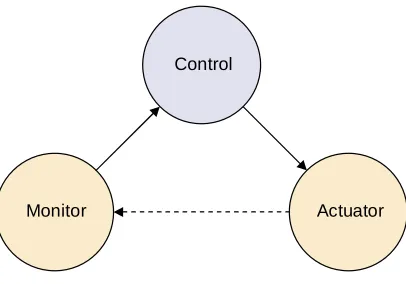
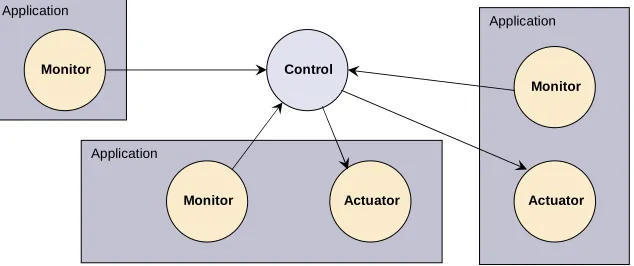
Monitor Actuator Control
Figure 2.2: Basic adaptation cycle
controller’s output causes the actuator to adapt the system’s behaviour in response to
disturbance, or changes in the system’s environment.
In the analysis presented here we propose a simplified closed loop system as the
basic abstraction of an adaptive system, borrowing from the design of the feedback
control systems. This abstraction includes three distinct functional elements (Figure
2.2):
• Monitor: The first element performs the monitoring of a specific source of
infor-mation that is ‘interesting’ for the adaptive mechanism. This inforinfor-mation source
could be, for example, the availability of a specific resource such as power or a
contextual trigger such as the system’s physical location.
• Controller: The second element is the controlling mechanism that takes decisions
concerning the adaptive reaction of the system. This decision is based on the
information received by the monitor. This controller could, for example, state
that when the power supply drops below a specific threshold then a reaction is
necessary.
• Actuator: The third element is the actual adaptation mechanism that performs the
specific adaptive action as directed by the controller. For example, an actuator
might reduce the network bandwidth consumed by an application. Note that this
reaction may in turn have an impact on the initial source of information, i.e. to
change the rate that the available power drops. This last link between the actuator
and the initial resource being monitored does not necessarily exist in all systems.
Most context-aware systems for example do not affect the initial resource that
This theoretical model allows the description of abstract concepts such as
“extensi-bility”, “reconfigura“extensi-bility”, etc. as explicit design characteristics that adaptive systems
should satisfy. In the next section these abstract concepts are used as the bases for
estab-lishing a set of criteria for the analysis of existing adaptive and context-aware systems.
These criteria are defined in relation to the abstract model of adaptation discussed.
2.3.2
Assessment Criteria
Before analysing the design characteristics of current adaptive and context-aware
sys-tems, it is necessary to establish a set of criteria that will guide this investigation. These
criteria will allow us to establish some general principles about how these systems
op-erate focusing on the issues that are of importance for this work. These principles will
be the basis for the analysis presented in chapter 3.
In this thesis we are concerned with supporting mobile systems that consist of a
col-lection of independently developed adaptive context-aware applications. As described
in Definition 2, adaptive context-aware applications are applications capable of adapting
to a variety of contextual triggers such as the availability of resources, the preferences
of the user, or the existence of other applications in the system that may interfere with
the application. Considering the focus of this thesis we can clearly identify a number of
key characteristics that are of importance for this work:
• Each adaptive application may require information about a wide variety of con-textual attributes that may be used as triggers for adaptation.
• The target environment is a system where multiple adaptive applications will co-exist and possibly interfere with each other.
• The application developer may not be aware of any possible interference or
unde-sirable side-effects between applications when designing their own application.
Based on these observations we define a set of criteria that will be used in the
2.3.2.1 Coordination
In an environment with multiple coexisting adaptive context-aware applications it is
important to support coordinated adaptation (Chapter 3). Adaptive responses by
indi-vidual applications may have contradicting effects or cause instabilities [Efstratiou00].
Coordinated adaptation can overcome conflicting situations and increase overall system
stability.
Mapping this statement to the theoretical framework of the basic adaptation cycle
(Section 2.3.1) by the term coordination we specify the ability of a controller to trigger
actuators that relate to more than one application. In more detail, a coordinated adaptive
reaction involves multiple applications triggered to perform particular actions, in
con-trast to isolated adaptation where a controller triggers only one application. In practice,
this functionality requires adaptation controllers to be able to retrieve information from
multiple applications (i.e. have access to multiple monitoring entities) and be able to
trigger adaptation on multiple applications (i.e. be able to trigger multiple actuators).
2.3.2.2 Extensibility
As previously described (Chapter 1), the target of this thesis is to provide support for
adaptive applications able to adapt to an extensible set of contextual triggers. Current
research efforts have already identified certain contextual attributes that can become
triggers for adaptation. These include, among others, network QoS [Davies98c], power
supply [Flinn99] and physical location [Cheverst00]. However, the possible types of
contextual attributes that may trigger adaptive reactions by applications can not be
de-fined as a static set of triggers, since future mobile systems should be able to incorporate
new adaptation triggers as and when they become regarded as important.
Mapping this statement to the theoretical framework of the basic adaptation cycle,
by the term extensibility we specify the ability of a controller to receive input by more
than one monitor. Moreover, we consider how possible it is for an existing controller
with a given set of monitors to be modified in order to receive input by more, possibly
newly created monitors. Most value is given to the ability of system to allow existing
2.3.2.3 Reconfigurability
Independently developed adaptive applications are constructed under a set of
assump-tions that the developer had to make about the target operating environment. However,
in environments where multiple adaptive applications coexist in the same system, it is
expected that interdependencies between adaptive reactions of individual applications
will lead to undesirable behaviour or even conflicts (Chapter 3 for a detailed
discus-sion).
In situations such as these, the ability of the mobile system to allow
reconfigura-tion of their adaptive behaviour is vital: under certain condireconfigura-tions applicareconfigura-tions may be
required to modify the default adaptive strategies defined by the developer. Therefore
the system should provide the means for modifying the system’s adaptive behaviour.
Mapping this criterion into the theoretical framework, by the term reconfigurability
we specify the ability of a controller to allow modification of their behaviour. These
modifications may be considered as related to the previously mentioned criteria. In
par-ticular, the incorporation of additional monitors and actuators into an existing adaptation
cycle may require modifications to the behaviour of the controller.
2.3.2.4 User Involvement
The importance of user involvement in the operation of adaptive systems has often been
neglected in current adaptive systems [Efstratiou01]. In a system where adaptive
be-haviour may require to be modified, as described in the previous criterion, user
involve-ment can allow the user to specify the desirable modification.
According to our theoretical framework, we require the controller to allow the user to
inspect its behaviour and potentially modify it according to their requirements. In terms
of existing systems we investigate the ability of the system to provide user awareness
about its adaptive behaviour and allow the user to modify that behaviour.
The following sections present a survey of existing system supporting adaptation
and context-awareness. In particular, this survey includes projects that support
adapta-tion following a wide range of design approaches such as, applicaadapta-tion aware adaptaadapta-tion
middleware, mobile agent based middleware, reflective middleware, etc. The
applications to contextual changes, e.g. location triggered, proximity triggered
adapta-tion.
2.3.3
Independent Adaptive Applications
Independent adaptive applications (also known as Laissez-Fair Adaptation [Noble98])
are applications that adapt independently without the need for any system support.
Ap-plications in this category include commercial systems such as the Microsoft Windows
Media Player [Microsoft03] or the RealPlayer [Real03] and research tools, such as Vic
[McCanne95a] and Vat [Jacobson94]. In such systems, applications monitor the
avail-ability of resources and make their own adaptation decisions in isolation of other
appli-cations or the system.
The laissez-faire approach provides a substantial benefit. No system support is
re-quired, a feature that is essential for commercial systems where the operating system is
a fixed commodity.
However, the laissez-fair approach does not support application concurrency:
appli-cations, operate in isolation from the rest of the system, unaware of other applications
possibly sharing the same resources. Moreover, the monitoring information received by
an individual application may not always reflect the metrics that can be achieved by a
system monitor that is aware of all involved parties.
Criteria based analysis:
• Coordination: Not possible. Applications act in isolation.
• Extensibility: Not possible. Applications have a fixed set of adaptive triggers
that they can react to.
• Reconfiguration: Depends on the application, but most available systems do not provide any mechanisms for reconfiguration.
• User involvement: Depends on the application, but most available systems do
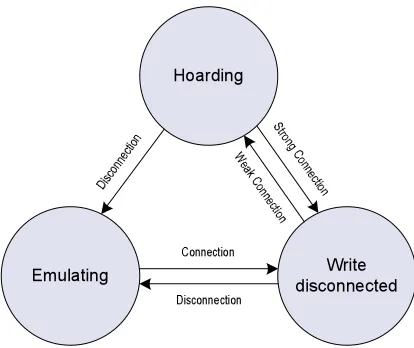
Write disconnected Hoarding
[image:39.595.212.419.68.242.2]Emulating
Figure 2.3: The Coda state transition diagram
2.3.4
Middleware-based Systems
2.3.4.1 Coda
The Coda filesystem [Satyanarayanan90] was developed in Carnegie Mellon University
as an extension to the work done on the Andrew File System [Satyanarayanan85]. Coda
is a highly available replicated file system offering disconnected operation for mobile
clients. In Coda file servers maintain a state transition mechanism consisting of three
states [Kistler91, Mummert95]: hoarding, emulating and write disconnected (see figure
2.3).
In the hoarding state, a mobile client pre-fetches in the local cache the user’s set of
working files. The pre-fetching can be initiated periodically or at the user’s request. The
set of files to be cached is determined by the hoarding database that is constructed using
file access traces and can be modified by the user.
When the client looses connection with the file server, Coda moves into the
emula-tion state. In this state the file system allows modificaemula-tion of the cached files as if they
were still connected to the file server.
All file access operations performed in the emulation state are logged in order to
be replayed when the client re-connects to the file server. Replaying the logged actions
allows Coda to update the database with any changes took place when disconnected.
This update process is performed in the write disconnected state. After the logged
ac-tions have been replayed, the files in the file server are up-to-date with the files in the
par-ticular, when the client is connected through a low speed connection, file updates may
take relatively long time. When the estimated time for a file update exceeds a certain
threshold (called the patience threshold) user intervention is required to specify whether
updates should be postponed until a high speed connection is established. During the
update state, inconsistencies may be discovered. These inconsistencies can be resolved
by either application specific resolvers or by direct user intervention. At the end of the
write disconnected state, if the client is connected to the server through a high speed
link, the file system moves back to the hoarding state.
Criteria based analysis:
• Coordination: No mechanisms to support coordination are offered.
• Extensibility: Not applicable. Coda is a special purpose system targeting
discon-nected file access.
• Reconfiguration: Coda offers mechanisms to specify how conflicts should be
resolved. However, the general behaviour of the system is static and can not be
reconfigured.
• User involvement: User involvement is required as part of the resolution of con-flicts in data updates.
2.3.4.2 Odyssey
The Odyssey system [Noble98] was created as a generalisation of the Coda system in
order to support media-specific adaptive communication for mobile clients. As with
Coda, Odyssey works on the assumption that a mobile network consists of light weight
mobile clients connected over wireless links to fixed servers with high processing
capa-bilities and no power limitations.
The general model of operation is based on monitoring the levels of resources such
as network QoS, CPU and battery power and notifying adaptive applications when the
levels of these resources do not satisfy the applications’ requirements. When such
noti-fications reach an application, it is the application’s responsibility to perform the
neces-sary adaptations and renegotiate new resource levels with the platform.
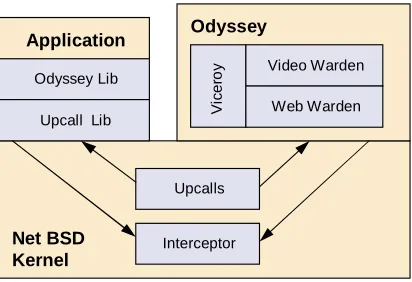
The monitoring and negotiation of resources is performed by the viceroy. The
Net BSD Kernel
Odyssey Application
Odyssey Lib
Upcall Lib
Video Warden
Web Warden
V
ic
e
ro
y
Upcalls
[image:41.595.214.420.70.211.2]Interceptor
Figure 2.4: The Odyssey system
of resource windows (an application will be satisfied as long as the resource levels are
within the bounds of the resource windows). The viceroy is responsible for monitoring
the system’s available resources and sending notifications to the applications when the
resource levels exceed the bounds of the resource windows.
The notifications sent to an application will in most cases require an adaptive
re-action from the application and a specification of a new resource window. Odyssey
offers a set of media specific agents that can perform modifications on the fidelity of
media transmitted over the network, in response to changing resource levels. Each of
these agents, called a warden, is specialised for a certain media type (video, audio, etc.)
and can offer media specific adaptation. For example a video warden can modify the
frame rate, encoding, dimensions, etc. of a video stream according to different levels of
required resources.
Criteria based analysis:
• Coordination: Odyssey considers coordination as a mechanism for sharing
re-sources between applications. In this sense Odyssey allows the coordinated
shar-ing of resources between multiple applications through the viceroy notifications.
The available system resources are handled by the Odyssey platform according to
the requirements of all applications in the system. Whenever an adaptive action is
necessary Odyssey can trigger multiple applications as needed. However, this
co-ordination support does not fully satisfy the criterion specified in section 2.3.2.1
as no explicit coordination of actions is involved.
• Extensibility: In Odyssey it is possible to extend the existing system and support a number of resource attributes that can trigger adaptation, including network
implemen-tation of the necessary viceroys that would deal with the particular resource and
the re-implementation of applications that will use that viceroy. The prototype
implementation supports adaptation triggered by changing network QoS only.
• Reconfiguration: The Odyssey platform does not offer any mechanisms for mod-ifying the default adaptive behaviour of applications or the system itself.
• User involvement: There is no support for user involvement in modifying the
system’s adaptive behaviour.
2.3.4.3 MOST
The MOST system is a collection of tools supporting collaboration among field workers
in the power distribution industry [Friday96]. The underlying support for adaptation in
MOST is achieved through an application aware platform that facilitates the creation
of explicit binding objects that encapsulate network connections between two or more
applications. The explicit binding object allows querying about the connection’s QoS
attributes thus breaking the transparency between the connection’s characteristics and
the application. Therefore the applications are able to perform adaptation in response to
changing network QoS levels.
At the application level MOST supports user awareness. In particular, the MOST
interface offers indications about the quality of the communication links with other
par-ties. These indications however do not give an information about any possible adaptive
reactions that the application might have taken.
Criteria based analysis:
• Coordination: The open binding approach followed by MOST (and by a number
of middleware platforms discussed later) allows the sharing of information
be-tween applications. In particular each binding object allows monitoring of their
interface by multiple applications. This fact means that applications can
poten-tially adapt based on information related to other applications in the system.
How-ever, this cannot be considered as coordination as applications do not coordinate
the actions they take.
• Reconfiguration: There is no built-in support for modifying the system’s adap-tive behaviour.
• User involvement: MOST supports user awareness of the attributes being mon-itored but there are no mechanisms that allows the user to modify the adaptive
behaviour of the system.
2.3.4.4 Rover
Rover is a toolkit developed at MIT that “combines re-locatable dynamic objects and
queued remote procedure calls to provide unique services for “roving” mobile
appli-cations” [Joseph97]. The Rover toolkit offers applications a distributed object system
based on a client/server architecture. It supports mobile communication based on two
ideas: relocatable dynamic objects (RDOs) and queued remote procedure calls
(QR-PCs)
An RDO is an object (code and data) that can be dynamically loaded to a server from
a client or vice versa. A mobile aware application includes RDOs for the data types
manipulated by the application and exchanged with the server. Moreover, it defines
portions of the application that run on the client and portions that run on the server.
By transferring part of the application’s functionality to the server, the application can
reduce the client-server communication requirements.
The communication between RDOs is performed through queued remote procedure
calls. QRPCs is a communication mechanism that allows applications to continue to
make non-blocking remote procedure calls even when a host is disconnected. The
queued requests and responses are exchanged upon network reconnection. Conflict
de-tection and resolution is offered by the RDOs involved in a transaction.
Criteria based analysis:
• Coordination: In the Rover toolkit each client/server couple is isolated from
any other coexisting client/server applications. Therefore there is no exchange of
information between applications and there is no mechanism to support
coordina-tion.
• Extensibility: The Rover toolkit supports adaptation triggered by changing