http://dx.doi.org/10.4236/ojce.2014.41001
Experimental Study of Dynamic
Characteristics on Composite Foundation
with CFG Long Pile and Rammed
Cement-Soil Short Pile
Jihui Ding
1, Yanliang Cao
1, Weiyu Wang
2, Tuo Zhao
2, Junhui Feng
31College of Civil Engineering, Hebei University, Baoding, China 2Hebei Academy of Building Research, Shijiazhuang, China
3China Metallurgical Design and Research Institute Co., Ltd., Baoding, China
Email: [email protected]
Received 28 November 2013; revised 28 December 2013; accepted 4 January 2014
Copyright © 2014 by authors and Scientific Research Publishing Inc.
This work is licensed under the Creative Commons Attribution International License (CC BY).
http://creativecommons.org/licenses/by/4.0/
Abstract
Keywords
Blasting Vibration; CFG Pile; Rammed Cement-Soil Pile; Combined Pile Composite Foundation; Dynamic Characteristics
1. Introduction
The composite foundation is that the part soil body in the natural ground foundation is reinforced or replaced during the ground treatment, and load is born by reinforced body and soil body around the pile [1]. Design theory of single pile composite foundation is relatively mature, and has certain limitations and shortcomings. The pile stiffness is smaller and the pile body has certain bond strength in the flexible pile composite foundation. The most commonly flexible piles are mixing cement soil pile [2][3], rammed cement-soil pile [4][5] pile, and so on. The strength of the flexible piles is low and load can not be effectively transmitted to the lower part of the pile. When the top of the soil-cement pile is crushed, the side friction of the pile length range did not develop out.
The pile in the rigid pile (i.e. CFG pile) composite foundation has higher strength, with large adjustment range of bearing capacity of composite foundation [6]. Usually the rigid pile has happened with piercing failure, and the pile body material strength has not fully developed out. To give full play to the advantages of various types of pile, the composite foundation to form by different typed piles combined together [7][8], can maximize the advantages of various types of pile. With the rapid development of economy, strength, length of pile in compo-site foundation can be greatly improved, and greatly improve the bearing capacity of compocompo-site foundation. The original design theory of composite foundation can not meet the requirements, and dynamic problems of com-posite foundation have become the focus of attention. Study on the seismic performance of the comcom-posite foun-dation is the main application of numerical analysis and simulation of the composite founfoun-dation of finite element software [9]-[11], this method still remain at the theoretical level, have not been applied to the actual design. Wang Weiyu, Zhao Tuo, Ding Jihui etc. studied dynamic characteristic and its influence factors of cement soil pile and CFG pile composite foundation under the action of the blasting vibration [12]-[15].
Optimization is made to CFG pile and rammed cement-soil pile, and the composite foundations of CFG pile, CFG long pile and CFG short pile, CFG long pile and rammed cement-soil pile are, the designed. The stress and dynamic characteristics of the three composite foundation are studied through field tests.
2. The Introduction of the Test Site
The test site is located in Shijiazhuang Heibei province. In the 20 m depth, the soil layers mainly are yellow silt clay, fine sand, middle sand and silt clay. In the 20 m driving depth, the underwater is not seen. There is not the harmful geologic action in the site. The main parameters of soil layer as shown in Table 1.
3. Model Test and Scheme of the Site
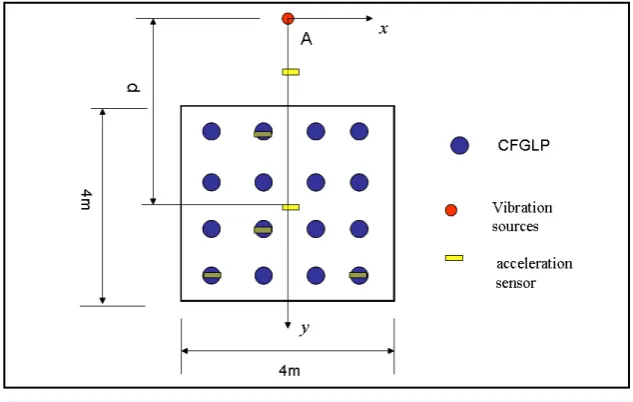
Three kinds of composite foundation model are designed: CFGP, CFGLP-CFGSP, CFGCP-RCSLP composite foundation. The model design parameter of composite foundation is shown in Table 2. CFG pile adopts C20 commercial concrete. Blasting is used as the vibration resource. The diameter of blasting hole is 50 mm. The Explosives are buried in the hole and than backfill tamping. The vibration is picked by acceleration sensors. The arrangement of the piles and measuring elements are shown in Figures 1-4.
The upper load is supplied by pilling concrete block, and each load of the composite foundation is added by an electric pressure pump-hydraulic jack. The square steel is 2.0 × 2.0 m as the loading plate.
4. The Analysis of Experiments Result
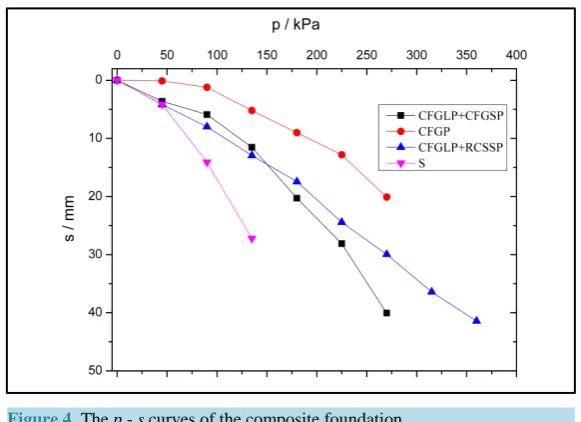
4.1. Load-Settlement Curves
Table 1. Mainly parameter of soil layer.
No. h mi fak kpa ES Mpa fsk kpa fqk kpa
1) 0.5 130 6.17 60
2) 1.5 140 10 55 800
3) 4.0 200 11.5 82 1500
4) 270 5.84 65 1000
Where, hi is thickness of the soil layer; fak is characteristic value of bearing capacity; ES is compression Modulus; fsk is ultimate shaft resistance;
[image:3.595.154.471.231.432.2]fqk is ultimate tip resistance.
[image:3.595.155.472.449.662.2]Figure 1. The arrangement o f the piles and measuring elements of the Model 1.
Figure 2. The arrangement of the piles and measuring elements of the Model 2.
Table 2. Model design parameter of composite foundation.
Model Type Pile length/m Pile diameter/mm Pile spacing/mm Replacement rate
1 CFGP 6.0 350 100 0.09616
2 CFGLP
CFGSP 6.0 4.0 350 350 200 200 0.04808 0.04808
3 CFGLP
RCSSP 6.0 4.0 350 350 200 200 0.04808 0.04808
(a) (b)
Figure 3. The arrangement of the piles and measuring elements of the Model 3. (a) Plane arrangement; (b) 1-1 profile
[image:4.595.167.458.417.628.2]ar-rangement.
Figure 4. The p - s curves of the composite foundation.
4.2. The Main Frequency of Vibration
CFGP composite foundation is at 21.1 - 27.7 Hz, and the vertical vibration frequency is at 6.8 - 31.6 Hz; the ho-rizontal vibration main frequency of the CFGLP-CFGSP composite foundation is at 17.4 - 29.6 Hz, and the ver-tical vibration main frequency is at 7.2 - 9.4 Hz; the horizontal vibration main frequency of the CFGLP-RCSSP composite foundation is at 7.6 - 38.4 Hz, and the vertical vibration main frequency is at 8.2 - 43.1 Hz. Horizon-tal vibration main frequency greater than the vertical vibration main frequency, and the vertical main vibration frequency close to the natural frequency of composite foundation. With the load increasing, the main vibration frequency of the CFGLP-RCSSP composite foundation decreases. When the load is 180 kPa, the horizontal vi-bration main frequency of the CFGLP-RCSSP composite foundation is at 7.4 - 22.6 Hz, and the vertical vibra-tion main frequency is at 7.3 - 28.0 Hz.
4.3. Peak Acceleration Results
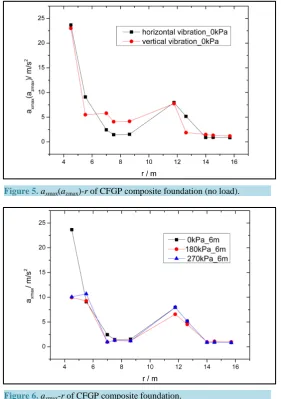
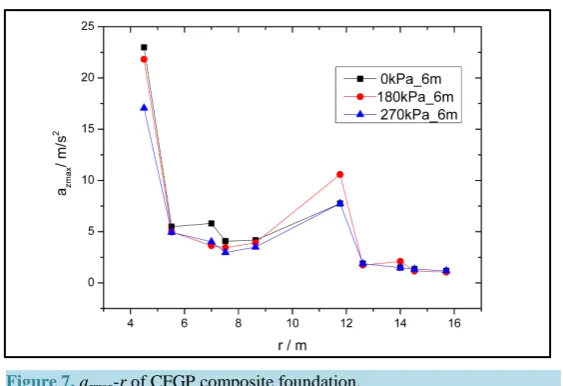
Figures 5-7 are the peak acceleration with the horizontal distance r from the measuring point to the vibration source without no pilling load on the CFGP composite foundation, when the depth of the vibration source is 6 m and the explosive quantity is 1.05 kg. From Figure 4, in addition to individual point the horizontal peak accele-ration is greater than the vertical peak acceleaccele-ration, and with the increase of r, the difference gradually decreases. From Figures 5-7, outside the scope of the composite foundation, the peak acceleration significantly decreased with the increase of the pilling load; in the surface of compound foundation, pilling load action makes the peak acceleration gently.
[image:5.595.173.455.318.718.2]Figure 5.axmax(azmax)-r of CFGP composite foundation (no load).
Figure 7.azmax-r of CFGP composite foundation.
When the depth of the vibration source is 6 m and r = 7 - 8.6 m, with the no-load, the horizontal acceleration peak of the CFG pile composite foundation surface is at 2.44 - 1.53, and the vertical acceleration peak is 5.8 - 4.2; while pilling load is 270 kPa, the horizontal acceleration peak is 1.00 - 1.17, and vertical acceleration peak is 4.01 - 3.96.
When the distance from vibration source to the center of CFGP composite foundation distance is 14 m and the depth of vibration source is 6 m from the ground, the ratio of horizontal acceleration and vertical acceleration peak is at 0.61 - 2.75, the measuring point outside CFGP composite foundation when the distance r is 1 m, the ratio was 1.03, and near to 1.0. When the distance from vibration source to the center of CFGP composite foun-dation distance is 7 m and the depth of vibration source is 6 m from the ground, the ratio of horizontal accelera-tion and vertical acceleraaccelera-tion peak is at 0.36 - 1.65; the farther the horizontal distance r from the measuring point to vibration source is, the greater the ratio.
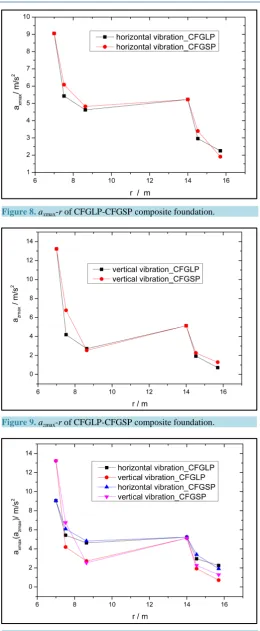
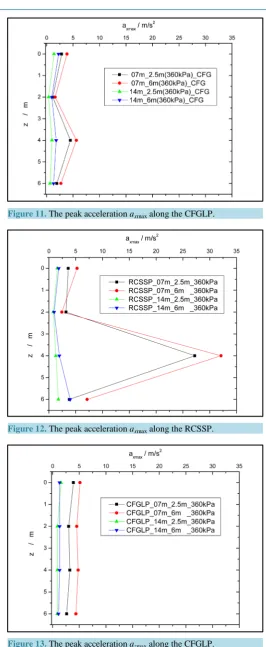
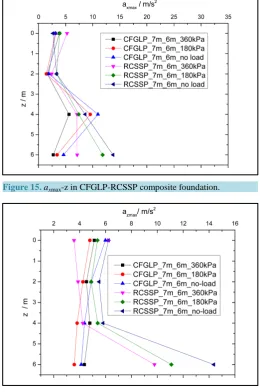
Figures 8 and 9 are the peak acceleration with the horizontal distance r from the measuring point to the tion source without no pilling load on the CFGLP-CFGSP composite foundation, when the depth of the vibra-tion source is 6 m and the explosive quantity is 1.05 kg. From Figures 8-10, the peak acceleration along the CFGLP on the CFGLP-CFGSP composite foundation is near to peak acceleration of the CFGSP.
When the depth of the vibration source is 6 m and r is at 7 - 8.6 m, with the no-load, the horizontal peak ac-celeration of the CFGLP-CFGSP composite foundation surface is at 9.05 - 1.53 m/s2, and the vertical peak acce-leration is 13.27 - 2.72 m/s2; while r is at 14 - 15.7 m, the horizontal peak acceleration is 5.23 - 2.25 m/s2, and vertical peak acceleration is 5.13 - 0.7 m/s2.
When the distance from vibration source to the center of CFGLP-CFGSP composite foundation distance is 14 m and the depth of vibration source is 6 m from the ground, the ratio of horizontal acceleration and vertical ac-celeration peak is at 1.02 - 3.15, measuring point distance from the vibration source is equal, the ratio is 1.49 on the CFGSP measuring point, and ratio is 3.15 on the CFGLP measuring point.
When the distance from vibration source to the center of CFGLP-CFGSP composite foundation distance is 7 m and the depth of vibration source is 6m from the ground, the ratio of horizontal acceleration and vertical ac-celeration peak is at 0.69 - 1.91, measuring point distance from the vibration source is equal, the ratio is 1.91 on the CFGSP measuring point, and ratio is 1.71 on the CFGLP measuring point. the farther the horizontal distance
r from the measuring point to vibration source is, the greater the ratio.
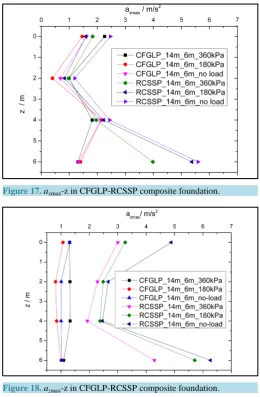
Figures 11-18 are CFGLP and RCSSP peak acceleration changes of the CFGLP-RCSSP composite
founda-tion with vibrafounda-tion source depth and pilling load, when the explosive quantity is 1.05 kg and pilling load is 360 kPa.
Figure 8.axmax-r of CFGLP-CFGSP composite foundation.
Figure 9.azmax-r of CFGLP-CFGSP composite foundation.
[image:7.595.183.440.447.697.2]Figure 11. The peak acceleration axmax along the CFGLP.
Figure 12. The peak acceleration axmax along the RCSSP.
[image:8.595.182.442.397.702.2]Figure 14. The peak acceleration azmax along the RCSSP.
Figure 15.axmax-z in CFGLP-RCSSP composite foundation.
Figure 17.axmax-z in CFGLP-RCSSP composite foundation.
Figure 18.azmax-z in CFGLP-RCSSP composite foundation.
Figure 12 is the distribution law of the horizontal vibration peak acceleration on the RCSSP of the CFGLP- RCSSP composite foundation. When the depth location of the vibration source is 7 m, the horizontal vibration peak acceleration maximum is at z = 4 m; when the location of the vibration source is 14 m, the horizontal vi-bration peak acceleration maximum is at z = 6 m.
Figure 13 is the distribution law of the Vertical vibration peak acceleration on the CFGLP of the CFGLP- RCSSP composite foundation. The vertical vibration acceleration peak on the CFGLP is change little, and the vertical vibration peak acceleration maximum is at z = 0 m.
Figure 14 is the distribution law of the Vertical vibration peak acceleration on the RCSSP of the CFGLP- RCSSP composite foundation. The vertical vibration acceleration peak on the RCSSP is change little, and the vertical vibration peak acceleration maximum is at z = 0 m.
Figures 14-18 are the distribution law of the vibration peak acceleration along the pile of the CFGLP-RCSSP composite foundation. With the increase of pilling load on CFGLP-RCSSP of the composite foundation the peak acceleration is reduced, the change range of composite foundation of 4 m pile body acceleration is consistent, the peak acceleration of the measuring point of the RCSSP is larger than that of the CFGLP. The maximum of the horizontal acceleration peak occurs in z = 4 m or z = 0 m. The maximum of the vertical acceleration peak occurs in z = 0 m.
5. Conclusions
is closed to linear relation. The bearing capacity of the four composite piles of the CFGP, CFGLP-CFGSP, and CFGLP-RCSSP in the site are separately 225 kPa, 179 kPa, and 197 kPa, separately increases 150%, 98.8% and 119% compared to the natural Foundation.
The field test shows that, under the same blast energy, vibration source position, form of composite founda-tion and properties of foundafounda-tion soil, influence the main frequency of the composite foundafounda-tion, but the rule is not obvious. The vibration main frequency is mainly depended on properties of foundation soil and piles be-tween vibration source and measuring point, pilling load value. Horizontal vibration main frequency greater than the vertical vibration main frequency and the vertical vibration main frequency close to the first-order natural frequency of composite foundation. With the pilling load increasing, the CFGLP-RCSSP pile composite founda-tion combined frequency decreased.
The field test shows that, under the same blast energy, vibration source position, the acceleration peak on the CFGP composite foundation is less than CFGLP-CFGSP the corresponding values, as the load increases, the peak acceleration gently. CFGP composite foundation is favorable on seismic.
Field test shows that, under the same blast energy, vibration source positions, form of composite foundation, properties of foundation soil and pilling load have a significant effect on the peak acceleration of composite foundation. The distribution of peak acceleration is consistent within 4 m from pile top in the CFGLP-RCSSP composite foundation. The maximum of the horizontal acceleration peak along the pile body occurs at a distance of pile top 4 m or the pile top, and that of vertical acceleration peak occurred at a pile top.
Funding
This work was supported by The Natural Science Foundation of Hebei Province under Grant (No. 2011- E080601).
References
[1] (2002) GB50007-2002 Code for Design of Building Foundation(s). China Architecture Industry Press, Beijing.
[2] Yoshio, S. (1983) Deep Mixing Chemical Method Using Cement as Hardening Agent. Symposium on Soil and Rock Improvement Techniques, Bangkok, 34-37.
[3] Horii, N., Toyosawa, Y., Tamate, S. and Hashizume, H. (1998) Stability of Composite Ground Improved by Deep Mixing Method. Proceedings of 2nd International Conference on Ground Improvement Techniques, Singapore, 193- 198.
[4] Zheng, G. and Jiang, X.L. (1999) Research on the Bearing Capacity of Cement Treated Composite Foundation. Rock and Soil Mechanics, 3, 46-50.
[5] Ma, H.L. (2003) Quantitative Analyses of the Influence of Pile Length and Other Factors on Capability and Modul of Cement Stabilized Soil Composite Foundation. Chinese Journal of Geotechnical Engineering, 11, 720-723.
[6] Fu, J.H. and Song, E.X. (2000) Analysis of Rigid Pile Composite Foundation’s Working Performance. Rock and Soil Mechanics, 21, 335-339.
[7] Wang, M.-S., Wang, G.-C., Yan, X.-F., et al. (2005) In-Situ Tests on Bearing Behavior of Multi-Type-Pile Composite Subgrade. Chinese Journal of Geotechnical Engineering, 27, 1142-1145.
[8] Yan, M.L., Wang, M.S., Yan, X.F. and Zhang, D.G. (2003) Study on the Calculation Method of Multi-Type-Pile Composite Foundation. Chinese Journal of Geotechnical Engineering, 25, 352-355.
[9] Ding, J.H. (2007) Reliability Analysis on the Bearing Capacity of Composite Foundation with Multi-Type Compound Piles. Engineering Mechanics, 25, 168-172.
[10] Ding, J.H., Liu, F.R. and Du, E.X. (2008) Dynamic Characteristic Analysis on Composite Foundation with Soil-Ce- ment Piles and CFG Piles. Fly-Ash Comprehensive Utilization, 6, 37-40.
[11] Wang, W.Y., Zhao, T. and Meng, Y.J. (2012) The Numerical Analysis on Dynamic Characteristics of CFG Pile Com- posite Foundation under Blasting. Engineering Mechanics, 29, 150-155.
[12] Wang, W.Y., Zhao, T. and Ding, J.H. (2011) Effects on Dynamic Characteristics and Response of Rammed Soil-Ce- ment Pile Composite Foundation. Engineering Mechanics, 28, 187-191.
[13] Wang, W.Y., Zhao, T. and Ding, J.H. (2010) Influence Factors of Dynamic Characteristics and Response of CFG Pile Composite Foundation. Chinese Journal of Geotechnical Engineering, S2, 115-118.
Blasting. Journal of Highway and Transportation Research and Development (Applied Technique), 7, 121-122. [15] Ding, J.H., Wang, W.Y., Zhao, T., et al. (2013) The Dynamic Characteristic Experimental Method on the Composite