5
XI
November 2017
Non-Linear Frequency Modulated Nested Barker
Codes for Increasing Range Resolution
K. Ravi Kumar1, Prof .P. Rajesh Kumar2
1
Research Scholar, Dept. of ECE, Andhra University,2Professor & Chairman, BOS, Dept. of ECE, Andhra University Visakhapatnam, Andhra Pradesh, India
Abstract: Range resolution is important parameter in radar for target detection. Using pulse compression technique high range resolution can be achieve in radar system. Nested Barker codes are known as bi-phase codes with minimum side lobes used for phase modulation in pulse compression technique. In this paper the wide band signals that is LFM and NLFM codes are modulates Nested Barker codes to get good range resolution while getting minimum side lobes. By introducing LFM in Nested Barker codesmainlobe width will be decreasing but grating lobes are appeared in delay axis of autocorrelation function. For reducing the grating lobes and the side lobes to get high delay resolution, NLFM code is introduced in Nested Barker codes. PSLR and ISLR values are tabulated for different lengths of Non-Linear frequency modulated nested Barker codes with the help of Ambiguity functions.
Keywords: Nested Barker codes, Pulse compression, Peak sidelobe ratio (PSLR), main lobe width, integrated sidelobe ratio (ISLR), Autocorrelation function and Ambiguity function.
I. INTRODUCTION
Modern Radar system uses pulse compression technique to get high energy of long pulse with high resolution of short pulses. Pulse compression is achieved by either phase or frequencymodulation [1].The most famous codes used in Radar technology are Phase coded signals (Barker codes, poly phase codes) and frequency modulated signals (LFM , NLFMand Costas codes). The transmitted waveform consists of a rectangular pulse of constant amplitude A and time period T. The frequency is increases linearly from f1 to f2 over the time period of entire rectangular pulse in LFM and non linearly increases in NLFM. In case of phase coded pulse compression, a long pulse of time period T is divided in to number of sub pulses (N) each of width tb. The sub pulses phase is chosen in two ways one is 0 and another is π radians [2]. In general at receiver the echo signal is processed in matched filter to improve S/N ratio. The output is aperiodic Auto correlation function (ACF) of echo signal. Depending up on the side lobe levels and main lobe width the range resolution can be determined.Lot of research has done for searching longer binary signals for lower peak sidelobe level and low integrated sidelobes[3-6]. When the grating lobes appeared in ACF it may mask the weaker targets. Different methods are used to minimize the side lobes grating lobes [7], when these levels are suppressed, weaker targets echoes can be easily identified from the stronger echoes. In this connection author [8] is applied weighting techniques. In [9] mismatched filters are used. By changing phase and amplitude of Multi level bi-phase pulse compression codes (MBPPC),sidelobes are lowered [10,11] but its drawback is energy loss. In all cases above mainlobe width is increased and some signal to noise ratio is degraded. Barker codes are limited lengths, maximum length of the sequence is 13 and PSLR is -22.3 dB [14-18]. In radar environment, minimum PSLR requirement is -30dB. When the length of the Barker codes are increased , range resolution can be improved. In this paper Nested Barker codes are constructed by two Barker codes using Kronecker product to increase the length of code. Maximum length is increased to 169. These codes are modulated by LFM and NLFM wave forms forimproving inPSLR and ISLR compared to the Barker codes. When Nested Barker codes are modulated by NLFM codes, the level of the side lobes is decreased and Peak Side Lobe Ratio is improved without the loss of signal to noise ratio. This paper is organized as follows: In section II, an over view of the Barker codes. In section III, discussion of Nested Barker codes and their ACF results are presented. In section IV, LFM waveform is introduced in Different Nested Barker codes to get better resolution. Section V, gives the results of NLFM nested Barker codes with the help of Ambiguity function plots.
II. BARKER CODES
R(k) = x x (1)
Where k= - (N-1)……+ (N-1)
The maximum length of Barkercde is 13, these are perfect codes. The length of the Barker code is the ratio of the main lobe to the side lobe level in the autocorrelation pattern, and all the side lobes are ‘1’ or ‘-1’ [12].The ISLR is the ratio of energy in the sidelobes to the energy in the mainlobe of Autocorrelation function is given as
ISLR (dB) = ∑| ( )|| ( )| (2)
R (0) is the mainlobelevel and R (k) is maximum side lobe level among all sidelobes.
PSLR is the ratio of absolute maximum among the side lobes to the main peak level in the Autocorrelation function is given as
PSLR (dB) =20 log10
| ( )|
| ( )| (3)
The output of the matched filter is maximum when the echo signal is matchedto transmitted waveform. It is the cross-correlation between the received signal and the transmitted signal, and could be given as
Output = ∫∞∞s(t) sr*(t-τ) dt (4)
Where sr(t) is the received signal, s(t)is the transmitted signal, the asterisk denotescomplex conjugation, and -τ isthetime delay. The transmitted s i g n a l can be expressed as
Where u(t)is the complex modulation and fo is the carrier frequency. The received signal is assumed to be the same as the transmitted si gn al except for the time delay τo and a Doppler frequency shiftand it is given as
Sr(t)=u(t-τo)e (j2π(f ̥+ν)(t- τo) (6)
Theoutputcanbedeterminedby substituting equa tion s ( 5)and(6) into(4).Itiscustomarytoset τ ̥=0(thatis,to"center”
thefilterresponseatthetargetdelay)andtoset f0=0(thatis,toremovetheeffectofcarrierandconsider the situation
atthebaseband).Assigningthesymbolχ torepresentthematchedfilteroutput,
χ (τ, v)=∫∞∞u(t)u*
(t - τ)e π
dt (7)
The equation(8) is thematched filterr esponse, χ (τ, v),isobtained b ycorrelatingasignalwithitsDoppler-shifted an dtimeshiftedversion,thatisχ(τ, v) is thetwodimensionalcorrelationfunctionindelayandDoppler. Themagnitude|χ (τ, v)|is called the Ambiguity Function that is given as
|χ (τ, v)|=|∫∞∞u(t)u*
(t + τ)e π
dt| (8)
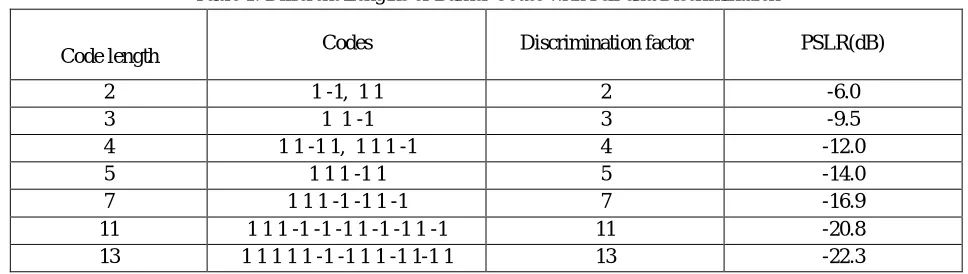
[image:3.612.63.547.581.718.2]Discrimination Factor and PSLR (dB) for all Barker codes are shown in table 1[1]. It shows, maximum length of the barker code is 13 and corresponding PSLR is -22.3 dB. The minimum PSLR required for good range resolution is -30 dB.
Table 1: Different Lengths of Barker Codes with Pslr and Discrimination
Code length Codes Discrimination factor PSLR(dB)
2 1 -1, 1 1 2 -6.0
3 1 1 -1 3 -9.5
4 1 1 -1 1, 1 1 1 -1 4 -12.0
5 1 1 1 -1 1 5 -14.0
7 1 1 1 -1 -1 1 -1 7 -16.9
11 1 1 1 -1 -1 -1 1 -1 -1 1 -1 11 -20.8
13 1 1 1 1 1 -1 -1 1 1 -1 1-1 1 13 -22.3
III. NESTEDBARKER CODES
Barker codes are easily generated.These are perfect codes because all the side lobes height is same. If the length is increased, the resolution is improved. It can be done by nesting of two Barker codes. Nested Barker codes can be obtained by using the Kronecker product of two Barker codes whose initial matched filter response is good. If an R-bit Barker code is denoted by BR, and another isBP, then an RP bit code can be constructed as BR⊗BP [13,19 and 20]. The Kronecker product is simply the BP code repeated R times, with each repetition multiplied by the corresponding element of the BR code. For example, a 33 bit code can be constructed as the product B3⊗B11. These codes have a peak sidelobes greater than 1. The nested codes of length 33, 39 and 169 are shown below.
Nested Barker code 33 (3⊗1) =
Nested Barker code
39 (3⊗13) =
1 1 1 1 1 -1 -1 1 1 -1 1 -1 1
1 1 1 1 1 -1 -1 1 1 -1 1 -1 1
-1 -1 -1 -1 -1 1 1 -1 -1 1 -1 1 -1
Nested Barker code 169 (13⊗13) =
1 1 1 1 1 -1 -1 1 1 -1 1 -1 1
1 1 1 1 1 -1 -1 1 1 -1 1 -1 1
1 1 1 1 1 -1 -1 1 1 -1 1 -1 1
1 1 1 1 1 -1 -1 1 1 -1 1 -1 1
1 1 1 1 1 -1 -1 1 1 -1 1 -1 1
-1 -1 -1 -1 -1 1 1 -1 -1 1 -1 1 -1
-1 -1 -1 -1 -1 1 1 -1 -1 1 -1 1 -1
1 1 1 1 1 -1 -1 1 1 -1 1 -1 1
1 1 1 1 1 -1 -1 1 1 -1 1 -1 1
-1 -1 -1 -1 -1 1 1 -1 -1 1 -1 1 -1
1 1 1 1 1 -1 -1 1 1 -1 1 -1 1
-1 -1 -1 -1 -1 1 1 -1 -1 1 -1 1 -1
1 1 1 1 1 -1 -1 1 1 -1 1 -1 1
A. Autocorrelation of Nested barker codes
The normalized output of the matched filter (Auto correlation function) for a Nested Barker coded waveforms of length 33 (3 ⊗11),length 39 (3 ⊗13) and length 169(13 ⊗13) are shown in Figure 1 (a-c). The pulse compression results in the appearance of range sidelobes on either side of the main lobe, the level of which lies in the range between ‘13/169’ and ‘0’ and the maximum main lobe level is 169 for nested Barker code of length 169 (13 ⊗13).In 33 length code, every 11th
sidelobe height in ACF is 11 andmainlobe height is 33. PSLR is -9.54 dB.For 39 length code every 13thsidelobe height in ACF is 13 and mainlobe height is 39. PSLR achieved for 39 length code is -9.54dB. In 169 length code every 13thsidelobe height is 13, that’s why PSLR is -22.3dB like Barker code 13, even though the length of code is increased.
1 1 1 -1 -1 -1 1 -1 -1 1 -1
1 1 1 -1 -1 -1 1 -1 -1 1 -1
(a) (b) (c)
Fig1. Autocorrelation functions of Nested barker code of length (a)3⊗11 (b), 3⊗13,(c)13⊗13.
The Nested Barker sequences are perfect only in the time domain i.e. for Zero Doppler shift. In presenceof Doppler shift, the output of the matched filter reduces rapidly, so the ambiguity function does not approach the ideal thumbtack, which is essential for good range and Doppler resolution. PSLR and ISLR values for different lengths of nested Barker codes are tabulated in table 2 and corresponding Ambiguity plots are shown in figure 2 (a-c).PSLR and ISLR are improved when length is increased.
(a) (b)
IV. BARKER CODES MODULATED BY LFM
The range and Doppler resolution can be improve by LFM signal in Radar [5]. The carrier frequency varies linearly with time over a specific period in LFM signal. It is mostly used in CW and pulsed radars. Amplitude (A) is constant and also this waveform spreads the energy widely in frequency domain. It can be expressed as
X(t) = A cos (Wo + kt2) (9)
The LFM carrier waveform used here is
cos (2πfc + kt2 ) (10)
In this method the band width is increased by linear frequency modulated (LFM) wave form introduced in Nested barker codes. PSLR and ISLR values are tabulated for different lengths of LFM nested Barker codes and respective ambiguity plots are shown in figure 3(a-c).When LFM is added to the nested Barker codes, the main lobe width is decreased but grating lobes are appeared in delay axis, it masks small targetsechoes. PSLR and ISLR values are improved for LFM nested Barker codes Compared to nested Barker codes.
(a) (b)
[image:6.612.59.557.296.702.2](c)
V. NESTED BARKER CODES MODULATED BY NLFM
In LFM nested Barker codes, grating lobes are appeared. Thesegrating lobes are masks the weaker targets. To suppress the grating lobes and improve the range resolution, NLFM is introduced in nested barker codes. Nonlinear Frequency Modulation (NLFM) is a continuous phase pulse compression technique, the frequency of which is varied in a nonlinear fashion. In this work Non Linearly frequency modulated wave modulates Nested Barker codes.The non-linear frequency modulation could be expressed as
X (t) = A cos (Wo + kt2 + k(t)) (11)
Where A is the amplitude of the signal.The NLFM carrier waveform used here is
cos (2πfc + kt2+ k(t)) (12)
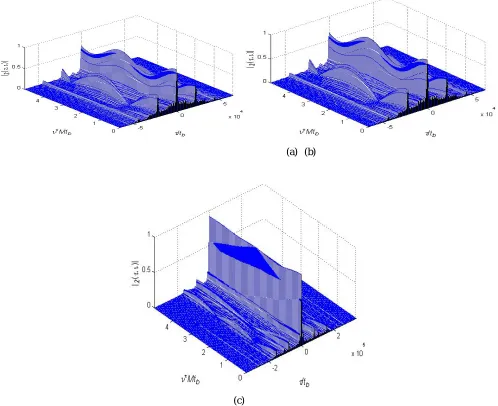
The output of matched filter is aperiodic Autocorrelation pattern. PSLR and ISLR values are tabulated in table 2 for different code lengths(33,39 and 169) and corresponding Ambiguity plots are shown in figure 4 (a-c). The PSLR and ISLR are improved compared to Nested LFM Barker codes and the levels of sidelobes are reduced. ThePSLR is achieved for 169 length code is -32.60 dB.
.
(a) (b)
TABLE.2. PSLR AND ISLR VALUES FOR VARIOUS NESTED BARKER CODES
Code length Nested Barker code LFM Nested Barker code NLFM Nested Barker code
PSLR(dB) ISLR(dB) PSLR(dB) ISLR(dB) PSLR(dB) ISLR(dB)
33 (3 ⊗11) -4.68 -3.22 -4.75 2.18 -22.65 -16.22
39 (3 ⊗13) -7.36 -2.67 -6.06 0.95 -25.79 -18.19
169 (13 ⊗13) -14.78 -10.19 -15.02 -8.04 -32.60 -27.30
V. CONCLUSION
Range resolution can be improved by reducing the grating lobes, mainlobe width and side lobe levels. An approach to improve range resolution, introducing LFM in to nested Barker codes. The resultant of LFM nested Barker code is reducing mainlobe width to prevent masking of nearby targets. PSLR and ISLR are improved than nested Barker codes. But grating lobes are appeared in delay axis, it can masks the small echoes. Suppress the grating lobes is also one of the main criteria for increasing the range resolution. For that,NLFM is introduced in Nested Barker codes. Grating lobes are suppressed.
PSLR is achieved for NLFM nested Barker code of length 169(13⊗ 13) is -32.60 dB and ISLR is -27.30dB. When compared to the nested Barker codes and LFM nested Barker codes, PSLR and ISLR are improvedin nonlinear frequency modulated nested Barker codes.
REFERENCES
[1] Merrill I. Skolnik, “Introduction to Radar System.(3rd ed.),” NewYork: McGraw-Hill, 2002.
[2] F.E. Nathanson, J.P. Reilly, and M.Cohen, “Radar Design Principles (2nd ed.),” NewYork: McGraw-Hill, 1991.
[3] Golay, M.J.E.: ‘The merit factor of long low auto correlation binary sequences’, IEEE Transactions inf. Theory, 1982, vol 28,pp. 543-549.
[4] D. B. Harris and Golay, M.J.E , ‘A new search for skew-symmetric binary sequences with optimal merit factor ‘, IEEE Transactions inf. Theory, 1990, vol 36, pp. 1163-1166.
[5] S. Mertens,’Exhaustive search for low-autocorrelation binary sequences ‘, J. Phys. A, Math. Gen., 1996, vol 29, pp. L473-L481
[6] J. Knauer, “ Home pages of LABS problem merit factor. See http://www.cecm.sfu.ca/~jknauer/labs/records.html
[7] Ackroyd M.H. and Ghani.F. ”Optimum mismatched filters for sidelobe suppression,” IEEE Transactions on Aerospace and Electronic Systems. AES-9 (Mar. 1973), 214-218.
[8] P. J. Admonson and P. M. Smith “ Pulse compression using weighted combined Barker codes”, Can. J. Elect. & Comp. Engg., Vol. 15 No 3, 1990.
[9] M. N. Cohen and J. M. Baden “Optimal peak sidelobe filters for biphase pulse compression”, IEEE international Radar conference, 1990.
[10] M.A. El-latif and A. El-Sayed, “New Radar pulse compression codes by partical swam algorithm,” ”, IEEE Aerosspace conference 2012.
[11] T. Heidary, T. Tonkaboni and Y. Norouzi,” PSO optimisation algorithm for multilevel biphase codes in radar systems”, 16 th Radar symposium (IRS) 2015, page no. 475-480.
[12] Kerdock. A.M. R Mayer and D. Bass. “Longest Binary Pulse Compression Codes with given peak sidelobe levels.” Proceeding of IEEE. Vol. 74.,No.2,p-366, Feb 1986.
[13] Radar signals by NadavLevanon and Eli Mozeson Wiley publications 2004.
[14] E. L. Titlebaum, S. V. Maric and J. R. Belleg. ”Ambiguity properties of Quadratic congruential Coding”, IEEE Transation on Aerosspace and electronic systems, vol. 27, no. 1 January. 1991, pp. 18-29.
[15] H. Kaung, C. K. Lee. “A Nural net work apporch to pulse Radar detection”
IEEE Transation on Aerosspace and electronic systems, vol. 29, no. 1 January. 1993, pp. 9-21.
[16] N. Levonon. “Non coherent pulse compression”. IEEE Transation on Aerosspace and electronic systems, vol. 42, no. 2 April. 2006, pp. 756-765.
[17] D. Blunt and K. Gerlach. “Adaptive pulse compression via MMSE estimation , ” IEEE Transation on Aerosspace and electronic systems, vol. 42, no. 2 April. 2006, pp. 572-583.
[18] S. R. Gottesman. “A class of Pseudo noise-Like pulse compression codes”, IEEE Transation on Aerosspace and electronic systems, vol. 28, no. 2 April. 1992, pp. 355-362.
[19] N. Levanon “cross-correlation of long binary signals with longer mismatched filter” IEEE Proc. Radar Sonar Navigation, Vol 152, no. 6.pp 377-382, December 2005.