Technology (IJRASET)
©IJRASET: All Rights are Reserved
718
Hybrid Active Filter With Variable Conductance
For Harmonic Suppression
Abdul Sattar Khan1, Pragya Mishra2, Prasanta Ku. Jena3
1,2
M.E. Student, RCET Bhilai, 3Astt. Prof. RCET Bhilai
Abstract- The tuned passive filter and the line inductance, causes unintentional series and/or parallel resonances, may result in severe harmonic distortion in the industrial power system.Here we present a paper in which hybrid active filter is used to suppress harmonic resonance and to reduce harmonic distortion. The proposed hybrid filter is operated as variable harmonic conductance according to the voltage total harmonic distortion; therefore, harmonic distortion can be reduced to an acceptable level in response to load change or parameter variation of the power system. Since the hybrid filter is composed of a seventh-tuned passive filter and an active filter in series connection, both DC voltage and kVA rating of the active filter are dramatically decreased compared with the pure shunt active filter. In real application, this feature is very attractive since the active power filter with fully power electronics is very expensive. A reasonable tradeoff between filtering performances and cost is to use the hybrid active filter. Design consideration is presented, and experimental results are provided to validate effectiveness of the proposed method. Furthermore, this paper discusses filtering performances on line impedance, line resistance, voltage unbalance, and capacitive filters.
Keyword-Harmonic resonance, hybrid active filter, industrial power system.
I. INTRODUCTION
HARMONIC pollution is becoming increasingly serious due to extensive use of nonlinear loads, such as adjustable speed drives, uninterruptible power supply systems, battery charging system, etc. This equipment usually uses diode or thyristor rectifiers to realize power conversion because of lower component cost and less control complexity. However, the rectifiers will contribute a large amount of harmonic current flowing into the power system, and the resulting harmonic distortion may give rise to malfunction of sensitive equipment or interfering with communication systems in the vicinity of the harmonic sources.
Fig.1 Circuit diagram of HAFU
Normally, tuned passive filters are deployed at the secondary side of the distribution transformer to provide low impedance for dominant harmonic
Technology (IJRASET)
©IJRASET: All Rights are Reserved
719
resonance between the power system and a capacitor bank. A Hybrid filter in series with a capacitor bank by a coupling transformer was proposed to suppress the harmonic resonance and to compensate harmonic current. However, this method needs extra matching transformers or tuned passive filters to guarantee filtering functionality. Recently, a transformerless hybrid active filter was presented to compensate harmonic current and/or fundamental reactive current. Design consideration of the hybrid filter For current compensation has been extensively studied. A hybrid active filter with damping conductance was proposed to suppress harmonic voltage propagation in distributed power systems. Nevertheless, this method did not consider the resonance between the passive filter and the line inductance. The fixed conductance may deteriorate the damping performances. An antiresonance hybrid filter for delta-connected capacitor bank of power-factor-correction applications were presented. This circuit was limited to three single-phase inverters, and the filtering performance was not considered. In addition, the hybrid active filter was proposed for the unified power quality (PQ) conditioner to address PQ issues in the power distribution system. Several case studies of the hybrid active filter considering optimal voltage or current distortion were conducted in .
In previous work, the authors have presented a transformerless hybrid active filter to suppress harmonic resonances in the industrial power system. The hybrid filter is constructed by a seventh-tuned passive filter and an active filter in series connection. It operates s a variable conductance at harmonic frequencies according to the voltage THD, so that harmonic distortion can be reduced to an acceptable level in response to load change and power system variation. Since the series
capacitor is responsible for sustaining the fundamental component of the grid voltage, the active filter is able to operate with a very low dc bus voltage, compared with the pure shunt active filter. Hence, both the rated kVA capacity and the switching ripples are reduced accordingly. Moreover, the proposed harmonic conductance is able to avoid overcurrent of the passive filter in the case of mistuning parameters. These features will benefit practical applications..
In this paper, we further present designing consideration of the hybrid filter. A prototype circuit of the hybrid filter based on 220-V/10-kVA system has been established to verify theoretic analysis, including steady-state behavior, transient response, and stability analysis. The filtering performance of the hybrid filter is discussed considering X/R ratio and magnified variations of line impedance. We also focus on filtering deterioration due to line resistance, voltage unbalance, and capacitive filters in the power system. In many cases, an active power filter is designed to compensate harmonic current produced by a specific nonlinear load, in such a way that it needs to measure the load current to be compensated. In this paper, the active filter is designed as a harmonic conductance to suppress both harmonic resonance and harmonic distortion by using inverter-side voltage and current measurements. Notice that it does not require current information of the nonlinear loads. Thus, this approach can be suitable in power distribution networks in which the loads may be distributed along a feeder. In addition, compensating fundamental reactive power due to unbalanced load is possible, but it is outside the scope of this paper.
II. NEED OF HYBRID ACTIVE FILTER
The main objective of the hybrid active filter such that the harmonics in the current waveform is reduced. The control algorithm has the following objectives :
To suppress harmonic resonance.
To control voltage injected by Active filter such that it compensate reactive power load current harmonics. To improve passive filter performance.
III. OPERATION PRINCIPLE
Fig.1 shows a simplified circuit diagram considered in this paper, where Ls represented the line inductance plus the leakage inductance of the transformer. The hybrid active filter unit (HAFU) is constructed by a seventh-tuned passive filter and a three-phase voltage source inverter in series connection. The passive filter − is intended for compensating harmonic current and reactive power. The inverter is designed to suppress harmonic resonances and improve the filtering performances of the passive filter. Fig.2 shows the overall control block diagram of the HAFU, including harmonic loop, fundamental loop, current regulator, and conductance control. A detailed principle will be presented as follows.
A. Harmonic Loop
To suppress harmonic resonances, the HAFU is proposed to operate as variable conductance at harmonic frequencies as follows:
phase-Technology (IJRASET)
©IJRASET: All Rights are Reserved
720
locked loop (PLL) is realized to determine the fundamental frequency of the power system. In the SRF, the fundamental component becomes a dc value, and other harmonic components are still ac values. Therefore, harmonic voltage component , can be
extracted from by using high pass filters. After transferring back to a three-phase system, the harmonic current command ∗ is obtained by multiplying eh and the conductance command ∗, as shown in (1).
Fig.2 Control block diagram of HAFU
B. Fundamental Loop
In this paper, the q-axis is aligned to a-phase voltage. Since the passive filter is capacitive at the fundamental frequency, the passive filter draws fundamental leading current from the grid, which is located on the d-axis. The proposed inverter produces a slight fundamental voltage on the d-axis, which is in phase with the fundamental leading current. Therefore, the control of DC bus voltage is able to be accomplished by exchanging real power to the grid. Thus, the current command is obtained by a proportional– integral (PI) controller. The fundamental current command in the three-phase system is generated after applying the inverse SRF transformation. Equation (2) shows the harmonic voltage drop on the passive filter due to the compensating current of the HAFU , where represents the maximum harmonic current of the active filter, and the voltage drop on filter resistance is neglected. As can be seen, a large filter capacitor results in the reduction of the required dc voltage. On the other hand, the filter capacitor determines reactive power compensation of the passive filter at the fundamental frequency.Thus, the dc voltage can be determined based on this compromise. Note that the compensating current should be limited to ensure that the hybrid filter operates without undergoing saturation, i.e.,
= 2√2∑ + . (2)
C. Current Regulator
The current command ∗ is consisted of ∗ and ∗ . Based on the current command ∗ and the measured current i, the voltage command ∗can be derived by using a proportional controller as follows:
∗= .( ∗− ) (3)
Where is a proportional gain. According to the voltage command ∗, space-vector pulse width modulation (PWM) is employed to synthesize the required output voltage of the inverter. Fig.(c) shows the model of the current control. The computational delay of digital signal processing is equal to one sampling delay T, and PWM delay approximates to half sampling delay T/2. Hence, the proportional gain can be simply evaluated from both open-loop and closed-loop gains for suitable stability margin and current tracking capability.
Technology (IJRASET)
©IJRASET: All Rights are Reserved
721
D. Conductance Control
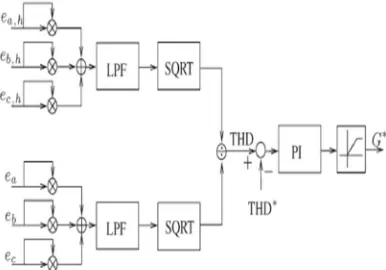
Fig.4 shows the proposed conductance control. The harmonic conductance command ∗ is determined according to the voltage THD at the HAFU installation point. The voltage THD is approximately calculated by the control shown in Fig.(c). Here, two low-pass filters (LPFs) with cutoff frequency = 20 Hz are realized to filter out ripple components . The error between the allowable
∗ and the measured THD is then fed into a PI controller to obtain the harmonic conductance command ∗. The allowable
distortion could be referred to the harmonic limit
in IEEE std. 519-1992. Note that PI parameters need to be tuned for required response and stability. For example, the proportional gain can be tuned for transient behavior, and the integral gain is responsible for suppressing the steady-state error. The bandwidth should be lower than one-tenth of the cutoff frequency of the current loop to assure stable operation. This way, the HAFU is able to dynamically adjust ∗to maintain harmonic distortion at an allowable level.
Fig.4 Conductance control block diagram
IV. SIMULINK MODEL
[image:5.612.205.398.215.350.2]The filtering performance of the HAFU has been addressed by developing equivalent circuit models, in which both harmonic impedance and harmonic amplification are considered. The frequency characteristic of the passive filter is changed by the proposed harmonic conductance to avoid unintentional resonances. Here, we will concentrate on the damping performance with variation of line impedance , line resistance , and ∗. Voltage unbalance and filter capacitors in the power system are also considered. The performance of the system with the proposed control strategy under different load conditions is discussed in detail in the following section. The proposed control strategy is simulated with a non-linear balanced load and the performance of the system is analyzed.
Table I: System Parameter
System Parameter Value
Voltage(L-L) 400 V
Switching Frequency 20 KHz
[image:5.612.210.402.526.682.2]Technology (IJRASET)
©IJRASET: All Rights are Reserved
722
Switching frequency 20KHz
Source Resistance 3.6Ω
Passive filter = 1.0 ,
= 150 , = 20
The proposed control strategy is simulated with a non-linear balanced load and the performance of the system is analyzed. The system data is given in Table-I With the system parameters in table-I, the proposed control strategy is simulated and the circuit diagrams with RL and in Fig(e). The MATLAB SIMULINK results are presented in Fig. shows the load current which is nothing but the source current of phase- „a‟ without any compensation. The THD of this current is shown in Fig.7 which is too high (28.04%) exceeding the IEEE standards. To filter the harmonics at first only the passive filter is connected and the source current waveform under this condition is shown in Fig.9. When both active and passive filters are connected together, the harmonics are still reduced and the source current is almost sinusoidal as shown in Fig.8. Now the THD of the current is very less (4.04%) and the harmonic analysis is shown in Fig.8. The use of active power filter increases the performance of the system and the overall power factor is also improved. In addition, the characteristics of the passive filter are also improved and the 5th and 7th order harmonics are greatly reduced.
Fig.5 Simulation diagram of HAFU
V. RESULT
Time-domain simulations have been carried out to compare filtering performances between current
Technology (IJRASET)
©IJRASET: All Rights are Reserved
723
Fig.6 Source current without filter
Fig.7 Source current with filter
Fig.8 Source voltage without filter
Fig.9 Source voltage with filter
Technology (IJRASET)
©IJRASET: All Rights are Reserved
724
Fig.11 THD of source current with filter
Fig.12 THD of source voltage without filter
Fig.13 THD of source voltage with filter
VI. CONCLUSION
The demand for electric power is increasing at an exponential rate and at the same time the quality of power delivered became the most prominent issue in the power sector. Thus, the reduction of harmonics and improving the power factor of the system is of utmost important. In this project a solution to improve the electric power quality by the use of Hybrid Active Filter is discussed. From the study of Hybrid Active Filter for power quality improvement the following conclusions are drawn-
A. Most of the load connected to the system are non-linear which are the major source of harmonics in the system
B. The non-linear load draws non-linear current from the supply
C. Thus the voltage at PCC is also non-linear affecting the performance of end user equipment
D. To compensate the load harmonics a filter is connected at the PCC, which injects the compensating current
E. To achieve this a Hybrid Active filter in series with Passive Filter is used
F. The HAFU is controlled based on variable conductance control Theory to compensate the load harmonics
Technology (IJRASET)
©IJRASET: All Rights are Reserved
725
H. The connection of HAFU improves the passive filter characteristics in addition to improve the system performance
I. The HAFU works well even with variable loads and improves the power factor of the system
REFERENCES
[1] Yi tang, Poh Chiang Loh, Fook Hoong Choo “Generalized design of high performance shunt active power filter with output LCL filter,” IEEE transactions on industrial electronics, vol. 59, no. 3, March 2011
[2] Avik bhattacharya, Chandan Chakraborty,” Parallel-connected shunt hybrid active power filters operating at different switching frequencies for improved performance”, IEEE transactions on industrial electronics, vol. 59, no. 11, November 2012
[3] Wai-hei choi, chi-seng lam,” Analysis of dc-link voltage controls in three-phase four-wire hybrid active power filters”, IEEE transactions on power electronics, vol. 28, no. 5, May 2013
[4] Pablo Acuna, Luis Moran, Marco Rivera, “Improved active power filter performance for renewable power generation systems”, IEEE transactions on power electronics, vol. 29, no. 2, February 2014
[5] Tzung-Lin Lee, Yen-Ching Wang, Jian-Cheng Li, and Josep M. Guerrero” Hybrid Active Filter With Variable Conductance for Harmonic Resonance Suppression in Industrial Power Systems, IEEE TRANSACTIONS ON INDUSTRIAL ELECTRONICS, VOL. 62, NO. 2, FEBRUARY 2015
[6] R. Inzunza and H. Akagi, “A 6.6-kV transformer less shunt hybrid active filter for installation on a power distribution system,” IEEE Trans. Power Electron., vol. 20, no. 4, pp. 893–900, Jul. 2005.
[7] T.-L. Lee, Y.-C. Wang, and J. Guerrero, “Resonant current regulation for transformer less hybrid active filter to suppress harmonic resonances in industrial power systems,” in Proc. IEEE APEC Expo., 2010.
[8] Y.-C. Wang and T.-L. Lee, “A control strategy of hybrid active filter to compensate unbalanced load in three-phase three-wire power system,” in Proc. IEEE PEDG Syst., 2012, pp. 450–456.
[9] R. H. Simpson, “Misapplication of power capacitors in distribution systems with nonlinear loads-three case histories,” IEEE Trans. Ind. Appl., vol. 41, no. 1, pp. 134–143, Jan./Feb. 2005.
[10] T. Dionise and V. Lorch, “Voltage distortion on an electrical distribution system,” IEEE Ind. Appl. Mag., vol. 16, no. 2, pp. 48–55, Mar./Apr. 2010.
[11] J. H. R. Enslin and P. J.M. Heskes, “Harmonic interaction between a large number of distributed power inverters and the distribution network,” IEEE Trans. Power Electron., vol. 19, no. 6, pp. 1586–1593, Nov. 2004.
[12] A. V. Jouanne and B. Banerjee, “Assessment of voltage unbalance,” IEEE Trans. Power Del., vol. 16, no. 4, pp. 782–790, Oct. 2001.
[13] P. Rodriguez et al., “Multiresonant frequency-locked loop for grid synchronization of power converters under distorted grid conditions,” IEEE Trans. Ind. Electron., vol. 58, no. 1, pp. 127–138, Jan. 2011.
[14] Website of Texas Instruments 2010. [Online]. Available: http://www.ti.com/
[15] D. N. Zmood, D. G. Holmes, and G. H. Bode, “Frequency-domain analysis of three-phase linear current regulators,” IEEE Trans. Ind. Appl.,vol. 37, no. 2, pp. 601–610, Mar./Apr. 2001.