Technology (IJRASET)
Investigating Image Processing Techniques on
Using Face Recognition
Khusbu Rani1, Mr. Sukhbir kamboj2
1
Research Scholar, 2Assistant Professor, Department of Computer Science and Engineering. Global Research institute of Management and Technology
Abstract: Algorithms based on Principal Component Analysis (PCA) and subspace Linear Discriminate Analysis (LDA) are popular in face recognition. PCA is used to perform dimension reduction on human face data and LDA creates another subspace to improve discriminate of PCA features. BPNN is used for training and learning, leading to efficient and robust face recognition. This system consists of three basic parts, first: the Face Detection part- automatically detect human face image using BPNN, second: the various facial features extraction, and the third: face recognition are performed based on Principal Component Analysis (PCA) with BPNN. The dimensionality of face image is reduced by the PCA and the recognition is done by the BPNN for efficient and robust face recognition. This paper focuses on highlighting the strengths and limitations of the earlier proposed classification techniques. The paper provides an insight into the reviewed literature to reveal new aspects of research.
Keywords: Face Detection, Face Recognition, linear discriminate analysis, Principal Component Analysis, Back Propagation Neural Network
I. INTRODUCTION
Face recognition, or the over-arching concept of feature [1] extraction and recognition, is a trivial ability for human beings. We’ve [1] developed this ability to accurately and instantaneously recognize things around us after millions of years of evolution. The need for machine intervention in face recognition to make the entire process gives rise to Automated Face Recognition (AFR) that simulates the Human Vision System (HVS). The past few decades have seen AFR receive immense attention due to its myriad applications in fields of security and surveillance. Implementation in computers is much [1] more complex though not impossible. Image processing (in this specific case, leading to face recognition) by computers usually takes place in this order:
Reduction of high-dimensional real-world data set to lesser dimensions in order to facilitate faster processing speeds on relatively low-end machines.
Implementing a machine learning algorithm to train with a test data-set.
The pixel shape is an important factor in image processing. Modern image processing systems and display devices deal with square shaped pixels wherein the gathered data that is composed of these square pixels is arranged in square lattices. Square pixel based face [1] recognition has been accepted universally, and hence square lattice forms the basis for Computer Vision. When Face Recognition is consider The aim of the current study is to evaluate the PCA and BPNN algorithms for face recognition in terms of speed and accuracy.
II. LITERATURE REVIEW
A. Rajath Kumar M. P. et al [1]
This paper proposeda face recognition system using Principal Component Analysis (PCA) with Back Propagation Neural Networks (BPNN) is analyzed A neural based algorithm is presented to recognize the frontal views of faces. The multi-variant data set of face image is reduced using the PCA technique. BPNN is used for training and learning, leading to efficient and robust face recognition. Experiments and testing were conducted over Olivetti Research Laboratory (ORL) Face database. Results indicate that PCA based execution is faster while the recognition accuracy suffers and vice versa for BPNN, thus suggesting a system incorporating both techniques is preferred. Face recognition, or the over-arching concept of feature extraction and recognition, is a trivial ability for human beings.
Technology (IJRASET)
more accurate detection of faces.
B. Ningthoujam Sunita Devi et al.[2]
in their paper proposed a methodology for face recognition based on information theory approach of coding and decoding the face image. Proposed methodology is combination of two stages – Feature extraction using principle component analysis and recognition using the feed forward back propagation Neural Network. The proposed method has been tested on Oracle Research Laboratory (ORL) face database containing 400 images (40 classes). A recognition score for the test lot is calculated by considering almost all the variants of feature extraction. The test results gave a recognition rate of 99.50%.The face is the primary focus of attention and plays a major role in identification and establishing the of a particular person from the rest of the human society. In spite of so many faces in the human society, there is remarkable ability of a human eye to recognized one face from another. The paper presents a face recognition approach using PCA and Neural Network techniques.
The result is compared with several techniques and proposed technique gives a better recognition rate then the other techniques.
C. Rizoan Toufiq et al.[3]
In their paper present a process of face recognition system using principle analysis with Back propagation neural network where features of face image has been combined by face detection and edge detection technique. In this system, the performance has been analyzed based on the proposed feature fusion technique. At first, the fussed feature has been extracted and the dimension of the feature vector has been reduced using Principal Component Analysis method. The reduced vector has been classified by neural network based classifier. In recognition stage,
Several steps are required. Finally analyzed the performance of the system for different size of the train database. The performance analysis shows that the efficiency has been enhanced when the feature extraction operation performed successfully.
The performance of the system has been reached more than 92% for the adverse conditions. We analyzed on the feature extraction technique and the performance of the face recognition system where the performance of the system vastly depended on the of the face detection and edge detection technique. The Viola- Jones face detection technique has been here which performance make effect on this recognition system. In this work, the vital issues is that if we fussed the feature of facial images by applying different feature extraction techniques then the performance of the recognition system will be enhanced based on the performance of feature extraction techniques.
D. Naveen Prakash et al.[4]
In their paper presented a fast efficient approach is proposed for the recognition of human faces. Thus, firstly Haar wavelet transform is implemented for multilevel decomposition of face image into several sub band images. The decomposed image sub bands are then used as input by Improved Principal Component Analysis (IPCA) approach for extracting features with the help of Eigen values and Eigen vectors. Then classification of features using Back Propagation Neural Network (BPNN) is done and finally image is being recognized comparing it to the testing images existing in the images database. More efficient BPNN is used to improve the recognition rate and to overcome the problems associated with variations in illumination and poses. Thus feed forward neural network shows the effectiveness of the proposed algorithm. biometric authentication technologies are increasingly used in practical applications. In comparison to other types of recognition such as fingerprint analysis and iris scanning, facial recognition is a more favorable approach and is non- interfering.
The face recognition system extends more natural and more prosperous approach for the identification and authentication of human beings in comparison to the preexisting biometric security technologies.
E. Prachi Agarwal et al.[5].
In this paper they proposed a new a robust face recognition system approach for image decomposition using Haar Wavelet Transform, feature extraction of Eigen values using Principal component Analysis (PCA) and then classification using Back Propagation Neural Network (BPNN). Also comparison with the traditional face recognition algorithms is done to show the effectiveness of the proposed algorithm. Human beings have good recognition capabilities of faces and complex patterns and anything cannot affect this capability. This ability is quite robust, in spite of great changes in the visual stimulus due to facial expression, masking conditions, aging, and mismanagements such as whiskers, changes in hairdo or spectacles.
Technology (IJRASET)
the human nervous system. In future, two or more functionalities can be added to the proposed approach which will allow performing many more operations and thus more securing the biometric system while it is being used for detecting and recognizing human faces.
F. Ye Jihua et al.[6].
In this paper they provided the an advanced face recognition method of BPNN based on Curve let transform and 2DPCA to increase the face recognition rate.. Firstly, we used Curve let transform to process the face images, after that we got higher dimension feature of face images, then used 2DPCA to reduce the dimension, finally we got some feature vectors, which could represent the face images. We used ORL face database to conduct the experiment, some of the feature vectors to train the BPNN classifier, the others to test. we repeatedly made some of the less important feature vectors value replaced by zeros, and made the recognition result depend on big event .
We obtained a better result in this way compared with traditional BPNN face recognition; this method can not only improve the face recognition rate, but also reduce the recognition time.
We did the experiments for many times, most results indicated that the improved method could reduce the recognition time and increase the recognition rate.
G. Hemant Singh Mittal et al. [7]
in their paper presented the PCA technique which involves a mathematical method that transforms a number of possibly correlated variables into a smaller number of uncorrelated variables called principal components. Pre-processing stage –In this stage the images are made zero-mean and unit- variance. Dimensionality Reduction stage: (PCA) - Input data is reduced to a lower dimension to facilitate classification. In this stage dimension are reduced. Classification stage - The reduced vectors output from PCA are applied to the BPNN classifier for the training of the data and used to obtain the recognized image. The recognition of a person by their facial image can be done in a many different ways such as by taking an image of the face in the visible region using an inexpensive camera or by using the infrared patterns of facial heat emission.
Facial recognition in visible light is the model key such as features from the central portion of a facial image. Face detection is essential front end for a face recognition system. Firstly the neural network is trained and then testing the images provides the image which matches with the actual image. And the detection rate of this system is approximately 100% for the trained images.
H. Poonam Sharma et al.[8]
In their paper presented an efficient face recognition method where enhanced local Gabor binary pattern histogram sequence has been used for efficient face feature extraction and generalized neural network with wavelet as activation function is being used for classification. In this method the face is first decomposed into multi resolution Gabor wavelets the magnitude responses of which are applied to enhanced local binary patterns. The efficiency has been significantly improved by combining two efficient local appearance descriptors named Gabor wavelet and enhanced local binary pattern with generalized neural network. Generalized neural network is a proven technique for pattern recognition and is insensitive to small changes in input data. The proposed method is robust-to-slight variation of imaging conditions and pose variations.
This paper proposes an efficient face recognition method, using LGBPHS and GMN neural network, which have shown better results even for slight appearance variations due to lighting and expression. The LGBPHS has proven the cap- ability to provide the significant features of the image as input to the neural network. Thus, the efficiency for recog- nition has improved and time complexity has been reduced.
I. Prof.Ujval Chaudhary et al.[9].
Technology (IJRASET)
access without a Personal Identification Number), better security (e.g., difficult to forge access). The neural networks aimed at providing artificial intelligence to the system. Neural networks using back propagation is presented in this paper for face recognition.
The recognition rate of BPNN system was found to be 99.25%.The identification result obtained using the neural network approach illustrates the success of its efficient use in face recognition. The BPNN algorithm is preferred over other neural network algorithms because of its unique ability to minimize errors.
J. Mohammod Abul Kashem et al.[10]
In this paper they presented a a face recognition system for personal identification and verification using Principal Component Analysis (PCA) with Back Propagation Neural Networks (BPNN) is proposed. This system consists of three basic parts, first: the Face Detection part- automatically detect human face image using BPNN, second: the various facial features extraction, and the third: face recognition are performed based on Principal Component Analysis (PCA) with BPNN. The dimensionality of face image is reduced by the PCA and the recognition is done by the BPNN for efficient and robust face recognition. This paper also focuses the face database with different sources of variations, especially pose, expression, accessories, lighting and backgrounds would be used to advance the state-of-the-art face recognition technologies aiming at practical applications. Face recognition has become increasingly relevant in today’s society. In this paper, Face recognition using Eigen faces has been shown to be accurate and fast. When BPNN technique is combined with PCA, non linear face images can be recognized easily and the acceptance ratio is increased and execution time decreased than the system using only BPNN technique.
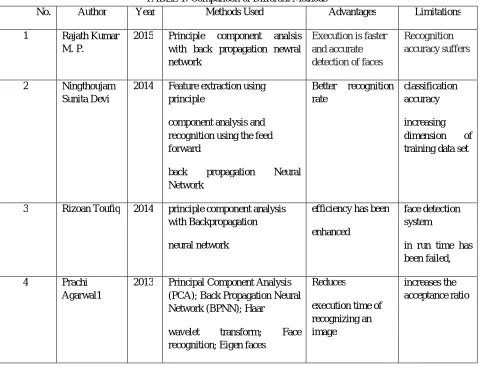
[image:5.612.70.554.334.702.2]Hence it is concluded that this method has the acceptance ratio is more than 90 % and execution time of only few seconds. TABLE 1: Comparison of Different Methods
No. Author Year Methods Used Advantages Limitations
1 Rajath Kumar M. P.
2015 Principle component analsis with back propagation newral network
Execution is faster and accurate detection of faces
Recognition accuracy suffers
2 Ningthoujam Sunita Devi
2014 Feature extraction using principle
component analysis and recognition using the feed forward
back propagation Neural Network
Better recognition rate
classification accuracy
increasing dimension of training data set
3 Rizoan Toufiq 2014 principle component analysis with Backpropagation
neural network
efficiency has been
enhanced
face detection system
in run time has been failed,
4 Prachi Agarwal1
2013 Principal Component Analysis (PCA); Back Propagation Neural Network (BPNN); Haar
wavelet transform; Face recognition; Eigen faces
Reduces
execution time of recognizing an image
Technology (IJRASET)
5 Naveen Prakash
2013 Eigen vectors, Improved Principal component analysis
(IPCA), Feature extraction, Discrete Wavelet Transform.
improve the recognition rate
variations in
illumination and poses.
6 Ye Jihua 2013 Curvelet, BPNN, 2DPCA, Face recognition.
reduce the recognition time.
it was obvious when the train samples and the test samples are
equal.
7 Hemant Singh Mittal
2013 Program Component Analysis, Face detection, Eigen values, Back Propagation neural networks.
fast, reasonably simple, and accurate in constrained
environments
accuracy decreases to a small extent by the increase in the number of images.
8 Poonam Sharma
2013 Gabor wavelets Local Gabor binary pattern Histogram sequence Generalized neural network
better results in terms of false acceptance rate, false rejection rate, equal error rate and time complexity.
robust-to-slight variation of imaging
conditions and pose variations.
9 Prof.Ujval Chaudhary
2012 Back-propagation Neural Network, Biometric Identification, Eigen faces, Eigen vectors, Principal components analyses.
unique ability to minimize errors.
execution time goes on increasing and the efficiency of recognition also decreases
10 Mohammod Abul Kashem
2011 Face Detection, Facial Features Extraction, Face Database, Face Recognition, Increase
Acceptance ratio and Reduce
Execution Time.
efficient and robust face recognition
Face detection Accuracy is less
III. CONCLUSION
Technology (IJRASET)
REFERENCES
[1] Rajath Kumar M. P., Keerthi Sravan R. K. M. Aishwarya” Artificial Neural for Face Recognition using peA and ”IEEE 2015 [2] Ningthoujam Sunita Devi, K. ” Face Recognition Using Principal Analysis”IEEE 2014
[3] Rizoan Toufiq, Md. Rabiul Islam” Face Recognition System using PCA-ANN Technique with Feature Fusion ”IEEE 2014
[4] Prachi Agarwal, Naveen Prakash” An Efficient Back Propagation Neural Network Based Face Recognition System Using Haar Wavelet Transform and PCA”IEEE 2013
[5] Naveen Prakash, Prachi Agarwal” Modular Approach for Face Recognition System using Multilevel Haar Wavelet Transform, Improved PCA and Enhanced Back Propagation Neural Network”IEEE 2013
[6] Ye Jihua, Hu Dan, Xia Guomiao,Chen Yahui” An Advanced BPNN Face Recognition Based On Curvelet Transform and 2DPCA”IEEE 2013
[7] hemant singh mittal,harpreet kaur” Face Recognition Using PCA & Neural Network”IEEE 2013
[8] Poonam Sharma , K.V.Arya , R.N.Yadav “Efficient face recognition using wavelet-based generalized neural network”IEEE 2013
[9] Prof.Ujval Chaudhary, **Chakoli Mateen Mubarak, **Abdul Rehman, **Ansari Riyaz, **Shaikh Mazhar” Face Recognition Using PCA-BPNN Algorithm”IEEE 2012