Technology (IJRASET)
Techniques for Inventory Classification: A Review
Praveen. M. P1, Jay. B. Simha2, Venkataram. R31
Mechanical Engineering Department, Acharya Institute of Technology
2
ABIBA Systems, Bangalore
3
Mechanical Engineering Department, East Point College of Engineering of Technology
Abstract— This Optimal Inventory levels is extremely crucial for maintaining appropriate service levels. But, inventory can be also be expensive to hold and to move around. Classification of Inventory is extremely essential to identify items that are critical to the operations of the firm so that the necessary service levels could be maintained without adding to the cost. Although traditional techniques of Inventory classification is most popular and widely used , it is inaccurate as it normally considers one parameter for classification, and in reality multiple factors could have greater effect on maintaining inventory levels which in turn could affect serviceability and cost. This paper attempts to highlight the need for Multicriteria Inventory classification and categorizes the techniques available for Multicriteria classification. The paper also presents a literature survey on the different traditional and Artificial Intelligence techniques used for Multi Criteria Inventory classification
Keywords— Inventory Control, Multi Criteria Inventory Classification , AI Techniques I. INTRODUCTION
The modern businesses are highly dynamic and challenging along with various uncertainties. In order to succeed amongst these demanding situations companies need to ensure that the service levels to both internal and external customers is up to the mark, for which an effective inventory management is extremely crucial. Inventory Management and control is an integral part of supply chain because the cost of inventories in a supply chain accounts for about 30 percent of the value of the product[49]. It is extremely important that a balance is struck between meeting the likely or existing demand for a product and the cost of holding the items , likely loss that the company would incur if there is less or no stock of the item. It is important for organizations to manage the three expenses that is usually associated with the inventory which are:
Administrative or cost of placing the order Holding Cost of Inventory
Shortage or cost of stock out resulting in loss of profit, good will etc.
Classification of Inventory plays a major role in identifying and subsequently optimizing the stock level of item/s in an organization. Overstocking could lead to increased holding cost and locking of the capital. Ordering for excess stock would also result in increase administrative cost. Financial losses due to Under stocking and Zero stock, referred to as the Shortage or out of stock cost, would result in the losses in profits, loss of good will with the customers, cost of production stoppages, possible extra cost associated with urgent replenishment etc.
Classification of item helps to identify the criticality of an item to a process so that the necessary service levels could be maintained without adding to the cost. Hence it is imperative for organizations to classify inventory for efficient inventory management and control. The classification of inventory enables companies to make decisions on production strategy (e.g. stock or make-to-order), production and inventory management and customer service for entire Inventory classes rather than for each product separately. This paper attempts to present the categorization of available techniques of Inventory classification. The paper also highlights some of the techniques available in the literature which is for classification of inventory.
This paper is organized into two sections A. Single Criteria Classification
B. Multi Criteria classification
1) Model / Statistical Based Approaches
2) Artificial Intelligence Based Approaches
II. SINGLECRITERIACLASSIFICATION
Technology (IJRASET)
of 80 - 20 principle is that 20 percent of the causes generate 20 percent of the results For Example Group A inventory items are those making about 70 percent of company's business but only taking about 10 percent of inventory. They are critical to the functioning of the company. Group B items are those representing 20 percent of company's business and taking about 20 percent of inventory. Group C items are those representing only 10 percent of company business but taking about 70 percent of the inventory. Junita et al.[27] have proposed the use of ABC-VED(Vital, Essential, Desirable) analysis to narrow down and prioritize medicines, that need better managerial control, on the annual expenditures and at the same time their availability in hospital.
Vaisakh et al.[43] have proposed the combined use of FSN(Fast, Slow and Non Moving items) and VED analysis to classify inventory based on their consumption pattern and criticality . The inventory items included raw materials, spare parts and work in process inventory in stores of a chemical process industry. The authors indicate that this hybrid technique could substantially reduce the space and the inventory holding costs.
Mitra et al. [48] have used ABC and HML(High, Medium and Low price) for inventory analysis techniques in an electric multiple unit (EMU) manufacturing industry. The analysis is performed to maintain and control the optimum level of inventory. For this study, they found that the priorities of the items change according to different inventory analysis techniques.
Madan and Ranganath[5] have proposed the use of ABC and VED analysis for inventory reduction. By combining the two techniques a 2D matrix was formed and cutting tool inventory modeling was done. The authors suggest that the technique was effective and efficient in reducing inventory space and also unused inventory.
Girija and Bhat[54] have proposed the use of Multi Unit Selective Inventory control technique [MUSIC-3D] for classification of pharmacy drugs and surgical instruments based on criticality, consumption and lead time from the data available from two multi specialty hospitals. The authors claim that the items were classified into eight categories which would then help the hospital management to manage materials effectively and simultaneously achieve the necessary cost reduction making the materials department a profit centre. The authors also stress the need for automation and computerization in pharmacy department as it ensures judicious utilization of resources and effective health care.
Thomas and Jayakrishnan [35] have proposed the use of SOS(Seasonal and Off Season) , ABC , VED and ABC -VED Matrix for the classification of pharmaceutical drugs for better inventory control in a In-House Drug Bank attached to a Government Medical College Hospital. The authors indicate that post the ABC and VED analysis of the drugs, the ABC-VED matrix was formulated by cross tabulating the ABC and VED analysis results. This resulted in classification of the drugs into three categories X, Y and Z which was further subjected to Seasonal(S) and Off Seasonal(OS) analysis by the chief , senior and junior pharmacists. This led to the classification of the drugs into three categories , where
Category I consisted of (SX,SY and SZ) i.e., seasonal drugs ,
Category II consisted of (OSX,OSY) i.e., off seasonal X & Y category drugs Category III with (OSZ) off seasonal Z category drugs
The authors claim that the above classification of the drugs helped them to predict the drugs required accurately which led to better priority management and economic forecasting of the items in the community pharmacy.
Soni et al. [22] have proposed the use of ABC, SDE and Economic Order Quantity[EOQ] analysis of the material used in the residential construction industry which includes Ceramic Tiles, doors , windows, plumbing / sanitary fittings, Kitchen cabinets, Wiring / Electric accessories. The authors conclude that the ABC and EOQ analysis would help the construction industry in wastage control, improve material handling, accurate forecasting and also reduce time. The authors further state that SDE analysis would help the industry device better procurement strategies and also aid in lead time analysis. The authors conclude that all the three analysis would help company's overall inventory performance.
Bulenski et al.[28] have presented a paper on the use of ABC and XYZ analysis of classification of inventory for an inventory selling house hold goods and electronic equipments like television, radio , multimedia etc. ABC classification was based on the individual items share against the total items sold and XYZ based on the rate of selling of each item. The authors conclude that the ABC/XYZ classification helped the enterprise to correlate ordering with the demand. It also helped the enterprise to identify the items that do not bring substantial financial profits. It also helped the enterprise identify the demand size per month for each of the items.
Technology (IJRASET)
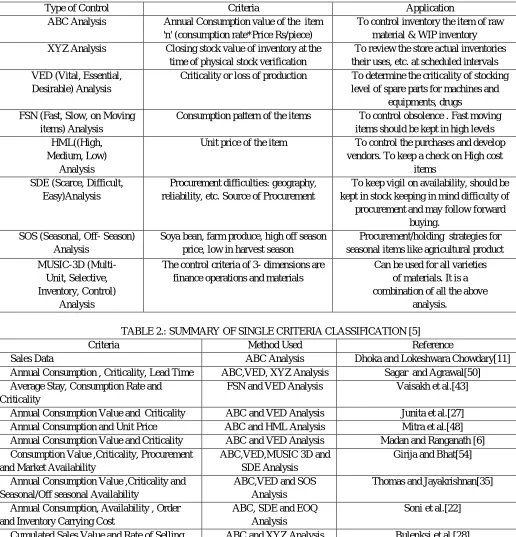
TABLE 1.: SELECTIVE INVENTORY CONTROL CATEGORIES AND CRITERIA
Type of Control Criteria Application
ABC Analysis Annual Consumption value of the item
'n' (consumption rate*Price Rs/piece)
To control inventory the item of raw material & WIP inventory
XYZ Analysis Closing stock value of inventory at the
time of physical stock verification
To review the store actual inventories their uses, etc. at scheduled intervals VED (Vital, Essential,
Desirable) Analysis
Criticality or loss of production To determine the criticality of stocking
level of spare parts for machines and equipments, drugs
FSN (Fast, Slow, on Moving items) Analysis
Consumption pattern of the items To control obsolence . Fast moving
items should be kept in high levels HML((High,
Medium, Low) Analysis
Unit price of the item To control the purchases and develop
vendors. To keep a check on High cost items
SDE (Scarce, Difficult, Easy)Analysis
Procurement difficulties: geography, reliability, etc. Source of Procurement
To keep vigil on availability, should be kept in stock keeping in mind difficulty of procurement and may follow forward
buying. SOS (Seasonal, Off- Season)
Analysis
Soya bean, farm produce, high off season price, low in harvest season
Procurement/holding strategies for seasonal items like agricultural product MUSIC-3D (Multi-
Unit, Selective, Inventory, Control)
Analysis
The control criteria of 3- dimensions are finance operations and materials
Can be used for all varieties of materials. It is a combination of all the above
analysis.
TABLE 2.: SUMMARY OF SINGLE CRITERIA CLASSIFICATION [5]
Criteria Method Used Reference
Sales Data ABC Analysis Dhoka and Lokeshwara Chowdary[11]
Annual Consumption , Criticality, Lead Time ABC,VED, XYZ Analysis Sagar and Agrawal[50]
Average Stay, Consumption Rate and Criticality
FSN and VED Analysis Vaisakh et al.[43]
Annual Consumption Value and Criticality ABC and VED Analysis Junita et al.[27]
Annual Consumption and Unit Price ABC and HML Analysis Mitra et al.[48]
Annual Consumption Value and Criticality ABC and VED Analysis Madan and Ranganath [6]
Consumption Value ,Criticality, Procurement and Market Availability
ABC,VED,MUSIC 3D and SDE Analysis
Girija and Bhat[54]
Annual Consumption Value ,Criticality and Seasonal/Off seasonal Availability
ABC,VED and SOS Analysis
Thomas and Jayakrishnan[35]
Annual Consumption, Availability , Order and Inventory Carrying Cost
ABC, SDE and EOQ Analysis
Soni et al.[22]
Cumulated Sales Value and Rate of Selling ABC and XYZ Analysis Bulenksi et al.[28]
Technology (IJRASET)
III.MULTICRITERIAINVENTORYCLASSIFICATION
ABC analysis is one of the most widely used method for Inventory classification. ABC classification is based on the Annual dollar usage of the item but however chooses to ignore other criteria like , FSN is based on the criterion of pattern of usage(Fast and Slow moving), VED is based criticality of the item and HML is based on the unit value. However the major drawback of all these methods is that they consider one single variable for the classification of the items ignoring other criteria's which could have the same or considerable effect on the inventory cost[49].
Hence, multi Criteria Inventory classification methods are used to classify Inventory by considering more than one factor that could affect the inventory classification. This would result in comprehensive managerial control of the inventory items leading to reduction in inventory holding costs and increased productivity.
Several authors like Kaabi et al. [26], Lolli et al.[14] , Kampen et al.[52] have broadly categorized the Inventory classification techniques into different categories based on the Inventory modeling methods / approaches.
We propose to classify the models developed for inventory classification , based on the available literature and the technique proposed by different authors, into two categories which includes
•Model / Statistical Based approaches
•Artificial Intelligence techniques Based approaches
The next section provides a brief survey of the inventory models based on multi criteria classification along with the categories.
A. Model / Statistical based Approach for Multi Criteria Classification.
Normally, cross tabulate matrix method, proposed by Flores[6] is used in case of Bi Criteria inventory classification . However this method becomes complicated when more number of criteria's are involved
Flores et al.[8] have proposed the use of AHP(Analytical Hierarchical Process) for classification of inventory items. The authors have compared the classification of inventory data of a hospital inventory system along with its ABC classification against the AHP classification. The authors indicate that utilization of AHP generates a consistent measure hence is a complete and effective method of inventory analysis. However they also indicate that more managerial time would be needed to develop more information for such a system.
Partovi and Burton [16] have proposed the use of AHP for multi criteria classification of Inventory items for the maintenance inventory of a pharmaceutical company.. The parameters considered were lead time, unit cost, demand range and procurement cost. The authors conclude although it was seen the traditional dollar usage classification, followed by the company, showed lower inventory associated costs , the savings in down time cost using the AHP model as compared to dollar classification method offset the savings of inventory associated costs. . The results indicate that the use of the proposed AHP-based classification method increases the ordering cost marginally, but substantially reduces downtime and average inventory investment.
Braglia et al.[36] proposed the use of AHP methodology as a decision making tool along with Reliability Centered Approach[RCM] used for spare parts classification and present a case study in a paper industry. The decision problem at each node of the diagram is supported/executed by using an AHP model. The authors conclude that AHP could be used as a valid alternative approach to solve the problems of decision making step in RCM procedure.
Though, Several authors have proposed the use of Analytics Hierarchy Process for Classification, its shortcoming is that it requires subjective judgment when making pair wise comparisons. This makes the AHP approach unstable as the subjective evaluation differs across subjects giving their opinions
Ramanathan [45] has used weighted linear optimization method and proposed a simple classification model which could be easily used by Inventory managers. These methods use weights, which are automatically generated as the model is optimized. A weighted additive function is used to aggregate the performance of an inventory item in terms of different criteria to a single score which becomes the optimal score for that item.
Zhou and Fan [42] proposed an extended version of the R-model called the ZF-model that proposes a similar weighted linear optimization model. The ZF-model adds a balancing feature for MCIC by providing the most and least favorable weights for each item. Then, the final performance score of each item is obtained by aggregating the best and worst performance scores and using a control parameter called whose value is determined by the decision maker subjectively.
Technology (IJRASET)
optimizer. The Ng-model is flexible as it could easily integrate additional information from decision makers for inventory
classification. But, Ng-model leads to a situation where the score of each item is independent of the weights obtained from the model. That is, the weights do not have any role for determining total score of each item and this may lead to a situation where an item is inappropriately classified.
Ng model was further improved by Hadi Venanch [3], who proposed a non linear programming model which determines a common set of weights for all elements in the inventory and keeps the effects of the weights in the final solution.
J.Park et. al [29] have proposed the use of Cross Evaluation based Weighted linear optimization model for inventory classification. The authors have compared the new CE-WLD model with four Data Envelopment Analysis [DEA] based models which include R,ZF,RC and NG and conclude that the inventory management savings is higher when compared to other approaches, however these models have the largest computational time when compared to other models.
Hatefi and Torabi [47] have proposed a common weight linear optimization method to classify inventory items using a set of common weights in an efficient and effective way. The numerical results along with some qualitative assessments have confirmed the superiority of the proposed method when compared with the previously developed relevant techniques.
Bhattacharya et. al [2] have proposed TOPSIS (technique for order preferences by similarity to the ideal solution) proposed a multi attribute inventory classification (MAIC) method. They have illustrated this technique in a pharmaceutical company by considering unit cost, lead time, consumption rate, perishability of items, and cost of storing of raw materials as the criterions for classification. They conclude that TOPSIS methodology is capable of handling multiple, conflicting criteria, and minimize the wastage of capital resources in inventory, thereby improving the inventory control of the firm.
M. Keshavarz Ghorabaee et al.[37] have proposed a method called Evaluation based on Distance from Average Solution(EDAS) for Multi Criteria Inventory Classification problem, especially when there are conflicting criteria. The classification results were compared with the popular DEA based models(R,ZF,HT, Ng, HV and Chen Models) and it was found that the proposed method had similar results. The authors conclude that the EDAS was simple and quick compared to the DEA methods. The authors indicated that EDAS method was stable and consistent in different criteria weights and was found superior when compared with other MCDM Methods(TOPSIS,SAW,VIKOR and COPRAS).
B. Artificial Intelligence Based Approaches
The use of Artificial intelligence techniques for Inventory classification has been proposed by several authors. In so far , the popular methods for classification using AI are Genetic Algorithm, Neural Networks and Fuzzy Logic. These techniques have been used
either in isolation or in combination with other traditional and nontraditional techniques for Inventory
classification[14],[30],[19],[41],[13],[4].
Guvenir and Erel [23] have used Genetic Algorithm for Inventory Classification. The method proposed, called GAMIC (for Genetic Algorithm for Multicriteria Inventory Classification), uses a genetic algorithm to learn the weights of criteria along with AB and BC cut off points for pre classified items. Then the weighted scores of each item is calculated with the same approach used in AHP[14],[15]. The scores above the AB cut off value is classified as A , those with values between AB and BC as class B, and the remaining items are classified as class C.
Partovi and Anandrajan [17] have proposed an artificial neural network for ABC classification of inventory. They utilized two learning methods in their approach: back propagation and genetic algorithm. The reliability of their proposed methods was tested by comparing their classification ability with two data sets. The methods were compared with the multiple discriminant analysis technique. Their results showed that both proposed methods had higher predictive accuracy than discriminant analysis.
Keramati and Mohajerani [38] have proposed a Neural Network based model for Inventory classification of Inventory items of HESCO, after Sales Service company, based on four criteria which includes Unit Price, Lead Time, Demand and Ordering Cost. The classification of the above criteria is done by using the traditional ABC classification, Eigen vector technique(to identify criteria weights) and Simple Additive Method(SAW, for ranking of items) , and the Neural Network. The authors conclude that Neural Network model provides better classification results compared to the remaining two techniques i.e., ABC classification and Eigen Vector/ SAW technique.
Technology (IJRASET)
compared with traditional MDA. The authors concluded that SVM gave better classification results than the other AI methods and all the AI methods fared better the traditional MDA technique.
Simunovic et al. [34] have proposed the use of Neural Networks for Inventory Classification of 432 items of an Agricultural machine. The inventory was classified based on Annual Cost usage , Criticality and lead time. The data results of neural network inventory classification with the original data AHP and Cluster Analysis (Using K Means Algorithm) model, was compared and it was found that neural network model predicted classes with acceptable accuracy.
Lei et al. [42] have used to Principal Component Analysis[PCA] and Hybrid Method (PCA combined with ANN) for Inventory classification. The data used was from an earlier paper(Partovi and Anandrajan) , considering four criteria namely unit price, ordering cost, demand range and lead time for classification. It was found through the results that the hybrid method could not only overcome the short comings of input limitation in ANN but also had better prediction accuracy compared to PCA.
Chu et al. [9] have proposed the use of hybrid method using ABC and Fuzzy Classification for Inventory classification on data obtained from a port. The parameters considered for inventory classification using the hybrid method included Unit Price, Procurement time, usage frequency, criticality and the severity of the impact if the inventory runs out. The authors have compared traditional ABC with the hybrid approach and concluded that the hybrid approach had better accuracy compared to the traditional ABC analysis method.
Kabir and Sumi [18] have proposed the use of use of multi-criteria inventory classification model by integrating fuzzy Delphi method with Fuzzy Analytical Hierarchy Process approach. The data for evaluating the model was obtained from 0one of the leading power engineering companies in Bangladesh. The parameters considered for classification include Unit price , Annual demand , Criticality , Last use date and Durability. The authors have conclude that the Fuzzy Delphi Technique is more realistic and reliable and it aids in removing the uncertainties and vagueness of decision making. However they have stated that FAHP approach proved to be a convenient method in tackling practical multi-criteria decision making problems
Kiris [46] has used fuzzy Analytic Network Process approach to analyze and solve a multi-criteria inventory classification problem. The proposed approach was evaluated for Inventory data obtained from a construction firm and takes into account the price, the criticality, the storage ability, the procurement process and the maintenance. The weights for each of these criteria were calculated and each inventory item was scored based on these criteria. These scores were then used for inventory classification. The author has concluded that the approach is useful and effective to classify the inventory items especially for the inventory of the construction
firm.
Kartal and Cebi [24] have proposed the use of Support Vector machine for Inventory classification. The classification of Inventory data of an Automobile firm was based on Criticality, Demand, Supply , Cost and Storage. By employing the raw inventory data as inputs and the produced classes as outputs, the study utilizes SVMs to measure the algorithm’s classification performance. The results indicate that SVMs can be successfully applied to inventory classification problems.
Tsai and Yeh [10] have proposed the use of Particle Swarm Optimization where inventory could be classified based on multiple objective like minimizing costs, minimizing inventory turnover ratios and maximizing inventory correlation. A criteria weight that reflects the degree of relevance to the objective is attached to every property(demand rate, unit cost). The algorithm then sorts all the items according to their weight scores and then assigns the items to various groups by comparing the weighted scores to the cut off points. The authors conclude that the PSO performed better then the ABC and Supplier classification when compared based on the objective values which are Cost , Turnover ratio and Demand Correlation.
Lopez- Soto et. al [12] have proposed pattern based classification technique using a Multi class model based on Logical Analysis of Data (LAD). LAD is a supervised data mining technique which extracts features and generates patterns that would provide information pertaining to distinguishing features between items belonging to different classes. The pattern obtained from the training set would then be used to classify new observations. This technique is devoid of any statistical assumptions and works in three phases which include training , testing and classification. The technique was tested on data sets available from the earlier literature and it was found that the prediction accuracies of the item classes was found to be accurate.
Chen et. al [56] have proposed a multi criteria based classification using Dominance based Rough set approach(DRSA). The DRSA generates linguistic rules to classify inventory items incorporating the decision makers preferences. The rules generated are then used to classify new SKU's. The new approach was compared with the existing techniques of classification which includes DEA(R,ZF,Ng) and AHP techniques. The authors conclude that the results obtained were better than the DEA models and at par with the AHP techniques, thereby confirming the applicability of this approach.
Technology (IJRASET)
follows a twelve step procedure which broadly includes the computation of the fuzzy decision matrix where each criterion(Quantitative and Qualitative) and the decision alternatives provided by the decision maker are considered together and the overall ranking is obtained. The authors present a case study for a multinational textile company, where the model was implemented for their spare parts inventory , and it was found that the model was capable of handle Multi Attribute Decision Making(MADM) problems under uncertainties. The authors have also compared the LAM model with other Fuzzy MADM methods and have indicated that all the methods provided identical inventory classes.
Lolli et. al [14] has proposed two AHP - K Means, AHP - K Means and AHP-K-Veto, based approaches for Multi Criteria based Inventory classification. In this method , the K Means a clustering algorithm, creates classes based on the ranking scores obtained from AHP(Analytical Hierarchy Process). In AHP-K means approach , AHP ranks the items and the K Means algorithm assigns them to different classes. However the authors claim that the AHP - K allows those items with low score in a particular criterion may be identified in a higher class .In order to overcome this problem the authors suggest that a sorting method is performed on each single criterion, where a veto system prevents an item evaluated as high/bad on at least one criterion to be top/bottom ranked in the global aggregation. The authors have implemented this method on data from previous literature and have concluded that the drawback of the veto system is that it worsens the clustering validity index because it contradicts the objective of the clustering methods.
Kartal et al.[21] have proposed the use of hybrid methodology that integrates Machine Learning Algorithms with Multi Criteria Decision Making for Multi Criteria Classification and subsequent prediction of the classes of items. The paper highlights the use of Simple Additive Weigh ting, Analytical Hierarchy Process and VIKOR process to determine the classes of Inventory items. Subsequently the three machine learning algorithms which include Bayes Classifiers, Artificial Neural Network and Support Vector Machines are used to predict the classes of initially determined stock items. The proposed model was used for classification and prediction for a large automotive components in Turkey. Three criterions Demand, Supply and Criticality were considered. It was concluded that SVM and ANN were able to predict classes accurately when compared to Bayes Classifiers. The authors finally conclude that the combination of machine learning algorithms with MCDM models would provide useful insights to support managerial decision making and improve inventory management strategies
[image:8.612.45.570.497.720.2]Simha et al.[32] have proposed the use of Self Organizing Maps(SOM) for Inventory Classification. The authors have provided a comparison between SOM, K Means and Fuzzy C Means by implementing these models on data available from previous literature. The criteria considered for classification include Average Unit Cost (AUC), Demand, Critical factor, and Lead-time for classifying inventory. The authors conclude that Self Organizing maps performed better than K Means and Fuzzy C means algorithm in terms of reducing the inventory cost. The authors also stress on the need for the use of unsupervised data driven technique for inventory classification and also demonstrate the superiority of Unsupervised learning techniques for Multi Criteria Inventory classification.
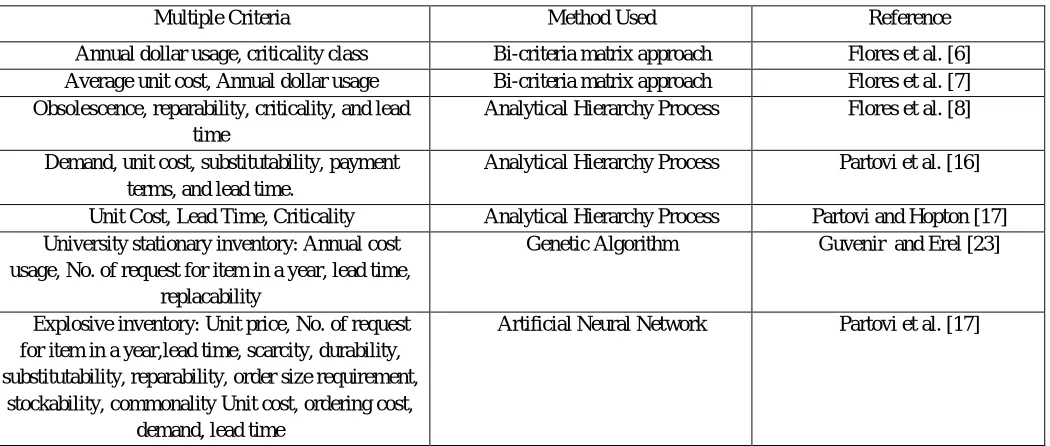
TABLE 3.
SUMMARY OF MULTI CRITERIA CLASSIFICATION TECHNIQUES
Multiple Criteria Method Used Reference
Annual dollar usage, criticality class Bi-criteria matrix approach Flores et al. [6]
Average unit cost, Annual dollar usage Bi-criteria matrix approach Flores et al. [7]
Obsolescence, reparability, criticality, and lead time
Analytical Hierarchy Process Flores et al. [8]
Demand, unit cost, substitutability, payment terms, and lead time.
Analytical Hierarchy Process Partovi et al. [16]
Unit Cost, Lead Time, Criticality Analytical Hierarchy Process Partovi and Hopton [17]
University stationary inventory: Annual cost usage, No. of request for item in a year, lead time,
replacability
Genetic Algorithm Guvenir and Erel [23]
Explosive inventory: Unit price, No. of request for item in a year,lead time, scarcity, durability, substitutability, reparability, order size requirement,
stockability, commonality Unit cost, ordering cost, demand, lead time
Technology (IJRASET)
Inventory constraints, costs of lost production, safety and environmental objectives, strategies of maintenance adopted, logistics aspects of spare
parts
Analytical Hierarchy Process Braglia et al. [36]
Average unit cost, Annual dollar usage, critical factor, lead time
Weighted Linear Optimization Ramanathan [18]
Average unit cost, annual dollar usage, critical factor, lead time
Quadratic Optimization Program Chen and Qu [57]
Unit cost, lead time, consumption rate, perishability of items and cost of storing of raw
materials
Distance-based multiple-criteria Consensus framework
Bhattacharya et al. [2]
Annual Dollar Usage, Average Unit Cost, Lead Time
Weighted Linear Model Ng [55]
Average unit cost, Annual dollar usage, critical factor, lead time
Weighted Linear Optimization (Extended Version
of R model)
Zhou and Fan [42]
Unit price, annual demand, stock ability, lead time, certainty of supply,
Fuzzy Analytical Hierarchy process
Rezaei [30]
Average unit cost, Annual dollar usage, Critical factor, Lead time
Dominance-based rough set approach
Chen et al. [56]
Annual dollar usage, number of hits, average value per hit
Exponential Smoothing Weights
Jamshidi et al. [20]
Price/cost, Annual demand, Blockade effect in case of stock out, Availability of the substitute
material, Lead time, Common use
Fuzzy Analytical Hierarchy Process
Cakir et al. [41]
Annual cost usage, Criticality factor ,Lead Time, working days
Artificial Neural Network Simunovic et al. [34]
Annual Dollar Usage, Average Unit Cost and Lead Time
Nonlinear Programming Model
Hadi-Vencheh [3]
Demand, unit cost, substitutability, payment terms, and lead time
Fuzzy Analytical Hierarchy Process
Cebi et al. [13]
Average unit cost, Annual dollar usage, critical factor, lead time
Artificial- Intelligence Yu [40]
Annual dollar usage, Limitation of warehouse space, Average lot cost, lead time
Fuzzy Analytical Hierarchy Process-Data Envelopment Analysis
Hadi-Vencheh and Mohamadghasemi [4] Unit price, Annual demand , Criticality , Lead
time, Ordering cost
Fuzzy Delphi and Fuzzy Analytical Hierarchy Process
Kabir et al. [19]
Durability, Availability, Replenishment, Criticality, Annual Cost
Fuzzy Linear Assignment Model Baykasoglu et al.[1]
Unit Price , Ordering Cost per lot, Demand per year, Lead Time
Logical Analysis of Data - Pattern Based Classification Technique
Lopez - Soto et al.[12]
Average Unit Cost, Annual Dollar Usage, Critical factor , Lead Time
Analytical Hierarchy Process and K Means and Analytical Hierarchy
Process, K Means and Veto
Lolli et al. [14]
Monthly Demand, Lead Time, Gross Profit Per unit, Inventory Holding cost per unit
Multi Integer Linear Programming M.A. Millstein et al. [39]
Unit Price, Annual Demand, Lead Time and Dollar Usage
Fuzzy Logic and Rule Based Inference System
Technology (IJRASET)
Item Set up cost, Unit holding cost, Demand per unit time, supplier ordering cost
Particle Swarm Optimization Tsai and Yeh [10]
Annual Cost Usage, Criticality Factor , Lead time 1 & 2
Cluster Analysis Using K Means Saric et al.[51]
Average Unit Cost, Annual Dollar Usage, and Lead Time.
Common Weight Linear Optimization Approach
Hatefi and Torabi [47]
Demand, Supply and Criticality Analytical Hierarchy Process,
Simple Additive Weighting and VIKOR
Kartal et al. [21]
Annual Demand, Annual Usage Value, Shape of the item Unit Price, and Unit weight of the
component
Analytical Hierarchy Process Balaji and Senthil Kumar[33]
Average Unit Cost, Demand, Critical Factor and Lead Time
Self Organizing Maps Simha et al. [32]
IV.CONCLUSION
Inventory classification plays a major role in helping organization to identify items that are critical to its smooth functioning and also to optimize the cost to order and hold inventory. All though single criteria based inventory classification is easy to perform, it is not as efficient and comprehensive as Multi Criteria based Inventory classification, which considers several factors that could affect inventory either in isolation or in tandem.
This paper has made an attempt to look at the possible approaches for Multicriteria Classification , which includes Model/Statistical Based and AI Based Techniques. The survey clearly indicates that the model / statistical based approach are found to be less consistent and time consuming. The literature also clearly indicates that Artificial Intelligence[AI] techniques have been used for Inventory classification and have yielded accurate prediction of inventory classes. Neural Networks, Fuzzy Logic and Genetic Algorithm are the AI techniques which have been used for classification while majority of them are based on Neural Network. The literature clearly shows that AI techniques used for classification have all been supervisory in nature and very little work has been done or published on unsupervised technique for inventory classification. However, the complexity involved in AI techniques and the simplicity of use in traditional analysis like ABC ,VED etc have ensured that Inventory Managers still rely on the traditional techniques for classification.
REFERENCES
[1] A.Baykasoglu, K. Subulan, and F.S Karaslan"A new fuzzy linear assignment method for multi-attribute decision making with an application to spare parts inventory classification,", Applied Soft Computing, vol. 42, pp.1 - 17, Jan. 2016.
[2] A.Bhattacharya, B. Sarkar, and S.K. Mukherjee, "Distance-based consensus method for ABC analysis", International Journal of Production Research, vol. 45(15), pp. 3405-3420, Jun. 2007.
[3] A.Hadi-Vencheh, " An improvement to multiple criteria ABC inventory classification" , European Journal of Operational Research, vol. 201(3), pp. 962-965, Mar. 2010.
[4] A.Hadi-Vencheh, and A. Mohamadghasemi, "A fuzzy AHP-DEA approach for multiple criteria ABC inventory classification ," Expert Systems with Applications, vol. 38(4), pp. 3346-3352, Apr. 2011.
[5] A.K. Madan, and M.S. Ranganathan, "Application of Selective Inventory Control Techniques for Cutting Tool Inventory Modeling and Inventory Reduction-A Case Study," in International Conference of Advance Research and Innovation, vol. 146, pp. 127 - 135, Feb. 2014.
[6] B.E Flores, and D.C Whybark " Multiple Criteria ABC Analysis," International Journal of Operations and Production Management, vol. 6(3), pp. 38-46, May. 1986.
[7] B.E Flores, and D.C Whybark " Implementing Multiple Criteria ABC Analysis, " Journal of Operations Management, vol. 7(1), pp 79-84,Oct. 1987.
[8] B.E. Flores, D.L. Olson, and V.K. Dorai, "Management of Multicriteria Inventory Classification," In Mathematical and Computer Modeling, vol. 16(12), pp. 71-82, May. 1992.
[9] C. W. Chu, G. S. Liang and C. T. Liao, "Controlling inventory by combining ABC analysis and fuzzy classification, " Computers and Industrial Engineering, vol. 55, pp. 84-151, Nov. 2008.
[10]C.Y. Tsai, and S.W. Yeh , "A multiple objective particle swarm optimization approach for inventory classification," International Journal of Production Economics, vol.114(2), pp. 656 - 666, Aug. 2008.
Technology (IJRASET)
Nov. 2013.[12]D. Lopez-Sato, S. Yacout, and F. Angel-Bello, " Root Cause Anlayis of Familiarity Biases in Classification of Inventory Items based on Logical pattern Recognition," Computers & Industrial Engineering, vol. 93 ,pp. 121-130, Mar. 2016.
[13]F. Cebi, C. Kahraman, and B. Bolat, " A multiattribute ABC classification model using fuzzy AHP, " in Proceedings of the 40th International Conference on Computers and Industrial Engineering, Awaji, Japan, pp. 25-28, Dec. 2010.
[14]F. Lolli , A. Ishizaka , and Gamberini R, "New AHP-based approaches for multicriteria inventory classification," International Journal of Production Economics, vol. 156, pp. 62-74, Oct. 2014.
[15]F.Y. Partovi , W.E. Hopton, "The analytic hierarchy process as applied to two types ofinventory problems," Production and Inventory Management Journal, vol. 26(1), pp.13-19, Mar. 1994.
[16]F.Y. Partovi, and J. Burton, "Using the analytic hierarchy process for ABC analysis" , International Journal of Production and Operations Management, vol. 13(9), pp. 29-44, 1993
[17]F.Y. Partovi, and M. Anandarajan, "Classifying inventory using and artificial neural network approach", Computers & Industrial Engineering, vol. 41(4), pp. 389-404, Feb. 2002.
[18]G. Kabir, and R.S. Sumi, "Integrating Fuzzy Delphi with Fuzzy Analytic Hierarchy Process for Multiple Criteria Inventory Classification" , Journal of Engineering, Project and Production Management, vol. 3(1), pp. 22-34,Jan. 2013.
[19]G. Kabir, M.A.A. Hasin, and M.A.H. Khondokar, "Fuzzy Analytical Hierarchy Process for Multicriteria Inventory classification" , in Proceedings of the International Conference on Mechanical Engineering, pp. 1 - 5,Nov-Dec. 2011.
[20]H. Jamshidi, and A. Jain, "Multi-Criteria ABC Inventory Classification With Exponential Smoothing Weights", Journal of Global Business Issues, Winter issue, Jan. 2008.
[21]H. Kartal, A. Ostekin, A. Gunasekaran, and F. Cebi, " An integrated decision analytic framework of machine learning with multi-criteria decision making for multi-attribute inventory classification " , Computers and Industrial Engineering, vol. 96,Jun. 2016
[22]H. Soni, Jayeshkumar Piroda, and J.J. Bhavshar, " Analyzing Inventory Material Management Control Technique On Residential Construction Project," International Journal of Advance Research and Innovative Ideas in Education, vol. 2(3), pp. 3071 - 3077, 2016.
[23]H.A. Guvenir, and E. Erel, "Multicriteria inventory classification using a genetic algorithm", European Journal of Operational Research, vol. 105(1), pp. 29-37, 1998.
[24]H.B. Kartal, F.Cebi, "Support Vector Machines for MultiAttribute ABC analysis", International Journal of Machine Learning and Computing, vol. 3(1), pp.154-157, Feb. 2013.
[25]H.F. Dickie, "ABC Inventory Analysis Shoots for Dollars Not Pennies" , Factory Management and Maintenance, 109(7), pp. 92-94, 1951.
[26]H.Kaabi, K. Jabeur, and L. Enneifar, " Learning Weights with TOPSIS Method and Conitnous VSN for Multi Criteria Inventory Classification," In Electronic Notes in Discrete Mathematics, vol. 47, pp.197 - 204, 2015.
[27]I.Junita, and R.K. Sari, "ABC-VED Analysis and Economic Order Interval (EOI)-Multiple Items for Medicines Inventory Control in Hospital," The 2012 International Conference on Business and Management , pp. 6-7, Sep. 2012.
[28]J. Bulinksi, C. Waszkiewicz, and P. Buraczewski, " Utilization of ABC/XYZ analysis in stock planning in the enterprise," Annals of Warsaw University of Life Sciences, vol. 61, pp. 89 - 96, 2013.
[29]J. Park, H. Bae, and J. Bae, "Cross-evaluation- based weighted linear optimization for Multi Criteria ABC inventory classification, " Computers and Industrial Engineerng, vol. 76, pp. 40-48,Oct. 2014.
[30]J. Rezaei "A Fuzzy Model for Multi-Criteria Inventory Classification," VI International Conference on Analysis of Manufacturing Systems, pp. 167-172, May 2007.
[31]J. Rezaeia, and S. Dowlatshahib "A rule-based multi-criteria approach to inventory classification, " International Journal of Production Research, vol. 48(23), pp.7107–7126, Jan. 2010.
[32]J.B. Simha, M.P Praveen, and R.Venkataram “Evaluating unsupervised learning techniques for inventory classification”, International Conference on Emerging Trends in Engineering and Management (ICETEM -2014), August 4th - 6th , Coimbatore, INDIA, 2014
[33]K. Balaji, and V.S. Senthil Kumar "Multicriteria Inventory ABC Classification in an Automobile Rubber Components Manufacturing Industry, "Procedia Cirp, vol. 17, pp. 463 - 468, 2014.
[34]K. Simunovic, G. Simunovic, and T. Saric, "Application of Artificial Neural Networks to Multiple Criteria Inventory Classification" , Strojarstvo, vol. 51(4), pp. 313-321, May 2009.
[35]L. Thomas, and S.S. Jayakrishnan ,"Development and Evaluation of Novel Inventory Management Software for Community Pharmacy Practice," International Journal of Pharmaceutical Sciences and Research, vol. 2(4), pp. 765 - 776, Apr. 2014.
[36]M. Braglia, A. Grassi, and R. Montanari, "Multi-attribute classification method for spare parts inventory management", Journal of Quality in Maintenance Engineering, vol. 10(1), pp. 55 - 65, 2004.
[37]M. Keshavarz Ghorabaee, E.K. Zavadskas1, L. Ofat, and Z.Tturskis," Multi-Criteria Inventory Classification Using a New Method of Evaluation Based on Distance from Average Solution (EDAS), " Informatica, vol. 26(3), pp. 435 - 451, 2015.
[38]M.A. Keramati, and N. Mohajerani, "Comparative Study of Inventory Classification (Case study: an after-sales services company related to hepco company)," Indian Journal of Fundamental and Applied Life Sciences, vol. 5(S2), pp. 1516 - 1524, May. 2015.
Technology (IJRASET)
2014.[40]M.C. Yu, " Multi-criteria ABC analysis using artificial-intelligence-based classification techniques ," Expert Systems with Applications, vol. 38(4), pp. 3416-3421,Apr. 2011.
[41]O. Cakir, and M.S. Canbolat " A web-based decision support system for multi-criteria inventory classification using fuzzy AHP methodology" , Expert Systems with Applications, vol. 35( 3), pp. 1367-1378, Oct. 2008.
[42]P. Zhou, and L. Fan, "A note on multi-criteria ABC inventory classification using weighted linear optimization", European Journal of Operational Research, vol. 182(3), pp. 1488-1491, Nov. 2007.
[43]P.S. Vaisakh, J. Dileeplal and V. Unni, "Inventory Management of Spare Parts by Combined FSN and VED (CFSNVED) Analysis," International Journal of Engineering and Innovative Technology , vol. 2(7), pp. 303 - 309, Jan. 2013.
[44]Q. Lei, J.Chen, and Q. Zhou, " Multiple Criteria Inventory Classification Based on Principal Components Analysis and Neural Network," In: Wang J., Liao X., Yi Z., editors. Berlin: Springer-Verlag, 2005, 105-863.
[45]R. Ramanathan, "ABC inventory classification with multiple-criteria using weighted linear optimization", Computers & Operations Research, vol. 33(3), pp. 695-700, Mar.2006.
[46]S. Kiris, "Multi-Criteria Inventory Classification by Using a Fuzzy Analytic Network Process (ANP) Approach," Informatica , vol. 24(2), pp.199 - 217,Apr. 2013.
[47]S. M. Hatefi and S. A. Torabi, " A Common Weight Linear Optimization Approach for Multicriteria ABC Inventory Classification, " Advances in Data Sciences, vol. 2015, Article ID 645746, Available http://www.hindawi.com/journals/ads/2015/645746.
[48]S. Mitra, S.K. Pattanayak, P. Bhowmik, ,",International Journal of Mechanical and Industrial Engineering , vol. 3(1), pp. 76 - 81, 2013.
[49]S. Narmadha, V.Selladurai, and G. Satish, "Efficient Inventory Optimization of Multi Product, Multiple Suppliers with Lead Time using PSO, " International Journal of Computer Science and Security, vol. 7(1), pp. 180 - 189, 2010.
[50]S.A. Sagar, and K.N. Agrawal, " Productivity Improvement in a Tractor Trailer Manufacturing Plant Using Selective Inventory Control Model", International Journalof Engineering Research, vol. 3(2), pp. 306-312, 2015.
[51]T. Saric, K. Simunovic, D. Pezer, and G.Simunovic "Inventory classification using multi-criteria ABC analysis, neural networks and cluster analysis, " Technickivjesnik, 21(5), pp. 1109- 1115 , 2014.
[52]T.J. Van Kampen, R. Akkerman, and D.P. Van Donk, " SKU classification: A literature review and conceptual framework," International Journal of Operations and Production Management , vol. 32(7), pp. 850-876, July 2012.
[53]T.V.S.R.K Prasad, and K.Sanjay, " Multi Criteria ABC analysis using artificial – intelligence-based classification techniques – case study of a pharmaceutical company, " International Journal of Innovative Research in Engineering & Multidisciplinary Physical Science, vol. 2(3), pp. 35-40, Dec. 2014.
[54]V.R. Girija, and M.S. Bhat , "Multi Unit Selective Inventory Control- A Three Dimensional Approach (MUSIC -3D)," CVR Journal of Science and Technology, vol. 5, pp. 98-104 , Dec. 2013.
[55]W.L. Ng, " A simple classifier for multiple criteria ABC analysis", European Journal of Operational Research, vol. 177(1), pp. 344-353, Feb. 2007.
[56]Y .Chen, K.W. Li, J. Levy, D.M. Kilgour and K.W. Hipel, "Rough-Set multiple-criteria ABC analysis", Springer Lecture Notes in Artificial Intelligence Series (LNAI) vol. 4259, S. Greco et al. (Eds.), pp. 328-337, 2006.