2017 2nd International Conference on Communications, Information Management and Network Security (CIMNS 2017) ISBN: 978-1-60595-498-1
Application of MSP430 in Low Power Low Temperature Recorder
Jia WANG, Hua-qun LIU and Yang LI
Beijing Institute of Graphic Communication, Beijing, China, 100026
Keywords: MSP430, Temperature recorder, Low power, Low temperature.
Abstract. A software and hardware design method of portable low power low temperature recorder is introduced, which is used to record the temperature changes during the transportation and distribution of cold chain of biological tissues. And the data can be read through the USB interface. The hardware of low temperature recorder consists of 5 parts: microprocessor, temperature acquisition module, memory module, power management module and USB interface module. If the temperature recorder is placed out of the freezer, extends a plurality of temperature probe into the freezer space around, can be measured by low temperature to -250℃; if the temperature recorder is placed in the freezer, minimum working temperature is -40℃. The low power consumption of the device can be realized by configuring the working mode of MSP430.
Introduction
Allotransplantation of human tissues and organs is an important technique in the treatment of critically ill patients. At present, there are about tens of millions of people in the world who need to undergo tissue or organ transplantation each year, while millions of patients are waiting to be transplanted. According to statistics, 20% of the international donor organs are from living relatives, 80% from after the death of donations. There is a big delay between supply and demand, namely time difference exists between clinical transplantation donor and receptor. Therefore, low temperature preservation of biological tissue is required, because hypothermia inhibits biological activity in organisms. Changes in all metabolic processes in the organism, although catalyzed by enzymes, exhibit a variety of specific forms, but are still subject to certain common physical and chemical laws. If an organism in 4℃ environment can survive for 2 hours, then according to the Arrhenius relationship to estimate effect of temperature on the rate of a chemical reaction, it can save a few days at -40℃, can be stored for a few months at -80℃, and at -196℃ for centuries is expected to save.[1]
Although organisms can be preserved for a long time at low temperature, they can easily be damaged by freezing, thawing, and osmotic pressure changes in the process of cooling and rewarming. This low temperature damage occurs mainly between 0℃ and -60℃, which is called the "dangerous temperature zone"[1]. In addition, monitoring the change of temperature in cooling and rewarming process has become the fastest growing and most influential research field in the field of low temperature biomedicine. It is necessary to prevent intracellular ice damage, and avoid "solution damage", that is to seek a reasonable control in the process of heat and mass transfer process.
The low temperature recorder is based on the research background. The design objective is to develop portable equipment for recording the temperature changes of biological tissues during cold chain transportation and distribution. The device measures temperature at a certain time interval and records temperature data for a period of time. The measuring range is -80℃ to 50℃, and the temperature data can be uploaded to the computer and saved for easy access.
Design of Low Temperature Recorder
low power consumption or devices with sleep mode. In addition, there may be uneven temperature in the preservation space of biological tissues, so it is necessary to design multiple measuring points. The low temperature recorder designed in this paper has four temperature probes.
[image:2.595.116.476.130.318.2]Figure 1 is a schematic diagram of the temperature recorder.
Figure 1. Design block diagram of multichannel temperature recorder.
Microprocessor
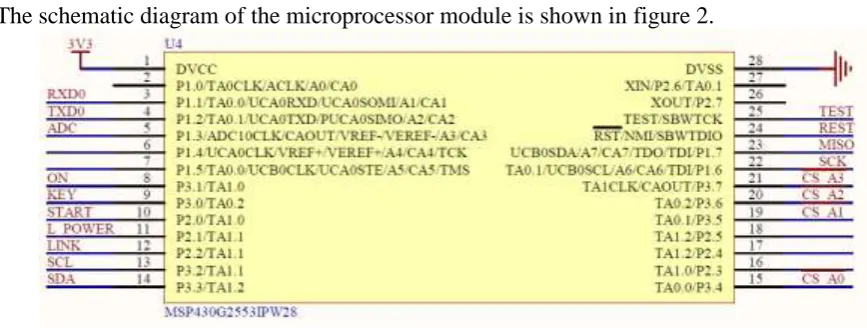
The MSP430 can operate at 1.8 to 3.6 V and is better adapted to direct battery power supply. It has a working mode and 5 low power modes, which can flexibly realize low power operation. The current is only 280 A (clocked at 1 MHz, working voltage 2.2V) in working mode. It has a digitally controlled oscillator (DCO) that saves external crystal oscillators and provides timing for system programs with very low current consumption. Therefore, the temperature recorder designed with MSP430 as the core meets the low power requirement of the design.
The schematic diagram of the microprocessor module is shown in figure 2.
Figure 2. Microprocessor.
Memory Module
[image:2.595.71.505.458.622.2]Figure 3. Memory module.
Temperature Acquisition Module
The temperature sensor uses the T type thermocouple (copper or copper nickel alloy), which has limited range of -250℃ - +350℃, and sensitivity of 43 V/℃. Selecting the T type thermocouple as the temperature detector is because it has the following advantages: (1) good linearity; (2) large thermoelectric; (3) high sensitivity, small amplitude variation can ensure precise measurement, data can fully display the change of environment; (4) it is copied and linear temperature well, can be a reasonable inference of data; (5) quick heat stability and good uniformity. Especially in the temperature range of -200℃ ~0℃, its stability can be less than ±3μV/year. It is identified as two class standard stable thermocouple for low temperature value delivery; (6) the price is low, can reduce the cost of design.
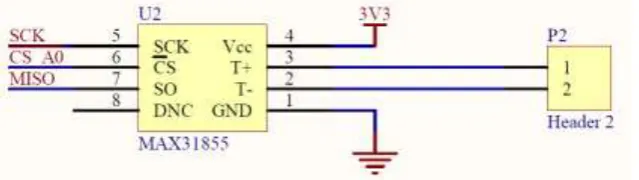
The T thermocouple needs to be coupled to a thermocouple digitizer to send data to the microprocessor. Select MAX31855 thermocouple digital output converter. The device uses 14 bit analog-to-digital converter (ADC), and a cold end compensation detection and correction, digital controller, SPI compatible interface, and associated control logic, designed to work in coordination with the external microprocessor temperature controller, process control or monitoring system.
The temperature acquisition module circuit is shown in figure 4.
Figure 4. Temperature acquisition module.
Power Management Module
The low temperature recorder has two power supply modes: battery power supply and USB power supply. The battery power supply mode is usually adopted. When the USB supply current is detected, the battery is automatically cut off, and the power supply mode is changed to USB. The power supply for MSP430 uses low dropout linear regulator TPS76933, which is characterized by ultra-low power consumption, 100mA, and low dropout voltage.
Low Temperature Resistance
[image:3.595.140.460.449.539.2]Table 1. Operating temperature range.
Model operating temperature range
MSP430 −40℃—— 85℃
AT24C256 -55℃——+125℃
MAX31855 -40℃—— +125℃
TPS76933 -40℃—— +125℃
low temperature lithium battery -50℃~+65℃
Thus, considering the operating temperature of all major chips and batteries, the designed circuit can work at -40℃. minimum. In the freezer, the minimum operating temperature of the low temperature recorder is -40℃.
Software Design
Microprocessor Software Design
The microprocessor program consists of main program and interrupt service program. The main program is responsible for parsing the commands from the host computer, reading the temperature, storage temperature, output control, etc. the interrupt service program is only responsible for the data transmission and reception between the microprocessor and the host computer.
In the circuit design, the light of the indicator lamp is used to indicate the working state of the circuit. When the switch is pressed on the low temperature recorder, the red light is on to indicate the beginning of the recording temperature, and then the red light is switched off to indicate the end of the recording. When the upper computer is connected, the green light indicates that the connection is successful; the green light flashes, indicating that the upper computer is reading the temperature data; the green light stops flashing after the reading is finished. When the yellow light comes on, it means that the battery is low, indicating the need to replace the battery.
The storage of temperature data in AT24C256 is based on page storage, where the first page is state data, and the other page is temperature data. Each page has 64 bytes, and the four temperature sensors store temperature data every minute, each page storing about 2 minutes of temperature data. 256K EEPROM has a total of 512 pages and can be stored for 1023 minutes (about 17 hours). To increase the recording time, you need to increase the memory capacity.
Host Computer Program Design
Low temperature recorder collection temperature value, through the serial transmission to the PC (MAX232 chip), based on Visual Basic 6 Mscomm communication control property and incident response, realize the serial communication with the microprocessor. In the PC, complete the temperature sensor 64 ROM read and display, real-time temperature data display, data storage, curve drawing, historical data query, the data query function, design the time temperature query, query and other functions.
During the test, the lights of the indicator are displayed in accordance with the program. The measurement data is the same as the thermometer value in the environment, and the measurement accuracy is ±1℃. In the ultra-low temperature environment as required, test the practicability and accuracy of the instrument by stage. At first in the refrigerator, as low as -10℃ to -20℃, the device can reach the same with thermometer when working after a period of record. Then we use dry ice to build the ultra-low temperature environment (-40℃), and the measured data agrees with the actual values, which indicates that the test results meet the design requirements.
Summary
temperature probe to the refrigerated space around, can be measured by low temperature to -250℃. If the temperature recorder is placed in the refrigeration, the minimum working temperature is -40℃. In the software design, the low power consumption of the system can be achieved by configuring the working mode of MSP430 to meet the long time recording temperature requirements.
Acknowledgement
This research was financially supported by Beijing teachers' training center (067145301400) as well as by the Beijing Municipal Education Commission (KM18190112005).
References
[1] Zezhao Hua. Cryogenic Biotechnology & Thermophysics, Physics and Engineering Vol.11 No.6 2001.
[2] Yu Conghua, Zhao Zhenhua. Application of M24LR64 in Cold Chain Temperature Logger, Microcomputer and Embedded System Application, Vol.5 2011.