Available online on www.ijpsr.com 34 IJPSR (2010), Vol. 1, Issue 9 (Suppl.) (Research Article)
Received on 24 May, 2010; received in revised form 14 July, 2010; accepted 29 August, 2010
FAST DISSOLVING CELECOXIB TABLETS CONTAINING SOLID DISPERSION OF CELECOXIB
S. Muralidhar*1, G. Devala Rao 2, V. Rajesh Babu 3, T. Karunakar Reddy 4 and Syeda Rana Nikhat 3
Dr. HLT College of Pharmacy1, Channapatna, Bangalore (Karnataka), India KVSR Siddhartha College of Pharmaceutical Sciences2, Vijayawada (AP), India MESCO College of Pharmacy3, Hyderabad (AP), India
Hetero Drugs Pvt. Ltd.4, Hyderabad (AP), India
ABSTRACT
Celecoxib is a selective cox-2 inhibitor is indicated to the treatment of Osteoarthritis, Rheumatoid arthritis, acute painful primary Dysmenorrhoea. It is also superior to other NSAID’s, due to lower incidences of symptomatic gastrointestinal ulcer complications than other NSAID’s. Celecoxib is practically insoluble in water. The present investigation deals with enhancement of dissolution rate of Celecoxib using Mannitol as carrier with different techniques like physical mixtures, kneading method and solvent evaporation method. The dispersions were evaluated for drug content uniformity, dissolution rate study, T50, DE20, ANOVA. The FTIR & DSC were used to characterize solid state of solid dispersions. A marked increased in the dissolution rate was observed with all solid dispersions, among that Celecoxib : Mannitol (1:4) KM. Showed maximum drug release which was selected for formulation of tablets and evaluated for drug release characteristics. The promising formulation (F2) was then compared with existing marketed product, the release profiles was studied in water containing 2 % SLS. The release study showed that these are fast release formulations of Celecoxib. So it is clearly evident that F2 and marketed product are greater than the pure drug .F2 subjected to stability studies the formulation was found to be stable for 4 weeks at 400c, with insignificant change in the hardness, disintegration time and in-vitro drug release pattern.
Keywords: Solid dispersions,
Celecoxib,
Physical mixtures,
Kneading method,
Solvent evaporation method
Correspondence to Author: S. Muralidhar
Dr. HLT College of Pharmacy, Channapatna, Bangalore (Karnataka), India
Available online on www.ijpsr.com 35 INTRODUCTION: Celecoxib is a NSAID, which
exhibits potent anti inflammatory and analgesic action by inhibiting prostaglandin synthesis by specifically inhibiting the COX-2 enzyme. It exhibits anti-inflammatory, analgesic and antipyretic action; it is mainly used for Osteoarthritis, Rheumatoid arthritis, and acute painful conditions, primary Dysmenorrhoea and Ankylosing spondylitis 1. Celecoxib is preferred over conventional NSAIDs, as the latter may lead to serious gastrointestinal complications like ulcer, severe bleeding and perforation, resulting in hospitalization and even death. The rate and extent of dissolution of the drug from any solid dosage form, determines the rate and extent of absorption of drug. In case of poorly soluble drugs dissolution is the rate limiting step in the process of drug absorption Potential Bioavailability problems are prevalent with extremely hydrophobic drugs (aqueous solubility less than 0.1mg/ml at 370C) due to erratic (or) incomplete absorption from G.I.T.
The solid dispersion approach has been widely and successfully applied to improve the solubility, dissolution rate and consequently the bioavailability of poorly soluble drugs 2-4. A number of drugs have been shown to improve their dissolution character when converted to solid dispersions. Aceclofenac 5, Sulphamethoxazole 6, Nifedipine 7, Glyburide 8, Melaxicam 9, Valdecoxib 10, Rofecoxib 11. Various hydrophilic carriers, such as PEG 12, PVP 13,
HPMC14, Gums 15, Sugars 16, Mannitol 17, Urea 18,
have been investigated for improving the dissolution rate and bioavailability of poorly aqueous soluble drugs. In the present work, solid dispersion of Celecoxib with Mannitol 19, prepared in different Drug: carrier ratios (1:1, 1:2, 1:4, 1:6) with different techniques like physical mixture (PM), kneading method (KM), solvent evaporation method (SE) to improve solubility and dissolution characteristics U V
Spectrophotometric was selected for assay as well as in-vitro dissolution study at 254nm in water containing 2% SLS 20. The dissolution profile of best solid dispersion i. e. CXB: Mannitol 1:4 KM, showed maximum dissolution rate which was selected for formulation of tablets containing SSG 21 as disintegrant.
MATERIALS AND METHODS: Celecoxib was
procured from Karup Pharma Pvt. Ltd., Hyderabad. Mannitol, Dichloromethane, Methanol purchased from Qualigens fine chemicals Mumbai, Sodium starch glycolate, Microcrystalline cellulose, Sodium hydroxide, Lactose, SLS and Magnesium stearate purchased SD fine chemicals Ltd., Mumbai. All other materials used were of pharmaceutical grade.
Preparation of Physical Mixtures: Physical mixtures were prepared by simple blending of accurately weighed quantities of drug (s) and carrier (s) sifted through sieve # 100 in a closed glass bottle. The powder were then stored in a dessicator.
Preparation of Solid Dispersion:
Kneading Method: The weighed quantities of drug and carrier were triturated in a glass motor with a small volume of methanol. The thick slurry was kneaded for 45mins and then dried at 500C to constant weight. The dried mass was Pulverized and sifted through Sieve #100 and stored in a dessicator.
Available online on www.ijpsr.com 36
and dried under vacuum to constant weight. The dried product was powdered and sifted through Sieve #100 and stored in a dessicator prior to use.
Drug Content Analysis: An ultra violet
spectrophotometric method based on the measurement of absorbance at 254 nm in water containing 2%w/v Sodium lauryl Sulphate was developed and used for the estimation of CXB. The method obeyed Beer’s law in the concentration range of 0-10g/ml. When a Standard drug solution was assayed repeatedly (n=6).
In- vitro Dissolution Study: The dissolution rate of Celecoxib as such and it’s solid dispersions was studied using DISSO 2000, Lab India 8-Station Dissolution Rate test Apparatus with a paddle stirrer .The Dissolution rate was studied in 900ml of water containing 2% SLS, Sodium lauryl sulphate was added to the dissolution fluid to maintain sink condition. Celecoxib (100mg) or its SDs equivalent to 100mg of Celecoxib, a speed of 50 rpm and temperature of 37oC ± 10C were used in each test samples of dissolution medium (5ml) were withdrawn through a filter (0.45 micron) at different time intervals, suitably diluted and assayed for Celecoxib by measuring absorbance at 254nm.The dissolution experiments were conducted in Triplicate.
Formulation and preparation of Tablets of Celecoxib- Mannitol Solid Dispersion: The tablet formulations F1, F2, F3 &F4, were developed from Celecoxib-mannitol solid dispersion among that F2 has shown maximum in-vitro dissolution, using SSG (sodium starch glycolate ) as disintegrant. Aerosil (1%) and magnesium stearate (1%) were used as a glidant-lubricant. The average weight of the tablet was adjusted to500 mg. Using lactose and micro-crystalline cellulose (MCC) as diluents .All the ingredients were mixed intimately and the mixture was
compressed in to tablets (500mg weight) on a Rimek rotary tablet machine (Karnavati Eng. Pvt. Ltd). The tablets were stored in a tightly closed glass container and evaluated for following characteristics in triplicate.
Evaluation of the Tablets of Celecoxib-Mannitol Solid Dispersions: Compressed tablets were then evaluated for hardness 22, disintegration 23, Friability 24 and drug content. Hardness was measured by Monsanto type hardness tester. One tablet was placed in each tube of disintegration apparatus (USP/IP standard). The test was carried out using distilled water as a disintegration media at 24oC±2oC.
Friability was determined in friabilator (model Ef- 2, electro lab), by taking 10 tablets. For drug content analysis, 20 tablets were accurately weighed and finally powdered. The quantity of powder equivalent to 100mg of Celecoxib was taken into a 100ml volumetric flask, and dissolved in 25 ml of methanol and volume adjusted to 100 ml with methanol and filtered. Filtrate was diluted suitably and assayed for drug content at 254nm. Using double beam U V/ Visible spectrophotometer (shimadzu, model -1700). The drug content of the tablet was found to be 100.5%.
In Vitro Dissolution Study of Tablets: In-vitro dissolution study of the tablets 25-26 was conducted using USP dissolution. Apparatus-1, at 50 rpm using water containing 2.0 %w/v SLS as a dissolution media at 37oC±0.5oC. Samples were withdrawn at various time intervals. Filtered through a 0.45 micron membrane filter, diluted, and assayed at 254nm using UV / Visible double beam spectrophotometer.
Available online on www.ijpsr.com 37
in stability chamber [Thermolab]. The formulation was withdrawn after 4 weeks and evaluated for change in in-vitro drug release pattern, hardness and disintegration time.
RESULTS AND DISCUSSION: All the Solid
dispersions (SDS) were found to be free flowing.
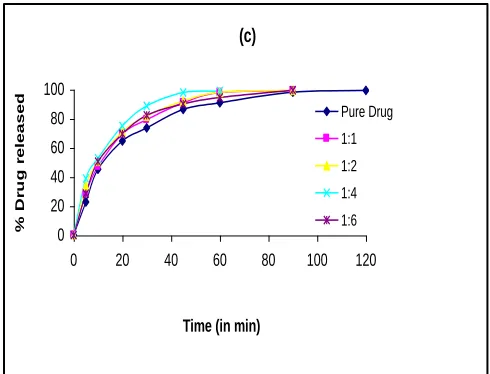
Low values of C.V (<1.0%) in percent drug content indicated uniformity of drug content in each batch of solid dispersions. The dissolution profiles of various physical mixtures and sold dispersions were shown in Fig. 1.
FIG. 1: DISSOLUTION PROFILES OF CELECOXIB FROM MANNITOL SOLID MIXTURES PREPARED BY (A) PHYSICAL MIXING; (B) KNEADING TECHNIQUE; (C) SOLVENT EVAPORATION
All the Physical mixtures and solid dispersions showed rapid dissolution of Celecoxib as compared to pure drug. Increase in carrier proportion led to an increase in dissolution rate up to1: 6 ratios. Further increase in polymer concentration shown decrease in the dissolution. This may be due to high viscosity generated by polymer in the microenvironment of drug polymer molecule particles during dissolution, reducing the diffusion rate of drug, thereby decreasing dissolution efficiency. The dissolution rates of solid dispersions prepared by kneading method were greater than the dissolution rates of solid dispersions prepared by other methods. The order of dissolution rates are SD>PM>pure drug. In each case the dissolution was found to obey First order kinetics (R>0.980).the dissolution rate constant (K1) was calculated from the slope
of the first order linear plots of the dissolution data. The dissolution efficiency (DE20) value based
on the dissolution data were calculated according to Khan 27. T50 (time taken for 50 % dissolution)
values were recorded from the dissolution profile. The dissolution parameters of pure drug, PM and SDs were shown in Table 1.
(a)
0 20 40 60 80 100
0 20 40 60 80 100 120
Time (min)
%
Drug
rel
eased
Pure Drug
1:1
1:2
1:4
1:6
(b)
0 20 40 60 80 100
0 20 40 60 80 100 120
Time (in min)
%
D
r
u
g
r
e
le
a
s
e
d
Pure Drug
1:1
1:2
1:4
1:6
(c)
0 20 40 60 80 100
0 20 40 60 80 100 120
Time (in min)
%
D
r
u
g
r
e
le
a
s
e
d
Pure Drug
1:1
1:2
1:4
[image:4.612.314.559.71.258.2]Available online on www.ijpsr.com 38
TABLE 1: DISSOLUTION PARAMETERS OF CELECOXIB SOLID DISPERSIONS PREPARED
Product % Dissolution in 10 min T50 min DE20 (%) K1 (min-1) r
Celecoxib
PM 1:1 1:2 1:4 1:6
KM 1:1 1:2 1:4 1:6
SE 1:1 1:2 1:4 1:6 __ 46.01 46.80 52.80 58.52 48.01 50.80 56.92 53.52 47.02 50.80 52.92 50.52 >60 12 10.50 9.2 11 10 9 8 9 10.40 9.5 9.0 11.0 38.32 27.5 38.12 46.00 46.87 43.75 48.12 52.50 46.25 38.75 46.00 46.87 42.50 __ 0.0467 0.0543 0.0644 0.0453 0.0619 0.0631 0.0962 0.0746 0.0561 0.0628 0.0771 0.0432 __ 0.980 0.9910 0.9933 0.9810 0.982 0.9918 0.9958 0.9809 0.9832 0.9885 0.9907 0.9833
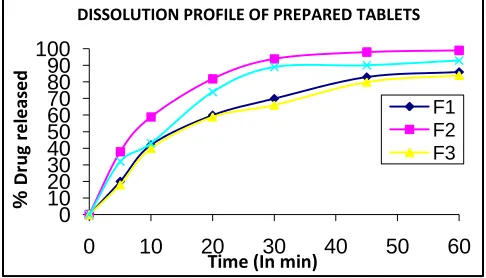
[image:5.612.317.561.331.466.2]It is indicated that The Celecoxib: mannitol. 1:4 Kneading methods shown maximum dissolution rate. It was converted to cost effective tablet formulation with improved dissolution .F2 gave faster dissolution rate than the tablets prepared according to other formulae shown in Fig. 2.
FIG. 2: DISSOLUTION PROFILE OF PREPARED TABLETS The mean hardness 3kg/cm2 .The results of disintegration and it disintegrates within (160s). The friability and assay of F2 was found to be0.82% and100.6% respectively. Fig. 3
Compares the in-vitro release profiles of F2 with conventional market capsule. (Brand Celecoxib-100 capsule containing Celecoxib-100mg of Celecoxib from Unisule Pvt. Ltd. Sonipat, Haryana) the results were similar to marketed capsule. F2 weighed
82% in 20 min marketed product with 85% in 20min.
FIG. 3: COMPARATIVE IN-VITRO RELEASE PROFILE OF F2 AND MARKETED FORMULATION
The T50 and percentage dissolution efficiency
(DE20) values of prepared tablets and MP were
shown in Table 2 and in- vitro drug release kinetic data of F2 and MP were shown in Table 3.
TABLE 2: DISSOLUTION PARAMETERS OF PREPARED TABLETS AND COMMERCIAL FORMULATION
FORMULATION DE20 T50
F1 28.75 15
F2 50.43 7.75
F3 28.56 15.25
F4 42.18 11.76
Commercial formulation 53.5 7.0
0 10 20 30 40 50 60 70 80 90 100
0 10 20 30 40 50 60
% D ru g re le ased
Time (In min)
DISSOLUTION PROFILE OF PREPARED TABLETS
F1 F2 F3 0 50 100
0 20 40 60
% D ru g re le ased
Time (in min)
Comparative in vitro release profile of F2 and Market product
[image:5.612.54.297.390.529.2]Available online on www.ijpsr.com 39
TABLE 3: IN-VITRO DRUG RELEASE KINETIC DATA OF COMMERCIAL PRODUCT AND F2
Commercial formulation Best formulation F2
Zero order Log% drug remained vs Time Zero
order Log % drug remained vs Time
(r) (r) K1 t 1/2 DE20 (r ) (r) K1 t 1/2 DE20
0.7703 0.9927 0.09925 6.9823 53.5 0.7163 0.9959 0.08751 7.9190 50.43
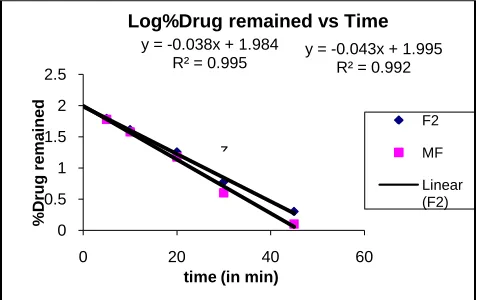
It is clearly evident that F2 and marketed product are greater than pure drug. So F2 as considered cost effective formulation with higher in-vitro dissolution. The dissolution was found to obey first order release in each case of F2 and MP respectively (Fig. 4).
FIG. 4: LOG % DRUG REMAINING VS. TIME The obtained DSC thermogram corresponding to the melting point of CXB and MANNITOL indicated that SDs was stable and absence of any additional peak indicated no interaction between drug and carrier. IR spectroscopy was used to study the possible interaction between CXB and MANNITOL in SDs the spectra showed the characteristic peaks corresponding to the drug and carrier used was unchanged showing no significant interaction between drug and carrier. Reproducibility studies are performed for SDS of CXB: MANNITOL 1:4 prepared by KM.
five batches prepared under similar set of conditions the drug content of all the batches
was calculated, the drug content values are subjected to one way ANOVA test. As the calculated F value is lesser than the tabulated F value, it is concluded that there is no significant difference in the batches prepared. In order to determine the change in the in-vitro release profile on storage stability study of F2 was carried out at 400c and 75% RH for one month, no visible physical changes were observed in the formulation withdrawn from the humidity chamber.
CONCLUSION: The present study conclusively indicated that the tablets prepared from CXB: MANNITOL 1:4 KM containing 5% SSG and MCC i.e. F2 shown high promising improvement in the dissolution characteristics and thus there is possible enhancement in the bioavailability of Celecoxib.
ACKNOWLEDGMENTS: The Authors are
thankful to Karup Pharma Pvt . Ltd, Hyderabad for providing the gift sample of Celecoxib and the Chairman and Principle , Dr H.L.T college of pharmacy , Channapatna , Ramnagra, Dist , Bangalore, for providing the necessary facilities to carry out the study.
REFERENCES:
1. N.M Davies, A.J. McLachlam, et al. Clinical pharmacokinetics and pharmacodynamics of celecoxib: A selective cyclooxygenase- 2 inhibitor. Clin. Pharmacokinetics. 2000, 38:225-42.
2. W.L.Chion, Rigelmons. Pharmaceutical application of solid dispersion system, J. Pharm Sci., 1971, 60: 1281-1302.
y = -0.038x + 1.984
R² = 0.995 y = -0.043x + 1.995R² = 0.992
0 0.5 1 1.5 2 2.5
0 20 40 60
%
D
rug
re
m
a
ined
time (in min)
Log%Drug remained vs Time
F2
MF
Available online on www.ijpsr.com 40
3. A. Senajuddin. A solid dispersion of poorly water soluble drugs: early promises subsequent problems and recent break through. J.Pharm Sci., 1999, 88:1058-1066.
4. C.Leuner, J. Dressman. Improving drug solubility of oral delivery using solid dispersion. Eur.J.Pharm.Biopharm. 2000, 50:47-60.
5. Komal deva, M.V Ramana, et al. Dissolution enhancement of aceclofenac through solid dispersion. The Indian Pharmacist, June 2006, 70-72. 6. B.Madhusudan, D.Rambhau, et al. Studies on
sulphamethoxazole solid dispersions and there tablets. Indian J. Pharma. Sci., 2003, 233-238. 7. N. Zajc, A. Obreza, et. al.Physical properties and
dissolution behavior of Nifedipine/Mannitol solid dispersion prepared by hot melt method. Int. J. Pharm., 2005, 29:51-58.
8. M. Valleri, P. Mura P, et al. Development and evaluation of Glyburide fast dissolving tablets using solid dispersion technique. Drug Dev Ind. Pharm., 2004, 30:525-534.
9. V.S.N. Malleshwar Rao, T. Shyam, et al. .Formulation and characterization of Meloxicam solid dispersion. 2008, 7:67-70.
10. S.S.Biradar, J.S. Mulla, et al.Enhancement of solubility of Valdecoxib by solid dispersion technique. The Pharma Review., 2006:154-156.
11. Tejal J. Shah, Avani. F. Amin, et al. Process optimization and characterization of poloxamer solid dispersion of poorly water soluble drug. AAPS Pharma. Sci-Tech., 2007, 8, E1-E7.
12. Liu. C, K.G. Desai. Characterization of Rofecoxib-PEG 4000 solid dispersion tablets based on solid dispersions. Pharm: Dev. Technol., 2005, 10: 467-477.
13. S.Sethi, E. Squllante. Solid dispersion of Carbamazepine on PVPK-30 by conventional solvent evaporation super critical methods. Int. J. Pharm., 2004, 19: 1-10.
14. I. Kushida I, M. Ichikawa, et al. Improvement and oral absorption of ER-34112, 1 poorly water soluble dual 5-lipoxygenase/ cycloxygenase inhibitor with anti-inflammatory activity by preparing solids. J. Pharm. Sci., 2002, 91:258-266.
15. G.V. Murali mohan babu, C.H.D.S. Prasad, et al. Evaluation of modified Gum Karaya as carrier for the dissolution of enhancement of poorly water soluble drug Nimodipine. Int. J. Pharm, 2002, 234:1-17. 16. K. Danjo, T. Nakata. Preparation and dissolution
behavior of Ethenzamide solid dispersion using various sugars as a dispersion carrier. Chem. Pharm. Bulk. (Tokyo)., 1997, 45:1840-1844.
17. M.J Arias, J.M Gines, et al. Influence of preparation method of solid dispersion on dissolution rate: Study of Triamterene-D-Mannitol system. Int. J. Pharm., 1995, 123:25-31.
18. W.L Chiou, S. Niazio. Phase diagram and dissolution rate studies on sulphathiazole-Urea Solid dispersion. J. Pharm. Sci., 60, 2006:1333-1338.
19. Raymond C Rowe, Paul j Sheskey. Hand book of pharmaceutical Excipients, 4th Ed, 455.
20. V.Kusuma devi, P. vijayalakshmi. Preformulation studies on Celecoxib with a view to improve the bioavailability. Ind. J. Pharm. Sci., 2003:542-545. 21. Raymond C Rowe, Paul J Sheskey and Paul J Waller.
Hand book of pharmaceutical Excepients, 4th Ed, The pharmaceutical press. London, 2003:581-583.