ISSN: 1992-8645 www.jatit.org E-ISSN: 1817-3195
20
A
FRAMEWORK
FOR
DESIGNING
MOBILE
QURANIC
MEMORIZATION
TOOL
USING
MULTIMEDIA
INTERACTIVE
LEARNING
METHOD
FOR
CHILDREN
1SYADIAH NOR WAN SHAMSUDDIN, 1NURUL FARIHAH ABU BAKAR, 1MOKHAIRI
MAKHTAR, 1MOKHAIRI MAKHTAR, 1WAN MALINI WAN ISA, 1AZILAWATI ROZAIMEE, 2NORHAFIZI YUSOF
1
Faculty of Informatics and Computing, Universiti Sultan Zainal Abidin, Terengganu, Malaysia
2
Faculty of Islamic Contemporary Studies, Universiti Sultan Zainal Abidin, Terengganu, Malaysia
E-mail: [email protected]
ABSTRACT
Quran is the fundamental holy book of Islam. Among the most important concerns is to learn it by heart. However, current method in Quranic schools is becoming less effective towards young generation. Thus, there is a need to find alternative solutions to memorize Quran for young Muslims. Mobile learning is an alternative to conventional learning that will support the existing method. Mobile devices have made an immediate impact on teaching and learning practices. However, for mobile learning to be effective for children in memorizing Quran, it is necessary to find specific design guidelines and pedagogy to this learning method. This paper aims at providing a unifying framework for developing Quran memorizer application using multimedia interactive method and learning theories for mobile learning.
Keywords: Quran Memorization, Mobile Learning, Game-Based Learning, Rote Learning, Chunking.
1. INTRODUCTION
Quran is the fundamental holy, authentic, and protected book of God since its revelation over 14 centuries ago. Muslims usually read Quran using the traditional printed version on paperback format called Mushaf [1].
There are effective methods to memorize Quran with different techniques and skills. The methods to memorize Quran include Al- Huffaz, Darul Quran, Deobandy, Panipati, and Cirebon etc.[2]. However, different techniques and approaches in each method give a different impact on the quality of memorization. All the theories and techniques have their advantages in practising to preserve the memorization of Quran. But students must choose an efficient way to memorize Quran within a short time and commit it to long term memory [3].
Based on Elobaid Hameed & Yahia Eldow’s study [4], people are now implementing
the latest technologies to access their favourite application to enhance their Islamic knowledge in their busy schedule and during their spare time. Mobile Quranic application may help users to access quranic resources and learn Holy Quran on the move i.e. at their convenient time and place [4].
Quran Memorizer is a tool that helps
users learn the proper recitation and memorization of the Holy Quran using the repetition method. Users can repeat and loop a range of verses as many times as they want [5]. The same idea was also developed for
Memorization Tool [6]. It is a bit different with
Quran Tracker [7] tool. It has more features
focused on the reciting, revising and managing the memorization of the quran. User can also track, set target, listen and recite quran. For
Juz30, it is an online system for memorizing
Quran [8]. Users can have their own profile and view their memorization progress.
E-halagat, an e-learning system is an
ISSN: 1992-8645 www.jatit.org E-ISSN: 1817-3195
21 the usual way followed either in the Quranic schools or in the Quranic rings at mosques [9]. It provides all the required computational tools for the perfection of the learner’s recitation, follow up, and correction of memorization electronically.
Quran memorizer is a portal feature to help users learn or memorize Quran using well tested method like playing the ayah repeatedly, then fading or removing words automatically, and allowing them to check if it is correct [10]. It also allows users to mark their progress through their user accounts. It also gives an option to test those Surahs.
Despite the widespread research into the use of quranic memorization, there are still opportunities for further enhancements. Gamification concept for motivating students have yet to be implemented. Necessary modules specifically for memorizing Quran and further evaluations with students have not been included in the study. In addition, the applications above use repetition theory only for the purpose of memorization.
This paper propose a conceptual framework for modelling mobile Quranic memorization learning by applying learning theories and essential modules to help young learners memorize Quran. This paper will first present mobile learning technologies and related works. The next section explains the details of the conceptual framework that consist of learning theories, multimedia elements and modules. The last section suggests design requirements for storyboarding based on the proposed framework.
2. MOBILELEARNING
Mobile learning has become an emerging tool in education and can be used to enhance the learning experience. After 2005, mobile learning started emerging and was researched by several researchers such as Sharples et. all [11]. They proposed an initial framework about mobile learning, to complement theories of infant, classroom, workplace and informal learning. Lui et. all.[12], proposed a conceptual design framework for Mobiledu project and mobile learning research. It focused on strategies to design mobile learning in a efficient way.
Figure 1. Design Framework of MLearning (Lui et. al., 2008)
Figure 1 shows 5 multi-disciplinary components that need to be incorporated in a mobile learning application proposed by Lui et. al., [12]. They are as follows;
● The mobile learning activity design is to clarify those mutually inter-dependent elements: learning objectives, learning tasks, learning strategies, resources and tools.
● Requirement and constraint analysis are important in designing mobile learning application by studying user’s needs and problems.
● The mobile learning scenario design focuses on the characteristics of specific users, their activities and the environment or situation.
● The mobile learning technology environment is the condition such as content databases, learning tools, platforms, networks etc. that supports and sustains the mobile learning activities.
●
● The learner support service design emphasize on extra services that are offered to learners in order for them to overcome difficulties, develop competencies and confidence in self-regulated learning.
Furthermore, mobile learning can be designed based on the suitable technology offered by the devices. Technology such as wireless network connection, embedded camera, embedded GPS receiver and additional RFID reader can give maximum impact during learning process [13].
ISSN: 1992-8645 www.jatit.org E-ISSN: 1817-3195
22
● Is it significantly different from current theories of classroom, workplace or lifelong learning?
● Does it account for the mobility of learners?
● Does it cover both formal and informal learning?
● Does it theorise learning as a constructive and social process?
● Does it analyse learning as a personal and situated activity mediated by technology?
Memorizing Quranic verses through mobile application is more attractive and easily accessible to young learners. Hence, by having a Quranic memorization mobile application, it would help to increase learners’ memorization of the Quran.
3. FRAMEWORK
This section describes the proposed conceptual framework.
3.1 Proposed Conceptual Framework
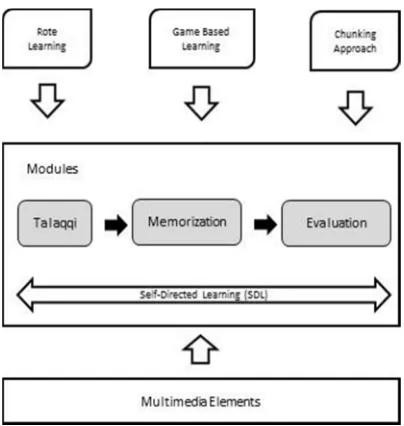
[image:3.612.89.291.459.672.2]The conceptual framework of designing and modelling a mobile Quranic memorization application using multimedia interactive learning method is shown in figure 2.
Figure 2. A Conceptual Framework for Designing Mobile Quranic Memorization Tool using Multimedia
Interactive Learning Method.
This conceptual framework consists of integrating learning theories and multimedia elements for effective learning process. Modules for memorizing are divided into three phases namely talaqqi, memorization, and evaluation.
3.2 Learning Theories
Learning theories are the main guide to
assist the learning process to be more effective.
Learning theories that will be implemented in the prototype are game-based learning, chunking approach and rote learning .
Game-based learning refers to the borrowing of certain gaming principles and applying them to real-life settings to engage users [14] around the world [27]. Digital game based-learning can improve the learning effectiveness of students [15][16][17]. Based on Whitton [28], game-based learning create attraction and engagement for experience and environment learning. In game-based learning, students play the game, participate in the learning activities to understand the concept, and allow students to engage with educational materials in a playful and dynamic way as well as guide participants towards the goal of the game [29][30]. This theory is suitable for the memorization of Quran so that children can be motivated to learn while having fun exploring.
ISSN: 1992-8645 www.jatit.org E-ISSN: 1817-3195
23 the ayat for five times. The repetition will strengthen the memory of the user.
The process of separating knowledge into smaller parts that have meaning is known as chunking. Chunking to memorize something will enable outstanding memory performance [32]. Chunking is an encoding strategy that improves working memory performance [20] and to reduce the cognitive load as the learner process information [31]. Based on psychology, a person can memorize something in limit information at once but if information is systematically organized and knowledge is integrated by meaningful and characteristic chunking, the person may develop memory in an effective way [33]. The information is broken down by chunking to accomplish the meaning of the information [34]. This is important to children who benefit from chunking to read large text. Chunking will help children to memorize short sentences [35]. This method is used in memorization where, the items are divided into small and easily memorable chunks or groups. Chunking the long ayat into parts will be easier for students to memorize [19].
3.3 Multimedia Elements
Multimedia is an integration of different elements such as text, graphic, audio, video and animation [21][22].
Text involves the use of text types, sizes, and colours. The use of images is to emphasize directed attention and illustrate concepts. Graphics help to illustrate ideas through still pictures. The use of graphics can help sharpen learners’ memories [23]. A multimedia application may require audio or sound to attract learners [24]. Video provides a powerful impact in a multimedia program. Animation is a process of making a static image look like it is moving. Animation is essential to improve understanding of young learners [23].
3.4 Modules
There are three important modules to memorize Quran in this framework. The modules are Talaqqi, Memorization and Evaluation.
Talaqqi Module is where listening, and repetition of the correct Al-Quran recitation takes place. Memorization module is focused on memorizing Quran. Each ayat will be repeated
five times. Furthermore, there are activities to ensure learners have memorized the surah. Evaluation module will assess learners on memorizing each surah. Time and score will be recorded and the result is displayed at the end of activity.
4. RESULTS AND DISCUSSION
The main finding of this research is a conceptual framework for designing mobile quranic memorization tool using multimedia interactive learning method for children. The proposed conceptual framework will be validated using prototyping approach.
In summary, by adapting the theories, and literature review, the conceptual framework proposed were applied in the design phase which is storyboarding. Storyboarding is typically part of the development phase.
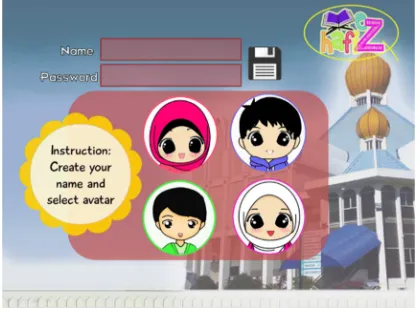
[image:4.612.323.533.467.623.2]Figure 3 shows an interface for user registration. Learners may choose their desired avatar throughout the learning process. This prototype will save learner information in a database. In doing so, they may always continue at the level they stopped last.
Figure 3. Interface for User Registration
ISSN: 1992-8645 www.jatit.org E-ISSN: 1817-3195
24 Figure 4. Interface for Levels
[image:5.612.91.535.53.261.2]There are two surahs for each level. An example for easy level is shown in figure 5. Learners must complete each surah before moving to the next one.
Figure 5. Interface for Easy Level
In module Talaqqi shown in figure 6, learners need to listen to the correct recitation first. Audio for each surah with correct recitation is important to young learners as they must listen intently to the surah.
Figure 6. Interface for Talaqqi
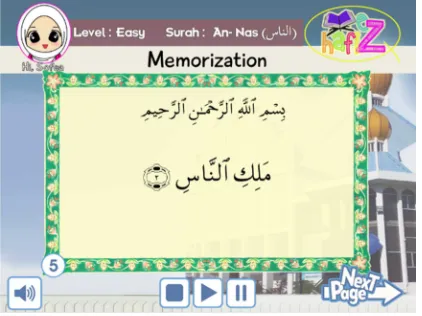
[image:5.612.89.297.348.502.2] [image:5.612.324.535.378.536.2]In this module memorization, chunking and rote learning will be applied in the prototype (Figure 7). Learners will repeat five times of the same ayat in memorizing each surah. The surah will be chunked by each ayat to make it easier for learners to memorize the surah. These theories are combined to complete the memorization module..
Figure 7. Interface for Memorization
ISSN: 1992-8645 www.jatit.org E-ISSN: 1817-3195
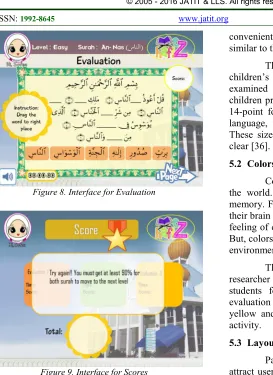
[image:6.612.95.368.63.438.2]25 Figure 8. Interface for Evaluation
Figure 9. Interface for Scores
5. DESIGNGUIDELINES
Past researchers have made large contributions to the learning process by adopting information technology in their work. They develop guidelines to help developers and designers in creating mobile application based on their targeting audiences [36]. So, this paper discusses design guidelines that will be implemented in the Quran memorization tool using multimedia interactive elements.
5.1 Typography
The first guideline is related to font types and sizes. Choosing the right font type and size will attract children to read and focus. The most important is to choose a clear typeface, straightforward, simple form and easy for children to read [36, 37]. So, the most suitable font to use is sans serif font which are Arial, Tahoma and Comic Sans MS [35, 36]. Additionally, most children are attracted to Traditional Arabic and Arial Unicode MS font for reading in Arabic language. This typeface is
convenient, comfortable for children’s level and similar to their text book [36].
The font size can also influence children’s focus. A number of studies have examined this issue for children. Majority the children preferred to use font size in 12-point or 14-point for English language. But, for Arabic language, they preferred 30-point of font size. These sizes are convenient, readable, large and clear [36].
5.2 Colors
Colors are an essential part to perceive the world. Colors can influence emotions and memory. For children, some colors may increase their brain activity, induce relaxation and create a feeling of excitement and helps them focus [35]. But, colors must synchronize with the application environment.
Therefore, for this application, the researcher uses cool colors such as blue to help students focus. In addition, for activity and evaluation module, bright colors are used such as yellow and orange to increase children’s brain activity.
5.3 Layout
Page layout plays a crucial role to attract users towards the interface. According to Osaimi [36], page layout preferences were analyzed from layout arrangement, object locations and utilization of user interface. The researcher found that the children preferred to place the object above or under text/images.
The children were more interested when main text/ images are on the middle center area [36]. That location is similar in appearance on the internet browser. Children feel comfortable to use the application.
In addition, the shape and symbol of the buttons also influence children. , The developed layout has objects placed above and under the middle center area. The shape of the buttons are curvy and familiar symbols easily recognized by the children are used. This development of layout will attract children to use this application.
6. CONCLUSION
ISSN: 1992-8645 www.jatit.org E-ISSN: 1817-3195
26 the validated proposed conceptual model, Quranic mobile tool has been successfully designed. This application has a great potential as a tool to memorize Quran anytime and anywhere. As for future work, the application will be evaluated for its usability and effectiveness to obtain perception from learners.
7. ACKNOWLEDGEMENT
This work is fully supported by UniSZA. (Grant No. UNISZA/2015/DKP/10)
REFERENCES:
[1] Khurram Khan M, Alginahi YM. The holy quran digitization: Challenges and concerns. Life Sci J. 2013;10(2):156–64.
[2] Ariffin Sedek. Keunikan metode-metode hafazan al-quran di dunia: suatu tinjauan terhadap kaedah di malaysia, india, pakistan, arab saudi, indonesia, dan turki. 2011;1–23. [3] Mazaayaa. A. Ilmu tahfiz : panduan
menghafal al-Quran. Kuala Lumpur: Darul Nu’man; 1996.
[4] Elobaid M, Hameed K, Yahia Eldow ME. Toward designing and modeling of Quran learning applications for android devices. Life Sci J. 2014;11(1):160–71.
[5] Education Quran Reciter [Internet]. 2016 [cited 10 February 2016]. Available from: http://www.islamicity.com/education/quranre citer/
[6] House of Quran [Internet]. 2016 [cited 2 February 2016]. Available from: http://www.houseofquran.com/quransys/qsys .html
[7] Quran Tracker [Internet]. 2016 [cited 7 February 2016]. Available from: http://www.qurantracker.com/
[8] ImaanStar. [Internet]. 2016 [cited 31 January
2016]. Available from:
http://www.imaanstar.com/juz30.php
[9] Mohamed Elhadj YO. E-halagat: An e-learning system for teaching the holy quran. Turkish Online J Educ Technol. 2010;9(1):54–61.
[10] Adhoni ZA, Hamad H Al, Siddiqi AA, Adhoni ZA. An Instant-Based Qur’an Memorizer Application Interface. 2013 Int Conf Inf Sci Cloud Comput Companion [Internet]. 2013;382–7. Available from:
http://ieeexplore.ieee.org/lpdocs/epic03/wrap per.htm?arnumber=6973622
[11] Sharples M, Taylor J, Vavoula G. Towards a Theory of Mobile Learning. Proc mLearn. 2005;1(1):1–9.
[12] Liu H, Huang R, Salomaa J, Ma D. An Activity-Oriented Design Framework for Mobile Learning Experience. Fifth IEEE Int Conf Wireless, Mobile, Ubiquitous Technol Educ. 2008;185–7.
[13] Jeng Y, Wu T, Huang Y, Tan Q, Yang SJH. The add-on impact of mobile applications in learning strategies: A review study. Educ Technol Soc. 2010;13(3):3–11.
[14] Trybus J. [Internet]. 2015. Available from: http://www.newmedia.org/game-based- learning--what-it-is-why-it-works-and-where-its-going.html
[15] Kebritchi M, Hirumi A, Bai H. The effects of modern mathematics computer games on mathematics achievement and class motivation. Computers & Education. 2010;55(2):427-443.
[16] Liu T, Chu Y. Using ubiquitous games in an English listening and speaking course: Impact on learning outcomes and motivation. Computers & Education. 2010;55(2):630-643.
[17] Yang Y. Building virtual cities, inspiring intelligent citizens: Digital games for developing students’ problem solving and learning motivation. Computers & Education. 2012;59(2):365-377.
[18] Hamiz M, Bakri M, Haron H, Jamil N. Repetitive Memorization Mobile Application Development for Elderly Memory Recall. 2014;150–5.
[19] Ariffin S, Abdullah M, Suliaman I, Ahmad K, Deraman F, Shah FA, et al. Effective Techniques of Memorizing the Quran : A Study at Madrasah tahfiz Al-quran, Terengganu, Malaysia. Middle-East J Sci Res. 2013;13(1):45–8.
[20] Huntley J, Bor D, Hampshire A, Owen A, Howard R. Working memory task performance and chunking in early Alzheimer's disease. The British Journal of Psychiatry. 2011;198(5):398-403.
ISSN: 1992-8645 www.jatit.org E-ISSN: 1817-3195
27 2nd International Conference on. 2010;3:V3-110-V3-112.
[22] Weiss I, Kramarski B, Talis S. Effects of multimedia environments on kindergarten children’s mathematical achievements and style of learning. EMI Educ Media Int [Internet]. Routledge; 2006 Mar 1;43(1):3–
17. Available from:
http://dx.doi.org/10.1080/0952398050049051 3
[23] Betrancourt M, Chassot A. Making Sense of Animation. Learning with Animations: Research Implications for Design. 2008:141-64.
[24] Ali B, Zaman HB. Framework for adaptive multimedia mathematics courseware. InProceedings of the 2nd IMT-GT Regional Conference on Mathematics, Statistics and Applications Universiti Sains Malaysia, Penang 2006 Jun.
[25] Al-Mosallam E. Towards Improving Quran Memorization Using Mind Maps. 2013 Taibah University International Conference on Advances in Information Technology for the Holy Quran and Its Sciences. 2013;.
[26] Bakri A, H AbuSafia A. A Conceptual Framework for Arabic Language Courseware Using Persuasive Design. International Journal of Innovative Computing. 2014 Jun 12;4(2).
[27] Skehan L. Game-Based Learning Australian Curriculum [Internet]. The Journal of Digital Learning and Teaching Victoria. 2014.
Available from:
http://www.dltv.vic.edu.au/sites/dltv.vic.edu. au/files/journal/pdfs/game_based_learning_a nd_the_australian_curriculum.pdf.
[28] Whitton N. Game engagement theory and adult learning. Simulation & Gaming. 2010 Aug 10.
[29] Pho A, Dinscore A. Game-based Learning. Association of College and Research Libraries and American Library Association. 2015;
[30] Featherstone G, Aston H, Houghton E. Game-based learning: Latest evidence and future directions. Slough: NFER; 2013 Apr. [31] Toh SC, Ahmed W, Munassar S, Ahmad W,
Wan J. Redundancy effect in multimedia learning : A closer look. Curriculum, Technol
Transform An Unkn Futur Proc Ascilite Sydney. 2010;988–98.
[32] Ito T, Matsubara H, Grimbergen R. The Use of Memory and Causal Chunking in the Game of Shogi. Third Int Conf Cogn Sci. 2001;134–40.
[33] Bao ZJ. On Constructing the Cognitive Model of Knowledge Acquisition in
Globalization-Oriented Study.
2013;10(7):517–23.
[34] Hobbs E. Aps cares Collaborative and Responsive Educational Support. APS Healthcare. 2014;(Fall 2014):2–18.
[35] Wängberg M. Developing Mobile Applications for Children. 2012.
[36] Al-Osaimi A, Alsumait A. Design guidelines for child e-learning applications with an Arabic interface. Kuwait J Sci Eng [Internet]. 2012;39(1B):149–73. Available from: <Go to ISI>://WOS:000307319200009
[37] Siti N, Nik F, Nor S, Shamsuddin W, Husain R. A Conceptual Framework for Designing a Computer-based Dyslexia Screening Test. Third Int Conf Informatics Appl [Internet].
2014;46 50. Available from:
http://sdiwc.net/digital-library/a-conceptual- framework-for-designing-a-computerbased-dyslexia-screening-test.html