5510
RECENT PROGRESS OF FACTORS INFLUENCING
INFORMATION TECHNOLOGY ADOPTION IN LOCAL
GOVERNMENT CONTEXT
1FAIZURA HANEEM, 2NAZRI KAMA
1,2Advanced Informatics School, Universiti Teknologi Malaysia, Kuala Lumpur, Malaysia
E-mail: 1[email protected], 2[email protected]
ABSTRACT
Information Technology (IT) adoption is increasingly being studied in many different contexts, both in public and private sectors. However, there are not many review papers published on IT adoption specifically in a local government context. Local governments have unique characteristics in terms of the organization’s structure, the power of authority, norms and culture. Hence, the primary aim of this study was to review recent literature from the year 2013 to 2017 on IT adoption at the organizational level in a local government context. We strategized our review methods through utilizing relevant keyword search in Scopus, Web of Science, Emerald and Springer Link databases which include journals, proceedings, books and book chapters. The search identified 715 publications during the initial stage using the snowballing technique. Thereafter, 22 relevant publications were filtered out during the quality assessment stage. Within the context of local government, this review presented the analyses of IT adoption research progress, the research domains, research methodology and the factors influencing IT adoption. This study identified 37 factors of IT adoption in local government context which have been categorized into four main dimensions which are Technological, Organizational, Individual and Environmental (T-O-I-E). Surprisingly, policy and regulations, top management support, relative advantage, cost, governance, personnel skills and citizen demand emerged as among the most influential factors for IT adoption in the context of local governments. The results from this study will help other researchers to understand the current stage of IT adoption in local government context in terms of research domains, research methodology, and the factors influencing IT adoption.
Keywords: IT Adoption, Local Governments, Local Authorities, Review
1. INTRODUCTION
In recent years, there has been increasing interest in studying IT adoption in many different contexts. According to Rogers 1995, IT adoption refers to “the process through which an individual or other decision-making association passes from first knowledge of an innovation to forming an attitude towards innovation, to a decision to adopt or reject, to implementation of the new idea, and to confirmation of this decision”. A study by Salahshour, Mehrbakhsh, and Dahlan 2017 reported that since the year 2006 - 2015, there has been a dramatic increase in the number of IT adoption studies. There are three dominant levels of analysis in the studies, which are individual, organization, and group of individuals. In addition, the majority of IT adoption studies aimed to understand, predict and explain the factors influencing adoption of IT innovations which typically led to the development of an adoption model.
5511 Additionally, Gangwar, Date, and Raoot 2014 also conducted a review on IT adoption at an organizational level to understand the requirements of integrated models for IT adoption. The study analyzed literary works on IT adoption from the year 2000-2012. The paper aimed to review the studies that adopted the Technology Acceptance Model (TAM) theory by Venkatesh et al. 2003 or TOE framework by Tornatzky et al. 1990 as the underpinning theories in identifying the factors that influenced IT adoption. Due to the limitation of TAM model and TOE framework, the study had proposed the integration between these two concepts to increase the comprehension level of technology adoption.
Although some review studies on IT adoption have been carried out, there is very little focus on IT adoption, particularly by local governments. Local governments have unique characteristics in terms of organizational structure, power of authority, norms and culture. Local governments typically comprise four core businesses in their organizations namely corporate management, town planning and development, engineering and maintenance, and town service. As the entities closely dealing with the citizen, they encounter different challenges compared to other types of government organizations as well as organizations from the private sector. Research studies on IT adoption in a local government context may need to use specific research methods that are suitable in the context of that country. Furthermore, the factors influencing IT adoption in local governments may be different from the factors in other organizations due to their unique characteristics.
Hence, this review study aims to address the knowledge gap by comprehensively reviewing recent literature on IT adoption in a local government context, regardless of the underpinning theories. This study attempts to answer main research questions of “What was the technological, organizational, individual, and environmental (T-O-I-E) factors that influenced technology adoption in a local government context?”. Within the local government context, this review study presents the analyses of IT adoption research progress from the year 2013 to 2017, the research domains, research methodology by country and the factors influencing IT adoption. This paper starts off by discussing the background of IT adoption and the gaps found in earlier studies, then it describes the review approach applied in the study. Subsequently, the investigation on 22 relevant publications and analysis of the
findings is reported based on the formulated research questions. Finally, the paper concludes with a recommendation for future work.
2. RESEARCH METHODOLOGY
This review paper is designed based on a systematic review methodology for IS research that is proposed by Okoli and Schabram 2010. This study simplified the review protocol suggested by Okoli and Schabram 2010 to four (4) stages, enumerated as follows: (1) research questions; (2) search strategy design; (3) study selection; and (4) analysis of findings.
2.1 Research Questions
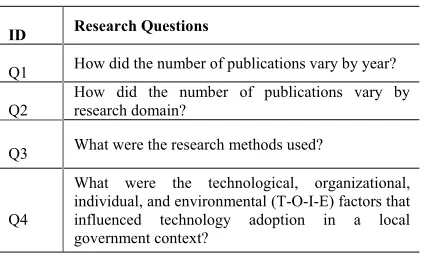
[image:2.612.309.520.371.498.2]As described earlier, this paper aims to synthesize the recent literature on IT adoption in a local government context. To achieve this aim, four research questions were formulated as shown in Table 1.
Table 1. Research Questions
ID Research Questions
Q1 How did the number of publications vary by year?
Q2 How did the number of publications vary by research domain?
Q3 What were the research methods used?
Q4
What were the technological, organizational, individual, and environmental (T-O-I-E) factors that influenced technology adoption in a local government context?
2.2 Search Strategy Design
Three search strategies have been designed, namely the source of databases, search keywords and search criteria.
Source of Databases: Four electronic databases were selected: 1) Scopus, 2) Web of Science; 3) Emerald, and 4) Springer Link. The title, abstract and index terms were used to conduct searches for journals, proceedings, books, and book chapters. The selection of databases was based on the librarian’s and experts’ recommendations, depending on the database availability at our university library.
5512 keywords in relevant papers or books; and 3) Usage of the Boolean OR to incorporate alternative spellings and synonyms. The initial search strings used were “adopt”, “adoption”, “acceptance”, “intention”, “local”, “government”, “authorities”, “city councils”, and “municipal”. Then, the search strings were combined using “AND” and “OR” Boolean. The search strings were used in each electronic database to retrieve the publications based on the titles, abstracts, and keywords, depending on the advanced search facility provided by each database.
Search Criteria: Three search criteria were used: 1) the language used in the paper was English; and 2) the paper was categorized under journals, proceedings, books, and book chapters, and 3) the search process involved a retrieval of publications from 2013 to 2017.
2.3 Study Selection
Initially, 685 publications were identified using the search keywords from the selected databases. The search was then extended to Google Scholar database using snowball method, which increased the number of publications to 715. This was to ensure that other publications that were not indexed in our selected databases were also considered. From the search, an additional 30 publications were found.
During the search process, metadata of the initial articles results were gathered and indexed. The metadata were: 1) Electronic Repository; 2) Title of the literature; 3) Abstract; 4) Year; 5) Publication Type; and 6) DOI/ISBN/ISSN Number. Based on the metadata, deduplication process was then performed to eliminate any duplicated copies of the articles [11], [12]
Next, a practical screening process was conducted which involved screening the titles and abstracts of the publications to select relevant publications. In this process, publications that discussed topics other than IT adoption (such as policy, environment, energy and product innovation adoption) were removed. Then, quality assessment was conducted against the selected publications by evaluating the criteria listed in Table 2. Quality assessment criteria involved retrieval of the full version of these publications, the type of study, the level of analysis, and the context of these studies. According to Hanafizadeh, Keating, and Khedmatgozar 2014, IT adoption studies can be classified into three categories, namely relational studies, descriptive studies and comparative studies. This study only considers the relational studies of
IT adoption which the discovery of adoption factors is a main objective of the studies.
Table 2. Quality Assessment Criteria
ID Criteria
A1
Can the full version of the publication be retrieved?
A2
Does the paper explain the adoption factors of the IT innovation domain (relational studies)?
A3
Does the publication study on the organizational level?
A4
Does the publication context involve the local government?
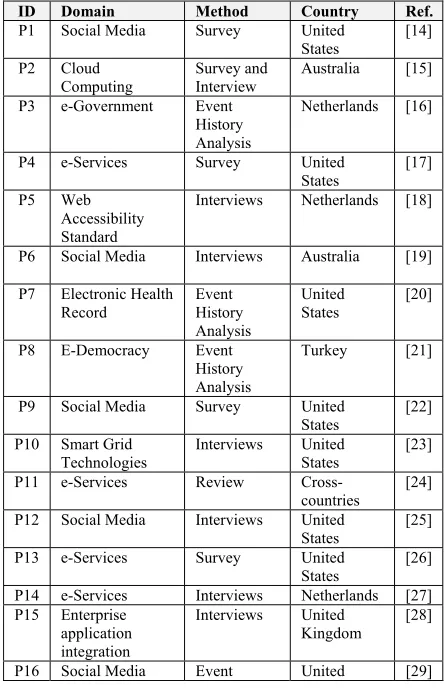
[image:3.612.306.528.392.736.2]After conducting the quality assessment, 22 publications were selected for the analysis stage. Table 3 presents all the qualified publications for the analysis based on the study domain, methodology, and sample. The following section analyses the findings from these qualified publications.
Table 3. Qualified Publications for Analysis
ID Domain Method Country Ref.
P1 Social Media Survey United
States
[14]
P2 Cloud Computing
Survey and Interview
Australia [15]
P3 e-Government Event
History Analysis
Netherlands [16]
P4 e-Services Survey United
States
[17]
P5 Web
Accessibility Standard
Interviews Netherlands [18]
P6 Social Media Interviews Australia [19]
P7 Electronic Health
Record Event History Analysis
United
States [20]
P8 E-Democracy Event
History Analysis
Turkey [21]
P9 Social Media Survey United
States
[22]
P10 Smart Grid Technologies
Interviews United States
[23]
P11 e-Services Review
Cross-countries [24] P12 Social Media Interviews United
States
[25]
P13 e-Services Survey United
States
[26]
P14 e-Services Interviews Netherlands [27] P15 Enterprise
application integration
Interviews United Kingdom
[28]
5513
History Analysis
States
P17 Social Media Survey United
States
[30]
P18 e-Government Survey United
States
[31]
P19 e-Government Interviews Pakistan [32]
P20 Data Sharing Survey United
States
[33]
P21 Social Media Survey United
States
[34]
P22 Cloud
Computing Interviews China [35]
3. FINDINGS AND DISCUSSION
The investigation was done on 22 qualified publications and the analysis of the findings is reported based on the formulated research questions. As described earlier, there are four research questions to be answered by this review study. The following sections describe the findings based on the research questions.
3.1 How did the Number of Publications vary
by Year?
[image:4.612.97.538.67.238.2]Figure 1 shows the graphic visualization of the number of publications on IT adoption in local governments from the year 2013 to 2017. Interestingly, there is a fluctuated trending shown from the visualization. In 2013, there were six literary works published (P14, P15, P16, P17, P18, and P19) and in 2014 the number of publications had decreased to four (P10, P11, P12, and P13). Meanwhile, the number of publications had further increased to five in 2015 (P5, P6, P7, P8 and P9) and later dropped again to three in 2016 (P2, P3, and P4). In 2017, three literary works were found (P1, P21, and P22).
Figure 1. Publication distribution by Year
3.2 How did the Number of Publications vary
by Research Domain?
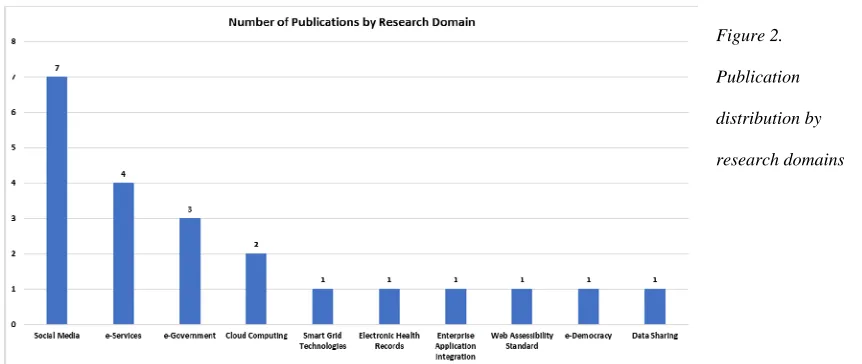
[image:4.612.98.529.543.725.2]A wide variety of IT domains were researched in the earlier studies as illustrated in Figure 2. Among the selected 22 publications, social media was the most popular domain researched for the past five years. Seven literary works (P1, P6, P9, P12, P16, P17 and P21) discussed the factors in adopting social media which included Facebook and Twitter. This is then followed by e-Services, e-Government, and cloud computing domains in which four (P4, P11, P13 and P14), three (P3, P18, and P19) and two (P2 and P22) literary works have been published respectively. Only one literary work has been found in the domain of smart grid technologies (P10), electronic health record (P7), enterprise application integration (P15), web accessibility (P5), e-democracy (P8), and data sharing (P20) respectively.
Figure 2.
Publication
distribution by
5514
3.3 What were the research methods used?
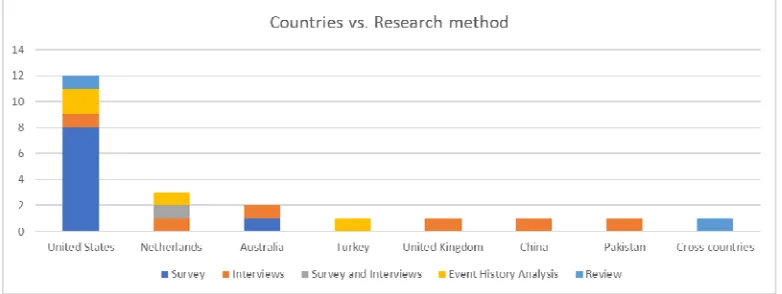
The analysis of the research methods revealed different research methods that were used by the earlier researchers in studying IT adoption in different context or country. Interestingly, a majority of the studies were carried out in the developed countries (P1-P7, P9-P18, P20-P22) which were Australia, Netherlands, United Kingdom, United States and China. There were two studies that had been conducted in a developing country which was Turkey (P8), and Pakistan (P19). Figure 3 shows the fraction of context employing a particular research method.
Most of the literary works used interviews in studying IT adoption by local governments. Interview technique was used in Pakistan (P19), Australia (P6), Netherlands (P5 and P14), United Kingdom (P15), the United States (P10 and P12) and China (P22). The next most commonly used technique was surveyed; interestingly this technique has been applied to the study of IT adoption in only one country which is the United States (P1, P4, P9, P13, P17, P18, P20, and P21). The Event History Analysis (EHA) techniques were applied in studying IT adoption in Turkey (P8), Netherlands (P3) and the United States (P3, P7, and P16). EHA refers to the analysis of secondary data from previous reports and web content analysis. Surprisingly, only one literary work was found applying both survey and interview techniques during data collection, which was a literary work from Australia (P2). Hence, one literary work (P11) used only literature review in studying IT adoption within the local government context.
3.4 What are the T-O-I-E Factors that Influence
Technology Adoption in Local Government Context?
The TOE framework by Tornatzky et al. 1990 suggests that adoption factors at firm level can be divided into technological, organizational and environmental dimensions. However, more recently, based on a thorough literature review by Wisdom et al. 2014, the study had divided the organizational dimension into two main groups, which are organizational and individual characteristics in which individual represents humans in the organization. Hence, for a better explanation, this study chooses to classify the identified adoption factors into four main dimensions namely technological, organizational, environmental, and individual dimensions.
[image:5.612.125.516.509.656.2]Table 4 represents identified factors that have been found in the recent literature on IT adoption in local government context according to technological, organizational, individual and environmental dimensions. Majority determinants of IT adoption in local government context are from organizational dimension (fifteen determinants), followed by technology (eight determinants), environmental dimension (eight determinants), and individual (six determinants). The most striking result that emerged from the data was that policy and regulations appear to be the most influential factors for IT adoption in a local government context. This is followed by top management support, relative advantage, cost, governance, personnel skills, and citizen demand.
5515
Table 4. Factor influencing IT adoption in local governments
• stated in the literature Factors of IT
Adoption in Local
Governments [14] [15] [16] [17] [18] [19] [20] [21] [22] [23] [24] [25] [26] [37] [28] [29] [30] [31] [32] [33] [34] [35]
Frequency in Literature P1 P2 P3 P4 P5 P6 P7 P8 P9 P10 P11 P12 P13 P14 P15 P16 P17 P18 P19 P20 P21 P22
TECHNOLOGICAL
Relative Advantage • • • • • • 6
Complexity • 1
Security • • • • 4
Cost • • • • • • 6
Compatibility • • • 3
Perceived Risk • • • 3
Data storage location • 1
Availability of providers
• • 2
ORGANIZATIONAL
Governance • • • • • • 6
Organization experience
• • • • 4
Organization size • • • • 4
Organizational structure
• • 2
Geographic location • • • 3
Type of government • • • 3
Region of the country • • 2
Citizen median house-hold income
• • • 3
Size of population
served • • • 3
Number of services offered
• 1
Poverty indexed factor
• 1
Population education
level • • 2
Population racial composition
• • 2
Adaptability • • 2
Trust • 1
INDIVIDUAL Top management support
• • • • • • • 7
Personnel knowledge • • • • • 4
Personnel experience • • 2
Personnel skills • • • • • • 6
Innovation culture attitude
• • • • 4
Technology champion
• • 2
ENVIRONMENTAL Policy and
Regulation
• • • • • • • • 8
Citizen Demand • • • • • • 6
Political Influence • • • • 4
ICT Infrastructure • • • • 3
Technology Movement
• • 2
Financial support • • • 3
Competition • 1
Higher authority
5516
3.1.1 Technological
Technological dimension describes the characteristic of the technology itself which includes the equipment, functionalities, cost and methods to adopt the technology Tornatzky et al. 1990; Wisdom et al. 2014. This study found that relative advantage was one of the most influential factors of IT adoption by local governments in recent literature (P6, P10, P15, P19, P21, and P22). Relative advantage refers to the degree to which IT innovation could increase the return on investment, reduce operating costs, resolve current problems and receive a lot of benefits. Local governments are tempted to adopt particular IT innovation when they perceive many benefits from the technology to their organization. On the other hand, the cost of implementing the IT innovation also appeared to be the most influential factor for IT adoption by local governments as shown by past studies. The financial budget needed in implementing the IT innovation is crucial and could influence local governments to adopt IT innovation such as web accessibility standard (P5), e-democracy (P8), smart grid technologies (P10), enterprise application integration (P15), e-government (P19) and cloud computing (P22). Other factors influencing local governments to adopt IT innovations are security, compatibility, complexity, perceived risk, data storage location and availability of different providers. Security refers to the degree to which IT innovation could preserve their information confidentiality. This study reveals that security factor plays an important role for local governments to decide whether or not to adopt the technology (P2, P11, P12, and P15). Compatibility, which refers to the degree of compatibility between IT innovation and organization’s norms and culture, appeared significant in the adoption of web accessibility standard (P5), social media (P6) and e-services (P11).
The degree of organization difficulty to implement the IT innovation or also known as complexity was an influencing factor in adopting e-services by local governments (P11). Perceived risks referring to the degree of probability in damage and loss to the organization appeared as the influencing factors in adopting e-services (P4), social media (P6) and enterprise application integration (P15). Meanwhile, data storage locations and availability of providers are the influencing factors on cloud computing adoption by local governments (P2 and P22). Data storage location refers to the location where the information will be located, whether in-shore cloud or off-in-shore cloud. While the
availability of providers refers to the number of vendors or solution providers that could deliver the IT innovation to the organization, it also involves the availability of the solution provided by the vendor.
3.1.2 Organizational
5517 top reasons why local governments intend to adopt IT innovation such as electronic health record (P7) and social media (P12 and P21). Citizen median house-hold income is also one of the key factors in local governments context for the adoption of social media (P17), and e-government (P18, P19).
The findings of this study also found that structure and region of the local government had influenced the adoption of social media (P1 and P17), e-services (P4), and e-government (P18). The region of the local government refers to whether the organization was located in the West, South, North Central, or Northeast of the country, while the type of local government refers to the authority power within the organization, whether centralized or decentralized. The education of the population which refers to the percentage of graduates or those with professional degrees among the citizens served by the local government is the factor that has an association with the adoption of e-government by local government (P18 and P19). It is similar to the population racial composition which refers to the percentage of each race in the country served by the organization, which also appeared relevant as an influencing factor of e-government (P18 and P19).
Other factors that are positively influencing the adoption of IT innovations in local governments context are adaptability, a number of services offered, poverty indexed factor and trust. Adaptability that refers to the degree to which an organization is able to respond to the need for change when implementing the IT innovation, has a significant effect to the adoption of e-services (P11) and cloud computing (P22). Meanwhile, the number of services offered to the citizens and citizen poverty index factor has a positive effect on the adoption of electronic health record (P7). A recent study of IT adoption in local governments context reveals that trust is a critical factor for the local governments to adopt cloud computing (P22).
3.1.3 Individual
An individual dimension represents the characteristics of personnel within the organization to adopt the technology [36], [38]. This includes top management support, personnel’s skills, knowledge, innovation culture attitude, experience, and technology mastering. This study found that top management support and personnel skills are very important factors in adopting IT innovation. Top management support refers to the degree of management support on the adoption of an IT innovation [39]. Top management support is revealed as a key factor in the adoption of social media (P1 and P12), web accessibility standard
(P5), smart grid technologies (P10), enterprise application integration (P15), e-government (P19), and cloud computing (P22). Meanwhile, personnel skills appeared to be relevant as an influencing factor in the adoption of e-services (P4 and P11), smart grid technologies (P10), enterprise application integration (P15), e-government (P19), and social media (P21). Local governments with an expertise to operate the IT innovation have a higher intention to adopt these technologies.
In addition, personnel knowledge and innovation culture attitude were also discovered to be influencing factors of IT adoption in a local government context. Personnel knowledge, which refers to the level of personnel’s knowledge of IT innovation or equivalent technology, is found significant in the studies of IT adoption (P1, P2, P5, P7, and P15). Meanwhile, innovation culture attitude that is referring to the degree of IT innovation acceptance by an organization’s personnel does have a positive effect on the adoption of social media (P1 and P6) and smart grid technologies (P10). The existence of IT champion in the organization also plays an important role in influencing the local governments to adopt smart grid technologies (P10) and enterprise application integration (P15). Personnel experience, referring to the years of personnel’s past experience in operating the IT innovation or equivalent technology, is also a key factor for local governments in adopting social media (P1) and web accessibility standard (P5).
3.1.4 Environmental
5518 Political Influence refers to the degree of political support for the local governments to implement the IT innovation. Even though the political influence is an external pressure from third parties, this factor is found to be significant for local governments in adopting social media (P1), e-government (P3 and P19) and e-services (P4). ICT Infrastructure, which refers to the degree of availability of ICT infrastructure to support the IT innovation implementation, appeared significant to the adoption of cloud computing (P2), e-services (P11), enterprise application integration (P15) and e-government (P19).
Technology movement that refers to the high proliferation of the IT innovation is found to have a significant effect on the adoption of social
[image:9.612.90.520.318.513.2]media and e-democracy (P6 and P8). Financial support that refers to the existence of financial support from external parties (e.g. politicians or federal government) has a significant effect to the adoption of cloud computing (P2, P22), and e-services (P11). Only one study found that the level of competition among local governments also plays an important role in the adoption of smart grid technologies (P10) while another study discovered that higher authority support is a critical factor to adopt enterprise application integration in local governments (P15). Higher authority support is the level of moral support received from external authorities (e.g. politicians, federal government). Overall, the influencing factors of IT adoption in a local government context is presented in Figure 5.
Figure 5. Factors of Technological, Organizational, Individual, and Environmental (T-O-I-E) of IT adoption in Local Governments
4. CONCLUSION
To conclude, this study has achieved the aims to review recent literature on IT adoption in local government context and answering the main research questions of “What was the technological, organizational, individual, and environmental (T-O-I-E) factors that influenced technology adoption in a local government context?”. This study has been one of the first attempts to thoroughly review recent literature on IT adoption in local government context from the year 2013 to 2017. This study has highlighted a fluctuated trend of IT adoption in
5519 local government context. One of the more significant findings to emerge from this review study is that 37 factors of IT adoption in local government context have been identified and they can be categorized into four main dimensions which are Technological, Organizational, Individual and Environmental (T-O-I-E). Interestingly, policy and regulations from the environmental dimension appear to be the most influential factors for IT adoption in local governments and followed by top management support, relative advantage, cost, governance, personnel skills, and citizen demand. Taken together, these findings can be used to help other researchers to understand the current stage of IT adoption in local government context in terms of research domains, research methodology, and the factors influencing IT adoption.
5. LIMITATIONS AND FUTURE WORKS
This study expands our knowledge about the factors influencing IT adoption among local governments. The study reviews literary works from four databases which are available to the author via the author’s library subscription. With this limitation, it is recommended that future works also review IT adoption studies in other databases as well. The primary aim of this study was to review recent literature from the year 2013 to 2017 on IT adoption at the organizational level in a local government context. Although the review had filtered out literature that investigates the IT adoption at the organizational level, the authors had in the process discovered a wealth of literature that investigates the IT adoption at the individual level. For this reason, it is recommended that this review study can perhaps be extended to also examine the factors that influence IT adoption in local government context at the individual level. Additionally, further studies should thoroughly review the current literature of each research domain (e.g. social media, government and e-services) to identify the factors that influence IT adoption within that specific area.
6. ACKNOWLEDGEMENT
The study is financially supported by 01M16, Matching Grant awarded by University Teknologi Malaysia.
REFERENCES
[1] E. M. Rogers, “Diffusion of innovation theory.” New York, 1995.
[2] M. Salahshour, R. Mehrbakhsh, and H. M. Dahlan, “Information technology adoption : a review of the literature and classification,” Univers. Access Inf. Soc.,
2017.
[3] M. Oliveira, Tiago., Martins, “Literature review of Information Technology Adoption Models at Firm Level,” Electron.
J. Inf. Syst. Eval., vol. 14, no. 1, pp. 110–
121, 2011.
[4] H. Gangwar, H. Date, and A. D. Raoot, “Review on IT adoption : insights from recent technologies,” J. Enterp. Inf.
Manag., vol. 27, no. 4, pp. 488–502, 2014.
[5] Tornatzky, L. G., M. Fleischer, and A. K. Chakrabarti, Processes of technological
innovation. Lexington Books, 1990.
[6] W. R. Scott and S. Christensen, The institutional construction of organizations:
International and longitudinal studies. Sage
Publications, Inc, 1995.
[7] C. L. Iacovou, I. Benbasat, and A. S. Dexter, “Electronic data interchange and small organizations: Adoption and impact of technology,” MIS Q., pp. 465–485, 1995.
[8] V. Venkatesh, M. G. Morris, G. B. Davis, and F. D. Davis, “User acceptance of information technology: Toward a unified view,” MIS Q., pp. 425–478, 2003.
[9] C. Okoli and K. Schabram, “Working Papers on Information Systems A Guide to Conducting a Systematic Literature Review of Information Systems Research,” Sprout
Work. Pap. Inf. Syst., vol. 10, no. 26, pp. 1–
51, 2010.
[10] B. Kitchenham and S. Charters, “Guidelines for performing Systematic Literature Reviews in Software Engineering,” Tech. Rep. EBSE-2007-01,
2007.
[11] Q. He, Z. Li, and X. Zhang, “Data deduplication techniques,” in Future Information Technology and Management Engineering (FITME), 2010 International
Conference, 2010, vol. 1, pp. 430–433.
[12] F. Haneem, N. Kama, R. Ali, and A. Selamat, “Applying Data Analytics Approach in Systematic Literature Review : Master Data Management Case Study,” in
New trends in Intelligent Software
5520 Press, 2017, pp. 705–718.
[13] P. Hanafizadeh, B. W. Keating, and H. R. Khedmatgozar, “A systematic review of Internet banking adoption,” Telemat.
informatics, vol. 31, no. 3, pp. 492–510,
2014.
[14] D. J. Seigler, “Social media responsiveness in the public sector: A study of social media adoption in three functional areas of local government,” Int. J. Organ. Theory Behav.,
vol. 20, no. 1, pp. 72–99, 2017.
[15] O. Ali, J. Soar, and J. Yong, “An investigation of the challenges and issues influencing the adoption of cloud computing in Australian regional municipal governments,” J. Inf. Secur. Appl., vol. 27–
28, pp. 19–34, 2016.
[16] W. Jans et al., “Mandatory innovation in a
decentralised system: The adoption of an e-government innovation in Dutch municipalities,” Acta Polit., vol. 51, no. 1,
pp. 36–60, 2016.
[17] S. Wang and M. K. Feeney, “Determinants of Information and Communication Technology Adoption in Municipalities,”
Am. Rev. Public Adm., vol. 46, no. 3, pp.
292–313, 2016.
[18] E. M. Velleman, I. Nahuis, and T. van der Geest, “Factors explaining adoption and implementation processes for web accessibility standards within eGovernment systems and organizations,” Univers.
Access Inf. Soc., vol. 16, no. 1, pp. 173–
190, 2015.
[19] M. H. M. Sharif, I. Troshani, and R. Davidson, “Public sector adoption of social media,” J. Comput. Inf. Syst., vol. 55, no. 4,
pp. 53–61, 2015.
[20] J. M. McCullough, F. J. Zimmerman, D. S. Bell, and H. P. Rodriguez, “Local public health department adoption and use of electronic health records,” J. Public Heal.
Manag. Pract., vol. 21, no. 1, pp. E20–E28,
2015.
[21] M. Z. Sobaci and K. Y. Eryigit, “Determinants of E-Democracy Adoption in Turkish Municipalities: An Analysis for Spatial Diffusion Effect,” Local Gov. Stud.,
vol. 41, no. 3, pp. 445–469, 2015.
[22] M. Anderson, K. Lewis, and O. Dedehayir, “Diffusion of innovation in the public sector: Twitter adoption by municipal police departments in the U.S.,” in Portland International Conference on Management
of Engineering and Technology, 2015, vol.
2015–Septe, pp. 2453–2464.
[23] J. Dedrick, M. Venkatesh, J. M. Stanton, Y. Zheng, and A. Ramnarine-Rieks, “Adoption of smart grid technologies by electric utilities: factors influencing organizational innovation in a regulated environment,” Electron. Mark., vol. 25, no.
1, pp. 17–29, 2014.
[24] L. Lagrandeur and M. D. Moreau, “Factors favouring adoption of e-services by municipal governments: A framework,” in
Proceedings of the European Conference
on e-Government, ECEG, 2014, vol. 2014–
Janua, pp. 154–162.
[25] S. Rubin, N. Bouri, N. Jolani, and K. Minton, “The adoption of social media and mobile health technologies for emergency preparedness by local health departments: A joint perspective from NACCHO and the UPMC center for health security,” J. Public
Heal. Manag. Pract., vol. 20, no. 2, pp.
259–263, 2014.
[26] M.-H. Li and M. K. Feeney, “Adoption of Electronic Technologies in Local U.S. Governments: Distinguishing Between
E-Services and Communication
Technologies,” Am. Rev. Public Adm., vol.
44, no. 1, pp. 75–91, 2014.
[27] A. D. Vincent Homburg, “Persuasive Pressures in the Adoption of E-Government,” 2013.
[28] M. M. Kamal, R. Hackney, and M. Ali, “Facilitating enterprise application integration adoption: An empirical analysis of UK local government authorities,” Int. J.
Inf. Manage., vol. 33, no. 1, pp. 61–75,
2013.
[29] J. K. Harris, N. L. Mueller, and D. Snider, “Social media adoption in local health departments nationwide,” Am. J. Public
Health, vol. 103, no. 9, pp. 1700–1707,
2013.
[30] C. G. Reddick and D. F. Norris, “Social media adoption at the American grass roots: Web 2.0 or 1.5?,” Gov. Inf. Q., vol. 30, no.
4, pp. 498–507, 2013.
[31] D. F. Norris and C. G. Reddick, “Local e-government in the United States: Transformation or incremental change?,”
Public Adm. Rev., vol. 73, no. 1, pp. 165–
175, 2013.
5521
Glob. Inf. Manag., vol. 21, no. 4, pp. 77–
102, 2013.
[33] E. W. Welch, M. K. Feeney, and C. H. Park, “Determinants of data sharing in U.S. city governments,” Gov. Inf. Q., vol. 33, no.
3, pp. 393–403, 2016.
[34] X. Gao and J. Lee, “E-government services and social media adoption: Experience of small local governments in Nebraska state,”
Gov. Inf. Q., vol. 34, no. 4, pp. 627–634,
2017.
[35] Y. Liang, G. Qi, K. Wei, and J. Chen, “Exploring the determinant and influence mechanism of e-Government cloud adoption in government agencies in China,”
Gov. Inf. Q., vol. 34, no. 3, pp. 481–495,
2017.
[36] J. P. Wisdom, K. H. B. Chor, K. E. Hoagwood, and S. M. Horwitz, “Innovation Adoption: A Review of Theories and Constructs,” 2014.
[37] V. H. Dijkshoorn, Persuasive Pressures in
the Adoption of E-Government. Grand
Successes and Failures in IT. Public and Private Sectors, 2013.
[38] H. Ahmadi, M. Nilashi, L. Shahmoradi, and O. Ibrahim, “Hospital Information System adoption: Expert perspectives on an adoption framework for Malaysian public hospitals,” Comput. Human Behav., vol. 67,
pp. 161–189, 2017.