6864
ADOPTION OF E-LEARNING SYSTEMS IN TANZANIA’S
UNIVERSITIES: A VALIDATED MULTI-FACTORS
INSTRUCTOR’S MODEL
1DEOGRATIUS MATHEW LASHAYO, 2MOHAMMED HAZIM ALKAWAZ,3MD GAPAR MD
JOHAR
1faculty Of Information Science And Engineering (Fise), Management & Science University (Msu),
Malaysia &
1a/Lecturer, Faculty Of Computer Science, Information Systems And Mathematics (Fcim), The Institute Of
Finance Management, Tanzania
2seniorLecturer, Management & Science University (Msu), Malaysia 3professor, Management & Science University (Msu), Malaysia
E-mails: 1[email protected], 2[email protected], 3[email protected]
ABSTRACT
Current studies indicate that there is no comprehensive instructor model in e-learning systems’ adoption in universities in Tanzania. This paper addresses this problem by developing an instructor model through adapting DeLone and McLean (2003) information system success model. The developed research model answers the following debatable questions: (1) what are the factors which affect the adoption of e-learning systems’ in universities in Tanzania? (2) what is the model which systematically affect adoption of e-Learning systems’ in Tanzania? (3) How can this proposed model be validated? This research study employs quantitative, cross-sectional survey, designed for a total of 86 instructors in eight universities in Tanzania. The data is analysed using the Structural Equation Modelling (SEM) using Analysis of Moment of Structure (AMOS 21 software). The results show that the predictors of adoption of e-learning systems in universities include: (1) Service Quality (SQ), (2) Technical Service Quality (TSQ), (3) Course Quality (CQ), (4) Intention to Use (ITU), (5) E-Learning Actual Use (EAU), and (6) Instructor Satisfaction (IS). These findings will help universities, government, e-learning institutions and other e-learning stakeholders to develop suitable policies and strategies to boost sustainability of e-learning systems, as well as acting as the tool to developers in the course of e-learning systems’ adoption. This valid and reliable model bridges the gap of literatures particular in e-learning systems’ adoption in universities in Tanzania and developing world at large. The novelty of this paper lies on impact of trust, university readiness environmental factors, intention to use and actual use on IS success model based on instructor’s perceptions in Tanzania.
Keywords: E-learning systems, Adoption, Universities, Tanzania, Multi-Factors, DeLone and McLean
(2003) IS model, Instructor.
1. INTRODUCTION
Only 46% of 33 universities in Tanzania have adopted e-Learning systems despite the considerable amount of investment which has been put in it [1]. E-learning system is regarded as a web-enabled system which provide a learning and teaching contents to mainly learner and instructor of different levels, and this system is accessed via a web-browser of electronic devises which are internet connected and a mode of interactions may be either online or offline [2, 7]. In an e-Learning environment, learner and instructors are the main
6865 and less concern with an instructor, who is an important player in these systems [16].
An existence of incomprehensive adoption models and frameworks in e-Learning systems in the world is a major problem [8, 10]. Despite some considerable efforts researchers are doing in this area, but there is still a hot debate about which model suit well a learning environment specifically in universities [10, 24]. One of the sounded claim is existence of limited factors for existing e-Learning systems’ models, that is current models are short of important factors (environmental factors, technical system factors, intention to use and actual use of e-learning systems) [8, 40].
This research study is focusing on developing multi-factors (seven factors) instructor model in universities in Tanzania. The specific debatable questions which this research study will address include: (1) what are the multiple factors for successful adoption of e-learning systems in universities? (2) what is the model which integrate these multiple factors for successful e-Learning system’s adoption? (3) how can this proposed multi-factors model be validated from instructor point of views?
2. LITERATURE REVIEW
2.1. E-learning in Universities
Since 1940s many universities in the world have being continue adopting several brands of e-Learning technologies to facilitate teaching and learning [60]. Watson and Watson [27] reported that the most common type of e-Learning systems is Course Management System (CMS) to which Blackboard, Moodle and WebCT are good examples, however these technologies have not been up to level expected and being sustainable adopted [41], since most of them are replicating and supplementing the teaching and learning rather than the expected goal which is to extend or transform the learning [42]. E-Learning systems in the universities are trending from supplementary to complimentary to be an integral part in curriculum delivery and later be infused in the curriculum [37, 43].
Figure 1:Paradigm shift of e-learning systems [37, 43].
2.2.Role of Instructor in E-learning Systems
The role of instructor in the e-Learning system is very essential [44, 59]. As in the traditional
learning system, in e-Learning system instructor performing more less activities. Andersson and Grönlund [17] reported that the instructor as a course manager do, content management, design of course and delivery of it. Dennen, Darabi, and Smith [18] also identified key roles of instructor on online or offline learning to include, course management, social interaction with learner and technical administration of course, which including how the course is delivered. According to Marks, Sibley, and Arbaugh [19], the common typology of interactions includes learner, instructor-instructor, and instructor-course, other typology is in terms of functions a system serves to instructor like academic, collaborative and interpersonal [20] and direct collaboration, social collaboration and organizational collaboration [21 - 22]. Ehlers [23] argued that in a modern e-Learning system, instructor is acting as a facilitator and organizer of course. Hence, an instructor is playing as the main human character in these e-learning systems.
2.3. Factors Affecting E-learning systems’
Adoption
E-Learning system is a type of information system specifically used in teaching and learning [24 - 25]. As any other type of information system, its adoption is challenged by several factors [25]. Andersson and Grönlund [17] reviewed research study, both in developing and developed countries, identified four themes of challenges facing e-Learning systems, which include “technological challenges, contextual challenges, users/individuals behaviour and course, in technological challenges it includes: software design, access and cost, in contextual challenges it includes organization and cultural, in users’ characteristics it includes learners and instructors’ challenges and in course challenges it includes course content, course design and course delivery ”. There are unlimited factors which affecting instructor adoption and these factors differ according to the geographical position, users’ perceptions, type of organization and self-efficacy [17]. Mwakyusa and Mwalyagile [26] in their research conducted in Tanzania they reported a number of factors which challenge adoption and implementation of e-Learning systems in Tanzania’s higher learning institutions for the past two decades these include technologies, support, cost, institutional issues and curriculum development. These evidence that there are still un-recorded factors affecting adoption of e-Learning systems in Tanzania’s universities [3, 10].
6866 There are varieties of adoption models for technology adoption which have been well used [28]. Most of them have been adopted and adapted separately into many researches and proved successfully. In this research article the DeLone and McLean (2003) model is adapted because it was developed for Information System (IS) success [29]. Dominance of DeLone and McLean (2003) model is well explained by stack it occupies in IS development, it is estimated that 38% of articles have used this model [24, 30]. The DeLone and McLean model of 2003 which was first presented in 1992 and, since then up to 2003, it has been used in over 300 scientific papers [31]. The two models of DeLone and McLean, have been referenced in over 3500 articles and they have been used broadly to several of IS worldwide [32].
[image:3.612.315.564.212.286.2]The other reason for adapting DeLone and McLean (2003) model is because it is focused to study organization’s benefits of information systems rather than individual benefits. This purpose goes along with the aim of this study which is also focused on organization benefits, particularly in universities.
Figure 2: The DeLone and McLean (1992) model [29].
The first model of DeLone and McLean (1992) was developed in 1992 with six constructs as shown in figure 2. The causal-impact relationship was the main idea between the constructs relationship. The two exogeneous quality factors (System Quality and Information Quality) impact the Use and User Satisfaction as intermediate constructs which in turn impact the immediate individual user of the system who are ultimately impact the whole organization. That shows the impacts of using information system and values are being measured in two stand points as individual impacts and as organizational impacts.
After ten years, DeLone and McLean (1992) model was reviewed because of the demands which were due to findings and recommendations for those number of researches which used that model which were about 300 research [31] and resulted into new model DeLone and McLean (2003) model as shown in figure 3. Then two constructs were added which were Service Quality and Intention to Use/Use and two previous constructs (Individual Impact and
Organizational Impact) were fused together to form Net Benefits, because the benefits of system are more in organization or workgroup compared to an immediate user [31].The needs of support from Information Technology (IT) department was observed and incorporated and types of users who are voluntary/occasional (explained by construct regarded as “Intention to Use”) and those mandatory/behavioural users (explained by construct called “Use”) [31].
Figure 3: The updated Delone and McLean (2003) model [31].
[image:3.612.90.297.374.442.2]6867 single university in Tanzania which was University of Dar es Salaam (UDSM), likewise to Lwoga [39] developed a model with seven constructs and tested it in a single university which was Muhimbili University of Health and Allied Science (MUHAS), Mohammadi [40] developed a model by adapting DeLone and McLean (2003) model with nine constructs and tested it in four universities in Iran. Šumak et al. [44] suggest that variations in context, size of sample and type of sample (most of the research studies mentioned apply quantitative method only to students) and methods of data validation may result into different findings. Despite a number of researches in modelling of e-learning systems in Tanzania, but none of them have investigated the impact of trust, environmental factors (peer universities, prospective students and education regulator), university readiness, intention to use and actual use on perceive benefits of e-learning systems based on instructor’s perceptions. This research study which will develop a multi-factors model using proposed eleven constructs and test it on sample of 86 instructors from eight universities in Tanzania.
3. MATERIALS AND METHODS
In the process of presenting an improved and
customized model, this research study adapts DeLone and McLean (2003) Information System (IS) success model which was developed for IS and since e-Learning system is a type of IS designed for learning environment then this IS model is convenient for this study.
3.1. Conceptual Model
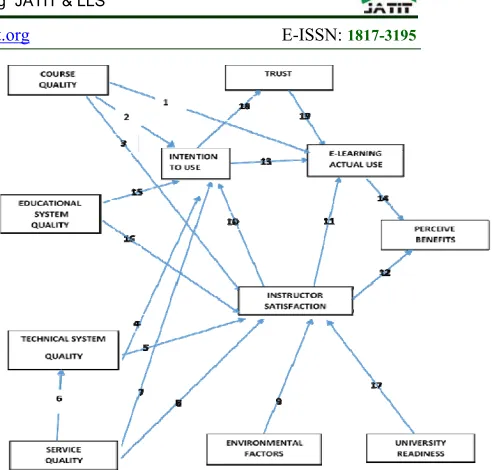
[image:4.612.313.559.61.296.2]An instructor model is presented in figure 4 with eleven constructs deduced from an extensive literature review.
Figure 4:Conceptual model
Components and scale development for each construct with associated hypotheses and measuring instrument are described below:
3.2. Components and Hypotheses 3.2.1. Course Quality
This is an information or output quality generated by the e-learning system, it is an information related to a course in which an instructor is in charge, it is a measure of how meaningful the course is [31]. DeLone and McLean [31], Hassanzadeh et al. [24] showed that Course Quality relate positively with Elearning Actual Use, Intention to Use and Instructor Satisfaction.
The following are hypotheses (Refer lines number 1, 2 and 3 on figure 4).
H1: Course quality has positive and significant effect on Elearning Actual Use.
H2: Course quality has positive and significant effect on Intention to Use.
H3: Course quality has positive and significant effect on Instructor Satisfaction.
3.2.2. Technical System Quality
6868
H4: Technical System Quality has positive and significant effect on Intention to Use
H5: Technical System Quality has positive and significant effect on Instructor Satisfaction
3.2.3. Educational System Quality
This construct measures a quality of education features of e-learning, it includes features for chatting, forum, video and other collaborative features [24]. This relate positively with both Intention to Use and Instructor Satisfaction.
The following are hypotheses (Refer lines number 5 and 6 on figure 4).
H5: Education system quality has positive and significant effect on Intention to Use e-learning.
H6: Education system quality has positive and significant effect on Instructor Satisfaction on e-learning system.
3.2.4. Service Quality
This measure the quality of technical support the IT department provides to the instructor in the course of using an e-learning system, it includes following items: availability, encouragement and training [8, 45]. This construct relates with Technical System Quality, Intention to Use and Instructor Satisfaction [40].
The following are hypotheses (Refer lines number 6, 7 and 8 on figure 4).
H6: Service Quality has positive and significant effect on Technical System Quality.
H7: Service Quality has positive and significant effect on Intention to Use.
H8: Service Quality has positive and significant effect on Instructor Satisfaction.
3.2.5. Intention to Use
This construct measures the decision to use a e-learning before you actually use it, it is an attitude which includes tendency and belief [24]. Mohammadi [40] shows that this construct relates positively with Elearning Actual Use.
The following is hypothesis (Refer line number 13 on figure 4).
H13: Intention to Use has positive and significant effect on E-learning Actual Use.
3.2.6. Elearning Actual Use
This is a construct which measure the extent of which the e-learning (course elements) are actual accessed/used or the amount of effort spend in interacting with the e-learning system [46]. It is a behaviour use of e-Learning system [38]. Lwoga [39] shows that Elearning Actual Use relate positively with Perceived Benefits.
The following is a hypothesis (Refer line number 14 on figure 4).
H14: E-learning Actual Use has positive and significant effect on Perceived Benefit.
3.2.7. Instructor Satisfaction
This construct measures the expectation of the instructor on the adopted e-learning system which is due to comparison between a product’s performance (or outcome) in relation to his or her expectations [47]. DeLone and McLean (2003) model shows that Instructor Satisfaction positively relate to Intention to Use, Elearning Actual Use and Perceived Benefits.
The following are hypotheses (Refer lines number 10, 11 and 12 on figure 4).
H10: Instructor Satisfaction has positive and significant effect on Intention to Use.
H11: Instructor Satisfaction has positive and significant effect on E-learning Actual Use
H12: Instructor Satisfaction has positive and significant effect on Perceived Benefit.
3.2.8. Environmental Factors
This construct measures the influence of external environments of the given university on Instructor Satisfaction over e-learning system [48]. Munguatosha et al. [48] shows that Environmental factors positively relate with Instructor Satisfaction. The following is a hypothesis (Refer line number 9 on figure 4).
H9: Environmental factors has positive and significant effect on Instructor Satisfaction.
3.2.9. University Readiness
This measure how ready the internal mechanism of a particular university to accommodate the e-learning system [48]. Munguatosha et al. [48] shows that University Factors positively relate with Instructor Satisfaction.
The following is a hypothesis (Refer line number 17 on figure 4).
H17: University Readiness positively and significant effect on Instructor Satisfaction.
3.2.10. Trust
Trust is the belief the trustor has on trustee that the exchange of learning contents between these two mutual parts will not exploit any of them, of which a trustee is web-based e-learning system and trustor is an instructor [49]. Ndume, Tillya and Twakiondo [50] show that Trust relate positively with Elearning Actual Use.
6869
H19: Trust has positive and significant effect on E-learning Actual Use.
3.2.11. Perceive Benefits
These are impacts caused by the adopted e-learning to an individual, group, organizational and community [24]. The impacts go beyond immediate user of e-learning system [51].
3.3. Population and Sample
The population for this context of this study including all list of instructors who are using or happened to use e-Learning systems as the means of design and delivering their course in their respective modules. Most of the universities policies in Tanzania universities do not mandate the use of e-Learning systems to instructors. According to Msonde and Van Aalst [52], 10% of a sample is enough to represent a population, based on that suggestion, a total of 130 instructors from eight universities in Tanzania were distributed with questionnaire in actual data collection which were conducted between March and May, 2017. Out of which 100 were returned back, in the course of sorting the 86 are remained as usable questionnaires. The returning rate is 77% of the distributed questionnaires.
4. DATA ANALYSIS
4.1. Data Analysis from Pilot Study
The aim of the pilot study was to test and rectify the data collection instrument (questionnaire) in order to improve it before proceeding into the actual data collection [8]. The pilot study for this research was conducted in Open University of Tanzania (OUT) between February and March, 2017. The instructor questionnaire was tested against 24 respondents who were picked randomly.
The reliability of each items combined (58 items) was analyzed using IBM SPSS version 21 in this pilot study (pre-test study) and the resulted figure of 0.961 prove that the items were consistent measuring what they supposed to measure. The Cronbach alpha (α) found for majority of constructs were more than 0.8 which was above the required threshold of 0.7 [53] which indicated how consistently the constructs were.
4.2. Data Analysis in Actual Data Collection
The data analysis of 86 instructors was
conducted after the verification of the instrument in pilot study.
The Structural Equation Modelling (SEM) was employed as a statistical method to analyse
instructor data using AMOS (Analysis of Moments of Structures version 21). The data were analysed to confirm nineteen hypotheses stated in section 3 through two main ordered steps which were measurement modelling and structural/path modelling.
In measurement modelling, the Confirmatory Factor Analysis (CFA) was employed as a technique which used three sub-processes, including the uni-dimensionality, reliability and validity.
[image:6.612.312.516.275.565.2]In a measurement modelling the threshold values of any squared item is supposed to be bigger than 0.6 and variance explained (R2) bigger than 0.4 [54].
Table 1: Confirmatory factor analysis
Construct number Construct name Item number Item name Factor loading Cronbach alpha Composite Reliablity Avearge Variance Extracted (AVE) 1 Course Quality
1 CQ3 0.876
0.809 0.816 0.598
2 CQ4 0.75
3 CQ5 0.682
2
Technical System Quality
1 TSQ5 0.64
0.692 0.703 0.546 2 TSQ6 0.826
3 Service Quality
1 SQ7 0.758
0.712 0.717 0.559 2 SQ10 0.737
4
Intention To Use
1 ITU1 0.75
0.898 0.906 0.708 2 ITU2 0.863
3 ITU3 0.802
4 ITU4 0.938
5 Elearning Actual Use
1 EAU1 0.924
0.767 0.786 0.653 2 EAU2 0.673
6 Instructor Satisfaction
1 IS1 0.834
0.83 0.831 0.711
2 IS4 0.852
7
Environment Factor
1 EF2 0.884
0.82 0.826 0.615
2 EF3 0.789
3 EF5 0.665
8 Perceived Benefits
1 PB2 0.839
0.858 0.859 0.67
2 PB3 0.842
3 PB5 0.773
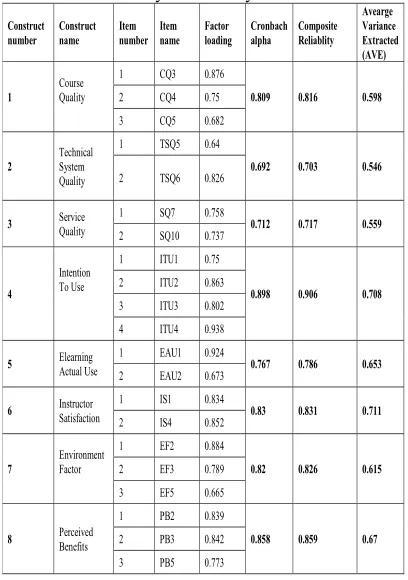
The results of the following assessment from table 1 were as follows:
4
.2.1. UnidimensionalityThis is achieved when the measuring items have acceptable factor loadings for the respective latent construct, any item should have factor loading of more than 0.6 and all items should be in one direction (all to be positive) [54].
6870
4.2.2. Validity
Validity is the measure of how strong the construct is, in measuring a given factor. It divided into convergent validity, construct validity and discriminant validity [54]. The convergent validity for measurement model is achieved when all items are statistically significant and their corresponding values of Average Variance Expected (AVE) exceed 0.50. Table 1 shows all AVE > 0.5, hence convergent validity was achieved.
The construct validity for the measurement model is achieved when all fitness indexes meet the required level. Table 3 shows all fitness indexes were achieved.
The discriminant validity is achieved when all redundant items are either deleted or constrained as “free parameter”. The summary of discriminant validity index in table 2 shows discriminant validity is achieved.
4.2.3. Reliability
[image:7.612.227.535.150.478.2]Reliability for the construct is achieved when all AVE are greater than 0.5 and Composite Reliability (CR) are greater than 0.7 [54]. From table 1, all AVE was greater than 0.5 and CR was greater than 0.7, hence reliability of each construct was achieved.
Table 2: Discriminant validity index summary for the constructs
EF CQ TSQ SQ ITU EAU IS PB
EF 0.784
CQ 0.170 0.774
TSQ 0.117 0.441 0.739
SQ -0.104 0.353 0.404 0.748 ITU 0.151 0.317 0.399 0.222 0.841 EAU 0.127 0.535 0.398 0.280 0.287 0.808 IS 0.216 0.402 0.641 0.371 0.769 0.525 0.843 PB 0.197 0.431 0.377 0.392 0.267 0.592 0.589 0.819
The Confirmatory Factor Analysis (CFA), confirmed eight constructs out of proposed eleven constructs after undergoing validity and reliability checks.
Then, the second part of analysis was structural/path analysis.
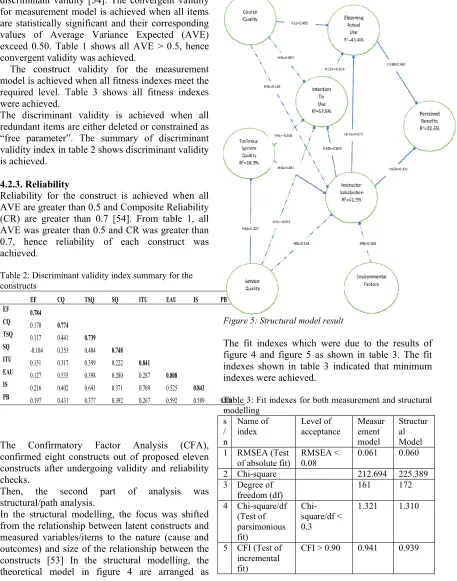
In the structural modelling, the focus was shifted from the relationship between latent constructs and measured variables/items to the nature (cause and outcomes) and size of the relationship between the constructs [53] In the structural modelling, the theoretical model in figure 4 are arranged as
proposed and then the model was run to test the path which connecting among latent constructs. The result of running the conceptual model of figure 4 was the model shown in figure 5.
Figure 5: Structural model result
The fit indexes which were due to the results of figure 4 and figure 5 as shown in table 3. The fit indexes shown in table 3 indicated that minimum indexes were achieved.
Table 3: Fit indexes for both measurement and structural modelling
s / n
Name of index
Level of acceptance
Measur ement model
Structur al Model 1 RMSEA (Test
of absolute fit) RMSEA < 0.08 0.061 0.060
2 Chi-square 212.694 225.389
3 Degree of
freedom (df) 161 172
4 Chi-square/df (Test of parsimonious fit)
Chi-square/df < 0.3
1.321 1.310
5 CFI (Test of incremental fit)
[image:7.612.90.547.157.738.2]6871 6 TLI (Test of
incremental fit)
TLI > 0.90 0.923 0.926
7 IFI (Test of incremental fit)
IFI > 0.90 0.944 0.942
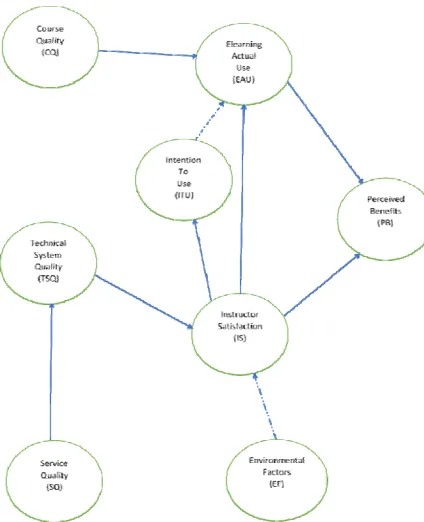
The total of 15 hypotheses were tested in figure 5 and the results is shown in final structural model in figure 6.
Figure 6: Final Structural model (Multi-Factors Instructor Model, MFIM7) where digit 7 stands for number of factors which explains the model.
4.2.4. Mediation (indirect and direct paths)
The results of figure 6 shows that the Technical System Quality (TSQ), Instructor Satisfaction (IS) provides indirectly mediation in the model. The Elearning Actual Use (EAU) provide a mediation between Instructor Satisfaction (IS) and Perceived Benefits (PB).
[image:8.612.84.537.71.159.2]So, according to Baron and Kenny [55], the question here is whether that mediation of the Elearning Actual Use (EAU) is full or Partial. The table 4 provide a test for full or partial mediation for construct EAU.
Table 4: Standardized indirect and direct paths
Indirect hypothesis (IS → EAU → PB) Direct hypothesis (IS → PB)
Strength size (β) 0.163 0.311 p-value (p < 0.05) 0.017 0.103
Significant Since 0.017 < 0.05 then path is significant Since 0.103 > 0.05 then path is not significant
From the table 4 the indirect path (IS → EAU → PB) is significant and direct path (IS → PB) is not significant, therefore the latent construct (EAU) provide a full mediation between IS and PB.
5.0: DISCUSSION OF STUDY FINDINGS
The results suggest that the model developed with eight factors are important in explaining the successful adoption of e-Learning systems in Tanzania’s universities with exceptional of Environmental Factors which was incapable of providing a significant correlation with other seven factors remained. In totality, seven of fifteen hypotheses are supported in the results of this analysis. The findings show that Instructor Satisfaction has strong impact on Intention to Use and also on Actual use of a system. Furthermore, new finding show that Service Quality has considerable impact on Technical System Quality (this was never being tested in the previous research studies).
Course Quality has positive and significant effect on Elearning Actual Use. This hypothesis is supported. This finding is consistent with the previous study of Al-Sabawy [13].
Course Quality has a positive and significant effect on Intention to Use. This hypothesis is not supported and is consistent with previous result of Hassanzadeh et al. [24]. Also, Course Quality has a positive and significant effect on Instructor satisfaction (not supported), this finding is consistent with previous finding of Samarasinghe and Tretiakov [8], which renamed Course Quality as Quality of the e-learning content.
Technical System Quality has positive and a significant towards Intention to Use e-Learning system in Instructor model (not supported). This finding is consistent with result from previous studies by Hassanzadeh et al. [24] and Samarasinghe and Tretiakov [8]. This evidence the fact that, the instructors Intention to Use e-Learning is not influenced by quality of technical system. Technical System Quality has a positive and significant effect on Instructor Satisfaction (supported). This finding is consistent with that of Hassanzadeh et al. [24] and Samarasinghe and Tretiakov [8].
[image:8.612.90.302.249.510.2]6872 Service Quality exhibited stronger effects on Technical System Quality with values of beta (β) =0.427. In the study by Le-Post [35], this Service Quality is one of the three indicators of System design construct. In that study, the explicit relationship between the three indicators (Service Quality, System Quality and Course Quality) is not indicated while in another study by Hassanzadeh et al. [24] show there is a relationship between Service Quality and Educational Service Quality but this study went further to evidence strong relationship between Service Quality and Technical System Quality, this finding is new in e-learning system adoption particularly in universities. Service Quality has a positive and significant effect on Intention to Use (not supported). This result is consistent with the previous result by Hassanzadeh et al. [24]. This evidence the fact that the System Quality is not a cause of attitude of an instructor to use the system.
Service Quality has a positive and significant effect on Instructor Satisfaction (not supported). The same result is previous obtained by Hassanzadeh et al. [24].
Environmental factors have a positive and significant effect on Instructor Satisfaction (not supported). This finding supports the quantitative research study of Roca et al. [56] who joint three theories, which were TPB, TAM and EDT (Expectancy disconfirmation theory) and other quantitative study of Sun et al. [57]. This means that the instructors are not affected by pressure of other competing universities, educational partners (HP, Dell, Lenovo) and collaborative universities. Instructor Satisfaction has a positive and significant effect on Intention to Use (supported). The relationship realized between the two-latent construct is so strongly with β=0.823 for instructor. This finding supports the previous studies of Hassanzadeh et al. [24] and Delone and McLean [31]. This evidence the potential of users (instructor) satisfaction in e-Learning systems’ adoption attitudes. Hassanzadeh et al. [24] found that the strength of impact to be 0.760 which is also strong.
Instructor Satisfaction has a positive and significant effect on Elearning Actual Use (supported). This hypothesis shows that there is a strong relationship between instructor satisfaction and actual use of the system (β=0.625). This signify the Instructor Satisfaction as one of the key components which determine the ELearning Actual Use. This result supports the other research study by DeLone and McLean [29].
Instructor Satisfaction has a positive and significant effect on Perceived Benefits (supported). The strength of the impact is also medium (β=0.321), implies that the higher the instructor satisfaction, the higher the perceived benefits of using system which include saving time of designing a course, multiple interactions and sharing more knowledge. This result is consistent with the study by Hassanzadeh et al. [24] with strong strength of impact of about, β=0.660.
Intention to Use has a positive and significant effect on Elearning Actual Use (not supported). The possible reason for this result is most of the universities, their ICT Policy is not forcing the instructors to use e-Learning system so at the end it remains as the voluntarily use rather than mandatorily use. The impact of Intention to Use on Actual Use needs more research. The study of Impact of Intention to use on Actual Use for instructor is subject for future investigation. Elearning Actual Use has a positive and significant effect on Perceived Benefits (supported). This result shows medium strength of impact (β=0.443), this finding is consistent with the previous studies of Hassanzadeh et al. [24], Samarasinghe and Tretiakov [8] and Xu et al. [58].
The Instructor’s path model (structural model) on figure 5 indicate that 43.6% of the factors affecting adoption of e-learning systems have been captured in the developed model, this shows that the model reflects substantive results [8] [61] from which the technical system quality measure 18.3% of System Quality, Instructor Satisfaction measure 41.9%, Intention to Use measure 57.5% and E-learning measure 45.4%.
6.0: CONCLUSIONS
The main purpose of this study was to develop a model for e-learning systems in universities in Tanzania in instructor perspective. To respond to that objective, this research study presents the valid and reliable, Multi-Factors Instructor Model (MFIM7), for successful adoption of e-Learning systems in Tanzania based on instructor point of views (figure 6). The model demonstrates a strong relationship between the Instructor Satisfaction with both Intention to Use and E-Learning Actual Use. Furthermore, it reveals the impact of Service Quality on Technical System Quality which has never be known before.
6873 strategic management and policies formulation in institutions.
The developed model is neither exhaustive nor closed model, hence it is open to continuous development. In future, studies may extend the model by adding other constructs to fit into different application domains and fast changing of e-Learning technologies. It may further be tested in longitudinal studies or combined with qualitative study.
REFERENCES
[1] D.M. Lashayo, and M.Gapar, “A review of e-learning systems' adoption in Tanzania universities”, South East Asia Journal of Contemporary Business, Economics and Law, vol 13, no. 2, pp.111-118, (2017). [Online]. Available: http://seajbel.com/wp-content/uploads/2017/10/K13-252.
[2] T. Ahmed, “E-learning as a new technological application in higher education and research: An empirical study and proposed model”, The International Academic Research Journal, vol.2, pp.2-13, (2011).
[3] T. Ahmed, “Toward Successful E-learning Implementation in Developing Countries:A proposed Model for Predicting and Enhancing Higher Educations' Participation”,
International Journal of Academic Research in Business and Social Sciences, vol.3, no.1, pp.422-425, 2013, [Online]. Available: http://www.hrmars.com/admin/pics/1485.pdf. [4] T. Unwin, B. Kleessen, D. Hollow, J.
Williams, L.M. Oloo, J. Alwala, I. Mutimucuio, F. Eduardo, and X. Muianga, “Digital Learning Management System in Africa: Myths and Realities”, The Journal of Open and Distance Learning, vol.25, no.1, pp.5-23, 2010.
[5] T. Monahan, G. McArdle, and M. Bertolotto, “Virtual reality for collaborative elearning”,
Computers & Education, vol.50, pp.1339– 1353, 2008.
[6] Y.S. Wang, H.Y. Wang, and D.Y. Shee, “Measuring e-learning systems success in an organizational context: Scale development and validation”, Computers in Human Behavior, vol.23, pp.1792–1808, 2007.
[7] M.K. Maina, and D.M. Nzuki, “Adoption Determinants of E-learning Management System in Institutions of Higher Learning in Kenya: A Case of Selected Universities in Nairobi Metropolitan”, International Journal
of Business and Social Science, pp.233-248, 2015.
[8] S.M. Samarasinghe, and A. Tretiakov, “eLearning system success in an organization context”, (PhD dessertation), 2012, Palmerston North-New Zealand: Massey: Massey University, [Online], Available: https://mro.massey.ac.nz/bitstream/handle/10 179/4726/02_whole.pdf
[9] B.Naresh, and B.S. Reddy, “Challenges and Opportunity of ELearning in Developed and Developing Countries-A Review”, International Journal of Emerging Research in Management &Technology, vol.4, no.6, pp.259 -262, 2015.
[10] T. Tossy, “Measuring the impacts of e-learning on students' achievements in e-learning process: An experience from Tanzania public universities”, The Online Journal of Distance Education and e-Learning, vol.5, no.2, pp.61-68, 2017. [Online], Available: https://www.tojdel.net/journals/tojdel/articles/ v05i02/v05i02-08.pdf.
[11] E. Lwoga and M. Komba, “Antecedents of continued usage intentions of web-based learning management systems in Tanzania” Education+Training, pp.738-756, 2015, [Online], Available: doi:10.1108/ET-02-2014-0014.
[12] O.E. Shivaraj, “Students’ Attitude towards the Uses of Internet”, Indian Journal of Library and Information Science, vol.7, no.1, pp.13-23, 2013.
[13] A. AL-Sabawy, “Measuring E-Learning Systems Success” (PhD dessertation), University of Southern Queensaland, 2013.
[Online], Available:
https://eprints.usq.edu.au/27422/
[14] M.Aparicio, F. Bacao, and T. Oliveira, “An e-Learning Theoretical Framework”, Educational Technology & Society, vol.19, no.1, pp.192-307, 2016, [Online], Available: http://www.ifets.info/journals/19_1/24.pdf [15] B. Sumak, M. Heric, and M. Pušnik, “A
meta-analysis of e-learning technology acceptance: The role of user types and e-learning technology types”, Computers in Human Behavior, vol. 27, pp.2067–2077, 2011. [16] A. Cramp, “Meaningful dialogue in digitally
mediated learning for in-service teacher development”, Technology, Pedagogy and Education, vol.24, pp.1–16, 2015. [Online], Available:
6874 [17] A. Andersson, and Å. Grönlund, “A
Conceptual Framework for E-Learning in Developing Countries: A Critical Review of Research Challenges”, The Electronic Journal on Information Systems in Developing Countries, vol.38, no.8, pp.1-16, 2009.
[Online], Available:
https://www.researchgate.net/publication/228 641067_A_conceptual_framework_for_Elear ning_in_developing_countries_A_critical_rev iew_of_research_challenges.
[18] V. Dennen, A.A. Darabi, and L.J. Smith, “Instructor–Learner Interaction in Online Courses: The relative perceived importance of particular instructor actions on performance and satisfaction”, Distance Education, pp.65-79, 2007, [Online], Available: doi:10.1080/01587910701305319
[19] R.B. Marks, S.D. Sibley, and J.B. Arbaugh, “A structural equation model of predictors for effective online learning”, Journal of Management Education, vol.29, no.4, pp.531– 563, 2005.
[20] I. Jung, “Building a theoretical framework of web‐based instruction in the context of distance education”, British Journal of Educational Technology, vol.32, no.5, pp.252–234, 2001.
[21] T. Anderson, L. Rourke, D.R. Garrison, and W. Archer, “Assessing teaching presence in a computer conferencing context”, Journal of Asynchronous Learning Networks, vol.5, no.2, pp.1–17, 2001.
[22] Z.L. Berge, “Facilitating computer conferencing: Recommendations from the field”, Educational Technology, vol.35, no.1, pp.22–30, 1995.
[23] U. Ehlers, “Web 2.0 – e-learning 2.0 – quality 2.0? Quality for new learning cultures”,
Quality Assurance in Education, vol.17, no.3, pp.296-314, 2009.
[24] A. Hassanzadeh, F. Kanaani, and S. Elahi, “A model for measuring e-learning systems success in universities”, Expert Systems with Applications, vol.39, pp.10959-10966, 2012. [25] J.K. Lee, and W.K. Lee, “The relationship of
e-Learner’s self-regulatory efficacy and perception of e-Learning environmental quality”, Computers in Human Behaviour, vol.24, pp.32–47, 2008.
[26] P.W. Mwakyusa, and N.V. Mwalyagile, “Impediments of E-learning Adoption in Higher Learning Institutions of Tanzania: An Empirical Review”, Journal of Education and Practice, vol. 7, no.30, pp.152-160, 2016.
[27] W.R. Watson, and S.L. Watson, (2007), “An argument for clarity: what are learning management systems, what are they not, and what should they become? TechTrends”, Springer Verlag, vol. 51, no.2, pp.28-34, 2007.
[28] T. Oliveira, and M. Martin, “Literature Reviews of Information technology adoption models at firm levels”, The Electronic Journal Information Systems Evaluation, vol.1, pp.110-121, 2011.
[29] W. DeLone, and E. McLean, “Information System Success: The Quest for Dependable variable”, Information Systems Research, vol.1, pp.60-95, 1992. [Online], Available: https://pdfs.semanticscholar.org/a041/45f1ca0 6c61f5985ab22a2346b788f343392.pdf [30] C. Despont-Gros, H. Mueller, and C. Lovis,
“Evaluating user interactions with clinical information systems: A model based on human–computer interaction models”,
Journal of Biomedical Informatics, vol.38, pp.244–255, 2005.
[31] W. Delone, and E.R. McLean, “The DeLone and McLean Model of Information Systems Success: A Ten-Year Update”, Journal of Management Information Systems, vol.19, no.4, pp.9-30, 2003. [Online], Available: http://citeseerx.ist.psu.edu/viewdoc/download ?doi=10.1.1.88.3031&rep=rep1&type=pdf [32] H. Lin, “Determinants of successful virtual
communities: Contributions from system characteristics and social factors”,
Information & Management, vol.45, no.8,
pp.522-527, 2008.
doi:10.1016/j.im.2008.08.002
[33] I. Dorobă, “Models for Measuring E-Learning Success in Universities: A Literature Review”, Informatica Economică, vol.18, no.3, pp.77-89, 2014.
[34] C.W. Holsapple, and A. Lee-Post, “Defining, Assessing, and Promoting E-Learning Success: An Information Systems Perspective”, Decision Sciences Journal of Innovative Education, vol.4, no.1, pp.67-85, 2006.
[35] A. Lee-Post, “e-Learning Success Model: An Information Systems Perspective”, Electronic Journal of e-Learning Volume, vol.7, no.1, pp.61-70, 2009.
6875 [37] P.D. Kihoza, I. Zlotnikova, J. K. Bada, and K.
Khamisi, “Designing a Business Model for Online Education Resources and e-Learning Implementation in a Developing Country: Case of Tanzania”, International Journal of Education, Business, Management and e-Learning, pp.27-39, 2015.
[38] J.S. Mtebe, and R. Raisamo, “A model for assessing Learning Management System Success in higher education in sub-Saharan countries” The Electronic Journal of Information Systems in Developing Countries, vol.61, no.7, pp.1-17, 2014.
[39] E.T. Lwoga, “Critical success factors for adoption of web-based learning management systems in Tanzania”, International Journal of Education and Development using Information and Communication Technology, vol.10, no.1, pp.4-21, 2014.
[40] H. Mohammadi, “Investigating users’ perspectives on e-learning: An integration of TAM and IS success model”, Computers in Human Behavior, vol.45, pp.359–374, 2015. [41] M. Weller, the digital scholar: How
technology is transforming scholarly practice, London: Bloomsbury Academic, 2011. [42] A. Kirkwood, “E-learning: You don’t always
get what you hope for. Technology”, Pedagogy and Education, vol. 18, pp.107– 121, 2009. [Online], Available: doi:10.1080/14759390902992576.
[43] Manitoba, A continuum model for literacy with ICT: A resource for developing computer literacy, Canada: Manitoba Education, 2006.
[44] I. Yengina, A. Karahoca, and D. Karahoca, “E-Learning success model for instructors’ satisfactions in perspective of interaction and usability outcomes”, Procedia Computer Science, vol.3, pp.1396–1403, 2011
[45] H. Selim, “Critical success factors for e-learning acceptance: Confirmatory factor models”, Computers & Education, vol.49, no.2, pp.396-413, 2007.
[46] Ramayah and Lee, “System Characteristics, Satisfactio and E-learning Usage: A Structural Equation Model (SEM)”, The Turkish Online Journal of Educational Technology, vol.11, no.2, pp.196-206, 2012.
[47] C.M. Chiu, C.S Chiu, and H.C. Chang, “Examining the Integrated influence of fairness and quality of learners’ satisfaction and web-based learning continuance intention”, Information Systems Journal, vol.17, no.3, pp.271-287, 2007
[48] G.M. Munguatosha, B.M. Paul, and L. Thaddeus, “A social networked learning adoption model for higher education institutions in developing countries”, On the Horizon, vol.19, no.4, pp.307 – 320, 2011. [49] P.A. Pavlou and M. Fygenson,
“Understanding and Predicting Electronic Commerce Adoption: An Extension of the Theory of Planned Behavior”, MIS Quarterly, vol.1, pp.115-143, 2011.
[50] V. Ndume, F.N. Tillya, and F.N. Twaakiondo, “Challenges of Adaptive eLearning at Higher Learning Institutions: A Case Study in Tanzania”, International Journal of Computing and ICT Research, vol.2, no.1, pp.47 – 59, 2008.
[51] J.B. Raouf, I.S. Naser, and B.K. Jassim, “Determinants of E-Learning Implementation Success in the Iraqi MoHE”, Eng. &Tech. Journal, vol.30, no.4, pp.659-671, 2012. [52] S.E. Msonde, and J. van Aalst, “Instructor and
student experiences of e-learning at a Tanzanian University”, International Journal of Educational Research and Reviews, vol.3, no. 2, pp.62-72, 2014.
[53] J.F. Hair, W.C. Black, B.J. Babin, and R.E.Anderson, Multivariate Data Analysis, 7th Edition, Upper Saddle River, New Jersey: Prentice Hall, 2010.
[54] Z. Awang, SEM Made Simple: A Gentle to Learning Structural Equation Modelling, Malaysia: MPWS Rich Publication, 2016. [55] R.M. Baron, and D.A. Kenny, D.A, “The
moderator–mediator variable distinction in social psychological research: Conceptual, strategic, and statistical considerations”,
Journal of Personality and Social Psychology, vol.51, no.6, pp.1173-1182, 1986.
[56] J. Roca, C. Chiu, and F. Martinez, “Under-standing e-learning continuance intention: An extension of the Technology Ac-ceptance Model”, International Journal of Human-Computer Studies, vol.64, no.8, pp.683-696, 2006.
[57] P.C. Sun, R.J. Tsai, G. Finger, Y.Y. Chen and D. Yeh,“What drives a successful e-Learning? An empirical investigation of the critical factors influencing learner satisfaction”,
Computers & Education, vol.50, pp.1183– 1202, 2008.
[58] D. Xu, W. Huang, H. Wang, J. Heales,
6876 [59] W.T. Wang, and C.C. Wang, “An empirical
study of instructor adoption of web-based learning systems”, Computers & Education, vol.53, no.3, pp.761-774, 2009
[60] H. Kay, “Aspects of educational technology XIII – Educational technology twenty years on”, In G. T. Whitlock, Educational technology 20 years on – Sheffield revisited, London: Kogan Page, pp. 11–18, 1979. [61] R.F. Falk, and N.B. Miller, A prime for soft
![Figure 2: The DeLone and McLean (1992) model [29].](https://thumb-us.123doks.com/thumbv2/123dok_us/8901722.955156/3.612.90.297.374.442/figure-delone-mclean-model.webp)