1
THE INFLUENCE FACTOR OF LEAN BEHAVIOUR TOWARDS JOB PERFORMANCE IN FUJITSU COMPONENT (M) SDN. BHD.
SUBATRA A/P KRISHNAN EN. YUNOS BIN NGADIMAN
Faculty of Technology Management & Business University Tun Hussein Onn Malaysia (UTHM)
Abstract: The context of lean has been ventured widely in the past decades by existing researchers. One of the practices includes lean behaviour. Lean behaviour is an essential practice to develop behaviours that can eliminate the amount of waste associated with large production operation line. In Malaysia, although the concept of lean can be seen implemented in many companies, lean behaviour practices seems to be vague. Hence, this study aims to identify the relationship between lean behaviour factor and job performance in Fujistu Component (M) Sdn. Bhd. The study approach is a qualititative research that uses questionnaire survey to obtain necessary information needed for the data collection of this study. The data collected will be analyzed using Statistical Package for Social Science (SPSS) version 22.0 and test of normality and correlations will be presented in this research. The respondents that are involved in this research study are operators from the relay production line from Fujitsu Component (M) Sdn. Bhd. The expected outcome from this research that can look forward to is that, there is a postive relationship between Respect for People and Job Performance, a positive relationship between Continuous Learning and Improvement and Job Performance and lastly, a positive relationship between Process and Result Driven and Job Performance.
Keywords: Lean behaviour, job performance, lean manufacturing concept.
1.0 INTRODUCTION 1.1 Introduction
Though the concept of lean manufacturing system can be found to be quite common nowadays, the implementation in real life situation can be difficult to achieve. Relevant case studies regarding lean behaviour were limited especially in the scope of Malaysian manufacturing system. The lean behaviour concept is similar to that of lean production. Lean behaviour are defined simply as behaviours that add or create value. It is the minimization of waste associated with random or opposing thoughts and actions that lead to defensive behaviour, ineffective relationships, poor co-operation, and negative attitudes. (M.L.Emiliani, 1998). Therefore, it is essential that the right behaviour among organization employees is maintained, so that the full benefits of lean can enjoyed.
1.2 Research Background
The concept of lean has originated from a Japanese automobile company which previously known as Toyota Production System (TPS). The basic goal was to eliminate waste and reduce activities that brings zero value to the organization (Norani et al., 2010). The waste that is discussed and identified in TPS by Muslimen R. et al in the proceeding of World
2
1.3 Problem StatementUpon interviewing senior managers from Fujitsu Component Sdn. Bhd, a manufacturing company that produces relays and keyboards, few problems related to the behaviour of the workers was shared. Mr.Jeyaseelan who is a senior executive at the planning department has working experience of 30 years in the company since 1996. Mr.Jeyaseelan stated that one of the problem faced by the company is that company tends to have backlog records on their material requirement planning (MRP) system. This information is necessary for the production line as it shows the accurate amount of material that needs to be used when production process goes on. Mr.Jeyaseelan mentions that workers behaviour contributes to this problem. The inability to perform the task given at a given time has caused a massive problem in the production which lead to wrong estimation of material purchase, over production and excessive inventory levels.
Another interview was carried out based on the production line of the company. Mr. Rajendran is the supervisor of the mixing department for the relay component. He stated that the company have experienced massive product defect due to error in mixing of the material to produce the relay component. Workers that are in charge of the mixing process, mix different percentages of material which differs from the original plan of production. Then, the sample of the produced parts are taken the laboratory for thorough inspection. Upon inspection, it was found that the parts do not pass the standard requirement of what was originally planned. Hence, these parts that was produced in a big batch all at once gets rejected. This subsequently has cost the company great deal of loss financially and has created unnecessary waste. Mr. Rajendran stated that the root of this problem is caused by the worker themselves. The workers lack awareness of what their action can cost the company. Besides that, he also stated the problem faced in terms of maintenance. Here, the one of the prominent problem was the regular maintenance was neglected by the worker in charge. This has resulted the moulding machine (for the relay component) to wear off and lose its shape. Hence, the parts produced where found to have misconfigured shape and resulted on being rejected.
1.4 Research Questions
In line with the problem statement as above, the main research question that are developed for this research undertaking is what are the
relationship between lean behaviour factors and job performance?
1.5 Research Objectives
Upon developing the research question, the objective have been developed. The objective is to identify the significant relationship between lean behaviour factors affecting job performance.
1.6 Significance of Research
The significance of research is to convince readers why the study is being carried out and for what reasons. Many parties can benefit from this research as it is helping the manufacturing industry to improve the readily available lean concepts to be put into work in the real life.
Employer
The employer of a manufacturing company will be aware of the appropriate lean behaviour practice that must be incorporated in their training modules when recruiting their employees.
Employees
The employees will have a better understanding on how their behaviours affect the overall performance of the company. This way they can help assist in the process of eliminating of unnecessary waste not only caused the machine and material but themselves as well.
Future Researchers
This study will be beneficiary to future researcher like university students who seek to find out more on the concepts and ideas that are presented in this paper. It can provide a brief or more in depth understanding on the discussed framework.
1.7 Research Scope
The respondents that are proposed to be involved for this research paper includes are the operators from the relay production line of the company. The respondents was specifically chosen from the relay production line as the problem statement was retrieved from these departments. The suggested method of conducting this research will consists of several questions in the form of questionnaire.
2.0 LITERARUTE REVIEW 2.1 Definition of Lean
3
is called Toyota Production System (TPS) now. (Melton, 2005). The understanding of lean involves maximizing customer value while minimizing waste. It involves reduction and use of everything less in mass production for example less manufacturing space, less investment in tools and less engineering hours to create a new product (Skrudupaite & Jucevicius, 2011). The techniques involved in lean helps to reduce cycle time, enhance quality, and increase flexibility in organization’s processes (Khot & Pradesh, 2010). In past years, researchers have listed down the benefits of implementing lean. The benefits are reduced inventory, increased process understanding, financial savings, less rework, reduced lead-time, and less process waste (Melton, 2005). . According to N. Ygadiman (2012), 5S makes the problem visible in the workplace. The elements include ‘SEIRI’, ‘SEITON’, ‘SEISO’, ‘SEIKETSU’, AND ‘SHITSUKE’.2.3 Lean Manufacturing
A literature review done by Jaiprakash Bhamu and Kuldip Singh Sangwan has listed several lean manufacturing definition from past researchers (Sangwan, 2014). The extensive review has been reduced taking the research findings from the year 2006 till 2012 to stay relevant with current trend.
Table 8.1: Lean Manufacturing from Different Points of View
Author Lean Manufacturing Definition
Taj and Berro (2006)
Lean is defined as “manufacturing without waste”. The lean approach is focused on constantly reducing waste (Muda) in the value stream.
Narasimhan et al. (2006)
Production is lean if it is accomplished with minimal waste due to unneeded operations, inefficient operations, or excessive buffering in operations. De Treville
and Antonakis (2006)
Integrated manufacturing system intended to
maximize capacity
utilization and minimize buffer inventories through
minimizing system
variability. Shah and
Ward (2007)
Lean is a management philosophy focussed on identifying and eliminating
waste throughout a product’s entire value stream, extending not only within the organization, but also along its entire supply chain network.
2.3.1 Tools and Techniques of Lean Manufacturing
Manufacturing companies in Malaysia are implementing and using certain tools and techniques of lean manufacturing in their organizations. Examples are Just-In-Time (JIT), Kaizen, Poka-yoke, Standardized Work, Total Preventive Maintenance (TPM), Value Stream Mapping (VSM) and 5s. (Bon & Kee, 2015) 2.4 Definition of Lean Behaviour
In this section, the concept lean behaviour will be introduced and explained thoroughly for a better understanding for readers. Lean behaviour defined by M.L.Emiliani, 1998 states that;
“Lean behaviours are defined simply as behaviours that add or create value. It is the minimization of waste associated with the arbitrary or contradictory thoughts and actions that leads to defensive behaviour, ineffective relationships, poor co-operation, and negative attitudes.”
According to a case study on Motorola, behaviour was pointed out to be one of the most important aspects to change the culture so that sustainability of lean concept can be implemented (Puvanasvaran, 2006). The engagement of management as well as the production site team need to have the same type of mind set to allow the company or organization to achieve their mission and goals concurrently.
2.4.1 Fat Behaviours
4
Threats, real or implied Micromanagement
Disappointing employee surveys
Minimal improvement
suggestions
Employees stuck in functional area
Scarcity mentality Low turnout at meetings Calls not returned
Slow response to changing conditions
Employee turnover Rumours
Transactional focus Ignorance
Failure not tolerated Unclear expectation Little or no feedback
Appearance over substance Favouritism
Mistakes repeated Low trust
Talk not walked Management secrets Few rewards
Ego-driven decisions
(Source: M.L.Emiliani, 1998)
2.4.2 Comparison of Fat Behaviour and Lean Behaviour
It can be seen that fat behaviours and lean behaviours are two totally opposite attributes. Fat behaviour is perceived as negative behaviour that does not contribute to organizations benefit while lean behaviour is perceived as positive behaviour that elevates the company’s overall performance. A comparison table that can show these attributes are listed down as below.
Table8.4.2 Fat Behaviours and Lean Behaviours
Fat behaviours Confusion Unnecessary commentary Irrelevant observations Random thoughts Self-imposed barriers Ego Irrationality Revenge Inaction Positions Interpretations Uncertainty Negativity Excess Gossip Sarcasm Preoccupation Ambiguity Extreme flattery Cynicism Subjectivity Bias/prejudice Deception Selfishness Pride Criticism
Lean Behaviours Self- awareness Humility
Compassion Suspension Deference Calmness Quietude Reflection Honesty Benevolence Consistency Generosity Patience Humour Understanding Respect Listening Observation Trust Sincerity Equanimity Objectivity Discipline Rectitude Wisdom Balance
Source: (Puvanasvaran, 2006)
2.4.3 Past Research on Lean Behaviour Context
5
have. The result of this study has stated that respect for people and continuous learning and improvement are the main critical factor contributing to lean behaviour practices. The research by A.P.Puvanasvaran, (2009) discusses the lean behaviour at an aerospace environment that is examined to determine the success lean implementation in a year. The study has discussed the differences in the result of lean behaviour practices after a year implementing it and identifying problem solving capabilities to make improvement of lean behaviour of kitting department. The results shows that after a year of implementing lean, there was an increase of 10 percent improvement in the department. The study also concluded that there is a relationship between the factor Respect for People, Continuous Learning and Improvement, and Process and Result Driven.The study by Benjamin, (2013) discusses fat behaviours that prohibits the smooth implementation of lean operations at Trinidad and Tobago. It involved employees from 19 different organizations. The researcher listed the factors such as ego-driven, low trust, ignorance, fear and confusion as the main cause of the problem. The researcher concluded that corrective actions should be taken to change the internal culture of organizations in order to develop a more productive organization.
The study by Beale (2007) explores the effect of various individual level-factors on employee willingness to accept lean behaviour practices. The study was conducted on a holding company with subsidiaries engaged in the research development, manufacture, and marketing of branded and brand equivalent pharmaceuticals. The expected outcome from the adaptation of lean behaviours includes making the company more competitive, helping them to work smarter, improve efficiency at the company, help to reduce cost within the company and many more.
Another review by B.Emiliani, (2014) focuses on leadership behaviours that can cultivate lean in an organization. The author mentions that the of people’s behaviour when interacting between employees is not always perfect. Hence, there is tendency for leaders to behave and misbehave at times. In reference to the award winning paper by M.Emiliani in the year 1998, Bob Emiliani stressed that the specific lean behaviour such as trust, patience, consistency, humility and balance promotes information flow within an organization whereas fat behaviours
such as high ego, manipulative, misleading, and disrespectful do not.
2.5 Job Performance
According to Dar, Akmal, Naseem, Ud, & Khan in the year 2011, job performance was defined as
“An activity in which an individual is able to accomplish the task assigned to him/her successfully, subject to normal constraints of reasonable utilization of the available resources.”
2.6.1 Types of Job Performance
C.Hwang in the year 2014 has a different point of view when it comes to types of job performance. He mentions that job performance is divided into two types. They are task performance and contextual performance. Task performance is the traditional in-role performance. It is the most basic form performance appraisal. It can be explained in way that task performance directly assesses the work or the task outcome. This often related to the work effectiveness that gives the organization the elevation it needs. Contextual performance on the other hand, are personalities that are involved and other un-related role expectations. Examples includes actions of volunteering to get a certain work done. It basically means to help other have less burden on their back. Helping out and cooperating with other colleagues in the organization is also defined as contextual performance.
2.6.2 Measures of Job Performance
Previous researchers has ventured into financial measures and non-financial measures of job performance. Non-financial measures discussed here are quantitative and can be objectively and subjectively measured. This includes the level of cooperation and sharing of knowledge that exist between each department in the organization as well as defect rates. In a review by Ngadiman.Y, et.al (2015) says that companies that use integrated performance measure perform better than those that do not measure their performance.
6
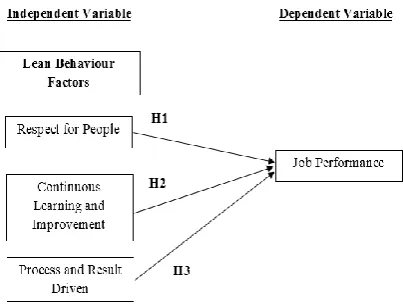
nonfinancial subjective measures include performance evaluation that may include subjective assessment of upper management involving various aspect of performance in accordance to their work nature (Lin, 2006). 2.6 Conceptual Framework and HypothesesH1: There is a positive relationship between respect for people and job performance. H2: There is a positive relationship between continuous learning and improvement and job performance.
H3: There is a positive relationship between process and result driven and job performance.
3.0 RESEARCH METHODOLOGY 3.1 Introduction
This chapter will discuss regarding the methods that will be implemented to obtain vital information needed for this study. This is a quantitative study and the data collection is done using questionnaire survey which is appropriate this study.
3.2 Research Framework
Below shows the proposed research framework for this study.
3.3 Research Design
This study will be conducted in quantitative method to obtain the sufficient data to support the study. Research design consists of the methodology and procedures used to carry out the study.
3.4 Research Sampling
3.4.1 Population
According to Neuman (2012), population is a larger collection of units from which a sample is taken. The main concern for sampling is identifying the target population which is the complete group of specific population elements relevant to the study. The population in this study is a relay and keyboard manufacturing company called Fujitsu Component (M) Sdn. Bhd.
[image:6.595.79.281.157.310.2]3.4.2 Sample Size and Sampling Method Each number of the population has an equal and independent chance of being selected to become a part of sample in this study. Based on the latest directory of Federation of Malaysian Manufacturers (FMM), Fujitsu Component (M) Sdn. Bhd. currently has a total of 1500 employee in their company. The number of operators working in the relay production line are 417 employees.
Table 3.1: Sample Population and Sample Size
Sample Population (Whole Fujitsu)
Sample Size (Relay Line)
1500 employees 417 employees
3.4.3 Target Respondents
The target respondents that will be involved in this research study are operators from the relay production line of Fujitsu Component (M) Sdn. Bhd.
3.5 Data Collection
Data collection method that is proposed in this research study will be conducted to gain the information that is reliable and valid. There are two sources of data collection in this study. 3.5.1 Primary Data
7
collected using survey method using questionnaire which are constructed based on the information gathered from the secondary data. The survey will consist of sets of questions relating to the objective the study and be distributed to the respondents.3.5.2 Secondary Data
Secondary data is data that is collected from instruments such as thesis, newspapers, reference books, reports, government documents, journals and other references that can help with the research study.
3.6 Data Instrument
Data instrument is one the most important criteria in a research. Data collection instruments are depending on the measurement method decided by the researcher. The research instrument in this study is survey questionnaires which construct based on the previous studies and literature review to collect the data.
3.7 Data Analysis Technique
After all the questionnaires complete and collected from the respondents, the primary data will have to be interpreted into understandable report format. All the data collected will be analysed using the Statistical Package for Social Science (SPSS) version 22.0. The data obtained from the analysis will be presented in table form and graphical charts such as pie chart or bar chart.
4.0 REFERENCES
Agus, A. (2012). Lean production supply chain management as driver towards enhancing product quality and business performance: Case study of manufacturing companies. International Journal of Quality & Reliability Management, Vol.29 No.1, pp. 92–121.
Aliaga, M., & Gunderson, B. (2000). Introduction to Quantitative research.
A.P.Puvanasvaran, M.H.M.A.Megat, S.H.Tang, Muhamad, M.R, A. M. . H. (2009). Lean
Behavior in Implementing Lean Process Management. Journal of Applied Sciences Research, Vol.5 No.8, pp. 930– 943.
Beale, J. (2007). Employee Motivation to Adopt Lean Behaviours: Individual-level Antecedents. Annual Conference Dallas, Texas, U.S.A May 4 to May 7, 2007. Pp. 53.
B.Emiliani (2014). Leadership behaviour: The path to lean culture. Retrieved on May 9,
2016 from
http://www.bobemiliani.com/leadership-behaviors-the-path-to-lean-culture/
Benjamin, C. T. (2013). A Study of Behaviours that Retard the Implementation of Lean Operations. The Journal of the Association of Professiona Engineers of Trinidad and Tobago, Vol.41, No.1, pp. 43–48.
Bon, A. T., & Kee, T. S. (2015). Implementation of Lean Manufacturing for Productivity Improvement in Malaysia. Proceedings of the 2015 International Conference on Industrial Engineering and Operations Management Dubai, United Arab Emirates (UAE), March 3-5, 2015. Universiti Tun Hussein Onn Malaysia, pp. 58–63.
Cardon, N. (2015). Respect For People : The Forgotten Principle In Lean Manufacturing Implementation. European Scientific Journal, Vol.11, No.13, pp.45–61.
Chen, J., & Silverthorne, C. (2008). The impact of locus of control on job stress , job performance and job satisfaction in Taiwan. Leadership and Organization Developemnt Journal, Vol.29, No.7, pp. 572–582.
8
Vol.6,No.2, pp.134- 146.Cropanzano, R., & Mitchell, M. S. (2005). Social Exchange Theory: An Interdisciplinary Review.Journal of Management, Vol.31, pp.874-900.
Dar, L., Akmal, A., Naseem, M. A., Ud, K., & Khan, D. (2011). Impact of Stress on Employees Job. Global Journal of Management and Business Research, Vol.11, No.6, pp. 0–4.
Emiliani, M.L. and D.J. Stec, 2004. Leaders lost in transformation, Leadership and Organization Development Journal, Vol.26, No.5, pp. 370-387.
Emiliani, B. (2008). The Equally Important “ Respect for People ” Principle, pp.1–8.
Hwang, C.-L. and M. (2014). Personality traits and simultaneous reciprocal influences between job performance and job satisfaction. Chinese Management Studies, Vol.8, No.1, pp.6–26.
Jankingthong, K., & Rurkkhum, S. (2012). Factors Affecting Job Performance : A Review of Literature. Journal of Social Sciences, Humanities, and Arts, Vol.12, No.2, pp.115–127.
Khot, D., & Pradesh, M. (2010). The Effects Of Lean On Employees ’ Affective Attitude in A Modular Homebuilding Manufacturer, National Institute of Technology, Bhopal, Madhya Pradesh, India: Master’s Thesis.
M.L. Emiliani, (1998). Lean behaviors. Management Decision, Vol. 36, Iss 9, pp. 615 – 631
Melton, T. (2005). What Lean Thinking has to Offer the Process Industries. Journal of Chemical Engineering Research and Design. pp. 662–673.
Ngadiman, Y., Dr Burairah, H., & Dr Izaidin, A. M. (2012). A study of total productive
maintenance implementation in manufacturing industry for generating greater profits. In Proceedings International Conference of Technology
Management, Business and
Entrepreneurship, Melaka, Malaysia, pp. 157–173.
Ngadiman, Yunos and Hussin,
Burairah and Abdul Majid, Izaidin, (2012). A study of total productive maintenance implementation in manufacturing industry. In: International Conference on Management, Economics and Finance (ICMEF 2012), Sarawak, Malaysia.
Ngadiman.Y, Nor Aziati A.H., Bon.A.T, Ahmad. M.F, Raja Zuraidah, R.M (2015). Review relationship TPM as mediator between TQM and Business Performance. In 2nd International Conference on Industrial Engineering Management Science and Applications (ICIMSA 2015), Tokyo.
Ngadiman.Y, Ramlan.R, Omar. S.S, and Yassin, A.M, (2015). Quantification of machine performance through overall equipment effectiveness. In International
Symposium on Technology
Management and Emerging
Technologies (ISTMET), Langkawi, Kedah, Malaysia.
Norani Nordin, Baba Md Deros and Dzuraidah Abd Wahab, (2010). A Survey on Lean Manufacturing Implementation in Malaysian Automotive Industry. International Journal of Innovation, Management and Technology. Vol. 1, No. 4, pp. 374-380.
Puvanasvaran, A. P. (2006). Enhancing Productivity Through Lean Behavior. Journal of Applied Sciences Research Vol.3, No.6, pp 298-317.
Ramune Cianiene, Milita Vienazindiene, (2012). Lean manufacturing: theory and practice. Journal of Economic and Management.Vol.17, No.2, pp. 726-732
9
Engineering 2011, London, U.K, Vol I WCE 2011, July 6 - 8, 2011Rizwan, M. (2014). Antecedents of Job Stress and its impact on Job Performance and Job Satisfaction. International Journal of Learning and Development, Vol.4, No.2, pp.187–203.
S. Vinodh, K.R. Arvind, M. Somanaathan, (2010). Application of value stream mapping in an Indian camshaft manufacturing organisation. Journal of
Manufacturing Technology
Management, Vol. 21 Iss: 7, pp.888 – 900
Salkind, N. J. (2012). 100 questions (and answers) about research methods. SAGE Publications. Vol. 1.
Sangwan, J. B. K. S. (2014). Lean manufacturing: literature review and research issues. International Journal of Operations & Production Management, Vol. 34, No.7, pp. 876–940.
Surge. (2016). Organizational Change Management : A Process-Driven Approach. pp.1-11
Wong, Y. C., & Wong, K. Y. (2011). Approaches and practices of lean manufacturing : The case of electrical and electronics companies. African Journal of Business Management. Vol.5, Iss:6, pp.2164– 2174.