Facies and Fracture Network Modeling by a Novel Image
Processing Based Method
Peyman Mohammadmoradi
PETROPARS Ltd. Oil and Gas Developer,Tehran, Iran Email: [email protected]
Received March 6, 2013; revised April 6, 2013; accepted April 13, 2013
Copyright © 2013 Peyman Mohammadmoradi. This is an open access article distributed under the Creative Commons Attribution License, which permits unrestricted use, distribution, and reproduction in any medium, provided the original work is properly cited.
ABSTRACT
A wide range of methods for geological reservoir modeling has been offered from which a few can reproduce complex geological settings, especially different facies and fracture networks. Multi Point Statistic (MPS) algorithms by apply- ing image processing techniques and Artificial Intelligence (AI) concepts proved successful to model high-order rela- tions from a visually and statistically explicit model, a training image. In this approach, the patterns of the final image (geological model) are obtained from a training image that defines a conceptual geological scenario for the reservoir by depicting relevant geological patterns expected to be found in the subsurface. The aim is then to reproduce these train- ing patterns within the final image. This work presents a multiple grid filter based MPS algorithm to facies and fracture network images reconstruction. Processor is trained by training images (TIs) which are representative of a spatial phe- nomenon (fracture network, facies...). Results shown in this paper give visual appealing results for the reconstruction of complex structures. Computationally, it is fast and parsimonious in memory needs.
Keywords: Filter-Based; Image Processing; Pattern; Training Image; Entropy Plot; MPS
1. Introduction
Static modeling of complex reservoirs calls for more than two point statistics. Certain features of these objects such as curvilinearity cannot be expressed via two-point rela- tions [1]. Multi Point Statistics (MPS) is used to produce realistic realizations of complex structures after the pio- neer work of Strebelle who applied image processing concepts for this purpose [2]. MPS is based on image pro- cessing techniques and proposes image construction ap- proach. In this approach, the patterns of the final image to be constructed (facies, fracture network...) are ob- tained from a training image that depicts relevant geo- logical patterns expected to be found in the subsurface [1]. Furthermore, MPS modeling has the potential to im- prove estimation in addition to simulation and the so called E-type average value at each node is taken as a local estimated value if training image is appropriate [3]. Training Images (TIs) provide spatial relations, exist-ing patterns and degree of connectivity which must be reproduced in the reconstructed images. The goal is not to reproduce the training image, but to simulate a model that shares some of the multivariate characteristics of the true distribution [4]. To achieve the most appropriate IT, several challenges were raised like: statistical richness of
the training image, the scale of the training image, the grid definition of the simulated model, and the univariate distribution of the training image. In this area, Boisvert selects the most data representative TI by comparing the distribution of runs and the multiple point density func-tion from TIs [5]. Boogaart applied variography as an auxiliary element to choose TIs which represent the true joint distribution of the field under consideration [6].
The pattern to point SNESIM method is the first algo-rithm for MPS modeling [7,8]. SNESIM is a combination of traditional sequential simulation with a search tree concept. Multiple point statistics (observed patterns) of a certain size of training images are stored in a tree struc- ture; Node properties of realizations are then assigned one by one in a search process loop. Search tree is ex- tremely memory demanding. Straubhaar proposed a list of approach modification of SNESIM [9]. Several case studies of successful application of the method are re- ported [10-14]. Okabe also modified SNESIM for pore network reconstruction [15].
take the probabilities of the whole multiple point patterns conditioned to the same multiple point data event from the training image [18]. SIMPAT produces visual ap- pealing realizations; however complete search in pattern database is needed. This makes the process of finding the most similar pattern too complex and CPU time-con- suming. FILTERSIM reduces pattern dimensions by ap- plying spatial filters and transferring patterns to a lower dimensional space. Coded patterns are then clustered and a prototype is chosen for each bin. This accelerates the search process and decreases run time compared to SIMPAT by means of reducing number of analogy loops. Structures continuity in FILTERSIM method, however, is not preserved as it is in SIMPAT.
Dimensional reduction in patterns is done by applying directional filters [16] or wavelet decomposition on train- ing image [19]. Honarkhah proposed a distance based algorithm DisPAT and automatic information theory based algorithms for selection of optimum template size and dimension of patterns target space [17].
In our previous work [20] one modified FILTERSIM algorithm was proposed for unconditional simulation in which pattern extraction, persisting and pasting steps are modified to enhance visual quality and structures conti- nuity in the realizations. Modifications such as optimum template size selection and additional search steps have considerable improvement in the algorithm performance and produced more visual appealing images compared to FILTERSIM. These changes add marginal computation cost to FILTERSIM because of using pattern frequency concept and yet still much faster than SIMPAT.
In this paper, we propose a novel multiple grid pattern- to-pattern algorithm for conditional simulation which is a combination of FILTERSIM fastness and SIMPAT ac- curacy. Results quality and continuity is far better in our proposed algorithm as will be shown shortly.
2. Training Image Processing
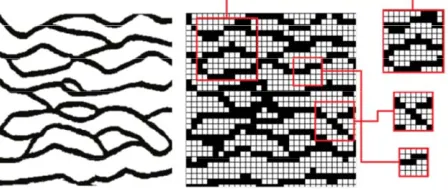
[image:2.595.60.284.595.690.2]Processing of training images consists of gridding, scan- ning and persisting the corresponding multiple point vec- tors in a database as shown in Figure 1. Pattern extrac-
Figure 1. Schematic of training image preprocessing steps consist of gridding, scanning and pattern extraction (As template size increases, pattern stores larger scale spatial information).
tion can be performed by templates in different sizes. Template size affects the extracted statistics, CPU time and scale of structures in results. A pattern of training image is defined as tit (u) and includes a specific multiple
point vector of tit (u) values within a template T centered
at node u.
1
2, , ,
,
T
t
n
ti u ti u h ti u h ti u h
ti u h
, (1)
where hα vectors define the geometry of the template
nodes; 1,,nT and nT is the template size. Content
of pattern with a frequency component, based on its oc-currence frequency in TI, are stored in pattern database
patdbT as the following vector:
1 , 2 , ,
, ,
T
k k k k
T T T T
k k
T n
pat pat h pat h pat h
pat h Frequency
,
(2)
Frequency component of patdbT has the advantage of
accelerating selection of appropriate pattern in simulation process. This achieves by elimination of repeated pat- terns and consequently repeated calculations. Pattern stores larger scale spatial information as the template size increases with the cost of simulation uncertainty and complexity. To find the optimum template size in a sin- gle grid simulation, Shannon’s entropy versus template size plot is used [21]. In order to calculate entropy in different template sizes, the following equation is ap- plied:
1 log
K
i i i
H
p p (3)where K = number of possible outcomes of the random variable, and pi represents the probability mass function.
Two different behaviors are expected with increasing the template size. In the first stage, entropy will sharply in- crease since the average number of nodes needed to guess the remaining nodes in the patterns is increased. At a later stage, where the template size has passed the op- timal range in an elbow that represents the stationary features of the training image, entropy would increase slowly. This is because the information needed for en- coding a large pattern with some stationary features is approximately equal the information of the stationary feature of the training image itself [17]. Mathematical details are discussed extensively by Honarkhah [17]. As shown in results of FILTERSIM automation in Figure 2, spatial statistics of the results are fixed with the passing of the Elbow in entropy plot.
Figure 2. Effect of template size on the simulation results (where the template size has passed the optimal window, stationary features in realizations are approximately equal the information of the stationary feature of the training image).
Table 1. Directional filters for dimension reduction of pat- terns [16].
Filter Equation Name
1 , 1 , , ,
v
f u v v n n
n
N-S directional average
2 , 1 , , ,
u
f u v u n n
n
E-W directional average
3 ,
v f u v
n
N-S directional gradient
4 ,
u f u v
n
E-W directional gradient
5 , 2
v f u v
n
1 N-S directional curvature
6 , 2
u f u v
n
1 E-W directional curvature
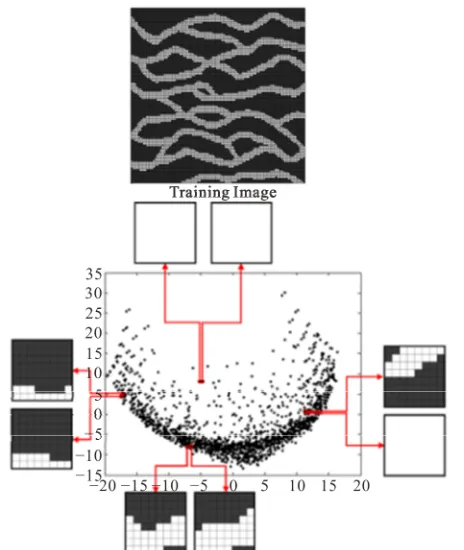
sample of pattern transferring to a lower dimensional space by measuring the responses of patterns to two di- rectional filters is shown in Figure 3. All extracted pat- terns are placed with other similar patterns into the speci- fied bins. Figure 4 shows the results of applying this step on the some face pictures.
Each filter score is divided into five categories and cluster the patterns into 5 ^ 6 bins. For each of which one prototype is calculated. Each prototype is binary average of patterns in a specific bin. Many of these created bins are empty and will be eliminated in the search process which is only done on selected prototypes for the filled bins.
Having processed the TI and filled the pattern database as just described, reconstruction of realizations can per- formed in unconditional and conditional situations. Simulation procedures with and without hard data are discussed in detail in the next sections. Table 2 lists the TI processing steps.
[image:3.595.58.289.339.494.2]Figure 3. Pattern transferring to a lower dimensional space.
Figure 4. Clustering assembles all similar patterns, marked by 6 filters, in the related bins.
Table 2. Training image processing steps of the Modified FILTERSIM approach.
Training Image Processing
1. Load and mesh training image to the desired grid network size Gti
2. Find optimum template size (Entropy plot)
3. Scan TI and store all patterns in patdb along with the frequency of each pattern as the last component of patTk vector.
4. Apply filters to patterns and calculate responses. 5. Cluster patterns according to node scores. 6. Eliminate empty bins.
[image:3.595.310.539.401.515.2]3. Facies Simulation
Simulation begins by defining a random path on realiza- tion nodes. Data event in the template is extracted in each node and its similarity to the existing patterns is then measured. Data event vector devT (u) is a set of previ-
ously informed nodes in unconditional simulation while hard data is also added to devT (u) in conditional simula-
tion. Similarity between data event and extracted patterns in patdbT is measured by a distance (or difference) func-
tion d x y, .We used the following single point man- hattan distance function:
0 , , , T ni i i i i i i a a
d x y d x y
d x y x y
,(4)
Having the random path defined, a search among the prototypes is done for each visited node to select the most similar prototype which shows minimum distance function d x y, with data event as below:
0 , , T k T T n k T Td dev u Prototype h
d dev u h Prototype h
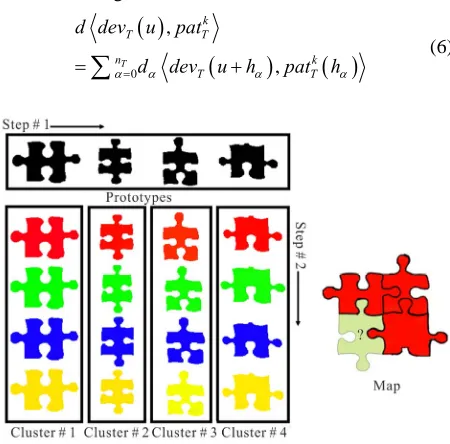
(5)The bin of selected prototype contains the most similar patterns to the visited data event. FILTERSIM routine is to select a random pattern among these patterns and set it as realization node. This obviously is not the best proce- dure and may lose the feature connectivity as is a known drawback of this method. Here we modified the proce- dure and performed a second searching step to find the most similar pattern to data event in the selected bin (Figure 5). Pattern selection in candidate cluster is based on the following distance function:
0 , , T k T T n k T Td dev u pat
d dev u h pat h
[image:4.595.61.286.480.702.2]
(6)Figure 5. Schematic of searching between prototypes in Step # 1 and between selected cluster in Step # 2 (Step # 2 in FILTERSIM is random).
Only the pattern nodes with known values are consid- ered in the above relation.
,
if and are both known
0 if or is unknown
y y y y d x x x x (7)
[image:4.595.158.527.482.714.2]The pattern with minimum distance function is then pasted entirely on realization nodes. If some patterns have the same distance to the data event vector, the one with the most frequency is selected. Random selection of patterns is only allowed when they all have the same frequency. This pattern selection strategy has improved the FILTERSIM performance and connectivity features of reconstructed realizations compare to the original method. This will be fully explored in the results section.
Table 3 shows the stepwise procedure of Modified FIL- TERSIM approach described above.
The last but not the least point is the updatable region of pasted pattern on realization nodes which is used for the first time by Arpat in SIMAPT [1].The selected pat- tern after imposing on the visited node of realization is not entirely fixed and some outer parts of it can be re- placed by future pasted patterns as shown in part 4 of
Table 3. This provides the opportunity of superior reali- zations with closer features of connectivity to those of TI (Figure 6).
Conditional Simulation Algorithm
Data obtained from cores, wells and/or other exploration
Table 3. Procedure steps of unconditional Modified FIL- TERSIM approach.
Unconditional Modified FILTERSIM
1. Training image preprocessing.
2. Define a random path onGre grid of realization re.
3. At every node u, extract the data event devT(u)from realization
re and find the most similar prototype that minimizes.
, k
T T
d dev u Prototype
Once the most similar bin is found, search most similar pattern in that bin to maximize similarity
, k
T T
s dev u pat ,
if some patterns have the same distance to the data event vector, most frequent of them is selected and if all of them have the same frequency, selection will be done randomly.
4. Paste the entire selected pattern to updatable data event:
+ * .
T T
dev u h pat h
Set inner nodes as fixed and outer nodes as updateable.
[image:4.595.310.539.484.717.2](a) (b) (c)
Figure 6. Effect of updatable nodes on structures continuity: (a) training image, (b) realization with updatable region, (c) realization without updatable region.
sources are considered as hard data. These data are dis- tinguished in TI and pattern data bank as hdevT (u). We
are willing to reproduce hard data exactly in the realiza- tions as they are occurred in the initial map. Unlike the other methods which are added additional searching steps, simulation algorithm we propose for realizations condi- tioned to hard data hdevT (u) is the same as unconditional
simulation algorithm presented above, except to the dis- tance function calculations for prototype selection. To do this, higher weights Wi, for the hard data are considered
in distance function calculation while searching between prototypes.
0
,
,
T
k
T T
n k
T T
d dev u Prototype h
d W dev u h Prototype h
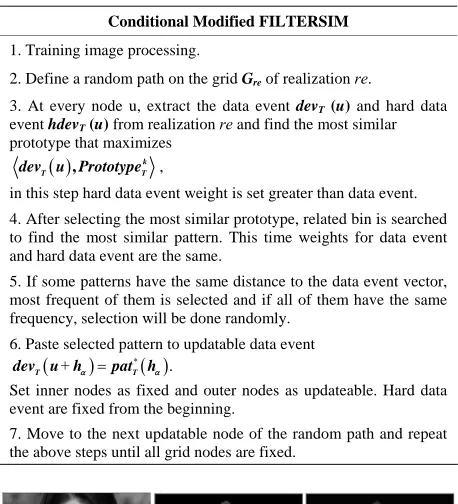
(8)Hard data weights should be set according to their con- fidence level and accuracy. Satisfactory realizations were obtained with hard data weights four times bigger than the previously informed nodes as will be shown shortly in the result section. It is however necessary to set the same weights for hard and soft data events during the search among the patters within the selected bin to main- tain features continuity in the reconstructed realization. If pattern data base is rich, hard data will be reproduced completely in visual appealing realization, otherwise training image is weak and algorithm cannot reproduce all the hard data in continuous structures. Simulation steps for conditional Modified FILTERSIM approach are summarized in Table 4.
Due to minimal changes in the main algorithm, no sig- nificant difference was observed in simulation time of conditional and unconditional cases.
4. Fracture Network Simulation
[image:5.595.309.538.109.361.2]In fracture network images, fractures are thin and require very fine mesh to capture all spatial statistics. Having low CPU usage and continuous fractures, we apply a chamfer distance transform to the training image of frac- ture network. This transform can detect and extract main features of an image as shown in Figure 7. The image for this purpose should be a binary image.
Table 4. Procedure steps of conditional Modified FILTER- SIM approach.
Conditional Modified FILTERSIM
1. Training image processing.
2. Define a random path on the grid Gre of realization re.
3. At every node u, extract the data event devT(u) and hard data
event hdevT(u) from realization re and find the most similar
prototype that maximizes
, k
T T
dev u Prototype ,
in this step hard data event weight is set greater than data event. 4. After selecting the most similar prototype, related bin is searched to find the most similar pattern. This time weights for data event and hard data event are the same.
5. If some patterns have the same distance to the data event vector, most frequent of them is selected and if all of them have the same frequency, selection will be done randomly.
6. Paste selected pattern to updatable data event
+ * .
T T
dev u h pat h
Set inner nodes as fixed and outer nodes as updateable. Hard data event are fixed from the beginning.
7. Move to the next updatable node of the random path and repeat the above steps until all grid nodes are fixed.
Figure 7. Skeletonisation using chamfer distance transform.
Consider a binary fracture network image where frac- ture and matrix nodes are set to 1 and 0 respectively. Chamfer transform creates a continuous figure in which its node values reflect their distance to the target objects,
i.e. fractures in our case. Node values decrease mono- tonically from 1 to 0 as their distance increase from frac- tures.
Chamfer transform for each node uα of the training
image ti is:
min
,
ti u u ti u d u u (9)
where uβ are the nodes within the template T with
. 1, ,nT
Distance of uαto each neighbor node uβis
calculated and the value of ti (uβ) is added to this distance
(which itself is a distance). Value of ti (uα) is set to the
minimum of these distances. Figure 8 shows the chamfer transformed image of fracture network TI.
Modified FILTERSIM just described in Table 3 can now be applied to this transformed image.
[image:5.595.311.539.350.425.2]Figure 8. Application of chamfer proximity transform to the binary training image.
Figure 9 shows two generated realizations of fracture network TI of Figure 8. It is evident that chamfer trans- form as we applied considerably enhanced the realization and generated closer patters to the TI.
5. Multiple Grid Approach
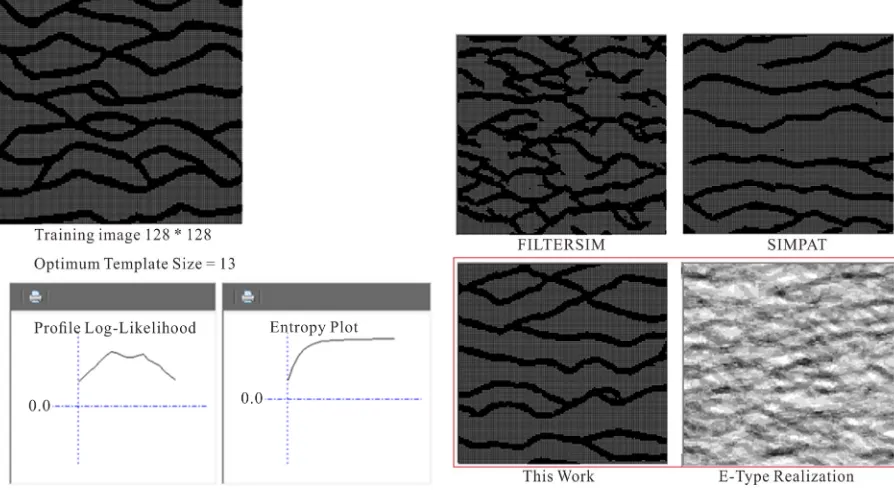
Optimum template size in training image processing con- trolls realization richness in different scales. Multiple template sizes are however needed to capture geological structures with various heterogeneity patterns at several scales. To this end, we propose a multi grid approach in which the simulations are run for one size greater than, equal to, and smaller than the optimum template size. Simulation starts by the biggest template size. Node val- ues from pervious steps are then considered as updatable soft data in the next simulations with smaller template sizes. Weights of these informed nodes considered as the half of those which informed in the current step for dis- tance function calculations. This makes the small scale structures to better reconstruct on a large scale back- ground as shown in Figure 10. Optimum template size of 13 is obtained for this TI. Realization with multiple grid approach used template sizes of 13, 11 and 9 after each other to better capture smaller scale heterogeneities as is evident in this figure.
6. Results and Discussion
Modifications are made to the original FILTERSIM al- gorithm in several ways of optimizing template size, con- sidering pattern frequency component in database and pattern distance function ranking in candidate bin instead of random selection. Performance of this modified algo- rithm is investigated by applying the method on 2D train- ing images with grid size of 128 × 128. Both uncondi- tional and conditional situations are studied. Figure 11
compares reconstructed realizations of a binary TI at with unconditional algorithms of FILTERSIM, SIMPAT and Modified FILTERSIM. Better visual continuity of the Modified FILTERSIM result is clear. Algorithm Per- formance was also investigated by applying the method on continuous 2D training image (Figure 12).
Conditioning to hard data just marginally increases computations due to the simple and fast proposed meth-
(a) (b)
Figure 9. Generated realizations (a) without and (b) with chamfer transformation ((a) structures are piecemeal, (b) have continues fractures and better reproduces the training image patterns).
Figure 10. Single grid and multiple grid simulation results.
odology. This is not the case for other methods as illus- trated in Figure 13 which compares CPU simulation times of SIMPAT, original and Modified FILTERSIM approaches. Although computationally more expensive than FILTERSIM, the Modified FILTERSIM method is still far faster than SIMPAT and is superior in perform- ance compare to the both methods.
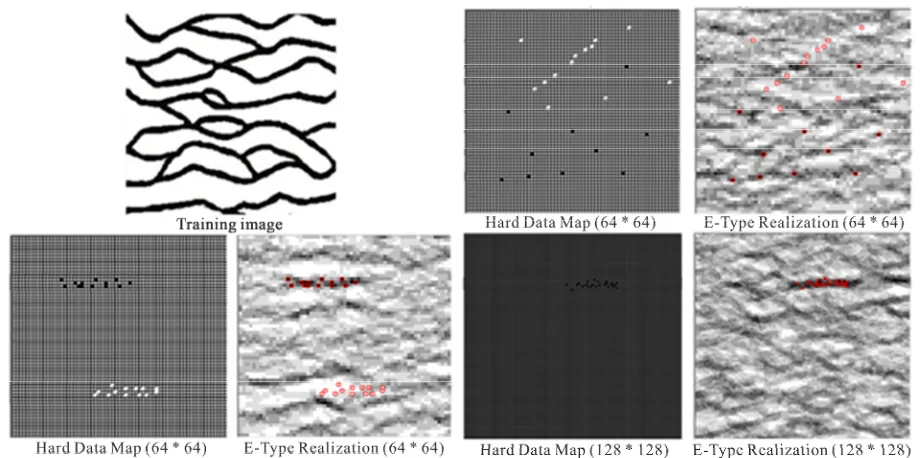
Modified FILTERSIM performance for conditional reconstruction of TI is illustrated in Figure 14. Chanelly TI similar to that of Figure 11 is considered with 3 dif- ferent hard data distributions. Several conditional reali- zations are generated for each hard data distribution. Av- eraging the results to E-type maps shows that all hard data are exactly reproduced in all realization as they are fixed in E-type maps of Figure 14.
It is worth to mention that parallel generation of sev- eral realizations is possible in our proposed algorithm. Our developed computer program can start several reali- zations simultaneously based on available computation cores and hardware characteristics. This considerable accelerate the simulations and makes the risk analysis and uncertainty management an easy task.
7. Summary
Figure 11. Simulation results by applying SIMPAT, FILTERSIM and this work method.
Figure 12. 2D continuous training image and simulation result (Optimum Template Size is 15).
Figure 13. CPU Time Qualitative Comparison of SIMPAT, FILTERSIM and Modified FILTERSIM methods (Minimum increase in CPU time due to adding conditionality feature occurs in Modified FILTERSIM).
search among stored patterns in the selected bin, is shown to improve the FILTERSIM performance consid- erably. Shannon entropy concept was used to infer opti- mum template size that can capture local structures in each template. Frequency component increases the chance
Figure 14. E-Type Realization obtained from 12 realizations by conditional Modified FILTERSIM.
ages com
REFERENCES
[1] G. Arpat and cale, Pattern-Based
al Simulation of Complex
Geolo-im pared to both FILTERSIM and SIMPAT algorithms. These improvements add marginal computa-tion cost to FILTERSIM and yet still much faster than SIM-PAT.
Chamfer transformation of TI for fractured rocks and simulation with multiple template sizes for complex structures with several heterogeneity scales make the performance of our Modified FILTERSIM algorithm even better.
Our algorithm, SIMPAT and original FILTERSIM have been implemented in C#. We have made our code stand alone and provided a user interface to upload TIs and to display simulation results. In the future, we plan to extend Modified FILTERSIM algorithm to non-station- ary and 3D pore space structures. The later will be based on 2D real thin section images.
J. Caers, “A Multiple-S
Approach to Sequential Simulation,” 7th International Geostatistics Congress. GEOSTAT 2004 Proceedings, Banff, October 2004.
[2] S. Strebelle, “Condition
gical Structures Using Multiple-Point Statistics,” Mathe- matical Geology, Vol. 34, No. 1, 2002, pp. 1-21. http://dx.doi.org/10.1023/A:1014009426274 [3] A. G. Journel and T. Zhang, “The Necessity of a
gh Order Correlation for
[5] J. Boisvert, M. J. Pyrcz and C. V. Deutsch,
“Multiple-,” Natural No. 4. 2007.
s, 2006.
Multi- ple-Point Prior Model,” Mathematical Geology, Vol. 38 No. 5, 2006, pp. 591-610.
[4] J. Ortiz, “Characterization of Hi
Enhanced Indicator Simulation,” Ph.D. thesis, University of Alberta, Edmonton, 2003.
Resources Research, Vol. 16,
Point Statistics for Training Image Selection
[6] K. G. Boogaart, “Some Theory for Multiple Point Statis- tics: Fitting, Checking and Optimally Exploiting the Training Image,” International Association for Mathe- matical Geology 11th International Congres
[7] F. Guardiano and M. Srivastava, “Multivariate Geosta- tistics: Beyond Bivariate Moments,” In: A. Soares, Ed., GeostatisticsTroia, Kluwer Academic Publications, Dor- drecht, 1993, pp. 133-144.
[8] S. Strebelle, “Sequential Simulation Drawing Structures from Training Images,” Ph.D. Thesis, Stanford University, 2000.
[9] J. Straubhaar, P. Renard, G. Mariethoz, R. Froidevaux, and O. Besson, “An Improved Parallel Multiple-Point Algorithm Using a List Approach,” Mathematical Geo- sciences, Vol. 43, No. 3, 2011, pp. 305-328.
[10] J. Caers, “GEOSTATISTICS: From Pattern Recognition to Pattern Reproduction,” Developments in Petroleum Science, Vol. 51, 2003, pp. 97-115.
http://dx.doi.org/10.1016/S0376-7361(03)80010-9 [11] X. Y. Liu, C. Y. Zhang, Q. S. Liu and J. Birkholzer,
“Multiple-Point Statistical Prediction on Fracture Net-works at Yucca Mountain,” 2004.
[12] M. J. Ronayne, S. M. Gorelick and J. Caers, “Identifying Discrete Geologic Structures That Produce Anomalous HyDraulic Response: An Inverse Modeling Approach,” Water Resources Research, Vol. 44, No. 8, 2008. http://dx.doi.org/10.1029/2007WR006635
[13] M. Stien, P. Abrahamsen, R. Hauge and O. Kolbjørnsen, “Modification of the Snesim Algorithm,” EAGE, Petro-leum Geostatistics, 2007.
Journal, Vol. 17, No. 8, 2009, pp. 1901-1911.
[15] H. Okabe and J. Blunt, “Pore Space Reconstruction Using Multiple-Point Statistics,” Journal of Petroleum Science and Engineering, Vol. 46, No. 1-2, 2005, pp. 121-137. http://dx.doi.org/10.1016/j.petrol.2004.08.002
[16] T. Zhang, P. Switzer and A. Journel, “Filter-Based Classi- fication of Training Image Patterns for Spatial Simula- tion,” Mathematical Geology, Vol. 38, No. 1, 2006, pp 63-80.
. http://dx.doi.org/10.1007/s11004-005-9004-x [17] M. Honarkhah and J. Caers, “Stochastic Simulation of
Patterns Using Distance-Based Pattern Modeling,” Ma- thematical Geosciences, Vol. 42, No. 5, 2010, pp. 487- 517. http://dx.doi.org/10.1007/s11004-010-9276-7 [18] M. Honarkhah and J. Caers, “Classifying Existing and
Generating New Training Image Patterns in Kernel
nal Reduction of Pattern-Based Simulation Using
rithm for Unconditional Simulation
1948. pp. Space,” 21st SCRF Aliate Meeting, Stanford University, 2008.
[19] S. Chatterjee, R. Dimitrakopoulos and H. Mustapha, “Di-mensio
Wavelet Analysis,” Mathematical Geosciences Work to Be Submitted, 2011.
[20] P. Mohammadmoradi and M. Rasaei, “Modification of the FILTERSIM Algo
of Complex Spatial Geological Structures,” Journal of Geomaterials, Vol. 2 No. 3, 2012, pp. 49-56.
[21] C. E. Shannon, “A Mathematical Theory of Communica-tion,” Bell System Technical Journal, Vol. 27,